It’s possible that I shall make an ass of myself. But in that case one can always get out of it with a little dialectic. I have, of course, so worded my proposition as to be right either way (K.Marx, Letter to F.Engels on the Indian Mutiny)
Saturday, May 02, 2026
With war on Iran, Venezuela and Cuba, US imperialism enters a new stage — The left needs to take a close look at it
Donald Trump’s rhetoric and actions against Iran, Venezuela and Cuba over the last year have few parallels in modern history. They have to be seen as marking a new stage. As such they call for a reevaluation of analysis and strategy on the part of the Left.
Trump’s repeated threat to bomb Iran “back to the Stone Ages where they belong” is unmatched by the rhetoric of even the most notorious and brutal heads of state over the recent past. Decapitating the entire leadership of a country to compel total submission, as Washington and Tel Aviv have done in Iran, is also a novelty in war strategy. The kidnapping of Venezuela’s president and First Lady as a first step in attempting to establish a colonial relationship by taking complete control of the country’s principal source of revenue, namely petroleum, represents a throwback to practices associated with centuries-old imperial rule
These are examples of “hyper-imperialism,” a concept theorized by Samir Amin to describe the United States “as the sole capitalist superpower.” More recently, the Tricontinental: Institute for Social Research has observed that U.S. hyper-imperialism persists despite a marked erosion of its economic and, though to a lesser extent, financial power. Its military supremacy is not only unrivaled, but is complemented by hybrid warfare, most notably “hyper-sanctions” and the use of lawfare.
What needs to be added to the concept of hyper-imperialism, particularly Trump’s version of it, is its sui generis nature. To find a parallel for the kind of hegemony the United States now exercises — highlighted by the continuous indiscriminate use of force and the threat of it — one would have to look back to the Roman empire or even earlier. One of Trump’s innovations is his deployment of the military to reinforce the system of economic sanctions, examples being the interdiction of oil tankers, the quarantine of Cuban oil, and full-scale war against Iran.
Trump II’s foreign policy hardly represents a complete break from the past. The groundwork was laid by past Democratic and Republican administrations. However, his actions force the Left not only to reformulate strategies, but to reconsider past evaluations and analyses of nations of the Global South subjected to extreme forms of imperialist aggression. The resistance to U.S. aggression must be given greater weight when evaluating governments. In addition, the popular desperation and exhaustion that erode revolutionary fervor and distance people from those same governments should be understood in light of the daily trauma people endure as a direct result of imperialist actions.
What Trump’s hyper-imperialism tells us
The starting point is to recognize that since Trump’s return to the White House, Iran, Venezuela and Cuba have been in a de facto state of war, which is an escalation of the multiple forms of hostility and aggression of past years. This is key to how all three nations should be judged. While the Left’s commitment to democracy needs to remain unquestionable and unwavering, in these cases primary responsibility for democracy’s somewhat uncertain prospects lies with the siege imposed by imperialist powers. No one other than James Madison said “Of all the enemies to public liberty, war is perhaps the most to be dreaded.”
The encirclement imposed by hyper-imperialism on Iran, Cuba, and Venezuela illuminates salient features of imperialism going back in time: first, Washington has honed the sanctions regime into a powerful tool, sometimes inflicting damage comparable to armed intervention; second, imperialism is the principal driver of the pressing economic problems facing the three nations; third, the justification for the actions taken against the three nations does not hold up under scrutiny; and fourth the brutality of the sanctions system underscores the need for its complete elimination. The discussion below looks at these points.
Tehran’s response to Operation Epic Fury underscores the crushing impact of sanctions. The nation’s leaders have made clear that the lifting of sanctions — as well as “international guarantees of U.S. non-interference” in the nation’s internal affairs — is a non-negotiable condition for ending the current conflict. That is to say, the Iranian leaders place the destruction caused by the sanctions on a similar footing as the bombs.
In the case of Venezuela, the events leading up to the abduction of Nicolás Maduro and Cilia Flores on January 3, 2026 reveal the far-reaching and highly coordinated machinery underpinning the sanctions regime. The second Trump administration’s tracking of the “ghost fleet” carrying Venezuela’s sanctioned oil — and its interdiction of several of those vessels — underscores how far Washington has gone in perfecting sanctions enforcement since the early years of the Cuban Revolution.
The first Trump administration pioneered in promoting “overcompliance” in which Washington’s well-publicized monitoring was designed to assure that companies and financial institutions world-wide would shun all transactions with Venezuela, even ones not specifically targeted by the sanctions. The aim was to impose a veritable blockade. Mike Pompeyo and Elliot Abrams spearheaded a campaign — drawing on the FBI, the Treasury, U.S. embassies, and the intelligence community — to scrutinize the dealings of companies worldwide with Venezuela, in what amounted to a warning shot to companies throughout the world. Even firms that engaged in oil-for-food swaps, which were not proscribed by the sanction regime, were warned that they ran risks. Companies under investigation were likewise told that penalties could be suspended if they halted all dealings with Venezuela.
A retrospective look at the first Trump administration’s sweeping enforcement measures and their devastating impact reinforces the argument that the sanctions have been so harmful that they need to be dismantled unconditionally and entirely. This position contrasts with that of liberals such as the Washington Office on Latin America (WOLA), which criticized the sanctions against Venezuela yet called for using “negotiations to flexibilize financial and oil sanctions” as leverage to secure concessions. Indeed, power brokers in Washington also favored sanctions relief as a bargaining tool to push the Maduro government to enact market-oriented reforms to the benefit of U.S. capital.
A full grasp of the scale and severity of Washington’s “war” on Venezuela undercuts the notion upheld by some on the left who argue that the sanctions were no more to blame for the nation’s pressing problems than government mismanagement. An even harsher position on the left affirms that the sanctions “do not explain the root causes of the societal collapse we have lived through.”
Likewise, the forcible removal of Maduro and Flores demonstrates that Washington was intent on dismantling a government whose example and policies ran counter to U.S. interests. Prior to the January 3 kidnapping, some on the left in Venezuela and elsewhere denied that Washington sought to remove Maduro from power because they were convinced that he had effectively sold out. But they were wrong insofar as Washington clearly wanted Maduro out. Pedro Eusse, a leading member of the Communist Party of Venezuela (PCV), which broke with the Maduro government in 2020, wrote in July 2025, “Everything indicates that the true intention of the US and its allies’ policy of aggression toward the Venezuelan government has not been its overthrow, but its subordination.”
In the case of Cuba, the extreme measures of the Trump II administration against the nation also shine light on the cruelty and effectiveness of the system of sanctions per se. Trump’s navy-enforced quarantine on oil shipments is a first for the nation since the October 1962 missile crisis. The result has been recurring 16-hour blackouts that have disrupted water delivery, hospital operations, food production, and garbage collection.
The quarantine spotlights Cuba’s near total dependence on oil, in contrast to nearby Jamaica and the Dominican Republic, which generate a significant share of their electricity from coal and natural gas. The dependence stems precisely from the sanctions, which impeded imports and pushed Cuba into relying almost entirely on Venezuelan oil — only for Trump to cut off that supply too.
Indeed, the quarantine underscores Cuba’s reliance on Venezuelan oil and the reciprocal solidarity that saw fuel exchanged for Cuban medical personnel. That’s a plus for Maduro. The program undercuts the claim of some on the left that Maduro’s foreign policy, in the words of the PCV, never moved beyond an “anti-imperialist rhetoric” without substance.
The Washington-crafted narrative on Cuba and the reaction to it by the mainstream media and the Left are curious. In contrast to the demonization directed at Venezuela and Iran, Washington’s condemnation of Cuba has been relatively hollow and has gained little traction in mainstream outlets or left-leaning circles. The anti-Cuba vilification — driven by hardline anti-Communism — remains largely confined to the far right, epicentered in Miami. The official rhetoric is a departure from the wording in 1982 when the State Department designated Cuba as a State Sponsor of Terrorism due to “its long history of providing advice, safe haven, communications, training, and financial support to guerrilla groups and individual terrorists.” Now the Trump administration’s justification for the same designation is that the Cuban government grants “safe harbor to terrorists” and refuses to extradite them.
As false as the narco-terrorism case against Maduro is, it nonetheless offered a rationale that undoubtedly resonated with at least a slice of public opinion. Compare that to Marco Rubio’s line on Cuba which flatly denies the catastrophic effects of the oil quarantine. Rubio claims “we’ve done nothing punitive against the Cuban regime” and adds, the blackouts “have nothing to do with us.” Instead Rubio faults the Cuban leadership on grounds that “they want to control everything.” A classic case of victim-blaming, but with few buying into it. A YouGov survey in March found that only 28 percent of U.S. adults support the U.S.’s blocking of oil shipments to Cuba, as opposed to 46 percent opposed.
In addition, Rubio’s assertion that the only novelty is that Cuba is “not getting free Venezuelan oil anymore” is blatantly fallacious. Rubio is well aware of Venezuela’s swap with Cuba involving the latter’s International Medical Brigades, which maintain a sizeable presence in Venezuela and elsewhere. This is precisely why Rubio has vigorously attempted to sabotage the program throughout the region, unfortunately with a degree of success.
If the oil quarantine demonstrates anything it’s that the hardships facing the Cuban people are rooted in Washington’s war on Cuba, now going on 65 years. Criticism of Cuban government policies, or of socialism itself, comes in a distant second place.
The Trump II disaster should be an eye-opener
Trump’s bullying offensive abroad has fueled mounting opposition to interventionism and has even fostered anti-imperialist sentiment in the United States. Just one week into the 2026 Iranian bombings, 53 percent of the U.S. population opposed the strikes, in sharp contrast to U.S. military involvement in Vietnam, the Gulf War, Afghanistan, and Iraq, which enjoyed large majority support at the outset. That the former editor of TheNew Republic called the U.S. war on Iran imperialistic is telling. In a New York Times op-ed, Peter Beinart wrote “Donald Trump’s foreign policy vision is imperialism.”
One lesson of recent events is particularly relevant for the Left: the demonization of heads of state is a sine qua non for military intervention. In the case of Iran and Venezuela, the discrediting combines some fact with a large dosage of fake news. In the case of Maduro, the demonization which dates back to shortly after he assumed office in 2013, was taken to higher levels as a result of the controversial presidential election of July 28, 2024, which the opposition claimed was fraudulent. Subsequently the corporate media consistently tagged the word “autocrat” and “dictator” onto Maduro’s name. Six months later, Trump was in office and the vilification escalated to a new pitch. Indeed, the branding of Maduro as a narco-terrorist was an indispensable prelude to the bombing of boats in the Caribbean and the subsequent kidnappings — notwithstanding the doubts raised by some media outlets regarding the veracity of the claim.
The takeaway is that the Left needs to distinguish between criticism and demonization and take cognizance of the possible dire consequences of the latter.
The demonization of Supreme Leader Ali Khamenei and his inner circle also set the stage for imperialist actions, but, of course, his government could not be placed in the same category as those of Cuba and Venezuela. The Iranian government is theocratic, not leftist, and it actively defends patriarchal values. Furthermore, the level of lethal repression unleashed during the Woman, Life, Freedom protests in 2022 — and in the demonstrations that erupted beginning late last year — has no parallel in Venezuela or Cuba.
Nevertheless, the U.S.-imposed stranglehold on Iran makes a peaceful path to democratization highly unlikely. Furthermore, as in Venezuela and Cuba, harsh sanctions have been conducive to shadow economies, clientelistic networks, and fraudulent dealings, patterns well documented in numerous studies on sanctions throughout the world.
Eskandar Sadeghi-Boroujerdi, a prolific scholar on Iran who is highly critical of the government, told Jacobin “While the Islamic Republic is paranoid, it is also very much under siege from all sides.” He also notes the intrinsic relationship between the sanctions and the nation’s pressing problems: “Sanctions and structural weaknesses of the Iranian economy feed off one another — there’s a symbiotic relationship between them.”
In short, any serious reading of Iran must foreground the role of sanctions — an approach that inevitably tempers the tendency to cast its leadership in purely demonizing terms.
The lessons of July 28, 2024
The issue of the accurateness of the July 28, 2024 election tallies in Venezuela needs to be reframed. Those elections could not have been democratic, regardless of the announced results, because Venezuelan voters had a gun pointed at their heads: reelect Maduro and the sanctions continue; elect an opposition candidate and the sanctions will be lifted.
The overwhelming majority of Venezuelans knew full well what was at stake. Luis Vicente León — the nation’s leading pollster, himself a member of the opposition — reported that 92 percent of the population believed that the sanctions negatively impacted the economy, and most characterized the effect as “very negative.” (The poll puts the lie to the State Department’s repeated claim that the sanctions only harm government officials.)
A similar scenario played out in the Nicaraguan presidential elections of 1990 when opposition candidate Violeta Chamorro upset the Sandinistas in the midst of a devastating, U.S.-promoted civil war. But there was a fundamental difference. Far from demonizing the Sandinistas, Chamorro accepted a power-sharing transition agreement with them. In contrast, for over a decade prior to the July 28 elections the opposition’s main leader, María Corina Machado, had ruled out negotiations with those who had allegedly violated human rights. She never tired of voicing the slogans “no immunity,” ”no to amnesty,” “no agreements with criminals,” often with specific reference to the Chavistas and to Maduro himself. Maduro and his followers had every reason to fear the type of repression that the opposition initiated during the two-day abortive coup it staged in April 2002 against the Chavista government. Even opposition pollster León admitted that the fear was well-founded.
Marta Harnecker, the renowned leftist theoretician, wrote that the Sandinistas erred in holding the 1990 elections amid U.S.-promoted violence and sabotage. Harnecker labeled the decision to organize elections “on terrain shaped by the counterrevolution” a “strategic error.”
A reevaluation and reinterpretation of the July 28 elections is instructive. The hard-core Chavistas accept the official results which showed Maduro winning with nearly 52 percent of the vote. The opposition refutes that claim. A third position is defended by supporters of Maduro who nevertheless express skepticism and point out that because of a massive hacking attack from outside the country, it may be impossible to ever know the true count.
The debate about the accuracy of the official results of July 28 sidesteps the overriding issue of whether the elections should have been held in the first place. Indeed, the idea of conditioning elections on the lifting of sanctions was not far-fetched. A year before the elections, Maduro, in a reference to the United States, declared: “If they want free elections, we want elections free of sanctions.” Subsequently, Elvis Amoroso, the Chavista head of the nation’s electoral council, tied the participation of European Union electoral observers to its lifting of sanctions. At the same time, the Biden administration indicated its willingness to bargain with the Venezuelan government along those lines.
Carlos Ron, a former vice-minister and currently an analyst for Tricontinental, told me that the Chavista leadership ruled out delaying the elections in order to demonstrate its democratic credentials in the face of the international smear campaign. Ron said “At that moment, greater importance was placed on the need to defend the democratic character of the Bolivarian political process and its continuity, and abide by the Constitution, in the face of imperialist pressures.”
Maduro’s intentions may have been commendable. But the decision overlooked one compelling reason to suspend the electoral process. Tying the holding of elections to the removal of the sanctions would have placed the entire blame for setbacks to democracy where it belonged: U.S. intervention in Venezuela’s internal affairs.
In defense of democracy
As a rule, the Left has always championed the defense of democracy. In this sense, the Left’s vision compares favorably with U.S.-style “liberal democracy,” shaped by the influence of big money and other inherently undemocratic practices such as gerrymandering, the Electoral College and voter suppression.
Historically, however, the Left has faced formidable obstacles on this front. For instance, it has come to power in countries like Russia, China and Cuba that were lacking in democratic tradition. That, however, was the least of the problem. Its main problem has been, and continues to be, imperialist hostility which limits options.
Precisely for that reason, the Left needs to tread cautiously in the way it frames the issue of democracy in nations that are in the crosshairs of imperialism. In the three countries discussed in this article, the Left can’t deny that democracy has been infringed upon. The Maduro government, for instance, stripped the PCV — the country’s oldest political party, forged in a history of militant struggle including two periods of clandestine resistance and armed struggle in the 1950s and 1960s — of its legal status, transferring recognition to a marginal breakaway faction that appropriated its name and symbols.
Nor can it deny that discontent is currently widespread in the three nations, which became most evident in the Iranian “Woman, Life, Freedom” protests and those of the first days of this year. In Cuba and Venezuela, protests reflect widespread disillusionment, even while the mobilizations have been manipulated and financed from abroad.
One troubling sign in Venezuela is that the disturbances have spread out from upper-middle class neighborhoods where they were confined during the 4-month protests (the “guarimba”) of 2014 and, albeit less so, during those of 2017. The two days following the July 28, 2024 elections, for instance, protests were registered in Caracas barrios such as Petare, the city’s largest. Reflecting on the protests, long-standing Caracas resident and international commentator Phil Gunson reported “Petare is a traditionally Chavista zone, but ever since a few years ago, people have been distancing themselves from the government.”
The Left can’t turn its back on this reality. But nor can it join mainstream voices that channel dissatisfaction into blanket vilification of governments under imperial siege. Rather its line has to be basically: “What do you expect!” In the face of hyper-imperialist aggression these countries are at war, figuratively and in some cases literally speaking. Criticism needs to be framed within this context.
Lenin’s concept of democratic centralism — the principle designed to guide the internal workings of his political party — is instructive. In his writing throughout his political career, party democracy remained a constant, but the degree of centralism depended on the political climate in the nation. Along similar lines, the Left’s adherence to democracy can never be minimized. However, valid criticism of undemocratic practices in countries like Venezuela and Cuba in which the Left is in power needs to consider those actions as overreactions to imperialist aggression.
In this era of intensified hyper-imperialism, the Left is compelled to stand behind nations like Cuba and Venezuela, and recognize that the real blame for backsliding including violation of democratic norms lies with imperialism. The barbaric actions of Trump II are making this imperative clearer than ever.
Steve Ellner is a retired professor of the Universidad de Oriente in Venezuela where he lived for over 40 years and is currently Associate Managing Editor of Latin American Perspectives. He is the author and editor of over a dozen books on Latin American politics and history. In 2018 he spoke in over twenty cities in the U.S. and Canada as part of a Venezuelan solidarity tour.
Citing Bogus ‘Threats’ to US, Trump Expands Already Devastating Sanctions on Cuba
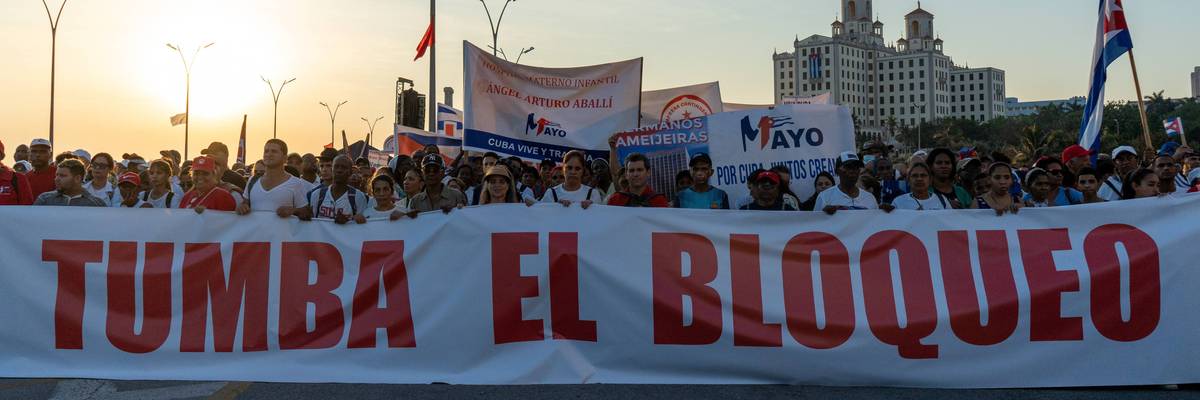
The president’s latest aggression toward Cuba comes amid his repeated threats to “take” the island. Cubans hold a banner reading, “Knock Down the Blockade” during an International Workers’ Day rally near the US Embassy in Havana on May 1, 2026. (Photo by Magdalena Chodownik/Anadolu via Getty Images)
Citing Cuba’s ties with its ally Iran, President Donald Trump on Friday signed an executive order expanding the already crippling US sanctions regime against Cuban officials, as the US administration has the island in its crosshairs after ousting Venezuela’s socialist leader.
The directive “imposes new sanctions on entities, persons, or affiliates that support the Cuban regime’s security apparatus, are complicit in government corruption or serious human rights violations, or are agents, officials, or material supporters of the Cuban government,” without identifying any of the affected groups or individuals.
For 65 years, the US has imposed an economic embargo on Cuba that has adversely affected all sectors of the socialist island’s economy and severely limited Cubans’ access to basic necessities including food, fuel, healthcare, and medicines—with disastrous results. The Cuban government claims the blockade cost the country’s economy nearly $5 billion in just one 11-month period in 2022-23 alone. United Nations member states have perennially—and overwhelmingly—condemned the embargo.
The Trump administration also imposed a fuel blockade and reinstated Cuba on the US State Sponsors of Terrorism list, from which former President Joe Biden removed the country before leaving office in 2021. Cuba was initially added to the list during the Reagan administration amid a decadeslong campaign of US-backed Cuban exile terrorism, failed assassination attempts, economic warfare, and covert operations large and small in a futile effort to overthrow the revolutionary government of longtime leader Fidel Castro.
Cuba says US-backed terrorism has killed or wounded more than 5,000 Cubans and cost its economy billions of dollars.
The Cuban government—which was celebrating International Workers’ Day on Friday—did not immediately respond to the expanded sanctions.
Experts warned that the new sanctions are worryingly broad, with Georgetown Law visiting scholar Peter Harrell writing on X that “basically any non-US person or company doing any business in/with Cuba could be sanctioned.”
Harrell noted that the edict “gives the Trump administration a fair amount of easy-to-deploy firepower to drive remaining international businesses out of Cuba.”
“The questions will be in implementation,” he added. “For example, will Trump sanction a Chinese firm installing renewable energy in Cuba?”
Trump’s edict comes months after the president ordered the invasion of Venezuela and abduction of socialist President Nicolás Maduro and amid the ongoing US-Israeli war on Iran, the 10th country bombed during the course of Trump’s two terms in office.
Trump last month declared that “we may stop by Cuba after we’re finished with this,” referring to war on Iran that’s left thousands of people dead or wounded, including hundreds of children. The president has also said that he believes he’ll “be having the honor of taking Cuba,” language echoing the 19th century US imperialists who conquered the island along with Puerto Rico, Guam, and the Philippines from Spain in another war waged on dubious pretense.
“Whether I free it, take it—I think I can do anything I want,” Trump said of the island and its 11 million inhabitants.
Silvio Rodríguez: ‘The world is run by an authoritarian, warmongering and thieving regime — and it's not Cuba’
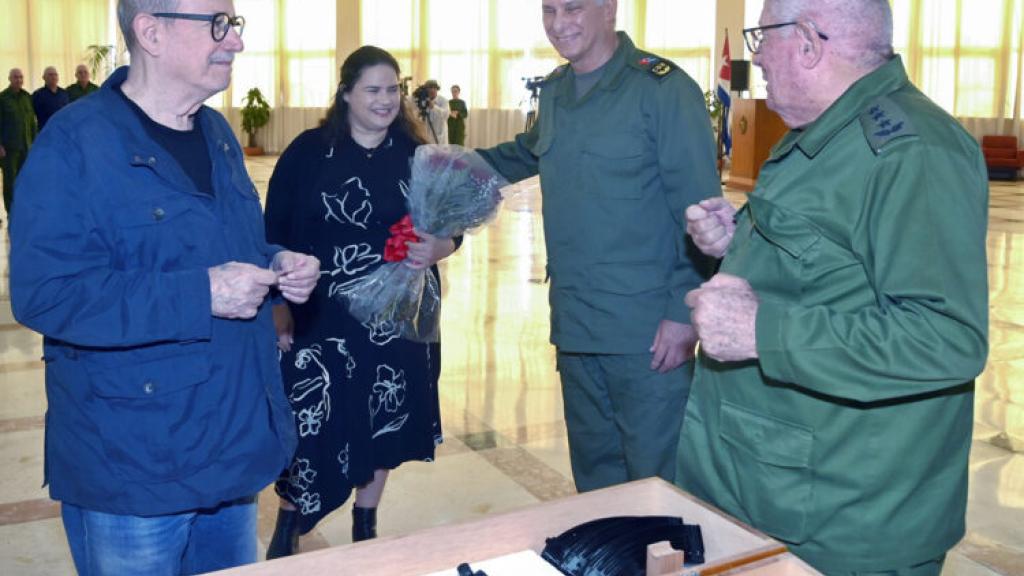
The Cuban singer-songwriter welcomed El País (Spain) to his studio in Havana, days after receiving a replica of the Kalashnikov rifle he had requested to fend off a potential United States attack.
Seeing an image of a singer-songwriter with a rifle in their hands is strange, but not when the person wielding it is Silvio Rodríguez.
The Cuban singer-songwriter has spent his entire life singing, directly or indirectly, about the Cuban revolution, its leaders and ideals, and the martyrs and guerrillas. “My songs have politics, but not propaganda,” says the musician, who welcomed El País at his Ojalá studios in Havana.
Rodríguez discussed the government's “orthodox and closed-minded” economic vision and his commitment to a less “rigid” socialism. “Textbook socialism is very idealistic,” he concludes.
His opinion of the US government has not shifted one iota: “The world is run by an authoritarian, warmongering and thieving regime — and it's not Cuba.”
Adored by the international left and reviled by the Cuban opposition — who refer to him as the “regime’s troubadour” — Rodríguez speaks against a backdrop of guitars and a painting by Cuban prisoners for whom he sang two decades ago, just a week after asking the Armed Forces for an AKM Kalashnikov rifle in case US president Donald Trump invades the island. “But it is a replica, a very well-made imitation,” he points out.
His intention to use a real one remains unchanged. “I am not going to tell you what I think of those who want their own country to be bombed and invaded,” he says, alluding to the Cuban-Americans who support Trump’s foreign policy. “I do not wish the opposition ill, but I do not want them to win either. Not for my sake, but for what it would mean for this country.”
In Rodríguez's legendary studio, which has hosted Chucho Valdés, Omara Portuondo and Pablo Milanés, among others, one of his soon-to-be-released songs plays. It is one of dozens spread across more than 20 albums that have been sold around the world, establishing him among Latin America’s most prestigious voices. “Fake Cuban and genuine Cuban; rebellious Cuban and official Cuban,” the lyrics go.
He smiles, imagining a Cuba where dissenting voices also have a place. “The positive thing is that people have the opportunity to express what they think and that truths emerge from discussion and dialogue,” he says.
Despite his country’s critical situation, the author of anthems such as “Ojalá,” “La Maza,” and “Unicornio” insists he has not succumbed to despair. “I refuse to believe that the future will be one devoid of human compassion. If that were the case, life would have been a failure. I do not believe that is the case.”
Why did you ask to be issued with an AKM rifle?
It is a replica, a very well-made imitation. But they gave me a document so that, in the event of an armed attack on our country, I can go to a military unit and request a real weapon.
To some extent, I come from the Armed Forces; I started playing guitar in the military. When someone from there [US Secretary of State Marco Rubio] said that the talks between the Cuban and US governments were not enough, and immediately afterward, their president said he was going to “take over the country,” it seemed to me that something was imminent. They had already done what they did in Venezuela and are still bogged down with Iran.
So I said, “They are coming here,” and wrote a short post on my blog. I did not think it would have that much impact, to be honest. But it did. And they gave me the replica.
Do you see a scenario in which Trump takes over Cuba as likely?
I see it as possible. Hopefully it is not imminent and I wish it was impossible, but it is possible. Especially given the long history of US interventions, sabotage, invasions…
Are there more Cubans willing to arm themselves if Trump invades the island?
I cannot guarantee it. There is a very long history of interventions and attempts to take over Cuba. The Cubans who know that history, who have lived through some of what I have lived through, I am sure would be willing to defend our country with weapons. But not everyone.
There are other Cubans who are crossing their fingers for an intervention to happen.
Yes. Today I read there was a demonstration in Miami by Cubans calling for the government to be overthrown by force — in other words, practically calling for an invasion. I am not going to tell you what I think of those who want their own country to be bombed and invaded.
What do you think?
Just imagine…
The Mexican government has supported Cuba, but other countries in the region have not. Costa Rica and Ecuador have withdrawn their embassies from Cuba, and Jamaica and Honduras have closed their doors to Cuba’s medical brigade. Is Latin America turning a blind eye?
When it comes to those dominated by right-wing governments, then obviously yes. But that has always been the case. Now, given the current climate of overt aggression in the world, many countries think it is better to avoid provocation. It is disappointing that we have fought so hard for Latin American unity and that suddenly there are countries selling out.
In an interview with Rolling Stone you said you had never been disillusioned with the government or the revolution. Do you still maintain that position?
Disillusioned? No, but I have my own views. The problem is that governments are made up of people, and each person, within their own sphere, does what they think is best or what they believe benefits them personally. Opportunism and extremism exist in all ideologies. I do believe that there are economic issues which, for the last 30 years, we should have approached differently.
In what sense?
The economic model dictated by “textbook socialism" is very idealistic. Practice has shown that people produce better and more when they directly benefit from what they do. And having so many bureaucratic obstacles is not helpful.
Do you see the government's recent economic measures as beneficial then?
Yes. A little late, because there are economists who have been at odds with the government for many years for that very reason.
Some of these measures are aimed at the diaspora, especially in Florida, where the main opponents of the government live.
That bothers me a little, because it may seem as though these measures are the result of talks with the US, but they have been discussed in Cuba for a long time.
But the announcement came days after acknowledging that negotiations were underway...
But, as I said, these issues have been raised in Cuba for many years. I have published countless articles on my blog by people criticising the orthodox and closed-minded approach to economic issues.
You were particularly critical of the government for the crackdown during the July 11, 2021, protests, when between 1000–1500 protesters were imprisoned.
I have always said so. Security forces should guarantee the safety of protesters.
Do you feel the same way about the current protests and pot-banging demonstrations against the government?
Yes. This is normal, people are having a very hard time. There is rampant inflation; older people like me, with a lifetime of savings, sometimes cannot even buy a carton of eggs. That is very serious. The situation in hospitals is dire. Schools are closing, universities are sending their scholarship recipients to the provinces… All because of the tightening of the blockade.
Leaving aside the blockade, what is the government’s share of the blame in all this?
We would have more food if these economic measures [to open up the economy] had been taken decades ago. People in the countryside would be more resilient and have more resources to withstand the crisis.
The opposition labelled the Nuestra América convoy as “ideological tourism.” What do you think?
It is logical that those who want to destroy Cuba would denigrate such acts of solidarity. It is part of the smear campaign we have been subjected to for many years. They talk about a regime and other similar words they like to use, but we all have regimes. Right now, the world is run by an authoritarian, warmongering, thieving, murderous regime — and it is not Cuba.
You talk about a media strategy, but there are dozens of journalists in exile who cannot return to the island.
It is sad that the deepest truth is drowned out by so much slander. Cuba is also at a disadvantage in the face of that [media strategy]. Many act in the interests of those who lack humanity.
Cuba has simply sought to be a country where everyone has rights, can go to university, and receive any kind of medical treatment. We enjoyed a period of prosperity for many years, but because we were Communist, that label stuck with us. They call you a Communist and say “aahhh.”
Has Cuba made mistakes? We would have to see what we would have been like without the blockade. That's another utopian ideal. They did not allow us to find out.
You were 12 years old when the revolution triumphed. You witnessed a functioning system and how it collapsed…
It was sad and alarming. Undoubtedly, this reluctance and suspicion to opening up has always existed and has continued with this government, which defined itself as “continuity.”
You do not believe that to be the case?
I have no way of judging what happens up there because I do not know what goes on there, but I do know that within the superstructure there are different ways of seeing things. There has always been a very quiet, unspoken conflict, one that never becomes public, between those who are more orthodox, more closed-minded, and others who are more open, with a more realistic approach.
Who is going to win this arm wrestling match?
This has been going on for many years, but I like to see ideas being exchanged. The positive thing is that people have the opportunity to express what they think and that truths emerge from discussion and dialogue.
Are you afraid of a complete opening up?
The only thing missing is for them [the US] to add us as another star on their flag. I do not want that to happen with Cuba, not at all. The US is a complex country, but one that must be taken into account because of its power and its “capacity for persuasion.”
You are a figure who evokes feelings of love and hate. To some you are a symbol of the left, to others the “regime’s troubadour”...
They hate me [laughs]. There is a song that goes: “They say they will drag me over rocks when the revolution falls, that they will crush my hands…” That was because they once smashed my guitar, and I heard that is what they would like to do to us the day the revolution falls.
I have never hated anyone enough to wish something so terrible on them. I do not wish the opposition ill , but I do not want them to win either. Not for my sake, but for what it would mean for this country.
What do you think of artists who seek to separate their work from politics?
That has always existed. Cuba is a controversial topic even within the left; there are people who behave as if they are leftists but keep their positions on Cuba to themselves.
Are you a radical?
In some respects. I am aware of what is going on. I have many political songs, but I do not set out to campaign with them. No, no. I was never interested in being a politician; I prefer beauty.
There are things that bring beauty and politics together. A few days ago, you admitted that you liked Bad Bunny’s song “Lo Que Le Pasó a Hawaii”...
Yes, because what he did at the Super Bowl was very brave. I think he is a brave guy for using his platform to promote that idea.
Do you think Cuban youth have stopped being left wing?
Young people born in an impoverished country such as ours may not find reasons to believe in their country. We have to understand that; circumstances have led them to think that way.
But I refuse to believe that the future will be one devoid of human compassion. If that were the case, life would have been a failure. I do not believe that is the case.
Venezuelan leftist Luis Fernando Marquez says “recuperating sovereignty and control over our resources is essential”. But he gives no indication of how to do this.
Venezuela has been subject to a US naval blockade. In December 2025-January 2026, US forces took control of nine ships containing Venezuelan oil. The US stole the oil and put money from oil sales in US-controlled bank accounts.
These ship seizures have had a lasting impact. Even if ships are not currently being seized, the threat remains. The Venezuelan government and shipowners know ships can be seized if they try to export oil without US permission. The intimidatory effect continues. The naval blockade remains in place, just in a less obvious form.
Oil exports require US approval, with revenue paid into US-controlled accounts. The US has imposed a “deal” on Venezuela that hands over oil commercialisation to intermediaries.
China was previously Venezuela's main customer. Now, the state oil company, PDVSA, is not allowed to sell oil to China, though US-approved intermediaries can.
How should the Venezuelan government respond? There are three choices.
Venezuela could try to export oil without asking for US permission. This would probably be met with renewed ship seizures. Defying these seizures would require placing Venezuelan soldiers on oil tankers with instructions to shoot at US troops boarding ships. The US would then likely bomb the ship. Venezuela could also attack US warships with missiles and drones. The US would undoubtedly respond by bombing Venezuela.
Another alternative would be ceasing all oil exports until the US hands back control of oil sales. Venezuela’s oil industry would be largely shut down and the government would lose oil revenue that funds government services.
The third alternative, chosen by the Delcy Rodríguez government, is to make big concessions to foreign capital and have polite discussions with US government officials, in the hope they will allow some oil revenue to go to the Venezuelan government.
Undoubtedly, many Venezuelans are dismayed by these concessions to US imperialism. But there have been no big protests, because the US seems too powerful to defy. This is obviously a bad situation. But Marquez gives no real indication of what he thinks should be done.
Left critics of the Rodriguez government have little support among the Venezuelan people. Marquez admits this, saying:
At the same time, liberal thought has gained ground among the population; that is undeniable. This largely has to do with the false equating of Chavismo with Communism. Moreover, the inability of left-wing sectors opposing the regime to create an organic movement has left a political void in most poor and working class sectors.
Left critics will be ignored by most people if they have no answer for how to respond to the threat of renewed US military action.
Marquez also says:
Progressive and left-wing sectors face the enormous task of winning people over to a nationalist program. Recuperating sovereignty and control over the country’s resources is essential; without this it will be impossible to develop the country's productive forces.
The question is how to implement such a program when Venezuela is subject to the threat of further US aggression. In my view, this problem can not be solved solely within the borders of Venezuela. There is a need for political change in the United States. There needs to be a huge movement — at least on the scale of the anti-Vietnam war movement - in opposition to US imperialist intervention in Venezuela and other countries.
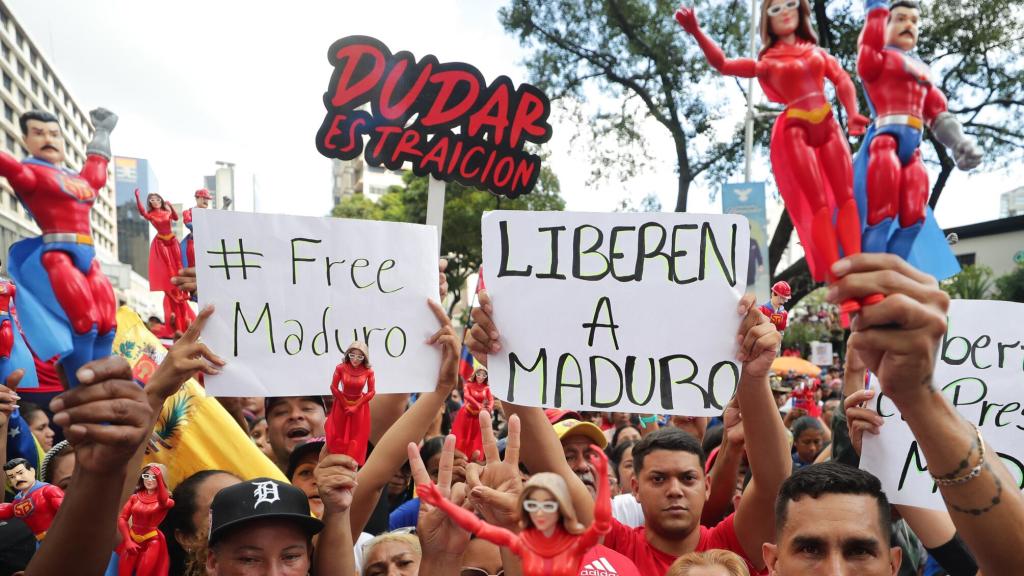
Of course, actions within Venezuela are important. There have been nationalist mobilisations calling for Nicolás Maduro and Cilia Flores’ freedom. Their kidnapping was a violation of Venezuela’s sovereignty; the demand for their freedom is a nationalist demand. While calling for a “nationalist program”, Marquez says nothing about these demonstrations. They are limited in their demands, but they are a start.
There are many other things I could criticise in the interview. Marquez talks of “countless episodes of violence” under the Maduro government, but fails to mention the right-wing opposition’s role in instigating violence.
Marquez refers to “the neoliberal policies imposed by the [Hugo] Chávez and Maduro governments over more than two decades”, which is a strange accusation. Chávez used oil revenue to bring free health care and education to poor areas. Chavez can be criticised for not moving quickly enough to diversify the economy away from an excessive oil dependence, but this is not the same as neoliberalism.
Marquez cites an opinion poll that shows 78% support for right-wing politician Maria Corina Machado, ignoring the notorious unreliability of opinion polls in Venezuela. In recent years, some workers became disillusioned with the Maduro government. But this does not mean they all became Machado supporters. According to the National Electoral Council, electoral abstention reached 42% in the 2024 presidential election.
Marquez is right that there is a “political void” in at least some working class and poor sections. This is mainly due to hardships created by US sanctions, which caused them to lose hope. They feel the US is too powerful to be successfully defied. The left needs to be able to explain how US imperialism can be defeated. Marquez has not done this.
‘Our oil’: Venezuela, Trump and the brutal logic of 21st century imperialism
On January 3, 2026, a long-brewing rupture in the post–Second World War order became explicit when the United States launched a military operation in Venezuela and abducted President Nicolás Maduro. This moment is significant not only because it violates international law, but also because imperial intent was articulated with unprecedented clarity. For decades, the moralistic language of democracy, human rights, and humanitarianism shrouded U.S. interventions in the Global South, concealing their underlying logic of dominance. Trump’s intervention eliminated these covert tactics. Declaring that “very large oil companies” would rebuild Venezuela and profit from “our oil”, he spoke in the language of possession rather than partnership, marking a moment when the empire no longer felt obliged to justify itself ideologically.
This action is a result of structural pressures, not solely due to the actions of one individual. The decline of US economic dominance, the ever-growing US-China geopolitical competition and the historical subjugation of Latin America as an area of extraction and strategic control created a point of convergence for these structural forces. The Bolivarian movement had previously created a glimmer of hope around the globe for the left, until it began to unravel under the Maduro regime due to the combination of extreme dependence upon oil revenue, an inability to diversify the economy and a growing reliance upon military loyalty instead of popular consent, leading to a state of built-in vulnerability. This phenomenon is evidenced by Venezuela, a nation severely damaged by years of economic mismanagement, international sanctions and a continued decline in political legitimacy.
The dual reality of external assault and internal collapse presents a profound dilemma for the left. Opposing U.S. intervention is necessary, but doing so without analysing the internal limits of the Maduro regime risks reducing politics to reflexive allegiance. The arrest of Maduro did not signal the end of a revolutionary movement; instead, it represented a critical juncture, underscoring the intrinsic weaknesses of a system dependent on commodity booms and incapable of sustaining democratic or social authority in the face of evolving external conditions.
In this story of imperial aggression, we have to examine the audacious revival of the Monroe Doctrine, the material and geopolitical limits of oil as a source of revenue, the contrasting eras of Chávez and Maduro; and the structural collapse of the Venezuelan state and military. Above all, it argues that the left must respond with clarity: opposing imperialism while reconstructing social power, deepening participatory structures, and addressing the internal contradictions that have historically undermined sovereignty. Venezuela today is both a victim and a warning: a lesson in the dangers of dependence, the fragility of redistribution without structural transformation and the imperative for anti-imperialist strategy rooted in working-class power.
Trump-era US imperialism
Donald Trump’s declaration that the United States would send oil companies to “fix” Venezuelan infrastructure and extract profits encapsulates more than rhetoric—it embodies a new phase of imperial governance where military might, corporate interests, and geopolitical ambition converge openly. The logic was straightforward: sovereignty is secondary to the imperatives of extraction and strategic control. In this, Trump did not depart from the historical pattern of U.S. imperialism; he simply stripped away the ideological veneer that traditionally accompanied it. This shift must be understood within the context of a changing global order. The United States, while still militarily dominant, is experiencing a strong challenge to its economic and technological supremacy. China is increasingly challenging trade and investment flows, undermining its industrial base, and straining traditional alliances. In this setting, coercion is replacing consent. The intervention in Venezuela illustrates this transition: the empire is now less focused on fostering cooperation or leveraging local proxies and more intent on ensuring compliance through the direct application of force. The phrase “our oil” shows not only arrogance but also an awareness of structural insecurity. Imperial power no longer trusts global norms, multilateral institutions, or ideological persuasion to get what it wants. Behind this posture stands a recognisable social bloc: energy capital intent on securing reserves, defence corporations dependent on continuous conflict, and logistics and construction firms, for whom occupation itself becomes a field of accumulation.
By framing the intervention as a business operation, Trump collapsed the traditional divide between violence and profit. Military occupation, infrastructure reconstruction, and resource extraction are no longer separate domains—they are integrated instruments of accumulation. Such an arrangement represents a departure from the versions of imperialism, which relied on proxy governments, economic coercion and conditional aid. Now, the United States openly entertains the direct management of foreign territory, treating the Venezuelan state not as a sovereign partner but as a resource to be appropriated. Military-backed corporate operations render local political actors, previously considered indispensable intermediaries, optional.
Yet the intervention is not only about immediate extraction. It serves as a demonstration of imperial capacity, designed to send a warning to the region: defiance of U.S. interests will be met with coercion, not negotiation. Venezuela functions as a laboratory for a new hemispheric order, where sovereignty is conditional and resistance is criminalised. The structural logic behind Trump’s posture also reflects internal pressures within the U.S. capitalist system. Slowing global growth, market volatility, and intensified competition for energy resources create incentives for direct appropriation. Military force becomes a tool for securing assets that cannot be reliably obtained through trade or diplomacy. Yet this strategy is inherently unstable: occupation can provoke resistance, administrative overreach can inflate costs, and reliance on coercion undermines the legitimacy necessary for long-term control. The Venezuelan case thus exposes a fundamental tension in contemporary imperialism: capacity for force exists, but the capacity for sustainable governance is limited. Imperial rhetoric presents simplicity, but material and political realities remain complex and costly.
Revival of the Monroe Doctrine
The intervention in Venezuela on January 3 is not an isolated act of aggression; it is the actual revival of a doctrine that has shaped U.S.–Latin American relations for more than 200 years: the Monroe Doctrine. Articulated in 1823, it positioned the Western Hemisphere as a U.S.-protected sphere, warning European powers against intervention. Historically, it functioned less as a legal principle than as a strategic claim: Latin America was to remain subordinated to U.S. geopolitical and economic interests. Under Trump, this doctrine has resurfaced with unprecedented bluntness, stripped even of the veiled language of diplomacy, multilateralism, or ideological pretext.
For most of its history, the Monroe Doctrine operated indirectly. Coups, covert operations, economic pressure, and proxy regimes allowed Washington to dominate regional politics while preserving the formal appearance of sovereignty. During the Cold War, support for military dictatorships, conditional aid, and covert sabotage enabled efficient control, often framed in moralistic terms—from anti-communism to the defence of democracy. Sovereignty was nominally respected while materially hollowed out.
Trump’s intervention in Venezuela marks a decisive break from this indirect model. His National Security Doctrine explicitly frames the hemisphere as a U.S. sphere of influence, leaving no ambiguity about autonomy or external presence. The conditionality of sovereignty—previously masked by diplomatic language—is now openly codified: deviation from U.S. strategic or economic priorities is treated as hostility. Latin American states are no longer junior partners or managed allies; they are objects of enforcement, with political legitimacy contingent on compliance. The Monroe Doctrine thus shifts from a strategic warning to an operational blueprint for unilateral intervention.
Venezuela functions as the testing ground for this revived doctrine. The intervention demonstrates that defiance, even when articulated through popular sovereignty or anti-imperialist rhetoric, can trigger direct military and economic coercion. The objective is not merely regime change but precedent-setting: resistance invites occupation, resource seizure, and geopolitical subordination. The message to the region is clear—we will punish autonomous policies, diversified alliances, or independent economic strategies.
Several structural factors accelerate this shift. Expanding Chinese investment across Latin America—particularly in energy, infrastructure, and mining—has eroded the U.S.’s uncontested dominance. Even where such engagement remains limited in scale, its strategic significance is profound. The Trump administration interprets these footholds as challenges to hemispheric control, with Venezuela’s oil reserves and strategic location making it the primary site for forceful reassertion. The revived Monroe Doctrine is therefore both a continuation of historical domination and a response to intensifying global competition.
Unlike earlier periods, this revival carries no promise for development, modernisation, or regional integration. It is no longer framed as benevolent hegemony or pan-American cooperation but as coercion: compliance in exchange for protection, defiance in exchange for punishment. By discarding the ideological veneers of democracy, human rights, or anti-corruption, Trump’s doctrine exposes imperial power in its rawest form—territorial and resource domination enforced by military capacity.
The consequences extend well beyond Venezuela. Open coercion destabilises regional politics, militarises domestic governance, and renders institutions such as the Organization of American States largely irrelevant. Even compliant elites recognise the danger: a hemisphere governed by force alone is inherently unstable, prone to cycles of resentment, unrest, and conflict. At a global level, the message is clear—sovereignty is conditional, international law is subordinate to power, and imperial aggression is no longer exceptional but normalised. Venezuela is not an anomaly; it is a warning of a broader descent into unapologetic power politics.
Chávez era, Maduro era
A thorough understanding of Venezuela’s crisis requires distinguishing between two distinct historical periods: the Chávez era (1999–2013) and the Maduro era (2013–2026). Collapsing these periods into a single narrative obscures the material and structural conditions that made the Bolivarian project viable initially and explains why it became untenable under Maduro. This is not merely a question of personal leadership or political competence, but of economic foundations, social legitimacy, and institutional resilience.
Under Hugo Chávez, Venezuela benefited from a historically exceptional conjuncture. The global commodity supercycle of the 2000s, driven in large part by Chinese demand for oil, pushed prices to unprecedented heights. For an economy overwhelmingly dependent on petroleum exports, this generated a massive inflow of rents. Chávez used these resources to finance expansive social programs: subsidies for housing, healthcare, and education, wage increases, and programs aimed at empowering the historically marginalised. These policies materially improved the lives of millions, anchoring the Bolivarian project in genuine popular support. The working class and poor were not merely passive recipients but participants in a broader project of social redistribution, creating a coalition that gave Chávez significant legitimacy.
Yet even at its peak, Chávez’s model rested on a fragile foundation. Redistribution was almost entirely dependent on oil rents, while the underlying economic structure remained largely untransformed. Non-oil sectors remained underdeveloped, productive diversification was minimal, and private capital retained control over most production. The state functioned primarily as a distributor of oil wealth rather than a planner or regulator of long-term investment. This meant that the system’s stability was contingent on sustained high oil prices and continued access to rents — conditions external to domestic political action.
The death of Chávez in 2013 coincided with a collapse in global oil prices, exposing the fragility of the rent-based model. Nicolás Maduro inherited not only a deteriorating economic situation but also a political apparatus dependent on continuous redistribution to maintain legitimacy. Unlike Chávez, Maduro faced structural constraints that severely limited his policy options. The social coalition that had supported the Bolivarian project was increasingly disillusioned as living standards declined, hyperinflation eroded wages, and shortages became widespread.
Maduro’s response marked a qualitative departure from Chávez’s approach. Rather than reconstructing popular participation or transforming the productive base, the state increasingly relied on coercion and administrative control. The military became central to regime survival, enjoying economic privileges, access to subsidised goods, and control over lucrative sectors. The broader working-class base, once empowered and politically engaged, was marginalised, with social programs functioning more as mechanisms of political compliance than as instruments of empowerment. In effect, Maduro substituted class-based support with military loyalty, hollowing out the social and political foundations of the Bolivarian project.
This transformation had multiple consequences. First, it weakened the capacity of Venezuelan society to resist external aggression. In principle, a politically mobilised populace could serve as a check on imperialist encroachment, but Maduro had largely disengaged this social base. Second, it amplified internal contradictions: reliance on oil rents and military patronage left the economy and state vulnerable to shocks, whether from sanctions, price fluctuations, or foreign intervention. Third, it reinforced the corporatisation of the state, transforming institutions that had once facilitated popular participation into tools for managing scarcity and preserving elite control.
It is crucial to note that these internal failures do not absolve external aggression. U.S. intervention, sanctions, and geopolitical pressure compounded the crisis, but they did not create the structural fragility that allowed the Venezuelan state to collapse so rapidly. The Bolivarian system, built on oil rents and charismatic leadership, required continuous popular engagement and economic diversification — conditions that were weakened over time. The Maduro era shows that redistribution without change can’t keep legitimacy during a long-term crisis and that relying on narrow institutional mechanisms, like military loyalty, makes a country vulnerable to both internal collapse and external pressure.
In short, Chávez and Maduro governed under different structural and historical conditions. Chávez operated during a period of extraordinary resource inflows that allowed for meaningful, albeit temporary, redistribution and the construction of popular legitimacy. Maduro inherited a weakened economy, declining rents, and an eroded social base, leading to a reliance on coercion, bureaucratic control, and military patronage. The Bolivarian project’s collapse under Maduro was therefore not accidental; it was structurally produced, reflecting the perils of resource dependence, limited economic diversification, and the hollowing-out of popular power. Recognising this distinction is essential for understanding the Venezuelan crisis and for formulating strategies that link anti-imperialist struggle with the reconstruction of genuine social and political empowerment.
Crude oil: Politics precedes economy
While President Trump presented Venezuelan oil as an immediate windfall for the United States, this claim is far more rhetorical than economic. Venezuela does possess the world’s largest proven oil reserves — around 303 billion barrels — but the assumption that military conquest can be smoothly converted into profit ignores deep structural constraints. What appears on paper as an irresistible prize is, in practice, technologically complex, politically risky, and economically uncertain.
Years of underinvestment, mismanagement, and political turmoil have severely degraded Venezuela’s oil infrastructure. Pipelines, refineries, and extraction facilities require massive capital infusion simply to restore basic functionality. Moreover, most Venezuelan crude is extra-heavy oil concentrated in the Orinoco Belt. Unlike light crude or U.S. shale, it demands complex processing, specialised refining, and continuous technological maintenance. These conditions make rapid profitability unlikely even for the largest and most experienced energy corporations, with upfront costs vastly exceeding the “billions” promised rhetorically.
Global market conditions further constrain profitability. By 2026, oversupply, slowing demand growth, and an accelerating energy transition characterise the oil markets. Benchmark prices remain relatively low, barely sustaining U.S. shale operations, while the technical and logistical challenges of Venezuelan heavy crude sharply reduce margins. Restoring production to even modest levels would require sustained investment running into the hundreds of billions, confirming that Venezuelan oil is not a short-term revenue source but a long-term, high-risk project.
Extraction is also inseparable from politics. Securing oil production would require continuous military and administrative controls to protect infrastructure, discipline labour, and suppress resistance. Trade unions, local communities, and sabotage risks ensure that extraction cannot be treated as a purely technical or commercial operation; it is a political process enforced through coercion.
For these reasons, Venezuelan oil functions less as an immediate economic windfall than as a geopolitical instrument. Control over reserves is primarily about strategic leverage: denying rivals — especially China — access to resources and reasserting U.S. dominance in the Western Hemisphere. Possession, despite limited direct profits, signals authority and reshapes regional power relations. Trump’s use of the phrase “our oil” serves as an ideological justification, hiding the fact that the intervention is motivated by control and subordination rather than quick profits.
This gap between rhetoric and material reality carries broader implications. Military aggression is framed as economic necessity, generating public support for ventures that are strategically risky and economically dubious. The left’s main concern is not just who benefits from extraction, but also who has power, who sets the rules, and who pays the social costs. Venezuelan oil is technologically difficult, politically contested, and economically precarious, yet symbolically central to imperial dominance. The anti-imperialist strategy must therefore focus less on resource arithmetic and more on sovereignty, popular mobilisation, and the reconstruction of social power.
Silence of the army and collapse of the state
One of the most striking features of the January 3, 2026, U.S. intervention was the conspicuous silence of Venezuela’s military. The armed forces’ inaction was not simply a matter of fear, incompetence, or poor leadership; it was the product of a profound political and institutional transformation that decoupled the military from the revolutionary and social bases it once defended. To understand this silence, it is necessary to situate the armed forces historically—from their politicised role under Chávez to their corporatised function under Maduro— and to see how these changes intersect with the broader collapse of state legitimacy.
Hugo Chávez saw the military as a politically aware and socially integrated part of the Bolivarian Revolution. Officers and soldiers were trained to see themselves as part of a broader collective mission: the defence of national sovereignty, popular redistribution, and the revolutionary project itself. Their loyalty was tied not merely to the abstract notion of the state but to the active participation of the people and to the material improvements that Bolivarian policies provided. The 2002 coup attempt demonstrated this alignment; segments of the armed forces mobilised decisively to restore Chávez, signalling that a politicised military could actively counter both domestic elites and foreign aggression. Institutional authority and popular legitimacy were intertwined, and the military functioned as both protector and enabler of the revolutionary social project.
By contrast, under Nicolás Maduro, this relationship underwent a decisive transformation. The military has increasingly become a self-contained, corporatised pillar of the state rather than a socially rooted force. Officers gained privileged access to markets, loans, property, and state-controlled resources. Their material interests became the primary guarantee of loyalty, rather than ideological commitment or connection to the populace. The armed forces were no longer vehicles of mass empowerment but instruments of administrative and political survival, insulated from the hardships and mobilisations of ordinary citizens. Political allegiance shifted from revolutionary ideals to bureaucratic and economic incentives, establishing a hierarchy in which the military itself became a beneficiary of the system it was charged with defending.
This depoliticisation had immediate consequences during the U.S. intervention. When confronted with a foreign military incursion and the kidnapping of President Maduro, the military defaulted to caution and inaction. The structures of authority upon which they had relied — state institutions, bureaucratic hierarchies, and personal privilege — remained intact, but the moral and political imperative to resist was absent. Their silence was not necessarily cowardice; it reflected a structural reality: the decoupling of state power from popular legitimacy had left them without a clear social or ideological mandate to act. The state itself had hollowed out the institutional connections that once aligned military action with societal defence.
The implications of this silence are profound. The Venezuelan state, already weakened by mismanagement, corruption, and a narrow economic base, now faces a legitimacy crisis that cannot be remedied by reinstating a single leader. Legal frameworks, constitutions, and formal institutions lose functional meaning when the coercive arm of the state — the military — is neither ideologically aligned with the populace nor capable of autonomous enforcement. In practice, the presence or absence of external forces, rather than domestic political authority, becomes the determining factor for sovereignty. Social trust diminishes, civil society is restricted, and the ability for spontaneous, collective resistance is significantly impaired.
The military’s inaction, on the other hand, shows how limited foreign intervention can be. The hollowing out of local institutions prevents even overwhelming U.S. military power from translating into sustainable governance. Occupation or coercion may secure short-term compliance, but it cannot substitute for social legitimacy, popular participation, or functional governance. The U.S. can remove a leader, control resources, or enforce submission, but it cannot rebuild political consent from the outside. In this sense, the silence of the Venezuelan armed forces is both a symptom of systemic collapse and a restraining factor against immediate, potentially catastrophic confrontation.
This situation teaches the left an important lesson. Defence against imperial aggression must account for the social and institutional foundations of power, not merely the military balance of forces. A politically hollowed state is vulnerable not only to external coercion but also to internal dysfunction. Strategies of resistance must therefore focus on rebuilding popular institutions, revitalising social accountability, and reconnecting state power with working-class organisations. The Venezuelan crisis demonstrates that sovereignty is inseparable from social legitimacy; without it, even nominally independent states can be rendered impotent in the face of external threats.
Erosion of popular support
The erosion of popular support under Nicolás Maduro is central to understanding Venezuela’s dual vulnerability: internal fragility compounded by external aggression. Under Hugo Chávez, the Bolivarian Project rested on a broad social coalition linking working-class communities, marginalised groups, and grassroots organisations through redistribution, participatory structures, and tangible improvements in living conditions. High oil revenues and Chávez’s political authority sustained this arrangement, anchoring the project in real popular legitimacy rather than symbolic allegiance.
Under Maduro, this foundation steadily unravelled. Venezuela’s structural dependence on oil, combined with falling prices, hyperinflation, and collapsing living standards, eroded the material basis of support. Social programmes became bureaucratic and politically mediated rather than empowering, while scarcity pushed communities into survival strategies that constrained collective mobilisation. The promise of participation gave way to the management of the crisis, replacing political engagement with administrative control.
The government’s increasing reliance on the military for political survival exacerbated this erosion. Officers became key beneficiaries of state-controlled resources, credit systems, and logistical monopolies, securing loyalty through material privilege rather than ideological commitment. The result was a widening divide between a protected security apparatus and an increasingly impoverished population. Bureaucratic regulation and coercion displaced active social consent, weakening the mechanisms that once underpinned popular resilience.
Partial neoliberal changes made the project even less coherent. Concessions to private capital, tacit accommodations for foreign investment in oil, and limited market liberalisation signalled a retreat from participatory and redistributive principles. Trade unions and community councils lost influence as top-down management replaced grassroots control, contributing to declining organisational and political initiative at the base.
These dynamics decisively shaped the response to U.S. intervention. The hollowing out of the institutional and material links that enable collective action, not apathy, muted popular mobilisation. Legitimacy had weakened, leaving the state exposed to both external coercion and internal disillusionment. The crisis intensified due to sanctions and military pressure, which exacerbated already structurally embedded vulnerabilities.
Therefore, we cannot reduce Maduro’s criticisms to personal failure. They reflect contradictions inherent in a project dependent on a single commodity, partial redistribution, and limited institutional democratisation. By prioritising military loyalty, bureaucratic control, and market accommodation, the government fragmented the social base that once sustained the revolution, leaving it insufficiently empowered to resist imperial encroachment.
For the left, the implications are clear. Opposing U.S. aggression does not require uncritical defence of the existing regime, nor can internal critique be detached from the reality of imperial threat. Rebuilding popular power — through revitalised community councils, labour organisation, and participatory structures — is essential to restoring sovereignty. Without the reconstruction of grassroots legitimacy, resistance remains fragile, and the state is vulnerable to both domination from without and disintegration from within.
The task of the left
The Venezuelan crisis confronts the left not with a menu of tactical choices, but with the consequences of a long historical impasse. The convergence of open U.S. imperial aggression and the internal hollowing-out of the Bolivarian project has produced a moment of exposure: sovereignty without social power collapses under pressure, while resistance stripped of popular legitimacy cannot be sustained. This is not a dilemma that can be resolved by rhetorical alignment or selective silence. It compels us to examine the ways we have practiced, defended, and often postponed anti-imperialist politics.
The U.S. assault on Venezuela — the military seizure, the open claim over oil, the revival of the Monroe Doctrine in its naked form — marks a qualitative shift. Latin America is no longer disciplined primarily through diplomacy, proxies, or conditional aid, but through the direct assertion of force. To normalise this as “geopolitical necessity” is to accept the demotion of sovereignty to a privilege granted by empire. For the left, opposition to this intervention is not a matter of loyalty to a government but of defending the possibility of autonomous social development against a precedent that threatens the entire continent.
However, external pressure alone cannot explain away the collapse of popular mobilisation in Venezuela. The erosion of participatory structures, the substitution of military loyalty for social consent, and the accommodation to market mechanisms fractured the very base that once sustained resistance. When sovereignty became concentrated in institutions detached from mass participation, it became vulnerable to seizure. This is not a moral indictment but a historical lesson: redistribution without durable popular power cannot withstand prolonged crisis, sanctions, or force.
What the Venezuelan experience reveals is not simply the brutality of imperialism but the limits of defensive politics that treat state power as a substitute for social organisation. Without active, organised, and self-confident working-class forces, anti-imperialism becomes reactive, brittle, and dependent more on leadership than collective capacity. The silence that followed the intervention was not only imposed from outside; it was produced internally, through the gradual dismantling of the mechanisms that once translated social support into political action.
The left now faces a dual danger. To oppose U.S. aggression while refusing to confront the internal failures that preceded it risks turning anti-imperialism into an empty reflex. To concentrate on those failures while excluding imperial violence constitutes complicity in subjugation. The Venezuelan crisis exposes the cost of separating these questions. Declarations and institutions alone cannot defend sovereignty, but the density of social power beneath them does.
Venezuela therefore stands not only as a victim but also as a warning. It warns against the illusion that control over resources can compensate for the erosion of democratic participation. It warns against substituting military or bureaucratic stability for popular legitimacy. And it warns that imperialism today no longer waits for ideological cover: it advances where resistance has been structurally weakened. Whether this moment becomes a precedent or a turning point depends less on diplomatic outcomes than on whether the left is willing to draw the full lessons of this defeat — and to rebuild, from below, the social forces without which sovereignty cannot survive.
Sankha Subhra Biswas is an Editorial Board Member of Alternative Viewpoint.
Trump’s kidnapping of Maduro: Meaning and consequences
On January 28, 2026, Focus on the Global South held an internet panel on developments in Venezuela, shortly after the United States kidnapped President Nicolás Maduro. Chairing the panel was Anuradha Chenoy from the Transnational Institute. The panelists were Peter Rosset, visiting scholar at the Chulalongkorn University Social research Institute, Lia Pinheiro Barbosa from the Universidade Estadual do Ceará, Edgardo Lander from the Central University of Venezuela, and Walden Bello, chair of the Board of Focus on the Global South.
The discussion was highly stimulating, though it was marked by sharp disagreements on the meaning of the US intervention in Venezuela and the character of the Maduro government. The full webinar can be viewed above. Rosset and Barbosa felt they had no chance to respond to the comments of Lander, who addressed at length the issues raised by the former in the first half of the program. In fairness to Rosset and Barbosa — as well as to deepen the discussion of the issues raised in the webinar — Focus decided to give them a chance to provide written responses to Lander’s comments. Lander was then provided Rosset and Barbosa’s responses to comment on.
What follows is presented in three parts. The first, “What does the kidnapping of Maduro mean?”, contains edited versions of the opening remarks from Rosset and Lander from the webinar. The second, “How should the left judge the Bolivarian project?”, presents the written responses from Rosset and Barbosa. The third, “Solidarity with whom?”, presents Lander’s rejoinder. What does the kidnapping of Maduro mean?
Peter Rosset
Thank you, Focus, and thank you to the other speakers. It’s a pleasure to be here. I am obviously very concerned about what has happened in Venezuela. I am also concerned about how the very justifiable outrage over ICE in Minnesota has completely displaced Venezuela and the kidnapping of a sovereign sitting president from the news media around the world.
It is very important that we discuss this and that we fight against any tendency for short-term memory or complacency, because I do believe that we have inaugurated — or reinaugurated — a new phase of old imperialism, as our moderator said at the beginning and as Lia also insisted. As Walden said, we have a return to a spheres-of-influence policy: America for the Americans, the Monroe Doctrine. That, combined with new low-cost military methods — which we have seen several times recently, notably as Walden said with Obama, but now with Trump — is deeply concerning. We should also remember the kidnapping of Aristide from Haiti, and of Manuel Noriega from Panama, though there was much more loss of life in those cases. Although there was also much more loss of life in Venezuela than the news media would lead us to believe.
This is very concerning because, as Lia said, every government in Latin America is wondering whether their security apparatus could protect them from what Trump called the “discombobulating machine” — which shut off all military and civilian communications and electricity in Caracas at the moment of the invasion.
One of the most concerning elements to me is the relative silence of Latin American governments. There have been a few governments speaking out — notably Brazil, Colombia, Mexico, Chile, and Cuba — but not speaking out very often, and being cowed. All the other governments have been very quiet. You get the feeling that every Latin American president is nervously checking their personal security apparatus rather than building any kind of common front against this new offensive of American imperialism in the Americas.
I am very concerned about Cuba, because we have now seen that Trump immediately cut off Venezuelan oil to Cuba and has put heavy pressure on President Sheinbaum of Mexico. He called her on the phone last week to ask her to stop petroleum shipments. She then stopped the petroleum shipment two days ago, refuses to confirm or deny it, but made quite clear in her press conference yesterday that she did stop it, without saying why or how permanent this is. No country in the 21st century can survive on zero petroleum. It does not matter whether you have good or bad administration of your government — you cannot survive. That could be the end of Cuba as we know it if Trump effectively cuts off all petroleum. He is also considering a naval blockade. It is imperialism without putting US troops at risk, if he can achieve it just by pressuring Latin American presidents.
If China and Russia do not live up to any kind of anti-imperialist history and supply that petroleum, what is going to happen to Cuba? The silence of countries around the world is amazing and extremely worrisome. As Lia said, I think it is important that we retake the discussion of imperialism and neocolonialism.
Since I have been in Southeast Asia, I have been a little worried to see that many people think these are passé arguments — that US imperialism is very 20th century, not very 21st century. Some people believe that there is economic imperialism and neocolonial structures from China in this region; other people defend China as a progressive anti-imperialist country. But we will see to what extent China and Russia are willing to do something about Venezuela, to do something about Cuba — or is this going to be the new free hand for US imperialism, anywhere it wants, in any way that it wants?
And what is the message to Russia and China? If the United States can do it and get away with it at zero political cost, does that mean China can do whatever it wants? Does that mean Russia can? If I were the premier of China, I would invade Taiwan tomorrow. If I were Putin, I would escalate against Ukraine. If this is really going to be the way things are — the three superpowers operating with impunity — what is to stop them? It is so outrageous and so obviously illegal.
I think it is interesting that people with political positions as different as those of Lander — whose work I greatly admire on the coloniality of knowledge — and myself and Lia, can find broad agreement here. As far as Venezuela goes, Lander is an opponent of the Maduro government and of the Bolivarian Revolution. Myself, I am highly critical of all of the progressive governments in Latin America for some of the same reasons that Lander is, such as their inability, unwillingness, or lack of interest in breaking away from the extractivist model and really taking any kind of anti-capitalist stance.
But on the other hand, I feel — and it is not a question of “Venezuela good or bad” or “Maduro good or bad” — that some straightening of the record is in order. I have always felt that Venezuela was the least bad, or you might call it the best, of the so-called progressive governments, who have turned out to be some kind of populist neoliberalism by and large. Venezuela has very interesting ongoing experiments, such as the communes and the communal councils, of which there are now more than three or four thousand. Obviously only about a quarter of them may be functioning very well.
But there is a huge debate around Latin America about autonomy for civil society to run its own affairs — whether it be indigenous people in rural areas, peasants, or people in urban slums. We have both de facto radical autonomies, like the Zapatistas or what the Mapuche are calling for, as well as juridical, constitutional forms of partial autonomy. In that sense, I can say they have mostly failed in countries like Bolivia and Ecuador. But I think that the experiment with communal power in Venezuela — I cannot call it successful yet, but it is in a process of being built as a different possible route towards socialism today, in a very different world from the last century’s socialist revolutions. It is something that I believe should be treasured by the global Left, and something that we should be outraged is being put into danger by the action of US imperialism.
We have to resist going along with the easy neoliberal commercial media caricaturing of the Maduro government or the Bolivarian Revolution, and have to look more closely at the grey areas — the hopeful aspects as well as the more negative ones. We should not forget that, certainly in my opinion, as is the case with Cuba — as Lia said — over 800 different sanctions against Venezuela, a media war, numerous attempts at Color Revolutions, the training of street gangs to oppose the government, all of the National Endowment for Democracy, all of the CIA, all of the State Department work for years, means to me that regarding the economic crisis in Venezuela, the least important factor has been whether the Maduro government was a good administrator or a bad administrator.
Just as the least important factor in the Cuban economic crisis is whether President Díaz-Canel has been a good or bad administrator. I would say that no government in the world could be a good administrator under those circumstances. While I disagree with a number of the policies of the Venezuelan government, and even of the Cuban government, and certainly of my own government in Mexico, we have to put things in their fair, just proportion. No government can be expected to survive in terms of managing an economy under the conditions to which Venezuela and Cuba have been subjected. It is not fair to judge them by that standard.
In fact, if we look at the other so-called progressive and non-progressive governments in Latin America, we can see political polarization growing under almost all of them. We can see violence growing all over Latin America. We can see very few, if any, presidents who we could say are doing a good job. This is why I question the imperialist narrative that singles out one or two leaders — Nicolás Maduro — to be demonized to the point where it almost passes without comment that he is kidnapped and taken to the United States to be tried in a foreign court, against all international law.
So I guess that is what I wanted to lay out here: that I am not fully in agreement with Edgardo’s characterization of Venezuela, but I do agree with him — and I am glad that people with different points of view can agree — on the illegal and outrageous nature of what the United States did. I agree with Lia that we really have to look closely at the new forms of imperialism, neocolonialism, and fascism in the 21st century.
In that sense, we have to look very critically at how US power is being reconfigured under the resuscitation of spheres of influence. If there is some kind of concession under that framework to China in Asia, or to Russia in its sphere, then we should be concerned about Russian and Chinese imperialism or neocolonialism as well. For example, the way China has repeatedly intervened in the Myanmar revolution — not in favor of revolutionaries, but in favor of the reactionary fascist government carrying out a war against the population of Myanmar.
These questions that have been considered passé, or have dropped out of academic policy analysis and public political debate, have to come very much back. This is a much-needed call to attention: that we have to refocus on imperialism, militarism, neocolonialism, and fascism in the world today. It is not going to be just a western hemisphere phenomenon. There is no way that this does not have major implications — as Walden has already spelled out — for Europe, for Iran, certainly for Asia, and for Africa as well.
Edgardo Lander
As you all know — but I think it is important to repeat — Venezuela has experienced a very deep economic crisis for more than a decade. In one decade, the economy shrank by approximately 80%, without a war having occurred. This was a consequence of both external and internal factors. During his first term, Trump imposed severe economic sanctions on Venezuela, particularly on two crucial sectors of the economy: oil and finance.
For a country where oil represents 95% of its export value, the loss of its main market, its source of inputs and spare parts, and access to external financing contributed to the collapse of the economy. This was precisely the purpose of the sanctions. A core aspect of the sanctions is their extraterritorial nature — that is, their imposition affected not only Venezuela’s relationship with the United States but also with multilateral organizations, companies, corporations, and countries worldwide. These sanctions have constituted a flagrant violation of international law and can properly be spoken of as acts of war.
However, the sanctions are only part of the determinants of this profound crisis. Internal factors were equally — and, according to some interpretations, even more — decisive. Political instability; an economic policy based on spending oil revenue without any systematic productive investment programs; inefficient public management; widespread corruption; the massive nationalization of companies that, under Cuban influence, equated socialism with statism without the required management capacities; and, very significantly, military control of a high proportion of the most important economic activities.
When the economic sanctions began to be applied for the first time during the first Trump administration, the Venezuelan economy was already in significant decline. Oil production had already shown a marked downward trend. There has been much debate in Venezuela about which of these two sets of factors has had more impact on the crisis, but there is no doubt that their combined effect has been catastrophic.
As I said in my presentation, the way Venezuelan society, political actors, and movements have reacted to the US military intervention is quite strange and in many ways unexpected. The way the United States carried out this overwhelming demonstration of power left everybody surprised. There is, of course, discussion of whether there was treason — whether there was some negotiation by sectors of the government to allow the United States to remove Maduro. There are doubts as to why there was no possibility of effective resistance against this intervention. Why was it possible for helicopters — so easily attacked from the ground if you have missiles — to operate without a single one being destroyed? It is a very strange situation on the whole.
The fact that the Chavista government, military, and party reacted in such a unified way, with no public fractures, is quite amazing. How can you turn a radical anti-imperialist government into one that is willing to negotiate with the United States, willing to accept its demands, calling for people to be calm, and beginning to do every single thing that the United States is asking for? That is quite surprising, and I am sure it is going to lead to fractures and divisions.
But the thing that is important to understand is the level of desperation that existed in Venezuelan society. I clearly disagree with Peter’s interpretation of what the Maduro government represented. This was a government that had incredibly massive levels of corruption. A very repressive government. Thousands of political prisoners, many of them tortured, many people simply disappeared. It took months for families to know whether their loved ones were alive or not. Quite a few political prisoners have died in prison with no explanation.
The transformation of the expectations, dreams, and experiences of the first years of the Chávez government are a long memory that people have just left behind, because it has nothing to do with present Venezuelan reality. In the first few years — before the Chavista revolution was declared to be socialist — in the context of the current Venezuelan constitution, which is a very progressive and advanced social-democratic constitution with extensive rights and new methods of participation and modes of organizing, there was an incredibly vigorous, dynamic process, with grassroots organizations of all sorts relating to water, education, literacy, and land rights. It was an incredible dynamic.
But as the government became more and more state-centered, and in many ways Leninist in its conception of power and the role of the state and the political party, it became increasingly centralized. It created a political party which in no way incorporated any reflection on the experience of one-party systems in actually existing socialism. There was this gradual trend towards a more state-centered, state-controlled system — this fusion of state, party, and military, and eventually the police. In his last years, Maduro talked about the “civic-military-police alliance.” The incredible transformation and potential of the grassroots organization and autonomy that was created during the first few years was systematically cut down by the government’s increasing control.
It created a massive institutional and legal structure for popular power, which established detailed norms for how people should organize, what they should do, how they took decisions, and — most importantly — where their resources came from. And the resources came from the central government. The resources came from oil while oil prices were high, and it was possible to subsidize this massive array of popular organization. But this led to incredibly severe problems.
On one hand, the communes and the communal councils were seen as Chavista structures — not as structures for the construction of a democratic society in which the whole of society was getting involved in self-organizing and autonomy. The fact that the party and the state became, in practice, the same thing meant that, as resources came from the state, the party always decided and imposed its politics on every single form of popular organization. These popular organizations, these communes and councils, had no autonomous economic base — except for some very wonderful but small, scattered experiences in rural areas that were an exception, not the rule.
Most of the communal councils had no alternative source of income. They were political organizations. They could not possibly be autonomous organizations because they had no source of wealth creation that they carried out themselves. They were political organizations with no economic base except for state financing — resources coming from above.
As a consequence, the dynamic of this process — which depended on oil income — was all of a sudden cut off by the fact that first oil prices collapsed, and then sanctions had a huge impact on the oil industry and on state income. The fact that the impact was so immediate shows that these organizations really had very small levels of autonomy and were highly dependent on being subsidized by oil income. When this disappeared, most of these organizations simply withered away. Even if the government continues to talk about communes and councils, there is really very little that actually exists in Venezuela today. The main organization that exists at the grassroots level is the one that distributes food in poor communities — and this is just a state giveaway that does not really imply any autonomy or participation whatsoever.
The fact that the great majority of the population of Venezuela today rejects the government; the fact that the Right wing has increased its presence and voting power so rapidly; the fact that, after years of a wonderful, fully automated electoral system in which there was no doubt that the results corresponded to the people’s will — and then the fact that, in front of people’s direct experiences, where they knew the results in their community, in their voting centers, and shared this information, the results presented by the voting machines were kept by many, many people, and they completely contradicted what the government claimed had happened — this was, as I said before, a breaking point.
At this breaking point, people realized that the electoral option to change the government was no longer available — that the government had decided to remain in power no matter what, and it increased repression. So the fact that so many people in Venezuela — unfortunately, I think this is really incredibly unfortunate — in some way welcome or assume as inevitable that the United States intervened is deplorable. It is going to have long-term political consequences for Venezuelan political culture.
But in spite of the fact that I feel so strongly that the ways Venezuelan society is reacting are reprehensible, it is something that has to be recognized. It is happening. No matter what we think of it, no matter what our opinions, it is really happening. And it is a result of the fact that the majority of the Venezuelan population came to see the Maduro government as a corrupt government, a repressive government, a non-democratic government — a government that pretended, or pretends, to remain in power no matter what.
So the fact that there is still some anti-imperialist discourse and some discourse related to communes and communal councils — this is really marginal in relation to the main facts of Venezuelans’ experience with this government. A third of the population has left the country. For young people in Venezuela there is a deep sense of having no future.
One of the things that I find quite amazing is the fact that, before the US intervention, when there were threats, people within the Left who did not agree with the Maduro government faced two evils, and it was difficult to decide which was worse: on one hand, a very repressive, authoritarian, corrupt government; and on the other, the threat of an intervention. It was really impossible to choose sides. Now we have a new situation in which the authoritarian, corrupt regime is intact—but under the orders of Trump. Both evils have fused into a single block, which makes it extremely difficult for Venezuelan society to react.
The social fabric has been to a great degree destroyed. Autonomous social organizations have been repressed. There is very little free press. Human rights organizations have to be very careful in what they say. So it is a completely new and unexpected situation.
I think it is extremely important for the Left globally to express solidarity with Venezuela in relation to both dimensions of the conflict. People have a right to decide their own government. This right has been denied both by the Maduro government and by the Trump intervention. Neither one allows sovereignty, democracy, or the Venezuelan people to decide their own future. We need solidarity that deals with both issues, not just one. Of course, Trump’s intervention is obviously the main issue we have to deal with. But it is not as if getting rid of Trump’s intervention would allow the country to recover democracy. That is simply not the case. How should the left judge the Bolivarian project?
Peter Rosset
Just as Edgardo said he “clearly disagrees with my interpretation of what the Maduro government represented,” I want to be on the record as disagreeing with many of his affirmations.
In some cases I simply do not agree at all, while in others I feel that he presents issues as black and white when in fact they are grey. Because of time limitations I cannot address them all, but here are some illustrative points.
On intensifying authoritarianism and repression, and thousands of political prisoners: Edgardo presents as unequivocal fact that Maduro was authoritarian and repressive, and that there were thousands of political prisoners. I believe these points to be more nuanced. First, there were several kinds of prisoners in Venezuela, prior to the recent releases, that the West has characterized as political. The longest-tenured ones were those tried and sentenced for their participation in the 2002 massacre and coup attempt against Chávez. The second group were those sentenced for violence, and inciting violence, during the fascistoid guarimba movement of 2014, when Chavista civilians were chased, savagely beaten, and sometimes brutally murdered by Right-wing mobs. The third group were mercenaries captured during acts of sabotage and similar operations. A more recent group are those who were detained after the disputed 2024 elections, when ample audiovisual material, testimonies, and documents were presented to prove: (a) the financing of violence by the Far Right and the USA, and (b) the involvement of the imprisoned individuals.
The larger point is: what is a government to do when US imperialism spends tens of millions of dollars over several decades to destabilize your country and undermine your government — including training and paying for all kinds of violent dissent? Do not misunderstand me, but sometimes I wonder why those progressive governments in Latin America that the US has since removed via Color Revolutions, varied types of coups (military, judicial or “lawfare,” etc.), and other means, did not arrest more obvious agents of US imperialism while they still had a chance to.
On the insinuation of high-level treason, lack of resistance by the Venezuelan military and security forces, and subsequent submissive obedience to Trump’s dictates: of course there was treason, but we so far have absolutely no way to know if it was low-level (at the level of bodyguards or similar) or high-level. And there was far more resistance than the USA let on — not just dead Cubans but dozens of dead Venezuelans, and many believe the US to be covering up the ongoing treatment of US casualties at a military hospital in Florida.
As to why acting president Delcy Rodríguez appears to be toeing the line with Trump, it is important to note that she is essentially governing with a gun to her head. The fact that the Trump Administration is currently seeking to indict her in federal court lends support to the notion that, behind the scenes, she may not be “behaving” as well as it seems. She is also moving forward with the national consultation on participatory budgeting for the comunas (communes), one of the most exciting (to me) and most hated (by the US government) exercises in grassroots democracy and people’s autonomy underway in Latin America.
I completely disagree with Edgardo’s negative presentation of the comunas, as I have just alluded to. There is a vast body of academic research and political reportage available that backs up my very positive viewpoint.
Edgardo returns to the old trope that Maduro stole the 2024 presidential elections. Over the years of the Chavista Bolivarian Revolution, there have been more than 30 elections at different levels of government, with Chavismo having only lost a couple. As for the disputed 2024 elections, remember that the government and the opposition came up with wildly divergent claims. If we look back, the first thing to note is that the María Corina Machado (MCM) group made their projection of results using a statistical methodology known as Parallel Vote Tabulation (PVT). The same methodology has been used in other countries where Color Revolutions have been promoted by US imperialism. But they didn’t use anywhere near the statistically required number of samples, and they failed to provide more than a few polling station records.
Legally, the Venezuelan constitution has mechanisms in place to resolve disputes of this kind. The Supreme Court acted and asked all political forces to carry out a verification. The only force that did not participate was that of MCM/Edmundo González, while other opposition parties did participate, and the results were officially verified. Later, MCM never managed to mobilize a group larger than 300 people after that process, even though they claimed to have won with 80% of the votes. But 80% does not disappear overnight, especially in a country as politicized as Venezuela.
At the end of the day, if there are doubts about the election, they should be resolved by Venezuelans themselves according to their own internal mechanisms. Nothing authorizes or justifies foreign intervention. To fall into that debate is to accept that some countries have the right to exercise tutelage over others.
Edgardo repeatedly highlights corruption in the Maduro government. Of course there was corruption. Please tell me which government in the world does not house a goodly number of corrupt officials. Should the USA kidnap all their presidents? In that case, please begin with the White House!
I could go on, but this is a seminar and not a doctoral dissertation. So let me sum up my viewpoint. There were both good and bad things about the Maduro government. I personally would not vote for Nicolás Maduro, but then I would not vote for any current president in Latin America, with the possible exception of Díaz-Canel in Cuba. Despite my also being a from-the-Left critic of the so-called “Pink Tide” or “Progressive” governments in Latin America, I feel that their shortcomings in no way justify external intervention. And for someone like Edgardo to fall back on many or most of the same arguments used by US imperialism is, in my view, to tacitly endorse imperial action while claiming otherwise. I cannot go along with that. Finally, I mention the comunas again, as probably the most interesting ongoing experiment by any government in Latin America, outside of Cuba.
Lia Pinheiro Barbosa
I would like to thank Focus for inviting me to participate in this webinar. My role here is to talk about what this means for Latin America, rather than discuss exactly what happened in Venezuela or its internal politics. But before I do that, I want to register my profound disagreement with Edgardo’s characterization of the Maduro government. While there are no saints among governments, not even so-called progressive ones, the Venezuelan government was clearly the best — or at a minimum, the least bad — of all of Latin America’s Pink Tide governments. I assume that Peter will address that later on in this seminar.
Now, for my assigned topic. Analyzing the consequences of the United States’ intervention in Venezuela is not just an analysis of a particular case. It is necessarily an analysis of regional and global geopolitics — of what is shaping up to be a dispute over hegemony on a global scale.
Firstly, the invasion of Venezuela brings to the forefront a historical problem that we experience not only in Latin America but throughout the Global South: the challenges of building and consolidating democracy on the one hand, and socialism as a revolutionary horizon on the other — especially in an environment in which imperialism inevitably tries to use the former to undermine the latter. So far, solutions to lawfare and Color Revolutions have been hard to come by.
Throughout the 20th century, this became more evident with the convergence of anti-imperialist, anti-colonial, and socialist revolutionary processes in Latin America. We could see a concrete revolutionary horizon, with broad popular participation, class consciousness, and critical political education. But after the Cuban Revolution of 1959, the United States’ strategy was to push hard for political and ideological intervention to prevent the advance of revolutionary movements and communism in the region. This culminated in military coups in South American countries, financed by the United States. Military dictatorships were violent processes of censorship, persecution, torture, and murder, with the clear objective of paralyzing revolutionary and democratic processes.
It was only in the mid-1980s that we were able to take up the process of re-democratization, with broad popular participation demanding direct elections. This allowed for a realignment of national Left political forces, such that at the beginning of the 21st century we had a correlation of forces favorable to the election of the progressive, Pink Tide governments. In the case of Venezuela — the most radical of that crop — Hugo Chávez’s rise to power came with a political commitment to 21st-century socialism.
At the beginning of the 21st century, there was a reconfiguration of the Left bloc, with progressive governments and a possible alliance with the socialist camp, paving the way for Latin American and Caribbean integration on the Left. The United States saw this as a real threat to its political influence in the region, even as it was also experiencing an energy crisis that threatened its technological and military hegemony and renewed its obsession with petroleum.
In the first decade of the 2000s, the United States resumed its imperialist policy of political intervention — no longer through military coups, but through hybrid warfare and parliamentary coups. That process began in countries with democratic governments. We can highlight a few concrete cases: the intensification of the blockade against Cuba, the coup in Honduras in 2009, and the constant and growing threats against Venezuela, to name a few examples.
The media war to construct a negative narrative about Venezuela—portraying it as a communist dictatorship — was one of the main strategies used to consolidate anti-Left public opinion among the social base of our Latin American countries.
There is also a new element: the formation of BRICS and the rise of China as an economic power, with the advance of its technological, military, and economic power. Today China has managed to extend its hegemony to Latin America and Africa with the Belt and Road Initiative and associated economic corridors, ensuring access to strategic minerals for its technological advantage. It is now the number one trade and investment partner of Latin America, having displaced the United States.
The United States, on the other hand, is experiencing a deepening political, economic, and social crisis, exacerbated by COVID under Donald Trump’s first administration. This crisis, which has been developing over the last 20 or 30 years, has generated an organic crisis in the United States with internal political polarization. And, as Gramsci told us, in contexts of deep crisis and the absence of a national project — whether from the Right or the Left — authoritarianism emerges; that is, fascism. This is the case with Donald Trump’s administration and the shift to the Far Right that we have seen in the United States and many other countries.
The trade war with China, threats of tariffs and economic sanctions against other countries, the policy of expelling migrants, and the intensification of the media war against Venezuela constituted a set of strategies to update the Monroe Doctrine. Today, with Trump’s second term in office, the United States’ intentions to deepen its domination in Latin America are becoming even clearer.
The military occupation of the Caribbean, the hijacking of oil tankers, and the invasion of Venezuela — with the kidnapping of President Nicolás Maduro and his wife, Cilia Flores—are the current highlight of imperialist action in our region. From a geopolitical point of view, I see it as a particular type of imperialism: namely, fascist imperialism, which violates international norms of national sovereignty and imposes a narrative of fear that silences countries around the world.
Imperialist action in Venezuela — as an illegal and unpunished act — sets a dangerous precedent for other Latin American countries: namely, that any of them could be invaded. Behind a supposed moral mission to save Venezuela and the Venezuelan people, the foundations are being laid for the appropriation of Venezuelan oil as well as critical minerals. And it does not stop there.
Trump has made it very clear: he can do the same thing with Cuba, Colombia, Mexico, and Greenland. The invasion of Venezuela is a message of discipline in the dispute for hegemony, and a real threat to the sovereignty of peoples in national contexts.
In this context, we have some important tasks in the process of developing our critical thinking in the Global South. First: to sociologically analyze the key political phenomena of the 21st century by naming them as what they are — imperialism, fascism, and neocolonialism. These three categories, which were extensively developed during the 20th century, disappeared from our analytical focus and discourse, especially during the first phase of progressive governments. This is now clearly a theoretical and analytical failure of the Left, which paved the way for a depoliticization of the social base and of political parties within the so-called Left itself, failing to update our collective analysis of the geopolitical conjuncture. It was a strategic mistake to think that democracy boils down to an electoral process, and that the election of progressive governments was, in itself, a true victory against imperialism.
Second: we need to demand a concrete response from international organizations regarding the intervention and kidnapping of President Nicolás Maduro. No country has the right to invade another country militarily, drop bombs, kidnap a president, and take him to be tried in foreign courts.
Third: we need continually to express our international solidarity with the Venezuelan and Cuban peoples, who have suffered uninterrupted sanctions from the United States.
To close, I reaffirm my fundamental disagreement with Edgardo, and hope that the discussion that follows will help correct the record on Venezuela. Solidarity with whom?
Edgardo Lander
I feel obliged to clarify some basic issues related to the characterization I have made of the Maduro government.
First, what I consider most serious. In his comments, Peter suggests that because I criticize what the Maduro government was, I am tacitly supporting this imperial intervention. This, in addition to seriously distorting what I stated categorically in my presentation, reflects a problem that has been present in broad sectors of the global Left in their characterization of progressive governments in Latin America, beginning with positions regarding Cuba and later Nicaragua.
Since Cuba has been subjected for more than six decades to a severe blockade, terrorist acts, and assassination attempts against its leaders by the United States government, a kind of pact of silence was established within the Latin American Left. One could not speak critically about the Cuban Revolution as long as the blockade remained in place. This ended up creating a historical debt of the Latin American Left toward the Cuban people. Unconditional solidarity with the Cuban process ultimately became a lack of solidarity with its population. The rich political debate of the early years, as expressed, for example, in the journal Pensamiento Crítico, basically came to an end in Cuba.
The unviability of an economic model in which the State sought to establish full control over all economic activity — even small-scale informal undertakings — became increasingly evident. Faced with this, most of the Latin American Left distanced itself from a crisis that was inexorably accumulating and did not assume as its own responsibility the task of contributing to thinking about how to move beyond that suffocating statist model in an autonomous and democratic way, without abandoning the ideals that had inspired the revolution and without replicating the experience of neoliberal transitions in Eastern European countries. In the absence of deep critical reflections on the forces at play, the crisis grew ever more severe.
In the Venezuelan case, unconditional solidarity with the Bolivarian process has had severe negative consequences. Left-wing intellectuals and politicians from all over the world — especially from Latin America and Europe — gathered time and again in Caracas to celebrate Hugo Chávez’s leadership. A critical reflection on core issues, which in light of the historical experience of actually existing socialism were becoming increasingly evident, was absent. With this seal of legitimacy granted by most of the international Left, some of the most negative tendencies of the Bolivarian Revolution were deepened and consolidated.
Among the most evident are the following: the authoritarian implications of the state–party fusion model; the deepening of extractivism through increased dependence on oil; the absence of a productive horizon beyond oil rents; the glaring contradiction between the logics of popular democratic participation and a military culture of verticality and obedience that was being strengthened; and the consequences of a systematic process of vertical control — from the state–party, through a dense legal-institutional network of the so-called Popular Power — over what in the early years of the Bolivarian process had been an extraordinarily rich, diverse, and widespread experience of grassroots democratic organization with high levels of autonomy.
This growing subordination of that participatory dynamic to increasing state control made Popular Power progressively less autonomous and increasingly dependent on the vertical direction of the state–party and the rentier resources it provided. With few exceptions in rural areas, these organizations have been political organizations without their own productive base. Once the period of oil abundance ended and, beginning in 2013, the prolonged crisis began, these state-provided resources dwindled. Most organizational structures of Popular Power — Communal Councils and Communes — were similarly weakened. The main grassroots organizational network that survived this crisis has been the Local Committees for Supply and Production (CLAP), a structure created by the national government to distribute food bags to low-income sectors.
Over the last decade, in spite of its discourse, corruption, the denial of basic human rights, and repression became the main defining characteristics of this government.
The Venezuelan experience, which in its early years had sparked so much hope and expectation—not only in the region but in many parts of the world—ended up becoming a negative reference used by Right-wing forces across the continent as an example of what would happen in their own countries if voters supported even mildly progressive parties. To attribute this solely to corporate media or imperial campaigns is to deny the personal experiences that Latin American populations have had with the millions of migrants throughout the region who recount the reasons that forced them to leave Venezuela. On the 2024 Presidential Elections
As I noted in my presentation, the Venezuelan electoral system has an extraordinarily robust automated technological platform, with multiple control and auditing mechanisms that, if protocols are followed, severely reduce the possibility of fraud. In all elections held over a quarter century — with the exception of two regional elections in which electoral norms were openly violated and some votes were removed from the automated count — the official results faithfully reflected the will of the voters. In parliamentary, regional, and municipal elections, as well as in the consultative referendum on constitutional reform, when the government lost, those defeats were acknowledged, even if by a narrow margin.
The July 2024 presidential elections were extraordinarily fraudulent — before, during, and after they took place. Acknowledging that the elections were being held under conditions in which most of the population rejected the government — as reflected in polls and in the relative size of government and opposition campaign mobilizations — the government used its power to ensure that the majority will of the population could not be expressed.
In the months prior to the 2024 elections, two main mechanisms were used. First, the government, through a National Electoral Council operating under absolute control of the Executive, decided which parties could participate and which could not. To do this, it blocked the registration of some parties and outlawed most opposition parties so they could not participate. This was done through simple administrative decisions by the Electoral Council, without any legal basis and with no right to appeal. In some cases, the government intervened in and took over political parties. By allying with a minority faction that sympathized with the government or sought to become salaried by the State, the government appointed and recognized this minority as the legitimate leadership of these organizations. In the case of the country’s oldest political party, the Communist Party of Venezuela (PCV), since there was no faction with which to negotiate, the government appointed as party leaders individuals who were not even members. This new PCV endorsed Maduro in the presidential elections.
Another mechanism consisted of deciding which candidates would be accepted and which would not. Without legal justification and often without explanation, several candidates were simply rejected.
During the campaign, two main mechanisms operated. The first was the massive and illegal use of state media and resources for Maduro’s campaign. The second was the persecution, threats, and sabotage of opposition campaigns.
On election day, everything proceeded relatively normally until mid-afternoon, when, as results began arriving, the government realized the magnitude of its defeat and decided to disregard the results. Claiming that the electoral system had been hacked from North Macedonia, the vote count was suspended, and a few hours later — without even convening the rest of the Electoral Council’s board — the president of the body announced baseless figures and declared Nicolás Maduro the winner. More than a year and a half after the elections, the results have still not been released.
One of the most important control mechanisms of this electoral system works as follows: once the voter indicates their choice on the screen, the machine prints a paper receipt. The voter reviews it and, if it matches their vote, places it in a ballot box. After voting ends, approximately 50% of the boxes are randomly selected and counted at the polling station with the participation of party representatives and witnesses. These figures are compared with the machine’s printed tally. A record is drafted and signed. That record has a QR code. Some party representatives keep copies. Since the Electoral Council is required to publish results from the national tally down to each voting machine, it is possible to verify whether the official results match the signed records. Since the Council did not release the results, there was no way to know where the announced figures came from.
Expecting fraud, sectors of the opposition, through an extraordinary organizational effort, systematically collected records from a high percentage of voting machines and conducted their own tabulations. According to these, the opposition candidate, Edmundo González Urrutia, more than doubled Maduro’s vote count. These figures are consistent with results obtained from much smaller samples by some electoral organizations. They are also consistent with repeated reports that in most polling stations in popular areas of Caracas — where the government had long held large majorities — Maduro lost.
After the elections, two events are worth highlighting. Convinced that a major fraud had occurred, protests erupted in the two days following the vote, mainly in working-class areas. The government responded with violence, resulting in more than two dozen deaths. More than 2,000 people were detained.
Finally, since the government could not present results supporting the figures it had announced, it asked the Supreme Court to validate them. The Court, consistent with its history of full submission to the Executive, issued the decision requested.
The limited capacity for self-critical reflection on one’s own experiences and the limited ability to learn from them has historically been a problem for the Left. If the authoritarian, repressive, extractivist, and corrupt government of Nicolás Maduro is presented as the model to follow and as an example of what the Left and socialism have to offer for the future, this actively contributes to the Right-wing and far-Right shifts occurring around the world.