Tuesday, September 08, 2026


EU chief unveils €200m Greenland package amid tensions over Trump claims

European Commission President Ursula von der Leyen unveiled a 200-million-euro investment package for Greenland during the second of a two-day visit. The European Union has increased its focus on the vast, strategic island since President Donald Trump began insisting that the United States should take control of it for security reasons.


Issued on: 07/09/2026 - RFI

Denmark's Prime Minister Mette Frederiksen (C), Greenland's government leader Jens-Frederik Nielsen (L), and President of the European Commission Ursula von der Leyen (R) visit Qoornoq, Greenland on Sunday, 6 September 2026. 
Mads Claus Rasmussen/Ritzau Scan 


Following a two-day visit to Nuuk, the capital of the Danish autonomous territory, von der Leyen stressed that "Greenland's future is for the people of Greenland and Denmark to decide, no one else."

US President Donald Trump insisted earlier this year that Washington needed to control Greenland for national security reasons, though he ultimately ruled out annexing it by force.

"Territorial integrity sovereignty, the inviolability of borders, these are fundamental principles of international law," von der Leyen told a press conference alongside Danish Prime Minister Mette Frederiksen and Greenlandic counterpart Jens-Frederik Nielsen.

Von der Leyen also announced the EU-Greenland Partnership Package, which comes on top of the doubling of direct EU aid to Greenland, intended to support the development of concrete projects.

Von der Leyen said the investment partnership "will create new opportunities and a strong and engaged EU in both Greenland and the Arctic, because Greenland is a strategic ally and a trusted friend."

'American? No!' says Greenland after latest Trump threat

It will also help Greenland improve education and fisheries, internet connectivity, hydropower systems, and the use of critical raw minerals. Funds are also earmarked for better housing, support to small businesses and sustainable tourism.

US President Donald Trump’s persistent claims on the island have raised sovereignty concerns and pushback from Greenlandic and Danish leaders and heightened tensions among NATO allies.

Denmark and seven of its European allies sent a small group of military personnel to the island in January, publicly for military exercises focused on strengthening Arctic security, but with the intention of showing support for Greenland’s sovereignty.

A Danish serviceman climbs out of a hatch on the bow of the military vessel HDMS Knud Rasmussen of the Royal Danish Navy docked in Nuuk, Greenland, on Saturday, Jan. 17, 2026. AP - Evgeniy Maloletka


In response, Trump threatened to slap new tariffs on all the participating nations: Denmark, Finland, France, Germany, the Netherlands, Norway, Sweden and the United Kingdom.

"Tariff threats undermine transatlantic relations and risk a dangerous downward spiral," they said in a statement. "We are committed to upholding our sovereignty."

Trump eventually backed down after NATO agreed to a security deal in the Arctic region.

Von der Leyen’s visit came as 11 NATO countries began military exercises in Greenland on Monday involving around 400 military personnel, including special forces troops trained to operate in Arctic conditions from Canada, Denmark and Finland.

No US troops are taking part in the Arctic Shield drills, which run 7-18 September.


US military presence in Greenland

The US already has a substantial military presence on the island, dating back to World War II.

In 1941, the Danish ambassador to Washington, Henrik Kaufmann, signed a defence agreement granting American forces almost unlimited rights to establish bases and installations on the island to protect it from Nazi Germany.

By the end of the war, the US had built 17 installations across Greenland, including major air bases at Narsarsuaq and Sondrestrom, as well as weather stations, radio beacons, ports, depots and artillery posts.

Greenland’s strategic importance grew massively since the Cold War: in 1951, under a new Greenland Defence Agreement, Washington constructed the top-secret Thule Air Base (now Pituffik Space Base) in north-west Greenland, placing it near the shortest route to the Soviet Union.

U.S. Vice President JD Vance and second lady Usha Vance pose with personnel at the US military's Pituffik Space Base in Greenland on March 28, 2025. via REUTERS - JIM WATSON

During the height of the Cold War, Thule served as a critical staging base for long-range bombers, an intercept point for Soviet aircraft, and a hub for ballistic missile early warning radars, at one point hosting close to 10,000 US and Danish personnel.
Scaled down

After the collapse of the Soviet Union and the end of the Cold War, the American military footprint in Greenland was significantly scaled down.

Most of the wartime and Cold War-era bases were closed or converted to civilian use, leaving Thule – renamed Pituffik Space Base in 2023 – as the only remaining US installation on the island.

While its role shifted from nuclear deterrence and bomber operations to missile warning, space surveillance and satellite operations.


 

Jaguar Land Rover cuts 4,000 jobs worldwide in effort to save costs

FILE - A worker polishes a Jaguar logo on a car at a Jaguar dealer in London, Wednesday Sept. 28, 2016.
Copyright AP Photo/Frank Austin, File


By Doloresz Katanich
Published on

JLR said it would cut around 4,000 roles worldwide over the next two years as part of its plan to simplify its organisation and generate £1.7 billion (€2bn) in savings.

Britain's biggest automaker plans to cut almost one in 10 jobs worldwide over the next two years.

Jaguar Land Rover (JLR) is to cut around 4,000 jobs globally as part of a plan to reduce costs and strengthen its finances, the company said on Monday.

The company, which employs around 43,000 people worldwide, said the voluntary redundancy programme would focus on salaried and management roles rather than direct manufacturing jobs.

“The automotive industry faces significant challenges, with technological change amidst intense competition and ongoing geopolitical uncertainty,” chief executive PB Balaji said in a statement.

JLR said the savings would help lower the number of vehicles it needs to sell to break even to around 300,000 a year.

The company plans to invest between £15 billion and £18 billion (€17.3bn to €20.8bn) over the next five years in electrification, digital technologies, advanced manufacturing and customer experience.

It also plans to launch five new products over the next 12 months and renew its focus on North America as it targets double-digit revenue growth.

“These actions will help build a stronger, more competitive JLR for all our stakeholders,” Balaji said.

Profits and sales under pressure

JLR, which makes Range Rover, Discovery and Jaguar vehicles, has been hit by weaker sales, supply problems, US tariffs and disruption from last year’s cyberattack.

Revenue fell by 9.6% year on year to £6 billion (€6.9bn) in the three months to the end of June, while wholesale volumes declined by 9.2%.

Pre-tax profit excluding exceptional items fell by 68.9% to £109 million (€126m), according to the company’s latest financial results.

JLR attributed the decline partly to supply constraints, disruption linked to the conflict in the Middle East and the planned withdrawal of older Jaguar models.

The company is also facing growing competition from Chinese manufacturers as the global car industry shifts towards electric vehicles. However, JLR’s statement did not identify Chinese rivals as a direct reason for the job cuts, referring instead to “intense competition” more broadly.

Under a trade agreement between Britain and the United States, the first 100,000 UK-made cars exported to the US each year face a 10% tariff. Vehicles above that quota are subject to the higher US tariff rate.

JLR’s operations were also disrupted by a major cyberattack in 2025, which forced it to suspend production at its UK factories for several weeks.

The company, owned by India's Tata Motors, makes most of its cars in factories across the UK. It employs around 34,000 people in the country, and the majority of the job cuts are expected to affect its UK operations, although the firm has not disclosed how the planned cuts will be divided between countries.

UK government rules out bailout

The announcement comes as the UK Chancellor John Healey set out plans to boost Britain’s sluggish economy and help companies cope with rising business costs.

Prime Minister Andy Burnham's office said on Monday that while market conditions are challenging for the automotive sector globally, Britain's government will not consider a bailout for Jaguar Land Rover.

The cuts come amid a broader shake-up of Europe’s car industry, as manufacturers contend with weaker demand, higher costs, US tariffs and growing competition from Chinese rivals.

Last week, Volkswagen agreed with unions to cut a further 50,000 jobs by the end of the decade, bringing its total planned workforce reduction to around 100,000. The German group also plans to halve its model range by 2035 and is considering alternative uses for four German plants under its Future Plan 2030.

Eiffel Tower reopens following staff strike after female employees 'made invisible' for Hindu group visit

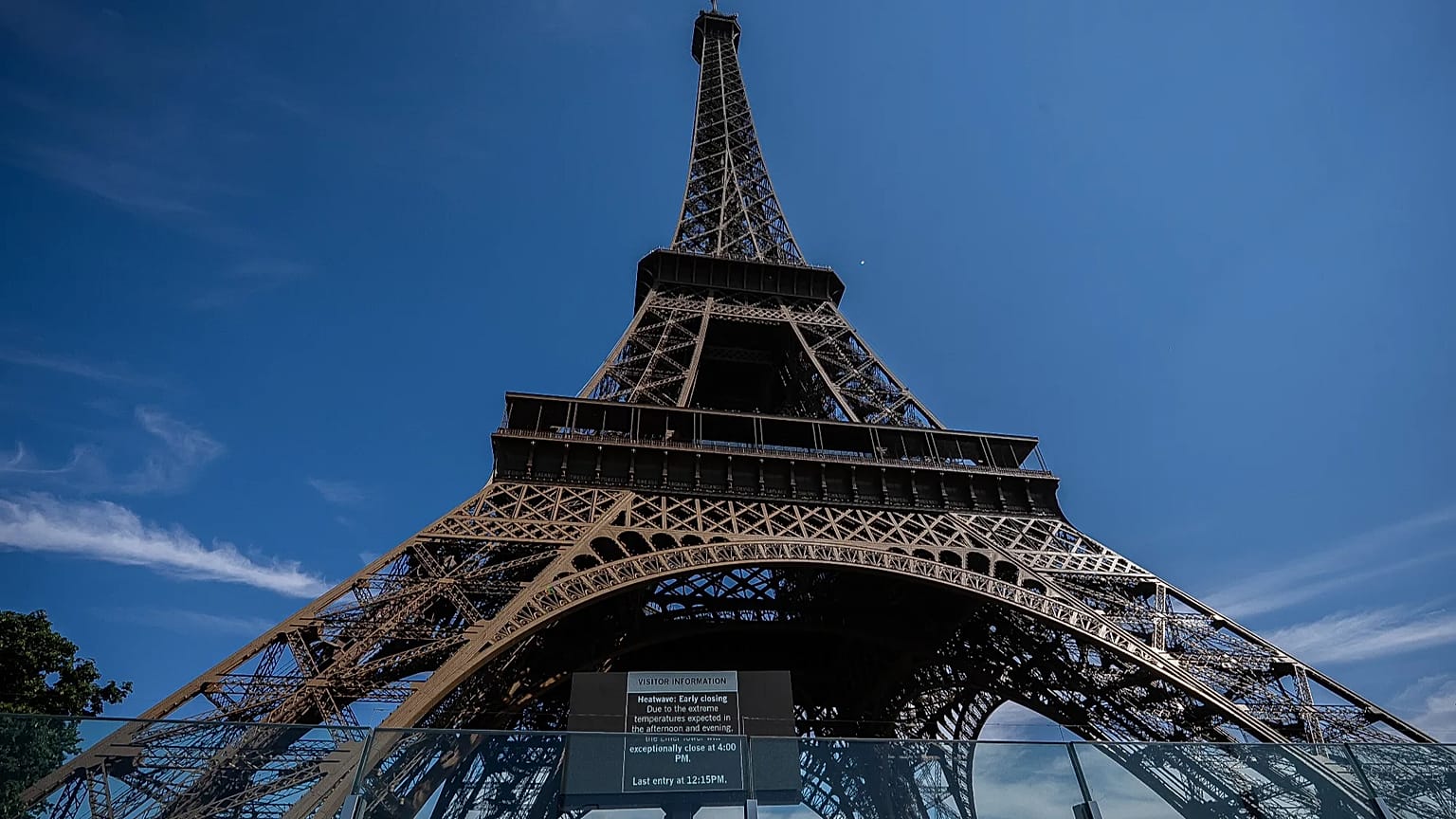
A sign is displayed announcing that the Eiffel Tower is closed at 4 p.m. due to a heat wave in Paris, Saturday, July 11, 2026.
Copyright Copyright 2026 The Associated Press. All rights reserved

By Gavin Blackburn
Published on

The Bochasanwasi Akshar Purushottam Swaminarayan Sanstha (BAPS) Hindu temple in Paris released a statement apologising for "any pain or inconvenience caused."

The Eiffel Tower reopened on Tuesday after staff staged a walk-out the day before over the removal of women colleagues during a visit by a Hindu religious group which later apologised.

The operating company that runs the Paris landmark, SETE, acknowledged that the Hindu delegation had requested the visit be organised so as to limit "interactions with women" and said that "these conditions should not have been accepted."

It said the landmark would open its doors again following a meeting between staff and management.

The Bochasanwasi Akshar Purushottam Swaminarayan Sanstha (BAPS) spiritual movement apologised for "any pain or inconvenience caused" by the incident.

"To the best of our knowledge, at no point was anyone prevented access to the Eiffel Tower," the organisation wrote on X.

"Due to the size of our delegation, the visit was arranged in conjunction with the Eiffel Tower team at the start of normal operating hours to avoid disrupting or inconveniencing others."

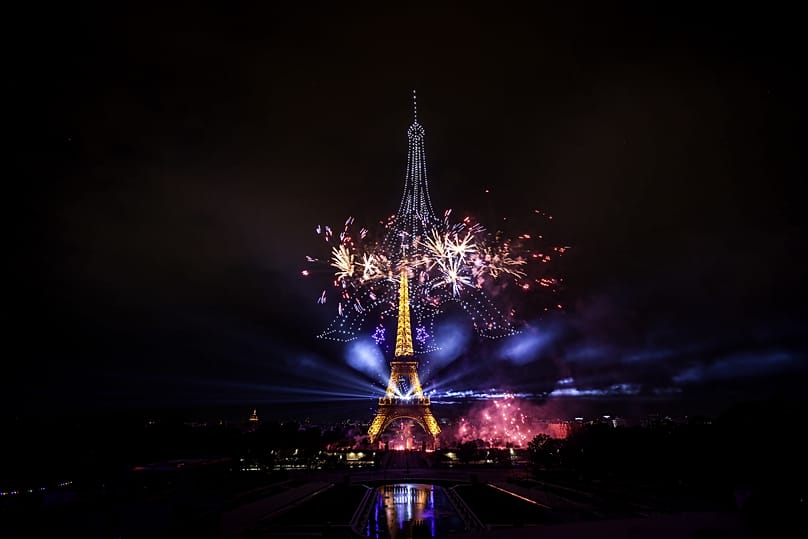
Fireworks and drones illuminate the Eiffel Tower in Paris on the eve of Bastille Day celebrations, 13 July, 2026 AP Photo

Eiffel Tower staff said in a statement that it condemned "professional instructions that led to female employees being sidelined, replaced and made invisible because of their sex" during the visit by the delegation.

"Instructions were given to female employees of the Eiffel Tower and to female employees of contractors to make themselves invisible in order to welcome this delegation," the staff said in their statement, adding they were shocked to have been put in such a situation.

"Some were asked to leave their posts and withdraw to other areas. In some posts they were replaced by men. And all female employees were instructed not to go through or cross certain areas while the delegation was present."

Paris' Mayor, Emmanuel Grégoire, promised an investigation "as soon as possible."

Yaël Braun-Pivet, the president of the National Assembly, condemned the incident on Monday.

"I refuse to accept that women should be told to step aside to meet the demands of foreign visitors," she said.

"Welcoming others never means giving up our values. In France, women are fully present in public life. No one tells them to become invisible there."

The Eiffel Tower's website said the landmark was closed on Monday due to "exceptional circumstances."

It advised visitors with tickets to check their emails and apologised for the inconvenience.


Eiffel Tower closes as staff strike after female employees 'made invisible' for Hindu group visit


By Nathan Rennolds
Published on

The Bochasanwasi Akshar Purushottam Swaminarayan Sanstha (BAPS) Hindu temple in Paris has released a statement apologising for "any pain or inconvenience caused."

Staff at the Eiffel Tower staged a walkout on Monday, forcing the closure of the iconic Parisian landmark after female employees were said to have been moved out of sight during the visit of a Hindu religious group.

The row began after the visit of around 100 people linked to the Bochasanwasi Akshar Purushottam Swaminarayan Sanstha (BAPS) Hindu movement, which inaugurated a new temple in France over the weekend.

Diane Davoine, a union representative, told French TV that female workers had been "moved away from their workstations as the delegation passed by" during a visit on Saturday.

Eiffel Tower employees have condemned in a statement what they described as "professional instructions that led to female employees being sidelined, replaced and made invisible because of their sex."

SETE, the company that runs the tower, has acknowledged that the Hindu delegation requested the trip be organised so as to limit "interactions with women," adding that "these conditions should not have been accepted."

In a statement released on Monday evening, the BAPS Hindu temple in Paris said it took the concerns raised "very seriously" and apologised for "any pain or inconvenience caused."

"Due to the size of our delegation, the visit was arranged in conjunction with the Eiffel Tower team at the start of normal opening hours to avoid disrupting or inconveniencing others," it said.

"To the best of our knowledge, at no point was anyone prevented access to the Eiffel Tower," it continued, adding that it believed in the "universal values of mutual respect and service."

In a post on X, Paris Mayor Emmanuel Grégoire said he was "aware of the outcry among the employees of the Eiffel Tower" and that it was "unacceptable" that such conditions were agreed to.

"These are not my values, nor are they the values that the Eiffel Tower should uphold, where everyone must be able to move about and act freely, without distinction between women and men," he wrote, adding that an investigation into the incident would be launched.

Yaël Braun-Pivet, the president of the National Assembly, has also condemned the incident.

"I refuse to accept that women should be told to step aside to meet the demands of foreign visitors," she said. "Welcoming others never means giving up our values. In France, women are fully present in public life. No one tells them to become invisible there."

The Eiffel Tower's website says the landmark is closed on Monday due to "exceptional circumstances."

It advises visitors with tickets to check their emails and apologised for the inconvenience.


LA REVUE GAUCHE - Left Comment: Hinduism Is Fascism


French firefighters begin six-week strike over funding after record summer fires

French professional firefighters launch a six-week nationwide campaign on Tuesday, demanding more funding, staff and better protection for their health after a summer of unprecedented wildfires.


Issued on: 08/09/2026 -  RFI

France's firefighters have been heavily called upon this summer to tackle a series of wildfires, like here in Gironde, and are now campaigning for better pay and more ressources. © Emma Da Silva / AP


At least 120,000 hectares went up in flames in France this summer – a record since satellite imagery was first used to measure wildfires 20 years ago.

Four firefighters died in July, and more than a hundred have been injured over the summer while responding to or travelling to fire incidents.

Faced with such pressure but also an increasing number of emergency call-outs, eight unions are calling for more than six weeks of strike action, beginning Tuesday.

The unions want more financial and material resources, as well as mass recruitment of professional firefighters.

"The system is not suffering from simple poisoning but from cancer," said Rémy Chabbouh, a spokesman for the SUD union. He said the crisis required major treatment and called for "action commensurate with the challenges".

Even if the strike action is widely followed, emergency services are unlikely to be affected.

The country's 44,300 professional firefighters can be ordered to work by fire and rescue services or requisitioned by local state representatives to ensure public services continue.


Funding pressures

The campaign begins as the government presents unions with the broad outlines of a proposed civil security law, following a year of consultations launched in mid-2024.

The talks were meant to lead to an ambitious law modernising a system seen as running out of steam, with additional funding. But unions say they have so far produced no results.

Their campaign is due to end on 20 October when parliament begins examining France's 2027 budget.

Unions therefore want to keep up the pressure on the government until then.


France's President Emmanuel Macron thanks personnel engaged in firefighting efforts during a visit to the Departmental Fire and Rescue Operational Center (CODIS) in Bordeaux, 27 July, 2026. via REUTERS - KENZO TRIBOUILLARD

Their main demand is for "sustainable, fair and ambitious funding" for local fire and rescue services, known as SDIS whose operating costs rose from €3.9 billion in 2012 to €5.2 billion in 2025, according to the Observatory of Local Public Finance and Management.

"The strike is about funding for the SDIS, not the civil security budget," said Xavier Boy, a spokesman for the inter-union group.

He said the €880 million civil security budget was used for national resources including reinforcements, aircraft, water bombers and helicopters.

Funding for local fire and rescue services amounts to about €6 billion, he said, with the state contributing about €1 billion – a share he described as insufficient.

Emergency assistance

Several parliamentary reports have pointed to growing difficulties as firefighters face more medical emergencies and natural disasters.

Professional firefighters, more than half of whom also serve as part of France's 200,900-strong volunteer brigade, are calling for a greater focus on their core emergency and rescue work.

Emergency assistance to people accounted for more than 4.89 million callouts in 2025, or 87 percent of firefighters' activity.

"We talk about forest fires now. Tomorrow, we'll talk about floods," said Alain Laratta, secretary general of the Avenir Secours union. But firefighters were under pressure all year because they were increasingly being called on for work that was not their responsibility, he said.

Unions plan further action in Paris on 27 and 28 September before a demonstration on 29 September.

(with newswires)
Former RFI journalist disappears in Niger after attempted coup

Reporters Without Borders has called for an investigation into the disappearance of Moussa Kaka, the director of a television station in Niger and a former correspondent for Radio France International, days after a failed coup in the country.


Issued on: 03/09/2026 - RFI

Nigerien journalist Moussa Kaka, former correspondent for RFI, in 2007. Reporters Without Borders is concerned about his disappearance on Monday evening, and is calling for an investigation. © Seyllou/AFP

Kaka, who worked for many years as an RFI correspondent in Niger and now directs private broadcaster Radio Télévision Saraounia, left his office in Niamey on Monday evening and never arrived home.

According to Reporters Without Borders (RSF), his relatives and colleagues have been unable to contact him.

"The disappearance of Moussa Kaka, a well-known journalist, is particularly concerning at a time when Niger is going through a period of heightened political and security tensions,” Sadibou Marong, director of RSF’s sub-Saharan Africa bureau, said in a statement.

“RSF is following the situation closely and calls on Nigerien authorities to immediately open an investigation in order to find him and establish the circumstances of his disappearance without delay.”

Attempted coup

Kaka's disappearance comes after an attempted coup over the weekend that Niger said it shut down with military support from Russia.

Authorities have accused several foreign countries, including France, of being behind the unrest, without providing evidence.

RSF editorial director Anne Bocandé told RFI the lack of information about Kaka’s disappearance was particularly worrying.

“At this point we have no information about the circumstances, the context or where Moussa Kaka could be today. And given the context of political instability in Niger in recent days, this is clearly an additional source of concern for us,” she said.

Growing pressure

Journalists in Niger, as well as activists and civil society figures, have come under increasing pressure since a military junta seized power in July 2023.

Kaka was one of six journalists arrested in October 2025 and accused of “complicity in distributing documents likely to disturb public order” – believed to be an invitation to a press briefing by the Solidarity Fund, a body Niger's military government set up to seek donations from the public.

After the junta used the briefing to announce workers would have to make new, mandatory contributions to the fund, critics shared the invite widely on social media.

Kaka was later released provisionally, while the last journalist still detained in the case was freed on Friday.

Relations between Niger and former colonial power France have deteriorated since the military took power.

In May, Niger suspended all access to RFI as part of a broader crackdown on French media. RFI's FM radio broadcasts were suspended days after the 2023 coup.


Germany seeks to quash 'facilitating genocide' in Gaza case brought by Nicaragua at top UN court


By Gavin Blackburn
Published on

The court could either side with Germany and throw out the case completely or rule against Berlin, meaning the case would then be considered "on the merits" in more detail.

Germany will ask the top United Nations court to toss out a case brought against it by Nicaragua on Monday, which accuses Berlin of "facilitating genocide" with its support of Israel.

Lawyers for Germany will kick off four days of hearings at the International Court of Justice (ICJ), the court based in The Hague that rules on disputes between countries.

The case dates back to 2024, following the start of Israel's offensive in Gaza. Nicaragua urged ICJ judges to impose emergency measures to force Berlin to halt all aid to Israel, in particular military equipment.

The court threw out Nicaragua's request in April of that year, saying "the circumstances, as they now present themselves" did not justify emergency orders.

The case is nevertheless ongoing and Germany is now seeking to have it removed, either by persuading judges they do not have the power to rule in the case or that Nicaragua's argument does not stack up.

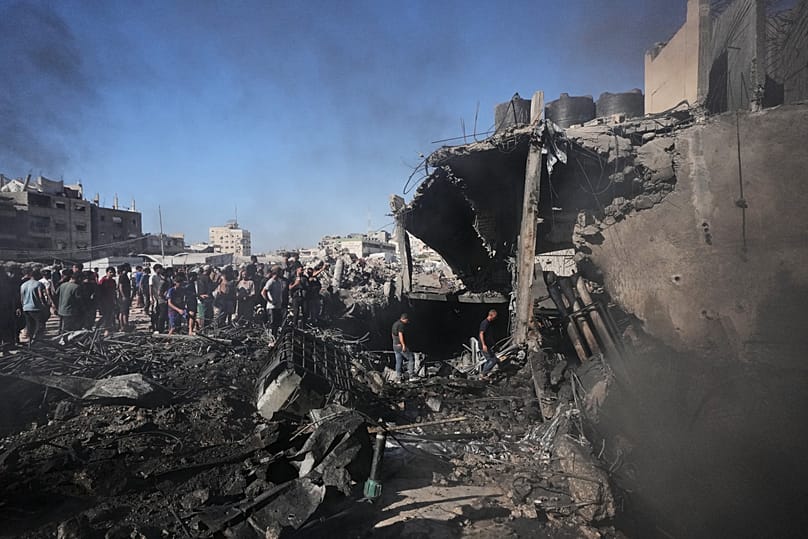
Palestinians gather and inspect the rubble of a building destroyed in an Israeli airstrike in Gaza City, 24 August, 2026 AP Photo

Berlin has filed so-called "preliminary objections to the jurisdiction of the Court and to the admissibility of certain claims" presented by Nicaragua, according to an ICJ statement.

The detail of Berlin's case has not yet been made public.

Genocide claim

After Germany presents its case on Monday, Nicaragua will respond before both countries get another chance to address the court on Wednesday and Thursday.

It takes on average six months for the court to hand down a ruling in such cases.

The court could either side with Germany and throw out the case completely or rule against Berlin, meaning the case would then be considered "on the merits" in more detail.

During hearings at the court in April 2024, Nicaragua said Germany was "pathetic" to provide aid to Gaza while also simultaneously furnishing Israel with weapons.

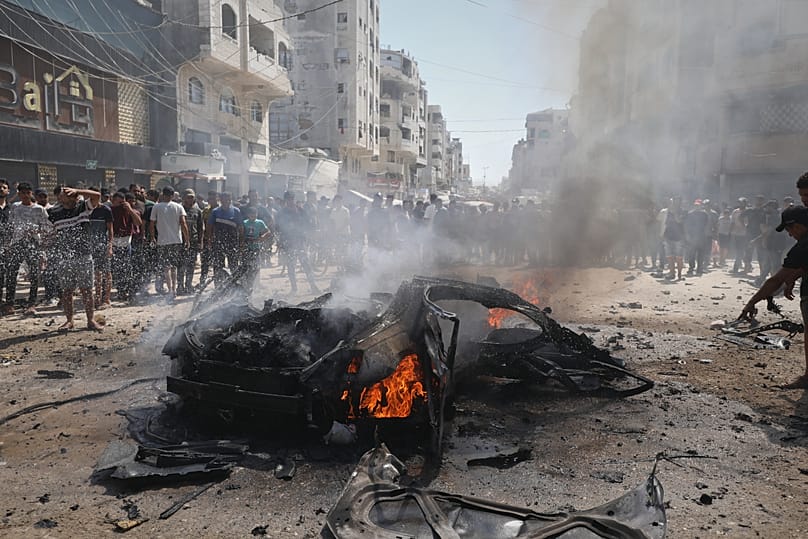
Palestinians gather around the burning wreckage of a car after an Israeli army strike in Gaza City, 31 August, 2026 AP Photo

Nicaragua's ambassador to the Netherlands, Carlos Jose Arguello Gomez, told the court: "Germany seems not to be able to differentiate between self-defence and genocide."

Germany retorted that Nicaragua's case was "grossly biased," strongly denying the accusations that it was in breach of the 1948 UN Genocide Convention.

Israel launched its offensive in Gaza in response to the deadly 7 October 2023 attacks against it by Hamas-led militants.

Due to its Nazi past, Germany has placed Israel's security "at the core" of its foreign policy, its representative told the court in the 2024 hearings.

Germany said its arms trade with Israel was subject to "detailed scrutiny...that far exceeds the requirements of international law."

This procedure is separate from a high-profile case also before the ICJ, in which South Africa has accused Israel of perpetrating genocide in Gaza, which Israel denies.

The ICJ's rulings are binding but it has no power to enforce them.

For example, it ordered Russia to stop its full-scale invasion of Ukraine, a demand that has been ignored by Moscow.

Monday, September 07, 2026

Nepal Flood Disaster Exposes Cascading Threats In Himalayas – Analysis


Many homes and infrastructure near the Bhotekoshi River were damaged or destroyed during the devastating flash floods that left thousands of people missing. Copyright: Gautam/UNICEF

September 4, 2026

By Tauseef Ahmad and Sajid Raina

Key Takeaways:

A late-August cascade in the Nepal–China border highlands—ice, rock and debris, likely on the Lhende Khola—apparently dammed a Bhotekoshi tributary for ~18–19 hours, then burst on 26 August. UN figures cited: more than 1,000 dead, nearly 4,000 missing, ~11,800 rescued; roads, bridges, hydropower and the Tibet trade route were wrecked.

Analysts (Planet Labs, IRDR) point to mass failure, not a rain-only flash flood. Steep valleys turned the release into a debris surge. Experts say Hindu Kush Himalaya hazards now chain—glacier collapse, landslide, blockage, flood—so single-hazard warnings miss the start kilometres upstream. Glaciers there lost ~12% of area from 1990–2020; ice loss has doubled since 2000.

Planning should treat compound risk across borders (Chamoli 2021 is a parallel). Satellites reconstructed this event and watch new lakes, but cannot reliably time a collapse. Call is for mixed systems: imagery, gauges, seismic sensors, cameras, forecasts and community alerts—plus fewer unmonitored glaciers.


A catastrophic flood in Nepal that left thousands missing started with a collapse of ice and rock high in the mountains—a warning that disaster planning must prepare for chains of hazards, not isolated events, say experts.

The cascade of ice, rock and debris that tumbled through the Nepal-China border region last week probably blocked a tributary of the Bhotekoshi river, forming a dam, before bursting downstream with devastating force, according to disaster analysis.

The torrent arrived in Nepal’s Rasuwa district with little warning, ripping through settlements along the Bhotekoshi river system, destroying bridges, roads and hydropower infrastructure and cutting a vital trade route with Tibet.


More than 1,000 people have been confirmed dead, with almost 4,000 still missing and around 11,800 rescued, according to UN figures on Tuesday (1 September). Thousands are in need of humanitarian assistance, hindered by blocked roads and damaged bridges.

Experts say the disaster illustrates a growing problem across the Hindu Kush Himalaya: hazards that once might have been assessed separately—glacier collapse, landslides, avalanches, river blockages, floods and even earthquakes—can interact within minutes or hours, creating an event that is much larger than any one of them.

“Most people think of flash floods as being caused by heavy rainfall,” said Liz Stephens, professor of climate risks and resilience at the University of Reading, in the UK.

But in high mountain regions such floods can result from “complex chains of hazards, including landslides, avalanches and glacial lake outburst floods”, she added.

That complexity, says Stephens, makes early warning particularly difficult.
Tributary blocked

Analysis of satellite imagery from US aerospace and data analytics company Planet Labs suggests that a substantial section of glacier and surrounding rock collapsed at high altitude near the Nepal-China border, sending an enormous mass of ice, snow and debris towards the valley.

The collapse appears to have affected the Lhende Khola, a tributary that becomes part of the Bhotekoshi river system.


A rapid-analysis report released by the Integrated Research on Disaster Risk (IRDR) on Friday (28 August) said the event was likely caused by an “ice, rock and soil mass failure” rather than intense rainfall.

The material probably blocked the river for about 18 or 19 hours, forming a natural dam which then gave way on the morning of 26 August, unleashing masses of water, ice, rocks and sediment, the report said.

Funnelled by the steep Himalayan terrain, the surge became a fast-moving mixture of water and debris capable of carrying huge boulders, destroying bridges and erasing riverbanks.

The rapid-analysis report said the steep gradient and narrow valley accelerated and concentrated the flow, while the heavy debris load increased its destructive power.

Chinese state broadcaster CCTV said the flood was “caused by glacier instability under the long-term effects of global warming” and described this as a “new and prominent feature of cryosphere disasters” on the Tibetan plateau.
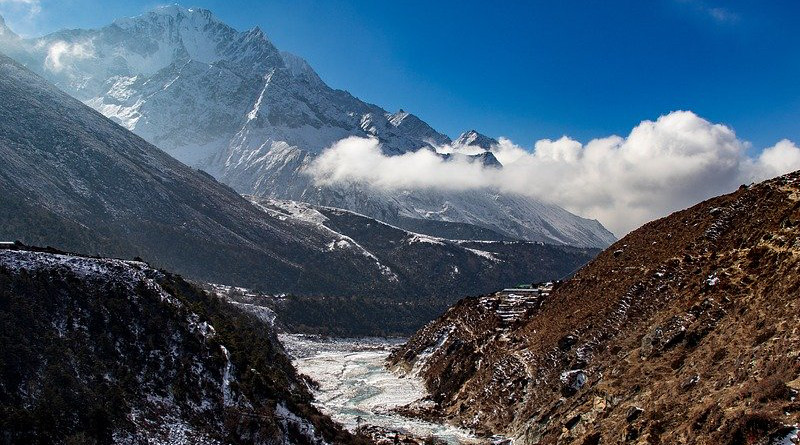
A view of the Himalayas in Nepal

‘Bigger than the atom bomb’

Experts say these findings highlight the need for change in disaster monitoring.

A conventional flood warning system may detect rising rainfall or river levels. But a cascading cryospheric event can begin kilometres away, and at much higher elevation, with no obvious warning for communities downstream.

The International Centre for Integrated Mountain Development (ICIMOD) argues that disaster planning in the region needs to move away from treating hazards independently.

“With the nature of disaster risks rapidly mutating in the region, disaster risk reduction strategies can no longer evaluate hazards in isolation,” Saswata Sanyal, a disaster-risk reduction specialist at ICIMOD, told SciDev.Net.

“The era of preparing for a single, predictable hazard is over.”

The disaster comes just over a year after another major flood affected the same Lhende Khola-Bhotekoshi system.

In July 2025, flooding in the area was linked by Nepalese authorities to a glacial lake outburst. The recurrence is raising questions about whether the river corridor is becoming a particularly exposed pathway for cryosphere-related hazards.

A 2026 ICIMOD assessment found that glaciers across the Hindu Kush Himalaya lost about 12 per cent of their area between 1990 and 2020, and the rate of ice loss has doubled since 2000.

As glaciers retreat, new lakes can form, slopes can lose the support provided by ice, and frozen ground can become unstable. A glacier collapse can then entrain rock and soil, turning an initial ice avalanche into a debris flow capable of travelling tens of kilometres.

Research published in April on Himalayan hanging glaciers found that rising temperatures and shifting regional precipitation patterns are reducing glacier stability and increasing the risk of ice avalanches. The authors identified more than 219 hanging glaciers in northern India’s Alaknanda basin and warned that break-offs can cause physical damage and trigger secondary hazards, including glacial lake outburst floods.

A separate study on ice-rock avalanches in the Himalayas similarly concluded that such failures can rapidly transform into high-velocity debris flows, while stressing the difficulty of identifying precursors, or warning signs.

Geohazard expert Basanta Raj Adhikari, director of Tribhuvan University’s Centre for Disaster Studies, in Nepal, described the 26 August flood as an unprecedented event in the region.

“In my research career, I haven’t seen a bigger flood event than this in the Himalayan landscape,” Adhikari said, attributing its extraordinary force to the enormous volume of ice and debris that descended from the mountains.


“I calculated the amount of energy, which is bigger than the atom bomb that happened in Hiroshima,” he added.

He said the scale of the event demonstrates the immense destructive potential of cascading ice, rock and water hazards in the Himalayas.
Neighbours at risk

The disaster also raises questions about disaster preparedness in the wider region.

The Hindu Kush Himalaya stretches across Afghanistan, Pakistan, India, Bhutan, Bangladesh, and Myanmar, as well as Nepal and the Tibetan plateau, connecting communities through river systems that cross political boundaries.
This infographic was designed using AI.

In India, the 2021 Chamoli disaster demonstrated the destructive potential of a similar ice-rock cascade. A massive collapse in Uttarakhand sent water, ice and debris through the Rishiganga valley, killing more than 200 people and destroying hydropower facilities.

Scientists are increasingly treating such events as compound hazards rather than isolated disasters.

Across Bhutan and Nepal, glacial lakes are being monitored for possible outburst floods. In Pakistan, rapidly changing glaciers and high-mountain valleys create a complex combination of flood, landslide and avalanche risks.


A recent UNDP assessment of human security in the Hindu Kush Himalaya warned that climate impacts can cascade across interconnected food, water and energy systems, creating compound threats that are greater than individual hazards considered separately.
Satellite warnings

Experts say the Rasuwa disaster also provides a powerful demonstration of the potential—and limits—of satellite technology.


Images shown above were captured by the Copernicus Sentinel-2 mission showing the Nepal glacier collapse and flood before and after (24/27 August 2026). Source: ESA (CC BY 4.0 INT)

Satellite images helped scientists reconstruct what happened in an otherwise extremely difficult-to-access area. High-resolution imagery can reveal changes in glacier geometry, newly formed lakes, landslide scars, blocked rivers and altered drainage channels.

In the aftermath of the flood, authorities have used satellite observations to monitor newly formed lakes upstream that could pose additional risks if their natural barriers fail.


But identifying a disaster after it happens is very different from predicting it beforehand.

Ishfaq Ahmad, a satellite scientist based in Nepal, told SciDev.Net that while scientists can identify and assess potentially dangerous glacial lakes using satellite imagery and visual observations, predicting the exact moment when a lake will burst remains a challenge.

“Glacial lakes can be seen with our eyes and through satellite data. We can assess whether the lakes are potentially dangerous or not,” Ishfaq said.

But he said sudden triggers, such as rockfalls or ice collapses, can occur too rapidly for orbiting satellites to detect them in advance.

Satellites do not continuously observe every Himalayan slope at the resolutions needed to reliably detect an imminent collapse. Clouds can obscure optical imagery, while revisit times can leave gaps between useful observations.

Ground sensors can provide continuous measurements but installing and maintaining them is challenging in remote, high-altitude terrain, where field observations remain sparse.

The answer, therefore, is unlikely to be a single technology.

Scientists increasingly argue for combining satellite imagery with seismic sensors, river gauges, automated cameras, weather forecasts, glacier monitoring and local community warning networks.

ICIMOD has noted that only a fraction of Himalayan glaciers are adequately monitored, leaving large areas as blind spots. It has called for better data and for scientific information to be translated into decisions that communities can act on.


This piece was produced by SciDev.Net’s Global desk.


About Tauseef Ahmad
Tauseef Ahmad is a freelance journalist based in South Asia. His work has appeared in Al Jazeera, TRT World, The Polis Project, The Guardian, and other publications.
View all posts by Tauseef Ahmad →


About Sajid Raina
Sajid Raina is a freelance journalist based in South Asia. His work has appeared in The Guardian, TRT World, Diplomat, News International and other publications.
View all posts by Sajid Raina →
Filipino Comics Matter: Empowering Parents To Fight School Bullying


PHOTO: Hechanova et al., 2026

September 4, 2026

By Eurasia Review


The Philippines has one of the highest rates of school bullying in the world: one in every three students is bullied at least once a week, according to the international Organisation for Economic Co-operation and Development (OECD). Ateneo de Manila University researchers are now looking at ways to empower Filipino parents to help address and prevent bullying to complement school efforts.

Empowerment begins with a deep dialogue with the parents to better understand their concerns and experiences. This is crucial, as parents are well-positioned to recognize early warning signs and provide immediate support outside of school.

Rather than simply treating parents solely as learners or recipients of anti-bullying information, researchers from the Department of Psychology and the Department of Information Systems and Computer Science took a participatory approach to the design process. They invited parents of public school students to explore ideas for bullying-prevention materials, which were then developed and refined through feedback from the communities they were intended to reach.

Parents suggested using an accessible medium: comic strips.

Once the comics were developed, they were shared back to parents to make sure that they were relevant. Notably, the parents challenged conventional portrayals of family roles: they called for fathers to be represented as actively involved in their children’s emotional well-being, rather than positioning empathy as primarily a maternal role. Revisions consequently depicted both parents participating in conversations about bullying, including a father who recognizes and apologizes for an initially unhelpful response to his child’s experience.

Other recommendations led to clearer language, more accessible visuals, and more realistic guidance on how families should work with schools to address bullying.

These changes reflect the project’s central principle of moving from “designing for users” to “designing with users.” By incorporating parents’ lived experiences into the development process, the researchers sought to make bullying-prevention materials more relatable, culturally grounded, and practical.

The comics are part of a larger, ongoing bullying-prevention project rather than a one-time finished intervention. The revised materials will serve as evidence-informed storyboards for short informational reels intended for further use and evaluation with parents in partner public schools.

The project demonstrates how prevention materials can evolve when the communities they are intended to serve are given a role in creating them.
A Secluded Russian Island May Hold Bioweapons Secrets – Analysis


An illustration shows Russian President Vladimir Putin (left), a satellite image of Lisy Island, and Vladimir Maksimov, head of the Center of Experimental Physiology located there.
Credit: RFE/RL


September 4, 2026

By RFE RL

By Mark Krutov, Sergei Dobrynin, Systema and RFE/RL’s Russian Service


Key Takeaways:

An RFE/RL-led report notes that the Center of Experimental Physiology on Lisy Island in Tver’s Vyshnevolotskoye Reservoir—closed after a 2023 “natural monument” designation—is led by Vladimir Maksimov, a former official of the Defense Ministry’s 48th Central Research Institute, which the U.S. sanctioned in 2020 over alleged biological and chemical programs. Ukraine’s HUR on 21 August claimed the center works with dangerous pathogens for the armed forces; Maksimov did not comment.

The island had imperial and Stalin-era animal-disease labs. The FMBA-run center was named in spring 2021; satellite images from July 2026 show a finished lab, housing and a helipad. Maksimov previously headed a virology unit later folded into the 48th Institute and, in older interviews, discussed hemorrhagic-fever viruses while calling the work defensive.

FMBA, which also oversaw COVID vaccine work, was placed under Putin in 2024; he has called it “medical special forces.” Systema has previously tied FMBA-linked institutes to Novichok and other poisoning cases. Moscow says research is only for protection. Analyst Milton Leitenberg doubts COVID fully explains the 2021 expansion and notes isolated-island siting echoed Soviet safety practice; he treats any wartime BW role as unproven.

A scientific facility on a secluded island that is closed to the public is affiliated with an institute accused of developing biological weapons for the Russian military, RFE/RL’s Russian Service and Systema, RFE/RL’s Russian investigative unit, have found.

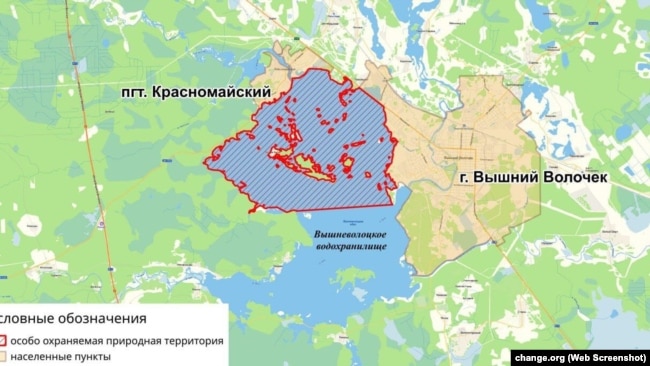
The islands in Vyshnevolotskoye Reservoir, in the Tver region northwest of Moscow, were once popular with locals for fishing and berry picking. After the northern part of the reservoir was designated as a “natural monument” in 2023, access to many of them — including Lisy Island, now home to the Center of Experimental Physiology — was restricted.

The blue area shows part of Russia’s Vyshnevolotskoye Reservoir in the Tver region, designated as a “natural monument” by Russian authorities.


Systema and RFE/RL’s Russian Service determined that the center’s head, Vladimir Maksimov, is a former official of the Russian Defense Ministry’s 48th Central Research Institute, the country’s leading developer of defensive systems against biological weapons. It was blacklisted by the United States in 2020 along with two other Russian institutes for allegedly continuing biological and chemical weapons programs.

Separately, the federal parent agency of the new center on Lisy Island has figured in investigations into the poisonings of Russian opposition politician Aleksei Navalny and former Russian GRU officer Sergei Skripal with a Novichok-type nerve agent.
‘Experimenting With Dangerous Viruses’

Although largely unused by the Russian government in recent decades, Lisy Island already had a rich history of scientific research involving infectious diseases, predating the state’s latest construction there.

It hosted a veterinary laboratory in Imperial Russia and a facility for “conducting acute experiments involving infectious diseases of agricultural animals” during Josef Stalin’s rule of the Soviet Union.

In spring 2021 — about a year before Russia’s full-scale invasion of Ukraine — the settlement on the island became the Center of Experimental Physiology, part of Russia’s Federal Medical-Biological Agency (FMBA), with one of the country’s newest research laboratory complexes being constructed there.

Construction of the Center of Experimental Physiology was completed by the autumn of 2025, and satellite images of Lisy Island from July 2026 show a large building — the lab — as well as a landscaped park, housing for personnel and guests, and a helicopter landing pad.


But on August 21 of this year, Ukraine’s military intelligence agency, HUR, claimed that the Center of Experimental Physiology was “experimenting with dangerous viruses and other pathogens for the benefit of the [Russian] armed forces.”

Systema and the RFE/RL’s Russian Service, also known as Radio Svoboda, found a connection to Russia’s armed forces through the center’s head, Maksimov.

Prior to leading the center on Lisy Island, Maksimov had long been involved in biological research for the Russian military.

Judging by his publicly available work, he had mostly specialized in exotic and deadly hemorrhagic fever viruses, such as Ebola and Marburg. Both pathogens were considered in the Soviet Union as potential foundations for the development of biological weapons.

“Ebola hemorrhagic fever…in our view, is one of the most likely agents for biological warfare,” Maksimov said in a 2004 interview with the Russian weekly Voyenno-Promyshlenniy Kuryer (Military-Industrial Courier).

Once described as a “young and enterprising colonel of the medical service,” Maksimov led Russia’s military unit 44026, the Virology Center of the Defense Ministry’s Institute of Microbiology, from 1999 to 2006.

In 2008, unit 44026, in the city of Sergiyev Posad outside Moscow, was effectively renamed the 48th Central Research Institute of the Russian Defense Ministry, which Western intelligence agencies believe brings together some of the remnants of the Soviet biological-weapons development program.

Maksimov continued to work at the facility in 2008, but apparently no longer as director.

In a 2005 interview with the newspaper Trud, Maksimov asserted that that the purpose of the Sergiyev Posad center was defensive.

“Contrary to what is sometimes attributed to us, we are not engaged in ‘spreading death.’ Our task is exactly the opposite — to be able to combat it,” he said.

Systema found a visiting card for Maksimov from 2022 on an online auction site. He did not respond to phone calls and messages sent by RFE/RL seeking comment.

In 2024, Radio Svoboda found that the center in Sergiyev Posad had also undergone a major expansion since Russian President Vladimir Putin launched the full-scale invasion of Ukraine in February 2022.
COVID As Timely Cover?

Systema and Radio Svoboda found that the expansion of Russia’s research facilities on Lisy Island and in Sergiyev Posad had effectively begun late in 2021, a few months before the invasion and against the backdrop of the subsiding global COVID-19 pandemic.


Both the 48th Central Research Institute and the Lisy Island facility’s overseer, the FMBA, were officially involved in the development of Russian COVID-19 vaccines.

However, Milton Leitenberg, a researcher at the Center for International and Security Studies at the University of Maryland School of Public Policy and an expert on the Soviet biological weapons program, expressed doubt that the research expansion was Moscow’s response to the pandemic.

“The coincidence of dates of the Russian public health response to the COVID pandemic and Putin’s decision on invading Ukraine are of course notable,” Leitenberg told Systema and Radio Svoboda. “Nevertheless, given that no later than mid-2021, Putin made the decision to invade Ukraine…the expansion of Russian biological weapons research, as well as the inclusion of new laboratories such as Lisy Island, must be viewed in that context.”

While the role Russia might have intended biological weapons to play in the war “remains a mystery,” he said, the development work may represent what he called “an opportunistic expansion” of biological research activity alongside other military sectors.

Leitenberg said the appointment of Maksimov and other senior former officials of the 48th Central Research Institute to lead the Center for Experimental Physiology appears to be a strong argument that the new facility on Lisy Island may represent an enlargement of military activities despite the formally civilian status of the FMBA.

Lisy Island’s location may also be telling. In the Soviet period, Leitenberg said, placing the laboratory on an isolated patch of land in the middle of a reservoir served as a safety measure — an additional layer of protection for local residents in the event that a dangerous pathogen escaped.

He also recalled that the main testing laboratory of the Soviet biological weapons program on Vozrozhdeniya Island in the Aral Sea, in what is now independent Uzbekistan, was likewise surrounded by water on all sides.
‘Medical Special Forces’

Formed in 2004, the FMBA handles many of Russia’s unconventional public health challenges. Among other things, it provides medical support for athletes and cosmonauts, people working in closed cities. It also responds to disasters and industrial accidents, and handles radiation, chemical, and biological incidents.

In 2024, the oversight of the agency was transferred from the Russian government directly to Putin, a move described in parliament as the “right decision” that “would help address issues of a confidential nature.”

Putin meets regularly with FMBA officials, most recently in August, and has previously referred to the agency as “medical special forces.”

In a 2020 investigation into an updated version of Novichok, Systema found that a research institute in Russia’s Leningrad region overseen by the FMBA was producing a number of biological supplements developed by a scientific center called Signal.

Signal was later found to have worked with epibatidine, a poison derived from an Ecuadorian frog that, according to a leading theory, was used to poison Navalny in the Arctic prison where he died suddenly in February 2024.

Officially, Moscow denies conducting research aimed at developing biological and chemical weapons, claiming that its research is limited to developing means of protection against their potential use.

However, the investigation into Navalny’s poisoning suggested that Russia continued its work on developing such weapons, in violation of the respective international conventions it had ratified.


Adapted by Mykyta Peretiatko from the original Russian-language report.Mark Krutov is a correspondent for RFE/RL’s Russian Service and one of the leading investigative journalists in Russia. He has been instrumental in the production of dozens of in-depth reports, exposing corruption among Russia’s political elite and revealing the murky operations behind Kremlin-led secret services. Krutov joined RFE/RL in 2003 and has extensive experience as both a correspondent and a TV host.

Sergei Dobrynin is one of the leading investigative journalists in Russia. He has been instrumental in the production of dozens of in-depth reports, exposing corruption among Russia’s political elite and revealing the murky operations behind Kremlin-led secret services. He joined RFE/RL in 2012.

Systema is RFE/RL’s Russian-language investigative unit, launched in 2023. The team conducts in-depth investigative journalism, producing high-profile reports and videos in Russian.

RFE/RL’s Russian Service is a multi-platform alternative to Russian state-controlled media, providing audiences in the Russian Federation with informed and accurate news, analysis, and opinion.


About RFE RL
RFE/RL journalists report the news in 21 countries where a free press is banned by the government or not fully established.
Vi=ew all posts by RFE RL →