Monday, May 02, 2022

American Indians, Alaska Natives see 5-fold rise in overdose deaths, study finds

American Indian and Alaska Native communities have seen higher rates of deaths caused by drug overdoses than other populations, a new study reports. 
File photo courtesy of West Virginia Attorney General's Office/Twitter

May 2 (UPI) -- The opioid overdose death toll has increased more than five-fold among American Indian and Alaska Native communities over the past two decades, a study published Monday found.

Nearly 800 opioid-overdose deaths among American Indian and Alaska Natives in the United States occurred in 2019, up from fewer than 100 in 1999, data published Monday by BMJ Open showed.


Men of American Indian and Alaska Native origin were about 50% more likely to die from an opioid overdose compared to women, the researchers said.

The rise in overdose deaths outpaced a roughly 30% rise in the cumulative populations of these communities, to nearly 2.3 million in 2019 from 1.8 million 20 years earlier, they said.

RELATED Opioid deaths in young Americans often involve other drugs

"Deaths due to opioids ... in the American Indian and Alaska Native community have increased significantly over time," Fares Qeadan, a co-author of the study, told UPI in an email.

"Therefore, it is important that substance use treatment programs, interventions and policies consider complexities surrounding polysubstance use and improved access to ... treatment," said Qeadan, an associate professor of biostatistics at Loyola University Chicago.

When a person takes a drug to increase or decrease the effects of a different drug or wants to experience the effects of the combination of the two, this is called intentional polysubstance use, according to the Centers for Disease Control and Prevention.

RELATED More than 100,000 people died of drug overdoses in one year in U.S., report says

However, when a person takes drugs that have been mixed or cut with other substances, such as fentanyl, unknowingly, this is called unintentional polysubstance use, the agency says.

Both forms of polysubstance use have been linked with an increased risk for overdose and death as a result, research suggests.

More than 100,000 across the United States died of drug overdoses in 2020, according to recent estimates, and that number is expected to rise over the next decade.

RELATED Report: 1.2M more opioid overdose deaths expected in North America by 2029

Many of these deaths have involved opioids, a class of drugs that includes prescription pain relievers as well as "street" drugs such as heroin, according to the CDC.

Earlier this year, Native American tribes reached a $590 million settlement with prescription drug distributors over lawsuits alleging their involvement in the so-called opioid crisis.

Qeadan and his colleagues reviewed national death records data from 1999 to 2019, focusing on overdose deaths involving opioids alone or opioids combined with other drugs, such as alcohol or methamphetamine, among American Indians and Alaska Natives ages 12 years and older.

Over the 20-year period, overdose deaths from opioids alone in these communities rose more than five-fold, to 16 per 100,000 people in the general population, from three per 100,000, in men, and to 26 per 100,000, from five per 100,000, in women, the data showed.

All overdose deaths involving opioids increased to 34 per 100,000 American Indian and Alaska Native people in the general population from five per 100,000 during the same period, the researchers said.

Overdose deaths due to opioids plus alcohol or benzodiazepines or methamphetamine also spiked -- up to 1,000%, over the course of two decades, they said.

Analysis of death rates attributable to specific types of opioids showed that those caused by heroin and prescription opioids such as oxycodone, hydrocodone and fentanyl increased, as well, according to the researchers.

"Our findings highlight how severely this community has been hit by the opioid crisis and continues to face rising levels of overdose mortality due to the use of opioids alone and in combination with other substances," Qeadan said.

"To address this issue, policymakers should advocate for interventions for American Indian and Alaska Native populations that are comprehensive, culturally centered and address ... socioeconomic factors and racial and ethnic discrimination," he said.
ECOCIDE
Missile attack causes tank fire in oil refinery in Iraq


May 2, 2022

The sun sets over an oil refinery in the southern Iraqi town of Nasiriyah on March 8, 2021
 [ASSAAD AL-NIYAZI/AFP via Getty Images]

May 2, 2022 

A missile attack targeted an oil refinery in Iraq's northern city of Erbil on Sunday causing a fire in one of its main tanks that was later brought under control, the Iraqi security forces said in a statement, reports Reuters.

A missile also landed on the outer fence of the refinery without causing any casualties, the statement added.

Earlier on Sunday, the anti-terrorism authorities in Kurdistan region said six missiles landed near the KAR refinery in Erbil, adding they were launched from Nineveh province.

The security forces said they found a launch pad and four missiles in the Nineveh Plain after the attack and defused them.

Iraqi Prime Minister Mustafa al-Kadhimi said the armed forces will pursue the perpetrators of what he called a "cowardly attack" while discussing the security situation in a phone call with Kurdish leader Masoud Barzani, the prime minister's office said on Twitter.

READ: Protesters shut down oil facilities in southern Iraq

Three missiles also fell near the refinery on April 6, without causing any casualties. Sources in the Kurdistan Regional Government told Reuters then that the refinery is owned by Iraqi Kurdish businessman Baz Karim Barzanji, CEO of major domestic energy company the KAR Group.

In March, Iran attacked Erbil with a dozen ballistic missiles in an unprecedented assault on the capital of the autonomous Iraqi Kurdish region that appeared to target the United States and its allies. Only one person was hurt in that attack.
Years after IS defeat, northern Iraq struggles to rebuild


Eight years after heavy fighting between Islamic State jihadists 
and the Iraqi army, the reconstruction of Hanash in northern Iraq 
is at a standstill 
(AFP/AHMAD AL-RUBAYE)

Guillaume Decamme
Mon, May 2, 2022, 

In Iraq, "maku" means "nothing", and father-of-five Issa al-Zamzoum says "maku" a lot: no electricity, no home, no rebuilding and no job.

Eight years after heavy fighting between Islamic State jihadists and the army, the reconstruction of his war-ravaged village in northern Iraq is at a standstill.

"There is nothing here, no electricity," 42-year-old Zamzoum sighed. "Even work, there is none."

Zamzoum lives with his wife and family in Habash, some 180 kilometres (110 miles) north of the capital Baghdad, a village dotted with dozens of bomb-blasted houses still ruined from intense fighting in 2014.

Part of their roof, which caved in during the bombardment, still lies in crumbling and bullet-scarred wreckage.

In one room, a hen watches over her chicks. In another, filthy mattresses are piled up against the wall.

The building does not even belong to Zamzoum: his own home was left uninhabitable.

While the Baghdad government eventually celebrated military "victory" over IS in December 2017, the scale of destruction was immense.

"Reconstruction? We do not see it," Zamzoum said gloomily. "Nothing has happened since the war."

- Sunni-Shiite tensions -


Habash paid a heavy price during IS's siege of Amerli, a town less than 10 kilometres away.

In 2014, the jihadists, who controlled the key northern city of Mosul and surrounding areas, moved south to attack Amerli, using surrounding settlements such as Habash as bases for their assault.

The combined forces of the Iraqi army, Shiite militias and Kurdish forces launched a counterattack to break the siege with gruelling street fighting, and IS forces were pushed out.

But for residents of the already hard-hit area, it was not the end of their suffering.

According to Human Rights Watch, after the siege "pro-government militias and volunteer fighters as well as Iraqi security forces raided Sunni villages and neighbourhoods" surrounding Amerli, including Habash.

HRW used satellite imagery to map "heavy smoke plumes of building fires, likely from arson attacks" in the village.

Today, nearly 20,000 people displaced by the conflict need aid in the area, according to the Norwegian Refugee Council, an aid agency.

"Humanitarian needs are significant," the NRC said.

As well as basic needs like clean water and electricity, even obtaining identity papers is a challenge for many.

"Many people have been displaced across governorates and face major barriers to travel to obtain civil documents," the NRC said.

"Others face security clearance issues related to perceived affiliation with the Islamic State" group, it added.

Like most of the residents of Habash, Zamzoum's neighbour Abdelkarim Nouri is a Sunni Muslim.

In Shiite-majority Iraq, Sunnis have sometimes been viewed with distrust, suspected of being complicit in past support of the extremists.

IS jihadists follow a radical interpretation of Sunni beliefs.

"Our life is a shame," Nouri said. "I don't have a job. I have five sheep, and they are the ones who keep me alive."

He said he had appealed to his member of parliament for support, but nothing had changed.

- 'Beyond our control' -


Nouri does not mention religion or talk of sectarianism -- a deeply sensitive topic in a country where tens of thousands of people died during bloody inter-religious conflict in 2006-2008.

Now, over four years since the end of IS's self-proclaimed "caliphate" in Iraq, many Sunnis say they are victims of harassment and discrimination.

A US State Department report last year cited concerns among Sunni officials that "government-affiliated Shia (Shiite) militia continued to forcibly displace Sunnis".

The report quoted officials describing "random arrests of Sunnis in areas north of Baghdad" and detentions made on suspicion of IS links.

In Salaheddin province, where Habash is located, officials speak of "security risks" which are delaying reconstruction -- without mentioning IS jihadists by name.

While Habash is under government control, the militants still operate just 15 kilometres further north.

On the road that leads to the village of Bir Ahmed, forces of the Hashed al-Shaabi -- a Shiite-led former paramilitary coalition now integrated into Iraq's state security apparatus -- stand guard.

"The situation in Bir Ahmed is beyond our control and that of the army," a senior officer said. "You can get in, but I can't guarantee you can get out."

gde/tgg/pjm/lg
Flood and cyclone-prone areas in eastern Australia may be ‘uninsurable’ by 2030, report suggests

Report mapped 10 electorates considered most at risk of becoming uninsurable due to flood, fire and other extreme weather risk


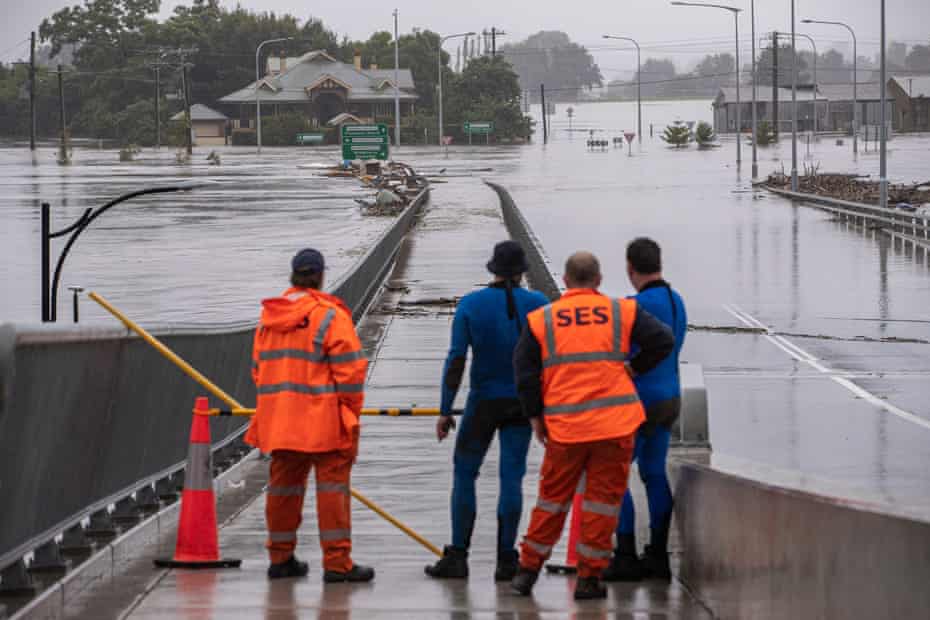
State Emergency Service members look over flood waters in Richmond, New South Wales, in March 2022. A report suggests 20% of properties in the area could could soon be uninsurable due to flood plain risk. 
Photograph: Xinhua/REX/Shutterstock

Royce Kurmelovs
Mon 2 May 2022


Extreme weather due to the climate crisis is expected to increasingly make some Australian homes “uninsurable”, with a new report suggesting up to one in 25 households will struggle to be covered by 2030.

The analysis by the Climate Council, using data from consultants Climate Valuation, mapped the 10 electorates across the country considered most at risk of becoming uninsurable due to flood, fire and other extreme weather risk.

The most at-risk areas were mostly found to be in flood and cyclone-prone areas of Queensland and in parts of Victoria built over flood plains near major rivers.

“Uninsurable” is defined in the report as an area where the required type of insurance product was expected to be not available, or only available at such high cost that no one could afford it.

Nicki Hutley, an economist and member of the Climate Council who wrote the report, said insurance costs were already rising sharply and people were struggling to get insurance in parts of the country. She said people were seeing changes, citing the black summer bushfires and the recent devastating floods in northern New South Wales.

Hutley said the report highlighted the level of “under-insurance” across the country, a term that refers to situations in which a property was covered for lesser risks but not for the greatest threat in the area where they lived. ASIC has previously estimated the rate of under-insurance in the country may be up to 80%.

The report includes a tool that shows how the risk of different catastrophes, and uninsurability, grows under different scenarios over timeframes out to 2100. People can enter their address to see how their property is expected to be affected.
Advertisement

It suggested up to 27% of properties in the electorate of Nicholls, in northern Victoria, and 20% of properties in Richmond, in New South Wales, could soon be uninsurable due to flood plain risk.

Dr Karl Mallon, chief executive of Climate Valuation, said the company aimed to make risks visible to homeowners, insurance companies and authorities.

“The underlying technology is indeed intended to give people an understanding whether a property has insurance challenges in the way an insurance industry does not,” he said.

The Climate Council report used generalised assumptions about the type of building at each address: that each is a single storey, detached house built using recent design specifications and materials.

The replacement costs were conservatively assumed to be $314,000 a home, based on Australian Bureau of Statistics data of the average cost. It categorises a property as uninsurable if the expected annual cost of damage is more than 1% of the rebuild cost.

Not everyone working in the field is convinced a totally accurate house-by-house analysis is possible.


CSIRO has become ‘extravagant consulting company’, one of its former top climate scientists says


Sharanjit Paddam, an expert in climate and environmental risk at Finity Consulting, said the report was “really important” at a broad level, particularly if it started to “make people think about whether climate change is going to affect their property, and their insurance costs”.

But he said he would be reluctant to say some areas would be totally uninsurable as there was always uncertainty about models that have to make “really difficult assumptions for which we don’t necessarily have all the information available”.

“The results won’t necessarily be correct at an individual home level but it will give a good guide to where the areas of risk are,” Paddam said.

“However, I don’t think the eight years is an exaggeration because the risk is here today, and we know this is the case because the government has intervened in cyclone costs to make it more affordable today.

He said there were also costs involved in doing nothing. “Not doing anything about climate change is the most expensive option and I think this report makes that very clear,” he said.

After the 
floods comes underinsurance: we need a better plan


The floods affecting Australia’s eastern seaboard are a “1 in 1,000-year event”, according to New South Wales Premier Dominic Perrottet. But that’s not what science, or the insurance industry, suggests.

THE CONVERSATION

Throughout Australia in areas prone to fires, cyclones and floods, home owners and businesses are facing escalating insurance costs as the frequency and severity of extreme weather events increase with the warming climate.

Premiums have risen sharply over the past decade as insurers count the cost of insurance claims and factor in future risks. The latest report from the Intergovernmental Panel on Climate Change, published this week, predicts global warming of 1.5℃ will lead to a fourfold increase in natural disasters.

Rising insurance premiums are creating a crisis of underinsurance in Australia.

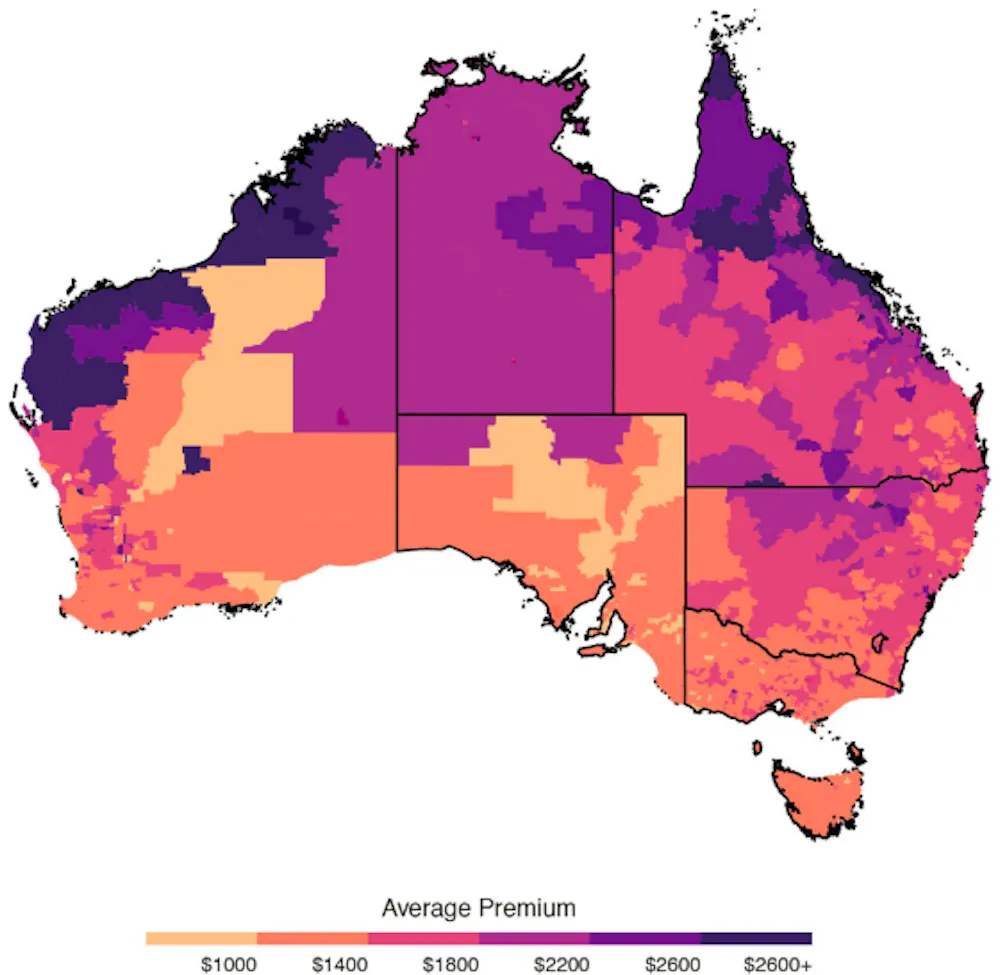
In 2017 the federal government tasked the Australian Competition and Consumer Commission to investigate insurance affordability in northern Australia, where destructive storms and floods are most common. The commission delivered its final report in 2020. It found the average cost of home and contents insurance in northern Australia was almost double the rest of Australia – $2,500 compared with $1,400. The rate of non-insurance was almost double – 20% compared with 11%.

Average premiums for combined home and contents insurance, 2018–19


ACCC analysis of data obtained from insurers., CC BY


While the areas now experiencing their worst flooding in recorded history aren’t part of the riskiest areas identified by the insurance inquiry, the dynamics are the same.

Those not insured or underinsured will be financially devastated. Insurance premiums will rise. As a result, more people will underinsure or drop their insurance completely, compounding the social disaster that will come with the next natural disaster.

So, what do about it?

Tackling insurance affordability


There are two main ways to reduce insurance premiums.

One is to reduce global warming. Obviously this is not something Australia can achieve on its own, but it can be part of the solution.

The other is to reduce the damage caused by extreme events, by constructing more disaster-resistant buildings, or not rebuilding in high-risk areas.

The federal government, however, has put most of its eggs in a different basket, with a plan to subsidise to insurance premiums in northern Australia.


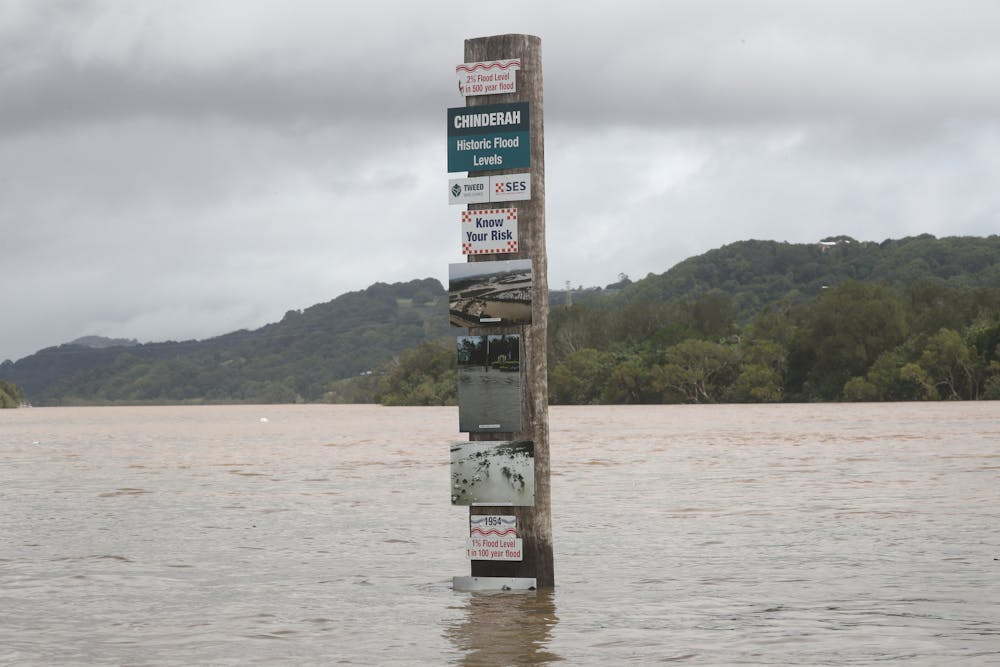
A sign of floods present and past in Chinderah, northern NSW, on March 1 2022. Jason O'Brien/AAP


This won’t do much for those affected by the current floods. It won’t even do much to solve the insurance crisis in northern Australia.

The reinsurance pool, a blunt tool

In the 2021 budget the federal government committed A$10 billion to a cyclone and flood damage reinsurance pool, “to ensure Australians in cyclone-prone areas have access to affordable insurance”. The legislation to establish this pool is now before parliament.

The ostensible rationale is that the government can drive down insurance costs for consumers by stepping in and acting as wholesaler in the reinsurance market, in which insurers insure themselves against the risk of crippling insurance payouts.

The idea is that discounted reinsurance will lead insurers to lower their premiums.

Read more: A national insurance crisis looms. The Morrison government's $10 billion 'pool' plan won't fix it

There is no guarantee, however, that insurers will pass on their cheaper costs to customers. This means the benefits of the pool are unclear.

So are its costs. Effectively, the government is shifting risk from insurers to itself, subsidising insurance premiums for those in some parts the country from the public purse.

The ACCC inquiry gave considerable attention to the idea of a reinsurance pool. While acknowledging there could be some benefits, it concluded the risks outweigh the rewards:

We do not consider that a reinsurance pool is necessary to address availability issues in northern Australia.

Targeting and mitigating


Above and beyond the aforementioned problems, there are two telling failures of the reinsurance pool plan.

First, subsidising insurance companies doesn’t target help to those who need it most: low-income households.

There is a growing body of research showing that natural disasters, and the ways governments respond to them, is contributing to greater inequality.

As the South Australian Council of Social Service makes clear in a report published this week, improving insurance access for people on low incomes at risk from natural disaster requires targeted support, such as promoting non-profit “mutual” insurance schemes.

Read more: Natural disasters increase inequality. Recovery funding may make things worse

Second, only mitigation can bring the overall cost of natural disasters down. Ways to do this include public works (building levees, upgrading stormwater systems, conducting planned burns) and improving buildings (reinforcing garage doors, shuttering windows, managing vegetation around homes, and so on).

The ACCC’s insurance report identifies a range of ways mitigation strategies can be tied into insurance pricing. Yet none of these has been incorporated into the Morrison government’s response to the insurance crisis.

There is little support for the reinsurance pool outside of the federal government. Neither the ACCC, the insurance industry nor community sector advocacy organisations support reinsurance as a meaningful solution.

A reinsurance pool for the whole of Australia?

For the areas of NSW and Queensland now flooded, as well as the rest of the country outside the ambit of the reinsurance pool, the relentless rise in insurance costs will continue, tipping ever more homes out of the insurance safety net.

We must find better solutions to the insurance crisis than what is being offered to northern Australia. A reinsurance pool cannot be a national solution because it isn’t the solution for northern Australia.

There are no cheap and easy solutions, but the terrain is clearly mapped out across an array of inquiries and reports into insurance and climate vulnerability. More than a blanket subsidy for the insurance industry, the time has come for climate vulnerability to be taken seriously by the federal government.

Published: March 2, 2022 
Author   
Antonia Settle
Academic (McKenzie Postdoctoral Research Fellow), The University of Melbourne

Online media fuelling divisions, global tensions: report

Mon, 2 May 2022

World map showing the different states of press freedom by countries and territories, compiled by Reporters Without Borders (AFP/Cléa PÉCULIER) (Cléa PÉCULIER)

Unregulated online content has spread disinformation and propaganda that have amplified political divisions worldwide, fanned international tensions and even contributed to Russia's invasion of Ukraine, a media watchdog warned Tuesday.

Reporters Without Borders said democratic societies are increasingly fractured by social media spreading disinformation and more opinion media pursuing a so-called "Fox News model", referring to the controversial right-wing television network in the United States.

At the same time, despotic and autocratic regimes that tightly control information in their societies are using their "asymmetric" position to wage "propaganda wars" against democracies and fuel divisions within them, the watchdog said in the 2022 edition of its annual World Press Freedom Index.

"Polarisation on these two levels is fuelling increased tension," Reporters Without Borders, widely known by its French acronym RSF, said in a five-page summary.

It noted Russia, where state-run media overwhelmingly dominate and independent outlets are increasingly stifled, invaded Ukraine following a propaganda war.

"The creation of media weaponry in authoritarian countries eliminates their citizens' right to information but is also linked to the rise in international tension, which can lead to the worst kind of wars," RSF Secretary-General Christophe Deloire said.

He added the "Fox News-isation" of Western media also poses a "fatal danger for democracies because it undermines the basis of civil harmony and tolerant public debate".

Deloire urged countries to adopt appropriate legal frameworks to protect democratic online information spaces.

- Record 'very bad' -

The situation is "very bad" in a record 28 countries, according to this year's ranking of 180 countries and regions based on the degree of freedom enjoyed by journalists.

The lowest ranked were North Korea (180th), Eritrea (179th) and Iran (178th), with Myanmar (176th) and China (175th) close behind.

Russia (155th) and ally Belarus (153rd) were also on its red list of the most repressive.

Hong Kong's position plummeted dozens of places to 148th, reflecting Beijing's efforts to use "its legislative arsenal to confine its population and cut it off from the rest of the world", RSF said.

Nordic countries Norway, Denmark and Sweden again topped the index, serving as a democratic models "where freedom of expression flourishes".

The NGO commended Moldova (40th) and Bulgaria (91st) this year due to government changes and "the hope it has brought for improvement in the situation for journalists".

But it noted "oligarchs still own or control the media" in both.

Media polarisation was "feeding and reinforcing internal social divisions in democratic societies" such as the United States (42nd).

That trend was even starker in "illiberal democracies" such as Poland (66th), a European Union country where suppression of independent media was also noted by RSF.

The NGO, launched in 1985 and which has published the yearly index since 2002, has become a thorn in the side of autocratic and despotic regimes around the world.

This year's listing was developed with a new methodology redefining press freedom and using five new indicators -- political context, legal framework, economic context, sociocultural context, and security -- to reflect its "complexity".

Hong Kong plummets towards bottom of press freedom ranking


The imposition of a strict national security law has seen dozens of democracy activists jailed and at least two Hong Kong publications shut down
 (AFP/Anthony WALLACE)

Mon, May 2, 2022, 

Hong Kong has plummeted down an international press freedom chart as authorities have wielded a draconian new security law to silence critical news outlets and jail journalists, a new report said on Tuesday.

For two decades, media rights watchdog Reporters Without Borders (RSF) has ranked countries and territories around the world by how free their press is.

Hong Kong, a regional media hub for both international and local media, has been steadily slipping down the table under Chinese rule.

In the last year alone it has plunged 68 places to 148th, sandwiching the international business hub between the Philippines and Turkey.

"It is the biggest downfall of the year, but it is fully deserved due to the consistent attacks on freedom of the press and the slow disappearance of the rule of law in Hong Kong," Cedric Alviani, head of RSF's Taiwan-based East Asia bureau, told AFP.

"In the past year we have seen a drastic, drastic move against journalists," he added.

China has imposed increasingly authoritarian strictures on Hong Kong following large-scale and sometimes violent pro-democracy protests three years ago.

It implemented a sweeping national security law in 2020 that has since crushed dissent and seen dozens of democracy activists jailed as well as journalists.

- Focus on international media -

Alviani said authorities initially used the law to pursue political opponents and democracy activists, but throughout 2021 it began to increasingly be deployed against local media.

Last year, Apple Daily and Stand News, two popular outlets that were critical of the government, collapsed after newsroom leaders were arrested and company assets were frozen by the security law.

Alviani said RSF's database now lists 13 Hong Kong media workers as being in jail, a number he said was "enormous" and equivalent to almost ten percent of all known journalist detentions in China.

China has consistently been ranked by RSF as one of the world's most hostile countries for journalists, and currently sits at 175th out of 180.

But until recently Hong Kong was a comparative oasis of free speech thanks to a "One Country, Two Systems" formula, in which Beijing promised the city could keep key freedoms and autonomy for 50 years after the 1997 handover by Britain.

When RSF published its first report in 2002, Hong Kong had some of the freest media in Asia and ranked 18th worldwide.

For now, the security law has been directed against local media but questions have swirled over the future of the international press based in the territory.

Last week, the city's foreign press club scrapped Asia's most prestigious human rights awards, citing the threat posed by the security law.

Multiple major news outlets -- including AFP, Bloomberg, CNN, the Economist and the Financial Times -- have longstanding Asia headquarters in the city.

"No media can do without correspondents in Hong Kong. But do the media need to have their regional headquarters in Hong Kong?" asked Alviani.

"Is it safe to leave your computer archive, to leave your server, to leave your management team in Hong Kong? In the current situation maybe not."

jta/aha/oho


Leni Robredo: 'Last woman standing' in Philippines presidential race

AFP 

Leni Robredo was a neophyte congresswoman in 2016 when she came from behind to narrowly beat Ferdinand Marcos Junior for Philippines vice president. She hopes to repeat the feat in their May 9 rematch for president.

The only woman in a field of 10 candidates, Robredo is the last obstacle to the Marcos family regaining the presidency they lost in 1986 following a popular uprising.


But this time, the former lawyer and economist faces a much bigger gap with Marcos Jr, the late dictator's only son, who voter surveys show is heading towards a landslide victory.

Relentless attacks from President Rodrigo Duterte, who once called her a "scatterbrain", and a vicious social media misinformation campaign waged by pro-Marcos groups have hurt the soft-spoken Robredo's popularity.


Her pledge to "defeat the archaic and rotten style of politics" in the feudal and corrupt democracy has resonated with progressive voters fed up with Duterte's authoritarian style.

Many also fear a repeat of the Marcos dictatorship, when billions of dollars were plundered from state coffers and widespread human rights abuses were committed.

"I am often told I am weak because I'm a woman, but I've never shirked from a challenge," Robredo, 57, told a forum in February.

"I am offering a brand of leadership that is trustworthy, competent, industrious and dependable. You will not be fooled, you will not be robbed, you will never be left behind," she said.

"In 2022, the last man standing will still be a woman."

- 'President of all colours' -

Volunteers wearing Robredo's pink campaign colour have gone door to door across the vast archipelago nation in an against-the-odds effort to win over voters.

It has sparked comparisons with the people-driven movement for former president and democracy leader Corazon Aquino in the 1986 snap election that led to the ousting of Ferdinand Marcos Senior.

Like Aquino, whose husband was shot dead by state forces in 1983, Robredo was reluctantly thrust into politics after the death of her husband.

Jesse Robredo, a respected cabinet member in former president Benigno Aquino's administration, died in a plane crash in 2012.

Originally a lawyer for poor farmers and battered women, Robredo served a single term in the House of Representatives, where she pushed for laws promoting transparency and accountability.

After winning the vice presidency in 2016 -- a result Marcos Jr fought for five years to overturn -- Robredo transformed her small-budget, largely ceremonial office into one that fed the needy, empowered women and helped typhoon victims.

But she earned the ire of Duterte by criticising his deadly drug war and opposing his plan to bring back the death penalty.

She also challenged his decision to allow the embalmed body of Marcos Sr to be buried at the national heroes' cemetery.

In the Philippines, the vice president and president are elected separately.

After months of pressure from supporters and opposition groups to join the presidential race, she announced a run for the top job on October 7 -- two days after Marcos Jr.

"The corruption, the incompetence, the lack of compassion must be replaced by competence and integrity in leadership," Robredo said at the time.

Like the Aquino-Marcos contest more than three decades ago, Robredo is the underdog in the battle against Marcos Jr.

Some analysts say Robredo, who has three daughters, lacks the feisty personality Filipino voters look for in a female leader. She has also been criticised for making her decision to run too late.

Marcos Jr has benefited from an alliance with vice presidential candidate and first daughter Sara Duterte and a years-long social media effort to revamp the family brand.

But a bump in the polls and huge turnouts at Robredo's rallies have fuelled hope among her fervent fans that her campaign is gaining traction.

Vowing to be a "president of all colours", Robredo recently implored her supporters to "embrace everyone" as they tried to woo voters.

"The future of the country rests on us all," she said.

cgm/amj/cwl/qan
Japan's 'womenomics' pioneer says mindsets must change


Three million women joined Japan's workforce in the past decade, and it's at least partly thanks to top executive Kathy Matsui, who coined the "womenomics" catchphrase that inspired government policy
(AFP/Charly TRIBALLEAU) 

Etienne BALMER
Mon, May 2, 2022

Three million women joined Japan's workforce in the past decade, and it's at least partly thanks to top executive Kathy Matsui, who coined the "womenomics" catchphrase that inspired government policy.

But with many women holding precarious part-time jobs, often in sectors hit hard by Covid-19, she says the world's third largest economy must try harder to tap underused talent.

That means chipping away at managers' sexist attitudes and challenging Japan's long-hours work culture, as well as encouraging start-ups with "more diverse founders".

"We have a very low ratio of female entrepreneurs in this country," Matsui, the former vice-president of US investment bank Goldman Sachs in Japan, told AFP.


"But if you want to be driving your own destiny, becoming an entrepreneur is one of the best ways to do that."

Matsui, 57, is one of the few women at the top of Japan's male-dominated business world, as co-director of a firm founded last year that invests in ethically minded young companies.

The Japanese-American was at Goldman Sachs in 1999 when she began publishing studies on the economic benefits of boosting female participation in the Japanese workforce, which she dubbed "womenomics".

To her surprise, the ideas were adopted by former prime minister Shinzo Abe in 2012 as part of his signature plan to revive the ailing Japanese economy.

Since then, the proportion of women in Japan who work has risen from 60 percent to over 70 percent, equivalent to around three million people, according to OECD figures.

But even now, only 15 percent of managers at Japanese companies are women, compared to around 40 percent in the United States.

- Pandemic problems -

"Trying to change the mindset and behaviour of very established organisations... is not impossible, but it just takes a long time," unlike start-ups which can be more flexible, Matsui said.

Recent progress has been so slow that Japan's government was forced to postpone its 30-percent target for women in management positions by a whole decade in 2020.

And like in other countries, the Covid crisis has not helped.

Worldwide, women were more likely than men to report a loss of employment in the pandemic's first 18 months, according to a University of Washington study published this year in the Lancet that analysed data from 193 countries.

In Japan, many women juggle looking after children or elderly relatives while working part-time, often in the Covid-hit service industries, Matsui said.


She thinks helping women into full-time roles where they are more likely to be promoted is not just the government's responsibility, but also that of managers.

Evaluations should be "much more focused on output and performance, as opposed to the time factor", and managers should undergo training to tackle prejudices.

NORTH AMERICA IN THE SEVENTIES AND EIGHTIES
"A lot of times I come across women who are passed over for promotion, because they just got married" and their boss doesn't want to "risk" them taking maternity leave, she said.


And it's urgent -- as Japan's rapidly ageing population causes its workforce to shrink, "the fastest thing you can do is try to tap into the talent that is staring you in the face."

- New perspectives -

Matsui grew up in California as the daughter of Japanese immigrants who ran a flower-growing business, which taught her the "value of work".

She studied at Harvard, where she majored in social studies. After graduation, she won a scholarship to study in Japan -- her first time in her parents' home country -- and stayed to build a career in finance.

Her "womenomics" argument struck a chord with ministers because it offered a new perspective on the benefits of equality, she believes.

As well as targets and requirements for large companies to disclose data on gender balance, Matsui has also seen a shift in how the issue is viewed in Japan, from a niche issue to a "daily topic of conversation".


But she remains committed to her original principles of crunching data and finding solutions, rather than just talking about the problems faced by women in the workforce.

"You cannot manage what you don't measure," she said.

Now, as co-director of the venture capital company MPower Partners, which invests in businesses that prioritise environmental, social and corporate governance (ESG), Matsui wants to grow Japan's relatively small start-up scene.

"Part of why it's so small is because there's not enough diversity, or because (the companies) don't think globally enough. Those are two angles where we at MPower really want to help change," she said.

But firms seeking investment should beware of resorting to superficial tactics like so-called greenwashing: "We're not so interested in companies just trying to tick the box."

etb/kaf/lto


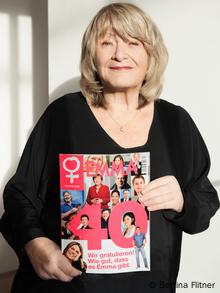
Germany's feminist magazine 'Emma' turns 40 as feminism gains ground

 As Germany's influential feminist magazine turns 40, "Emma" and its founder Alice Schwarzer remain outspoken, even as they lose the support of younger women.

FAMOUS FEMINISTS AND THE STRUGGLE FOR EQUALITY
Olympe de Gouges (1748-1793)
The French revolutionary was a pioneer in the struggle for women's rights. In 1791, Olympe de Gouges wrote a "Declaration of the Rights of Woman and the Female Citizen" in response to the 1789 declaration of human and civil rights, which didn't take women into account. In her text, she wrote that women are born free and are equal to men in all of their rights.
123456789101112


Hundreds of thousands of people took to the streets. They wore pink hats and carried signs to express their disgust towards misogyny, homophobia, racism and intolerance. The day after President Donald Trump's inauguration, the Women's March not only took over the streets of American cities like Washington, D.C., Seattle and New York; protests of solidarity also took place around the world, from London and Berlin to Nairobi, Tokyo and Sydney.


The images recall the beginnings of the women's liberation movement in 1970s Germany. Laws that put women at a substantial disadvantage to men drove women into the streets to protest back then - as they do now. In Germany in the 70s, married women were legally required to manage the household, and were only permitted to hold a job if it didn't mean neglecting their responsibilities as wives and mothers. Men, on the other hand, could quit their jobs without any approval of their wives.


All the while, Germany's constitution from 1949 maintained that "women and men have equal rights."
Alice Schwarzer, 'scorner of men'


The first edition of "Emma" was released on January 26, 1977

At the time, women in Germany began to rebel against this brand of inequality. One of their most important mouthpieces was the magazine "Emma," whose name was derived from the word "emancipation." Its subheading called it a "magazine for women by women," and it fast became a symbol of the feminist resistance.

The magazine's first edition appeared on newsstands on January 26, 1977. Its founder, Alice Schwarzer, was scourged in the media, dubbed a "scorner of men" by the national daily newspaper, "Die Welt."

Today, 40 years on, the publication is still in print.

"As far as I can see, 'Emma' is the last professional magazine for sale today that remains in feminists' hands," Schwarzer told DW.

Around the same time that "Emma" was founded, another feminist magazine called "Courage" was launched in West Berlin. It only lasted until 1984; Emma, by comparison, continues to print nearly 30,000 copies of each issue to this day.

Nearly two-thirds of those issues land directly in its subscribers' mailboxes. One of those subscribers is Ilse Lenz, a retired professor of Gender and Social Structures at the University of Bochum. She has collected around 1,200 pages documenting the development of the women's movement in Germany from 1968 through today.

"'Emma' repeatedly uncovered grievances and criticized the exploitation and subordination of women. It moved many women to action and was able to be a powerful voice in society. A lot has changed in the country as a result," said Lenz.

Breaking taboos by talking about them


Even before "Emma" was launched, Alice Schwarzer was well-known as a feminist. In 1971, she initiated the campaign "We had abortions" in Germany, based on a similar movement in France. It became a nationwide scandal: On the cover of the magazine "Stern," women confessed that they had broken Paragraph 218 of the law by terminating a pregnancy.


"Emma, it's enough!" The editorial office was vandalized in 1994


In 1975, Schwarzer managed to rock the boat again with her book, "The Little Difference and Its Huge Consequences." She not only interviewed women about their daily lives, marriages and children, but also about power roles in bed, the weight of sexual pressure and the oppression of women as sex objects.

Over the past 40 years, "Emma" has dealt with numerous women's issues. In 1978, it sued "Stern" for publishing misogynistic cover images. Later, it launched a campaign against pornography, genital mutilation and the discrimination of young Muslim women.

"'Emma' regularly stirs up controversies. It has sparked controversies itself and has started debates, and that is perhaps its greatest achievement," said Lenz.

The magazine, which is also available online, publishes portraits of strong women and practical do-it-yourself tips on things like changing tires.

4,000 years of patriarchy


Though it may be well-established after 40 years, "Emma" still takes fire from critics on a frequent basis. The young German feminist Margarete Stokowski canceled her subscription because she found the magazine "unbearable," she wrote in November 2015.

"'Emma' accompanied the women's movement for 40 years, and now we are seeing a conflict with the new generation of internet feminists. The main points of contention are anti-racism and "Emma's" initiative to regulate prostitution. I also see 'Emma's' problematic stances, which don't differentiate between Islam and fundamentalist Islamism. These contribute to problematic opinions of immigrant women. But I think that this conflict should not ignore what 'Emma' has achieved and opened up over the past 40 years," said Lenz.

Schwarzer herself has been criticized for her autocratic leadership style, for participating in ad campaigns for major German tabloids and for tax evasion, to which she confessed in 2014.

There was a time when Schwarzer considered giving up her role as editor-in-chief of "Emma," but she has held on to the position with no successor in sight. She said that letters from readers, some of which have been published on the occasion of the magazine's 40th anniversary, have kept her motivated.


Alice Schwarzer (second from left) with her editorial team in 1977

"These letters are very self-confident, but also heart-wrenching. They show how 'Emma' very concretely gives women courage and changes their lives," said Schwarzer. "And they show that feminist thoughts and actions continue to be vital. You can't do away with 4,000 years of patriarchy in 40 years."

Where are the female executives?

When the first edition of "Emma" was released, there were only 38 women in the German parliament, representing less than 10 percent of the lawmakers. Now women comprise 37 percent of parliamentarians. The vast majority of people in Germany want gender equality, said Ilse Lenz, but we're still a long way off.

According to the German office of statistics, women earn seven percent less than men in the same jobs and with the same qualifications. The German Institute for Economic Research (DIW) attests to slight progress in the proportion of women on supervisory boards. However, the numbers are still weak: Just 23 percent of the supervisory boards and eight percent of executive boards of top companies are made up of women.

If the trend continues, it will take another 60 years until boards contain an equal number of men and women, according to the DIW - and that's an optimistic estimate.

Right-wing party brings a retrogressive view of women


Alice Schwarzer has been editor-in-chief of "Emma" for 40 years

"The domination of the old men and the husbands, which was prominent in West Germany well into the 20th century, has been broken, but we have new problems: due to greater flexibility at work, the social inequality of class, migration and gender, and ongoing unequal division of labor in relationships," continued Lenz.

"Not much has changed in family life. Women largely continue to take on caring for children and the elderly."

Feminist ideas are not only being challenged in the US, but also in Germany with the rise of the right-wing populist party AfD. "Their model is a woman that is there for the family and the nation. Immigrant women and men are devalued and excluded by party representatives. One wing of the AfD apparently wants to get rid of abortion in the context of the current laws," according to Lenz.

The return to fundamentalism in politics, religion and society will certainly give "Emma" plenty of material to work with in the coming years.
#ABOLISHSCOTUS
Protesters gather at Supreme Court as draft overturning Roe vs. Wade leaks
CANADA CAN EXPECT MORE AMERICAN WOMEN VISITING FOR ABORTIONS

Supporters of legal abortion gather outside the US Supreme Court on the first day of their new term in Washington, DC., on Monday, October 4, 2021. Protesters gathered outside the high court again Monday night after a leaked opinion indicated the justices would vote to overturn Roe vs. Wade.
File Photo by Bonnie Cash/UPI | License Photo

May 2 (UPI) -- Protesters gathered outside of the Supreme Court on Monday night following a report of a leaked draft opinion signaling the high court intends to overturn abortion protections ensured in Roe vs. Wade.

Demonstrators gathered outside the court chanting "abortion is healthcare" and carrying signs in opposition of the leaked opinion.

In the opinion, drafted in February and reported by Politico on Monday night, Justice Samuel Alito was joined by at least four other justices in the decision to overturn Roe vs. Wade's holding of a federal constitutional right to abortion and Planned Parenthood vs. Casey, which largely maintained that right.

"We hold that Roe and Casey must be overruled," Alito writes in the document. "It is time to heed the Constitution and return the issue of abortion to the people's elected representatives."

Politico said that it obtained a copy of the draft opinion from a person familiar with the court's proceedings in Dobbs vs. Jackson, a challenge to Mississippi's 15-week abortion ban. It was not immediately clear whether changes had been made to the draft since it circulated in February, as Politico noted it was not final while adding that opinions can often undergo multiple drafts and vote changes before a decision is revealed.

The opinion in the case is not expected to be published until late June.

Dafna Linzer, Politico's executive editor, wrote in an editor's note that "after an extensive review process, we are confident of the authenticity of the draft" as Politico noted that "no draft decision in the modern history of the court has been disclosed publicly while a case was still pending."

"This unprecedented view into the justices' deliberations is plainly news of great public interest," she wrote.

SCOTUSblog, an independent blog written by lawyers, law professors and students about the high court, condemned the leak.

"It's impossible to overstate the earthquake this will cause inside the Court, in terms of the destruction of trust among the Justices and staff," the site's Twitter account wrote. "This leak is the gravest, most unforgivable sin."

Planned Parenthood President and CEO Alexis McGill Johnson called the leaked decision "horrifying and unprecedented," adding that it "confirms our worst fears" that the Supreme Court would end the constitutional right to abortion in a statement Monday.

McGill Johnson added that Planned Parenthood had been preparing for a potential move by the high court to overturn Roe vs. Wade and is "built for the fight" but asserted that abortion remains legal in the meantime.

"Planned Parenthood health centers remain open, abortion is currently still legal and we will continue to fight like hell to protect the right to access safe, legal abortion," she said.

Lila Rose, founder and president of anti-abortion group Live Action, called for even further action to ensure that "every human being's right to life is legally protected from the moment of fertilization" in a statement emailed to UPI.

"Roe has been wrongly decided since the day it was issued. It's illogical and gravely unjust," said Rose. "A decision overruling Roe would be an important step in the right direction of acknowledging and protecting our fundamental right to life, but if this decision is issued, true justice has not yet been achieved."

The leak also prompted calls to action from members of Congress on Monday night.

"Congress must pass legislation that codifies Roe vs. Wade as the law of the land in this country NOW," Sen. Bernie Sanders, I-Vt., wrote on Twitter. "And if there aren't 60 votes in the Senate to do it, and there are not, we must end the filibuster to pass it with 50 votes."

Roe vs. Wade will be overturned, purported leaked Supreme Court draft suggests

LA Times

David G. Savage - 1h ago

The Supreme Court is ready to overturn Roe vs. Wade and allow states to outlaw abortion, according to purported draft opinion that was leaked to Politico.

It is highly unusual for the high court to overturn a landmark decision and equally extraordinary, or perhaps more so, for a draft opinion to leak out in advance of its final release

The Los Angeles Times could not authenticate the purported draft. Sometimes draft rulings can be revised in the final months as justices weigh in during the writing process.

According to Politico, Justice Samuel A. Alito Jr. wrote a draft in February that says the abortion ruling was “egregiously wrong” and should be overturned completely.

Such an outcome would not be a surprise. Alito and Justice Clarence Thomas have made clear for years they thought Roe should be overturned. In recent years, they have been joined by three Trump appointees who agree with them: Justices Neil M. Gorsuch, Brett M. Kavanaugh and Amy Coney Barrett.

During the oral argument in December, Chief Justice John G. Roberts Jr. focused on the Mississippi law and its 15-week limit on abortion, which is at the heart of the current discussion.

Roberts argued that the court should decide that issue and stop there. The tenor of his argument suggested the five conservatives on his right were leaning toward overturning Roe entirely.

Typically justices take a tentative vote on an issue in their private conference, and the majority then begins work on a draft opinion.

But the outcome is not set until all the justices have signed off, and it is not uncommon for the wording or votes in some cases to change in May or June.

In 2012, for example, it appeared there were five justices ready to strike down the Affordable Care Act, but the chief justice switched his vote and decided on a narrow way to uphold it.

This story originally appeared in Los Angeles Times.

Roe v. Wade: Supreme Court reportedly votes to repeal abortion law

A leaked draft opinion published by Politico suggests that a majority of Supreme Court justices have voted to overturn the ruling that legalized women's right to abortion in the US nearly fifty years ago.

Abortion has become a heated topic for controversy, with strong opinions 

on both sides of the spectrum

The US Supreme Court has voted to overturn Roe v. Wade judgment behind closed doors, according to a draft majority opinion published by Politico news outlet.

Written by Supreme Court Justice Samuel Alito, the initial draft is his opinion and what he believes reflects the opinion of at least four other members of the top court.

It does not reflect comments or reactions from other members of the nine-member court.

In the reported draft opinion, Alito said he believes that "Roe was egregiously wrong from the start."

"It is time to heed the Constitution and return the issue of abortion to the people’s elected representatives," the opinion reportedly adds.

What is the Roe v. Wade ruling?

Roe v. Wade is the landmark US Supreme Court judgment of 1973 that legalized women's right to abortion across the country.

It was once again upheld in a 1992 ruling, but has lately been challenged by several Republican-led state legislatures.

This is a developing story. Please check back for updates.

rm/rt (AP, Reuters, AFP)

Roe v. Wade: 1973 case that enshrined US

 abortion rights


Mon, 2 May 2022

A US Supreme Court draft opinion leaked to the press on Monday suggests a majority of justices are ready to overturn the landmark Roe v. Wade, shredding nearly 50 years of constitutional protections on abortion rights.

Here is how the original 1973 court case played out.

- Right to privacy -

On January 22, 1973, the court decided that the constitutional right to privacy applied to abortion.

Roe was "Jane Roe," a pseudonym for Norma McCorvey, a single mother pregnant for the third time, who wanted an abortion.

She sued the Dallas attorney general, Henry Wade, over a Texas law that made it a crime to terminate a pregnancy except in cases of rape or incest, or when the mother's life was in danger.

Filing a complaint alongside her was Texas doctor James Hallford, who argued the law's medical provision was vague, and that he was unable to reliably determine which of his patients fell into the allowed category.

The "Does," another couple, childless, also filed a companion complaint, saying that medical risks made it unsafe but not life-threatening for the wife to carry a pregnancy to term, and arguing they should be able to obtain a safe, legal abortion should she become pregnant.

The trifecta of complaints -- from a woman who wanted an abortion, a doctor who wanted to perform them and a non-pregnant woman who wanted the right if the need arose -- ultimately reached the nation's top court.

The court heard arguments twice, and then waited until after Republican president Richard Nixon's re-election, in November 1972.

- 'Sensitive and emotional' controversy -


Only the following January did it offer its historic seven-to-two decision -- overturning the Texas laws and setting a legal precedent that has had ramifications in all 50 states.

Justice Harry Blackmun, writing for the majority, said the court recognized the "sensitive and emotional nature of the abortion controversy, of the vigorous opposing views, even among physicians, and of the deep and seemingly absolute convictions that the subject inspires."

But he argued that the "right of privacy... is broad enough to encompass a woman's decision whether or not to terminate her pregnancy."

"A state criminal abortion statute of the current Texas type, that excepts from criminality only a lifesaving procedure on behalf of the mother, without regard to pregnancy stage and without recognition of the other interests involved, is violative of the Due Process Clause of the Fourteenth Amendment," the ruling read.

But the top court agreed with lower court rulings that the right to privacy with regard to pregnancy "is not absolute, and is subject to some limitations."

"At some point, the state interests as to protection of health, medical standards and prenatal life become dominant," Blackmun wrote.

The top court thus ruled partially against the doctor and the Does, but in favor of Jane Roe, who has since become a pro-life activist.

On the same day, the justices ruled in the separate "Doe v. Bolton" case, which authorized each state to add restrictions to abortion rights for later-term pregnancies.

The constitutional right to abortion was later confirmed in a number of decisions, including "Webster v. Reproductive Health Services" in 1989, "Planned Parenthood v. Casey" in 1992 and Stenberg v. Carhart" in 2000.

bur-caw/mtp


Google honors engineer, inventor Elijah McCoy with a new Doodle

Google is paying homage to Black Canadian-American engineer and inventor Elijah McCoy with a new Doodle.


 Image courtesy of Google


May 2 (UPI) --
Google is celebrating Black Canadian-American engineer and inventor Elijah McCoy, who made great strides in improving train efficiency, with a new Doodle.

Google's homepage features moving artwork of McCoy thinking with a pencil to his chin. A train also travels around him in a circle.

McCoy's parents escaped slavery in Kentucky through the Underground Railroad in 1837 and relocated to Canada. McCoy was born in Colchester, Ontario and grew up with a passion for mechanics and trains.


The inventor moved to Edinburgh, Scotland, to become a mechanical engineer apprentice. McCoy then settled in Michigan but had trouble finding a job that matched his experience in 1866 due to racial discrimination in the U.S.

McCoy joined the Michigan Central Railroad are a fireman and oiler. He later invented the oil-drip cup, which helped oil steadily flow around a train's engine without having to stop the train every few miles.

McCoy then obtained his first patent titled Improvement in Lubricators for Steam Engines. The invention was later used to revolutionize oil-drilling, mining equipment and construction and factory tools.

The engineer held 57 patents in his lifetime including patents for a lawn sprinkler and ironing board. He later started the Elijah McCoy Manufacturing Company in 1920 and made lubrication devices that featured his name.

McCoy was inducted into the National Inventors Hall of Fame located in Akron, Ohio in 2001 and has a dedicated exhibit in the Detroit Historical Museum.