Sunday, May 17, 2026

Vatican synod report criticizes conversion therapy, features gay Catholic testimony

(RNS) — Advocates for LGBTQ+ Catholics expressed surprise to see the Vatican publishing the testimonies of married gay men.


Some of the hundreds of LGBTQ+ Catholics and their families who joined a Holy Year pilgrimage to Rome, celebrating a new level of acceptance in the Catholic Church and crediting Pope Francis for the change, walk through the Holy Door of St. Peter’s Basilica at the Vatican, Sept. 6, 2025. (AP Photo/Andrew Medichini)

Aleja Hertzler-McCain
May 5, 2026
RNS


(RNS) — The Vatican released a report from a study group of theologians on Tuesday (May 5) that included the testimony of two married gay Catholics and acknowledged the church’s role in “the solitude, anguish, and stigma that accompany persons with same-sex attractions and their families.” The report also reflects on the negative impacts of conversion therapy, or “the devastating effects of reparative therapies aimed at recovering heterosexuality.”

“ It’s a big deal because they included testimonies and published testimonies from two LGBTQ people, both of them married, which is also unusual for the Vatican to do,” said the Rev. James Martin, a founder of Outreach, an LGBTQ Catholic ministry. “As far as I know, it’s the first time that in any official publication of the Vatican, they’ve included witnesses and testimonies and stories from LGBTQ Catholics in any kind of detailed way.”

The report comes from a group of theologians, including bishops, priests, a sister and a layperson, convened by the Vatican to study “controversial” issues raised by the Synod on Synodality, Pope Francis’ signature listening initiative, to which Martin was a delegate. Though church reform advocates hoped — and traditionalists feared — that the synod would bring major changes to church teaching around gender and sexuality, the decision to relegate contentious issues, such as LGBTQ+ inclusion, to study groups instead of general discussion was widely seen as a damper.

As expected, the synod study group report, which was written to advise the pope, does not announce major changes to church doctrine, but it does suggest that the Catholic Church address the impasse between “doctrinal firmness” and “pastoral welcome” by listening and using a transdisciplinary approach, such as incorporating insights from psychology, alongside the Bible and church doctrine.

This synod document was written by the study group, not the pope, but its release to the public would have required his authorization.

“ It’s a really good — I would even say historic — document,” said Yunuen Trujillo, a lesbian lay minister from Los Angeles. “ It’s still calling for all Catholics to engage in a process of discernment that is respectful of people’s lived experiences.”

Trujillo, author of “LGBTQ Catholics: A Guide to Inclusive Ministry,” said it might take a while for LGBTQ+ Catholics in the pews to feel the impact and noted that the document only focuses on lesbians, gays and bisexual people. “But I do believe it would be a positive impact, not a negative one,” she said.


In this Oct. 4, 2023, file photo, Pope Francis, far right, participates in the opening session of the 16th General Assembly of the Synod of Bishops in the Paul VI Hall at the Vatican. (AP Photo/Gregorio Borgia)

Marianne Duddy-Burke, a married lesbian Catholic and DignityUSA’s executive director, said, “ The most significant thing for me was the recognition that top-down trying to dictate behavior and morality on the basis of dogma isn’t working,” adding she was “hopeful” to see the report using the language of a “paradigm shift.”

The “paradigm shift” the report proposes is a move away from applying abstract theological principles to on-the-ground realities and instead seeing theory and practice as a “virtuous cycle.” For the two to effectively inform each other, the report argues, requires a focus on relationships, transparency and learning. The document offers this theological framework not just for LGBTQ+ issues but for broader use, including in nonviolent activism and protest.

The report’s release garnered some blowback, a portion of which fell on Pope Leo XIV. Far-right Catholic news organization LifeSite published a story on the report, raising concerns that the report was questioning “the sinful nature of homosexuality” and leaving unresolved the “debate on same-sex ‘marriage.'” Co-founder John-Henry Westen released a video warning that the report’s pro-LGBTQ+ stance makes clear the meaning of “synodality” under Leo.

But there are also signs Leo is not eager to change church teaching, including remarks he made in interviews last year. On Wednesday, the Vatican published a 2024 letter by the Vatican doctrinal office condemning German Catholic bishops’ plans to create formalized blessings for same-sex couples.

Advocates for LGBTQ+ Catholics expressed surprise to see the Vatican publishing the testimonies of married gay men.

“ I was expecting a rather bland report. And this was not that,” said Francis DeBernardo, executive director of New Ways Ministry, which serves LGBTQ Catholics. “ In days gone by in the church, they would try to tick off the token box by getting someone who had certain traits and characteristics, but who was just not critical of the church in any way.”

Martin said this is the first time he remembers seeing conversion therapy “critiqued that strongly” in a Vatican document. “There have been certain bishops who have been very muted in their critique of conversion therapy, but then there have also been bishops who have used organizations whose techniques really verge on conversion therapy,” he said.

One gay Catholic wrote of “wounds from the Christian community” in his Vatican-released testimony. “I cannot ignore the scars I carry. I have witnessed the devastating effects of ‘conversion therapies’ and the break-up of families, which felt like an attack on God’s sensitive and blameless creation. These experiences deeply hurt, because they target the inherent dignity of a person who simply bears the love of another of the same gender.”

But the married Portuguese man also wrote of his deep faith in the Eucharist and his sharing “a life of faith, service, and love” with his husband. “I live my life in profound peace with God, who knows me from my mother’s womb.”

“I feel the Church needs to move beyond mere ‘welcoming’ and ‘pity,'” he wrote in the testimony. “We need to proclaim the unspoken truth: God loves you and desires your wholeness. Sexuality is one part of our life, and difference is a hallmark of Creation.”

DeBernardo said the testimonies of LGBTQ+ people and their advocates have also been moving for the 17 bishops who have participated in three different meetings with New Ways Ministry in recent years. “We had a bishop at the end of the meeting in tears because he was so regretful of the way he had thought about LGBTQ people,” DeBernardo said.

“Dialogue really is the first step,” said DeBernardo. “ The genius of Pope Francis is that he realized that people had to start talking with one another, and learning about each other and not having the fear and the stereotypes.”

For Duddy-Burke, who represents a grassroots group led by LGBTQ+ Catholics that was banned 40 years ago from meeting in Catholic spaces — and who said she has struggled for years as a result to even have these conversations — the document inspires hope: “We didn’t have a place at the table and, and this document says that it’s time that we did,” she said.

At the same time, Duddy-Burke worries about whether those who hold the power will continue to dialogue and be willing to have their “minds and hearts changed.”

“And how will that be managed in parts of the world where it’s absolutely unsafe and it’s sometimes illegal, you know, for people to come forward as queer?” she asked.

The synod report also addresses “active nonviolence,” highlighting the examples of Martin Luther King Jr., Mahatma Gandhi, Filipino “People Power” and Polish “Solidarity” anti-government movements, as well as the experience of a Catholic Serbian conscientious objector. Peace has been a major focus of Leo’s pontificate, and his recent anti-war statements have led to conflict with the Trump administration, which has used theological language to promote its war in the Middle East.

In the Vatican report, the theologians suggest that “just war theory,” which Catholic U.S. Vice President JD Vance has referenced to defend the war, is “inadequate” in the modern context. “Since war can no longer be confined to military targets but overflows into civilian life, taking on new forms (hybrid, asymmetrical, etc.), the recourse to frameworks used in the past for legitimate defence — and even more so for ‘just war’ — appears increasingly inadequate,” they write.

On Tuesday, the Vatican also released the report of another Synod study group dedicated to bishop selection and other bishop issues. That report proposed broad consultation — including the perspectives of lay people, in addition to clergy and religious — when it comes to potential bishop candidates as well as ideal future bishop qualities.

This story has been updated to add more information about the purpose of the report and details about Leo’s response to the German Catholic bishops’ plans to formalize same-sex blessings.


INTERNATIONALIST FREETHINKER 

Thomas Paine helped start America. In the Trump era, he's under fire.

In some ways, the debate over Paine's legacy today is a proxy for a much larger debate over whose vision gets to govern.


Jack Jenkins
May 13, 2026
RNS

(RNS) — Rep. Jamie Raskin, D-Md., was revving up a crowd of tens of thousands gathered in Philadelphia for the first major No Kings protest last June. His speech, like the demonstration itself, was focused primarily on pushback against President Donald Trump, whom critics such as Raskin likened to a would-be monarch.

But after railing against the president, Raskin paused to focus on one of his favorite Founding Fathers: Thomas Paine, an English-born political writer who supercharged the American Revolution with his wildly popular pamphlet “Common Sense” 250 years ago.

Noting that he named his own late son after Paine, Raskin recalled the corset-maker-turned-revolutionary’s dream of an America that would operate as “an asylum to humanity.” Paine, he told the crowd, envisioned “a place of refuge for people seeking freedom from religious and political and intellectual and economic repression from around the world” — and then helped spur a revolution to make it a reality.

Less than a month later, at the inaugural service of Christ Church DC — a congregation organized by self-described Christian nationalist Doug Wilson and attended by influential conservatives, including Defense Secretary Pete Hegseth — Pastor Jared Longshore delivered a sermon that held up Paine not as a hero, but a cautionary tale. Longshore dismissed Paine as someone who “exalted human reason to the place of a golden calf,” an apparent reference to Paine’s deism and his criticism of organized religion’s entanglements with political power.


Portrait of Thomas Paine by Laurent Dabos, circa 1791.
 (Image courtesy of National Portrait Gallery/Wikimedia/Creative Commons)

“Thomas Paine actually lost all of his old friends,” Longshore said, standing at a pulpit underneath an American flag. He then implied Paine’s fall from grace could be the ultimate fate of modern progressives, saying: “Only a few mourners came to his funeral, and even the Quakers wouldn’t let him be buried in their cemetery. That’s tough. Shows you how people used to think and how people are thinking now.”

The contrast captures not only Paine’s contested place in American memory, but the larger political and religious debate in the US over whose founding vision should govern.

Scholars say Paine’s historical importance is undeniable. A seminal and celebrated voice in the American Revolution, Paine was so influential that John Adams once referred to the late 1700s as “the age of Paine.” What’s more, in addition to his role in America’s founding, Paine, an Englishman, championed democratic values so fervently that he later became a leader in the French Revolution despite not speaking French.

But Paine ultimately proved polarizing in his own lifetime, largely because of his blistering critique of organized religion, historians say. Among other things, he helped initiate debates over the separation of church and state that continue to this day, resulting in a bifurcated legacy: Paine as a champion of freedom or Paine as the “Forgotten Founding Father” — embraced or dismissed, depending on who is doing the remembering.

That fissure appears to be growing amid ongoing celebrations of the 250th anniversary of the U.S., with left-leaning leaders who support the separation of church and state championing Paine even as he is derided by prominent Christian nationalist figures aligned with Trump. And as the Trump administration and its allies prepare a faith-themed event on the National Mall to “rededicate” America “as One Nation to God,” debate over Paine’s ideas — such as his passionate opposition to “mingling religion with politics” — is unlikely to abate.

Paine once enjoyed vocal bipartisan support in Washington. In 1992, bipartisan legislation, signed by President George H.W. Bush, authorized construction of a memorial, but the project stalled. A 2022 bill renewed the push for a Paine memorial that could be erected on the National Mall by 2030, but it is still awaiting approval from the U.S. Department of the Interior and, ultimately, Congress.


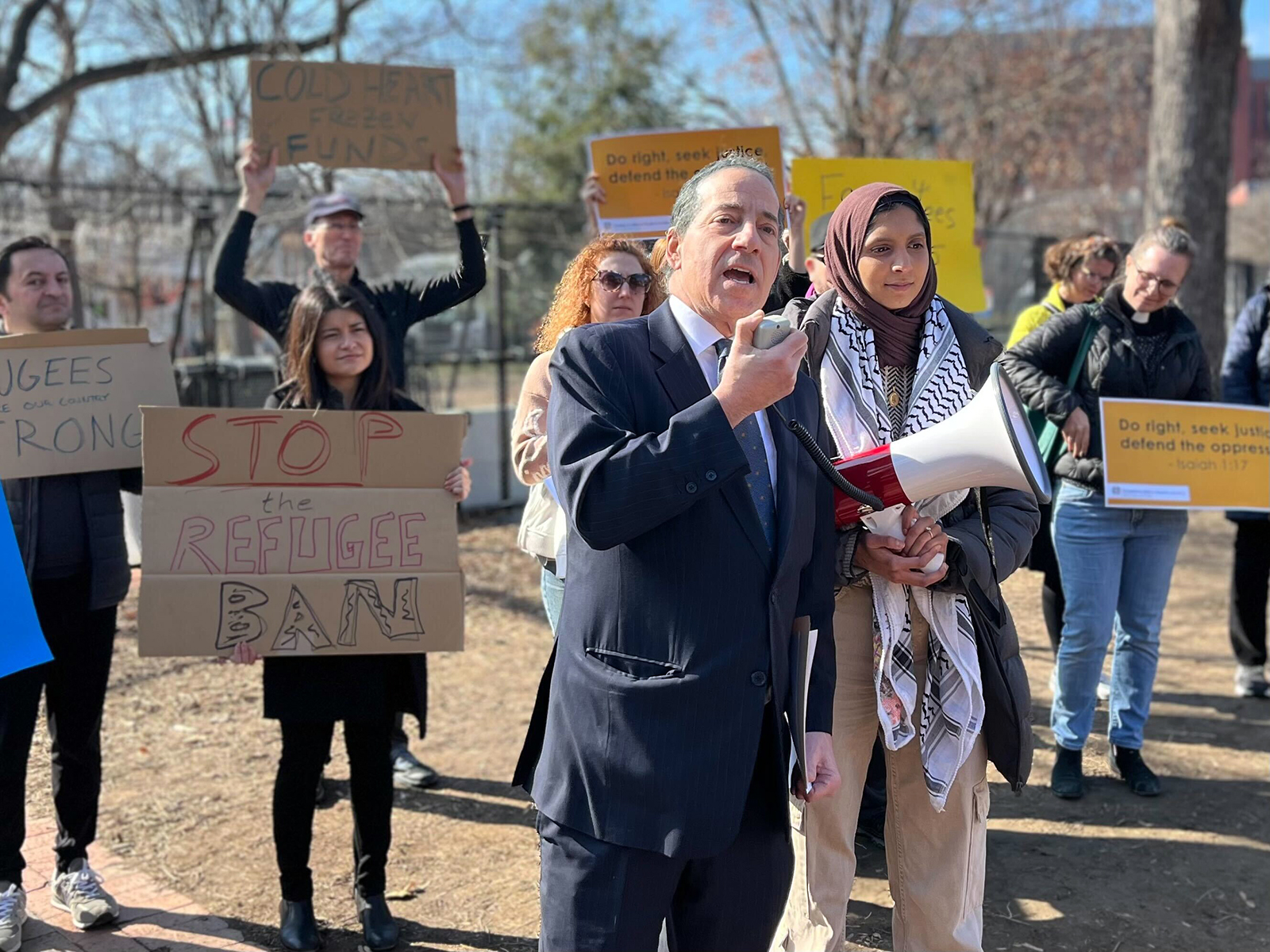
Rep. Jamie Raskin, D-Md., speaks during a protest against the shuttering of the United States Refugee Admissions Program, Feb. 4, 2025, in Washington. 
(RNS photo/Aleja Hertzler-McCain)

As the sponsor of the 2022 bill, Raskin is perhaps Paine’s most visible modern-day champion in Washington. The Maryland congressman told Religion News Service he first encountered Paine in high school by reading the revolutionary’s best-known works: “Common Sense,” “The American Crisis” and “The Rights of Man.” “I read Paine and I just felt like a light bulb went off,” Raskin said, noting that President Abraham Lincoln was also a fan of Paine. “(Paine) had this passionate and unwavering commitment to democracy as the system that will both protect people’s freedom and allow for mutual progress in society.”

Raskin often cites Paine in speeches and even pushed to name a congressional caucus he co-founded with Rep. Jared Huffman the “Thomas Paine Caucus.” The group, which boasts 36 members and is dedicated to both religious freedom and church-state separation, ended up being called the Congressional Freethought Caucus instead, although a portrait of Thomas Paine graces the group’s website.

“Tom Paine is still too radical a figure even in the 21st century, apparently,” Raskin joked.

Liberals, progressives and radicals across the globe have long claimed Paine as one of their own, often pointing to his progressive policy views for his day, such as opposition to slavery as well as support for public education and state-sponsored prenatal and postnatal care.

However, it is Paine’s views on religion — as well as how religion should interact with government — that have likely complicated his legacy. Raised in a Quaker home, Paine made several lengthy theological arguments in “Common Sense,” but ultimately declared himself a passionate deist.

“I believe in one God, and no more; and I hope for happiness beyond this life,” Paine wrote. “I believe in the equality of man, and I believe that religious duties consist in doing justice, loving mercy, and endeavouring to make our fellow-creatures happy.”

"The Age of Reason" by Thomas Paine was controversial, in part because of his blistering critique of organized religion. (Public domain image)

"Common Sense" by Thomas Paine is credited with helping to inspire the American Revolution. (Public domain image)

In 1793, Paine published “The Age of Reason,” a lengthy critique of organized religion — especially what he called “the adulterous connection of church and state.” Among other claims, he wrote that he believed the American Revolution would be followed by revolutions in the religious world.

Seth Perry, who teaches American religious history at Princeton University, told RNS the book was hardly met with the rapturous praise enjoyed by “Common Sense.” Part of the issue, Perry said, was timing: “The Age of Reason” was published just as religious revivals associated with the Second Great Awakening had already swept across the U.S., and Paine’s involvement in the chaotic French Revolution — during which Paine himself was imprisoned — gave his ideological opponents in the U.S. cause to condemn him.

“There’s good scholarship showing how the anti-religious vibe of the French Revolution was used by those at the time who wanted more religion in the government as a cudgel to push back on people like Thomas Paine, who were pushing against religion in the government,” Perry said.

In the 20th century, some prominent conservatives embraced Paine, particularly President Ronald Reagan, who often referenced Paine in public remarks. But these days, Paine has become a target among far-right intellectuals, particularly those aligned with Christian nationalism or Catholic integralism, an ideology similar to Christian nationalism that advocates for a less overt approach to exerting Christian influence over society.

“We can find in Paine antecedents for almost every political ideology we find today,” Ben Wright, a professor of American history at the University of Texas at Dallas, said in an interview. “It’s curious to see who decides to claim him and who doesn’t — and that changes over time.”

It's curious to see who decides to claim him and who doesn't — and that changes over time.Ben Wright, professor of American History at the University of Texas at Dallas

At last year’s National Conservatism Conference in Washington, Patrick Deneen — a professor at the University of Notre Dame who is associated with Catholic integralism — urged conservatives to distance themselves from Paine. After acknowledging Paine’s influence, Deneen argued far-right thinkers have overlooked Paine’s involvement in the French Revolution and his longstanding debate with Edmund Burke, a seminal conservative intellectual figure.

“Paine was no conservative, and nor, really, was his political theology,” declared Deneen, who went on to voice support for more public religious expression in government. “I would submit that by adopting this Painian, Rousseauan, French Revolutionary … political theology that conservatism has been equally the cause of woe and destruction to the values and the institutions that conservatives all along claimed to hold dear.”


Patrick Deneen addresses the National Conservatism conference, Thursday, Sept. 4, 2025, in Washington. (RNS photo/Jack Jenkins)

Gary Berton, president of the Thomas Paine Historical Association, acknowledges that Paine has long made some conservatives uncomfortable. But he insisted Paine’s criticisms of religion continue to inspire young people, many of whom are religiously unaffiliated: Berton said that, in recent years, young people often walk into the association’s building wanting to know more about Paine after reading “Age of Reason.”

Raskin, meanwhile, sees the hostility from conservatives in the Trump era as predictable.

“Monarchists and reactionary conservatives have always hated Tom Paine,” Raskin said, noting that Paine famously railed against the divine right of kings, the theology that monarchs answer only to God.

In the meantime, Raskin said, he is looking forward to a Paine memorial eventually being erected in Washington, and will continue to draw inspiration from a man he insists is unfairly maligned by those on the right.

“Democracy is always a controversial idea,” Raskin said. “Monarchy is obviously a betrayal of that idea. Aristocracy is a radical betrayal of that idea. Theocracy is just somebody dressing up their pretensions to power and dictatorship in religious garb.”


Federal employees sue USDA secretary over Christian messaging

(RNS) — Asked to comment on the suit, a USDA spokesperson said: ‘While we do not comment on pending litigation, we will keep the plaintiffs in our prayers during this process.’


Secretary of Agriculture Brooke Rollins speaks during an event on the South Lawn of the White House, March 27, 2026, in Washington, as President Donald Trump looks on.
 (AP Photo/Alex Brandon)

Adelle M. Banks
May 13, 2026
RNS


(RNS) — Federal employees are suing Agriculture Secretary Brooke Rollins and the U.S. Department of Agriculture, arguing that her use of Christian messaging in the workplace is “unconstitutionally coercive.”

The lawsuit, filed Wednesday (May 13) in the U.S. District Court for the Northern District of California, said Rollins “has adopted a practice of sending increasingly proselytizing communications to the entire USDA workforce, promoting her own preferred brand of Christian beliefs and theology to the captive audience of employees that report to her.”

The complaint was filed by the advocacy groups Americans United for Separation of Church and State and Democracy Forward Foundation and the California-based firm Bryan Schwartz Law on behalf of the National Federation of Federal Employees and seven named plaintiffs of a variety of faiths and no faith — including Jewish, Buddhist, pagan and atheist employees of the USDA, according to the lawsuit.

The union of more than 110,000 federal workers — including more than 19,000 USDA staffers — and the individuals charge that Rollins’ actions do not reflect the secular mission of the department.


Part of an an Easter email sent by Agriculture Secretary Brooke Rollins on April 5, 2026
. (Image via lawsuit)

“The Secretary’s practice reached a crescendo,” their complaint said, with an Easter (April 5) email that described the holiday as marking “the greatest story ever told, the foundation of our faith, and the abiding hope of all mankind.” It went on to declare “Jesus has been raised from the dead. And God has granted each of us victory and new life.” Her entire Easter message to “Team USDA” is attached to the complaint and features an illustration of a tomb with a stone rolled away and the words “Christ is Risen.”

Asked to comment, a USDA spokesperson said: “While we do not comment on pending litigation, we will keep the plaintiffs in our prayers during this process.”

The suing parties said Rollins’ Easter message “communicates that there is a preferred religious ‘in-group’ at USDA,” a sentiment not permitted by the establishment clause of the U.S. Constitution, which states “Congress shall make no law respecting an establishment of religion.” They also said her messaging violates a USDA policy adopted in November 2025 that requires department officials not to “use official authority to pressure subordinates” about their religious beliefs.

The union and individuals also allege that Rollins has not sent messages about holidays for other religions.

The complaint says it seeks to protect the rights of USDA employees from proselytizing and religious coercion, including those who may feel intimidated, fear retaliation for objecting to Rollins’ messages or feel compelled to hide their beliefs if they don’t share those of their department head.

“The Trump administration is waging a relentless and increasingly brazen crusade against church-state separation and the religious freedom of federal workers,” said Rachel Laser, president and CEO of Americans United, in a statement. “Trump is not Jesus, federal agencies are not churches, and cabinet secretaries are not government preachers.”

NFFE President Randy Erwin said employees of other government departments also have expressed concerns about the state of the federal workplace.

“Every agency feels like it’s the epicenter for a new outbreak of Christian Nationalism,” Erwin said in a statement. “We just want to do our jobs without having to fend off proselytizing and preaching.”

The suit goes on to describe “an escalating pattern of subjecting all USDA employees to proselytizing Christian messaging promulgated from (Rollins’) position of authority.” According to the suit, her July 4 message last year said, “May God continue to protect the United States of America and may His favor shine over all her land” and her Thanksgiving message expressed “gratitude towards a loving God.” In a Christmas video message addressed to department staff, she said, “The spirit of generosity flows from the very first Christmas when God gave us the greatest gift possible, the gift of his Son and our Savior Jesus Christ, who came to free us from our sins and open the door to eternal life. This is the reason for the season.”

The suing parties also state that they feel compelled to read Rollins’ email messages because they often include nonreligious information that may affect their job duties.

“And historically, even holiday emails from USDA leadership have included specific job-related announcements, such as, for example, notifications regarding administrative leave,” the plaintiffs said in the suit.


Opinion

How the devil was disguised in the SBC and Paul Pressler's Conservative Resurgence

(RNS) — During the Conservative Resurgence, I thought we were fighting for the Bible. Instead, we were also political pawns for an abuser.


Paul Pressler in a video from 2015. (Video screen grab)

Karen Swallow Prior
May 6, 2026
RNS


(RNS) — There’s a brilliant scene in the film “The Devil Wears Prada” in which a villainous high fashion editor berates her new, plainly dressed assistant for thinking she is above the dictates of the fashion world when the fact is that even the discount items she buys have trickled down from the upper echelons of a ruthless and rabid fashion industry.

In the movies, the devil may wear Prada, but in the Southern Baptist Convention, the devil came cloaked in its so-called Conservative Resurgence.

The Conservative Resurgence within America’s largest Protestant denomination was co-engineered by the late Paul Pressler — a Texas judge and a mover and shaker in the Republican Party and the SBC — along with former SBC seminary and convention president Paige Patterson.

Armed with evidence that liberals were invading the nation’s largest Protestant denomination, the two organized fellow conservatives to fight back, seizing control of the SBC in a decades-long denominational civil war. Now, a new and exhaustive report by Robert Downen at Texas Monthly details the horrific, lengthy history of sexual predation and abuse by Pressler, the facilitation of this abuse, and the cover-up of this abuse and other abuse cases by those within his inner circles of power (including Patterson) in both the SBC and local and national Republican politics.

Much of this history has leaked out slowly over the past few years as a result of various court proceedings, but this new report connects sparse details to a larger picture that begins with the Southern Baptist Convention but extends far beyond.

“You might not know Paul Pressler’s name,” Downen writes. “But your life has been profoundly affected by the fruits of his labor.”

“As the architect of the SBC’s so-called conservative resurgence, Pressler—or the Judge, as many knew him—played a crucial role in the marriage of the Republican Party and the white evangelical voters who still sustain its power.” In other words, the Conservative Resurgence cannot be separated from the merging we see today between the Republican Party and evangelicals. This is the thesis of the 12,000-word article.

But the devil is in the details.

Those details describe a deeply rooted culture of abuse that has been perpetuated for decades in the SBC despite numerous, vocal and at times seemingly serious attempts — mainly by abuse survivors (and some who ultimately did not survive their abuse) — to bring about change.

Those chances for real change, according to Downen’s analysis as well as the conclusions of many who tried to effect reform, are now dead in the water. The history of the Conservative Resurgence shows why.

The resurgence began because the SBC’s seminaries had been influenced by scholars who held to less literal interpretations of the Bible, which clashed with the more conservative views local churches and pastors tended to hold.


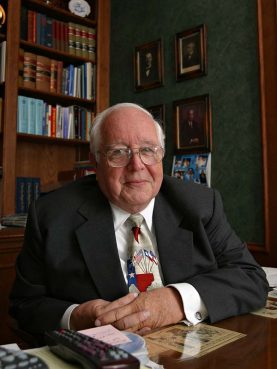
Former Judge Paul Pressler, who played a leading role in wrestling control of the Southern Baptist Convention from moderates in 1979, poses for a photo in his home in Houston on May 30, 2004. (AP Photo /Michael Stravato)

Pressler used that tension to gain power — and along the way, crushed countless vulnerable and innocent people, who were labeled as liberals and enemies of the church.

Tragically, Pressler pretended to believe in conservative Christian sexual ethics while allegedly raping and abusing boys and young men for decades. Some of these victims were supplied to him by his own political party.

Rumors and accusations about Pressler’s conduct — which led to him failing a background investigation for a job in the George H.W. Bush presidential administration — were brushed off as the stratagems of apostate, power-hungry liberals.

Pressler and Patterson were hailed for years as heroes — and many of their disciples went on to positions of power in the SBC, running SBC seminaries and entities, filling powerful pulpits and denominational appointments.

Every leader in today’s SBC pays homage to the idea that the movement led by Pressler and Patterson saved the SBC.

Yet the movement was not just about theology. It was about political power.

I am not a survivor of sexual abuse as too many of my friends in SBC circles are (some of whom are described in the Texas Monthly article). But my life was indeed profoundly affected by Paul Pressler, Paige Patterson and the Conservative Resurgence — years and years before I knew it. Reading the timeline of Pressler’s rise within the SBC and the GOP was like raising the backdrop on the stage of my own life to find the hidden directors behind the scenes.

I had no idea that the choices I was making were, at least in part, the manufactured product of an interconnected web of religious and political powerbrokers whose real interests were far from the ideals of truth and justice they peddled.

In the mid-1980s, just a few years after helping launch the Conservative Resurgence in the SBC, Downen reports, Pressler was advising the Council for National Policy, a secretive conservative networking organization whose partial membership list is a “who’s who” of right-wing politicians, corporate heads and evangelical leaders, on ways to mobilize churches and register voters by working with Jerry Falwell.

These efforts soon reached the small country church my husband and I attended in western New York. Our church was not SBC or even Baptist, but the pastor was a graduate of Falwell’s Liberty Baptist College (now Liberty University), and while we never heard the phrase “Conservative Resurgence,” I know now in looking back that our church was one of the many spoils taken by the victors of that battle.

Here we were instructed that God’s word in the Bible was delivered through full, inerrant, verbal and plenary inspiration (a phrase we were encouraged to memorize), and each term countered liberal views of Scripture that were gaining traction in the culture and undermining the Bible’s authority.

By the late 1980s, Pressler was president of the CNP and, along with other members of the organization, wrote a letter to then-Vice President George H.W. Bush that, Downen reports, “promised to deliver evangelical voters in exchange for ‘direct access’ to the White House.”


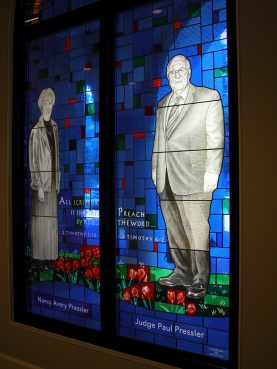
Paul Pressler, right, in a stained-glass window that was removed from Southwestern Baptist Theological Seminary. (Photo courtesy of Don Young Glass Studio)

I am one of those voters that was delivered, as promised.

I didn’t just vote, either. I invested time, money and resources into institutions I thought were rooted in Christian conviction, only to realize they were largely fronts for partisan politics.

I was enlisted into the pro-life movement, understanding the issue to be one of social justice, human rights and human dignity, only to learn much later that abortion had been seized upon by the Republican Party as a combat partner in a war against “a malevolent secular state” and the SBC was taken along for the ride.

By 1998, I had been so convinced of the rightness of the religious right and the conservative movement that when news of the Clinton-Lewinsky abuse case broke, I thought the leaders who spoke against Clinton and sought his impeachment actually cared about the immorality of it all.

I thought the politics were flowing from the theology (and surely at times they were). But now I see that too often the theology was being exploited for political gain — especially after many SBC leaders turned into vocal supporters of serial adulterer and self-described abuser Donald Trump.

I am grateful for the theological and ethical questions I was able to wrestle with during those years of and following the Conservative Resurgence. I developed convictions then that remain my convictions today.

But I didn’t need enemies in a trumped-up culture war to gain those convictions. I needed education, reflection, dialogue, curiosity and genuine faith. This is what we all need. Christians, too. Christians especially, because we are called to follow a narrow path.

I see now that I and countless others were pawns in what turned into a devilish enterprise to satisfy lusts of the flesh. Some of these pawns have been horrifically abused; even more have simply been used.

As more and more layers are peeled away and we see more and more the abuse of power — power used to abuse the vulnerable, power used to cover up for friends and allies, power used to curry favor with those with greater power — we must use our power to resist such abuse.

We are actors even as we are acted upon.

For a while, we did not know. But once we do know, we become accountable. The leaders may be dead or gone, but the machine they put in place whirs on. It still depends on our continued quiet consent.


RELATED: Paul Pressler, SBC legend accused of abuse, is dead at 94


Rejecting church and state separation is on the wish list for Trump's religious liberty commission

(AP) — Commissioners had an opportunity to describe their wish lists during their most recent meeting in April. There was little dissent as the commissioners, most drawn from Trump’s base of conservative Christian supporters, covered the items they want in the report.


Peter Smith
May 11, 2026

One member calls for a Presidential Medal of Freedom for a baker who refused to create a wedding cake for a same-sex couple.

Another calls for court interventions by the Department of Justice on behalf of Amish parents fighting New York vaccine requirements and Catholic nuns challenging that state’s requirement that they accommodate hospice patients’ gender identities.

And the chair of the Religious Liberty Commission is calling for a federal hotline with this automated recording: “There is no separation of church and state.”

These are just some of the recommendations that members of the advisory panel formed by President Donald Trump last year want to see included in the commission’s final report.

That report is still in the works, but commissioners had an opportunity to describe their wish lists during their most recent meeting in April. There was little dissent as the commissioners, most drawn from Trump’s base of conservative Christian supporters, covered the items they want in the report.

Their ideas reflect the prevailing perspectives on the definition of religious liberty among many conservative Catholic and evangelical activists: increasing avenues for religious expression in public schools; expanding opportunities for faith-based organizations to receive public money; and allowing for religious-based exemptions in areas ranging from labor law to classroom lessons to healthcare mandates.

Such views have also been reflected in Supreme Court decisions issued in recent years by its conservative majority.

Commission criticized for narrow views

Critics of the commission say it embodies a one-sided perspective of Trump’s supporters and is threatening a well-established constitutional separation of church and state, despite the chair’s claims.

A lawsuit by a progressive interreligious coalition argues that the commission fails to comply with federal law requiring advisory panels to feature diverse members and viewpoints.

The lawsuit echoes criticism that most commissioners are conservative Christian clerics and commentators; one is an Orthodox Jewish rabbi. The coalition says members have asserted that America is specifically a Judeo-Christian or Christian nation and notes that most commission meetings took place at the Museum of the Bible in Washington, an institution with Christian leadership.

The Republican administration is asking a federal court to dismiss the lawsuit. The government is citing legal technicalities and contending the law does not define how a commission should be fairly balanced or whose viewpoints should be represented.

Another entity created by Trump — the Task Force to Eradicate Anti-Christian Bias — issued a report saying Christians faced discrimination under the administration of Democratic President Joe Biden in areas such as education, tax law and prosecution of anti-abortion protesters. Progressive groups said that report failed to document systemic discrimination, focused on causes favored by conservative Christians and amounted to advocacy rather than an investigation.

In a further interlocking of Trump-related initiatives, several members of the Religious Liberty Commission are scheduled to take part in a May 17 prayer event marking the country’s upcoming 250th birthday. Several also participated in a recent Bible-reading marathon staged largely at the Museum of the Bible.

Harmony and tension within the commission


The commission has mostly featured agreement among members, with one dramatic exception. One commissioner, Carrie Prejean Boller, was ousted in February after a contentious hearing on antisemitism.

Commission Chair Dan Patrick said Prejean Boller sought to “hijack” the hearing, in which she had sharp exchanges with witnesses about the definition of antisemitism and defended commentator Candace Owens, denying her record of antisemitic statements. Prejean Boller, a Catholic, contended she was wrongly ousted for expressing her beliefs.

In other hearings, witnesses described how they defied workplace regulations that they said conflicted with their conservative religious values on gender, abortion, COVID-19 vaccines and more. Some said they were prevented, at least temporarily, from displaying a religious symbol at work or trying to sing a Christian song at a school talent show.

At the hearing devoted to antisemitism, Jewish witnesses spoke of being harassed and threatened at campus pro-Palestinian protests against Israel. The commission has also heard from some Hindu, Muslim, Sikh and other witnesses.

Even so, critics said the commission mostly focused on conservative Christian and right-leaning political grievances.

The Rev. Paul Brandeis Raushenbush, president of the progressive Interfaith Alliance, one of the groups suing over the commission’s composition, said the panel’s omissions are as significant as what it focuses on.

He said the commission has failed adequately to address such issues as anti-Muslim efforts in Texas and elsewhere, and also the rise of antisemitism on the right, not just the left.

Separation of church and state debate


Raushenbush said he is especially worried about the commission chair’s challenging the very notion of church-state separation

Patrick, a Republican who is the Texas lieutenant governor, repeatedly denounced a concept that is embedded in Supreme Court precedent.

“We need to say there is no separation of church and state,” Patrick said at the April meeting. “That’s a lie.” He suggested printing “a million bumper stickers” to that effect.

No one at the commission meeting disagreed.

Trump made similar comments at a prayer event at the White House in 2025. “They say separation between church and state,” Trump said. “I said, all right, let’s forget about that for one time.”

While the phrase “separation of church and state” does not appear in the Constitution, 20th-century decisions by the Supreme Court cited Thomas Jefferson’s description of the First Amendment as creating “a wall of separation between church and state.” The court applied the First Amendment’s prohibition of any church “establishment” to the states in addition to the federal government, citing the 14th Amendment’s ban on states denying citizens’ rights.

Courts have since wrestled with how to balance freedom of religion and freedom from government-sponsored religion.

Concerns touch on schools, vaccines, workplaces and more


Patrick has advocated for prayer and Ten Commandments postings in public schools.

“I don’t have any malice towards anyone that doesn’t believe in any type of faith,” Patrick told fellow commissioners. “That’s fine. That’s what America is about. But these organizations that are pushed by some ideology and pushed by someone’s bank account who wants to remove God from our country? We need to push back.”

On other issues, various commissioners called for requiring schools and workplaces to post notices of the rights of religious expression and exemptions.

Some called for restoring full pay and pension benefits for military service members who were discharged for refusing COVID-19 vaccines.

Bishop Robert Barron of the Catholic Diocese of Winona-Rochester, Minnesota, called for enabling religious groups such as Catholic Charities to receive federal money without compromising on traditional church teachings about the family.

He also said Catholic immigrants in detention should have humane treatment and access to sacraments and that immigration agents should not disrupt worship services in enforcement actions. The administration last year eliminated a policy against immigration enforcement in sanctuaries, which other religious leaders said should not occur at any time.

Kelly Shackelford, president and chief executive officer of the legal organization First Liberty Institute, called for new requirements that governments pay all legal bills if they lose a religious liberty case. He said many individuals lack the money to challenge the government in court.

“That would be a huge shifting of power in favor of citizens,” he said.

___

Associated Press religion coverage receives support through the AP’s collaboration with The Conversation US, with fun
ding from Lilly Endowment Inc. The AP is solely responsible for this content.


‘Jubilee of Christian Nationalism’: Trump Event Denounced as Attack on Church and State Separation

“If President Trump and his allies truly cared about America’s legacy of religious freedom, they would be celebrating church-state separation as the unique American invention that has allowed religious diversity to flourish.”


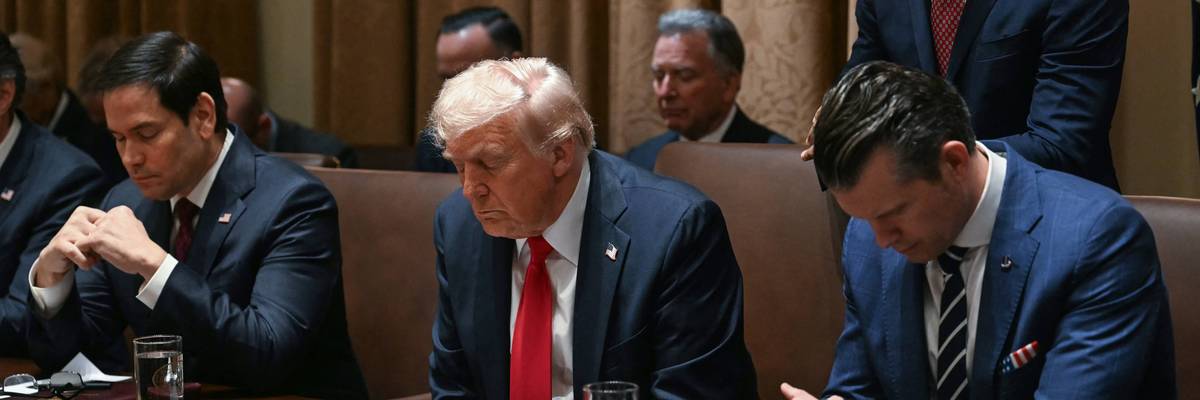
US President Donald Trump bows his head in prayer alongside Secretary of State Marco Rubio, Secretary of Defense Pete Hegseth, and Housing and Urban Development Secretary Scott Turner during a Cabinet meeting at the White House in Washington, DC, on February 26, 2025.
(Photo by Jim Watson/AFP via Getty Images)

Julia Conley
May 15, 2026
COMMON DREAMS


An all-day prayer event scheduled for Sunday on the National Mall is set to feature evangelical Protestant leaders as well as top White House and Republican Party officials as speakers, and is being promoted as a celebration of “thanksgiving” as well as an opportunity for participants to learn about the founding of the nation as the 250th anniversary of its independence approaches.

In reality, said Rachel Laser, president and CEO of Americans United for Separation of Church and State, the “National Jubilee of Prayer, Praise, and Thanksgiving” appears to be a “Jubilee of Christian Nationalism”—with evangelical Christians making up three-quarters of the scheduled speakers, despite the fact that they account for just a quarter of Americans overall.

“If President Trump and his allies truly cared about America’s legacy of religious freedom, they would be celebrating church-state separation as the unique American invention that has allowed religious diversity to flourish in our country,” said Laser. “Instead, they continue to threaten this foundational principle by advancing a Christian nationalist crusade to impose one narrow version of Christianity on all Americans.”

The event, which is partly funded by taxpayer dollars earmarked for the nation’s 250th anniversary, will feature Christian musical performers organized around three “pillars” that are labeled as “miracles” a Christian God bestowed on America, “personal testimonies of God’s healing,” and a “unified moment of rededication.”

At a webinar last month, Rev. Paula White-Cain, who serves as a faith adviser to the White House, said the event is “really truly rededicating the country to God.”

The idea that the founders of the United States intended the country to be a Christian one has long been a fixation of evangelical Christian leaders, despite the lack of evidence for such a claim.

“Look at the document,” Princeton University history professor Kevin Kruse told The Washington Post, referring to the Constitution. “The only rules they wrote about religion were ones that keep religion at arm’s length. No establishment, no limits on free exercise, no religious test for office... There’s a difference between saying America is a nation with many Christians in it and that America is a nation dedicated to Christianity and defined by it.”

Robert Jones, president of the Public Religion Research Institute, told the Post that about a third of Americans currently report that they have no religious affiliation, making the US more religiously diverse than it’s ever been.

“We proudly celebrate 250 years of American independence from kings who ruled over both church and state,” said Laser. “For 250 years, America has been marching toward the promise of a country where all people can be free to live as themselves and believe as they choose, as long as they don’t harm others. Christian nationalists threaten that promise by undermining church-state separation, a pillar of our democracy.”

The jubilee, which will also feature an 18-wheeler “Freedom Truck” featuring educational content made by the right-wing group PragerU and the Christian school Hillsdale College, comes after numerous displays of religiosity from the Trump administration.

Even many of the president’s supporters on the Christian right were aghast at an artificial intelligence-generated image he posted last month on social media, appearing to depict him as a Christ figure. Defense Secretary Pete Hegseth, who is set to speak at the jubilee, has spoken about the US-Israeli war on Iran as Christian crusade and has hosted evangelical worship services at the Pentagon, while Agriculture Secretary Brooke Rollins wrote, “He is Risen indeed!” in an Easter email to federal employees that recounted the biblical story of the resurrection.

Robert Weissman, co-president of government watchdog Public Citizen, noted that the corporate sponsors of Freedom 250, the public-private partnership that’s organizing the 250th anniversary, “may want to curry favor with the Trump administration.”

The sponsors, including John Deere, Oracle, and Lockheed Martin, “should be forced to answer whether they support the extreme agenda they are celebrating,” he said.

“This outrageous event makes a mockery of a core constitutional tenet of American life, the separation of church and state, essentially promoting a particular flavor of white evangelical protestantism as state-sponsored religion,” said Weissman. “This self-proclaimed day of thanksgiving torpedoes the best of American traditions—inclusivity and diversity—and has no place being connected to the US government.”


Opinion

Jesus’ Great Commission is a rebuttal to the Christian nationalism of Rededicate 250

(RNS) — Jesus did not command his followers to build a Christian nation. He commanded them to love, feed, welcome and tell the truth.


People march during the 60th anniversary of the march to ensure that African Americans could exercise their constitutional right to vote, March 9, 2025, in Selma, Ala.
 (AP Photo/Mike Stewart)

Jim Wallis
May 15, 2026
RNS

(RNS) — Forty days after Easter, Christians observe Ascension Day (May 14), celebrating the bodily ascension of Jesus into heaven. After many post-Easter appearances and conversations with his disciples, this was the last time they would see the earthly Jesus, marking the conclusion of his earthly ministry.

Just before his ascension, in what is now often called the Great Commission, Jesus gave his final commandment to his disciples. The Bible says:

“Now the eleven disciples went to Galilee, to the mountain to which Jesus had directed them. When they saw him they worshiped him and some doubted, And Jesus came and said to them, ‘All authority in heaven and on earth has been given to me. Go therefore, and make disciples of all nations, baptizing them in the name of the Father and of the Son and of the Holy Spirit and teaching them to obey everything that I have commanded you. And remember, I am with you always, to the end of the age.” (Matthew 28:16-20)

Growing up in a conservative evangelical church, I struggled with how the Great Commission was often privatized and reduced to a message of personal salvation alone, with little reference to the teachings Jesus commanded his disciples to live out in the world.

I later came to see a fuller and more biblical meaning of the Great Commission — one anchored in the teachings and commandments of Jesus himself. Understanding the importance of this day of ascension guides us to answer the Christian call to help build a more just, compassionate and truthful world for all people by following the way of Jesus and rejecting the narrow privatized interpretation.

The Trump administration violates the Great Commission every day. In Matthew 25, Jesus says, “I was hungry,” yet this administration continues to advance policies that make more people hungry both here in the United States and around the world. Cuts to Supplemental Nutrition Assistance Program benefits have increased our nation’s food insecurity, leaving families to struggle, while the Department of Agriculture has halted data collection efforts, effectively obscuring the human impact these cuts have had and avoiding accountability for the growing hunger facing millions of Americans. Beyond our borders, people are dying amid wars and humanitarian crises that the Trump administration has helped fuel, finance or refused to end.


Work continues on the stage for the Rededicate 250 event on the National Mall, Tuesday, May 12, 2026, in Washington. (AP Photo/Alex Brandon)

Jesus says, “I was a stranger,” yet the cruelty and violence of the White House’s mass deportation policies, disproportionately targeting immigrants of color, continues on. With Markwayne Mullin taking charge of the Department of Homeland Security, there have been efforts to decrease reporting on immigration crackdowns, The New York Times reported. This has been a tactical switch as we approach the midterm elections, due to Republicans’ fears of voter resentment over immigration policies. Even so, in April there was a 94% increase in removal flights, with 245 deportation flights departing in a single month.

Jesus also says, “I was sick,” but the GOP is reportedly considering cutting federal health spending to help supplement the $200 billion military budget to pay for the war on Iran.

These realities should lead Christians, especially those who support the current administration, to ask what it truly means to obey the teachings Jesus commanded his disciples to follow. The Great Commission should give us the opportunity to evaluate whether our public life reflects the values of God’s kingdom.

While the Ascension Day feast technically falls exactly on the 40th day after Jesus’ resurrection, many Christians will observe and celebrate this weekend at church. Also this weekend, two contrasting public events, both anchored by faith leaders, will put forward radically different understandings of what Christians in this moment are being called to do for their separate visions of America.

On Saturday, thousands are gathering in Selma and Montgomery, Alabama, for All Roads Lead to the South — a National Day of Action. The mobilization comes as a response to the dangerous attacks on civil and voting rights we have experienced in the past weeks, including the clear racial gerrymandering efforts across Southern states aimed at weakening Black representation at both the state and national levels. Faith leaders, organizers and activists are joining together in direct action to defend voting rights and Black political power across the South.

While thousands gather in Montgomery, a very different vision of America will be on display at the National Mall the following day. Organizers of the “Rededicate 250: A National Jubilee of Prayer, Praise & Thanksgiving” event, a large-scale Christian nationalist rally framed around the nation’s 250th birthday, are calling Americans to the mall for Scripture, prayer, testimony and what they describe as a “rededication” of the country as “One Nation to God” — language that goes beyond patriotism and firmly advances into a false theological claim about our nation’s identity and divine status. Running from morning fellowship on the Capitol grounds to an evening concert, the event is designed to project the image of a Christian America seeking divine guidance for its next 250 years as a newly chosen nation.

The contrast with Montgomery, and more importantly with the Great Commission itself, could not be sharper.

The Great Commission offers a direct rebuttal to the Christian nationalist vision on display by some politicians today and at Rededicate 250. Its call to make disciples of all nations rejects any privileged status for America, or for any racial or ethnic group, and, by its own logic, is a repudiation of white Christian nationalism. Equally important is the distinction between making disciples and making converts. The Commission is an invitation into the life, teachings and values of Jesus — love, justice, compassion, forgiveness and care for others. The kingdom of God, in other words, is not a political regime or a national identity. It belongs to the whole world.

Aaron Graham, pastor of the District Church in Washington D.C., has a new book, called “Unshakable Faith,” where he speaks to what the Great Commission means to us right now and for the long haul. To follow the things Jesus commanded in a time like this, when authoritarian power holders promise and execute retribution against all who oppose them, will require courage on our parts.

To hold onto our hope we must always remember the cloud of God’s presence that protects and guides us. I am very grateful for how the Great Commission ends, “And remember, I am with you always, to the end of the age.” Knowing that Jesus is with us through it all gives us the courage to follow his teachings in the face of authoritarian power and injustice.

Happy Ascension Day!

(The Rev. Jim Wallis is Archbishop Desmond Tutu Chair and director of Georgetown University’s Center on Faith and Justice and is the author, most recently, of “The False White Gospel: Rejecting Christian Nationalism, Reclaiming True Faith, and Refounding Democracy.” A version of this commentary appeared on the Substack God’s Politics with Jim Wallis. The views expressed here do not necessarily reflect those of RNS.)
Spiritual Politics

The US is not a nation-state, much less a Christian one

(RNS) — The framers of the Constitution went a long way toward making sure that wasn't the case.


Tourists visit the Lincoln Memorial as work continues on the Lincoln Memorial Reflecting Pool, Tuesday, May 12, 2026, on the National Mall in Washington.
 (AP Photo/Rahmat Gul)

Mark Silk
May 15, 2026
RNS


(RNS) — George Orwell famously defined nationalism as “the habit of identifying oneself with a single nation or other unit, placing it beyond good and evil and recognizing no other duty than that of advancing its interests.” But what exactly is a nation?

The term derives from the Latin natio, meaning breed or species, and was adopted in medieval universities to organize students coming from different places. (At the University of Paris, the principal nations were French, Norman, Picard and English-German.) In due course, the term was applied to entire populations, but geography alone did not suffice to establish national identity. What also counted (or could count) was your native language, your ethnicity or ancestry, and your religion.

Countries defined in terms of a single nation thus came to be called nation-states. A significant dimension of 19th-century nationalism was the desire on the part of nations that lacked a country of their own to have one.

After World War I, various nations in Central and Eastern Europe that had been part of multinational empires, like Russia and Austro-Hungary, were enabled to establish nation-states — Poland for the Poles, Hungary for the Hungarians, Lithuania for Lithuanians, etc. In our time, the breakup of the Soviet Union created comparable nation-states like Kazakhstan, Uzbekistan and Tajikistan.

But what of the people in a given nation-state who belonged to a different nation — Ukrainians or Germans or Jews, for example, living in interwar Poland? They could express their national identity through their own (sometimes state-supported) educational and cultural institutions, and with representation in governmental bodies.

All this is at odds with how the United States has defined itself. Within our borders the only nations in the European sense are Native Americans, many of whom have territory and laws of their own and who in fact identify as nations.

If, in the words of the Pledge of Allegiance, we are “one nation,” it’s because of the terms laid out in our founding documents. Or as Supreme Court Justice Neil Gorsuch told New York Times columnist David French the other day, “We’re a creedal nation, right, David? I mean, we don’t share a religion, we don’t share a race, we share an idea, OK?”

To be sure, many Americans identify with a particular ethnic or racial community, a religious body or a country of origin. And while they are not identified as separate nations, they may be considered adherents of separate nationalisms.

Before the fall of the Soviet Union, there were Ukrainian nationalists raising money for an independent Ukraine. Zionists — Jewish nationalists — support the state of Israel as the Jewish homeland. Black nationalists reject integration in favor of self-determination, economic empowerment and racial solidarity.

Such nationalisms relate to the interests or aspirations of minorities of the population. It’s something else entirely when nationalist claims are made on behalf of the majority. These have to do with defining the United States itself.

Christian nationalism thus has to do with advancing the claim that Christianity has special standing in the country. As religion scholar Jerome Copulsky makes clear in a fine essay on this site, the desire to do so has a long history, in large part because the framers of the Constitution went a long way toward making sure that wasn’t the case — rejecting religious tests for office, barring religious establishments and guaranteeing religious free exercise.

According to White House faith adviser Paula White-Cain, Sunday’s daylong federally underwritten Jubilee of Prayer, Praise & Thanksgiving on the National Mall is about “rededicating the country to God.” The thing is, our nation wasn’t dedicated to God in the first place.
A Christian nation? At 250, America is still fighting over what that means

Scholars say American history is more Christian than secular advocates claim — and less religious than Christian nationalists would assert. A look at the complicated, contested history of America as a Christian nation.


Bob Smietana
May 13, 2026
RJS


(RNS) — When people ask Holly Hollman if America is a Christian nation, she has a simple response.

“What do you mean by that?”

The longtime general counsel of the Washington, D.C.-based Baptist Joint Committee for Religious Liberty, which promotes the separation of church and state, Hollman explains that if the question is whether most Americans are Christian, that’s yes. But if they’re asking whether Christians should have special legal privileges that others don’t have, she says her answer is a hard no.

Most historians and legal scholars agree that two things have always been true about the United States — it has no official religion, and Christianity has shaped its culture, laws and public life since before its founding. But what does it mean to be a nation of mostly Christians without a state religion? For most of the nation’s history, the country held that tension without resolving it.

The debate over that question has gained new intensity in the Trump era, especially as the country approaches its 250th anniversary. On Sunday (May 17), the Trump administration will host “Rededicate 250,” a daylong festival of prayer and thanksgiving on the National Mall. The idea, Trump said when he announced the event at the National Prayer Breakfast, is to “rededicate America as one nation under God.” Many of the speakers at the event — most of them Christian and evangelical — espouse the idea that America was and always has been a Christian nation.

The argument is not merely historical. Some proponents of America as a Christian nation argue that non-Christians are essentially second-class citizens — and say only Christians should enjoy religious freedom or have the right to run the country. That’s turned disagreements over America’s founding into a debate over national identity with direct consequences for the country’s growing number of non-Christian Americans.


“The Prayer at Valley Forge” engraving by John C. McRae, from an original painting by Henry Brueckner, circa 1889. (Image courtesy of Library of Congress/Creative Commons). The painting was inspired by a biography of George Washington that contains factual errors, says author Warren Throckmorton.

Until the 1970s, the belief that America was a Christian nation — demographically and culturally — was commonplace, said John Fea, a professor of history at Messiah College in Pennsylvania and author of “Was America Founded as a Christian Nation?” Many of the nation’s laws, on everything from sexuality and marriage to more mundane details, such as what kinds of businesses could open on Sundays, were shaped by Christian ideas.
RELATED: Hegseth, Barron, evangelical leaders to join Trump event rededicating America to God

The notion of America as a Christian country became contested and redefined during the Reagan era and the rise of the religious right, which wanted the country’s laws to be more explicitly Christian. There were calls for official prayers and Bible readings in school and a return to “family values” in response to the sexual revolution of the ’60s and 1970s and the rise of feminism.

All of a sudden, the idea of being a Christian nation became a partisan debate, not a historical one.

“You want to get on the side of Christian America, or you’re going to oppose a Christian America — that pretty much tells you where you are at politically today,” said Fea.

Fea is careful to note that America has never been legally a Christian country — the establishment clause in the First Amendment to the Constitution explicitly forbids establishing an official national religion. Nonetheless, from the earliest days of the republic, many Christians, on all sides of the political spectrum, have argued that all aspects of society, including governmental policy, should be shaped by their faith.


John Fea gives a lecture at the Lumen Center near the University of Wisconsin–Madison on Oct. 3, 2025, in Madison, Wis. (Photo courtesy of Stephen and Laurel Brown Foundation)

Matthew Avery Sutton, a professor of history at Washington State University and author of “Chosen Land,” a religious history of America, said the country is more religious than secular Americans claim and less religious than Christian nationalists would have us believe.

White Protestants, he said, had no qualms about shaping education, politics and foreign policy, as well as the day-to-day aspects of life — especially in the first 150 years of the country’s life. There were Christian prayers in school, and political debates on issues such as immigration, slavery, the use of alcohol and other social issues were rife with references to religion.

And politicians talked a lot about God.

That’s something conservatives like David Barton, a popular evangelical author who promotes the idea that America has always been a Christian nation, get right.

“When they say that the First Amendment did not keep religion out of government but simply kept government out of religion — I think that is an accurate description of the way the First Amendment was applied,” Sutton said.


The flags circling the Washington Monument fly at half-staff in Washington, Thursday, Aug. 28, 2025. (AP Photo/J. Scott Applewhite)

Much of the modern debate about America as a Christian nation has been shaped by a 1947 Supreme Court decision, Everson v. Board of Education. In that case, a New Jersey taxpayer named Arch Everson objected to a local school board policy that reimbursed parents for bus fare to school, even if kids went to Catholic schools.

Everson lost — the court ruled that since the reimbursement went to the parents, it was legal. However, the court also ruled for the first time that the First Amendment applied to state governments — and it made Thomas Jefferson’s idea — that the First Amendment made a “wall of separation” between church and state — an explicit part of law.

“The First Amendment has erected a wall between church and state,” the court wrote. “That wall must be kept high and impregnable.”

That ruling would pave the way for later ones that ended official prayer and Bible readings in school and would eventually shift the way many Americans view this issue, especially those on the political left, Fea argues.


Holly Hollman. (Photo courtesy of BJC)

“For people on the left, especially, Everson has reshaped the way the whole national history, going back to 1776, has been told,” Fea said. “All of a sudden, you have this wall of separation of church and state that’s high and impregnable.”

Sutton said the Everson decision was good for America. But the court’s reading ignored a lot of history. “I like that interpretation better,” he said. “I think that produces a better country, but it is a bit ahistorical.”

Legal experts like Hollman have a different view.

Hollman, who also teaches law at Georgetown University, sees the Everson case not as a turning point but as surfacing a principle present from the beginning.

“There’s a thread in the understanding of the First Amendment — one of the central purposes is to keep the government out of essential matters of religion,” she said. “Certainly, an essential matter of religion is how people believe about God and their relationship to God, and what Scripture they hold as important.”

Sutton pointed to “The Light and the Glory,” a bestselling book first published in the 1970s, after government-sponsored prayer and Bible reading were banned in school, as helping to inspire calls to revive Christian America. Co-written by Peter Marshall Jr., a pastor and speaker who championed the idea that America was founded as a Christian nation, the book was popular with homeschoolers and conservative Christians.

“They helped fuel this idea that the nation was once one thing and that had been lost, and that it’s up to Christians to reclaim it,” Sutton said.

Christians have been making that same argument since the earliest days in the United States, often in ways that sound like the Seven Mountain Mandate, a conservative evangelical idea that Christians should run all parts of society.

“The complete Christianization of all life is what we pray and work for, when we work and pray for the coming of the kingdom of heaven,” the Rev. Washington Gladden, a Columbus, Ohio, pastor and leader of the Social Gospel movement, told the State Association of Congregational Churches of Ohio in May of 1894.

For Gladden, though, making society more Christian meant doing things such as building housing for the poor, ending segregation, giving better wages for workers, welcoming immigrants, putting limits on profits from the stock market and other social causes.

That call to revive a God-blessed past has gained new popularity today in conservative circles, through writers such as Barton and through the rise of Christian nationalists. For them, making society more Christian means making sure conservative Christians have political power and opposing same-sex marriage and abortion.

Much of what proponents cite as proof that America was founded as a Christian nation is factually incorrect, according to Warren Throckmorton, a retired psychology professor and author of “The Christian Past That Wasn’t,” due out May 19.

Throckmorton notes that Ben Carson, the former secretary of Housing and Urban Development, neurosurgeon and author, claimed that prayer saved the U.S. Constitution. While on a book tour in 2024, Carson told the story of how delegates to the Constitutional Convention in June of 1787 found themselves bogged down. Then Ben Franklin suggested that the delegates start praying and asking for “the assistance of Heaven.”

“And they knelt and prayed. And they got up and they put together the Constitution of the United States, which I think is a God-inspired document if we will follow it,” Carson said, at an event Throckmorton recounted in his book.

Franklin did implore delegates to pray, said Throckmorton. But they decided not to.

“The Convention, except three or four persons, thought prayers unnecessary,” Franklin would later write.

For Throckmorton, concerns about the separation of church and state go way back — all the way to his distant ancestor, John Throckmorton, a follower of the Baptist preacher Roger Williams. When Williams was exiled from Massachusetts after clashing with Puritan leaders, John Throckmorton joined him in what became the state of Rhode Island — one of the few early Colonies not to have an official state church.

Warren Throckmorton, author of a new book, "The Christian Past That Wasn't" (Courtesy photo)

"The Banishment of Roger Williams" by Peter F. Rothermel, circa 1850.
 (Image courtesy Wikipedia/Creative Commons)

“Religious freedom in America and separation of church and state does not only go back to Williams, but it goes back to the people who are willing to sacrifice everything and move to Providence with him,” Warren Throckmorton said.

Even though most Americans have been Christians, Throckmorton said, there’s been no consensus on the most Christian way to run a country. Those disagreements started even before the country was founded — like the feud between Williams, a Baptist, and the Puritan leaders of Massachusetts, who were Congregationalists. Christians even fought over which edition of the Bible to read in public schools — leading in the 1800s to the so-called Bible War in Cincinnati and the riots in Philadelphia between Catholics and Protestants.

Those disagreements continue today with different Christians arguing over immigration enforcement policies and claims by Defense Secretary Pete Hegseth that God has blessed America’s war on Iran.

“There’s no unified view with Christianity,” said Throckmorton.

In his latest book, Throckmorton debunks what he calls seven myths about America’s past — from the idea that early colonists made a “covenant” with God to the idea that America’s founders were all Christians and wanted to create a Christian homeland.

These myths are built on stories like the one about Franklin and prayer — which are partially true — in order to create a politically useful version of the past.

“One of the reasons that founding myths arise is so that we can feel a part of something bigger than ourselves — part of a really great country and a really great religion,” he said. “I mean, you don’t want to be a part of a bad religion or a bad country.”

Daniel Darling, author of “In Defense of Christian Patriotism,” is sympathetic to the claim that Christianity is a central part of America’s identity. Christianity has long served as America’s civil religion, he said, providing a common moral framework for American culture and law.

Along with giving a sense of right and wrong, that framework taught that our fellow citizens are people made in God’s image and, as such, have inalienable rights not from government but from God, said Darling.

He said that Christianity and especially churchgoing also helped provide social capital and build community, two things that are in short supply these days as religion has declined over the past few decades. When people say they want to get back to being a Christian nation, Darling thinks they are really longing for a return to a sense of community and common purpose. They don’t want to go back to the 1950s, he said, because that would mean undoing the progress that’s been made on civil rights and other issues since then.

“But I do think there is a sense that we’ve lost something good, even if we’ve made progress. I think you can hold those two things together.”

Fea said that as a historian, he wants to know what people think being a Christian nation means. He pointed to Martin Luther King Jr.’s letter from a Birmingham jail, which linked “Judaeo Christian” values to the nation’s founding.

Civil rights protesters, King wrote, drew on the heritage.


In this file photo taken April 12, 1963, the Rev. Ralph Abernathy, left, and the Rev. Martin Luther King Jr., right, are taken by a policeman as they led a line of demonstrators into the business section of Birmingham, Alabama. Arrested for leading a march against racial segregation, King spent days in solitary confinement writing his “Letter from Birmingham Jail,” which was smuggled out and stirred the world by explaining why Black people couldn’t keep waiting for fair treatment. (AP Photo)

“One day the South will know that when these disinherited children of God sat down at lunch counters, they were in reality standing up for what is best in the American dream and for the most sacred values in our Judaeo Christian heritage,” he wrote, “thereby bringing our nation back to those great wells of democracy which were dug deep by the founding fathers in their formulation of the Constitution and the Declaration of Independence.”

Fea said that there has often been a backlash in American culture during times of demographic and social change. That was true in the 1800s, when Irish immigrants came to the U.S., and in the early 1900s, when Italians and other Europeans arrived, and it’s been true in recent years with Hispanic immigrants — and with Muslim and Hindu immigrants.

He believes that backlash is helping fuel the arguments that America is a nation for Christians. Recently, Jenna Ellis, a former Trump lawyer turned podcaster, argued that freedom of religion only applied to Christians — not those of other faiths.

“I mean, we don’t have all of these protections for our rights that our founders recognize come from God, our Creator, so that we can go out and live a pluralistic society and say, well, let’s recognize the dignity of Islam,” she said, claiming that the founders only wanted to protect Christians.

Fea says that’s not what history tells us. The founders knew that Hindus and Muslims might make their way to America and believed religious freedom applied to them.

“The challenge at the 250th is to think about how we can still hold on to those ideas about equality, liberty and religious freedom and make them work in a modern context,” he said.