Tuesday, May 26, 2026


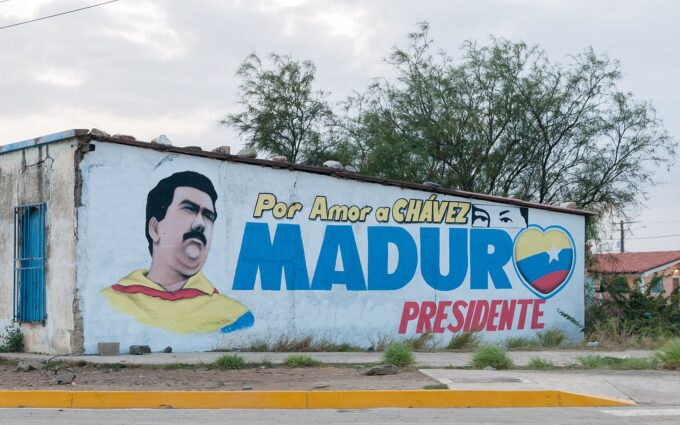
The Bogus U.S. Case Against Nicolas Maduro

May 25, 2026

Photograph Source: Wilfredor – CC0

So the U.S. military and CIA kidnapped the duly elected, legitimate president of Venezuela in January, shackled him, brought him to a U.S. prison, and now the white house is desperate to pin crimes on him that fit the unjustifiable punishment it has inflicted. That would be money laundering. And, apparently, the gang in the white house worries, per CBS May 19, about the absence of this charge from the New York indictment of Venezuelan president Nicolas Maduro, because their case is weak, and they know it. In fact, it’s a good guess – mind you, a guess – that it’s been fabricated, spun out of whole cloth to frame Maduro for whatever might stick, because Donald “We’ll Take the Oil” Trump despises Maduro’s political pedigree – socialist – and coveted, before grabbing, his nation’s energy.

I suppose if the money laundering charges don’t work, there are always gun charges, and if those don’t pan out, the Department of Justice (sic) can try a drug indictment. Meanwhile, Washington, having evidently co-opted the acting president in Caracas, Delcy Rodriguez, has finally got its hands back on luckless Venezuelan diplomat Alex Saab, deported over the weekend of May 16 from Venezuela back to the U.S., whence he had previously been released from prison by Joe Biden on December 20, 2023.

Saab’s an ally of Maduro, and according to the AP on May 19, “was charged Monday with bribing top officials to steal hundreds of millions of dollars from lucrative contracts to import food at a time of widespread hardship” in Venezuela. Who caused this hardship, Saab allegedly exploited? The government for which that so-called justice department works, the government whose sanctions starve Venezuelans, the government that had the brazen nerve to blame an admittedly shady character like Saab for the atrocious damage it inflicted on Venezuela. That would be the government of the USA.

So there is “a single count of money laundering tied to a decade-old conspiracy” against Saab. He was previously kidnapped in the first iteration of Trump’s rule, back in 2020, during an airplane refueling stopover in Cape Verde on “a high-level humanitarian mission to Iran.” Those who saw Israel’s hand in this kidnapping of the Venezuelan with supposed Hezbollah ties and in the renewed nabbing of Saab could perhaps be termed paranoid, but be that as it may. Trump, as was seen with Maduro, is perfectly capable of doing horrible things without Israel’s instigation.

Trump’s original Saab caper involved flouting the law of diplomatic immunity by seizing Saab, then on a diplomatic mission, a move that stupidly endangered diplomats everywhere, including American ones. As I wrote in this space on November 3, 2023, “Washington especially loathes Saab, 51, because he was such a SUCCESSFUL Venezuelan diplomat, one who arranged deals for his country with Iran, deals that evaded the stranglehold of U.S. sanctions on both nations.” This was at a time of indisputable hardship for ordinary Venezuelans, due to illegal U.S. sanctions. So Saab, sketchy as he may be, was nonetheless doing this very good, altruistic work, trying to obviate starvation sanctions to aid his financially blockaded country. Saab was likely tortured in Cape Verde, and he wasn’t exactly treated with kid gloves thereafter in the Miami Federal Detention Center, where he rotted away, among other things, vomiting blood, not receiving the life-and-death medical care he desperately required.

One wonders with what threats of lawless violence Washington twisted Delcy Rodriguez’s arm to get its hands on Saab. Anything is possible. After all, look what they did to Maduro – a kidnapping that ranks up there as one of the greatest international crimes of the century. But a white house that has deployed the departments of justice and war like its own private mercenary army has few cards left to play. Gangsterism is its ace, though it may well have maxed out with that: if it crucifies Maduro on phony charges, not only does it lose any credibility a fool might attribute to it, but it also creates a martyr. Maduro was far from a perfect president, but thanks to this revolting kidnapping (and to many of Maduro’s own policies) that is not how he will be remembered. He will be remembered as a president who represented his people and was, in one of the most repellent military operations in recent history, abducted so that Washington could plunder oil.

Maduro and his wife, Cicilia Flores, are in federal custody in the Metropolitan Detention Center in Brooklyn and scheduled to return to court on June 30. The feds have been after him – one could reasonably conclude for his politics – for a long time. The original indictment against him and other Venezuelan officials was filed in the Southern District of New York in 2011 and unsealed in March 2020. Per Wikipedia, that indictment alleged that they “conspired with Colombian guerrilla groups to traffic cocaine into the U.S. in a narcoterrorism conspiracy.” “On January 3, 2026, a superseding indictment was unsealed” after Maduro’s and Flores’ forcible removal to the U.S.

Meanwhile, again per Wikipedia, Argentina had leapt into the act. There, a case against Maduro’s alleged crimes was filed in 2023. An international arrest warrant for Maduro was issued in 2024. In February 2026, an [Argentine] extradition of Maduro was requested after his capture. Argentine judge Sebastian Ramos signed a warrant on Maduro for crimes against humanity. Charges include torture, arbitrary detention and enforced disappearance by the Bolivarian National Intelligence.” In this connection, of course, one must note the politics: Argentina is under the economically incompetent, far-right president Javier Milei, who, it appears, will do almost anything to curry favor with Trump. How and if this political atmosphere influenced the recent extradition request for Maduro in Argentina is an open question, but one worth considering.

On May 20, news via Reuters came that the U.S. is pursuing a second criminal investigation into Maduro. “The second investigation, run out of the U.S. Attorney’s office in Miami, has been ongoing for months,” according to two anonymous sources. Per google, it acts as a “legal fallback to the superseding indictment unsealed last January. An unnamed DOJ official told Reuters that “the Florida probe was active at the time that President Donald Trump ordered the US military raid that captured Maduro.” Reuters credits CBS with being the “first to report on the second investigation fun out of Florida. It is not clear if that probe will lead to additional charges…The Florida investigation could give the Justice Department a fallback option if it faces legal complications in Maduro’s New York case.” On May 18, that same U.S. attorney’s office unsealed money laundering charges against…Alex Saab. The office is also expected on [May 20] to charge Cuban President Raul Castro over the downing of planes piloted by a Cuban exile group in 1996.” Indeed, it promptly did just that, causing RT to wonder, May 21, if Washington had the same scheme in store for Raul Castro as it did for Maduro. So that week in May is officially the “feds get a commie week.” Apparently, it doesn’t matter much which one.

“Interim president Delcy Rodriguez’s action against Saab [turning him over to the U.S.] was one of treachery and should be referred to as such,” wrote Margaret Kimberly in Black Agenda Report, May 20. “The pain of seeing the Bolivarian revolution being picked apart by Donald Trump with the help of some willing participants in Venezuela is devastating to anyone who supported the rights of sovereignty and self-determination for that country and its people.” Kimberly cites the Trump regime’s use of lawfare not only against Saab, Maduro and Flores, but also against Rodriguez, who “is the nominal head of state, but she is following Washington’s orders.”

Years of cruel U.S. sanctions have killed multitudes of Venezuelans by making hungry poor people skip meals, diabetics ration their insulin and cancer patients forgo chemo. Now, under Trump, Washington wants to finish the job. If Rodriguez makes an infernal pact and assists in this endeavor, well, call it what it is: a deadly assault on some of the most vulnerable people in Latin America. You don’t know how Chavista Rodriguez, whose father was tortured to death by the CIA, has been threatened, but you’ve got to assume it was horrifying, not just for her personally but for her country. She has probably avoided a guerrilla war, but in the process, it sure looks like she is making a desert and calling it peace.

Eve Ottenberg is a novelist and journalist. Her latest novel is Old Man Alone. She can be reached at her website.

The Politics of Purity and the War on Venezuela


May 26, 2026
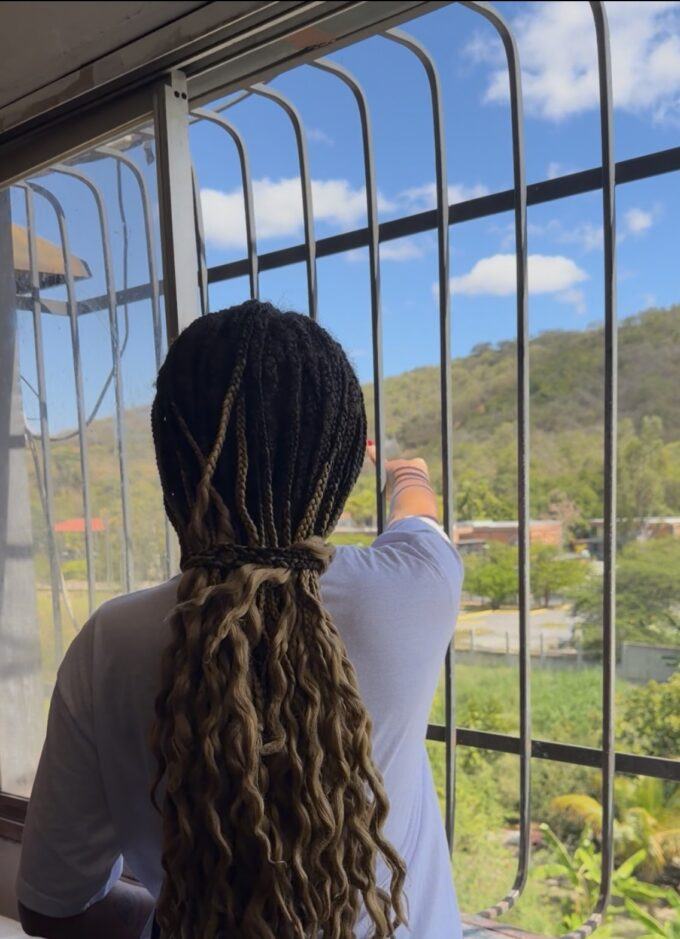
Oriana points through her living room window at the bombing site where President Nicolás Maduro and First Lady Cilia Flores were abducted, January 2026.
Photograph by Celina della Croce.

In mid-January, a young Venezuelan mother named Oriana invited me into her home in Ciudad Tiuna, a government-built housing project with thousands of apartments and roughly 20,000 residents. With her five- and twelve- year-old sons in the other room, she pointed through the window at the charred earth where the United States military had abducted President Nicolás Maduro and First Lady Cilia Flores two weeks earlier. A few buildings down, Oriana’s neighbor showed me the path where a bullet had entered through the bedroom window, ricocheted off the wall, and pierced a dresser, a pair of shoes, and a towel next to her bed. The exterior and interior walls of the building, too, were pierced with bullets. So was the nearby primary school that Oriana’s son attends.
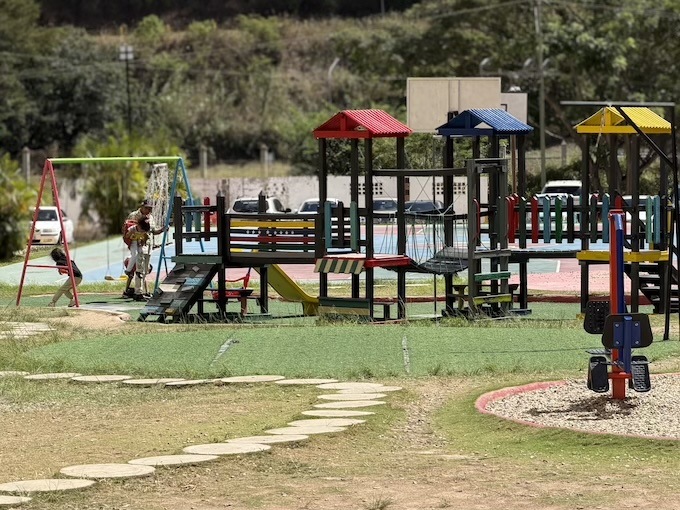
Children in a playground in Ciudad Tiuna, January 2026. Photograph by Celina della Croce.

Since the January 3 assault, rumors and accusations have spread like wildfire across the globe. On the evening of January 3, one of my neighbors in Queens, New York – who knew I was in Venezuela at the time – sent me a screenshot of a Tweet that had been seen by 4.3 million people alleging that “the so called ‘capture’ of Maduro was a negotiated deal between Maduro and US for an agreed exit strategy. …  Maduro likely already has purchased property in Dubai to retire to.” Last month, an attendee of an event in Brooklyn, New York – not far from where Maduro and Flores sit in prison – quipped, like many, that the country’s leadership has sold out since January 3 and asked somewhat rhetorically, why Venezuelans weren’t “fighting back”.

When I was invited to Venezuela for an assembly for peace in December, a friend of mine – a photographer – asked if I might have room in my suitcase to bring him a pair of combat pants. He, like many Venezuelans, had begun civic-military training exercises in the build-up to the bombing, in which Trump’s administration killed 150 fisherpeople, seized Venezuelan oil tankers, and repeatedly threatened and carried out acts aggression of against Venezuela. When I arrived in Caracas and caught up with a member of a commune in the neighborhood 23 de Enero (an economist by trade), he had a pistol tucked into his waistband: he was headed straight to his volunteer patrol shift after our conversation, preparing for the possibility of an invasion at any moment.

The idea that Venezuelans have given up or are not “real” revolutionaries is easy to profess from an armchair in the imperial core (as Vijay Prashad, Roxanne Dunbar Ortíz, and others reminded us in “A letter to intellectuals who deride revolutions in the name of purity,” published in the aftermath of the 2019 coup in Bolivia). There is a deep irony that this assertion is made – and made often – in a country that has not only intentionally and strategically “increase[ed] pain and suffering that the Venezuelan people are suffering from,” to use the boastful words of former Secretary of State Mike Pompeo, but that continues to brutally repress the right to democratic expression within its own borders (as is evident from the mass arrests of anti-police and anti-ICE protestors through the years, murders of Alex Pretti and Renée Good in Minneapolis earlier this year, and decades’-long political prisoners such as Mumia Abu-Jamal and Josh Williams). Yet for this group of people, the focal point, seemingly exclusively, is whether or not Venezuela (or Cuba, for that matter) is “doing it right.” Have they sold out? Has enough blood been shed to win the approval of these studied observers? (What happens within the US seems to be of no interest here).
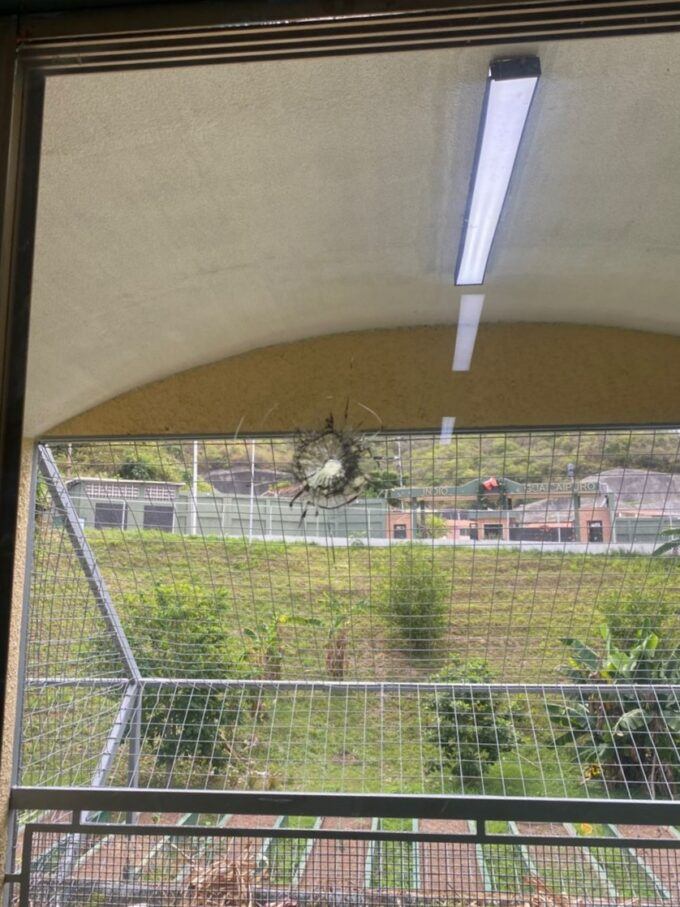
A window of the classroom where Oriana’s five-year-old son studies in Ciudad Tiuna, January 2026. Photograph courtesy of Celina della Croce.

In Venezuela, a country that has lived through terrorism in many forms – from the degradation imposed by the poverty in which 70% of the population lived before the revolution to the economic warfare wrought by the US which caused 40,000 people to die in the first year of Trump’s “maximum pressure campaign” and attempts to assassinate Maduro – many would prefer to die on their feet rather than to live on their knees. Over the years, the United States has spent millions of tax-payer dollars on “pro-democracy” initiatives in Venezuela that seek to enact regime change and has imposed over 1,000 unilateral coercive measures, including one of the harshest sanctions regimes in the world (in fact, the very idea of economic warfare is for the population to overthrow its own leader by, as US President Richard Nixon put it 1970, ‘mak[ing] the economy scream”).

The Trump administration has taken no pains to hide its agenda, declaring, repeatedly, some variation of phrases like “America will not … allow a hostile regime to take our Oil, Land, or any other Assets” (President Donald Trump) and the US is “deadly serious about getting back the oil that was stolen from us” (Secretary of War Pete Hegseth, “our” meaning Venezuela’s oil). Furthermore, Trump has been clear that a decision from the Venezuelan government to refuse to make concessions would undoubtedly lead to mass destruction, stating at his January 3 press conference, for instance, that “we are ready to stage a second and much larger attack if we need to do so… a much bigger wave, actually” and that “All political and military figures in Venezuela should understand what happened to Maduro can happen to them”. (Interestingly, in the press conference there is not a single mention of international law, which the US has violated repeatedly – only of “American justice,” “American property,” “American foreign policy,” “American dominance,” and “American sovereignty.” As Trump said in a telling slip of tongue, “I watched last night one of the most precise, uh, attacks on sovereignty. I mean, it was, uh, an attack f- — for justice.”)

Trump and his predecessor showed how far they are willing to go, and what they are capable of, to further the American agenda and consolidate US hegemony. The livestreamed genocide in Gaza has been one warning to the world; January 3 was another, when the US military shut off power in Caracas, disabled detection and air defense systems, flew over 150 aircraft into the city, bombed at least seven locations, and made off with the president and first lady (herself an important leader in the country since the early years of the revolution) after rehearsing the attack on a full-scale replica of Maduro’s compound built in Kentucky.

As US President Donald Trump boasted later the same day, “[t]his extremely successful operation should serve as warning” and “if you would’ve seen the speed, the violence… it’s just, it was an amazing thing, an amazing job that these people did.” Caracas became an example for the US government to show off its military might; as many survivors of the bombing told me, “we experienced, briefly, what it is like to be Palestinian.”

The discussion of where Venezuela “should” – or can – draw the line is an extremely complex one, and not something that should be taken lightly. January 3, and the genocide of Palestine before it, ushered in a heightened era of hyper-imperialism, an increasingly unrestrained, and illegal, use of US military power as the country’s economic and technological edge lose their edge. Faced with the threat of continued bombings and bloodshed, the Venezuelan people are left with a difficult, if not impossible, set of choices and their own internal contradictions to struggle through.

To fixate on these calculations while ignoring the context that informs them – implying that we, in the West, in fact know what is best and what decisions should be made – is an adaptation of imperialist thinking disguised as left intellect. Or, as Fidel Castro said, “You strangle us for… years and then criticize us for the way we breathe.”
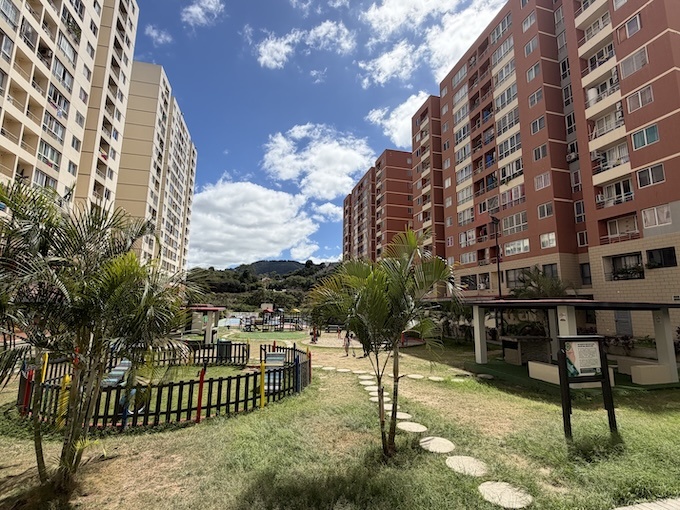
Apartment buildings near a January 3 bombing site in Ciudad Tiuna, a government-funded housing project through Mision Vivienda which has in total constructed over 5 million homes across the country. Photograph by Celina della Croce.

The decision of where to draw the line, what setbacks to accept and at what cost, and how much blood is to be shed, is one that belongs to the Venezuelan people – the ones who would pay the price for a hard stance with their lives. To imply that the Venezuelan people do not have agency in this choice is not only ahistorical but pedantic, colonial, and quite frankly racist. To point to one segment of the population – especially the diaspora in the US – as if they represented the voice of an entire people, is lazy, inaccurate, and unscientific. Those in the West who insist that Venezuela must take a hard stance to be a “real revolutionary” in so doing imply that Venezuelans are not acutely aware of the complex reality in which they find themselves and that they cannot think for themselves or sort through the contradictions and challenges they face, whether external or internal. This assumption is particularly ironic when imposed on a country where the revolution has from the onset used its wealth to fund programs that have not only vastly improved the quality of life of its people but have also bolstered their training, consciousness, and confidence to lead their own revolution, from Mission Robinson (which eradicated illiteracy by 2005 and taught 1.5 million people to read and write) to a variety of programs that have built dozens of universities and developed cadre training and political education.

The task for revolutionaries in the West is not to determine the “right” thing for Venezuela to do, nor is to make ahistorical comparisons that equate the reality in Venezuela with countries like Iran. The task, rather, is to recognize – and learn from – the extraordinary skill, leadership, and fierce dedication of a people who have endured decades, if not centuries, of foreign interference (including the kidnapping of former President Hugo Chávez in 2002) while building a struggle for social advancement and liberation at home. With no such accolades to boast in the US – a country rife with poverty and inequality whose president recently professed that the only obligation of the government is to fund the military – we would do well to learn from the Bolivarian Revolution rather than challenge the competency and ability of the Venezuelan people to determine their own future.


Celina is the director of publications and an editor at Tricontinental: Institute for Social Research. She has also been a participant and leader in internationalist, anti-imperialist, and working-class struggles in the United States for over a decade.

“The Decline of the Nation State and the End 

of the Rights of Man”


Photograph by Nathaniel St. Clair

When Edmund Burke learned that the French Assembly had proclaimed all men to be possessed of natural and inalienable rights, he is reported to have responded that he preferred his rights as an English man. Inalienable rights sound good, but who is going to enforce them? Under the cloak of Liberalism that question of enforcement has been profitably postponed for two centuries, usefully providing cover for an expansive Capitalism that now covers the globe.

Whilst in the early 19th century so called democratic rights were granted to tame the dangerous classes at Capitalism’s core – deluding workers into believing that citizenship transformed them into Burke’s political equals – the peoples of the colonised periphery continued to be exploited and their resources looted. The ruse, and Liberalism’s inherent obfuscation furthered this, was that some notion of equal rights would eventually follow as national liberation movements forced the West to decolonise. However, what has become increasingly apparent is that maintaining stability at the core is dependent on continuing exploitation at the periphery. As a monopolistic form of Capitalism (Lenin’s description of its last phase) needs to reboot itself with more additions of ‘primitive accumulation’ or free stuff, to keep the profits flowing and the dangerous classes quiescent. As arch-imperialist, Cecil Rhodes opined in 1895, “The Empire is a bread and butter question. If you want to avoid civil war, you must become imperialists.”[2]

It was Lenin’s prediction that this last imperialist phase would play out on the eve of the socialist revolution. And whilst the long-awaited proletarian overthrow looks unlikely, particularly now that large swathes of the working class are supporting the racist ideology of emerging elites, the stability of the nation state is, perhaps, less assured. Hannah Arendt thought its fate sealed by the refugee crisis she witnessed after World War 11 when Liberal states failed to recognise the human rights of the stateless. For Arendt, the fates of the two were intertwined since the concept of the sovereign individual imbued with rights by virtue of their birth was the very supposition for the rights of the citizen. Citizenship was the mechanism for preserving rights not for producing them. If the words of the declaration turn out to be a historical fiction, then the legitimacy of the nation state that is based on them goes the same way, “the crisis of one necessarily implies the end of the other.”[3]

World Systems analyst Immanuel Wallenstein believed the crucial date heralding the demise of the current world system was 1968, when the push back against global capitalism and its sham freedoms began. Though the collapse of Communism in 1989 was obviously important since it saw the removal of the “Liberal-socialist justification of the capitalist world economy”.[4] However, he thought that the real chaos would erupt later, when the periphery began to arrive at the core and the demographic balance of the northern states was disrupted. Because, whilst Liberalism has been holding in check the implications of individual sovereignty ever since its enunciation – essentially it’s been successfully externalising racism – that hold is now slipping and the system is in crisis. According to Wallenstein, what will ultimately emerge in the next world historical system, around 2050 to 2070, once the chaotic upheavals have subsided will be something very different – close to either rights for all or rights for none. Either the emergence of some genuine egalitarianism or a return to the hierarchy of privilege, presumably maintained with high levels of technological oversight. And whilst many of us won’t be around to check his theory, we can already see Western nation states – their legitimacy fading – attempting to stifle, often violently, the emerging inner contradictions.

As we watch, the Liberal West is flagrantly ignoring International law and the post war institutions set up, purportedly, to defend human rights. And, increasingly, it appears more comfortable with terrorism than with diplomacy – retrograde developments fully endorsed by the mainstream at the core – making it impossible not to recognise that the era of pretending universal rights is over. But as the Liberal mask slips and the West’s imperialist ambitions become evident, what is emerging is a significant disconnect within the core itself between the right-wing political elites and their acolytes who endorse the rising violence, and a substantial proportion of the demos which does not. No doubt the West’s support for Israel’s genocide in Gaza awoke much of the European and American populace from their political slumbers. And, as the dots are now joined from the horrors of Gaza to Israel’s ethnic cleansing in Lebanon to the illegal war on Iran, there is no sign that the populace is going back to sleep. Whether that profound discontent coalesces into some form of resistance is, of course, a different matter, and, no doubt, one currently under careful scrutiny.

Whilst Liberal-minded commentary continues to mention human rights commissions and reports, and even the possibility of another Nuremberg, these are simply iterations from the same old Liberal play book. Liberalism always was a buffering ideology; its purpose to insulate power from democratic reach, usually by gifting ‘rights’ –which, essentially, are no more than licences and easily withdrawn – to appropriate sectors at opportune times. Liberalism’s purpose was never to deliver accountability, but to deflect it.

Rubio’s revanchist speech at the Munich Security Conference set the tone. Decrying communism and anti-colonial uprisings for blocking the West’s ascendance, Rubio promised a colonising relaunch and was looking to Europe to reclaim its old heritage. A kind of Colonialism 2.0 no doubt: with heavily automated hardware, guided by Israeli surveillance and liquidation prowess, which was shaped by US tech bros after all. And presumably, zone specific, focussing on assets to be exploited and not needing to bother with all that old civilising rhetoric that weighed down the earlier colonialism, burdened as it was by the need to contribute something to the Liberal façade.

But just as the West is tuning up the propaganda for more Imperialist wars, it is presented with a domestic problem. Because realisations about the periphery have punctured the core, and a considerable proportion of its demos now openly identify with the forces resisting western backed violence. In the UK, the Labour government, which is widely recognised as an Israeli asset, has responded by arresting citizens protesting against the genocide. Not only has Palestine Action been proscribed, (although the proscription was ruled unlawful in November 2025, the government has appealed and arrests are still being made), but lawyers representing activists have been warned off advising juries on their right to acquit. The attack on civil liberties – much of it under the cover of ‘terror’ legislation – has been profound, as indeed it has in other European states.

Pro-Palestine protests, which have been going on in the capital for decades, are now being dubbed ‘Hate Marches’ – charged with being ‘anti-Semitic’ or ‘supportive of terrorism’ and are under constant threat of being banned.  The annual Nakba march which marks the anniversary of that tragic event and last year swelled to over half a million was recently forced to reroute to give way to an Anti-Islam protest led by Zionist tool, Tommy Robinson. There you have it – domestic divisions on Imperialist foreign policy parading through the London streets. And it is transparently clear which one the political class supports. What in Schmittian terms could be described as the distinction between enemy and friend – a distinction he deemed to be fundamentally unworkable within the body politic of the modern nation state.

As racism becomes a requirement for citizenship in western states, it’s not surprising that the writings of Nazi jurist, Carl Schmitt, are making a come-back. In his work, ‘Political Theology’ (Schmitt was of the view that all political concepts are essentially secularised religious ones) Schmitt explains why he believes that a nation has to be composed of the ‘like-minded’- what he calls ‘friends’. For Schmitt this essentially means the obedient. Since he specifically denies the individual the freedom or even the capacity to make their own moral judgments or hold contrary political views.  As Schmitt explains, such a political unity can be built “from below by consent” or, rather more ominously, ‘from above (through command and power)’. But, according to Schmitt there can be no nation state without that ‘substantive homogeneity of the people’.[5] The values of the populace must be identical and must be determined by the authority of the state. Because for Schmitt, the state is its own ‘autonomous ethic’, following its own moral direction. Which is why, for German jurists like Schmitt, ‘following orders’ was an entirely legitimate defence to war crime allegations.

Since Schmitt’s time, international law has developed further and, of course, pluralism has become a feature in the multicultural modern state, which makes it difficult to see how a racially diverse populace at ease with a multiplicity of views can be condensed back into an inward-looking monoculture of white ethnic supremacy. Although that seems to be precisely what Western governments are now trying to achieve –through a combination of elevating spurious Western values, heavy policing and terror tactics.

In that work Schmitt also sets out what he sees as the state’s justification for authoritarian rule, specifically its entitlement to act outside the bounds of the law – in the ‘State of Exception’, as he describes it. The State of Exception is the place of power above the law; it is where the essential decision-making takes place, and as such, according to Schmitt, is the locale of the nation’s true sovereignty. Quite simply, the Sovereign is the one with the power to command obedience and has nothing to do with legitimate authority or any constitutional rights. Unsurprisingly, perhaps, the entirety of Nazi rule took place in the state of exception which Hitler summoned into being with his appropriately worded directive ‘The Decree for the Protection of the People of the State’. And, generally, some justification around protection or state security is what is drawn on for actions emanating from the State of Exception, which, according to Italian philosopher, Gorgio Agamben, has increasingly become “a technique of modern government whether declared or not.”

In two works – State of Exception [2003] and Homo Sacer [1998] Agamben examines how modern states, including so-called democratic ones, increasingly use State of Exception mechanisms to govern; and the implications of this form of control for citizens and non-citizens alike.  In contrast to Schmitt’s ‘friend and enemy’ couplet, Agamben believes the most significant political distinction of the modern era is that between ‘Bios’ and ‘Zoe’: two distinct evaluations of human life. ‘Bios’ is the life with political significance, the one worthy of rights and protection, and belonging to the citizen. Whereas ‘Zoe’ – is bare life – the life-form without political value and that doesn’t deserve protection such as that of the refugee or the stateless. The distinction between Bios and Zoe is clearly apparent in the western media’s portrayal of Palestinian life, which is presented as a nameless, undifferentiated and essentially worthless mass. In sharp contrast to Israeli life, which is both differentiated and named, attributed with some biography and a sense of value.  It is this distinction which has now been brought to the core and is the subject matter of ‘Biopolitics’ – the politics that determines life’s value – that Agamben believes will swallow up all earlier oppositional categories like Right/Left, Public/Private, or Democracy/Absolutism, “as the era of Bourgeois democracy with its rights, its constitutions and its parliaments fades.”

Through the State of Exception, which Agamben believes is now the dominant paradigm, former constitutional norms become radically altered- in fact those norms are “annulled and new norms introduced,” as Sovereign power becomes linked to bare life, which is no longer at the distant periphery. And through extra-judicial measures determinations begin to be made as to that life’s value. “With the state of exception, which everywhere becomes the rule, bare life – which used to be at the margins of the political order, gradually begins to coincide with the political realm.” This was certainly the case in Nazi Germany where such ‘life-value’ determinations became the ‘Supreme Political Principle.’ And indeed, for Agamben, Nazism, like Fascism is an ideology of Biopolitics because its very essence is to “redefine the relations between man and the citizen.” And, of course, Zionism should also be seen as an ideology of Biopolitics: the Palestinian fulfilling Agamben’s definition of “the new living dead man,” just as Gaza is ‘the camp’ – the threshold for distinctions beyond the ‘dark boundaries’. For “the camp is the space that is opened when the state of exception begins to become the rule.”

State of Exception measures are not law. They are political measures that take place outside the law. Such as Israel’s genocide of the Palestinians. Or, consider the US government’s  ‘war on terror’, its roll out of mass surveillance and the use of rendition and black sites for torture, the introduction of the novel category of ‘detainee’ which removed lives from any legal framework. Or the UK government’s misuse of ‘Defence of the Realm’ legislation to repress dissent and quash industrial unrest. Its ruthless operations against strikers went on for decades using phone tapping, black listing, police infiltration and entrapment as well as threats and smear campaigns. But the significance of the State of Exception goes beyond extra-judicial measures. Because it is from this place that the state’s norms, and indeed its very concept of reality emanate. As Agamben explains, the State of Exception is the ‘threshold between law and fact’ it is ‘the opening to new norms.’ It is also the place where ‘the political foes of the state can be eradicated’, as indeed can be “entire categories of citizens who for some reason cannot be integrated into the political system.”[6]

Powerful lessons on political integration are currently being delivered by the Imperialist class.  It’s not simply that states are deporting or refusing visas to anyone critical of Israel, as has happened in the US, Germany, the Netherlands and elsewhere, but even existing European and American citizens are being punished through extra judicial sanctions for lawfully expressing their views or carrying out their duties. The most obvious victims have been ICC and ICJ judges and prosecutors, like Karim Khan – held responsible for the issuing of arrest warrants against members of the genocidal Israeli government, who has been sanctioned, threatened with dismissal and personally upbraided by US senators and UK politicians. Francesca Albanese – the UN Special Rapporteur on the Occupied Palestinian Territories has also been sanctioned and had access to her finances cut off – for issuing a report on the corporate collusion in the genocide, and for generally advocating on behalf of the people of Palestine. Huseyn Dogru a German citizen of Turkish heritage and father of three has been so heavily sanctioned that it is hard to see how he can provide for his young family. He’s also had the fact of his German citizenship erased and been informed that the purpose of the sanctions is “to punish someone into changing his legal behaviour, to promote European Security Policy.”[7] In true Kafkaesque fashion, whilst these punishments are extra judicial and therefore do not emanate from any legal proceedings that can be appealed, any attempt to circumvent them, say by accepting assistance from others, could be punished as a criminal offence and render the offender liable to up to 5 years in prison.

And, it is not just about the West’s support for genocide. Jacques Baud – a Swiss citizen living in Brussels has also been sanctioned and deprived of the right to travel or to access his own money – for offering a narrative on the war in Ukraine which does not cohere with the official EU position.  And how many others have been smeared, debanked, sacked, struck off professional registers, threatened with financial consequences, deported or denied travel visas and subjected to a whole raft of other sanctions all without committing any crime at all? We don’t know because it is not a story that is reported in the mainstream media.  Not to mention the violent assaults, kidnaps and even murders of European and US citizens who have challenged the murderous ideology of Zionism. Contra Burke, when up against the violence of the imperialist machine, the rights of the citizen don’t mean much, and increasingly are meaning a lot less.

The catch word for these extra-judicial intrusions is, of course, security, as in ‘Promoting European Security Policy’ or ‘Keeping the country safe’. In the UK ‘Countering terrorism’ is the perverse justification for locking up peace activists, even the old and infirm. Because advocating for peace is the new terrorism in the lusty imperialist dystopia we’re now entering. So, it should not surprise us that the New Right, (which is really just cover for the Old Right) in its drive to promote some notion of a reliable and authentic white citizenry is loudly blaming Islam and immigration for the demise of European culture, and attempting to stir up religious tensions in the process.

However, it’s worth pointing out that in many European countries Citizenship was abandoned as a political model years ago. Long before it became politically advantageous to blame immigrants for the decline of nations, public services had been hollowed out by a lack of investment following the departure of many of the cosmopolitan middle classes, abandoning the homestead for ‘moneyland’ options abroad, such as a tax-free Dubai, Golden visas, Charter cities and the like. As former citizens jetted off to swell the ex-pat ranks in places like Tuscany or Portugal, or became remote workers traversing the globe– the light-footed digital nomads pushing up the cost of rentals and displacing locals wherever they went, there was little interest in investing in the crumbling services back home when the market could provide superior alternatives.[8] And at the same time as the wealthier metropolitan class abandoned the nation’s social space that used to house its cultural motifs, corporate interests and privatisation moved in – offering a kind of faux community of products, entertainment services and ‘responsible values’.

This was the substance of much of the political critique of the 1980s and 90s. When it was global capitalism, particularly rampant Americanisation, and not immigration that was blamed for the demise of European culture.  As Guillaume Faye, another icon of the New Right, but with more nuanced origins, set out in ‘Ethnocide’ – his excoriating account of global capitalism’s destruction of nation states, published in 1981. Disappointingly, Faye later renounced his heavily referenced critique only to blame Islam for Europe’s woes. It was an extraordinary volte face to go from statements such as “a system is replacing western civilisation. A system that is anti-human and anti-history, without culture, or values or even life.” And from suggestions that western societies had become nothing but machines because European elites had sold them out to join American-Styled Globalists, only to dismiss it 20 years later as some kind of  mental relapse and to blame immigrants instead. Still, Faye often mentioned his fear of irrelevance, so maybe that is some kind explanation for the alternative account he presents in his right wing best seller, Archeofuturism, published in English in 2010.

In that futuristic work Faye imagines a Europe liberated from Islam by Russia, with which it then unites to form a Euro-Siberian Federation. And the world then falls into separate zones, almost like parallel time dimensions. Members of the federation, and other special elites, get to travel freely – their Faustian spirit having important matters to attend to, no doubt – whilst the rest – presumably the ousted Muslims and other ‘simpletons’ get to live ‘authentic’ lives in off-grid 13th century conditions, producing delicacies like organic yak meat for the elites to buy when they drop in. It’s all very ecologically responsible and technophile with chimeras and robots doing the horrible jobs. And even if readers don’t buy into it as a convincing political treatise, there’s a sufficient number of doting female characters to make it a satisfying fantasy novel for aging, irrelevant white men.

Away from the fantasy, Schmitt’s political ideas on authentic citizenship reached their logical conclusion in Germany in the 1930s, when the Biopolitical ideology of Nazism played out.  Notwithstanding their obedience, German Jews were demoted to ‘undesirable citizens’ and excluded from social and political life before being rendered stateless and exterminable.  It’s also worth remembering that years before that extermination policy was put into action, Dachau was opened as a camp for the disobedient, i.e., left-wing political opponents and other ‘enemies of the state’. It began one random day in the spring of 1933 with a casual announcement in the local newspaper, assuring people that its purpose was “in order to restore calm to our country and in the best interests of our people.” As soon as it opened it slipped into a new realm of reality and was manned by a novel class of officers – the SS – neither police nor army and therefore outside every code of law or moral norm. As Agamben explains, through the logic of Biopolitics, “An entirely new space is opened up within which those who operate the new norms whether judge or civil servant no longer orients himself according to a rule or a situation of fact. Binding himself solely to his own community of race with the German people and the Fuhrer, such a person moves in a zone in which the distinction between life and politics, between questions of fact and questions of law, has literally no more meaning.” Questions about what is the law or what is moral or even what is true are no longer determinations reached by a person because the State of Exception has already made them. Which is presumably why the transition to using AI systems as Biopolitical operatives has been so seamless.

According to Agamben, the ideology of Biopolitics – which puts material life at the heart of the political and is indivisibly linked with Zoe – the stateless – the refugee – the politically insignificant, is what will shape the modern world. And it will do so because the presence of the refugee has put “the originary fiction of modern sovereignty in crisis” by “breaking the continuity between man and citizen”. And because, “One of the essential characteristics of modern Biopolitics (which will continue to increase in our century) is its constant need to redefine the threshold in life that distinguishes and separates what is inside from what is outside.” Accordingly, it is “not the city but the camp that is the fundamental paradigm of the West.” It could be a literal camp like Gaza, or any place with exclusion as its function. Because, according to Agamben, the question of who is in and who is out will emerge as modern life’s ‘governing matrix’.

The distinction between Bios and Zoe, Agamben takes from the ancient world and the beginning of man’s political significance when he first enters into communal life to share his thoughts on justice and the proper way for a human being to live. This is the threshold through which a person passes when they become a citizen and share a politically significant life. And in this regard it’s worth pointing out that for Aristotle, unlike Schmitt, morality is an essential aspect of the political. In fact Aristotle described his writings on Ethics as being foundational to his political work, because he had the view that it was virtue and not obedience that was the route to human fulfilment. And, indeed, it’s impossible to imagine an obeisant German population flourishing under Nazism, whether they agreed with its Biopolitical ideology or not. Authenticity is an impossible measure for citizenship and one with terrifying consequences, as the world has already seen. And, the irony, of course, is that if we support abhorrent policies abroad in order to secure comfort back home, we’ve already given up on having politically significant lives anyway. As a concerned De Tocqueville observed in his travels around the American states, “A nation that demands from its government nothing but the maintenance of order is already a slave in the bottom of its heart.” Nobody escapes the judgement at the threshold.

The title is taken from the ninth chapter of Hannah Arendt’s On Totalitarianism.

Notes.

[2] Quoted in Lenin’s ‘Imperialism: The Highest Phase of Capitalism’,1917

[3] Origins of Totalitarianism

[4] Immanuel Wallenstein, After Liberalism, 1995

[5] Carl Schmitt, Political Theology.

[6] Agamben, State of Exception, 13

[7] Huseyn Dogru, Electronic Intifada interview with Ali Abunimah

[8] Colin Crouch, ‘Post Democracy’; Sheldon Wolin, ‘Inverted Totalitarianism’.

Susan Roberts is a lecturer in moral philosophy and animal rights.