Wednesday, July 15, 2026

UK

Trash Politics with Brio: Count Binface Versus Nigel Farage


 July 15, 2026

Photograph Source: Jpdfive – CC BY-SA 4.0

Let the mockery and disdain begin.  The elected member of the Essex seat of Clacton, also leader of the populist Reform UK party, has decided to avoid the investigation into his financial affairs by going to the polls on August 13.  To do so, Nigel Farage has resigned, thereby forcing the by-election vote.  He senses a squeeze on various fronts: a parliamentary investigation into undeclared financial affairs, a dip in favourability as a potential Prime Minister (even if his party only has eight sitting members), and the nipping of a rival, even more savagely populist party, Restore Britain.

The payment most pressing is the £5 million, given as a supposedly unconditional gift to Farage in 2024 by Christopher Harborne, a British-Thai cryptocurrency financier who loves the Britannic flag from tropical comforts.  This caught the eye of the Parliamentary Commissioner for Standards, given that Farage had failed to declare Harborne’s gift in accordance with parliamentary rules.  Other revelations have further cluttered the Farage record, including undeclared financial assistance from the aristocratic, brattish George Cottrell, fortunate to only spend eight months in a US prison for wire fraud charges.

Picking up the lessons from the school of dashing distraction and dogged deflection, Farage hopes to change the trend.  But the process of electing a member to parliament is separate from the processes by which a sitting member should behave when in office, or when making a steam for it.  A good number of voters will simply express wonder that they find themselves making a needless, even futile decision, seeing as they may have to go to the polls again depending on the commissioner’s findings.  But Farage is seeking absolution at the ballot box, which does not improve his situation regarding the receipt of monies he finds utterly respectable.

None of the main parties have shown an interest in having their candidates stand, which may suggest either an utter contempt for democratic representation or just a contempt for Farage, who has made it a habit of trying to call the bluff of the establishment he assiduously cultivates.  Either way, it leaves ample room for other prospects, those idiosyncratic figures who have made British politics a well of rich hilarity when it comes to reading out the results of the ballot.  In Britain, it helps that all you need is £500 as an electoral deposit.  Hence the likes of Screaming Lord Sutch, Lord Toby Jug, Captain Beany and Howling Laud Hope.

Given the brushfire nature of the modern social media landscape, one such potential candidate to ruffle feathers and seize the ticker tape updates with brio is Count Binface, a figure who is most likely the comedian Jon Harvey.  (What follows is mostly true.)  The Count proudly, and stubbornly, wears a bin.  He claims to be 5,900-year-old intergalactic warrior from Sigma IX and leader of the Recyclons, with a curious interest in British elections, standing in five since 2019.  These include the London Mayoral elections and the general elections of 2019 (against Boris Johnson) and again in 2024 when he threw in his bin in the constituency of the then Prime Minister Rishi Sunak.  Most recently, he graced the by-election in Makerfield, won by prime ministerial aspirant Andy Burnham.

That said, Harvey, whose comedic credits include being a scriptwriter and producer for Armando Iannucci’s Veep, had a previous electoral persona.  In 2017, he stood in Maidenhead, the constituency of then Prime Minister Theresa May, promising “strong, if not entirely stable leadership.”  He did so as Lord Buckethead.  Harvey was not the first – Lord Buckethead even stood against Margaret Thatcher in 1987 and John Major in 1992.  But the Maidenhead exercise was notoriously viral enough (social media wise) to catch the attention of Todd Durham, who created the character in the 1984 Star Wars parody Hyperspace (also known as Gremloids).  Copyright quibbles with director Durham eventually led to Harvey’s surrender of the password to the Lord Buckethead Twitter account.  A new helmeted character was needed.

Despite his rebranded intergalactic background, the Count pursues an electoral agenda that rarely alters.  He promises the building of one affordable council house, the nationalisation of the singer Adele (public ownership is a public good), the renaming of London Bridge Phoebe Waller-Bridge (it is that thespian’s actual name) and placing the hand dryer in the men’s toilet at the Crown and Treaty pub in Uxbridge in “a more convenient place”.  He is also standing on a platform of bringing back Ceefax, capping the price of croissants and Wigan Kebabs and tying the pay of MPs to the salaries for nurses working for the National Health Service (NHS).

There has been sheer wonderment, anger and amusement at this turn up for the books.  The Count has been asked where his funding comes from.  Political spouters such as Lewis Goodall, who often exude the severity of temperance activists, have decided to call him a “nobody”.  Tim Stanley of The Telegraph finds it appropriate that a country that has gone the way of loonies should have a loony bin as a candidate in a seat.  The dour types at The Economist muse that “the man who aspires to become prime minister at the next election will be surrounded by satirists and looneys.”  Stella Creasy, MP for Walthamstow, complains that “we cannot continue to rely on a man with a bin on his head to stop the toxic rot in our politics feeding off the public’s concern that donations drive our decision-making.”  On Newsnight, the humourless Paddy O’Connell, not wishing to get into the spirit of things, pressed the Count to “bin off the bin”, declaring that all knew the suited warrior’s identity.  (If so, why ask?)

However absurd this may all seem, Count Binface has already won in a fashion, even if he promises to avoid door knocking constituents for fear of heatstroke.  As he explained on BBC Radio 4’s Today Programme, “my job is to celebrate and defend the wonders of British democracy.  And look at this?  The fact that you are interviewing me… Because all the other parties aren’t standing, says more about them than it does about me.”  He may not get the winning votes, but he has demonstrated through his mischievous willingness to stand how a rival, apparently serious political figure, claiming to upend the establishment, is simply another one of them, a hustler, a mountebank, and a spiv.  Throw in the rich drippings of prejudice and a sharp dose of casual bigotry (sometimes not so casual), and alternatives, even those wearing a trash receptacle, look far more appealing.

Binoy Kampmark was a Commonwealth Scholar at Selwyn College, Cambridge. He lectures at RMIT University, Melbourne. Email: bkampmark@gmail.com

Experts sound the alarm on 'deranged' Trump for doctored US-Canada-Greenland map

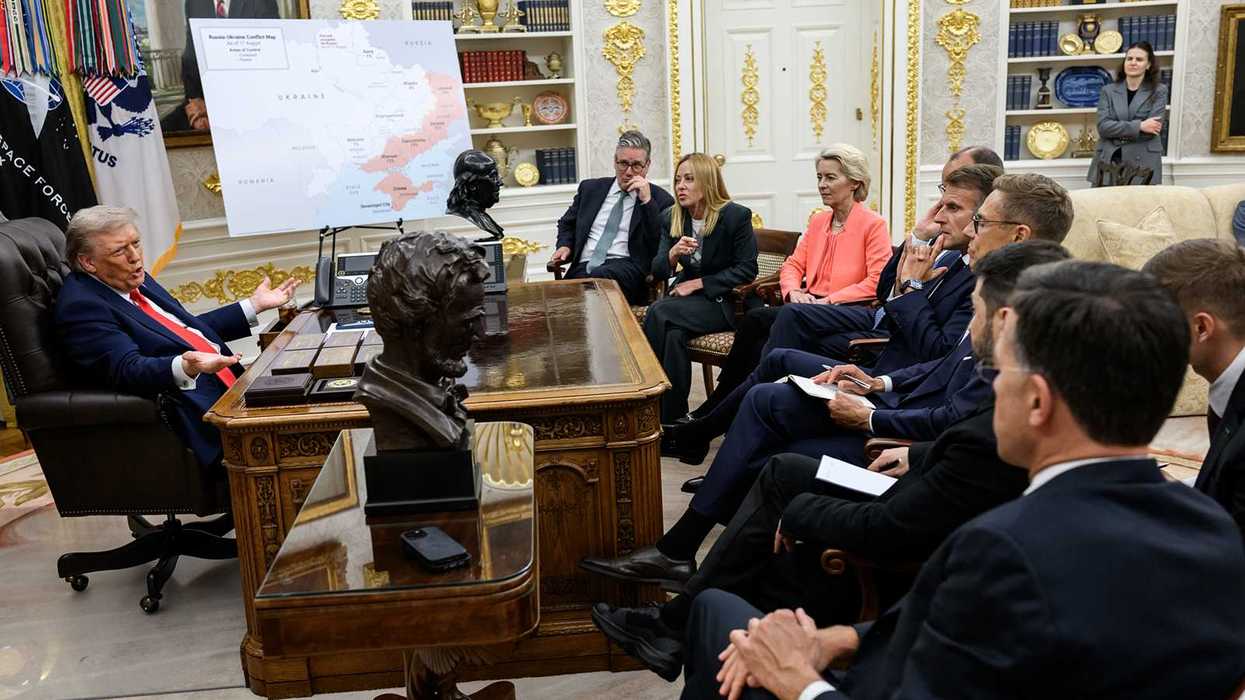
18 August 2025, European Union memnbers travel to Washington, to speak about Ukraine in the Oval Office. 
(Official White House Photo by Daniel Torok)

Sarah K. Burris
July 14, 2026
ALTERNET


President Donald Trump posted an AI photo of himself in the Oval Office speaking to European leaders with a map of North and part of South America with the American flag covering not only the U.S. but Canada, Greenland and Venezuela.


The photo was likely taken during the leaders' visit to the White House in Aug. 2025, but the map on the stand beside the desk wasn't the one in the photo. According to an Instagram photo posted on the White House's page on Aug. 19, 2025, the map primarily features Eastern Ukrainian provinces and Crimea. The White House uploaded the original photo to its Flickr page, which was then added to the Wikimedia Commons.

Trump replaced the map with one of his "manifest destiny" maps, featuring the American flag imposed over Canada, Greenland and Venezuela. Each country has been part of Trump's ongoing efforts to have the U.S. take over countries.

Political experts and reporters noted that it appears Trump is growing bored with Iran again and seeking out Canada, Greenland and Venezuela to entertain him.

Former George W. Bush speechwriter David Frum noted, "On this map, Mark Carney would be the front-runner for the 2028 Democratic nomination and very likely next president of the United States."

"Just in case Canada didn't already loathe Trump enough," said lawyer Scott Greenfield.

Researcher and psychologist Dr. Sam Youssef called the post "deranged" for covering Canada in American flags.

"There it is. Trump's boredom with his Iran war had already led back to attacking NATO and proposals to annex Greenland. Now he's remembered Canada, too," wrote Kyle Orton, who writes about terrorism and national security.

Canadian news editor Trevor Robb joked about the boycotts in Canada of U.S. goods. Including the Trump takeover map, Robb implied that Americans appear clueless as to why the boycotts happen: "Why won't Canada buy our booze??"

MAGA fans and Trump loyalists were convinced it was 100 percent real and laughed at what they perceived to be an international version of "owning" world leaders.

"President Trump posted this absolute gem: Him in the Oval Office surrounded by European leaders with a map of GREENLAND, CANADA and VENEZUELA being claimed as USA territory. Cue the meltdowns," said Eric Daugherty, the chief content officer at Right Line News, assuming the photo was real.

The account for Polymarket Intel that posts "breaking news & geopolitics," also assumed the map was real.

The Daily Wire posted it with a laughing-crying emoji and a skeleton skull emoji.

Russia Today also posted it, though it made it clear that the photo was "his doctored Oval Office photo."

"Wild post just now from Trump — appears to show August 18, 2025 WH meeting with Euro leaders The map shows Canada AND Venezuela colored in [with] American flag, more than 3 months before the Maduro raid," wrote White House correspondent Christian Datoc with the conservative Washington Examiner. He later noted he thought the map may have shown Cuba in red and blue as well.

"Trump has once again posted a picture of a meeting of NATO leaders in the Oval Office where the map on the easel was changed from Ukraine to the US. Canada, and Greenland covered with the American flag. Why now? Maybe we'll find out with Thursday's speech," said an anti-Trump protester, including the original photo.Another anti-Trump person noted, "I think that's called the Moron Doctrine."
\


Inside Trump's secret network preparing for civilizational collapse


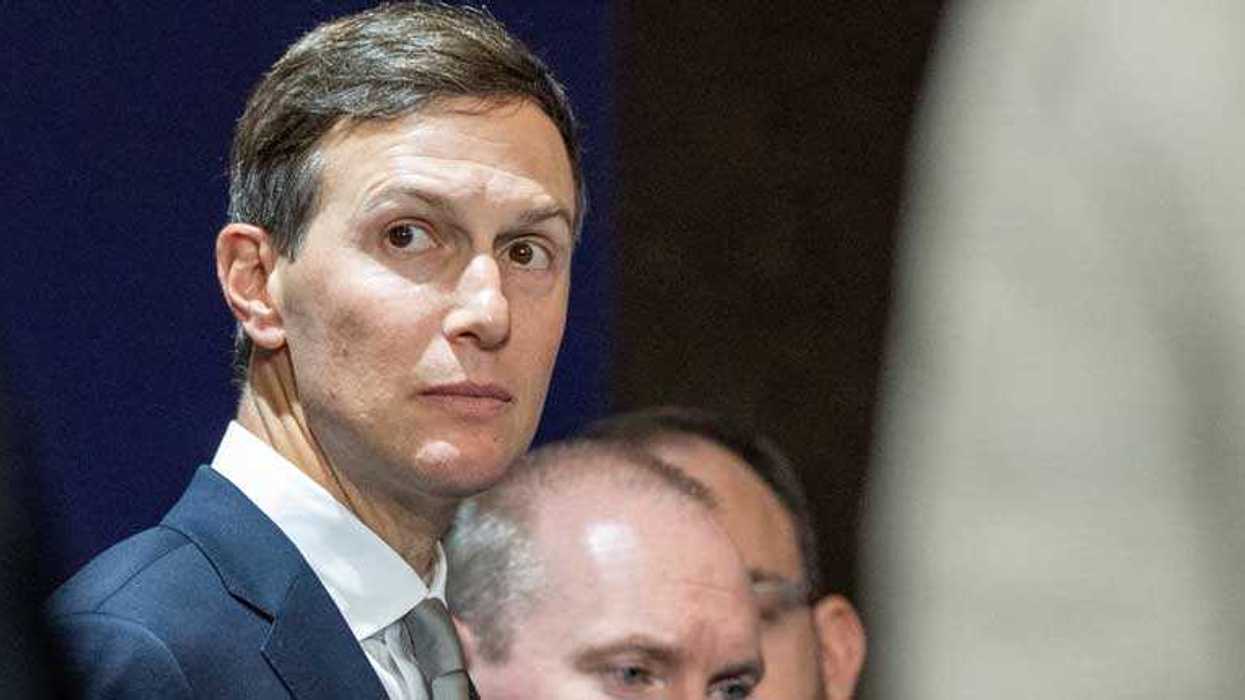
Jared Kushner of the U.S.-Delegation at Lake Lucerne Summit at the Buergenstock resort in Obbuergen, near Lucerne, Switzerland, Sunday, June 21, 2026. URS FLUEELER/Pool via REUTERS

July 15, 2026


It recently emerged that tech billionaire Peter Thiel is running a secret society that brings together fellow CEOs and billionaires with political leaders. Members reportedly include figures like Nato supreme commander Alexus Grynkewich and son-in-law of US President Donald Trump, Jared Kushner.


Thiel, a German-American entrepreneur and activist, was a co-founder of PayPal and software firm Palantir. Revelations about the society – known as “Dialog” – have attracted widespread attention. And Thiel himself gave a confidential lecture series in San Francisco this year, in which he framed issues of politics and technology in biblical terms.

Thiel has said he believes that humankind faces existential threats from nuclear war or runaway artificial intelligence (AI) that could lead to “Armageddon”. In such an end-times era, so the thinking goes, only the most ingenious – like those in the secret society – would survive.

Thiel is an extreme, but by no means isolated, case. Other powerful people in politics and technology are viewing today’s world through a lens of civilisational crisis and impending catastrophe.

Politics of the end times


Over the centuries, political leaders have often invoked fears of decline and collapse. In ancient times, Augustus, the first Roman emperor, championed the narrative that Rome faced moral collapse to justify concentrating power in his own hands. Yet the current moment of “end-times politics” is different on several fronts. Threats, both real and imagined, spread faster than ever, diffused through social media algorithms that favour hysteria and conspiracy.

In Silicon Valley, influential figures routinely discuss AI as either humanity’s salvation or an extinction event. Palantir CEO Alex Karp has described the AI race as “our Oppenheimer moment”, when the world’s rich nations must decide whether to halt the development of a dangerous technology or tip the balance of power in its favour.

Yet the phenomenon extends beyond eccentric tech circles. End-times narratives have made their way into the halls of power, as political figures seize the opportunity to propagate radical politics.

US military personnel have filed a large number of complaints, stating that their commanders have been using biblical end-times rhetoric to justify the US attacks on Iran. Their leadership reportedly made reference to the Armageddon, viewing the war in Iran as a necessary step in bringing about the return of Christ.

This occurs in a context where the Trump administration has been catering to the Christian right, particularly evangelicals, as a major constituency for its “spiritual warfare”. The US secretary of war, Pete Hegseth, in particular has been portraying himself as an instrument of god in an existential civilisational battle for Christianity.

Hegseth and other central figures have reportedly been stacking their departments with evangelicals and Christian Zionists. These instances can be viewed as elements of a larger shift, where political and corporate leaders mix their interpretation of Christianity with beliefs about US supremacy.

Radical minds, radical politics


Trump’s threats towards Iran, including his decree in April that “a whole civilisation will die tonight, never to be brought back again”, indicate the consequences of this myth-making. It paves the way for radical politics in the US, and also beyond.

The Trump administration has claimed that Europe is facing continental decline and “civilizational erasure” due to immigration and European integration. In the same vein, Nigel Farage, leader of Reform UK, has sounded the alarm about the UK facing “societal collapse”.

Research has shown that people are more willing to support extraordinary measures when they believe they face an existential threat. It has also been shown that political leaders’ psychological dispositions matter more in times of uncertainty. The unforeseeable effects of technological and environmental transformation create risks and anxiety – and the danger is that leaders treat opponents, social movements or minority groups as mythical foes.

End-times politics then becomes a struggle over the definition of the ultimate threat to humankind. We are in a time when humans face multiple risks. These worldviews eventually determine how national politics and geopolitics evolve.

There is another reason to pay attention. For much of the modern era, the most influential people were elected leaders and state officials. Today, a novel type of leader has emerged: technology executives with wealth and media influence. Their influence can extend deep into the state – symbolised by Elon Musk’s role in the US Department of Government Efficiency and the critical role of SpaceX in US global strategy.

For a long time, scholars explained global politics in terms of institutions and structural relations, and globalisation through business interests. Now, the future of both increasingly depends on the psychology of a small political and corporate elite.

End-times leaders will exaggerate certain threats while downplaying others. Often, technology executives will establish links between a prosperous future and the necessity of disruptive innovation. US venture capitalist Marc Andreessen has been a proponent of “technological accelerationism” – the idea that unregulated technological development is the only way to overcome the world’s existential problems.

The challenge is distinguishing between genuine threats and narratives that amplify fear while obscuring more pressing problems. At a time when the debate is saturated with predictions of collapse, it may be more important than ever to focus on the risks that are supported by evidence – the climate crisis and an erosion of democratic systems, for example.

On the question of whether technology can overcome climate change and bring world peace, it might be wise not to take the word of tech billionaires. After all, Thiel has recently been hedging his bets between a bunker in New Zealand and a refuge in Javier Milei’s Argentina. 


Joscha Abels, Post-Doctoral Researcher, Institute of Political Science, University of Tübingen 

 Juliana Tappe Ortiz, Post-Doctoral Researcher, Institute of Political Science, University of Tübingen

This article is republished from The Conversation under a Creative Commons license. Read the original article.
Trump wants permanent daylight saving time —but scientists say it would be a nightmare


U.S. President Donald Trump, next to Ivanka Trump's husband Jared Kushner, salutes as a U.S. flag is raised on a new flagpole installed on the South Lawn of the White House in Washington, D.C., U.S. June 18, 2025. REUTERS/Kevin Lamarque

July 15, 2026 

One of the most intractable, contentious and niche issues in US politics has come back into the spotlight. This week, the US House of Representatives voted to make daylight saving time permanent in the United States.

The Sunshine Protection Act, which the House approved by a bipartisan vote of 308–117, would implement year-round daylight saving time nationwide. This would effectively extend the current eight-month period of daylight saving to cover the four winter months, in which standard time is observed.

Having now passed the House, it will head to the Senate, where it is likely to encounter stiff opposition even from some Republicans.

President Donald Trump promised before his second inauguration to “eliminate” the “inconvenient, and very costly” twice-yearly clock changes.

But it may not be so easy. Debate has raged for decades between sleep scientists and industry groups as to whether the time change should be abolished in favour of year-round standard time (with brighter mornings and darker evenings), or year-round daylight saving time (with darker mornings and brighter evenings).

While it may appear to be an academic choice between the two, they would have radically different impacts on the lives of hundreds of millions of Americans.

Daylight saving’s moment in the sun

The debate over whether or not daylight saving is worth the trouble has progressed little in the past century. Senators as far back as 1919 argued over whether or not the benefits of daylight saving time for urban workers outweighed drawbacks for farmers.

The cost of shifting between the two time zones each year has been estimated to cost the economy over half a billion dollars annually. The time changes cause a rise in heart attacks, car accidents and hospital admissions, though an extra hour of evening daylight can also bring increased leisure time, consumer spending and potential energy savings.

Modern polls consistently show that Americans abhor the inconvenience of the biannual clock change but also that they can’t agree on a permanent solution. According to a YouGov poll in February 2026, while 64% of Americans want to abolish clock changes, 43% want to see year-round daylight saving time and 28% want to see year-round standard time. Almost a third are undecided. In March 2025, Trump himself called it a “50–50 issue”.

During his time in the Senate, Secretary of State Marco Rubio repeatedly introduced the Sunshine Protection Act to make daylight saving time permanent. The Senate surprised many when it passed the act in 2022, though it failed to reach a House vote at the time.

In the past seven years, 19 states have approved similar proposals that would authorise permanent, year-round daylight saving time if permitted by Congress. Proponents of such a system point to possible economic benefits and suggest it could lead to energy savings, lower crime and fewer road accidents.

However, leading sleep research associations such as the American Academy of Sleep Medicine instead support year-round standard time and oppose year-round daylight saving time on the grounds that the increased disconnect between the sun and people’s body clocks in winter would be particularly unhealthy.

Our analysis at the United States Studies Centre in 2024 showed that if clock changes were abolished in favour of year-round daylight saving time, 87% of the contiguous urban US population (around 70% of the total population) would experience sunrise after 8am in winter.

Residents of New York City, Chicago, San Francisco, Philadelphia, Washington DC, Denver and Tampa, among many others, would all see winter sunrises that occur after 8.15am. Indeed, close to half of the over 2,500 urban areas in the contiguous United States would see sunrise after 8.30am on the winter solstice.

Such late sunrise times are currently almost unheard of in the United States. Just 3% of the contiguous urban US population currently experiences sunrises after 8am.

Sunset times would still be no later than 6.30pm in the vast majority of the country at the solstice under year-round daylight saving time, limiting its winter evening benefits.

The misalignment between clocks and circadian rhythms as a result of artificially dark mornings is associated with a host of negative health outcomes, particularly for adolescents.

Given close to 60% of US workers depart for work prior to 8am, the impacts of such late sunrises on a population level would likely be significant. The average school start time of 8am would also mean most children wake, go to school and start class in the dark in winter.

By contrast, year-round standard time would produce brighter mornings and earlier sunsets than under year-round daylight saving time. However, it would sacrifice the popular extra hour of daylight in summer evenings that is produced by switching to daylight saving in summer.

The current daylight saving regime attempts to strike a balance between the two extremes, with standard time used during the darker winter months and daylight saving time used during summer to capitalise on the longer days.

The lack of consensus over whether this flexibility is worth the cost of resetting clocks twice yearly has meant the system has endured, though 16 US states have considered time zone legislation this year alone.

A recurring nightmare

Perhaps most surprising about the concept of year-round daylight saving time is that the United States has already tried it. In 1973, Congress authorised a two-year trial of year-round daylight saving in an attempt to save energy during the global oil crisis.

Yet initial public support for the trial of close to 80% almost halved by the end of the 1973–74 winter amid safety concerns for children and criticisms from the construction and agricultural industries. The trial was abandoned prematurely, and American clocks have changed twice a year ever since.

Lawmakers now find themselves once again navigating a fierce debate between whether to adhere to year-round standard or daylight time. But with Americans so divided on the issue and historical precedent for how quickly support for year-round daylight saving time can collapse, the Senate would do well to take its time deciding whether to make nine in 10 urban Americans experience winter sunrises after 8am – or whether permanent standard time would instead help the country to sleep better at night.

Samuel Garrett, Senior Research Associate, United States Studies Centre, University of Sydney

This article is republished from The Conversation under a Creative Commons license. Read the original article.]

The Dishonesty of Political Buyer’s Remorse


 July 15, 2026

Photograph Source: Artaxerxes – CC BY 4.0

On June 9, Graham Platner won the Democratic Party’s nomination for US Senate from Maine with 72.1% of the primary vote. On July 10, Platner withdrew from the race, presumably due to popular demand by the same voters who nominated him.

I’m tempted to a bit of schadenfreude toward those voters.

This was not a case of “seems like a really good guy, very consistent, upright citizen … oh my God, I had no idea!”

Platner’s entire short political career — his whole adult life, in fact — resembles a locomotive, on fire, pulling boxcars stuffed full of dynamite, accelerating down tracks that terminate at a children’s playground.

While the final straw was an allegation of rape, it’s not like he hadn’t already been credibly and multiple times been accused of poor behavior toward women, ranging from marital infidelity to physical assault.

Until the rape allegation, he was able to shrug that kind of thing off with a plea of PTSD from his military career. Speaking of which:

As a candidate, Platner told his opponent, US Senator Susan Collins, “You voted to send me to Iraq. Did you not learn anything from that experience?”

It’s a reasonable question, but it rings a little hollow from someone who wasn’t drafted, who joined up after the wars he fought had begun, and who kept coming back for more. Platner spent four years in the Marine Corps, then returned for four more in the National Guard, then worked as a mercenary (“security contractor”), for a total of three combat tours in Iraq and a six-month deployment to Afghanistan.

I’m sympathetic to veteran regret (got a bit of that myself), but it seems to have taken that regret a long time to develop despite  severe negative consequences, including the PTSD he tries to blame all his bad behavior on.

I guess Platner is a slow learner. It supposedly took him 19 years to figure out that he had a Nazi tattoo on his chest.

Or maybe, just maybe, Platner is an opportunist who figured, correctly, that Maine’s Democratic voters were gullible enough to overlook the obvious flaws in a candidate who sold himself as an “outsider” and a “populist.”

And that worked out … for a little while, anyway.

There’s an old saying: “You can’t cheat an honest man.”

Are voters honest? They keep falling for politicians who turn out to be even worse than average … and then complaining endlessly about it.

Thomas L. Knapp is director and senior news analyst at the William Lloyd Garrison Center for Libertarian Advocacy Journalism (thegarrisoncenter.org). He lives and works in north central Florida.


Graham Platner was ‘grown in a vat’ by

political hucksters


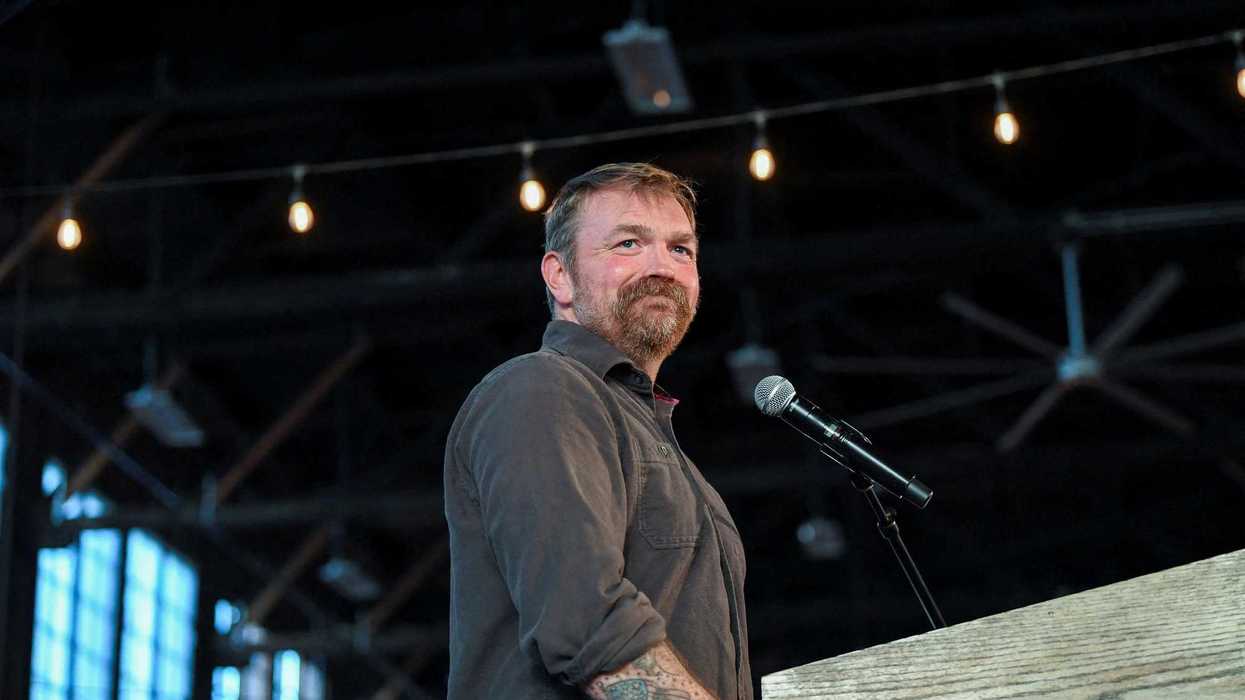
Graham Platner, Democratic candidate for U.S. Senate in Maine, speaks during a "Fighting Oligarchy" campaign rally with U.S. Senator Bernie Sanders (I-VT) in Portland, Maine, U.S., May 25, 2026. REUTERS/Amanda Sabga

July 13, 2026 |


There are many instructive lessons to be learned about the rise and fall of now-former Maine Democratic Senate candidate Graham Platner, who dropped out of the race last week last under enormous pressure after a credible rape allegation was made against him. One I want to focus on is how he was chosen, shaped and pruned by political operatives who bear a large portion of the responsibility for what happened here.

One of them at least, Dan Moraff, probably should not work in politics again. This guy allegedly actually tried a few years ago to get a journalist to delete quotes made by a candidate in an already published article because they were too critical of Donald Trump—more on that further down—as Moraff went about his usual behavior of molding candidates into something he thought would sell better to the electorate.

Let me be clear that I’m all for bringing in new and fresh candidates, and we surely need progressive fighters. That is not the issue here. The problem is that the progressive out-of-state consultants who encouraged Platner to run are just as bad as the people in the Democratic establishment who groom candidates with poll-tested talking points and political posturing. Policies and problem-solving for the people take a back seat to winning at any cost.


Last month, after so much had come out about Platner, Moraff told the Wall Street Journal in a video short accompanying a larger piece about him in the paper that he wasn’t worried about Platner’s Nazi tattoo or the vile Reddit posts that had come out at that time. (The meager vetting missed the tattoo but had some of the Reddit posts.)

“Part of our thesis here is that people do not want their candidates grown in vats,” Moraff told the WSJ reporter, alluding to the Democratic establishment, which is risk averse and has been dismally choosing middle-of-the-road, unexciting candidates who are not right for our times. “They want people who are real human beings, and they want people who do not look and sound like the vat-grown people who’ve been leading this country off a cliff for the last century, and that was Graham.”


On the criticism of the Democratic establishment, we certainly agree. And at about the same time as the interview, I defended Platner from the ludicrous attacks coming from Republicans vilifying him as “immoral” while they embrace the rapist in chief, Donald Trump.

But Moraff is just as guilty of creating candidates “in a vat” as the people he’s criticized.

As The New York Times last week described Platner’s rise, “Last July, in a small town in coastal Maine, a couple of progressive, self-styled recruiters of economic populists showed up at the blue-shingled house of Graham Platner, a little-known oyster farmer and Marine veteran who lived largely off government benefits.”


They had been looking around for a candidate who could take on Republican Susan Collins and were studying quite a few people, according to various reports. They apparently heard about Platner via local activists and had seen a video of him discussing oyster farming. They were taken by the working-class vibe (though Platner is from a wealthy family), the fact that he was a war veteran, his left-leaning politics, and his gruff demeanor. They’d decided they’d found their guy and made the case to Platner, who clearly was enthralled.
The initial headhunters, Dan Moraff and Leanne Fan, and then a third out-of-state operative they called up to Maine — Morris Katz — told Mr. Platner he was “the one,” a “hero of the movement,” “a historical figure” who could be “leading a revolution,” according to half a dozen people with knowledge of their conversations.
But a clutch of people who cared about Mr. Platner were telling him something else. They worried about his mental health, amid his ongoing efforts to heal from post-traumatic stress disorder after tours in Iraq and Afghanistan. They feared this trio of out-of-state operatives was a dangerous combination of inexperienced and overconfident. The worst-case scenario, they thought, wasn’t running for Senate and losing — it was destroying the life he worked hard to build.


Read the boldface text there. I don’t mean to make Platner into the victim here—he’s not, having credibly been accused of raping a woman and having hidden it from his advisers, Democratic leaders, and voters—but it’s clear that he was a very troubled individual who was sold something by a group of people who chose him right out of central casting, getting him all ginned up on the idea of winning a Senate race.


Moraff and his team didn’t do a full vetting, which would take weeks and cost $20,000 per month on retainer, opting for an expedited review that took a few days. They clearly missed a lot.

But this was something Moraff had done before, having come off a string of failures as a strategist. And it needs more attention. After working as a “super volunteer” on Bernie Sanders’ campaign in 2016, and then having an early victory in recruiting progressive activist Summer Lee to run for a state legislative seat in 2018 in Pennsylvania—she won, and then was successful in getting elected as a U.S. House member in 2022—Moraff ran into problems. Per the Wall Street Journal:
Moraff’s backers call him a brilliant disrupter with a fresh perspective who doesn’t mind rubbing people the wrong way to win. But his work for Platner fits a pattern of management of previous campaigns, according to more than a dozen people who have worked with him over the last decade. In particular, candidate vetting has been a frequent source of tension.


In Pittsburgh, the WSJ reports, Moraff “was involved in Turahn Jenkins’s 2018 campaign to take on the county’s district attorney, Stephen Zappala Jr. Less than a week into his campaign, progressive groups backed away from Jenkins when it emerged that he belonged to a church that held antigay views.”


Also in Pennsylvania, Moraff told local journalist Mike Elk that he was recruiting Bryan Pietzrak, a General Electric locomotive factory worker, to run for Congress in Erie in 2022. According to Elk in a piece he wrote this week, Moraff called him while he was out of the country working on a story in Brazil and urged him to remove anti-Trump quotes attributed to Pietzrak from a 2020 piece Elk had written.
Moraff explained at length that Pietzrak’s quote against Trump could hurt his chances of appealing to Trump voters in Erie. I told him deleting a quote as a political favor would violate journalistic ethics. He insisted I do it even after I said no.
Cajoling me, Moraff told me that, “No one would know that I deleted the quote.” I told him that wasn’t the issue, and that it was unethical, so I refused. He told me to forget the conversation and never mention it to anyone. It’s important to know Moraff asked me to lie for a candidate he was recruiting.


In New York, as reported by the WSJ, “Moraff worked as campaign manager for state Senate candidate Debbie Medina. Her 2016 admission that she beat her son as a child with a belt derailed her campaign. The revelation came after older testimony from the sentencing of her son in a murder trial surfaced.” Clearly, another bad vetting issue.

Moraff recruited a candidate in Iowa this year to run for the Senate, Nathan Sage, a veteran and former executive director of the Knoxville Chamber of Commerce. Again, he didn’t do a full vetting, just an expedited one. In this case it appears Sage, who wasn’t getting traction, dropped out in part because Moraff seems to have abandoned him, turning his sights to Maine and Platner, a shiny new object. According to the WSJ:

Sage said Moraff, who showed up at his workplace unexpectedly and convinced him to run, shifted his attention almost entirely from Iowa to Maine once he found Platner. He would sporadically make calls and join meetings only to criticize the campaign’s strategy or offer ideas that didn’t align with Sage’s views and the electorate in Iowa.


Moraff apparently doesn’t delve into policy much, except to tell his candidates “to back Medicare for All and characterize the Israel-Hamas conflict as a genocide,” the WSJ reports, “but beyond that, doesn’t believe voters care about detailed proposals.” For Platner, he apparently crowdsourced policy proposals from activists on Discord, basically just seeing what would play to the crowd.

There’s no question that Chuck Schumer and Democrats in the DC establishment share the blame here, as they refused to draw upon the dynamic candidates in Maine who are now being looked at as Platner’s replacement. They went instead with Gov. Janet Mills, who just didn’t have the fight and wouldn’t bring in younger voters. Few elected officials in Maine then probably wanted to take on the sitting governor the establishment had coalesced around.

This encouraged the very situation we have, in which progressives from out of state came in, did a search, chose Platner, and built support around him. So yes, the Democratic establishment by far isn’t unscathed. But that doesn’t absolve Moraff and his team for the sloppy vetting and for what we would later learn was a disorganized campaign with little money on hand, as Susan Collins had bankrolled ten times more. That is all on them.


And it also shows that they were doing the same thing they accused the establishment of doing: molding a hand-picked candidate, feeding him policy mantras and stage-crafting a campaign.