Monday, July 27, 2026

The American Presidency and Perpetual War


by | Jul 27, 2026 |

One of the defining failures of modern American government has been the steady erosion of Congress’s constitutional authority over war. The Constitution grants Congress — not the president — the power to declare war. Congress decides to go to war. The president wages it.

Over the past several decades, presidents of both major parties have increasingly treated military intervention as an executive prerogative rather than a congressional requirement.

The last six presidents have not reflected distinct foreign policy doctrines but a uniparty continuum of executive overreach. While the particulars differ, each administration has initiated or significantly expanded military action without a formal declaration of war or without clear evidence that the targeted country posed an imminent threat to the United States.

President George H.W. Bush assembled an international coalition following Iraq’s invasion of Kuwait in 1990. Congress ultimately authorized the use of military force. However, it was not a defensive war; it fostered the growing post-Cold War assumption that the United States should act as the world’s policeman.

President Bill Clinton likewise employed military force without declarations of war. The 1999 NATO bombing campaign against Serbia during the Kosovo conflict proceeded despite Congress failing to authorize it in a clear and lasting manner. The administration argued humanitarian intervention justified military action. But even compelling humanitarian concerns do not erase the Constitution’s allocation of war powers.

President George W. Bush fundamentally reshaped American foreign policy after the Sept. 11 attacks. The invasion of Afghanistan initially enjoyed broad support and congressional authorization in response to al-Qaeda’s attacks. However, the 2003 invasion of Iraq remains one of the most controversial and catastrophic military actions in modern American history.

Congress did authorize force, but the constitutional process was undermined by intelligence failures and exaggerated claims about weapons of mass destruction and links between Saddam Hussein and al-Qaeda that ultimately proved unfounded. We now know that Iraq posed no imminent threat to the United States warranting a preventive war. The conflict resulted in enormous human suffering, significant financial costs, regional instability and expanded executive authority that future presidents would inherit.

President Barack Obama accelerated executive war-making despite his early criticism of the Iraq War. His 2011 intervention in Libya stands as perhaps the clearest example. The United States joined NATO air operations that helped overthrow Muammar Gaddafi, yet Congress never authorized the intervention. The administration argued that the operation did not constitute “hostilities” under the War Powers Resolution because American forces faced limited risk and most of the killing was done by U.S. intelligence assets.

President Joe Biden continued this pattern through military operations in Yemen, Syria, Iraq, strikes against Iranian-backed militias — and by funding Ukraine’s war against Russia. The administration justified these actions primarily as force protection, counterterrorism, responses to attacks on U.S. personnel, or defense of democracy and sovereignty. None of these rationales substitutes for congressional authorization.

Moreover, Russia, Ukraine and the U.S. are members of the United Nations. Like the U.N. or not, the U.N. Charter is a treaty written by U.S. officials and ratified by the Senate. Under the Constitution, treaties are the supreme law of the land along with the Constitution itself. The U.N. Charter prohibits all war except for immediate defensive purposes or when authorized by the U.N. Security Council; neither of which is the case with Ukraine.

President Donald Trump famously campaigned against “endless wars,” yet his administration launched missile strikes against Syria in 2017 and 2018 without congressional approval, assassinated Iranian General Qassem Soleimani in Iraq in January 2020, commenced the current unlawful and meaningless war against Iran, now in its third stage of combat, and he has financed Israeli expansion — all without congressional authorization.

He has famously indicated that he rejects the constitutional role of treaties and the international laws written pursuant to them. He has even threatened to annihilate the Iranian/Persian civilization.

Those who believe that the Constitution means what it says condemn the underlying assumption that the United States should maintain a global military presence of nearly 800 bases worldwide in 80 countries. These bases, security guarantees and permanent deployments create continual opportunities for military entanglement.

Every intervention generates unintended consequences, some of which become the justification for the next intervention. History teaches that the interventions don’t liberate. They subordinate, control and dominate.

This cycle expands government power at home as well as abroad. It has given us mass incarceration, mass surveillance, mass attacks on speech.

The founders warned against precisely this dynamic. James Madison wrote that “of all the enemies to public liberty, war is, perhaps, the most to be dreaded.” War concentrates power in the executive, increases public debt, expands surveillance, limits civil liberties and encourages secrecy.

A government organized around perpetual military readiness acquires the earmarks of an empire. Foreign policies of empires are based on dominance and force. Foreign policies of republics are based on commerce, diplomacy and genuine national defense. Military force should be reserved for defending the United States against actual or imminent attacks, not for remaking foreign societies, policing civil wars or pursuing humanitarian objectives.

From this perspective, the constitutional issue is inseparable from the policy issue. Even when intervention appears morally appealing or strategically prudent, allowing presidents to wage war unilaterally establishes precedents that future administrations will inevitably expand.

Executive power, once claimed, is never surrendered voluntarily.

The uniparty pattern in the past 36 years suggests that the problem is institutional rather than partisan. Republicans and Democrats alike have embraced increasingly unconstitutional theories of presidential war powers, while Congress has often acquiesced by avoiding politically difficult votes.

The result has been a steady transfer of the Constitution’s most consequential power from the legislative branch to the executive. The result has also been millions of innocent deaths, trillions of wasted dollars and industrial scale destruction. Is America really safer, are Americans truly freer, because of all these wars? NO and Hell No; we are weaker, poorer, less safe and less free.

Andrew P. Napolitano, a former judge of the Superior Court of New Jersey, is the senior judicial analyst at Fox News Channel. Judge Napolitano has written seven books on the US Constitution. The most recent is Suicide Pact: The Radical Expansion of Presidential Powers and the Lethal Threat to American Liberty. To find out more about Judge Napolitano and to read features by other Creators Syndicate writers and cartoonists, visit www.creators.com. COPYRIGHT 2025 ANDREW P. NAPOLITANO – DISTRIBUTED BY CREATORS.COM

Global population growth peaked six decades ago - OWID

Global population growth peaked six decades ago - OWID
The world’s population stop growing six decades ago and is now in decline nearly everywhere, except Africa. / bne IntelliNewsFacebook
By Esteban Ortiz-Ospina for Our World in Data July 27, 2026

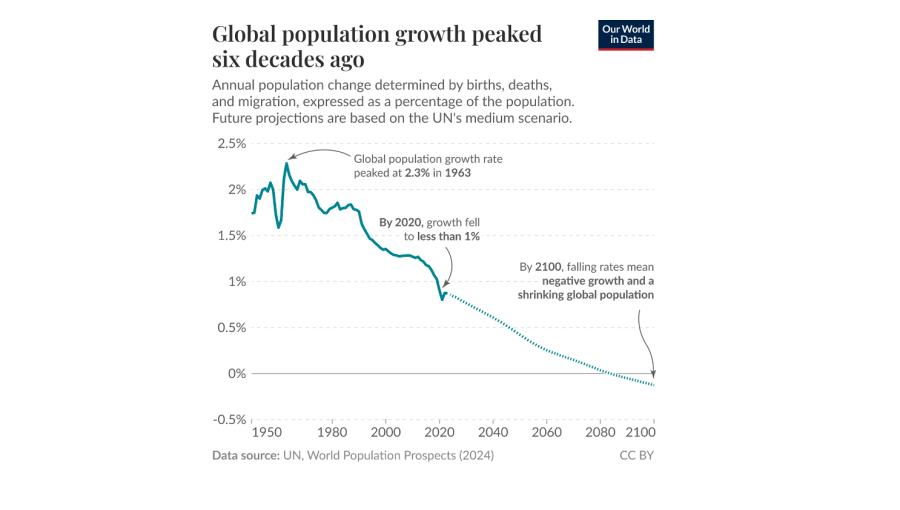
The increase in the world’s population is not exponential. The global population is growing, but the growth rate has declined since its peak six decades ago.

The chart shows the annual rate of global population growth according to historical estimates and projections from the UN World Population Prospects.

The growth rate peaked in 1963 at over 2% per year, and since then, it has more than halved, falling to less than 1% by 2020.

The UN demographers expect rates to continue falling until the end of the century, eventually leading to negative growth rates and a shrinking global population.

Explore how these projections change with different assumptions in our new population simulation tool


Kuwait signs $16bn pipeline deal with Blackstone, Brookfield and KKR despite Iran attacks

Kuwait signs $16bn pipeline deal with Blackstone, Brookfield and KKR despite Iran attacks
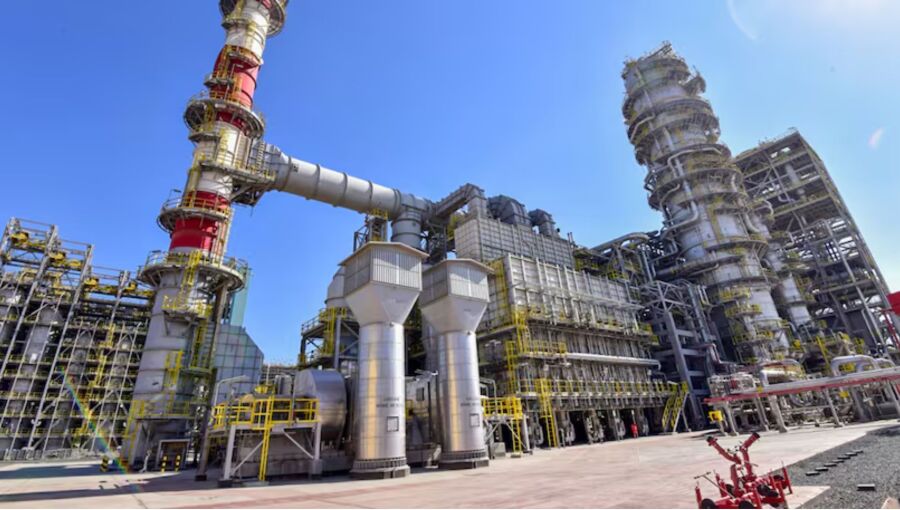
Kuwait refinery. / bne IntelliNewsFacebook
By Ben Aris in Berlin July 27, 2026

Kuwait Petroleum Corporation (KPC) said on July 25 that its subsidiary Kuwait Oil Company (KOC) has signed a $16bn lease-and-leaseback agreement covering its entire crude oil pipeline network with a consortium of Blackstone, Brookfield and KKR, in what it called the largest foreign direct investment in Kuwait's history.

Under the deal, dubbed Project Peregrine, a newly formed Kuwaiti joint venture will lease usage rights to all 13 of KOC's pipelines – roughly 320km of network – for a 20.5-year period in exchange for a volume-based tariff. Blackstone, Brookfield and KKR will collectively hold a 49% stake in the JV in three equal shares, while KOC retains 51% and full ownership and operational control of the network, with no restrictions imposed on Kuwait's production or refining volumes.

The transaction is expected to generate $7.85bn in upfront proceeds for KOC, funds KPC said would support its capital spending plans, including a target of 4mn barrels per day of crude production capacity by 2035 under its 2040 Strategy.

"Project Peregrine represents the largest foreign direct investment in Kuwait's history and a defining milestone for our country's economic development," said Sheikh Nawaf Saud Al-Sabah, KPC's deputy chairman and chief executive, adding it fulfils a commitment made by Kuwait's prime minister at the Kuwait Oil & Gas Show in February to attract world-class investors into strategic infrastructure "while preserving full national ownership and operational control."

KKR co-chief executives Joe Bae and Scott Nuttall said the firm had "greatly valued" its partnership with Al-Sabah's team, while Brookfield chief executive Bruce Flatt said the firm was "proud to support Kuwait as it continues to build out its vital energy infrastructure." Blackstone chairman and chief executive Stephen Schwarzman called the deal part of the firm's "nearly four-decade partnership with Kuwait." Centerview Partners, HSBC and J.P. Morgan advised KPC on the transaction, which is subject to customary closing conditions and regulatory approval.

The scale of the commitment is notable given the regional backdrop: Kuwait has come under daily attack from Iran as the wider US-Israel-Iran war continues, oil and gas analyst Giovanni Staunovo noted, with the deal signed even as the Gulf state hosts US forces that have been targeted repeatedly by Iranian drone and missile strikes. KPC called the agreement, among the first major inward investments in the Gulf since the latest round of regional tensions began, testament to "Kuwait's resilience and agility" and to continued investor confidence in the country despite the conflict raging around it.


Has Ukraine declared war on Iran?

Has Ukraine declared war on Iran?
Ukraine has flexxed its air capabilities, but Iran also can hit Kyiv. / bne IntelliNewsFacebook
By bnm Gulf bureau July 26, 2026

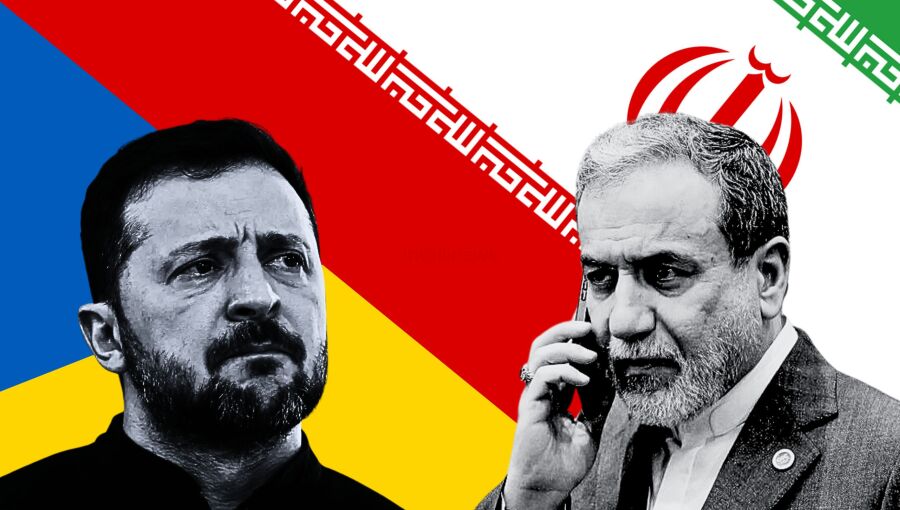
The question sounds theatrical, and Kyiv would say it answers itself: no state declares war by footnote, and a single line buried in a nightly list of Russian targets is about as close to a footnote as a president gets. Volodymyr Zelenskiy's post on July 25 ran through the usual roll of what he calls long-range sanctions, a weapons plant in Kirov, a refinery in Tyumen, a depot in Rostov, and then, almost in passing, "vessels used in military cargo shipments involving Iran, as well as a warship" in the Caspian Sea. No vessel named, no flag stated, no elaboration. By the time Tehran confirmed that an Iranian commercial ship had been hit, one sailor dead and another wounded, the framing was already set. This was a strike on the Russian war machine that happened to catch an Iranian hull.

That framing is doing a great deal of work, and it is worth taking apart.

Start with what is not in dispute. Ukraine has hit targets more than 1,000 km inside Russia before and will again. Its case against the Caspian shipping lane is not fabricated: the corridor between Russian ports and the Iranian coast has carried Shahed components and, by several accounts, Fath-360 ballistic missiles north since 2022, and the two vessels Ukrainian sources named, the Port Olya 2 and the Begey, are both under Western sanctions precisely for that traffic. If Kyiv strikes a sanctioned cargo ship moving munitions to the army bombing its cities, that is a recognisable act within a recognisable war. Nobody in Kyiv thinks they picked a fight with Tehran. They think they interdicted a supply line.

But intent and effect are different things, and the effect is what Tehran now gets to define. From Iran's chair, a foreign military with which it is not at war killed an Iranian citizen aboard an Iranian-flagged commercial vessel in a sea Iran borders. Abbas Araghchi did not reach for the language of interdiction. He reached for the UN Charter, named Zelenskiy personally, and said the act was carried out "at Israel's behest to drag Europe into its war." The foreign ministry cited Article 2(4), the prohibition on the use of force against another state, and promised a proportionate response. Whatever Ukraine meant, Iran has decided to treat this as an attack on Iran.

This is the pivot the whole episode turns on, and it is where the war-declaration question stops being rhetorical. Under international law, a claim that a commercial ship carries weapons does not, by itself, license firing on it. The presumption runs the other way: merchant vessels are civilian until proven otherwise inside the rules of armed conflict, and there is no state of war between Iran and Ukraine within which those rules would even apply.

Iran was not a party to the Russo-Ukrainian war in any formal sense. It armed one side, which is a hostile act and arguably a violation of several Security Council measures, but arming a belligerent is not the same as being one. Ukraine has now used lethal force against the nationals and property of a third state outside any declared conflict between them. That is the definition of an act that generates state responsibility, and, if Tehran wants to call it one, an act of war.

Whether Iran wants to is the real question, and here the theatrics give way to cold arithmetic. Iran is five months into a war with the United States and Israel that has killed its supreme leader, closed its main export artery, and drained its military. It has no spare capacity for a second adversary, and it knows Ukraine sits behind a wall of Western support that Iran cannot afford to test.

The threats from Tehran's hardline press that "all of Ukraine is within reach" of Iranian missiles are almost certainly bluff; Iran's missile stocks are needed elsewhere, and a strike on Kyiv would hand Europe exactly the casus belli Araghchi accuses Kyiv of manufacturing. So the likelier path is the one Iran always prefers when it cannot respond in kind: summon the diplomat, file the legal protest, keep the channel open, and wait. Manouchehr Moradi has already delivered the démarche. The lawyers will follow.

The more interesting actor in all this is Russia, which Araghchi called before he called Brussels. The Caspian is a Russian lake in all but name, and a Ukrainian drone campaign that reaches Lukoil's Filanovsky platform and a Molniya missile boat is a demonstration that Moscow cannot protect its own southern waters, or its clients within them. That is a message to Tehran as much as to anyone: the protector is porous. It also tightens the knot Zelenskiy has been trying to tie all year, the linkage of his war to the Middle East one.

Kyiv has spent 2026 turning itself from a recipient of aid into an exporter of counter-drone expertise, selling Gulf states the know-how to shoot down the very Shaheds Iran designed. Striking the Iran-Russia supply line is the militarised version of the same play: proof that Ukraine's war and the Gulf's war are the same war, fought against the same weapons, and that the West should treat them as one file.

So, has Ukraine declared war on Iran? No, not in any official sense Kyiv would accept, and not in a way that will produce Iranian missiles over Ukrainian cities. But it has done something subtler and, for Tehran, more galling. It has forced Iran to absorb a lethal blow it could answer, exposed the limits of Russian protection in a sea Iran thought safe, and stapled the Iranian file to the Ukrainian one at precisely the moment Iran most needs the two kept apart.

The declaration, if it comes, will not come from Kyiv. It will come, or more likely will not come, from a Tehran doing the maths and deciding, again, that the smarter move is to swallow it. It could also mean two wars have become one. 

Russia adopts AI regulations, lags behind in the race

Russia adopts AI regulations, lags behind in the race
Russia has adopted a new law aimed at regulating AI that inadvertently admits that it has made almost no progress in developing the technology so far. / bne IntelliNewsFacebook
By IntelliNews July 27, 2026


Russia has adopted a law aimed at regulating artificial intelligence in the country, inadvertently admitting that the country has next to nothing in the area of "sovereign AI" stipulated by the law, with almost all of its major AIs based on foreign models. Despite senior officials' claims that Russia is an important participant in the global AI race, a brief reality check shows that this is far from true.

AI law passed

Earlier this month, the State Duma, Russia's lower chamber of parliament, passed the law On Supporting the Development of Artificial Intelligence Technologies in the Russian Federation.

The law introduces two types of AI in Russia: "sovereign" and "national." In accordance with the law, a sovereign neural network is one that has been developed and deployed entirely by a Russian company that controls all stages of the process and stores data on servers within the country. Meanwhile, national neural networks are permitted to use foreign components, although only those available as open-source code.

In terms of the regulatory framework, the law doesn't offer anything groundbreaking. The ministry of digital development was appointed as the sole regulator. The labelling of AI-generated content in consumer products and the media is supposed to be voluntary. Training AI models on data from publicly available sources is not considered to be copyright infringement.

Tech industry insiders unimpressed

The Russian tech industry was largely unimpressed with the law. Natalya Kasperskaya, president of the software development company InfoWatch Group and a major lobbyist for the country's IT sector, published a scathing review of the law on her Telegram account.

"The bill suffers from being overly declarative, lacking a consistent terminology framework, delegating excessive authority to the Russian Federation Government, and fundamentally ignoring security issues," she said, adding that the legislation is effectively aimed at cementing the monopoly of two AI developers, Sberbank and Yandex.

According to Kasperskaya, the law contains no safeguards regarding AI trustworthiness and security, while it "almost entirely lacks protections for citizens' rights, including the right to privacy, the right to be informed, the right to protection from autonomous decisions made by technical systems regarding their rights and legal status, and the right to opt out of AI use."

"Adopting the bill in its current form will cement our country’s lag behind others and lead to the collapse of the domestic AI industry," Kasperskaya concludes.

Big expectations

For years, top Russian officials have been speaking about the importance of fostering the AI segment, promising support for companies using AI-based systems and those developing their own AI models.

Back in 2023, the Russian government said that the use of AI would be mandatory for all companies that plan to receive any subsidies from the federal budget, although that stipulation was never enacted. Apparently, Russian officials hoped that AI could contribute to the growth of the country's economy, which has been struggling since Russia’s invasion of Ukraine in February 2022 and the ensuing Western sanctions.

But the development of AI required substantial investment, which the Russian economy, burdened by the war in Ukraine and sanctions, could hardly afford.

Still, the government and lawmakers seem to be under the illusion that Russia is indeed a major player in the global AI race.

While presenting the recently adopted bill, Sergey Boyarsky, head of the State Duma committee on information policy, said: "There is a race not only between services, but between countries. There are three of them: China, the United States of America, and the Russian Federation."

Reality check

However, a brief glance at Russian AI models shows that most of them could hardly qualify as "sovereign" under the recently adopted law, as they rely heavily on Chinese models.

Currently, Russia has several workable AI models: GigaChat, developed by the country's largest lender, state-run Sber; Alisa AI from Yandex, "the Russian Google"; T-Pro from lender T-Bank (formerly Tinkoff); Cotype from mobile phone operator Mobile TeleSystems (MTS) and BerryLM from e-commerce giant Wildberries.

Novaya Gazeta Europe recently ran tests of Russian AIs, concluding that all of the above solutions, except for Sber's GigaChat, are built on top of Qwen, a model developed by China's Alibaba.

Incidentally, Yandex admitted the use of a Chinese AI model in its documentation, saying: "We initialized our training pipeline not with random weights, but with the weights of the Qwen-2.5-32B-base model (in AI model design, weights are numerical coefficients that determine the importance of information and in which the model’s knowledge is stored). A full training cycle for our Alice AI LLM model, initialized with Qwen3-235B weights, takes an order of magnitude less time than if we had initialized it with random weights."

The tests found that T-Bank's T-Pro 2.0 model is based on Qwen3-32B and MTS' Cotype on Qwen-2.5-32B.

Sber’s GigaChat, the only technically "sovereign" Russian AI, was "inspired" by China's DeepSeek V3, as its developers admitted, according to the Novaya Gazeta report.

However, the performance of GigaChat turned out to be inferior. Novaya Gazeta's tests showed that GigaChat was unable to correctly solve rather basic tasks.

Lagging behind in capacity and investment

The main reason why Russia has been unable to develop competitive AI models is a substantial gap in computing capacity, a shortage of AI-compatible chips, and significantly lower investment.

Capital expenditures by the four US companies involved in the AI race - Microsoft, Amazon, Alphabet and Meta - for 2026 are projected at $635bn to $665bn and could still be increased to $725bn. By comparison, the combined budget of all Russian players for purchasing AI hardware is $1.5bn to $2.5bn.

Data centre capacity is also a major factor. Just one US data centre, the xAI campus outside Memphis, is already operating at 1.3 gigawatts and is rated for 2 gigawatts. The combined capacity of all Russia’s data centres ranges from 1.2 to 1.7 gigawatts.

Meanwhile, potential investors in Russian data centres would also face electricity shortages. Even if they are able to purchase hardware abroad and bring it to Russia, they would not be able to connect new data centres to the electricity grid - at least in the Moscow region, where most companies developing AI models are based. Currently, utility companies are simply refusing to connect new data centre facilities due to a lack of capacity.

Sanctions, local production delays

Finally, sanctions imposed on Russia over the war in Ukraine are blocking local companies' access to AI-compatible chips. The A100, H100, H200, and B200 chips have been under an embargo since 2022. Gray-market imports, on which companies had relied for years, have collapsed - from thousands of servers in 2024 to just dozens in 2026, according to Novaya Gazeta.

Nvidia, a major chip manufacturer, can now determine, based on network latency, which country a chip is operating in and can block those used in Russia.

When it comes to Russia's own AI-compatible chip production, the picture is grim. Baikal AI accelerators are expected to be launched around 2029-2030, and they already lag behind Nvidia's latest products.

Technically, Russia could import some AI-compatible chips from China, but Chinese companies prioritise domestic customers, leaving Russian firms waiting in line for years.

In this situation, Russia's chances of closing the gap with the leaders in the AI race appear very slim.

Russian missiles hit Ukrainian drone-industry expo near Kyiv, killing at least 10

Facebook

By bne IntelliNews July 27, 2026

Russia carried out a daytime ballistic and cruise missile attack on Kyiv Oblast on July 24, striking among its targets a defence industry exhibition organised by Armada, an association of Ukrainian drone and unmanned systems manufacturers, according to open-source mapping account AMK Mapping. The event, a "Defence Demo Day & Defence Expo" focused on protecting critical infrastructure from aerial threats, had been advertised on social media with its time and location made public.

The exhibition site was hit by at least two Iskander-M ballistic missiles, part of a wider strike that AMK Mapping said involved roughly six Iskander-M missiles and around four Zircon hypersonic cruise missiles aimed at Kyiv and the vicinity of Vasylkiv air base.

Ukraine's State Emergency Service said rescue operations continued throughout the day at the site of the strike, according to the Military Summary account, which cited the service in reporting that ten people were killed and dozens more injured. That toll rose from the six deaths and unspecified dozens of injuries reported by AMK Mapping in the immediate aftermath of the strike, a pattern common in the early hours after such attacks as casualty figures are updated.

The strike also caused extensive damage beyond the exhibition site itself. In the nearby Bucha district, fires that broke out at three private homes and involving eight vehicles were extinguished, while a further 23 private homes, two hotels, a restaurant and 34 cars were damaged, the State Emergency Service said.

The attack is the latest in a series of Russian strikes on Ukraine's expanding domestic drone industry, which has become central to Kyiv's war effort as it seeks to offset battlefield disadvantages with locally produced unmanned systems.

Japan Eyes Foreign Banks to Back $33 Billion U.S. Natural Gas Investment

The Japanese government may approach foreign banks to help finance pledged investments in U.S. natural gas production that are part of Tokyo’s trade deal with the Trump administration, agreed last year.

“If financing from foreign banks materialises, it should further facilitate the procurement of foreign-currency funding needed to implement the investment initiative,” the Japanese finance ministry said in an X post, as quoted by Reuters.

The publication reported earlier this month that JP Morgan and other U.S. lenders were close to sealing a deal for participating in the investment initiative. According to the Japanese finance ministry, loans provided by foreign banks could be guaranteed by the country’s export credit agency, NEXI. Part of the money for the infrastructure investment projects would be provided by Japan’s state-backed Bank for International Cooperation.

The U.S. and Japan sealed a trade deal last summer, featuring a reduction in proposed tariffs—from 25% to 15%—on Japanese imports and a $550-billion Japanese investment pledge for the U.S. economy. Japan also pledged under the deal to expand market access for American goods, including cars, agricultural products, and energy.

Of the total $550 billion in pledged investments, some $33 billion will be committed to natural gas, including for the construction of the largest natural gas power plant in the world, with a capacity of 9.2 GW, according to earlier reports. The investment package will also fund the construction of a deepwater oil port in the Gulf.

“This project is expected to generate $20–30 billion annually in U.S. crude exports, secure export capacity for our refineries, and reinforce America’s position as the world’s leading energy supplier,” U.S. Commerce Secretary Howard Lutnick said at the time. The facility would have a daily capacity of 1 million barrels of crude, boosting U.S. oil export capabilities.

By Charles Kennedy for Oilprice.com

The Carbon Capture Boom Is Starting to Crack

  • Governments and major energy companies have committed billions of dollars to carbon capture projects as a way to reduce emissions from hard-to-abate industries.

  • Many CCS projects have failed to achieve their expected capture rates, while costs remain significantly higher than initially forecast.

  • Growing evidence suggests CCS may play only a limited role in decarbonization, with critics arguing that greater investment should go toward permanent low-carbon alternatives.

Carbon capture and storage (CCS) technology grew in popularity during the Covid-19 pandemic as several governments and private companies pledged to support a green transition. The use of CCS was expected to help decarbonise hard-to-abate industries until a long-term transition to clean energy could be achieved. However, in recent years, many have become more sceptical about the effectiveness of CCS technologies, as several projects have failed to perform.

CCS technology is used to capture carbon dioxide at emission sources, so it can be transported and stored or buried in a suitable underground location. Several CCS technologies have been launched in recent years, including conventional CCS installations and direct air capture (DAC) – which removes CO2 directly from the atmosphere – as they have grown in popularity, particularly across hard-to-abate industries.

As governments have put increasing pressure on industries to decarbonise their operations, companies that cannot simply switch to renewable alternatives have invested heavily in CCS activities to reduce emissions. While many have criticised companies for relying on carbon capture rather than cutting emissions at the source, CCS tech has been expected to help companies support a green transition as they assess possible long-term solutions.

In 2025, the World Economic Forum predicted that the CCS industry would grow fourfold by the end of the decade. This prediction is supported by a massive pipeline of CCS activities, as several sectors invest heavily in the technology. In the oil and gas industry, ExxonMobil, Shell, Chevron, TotalEnergies, Equinor, and Occidental have all pledged major investments in CCS technologies.

Some governments are also backing CCS in a big way. In May, Germany launched a $5.7 billion Carbon Contracts for Difference scheme that aims to promote and support CCS and carbon capture and utilisation (CCU) projects. In 2024, in the United Kingdom, the government announced up to $29 billion of funding over 25 years to make the country an early leader in two growing global sectors, CCUS and hydrogen, to be allocated between these two clusters.

Meanwhile, in Denmark, the cement maker Aalborg Portland signed a $2.55 billion CCS contract with the country’s energy agency. Aalborg Portland’s CEO Soren Holm Christensen stated, “We can now take the decisive step toward realising a project that is not only significant in a Danish context, but is also among the largest industrial CO2 capture projects in Europe.”

Despite the clear optimism around CCS technology, the cracks are starting to show as several companies fail to see the results expected from CCS operations. An Institute for Energy Economics and Financial Analysis (IEEFA) review of 13 operating CCS projects around the world found that most captured below design levels of 90 per cent, while some failed outright, highlighting the ongoing technical challenges of CCS as a solution and the potential for further cost escalation per tonne. According to the Global CCS Institute, only 50 facilities were operating worldwide in 2024, with the capacity to capture around one thousandth of global emissions.

Meanwhile, environmentalists argue that CCS is simply another form of greenwashing, and that funding for the technology could be better spent exploring alternative, clean energy options to decarbonise hard-to-abate industries. Many argue that using CCS technologies will give companies an excuse to use the “transition fuel” of natural gas for longer than necessary. In addition, CCS is being used by the oil industry to allow them to claim that they are producing “low-carbon oil”, even though burning fossil fuels continues to contribute heavily to climate change.

CCS technology is extremely expensive to incorporate into operations, with many projects relying on taxpayer support. For this purpose, key industry players suggested that CCS should only be pursued after other green solutions during a 2025 conference in London.

In the United States gas industry, the cost of adding CCS to U.S. plants is estimated at $20 to $30 per megawatt hour (MWh), which could potentially double the cost of power production. Meanwhile, in Europe, the think tanks Agora Industry and Oeko-Institut, estimate the cost of carbon capture, transport, and storage at between $170 and $340 a tonne. “According to these calculations, the costs of existing or planned CO2 storage projects are at least 50 per cent higher than previous forecasts,” the think tanks stated in a press release.

Several fossil-fuel dependent industries and companies have long promoted CCS technology as key to decarbonising operations. This has helped improve the image of CCS and allowed major oil companies and heavy industry to get government backing. However, the high cost of CCS technology use, as well as the barriers to commercial rollout, suggest that CCS promotion may have been one big (and fairly successful) PR stunt. While it may still be used in a limited capacity, governments should be encouraging companies to invest in long-term decarbonisation solutions if they hope to achieve a green transition.

By Felicity Bradstock for Oilprice.com