Friday, July 31, 2026

AI before AI: The forgotten Soviet programme (1/2)

ANALYSIS


Beginning in the 1950s, the Soviet Union launched an ambitious programme aimed at developing artificial intelligence. While the history of AI today seems to be shaped by the giants of Silicon Valley, ideas originating from behind the Iron Curtain had a significant influence, although they remain largely overlooked.


Issued on: 30/07/2026 - FRANCE24
By: Sébastian SEIBT

The Soviet Union took an interest in artificial intelligence as early as the 1950s.
 © Studio graphique France Médias Monde


American chess genius Bobby Fischer defeated the reigning world champion Russia's Boris Spassky in 1972 in what has been called "the most exciting world chess championship ever".

But the Eastern Bloc got its revenge on August 8, 1974, when Kaissa, a Soviet computer, checkmated its opponent, securing the very first World Computer Chess Championship title for the Soviet Union. Russian artificial intelligence had crushed its capitalist competitor.

The victory proved to the world that the Soviets also had a say in the field of AI, which had until then mostly been developed at top US universities.

AI, a ‘bourgeois science’?


In the early 1950s, AI – which was not yet known by that name – was viewed behind the Iron Curtain with suspicion. The Soviets viewed what was to become AI primarily through the lens of cybernetics, a field of research that was very much in vogue for studying human-to-machine or machine-to-machine behaviour.

Some saw cybernetics as a “false bourgeois science”, while others thought it held great promise for scientific advancement.

“Cybernetics almost became a sort of official philosophy of scientific research in the USSR,” said Olessia Kirtchik, a sociologist at the European Centre for Sociology and Political Science who has worked on the history of AI in the Soviet era.

The hallways of research institutes and universities were then filled with mathematicians, philosophers and other researchers, tasked with ensuring the communist regime reaped the benefits of cybernetics. While it fell out of favour in the US by the late 1950s, giving way to computer science and what eventually became AI, the Soviets remained committed to cybernetics, particularly the concept of the “thinking machine”.

The gold mine of Soviet AI

One of the leading figures in Soviet AI to go down in history was Alexander Kronrod, a mathematician who was, among other things, in charge of the team that developed the Kaissa chess programme. For some, Kronrod was even the Soviet “father of artificial intelligence”.

But before him, another mathematician had a considerable influence on the development of AI. His name was Dmitry Pospelov.

Pospelov brought prestige to the discipline by “fostering and supporting the artificial intelligence research community for years”, said Kirtchik. This “lobbying” work culminated in the creation of the Russian Association for Artificial Intelligence in 1989.

Pospelov’s pro-AI campaign within Moscow’s corridors of power also illustrates how the field was not immune to the ideological battle of the Cold War era. The Russian mathematician strongly criticised the Western approach to AI, which he deemed too “reductionist”. In his view, American researchers were reducing the human brain to a sort of supercomputer, performing rigorous but disembodied calculations. For him, intelligence had to be conceived as a social activity dependent on its environment, rather than as a purely logical process.

In the Soviet Union, AI was expected to solve practical problems, and the USSR primarily “used algorithms to optimise the management of the socialist economy”, according to Kirtchik.

The oil and gas industries, for example, used it to improve their operations.


Are we in an AI bubble?
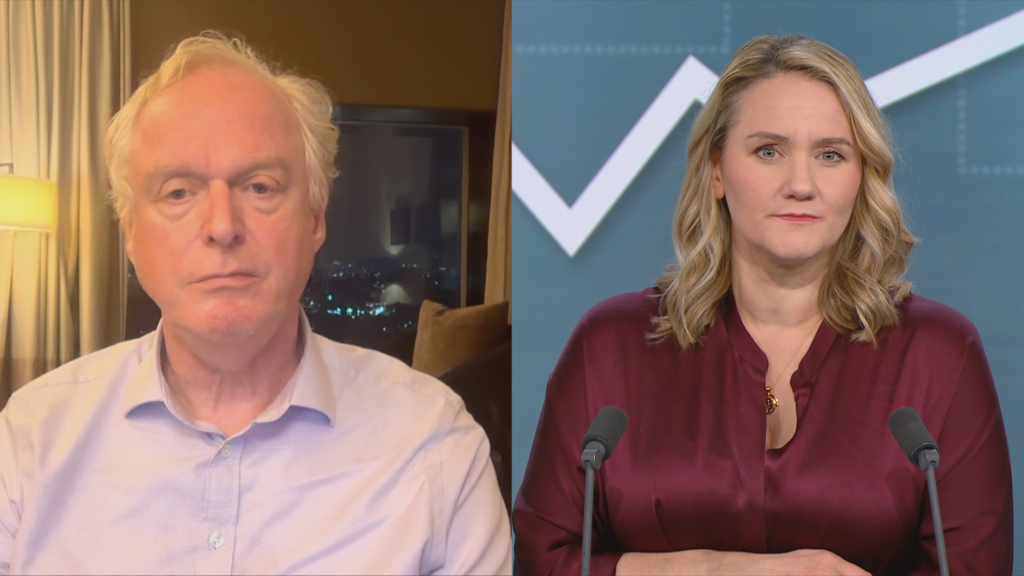
Cover image: PEOPLE & PROFIT © FRANCE 24
11:59


Algorithms even proved to be a gold mine for Moscow – quite literally, given that in the 1960s authorities were trying to identify where to dig in Soviet territory to find gold deposits. To achieve this, Yuri Zhuravlyov, one of the most highly decorated mathematicians of the Soviet era, developed an algorithmic approach. Using data on the known locations of gold mines around the world, Zhuravlyov built a programme in 1966 that successfully identified where to find gold within the Soviet Union.

This may have been one of the first practical success of “machine learning”, the ability of an algorithm to learn from the data it is given. Others see it as proof that AI does not necessarily need huge datasets to find the right answers.

“With clever methods, small data can move mountains – or in this case, reveal them,” Valery Manokhin, a machine learning specialist, wrote in a blog post on Medium on the Soviet gold rush.

When Russian AI inspired Apple

Some of Silicon Valley’s big names also have Soviet AI to thank. Apple might never have released its Newton tablet in 1993 without the work of Shelia Guberman, the Soviet mathematician who solved a puzzle that had been troubling many Western AI specialists: how to get machines to recognise handwriting.

“He achieved this by adopting an approach known as Gestalt (a form of pattern recognition), which had been overlooked in the West,” Kirtchik said.

Guberman's solution was adopted by Soviet entrepreneur Stepan Pachikov for the Paragraph company. His handwriting recognition software was used by Apple to develop the Newton personal digital assistant; the technology was subsequently sold to Microsoft and used by the US Postal Service.

Other ideas that were developed in the Soviet Union are now enjoying a resurgence, including the “automaton” conceived by Michael Tsetlin in the early 1960s. These ideas inspired Norwegian computer scientist Ole-Christoffer Granmo, who in 2024 introduced the idea of the “Tsetlin machine”, designed to be a more energy-efficient alternative to today’s large language models like ChatGPT.

But Tsetlin's ideas would likely annoy tech bros of today like Sam Altman and Elon Musk, however. For Tsetlin, “the workings of these automata had to be perfectly transparent, unlike the black boxes that are today’s AI models”, Kirtchik said.

The Soviets were not short of ideas, but as was often the case during the Cold War, they simply did not have the same resources as the West.

The practical applications of Soviet research often remained “marginal", Kirtchik said, "since the computers at their disposal were often incapable of performing the necessary calculations”.

This article was translated from the original in French.


 What we know about the Hamas disarmament deal announced by Trump


Palestinian militant group Hamas confirmed Friday that it had agreed to a deal with Israel that would lead to the group's disarmament in return for the gradual withdrawal of Israeli troops from the Gaza Strip. Here's what we know so far.


Issued on: 31/07/2026 
By: FRANCE 24
Video by: Peter O'Brien

Palestinians inspect destroyed buildings after they were targeted by Israeli strikes the previous night in Deir al Balah, central Gaza Strip on July 29, 2026. © Eyad Baba, AFP
01:43


Hamas said on Friday it agreed to a deal to end the war with Israel that included provisions addressing its weapons and the gradual withdrawal of Israeli forces from the devastated Gaza Strip.

The text of the deal has not been released publicly, and there was no immediate statement from Israel.

Here is what we know about the announced agreement:

What's in the deal?

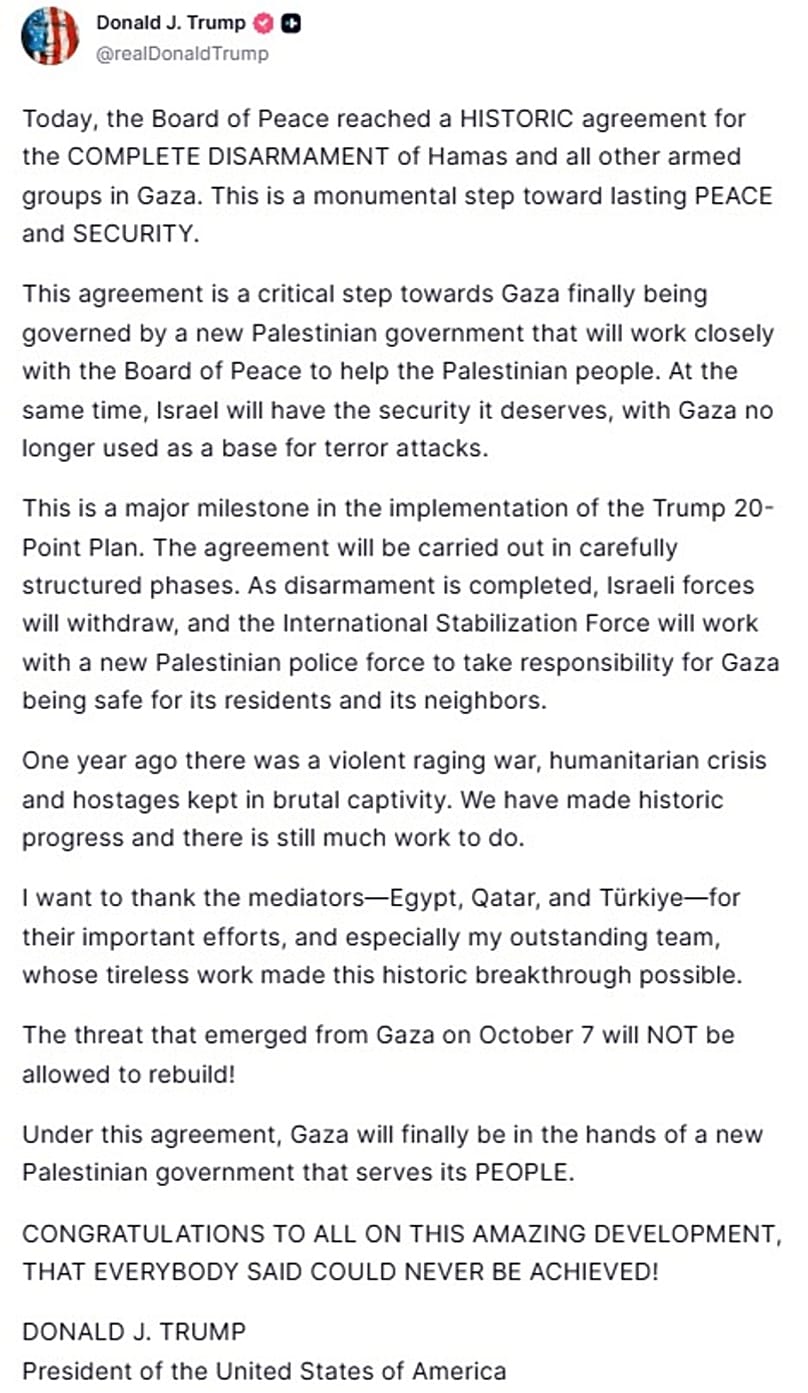
US President Donald Trump announced the "complete disarmament" of Hamas, calling it a critical step towards a new Palestinian government in Gaza.

He said Israeli forces would withdraw from Gaza "as disarmament is completed".

Israel’s military now occupies more than half of the Palestinian territory, leaving Palestinians confined to squalid tent camps and bombed-out urban neighbourhoods.

Palestinians salvage their belongings from the rubble of a building and tents destroyed in an Israeli air strike in Gaza City on July 30, 2026. © Jehad Alshrafi, AP

Hamas officials told AFP a committee established by Trump's Board of Peace to govern Gaza would oversee the process of storing the Islamist movement's weapons.

The group said it expected mediators and the Board of Peace to ensure Israel complied with the deal's terms, which included Israel's "gradual withdrawal" from Gaza.

Trump Board of Peace's official Gaza fund is empty despite billions pledged, source says

Ghazi Hamad, a member of the group's negotiating team, said the movement was making "concessions for the sake of our people in the Gaza Strip, to save them from killing and displacement".

"The agreement contains a clear provision stating that Israel must commit to and implement its obligations. If Israel does not implement the agreement, neither will we," Hamad said.

A diplomatic source told AFP before the deal's announcement that the plan would create "a process for the elimination of all tunnels, depots of weapons and any weapons production facilities".
Who will implement the deal?

The Board of Peace confirmed in a post on X that Hamas had "agreed to a detailed Roadmap for implementing the next phases of the Gaza ceasefire".

"Our focus now turns to implementation," the organisation wrote, adding that the National Committee for Administration of Gaza (NCAG), established by Trump's Board of Peace, will "soon begin a phased transition toward full authority".


Trump said in a social media post the International Stabilization Force "will work with a new Palestinian police force to take responsibility for Gaza being safe for its residents and its neighbours".

Hamas announced earlier this month that it had dissolved its government in Gaza and was preparing to transfer power to a technical committee backed by the United Nations as part of the ceasefire deal


What is the situation in Gaza?

An October ceasefire remains in place between Israel and Hamas, but it has not halted the violence in Gaza. Efforts to secure a lasting agreement to end the war have stalled.

Israel has continued carrying out near-daily air and artillery strikes across the territory, more than 60 percent of which it occupies, since the fragile truce came into effect.

Palestinians pray as they attend the funeral of Palestinians who were killed in Israeli strikes on tents, according to medics, at Nasser Hospital in Khan Younis, in the southern Gaza Strip, July 30, 2026. © Ramadan Abed, Reuters

At least 1,214 Palestinians have been killed in Gaza since the ceasefire, according to the territory's health ministry, whose figures the United Nations considers reliable.

Israeli strikes on Thursday killed at least four people, including two children, health officials said.


Tens of thousands of people in Gaza still live in tents, after nearly three years of Israeli air strikes flattened much of the Palestinian territory's standing structures.

Hamas has accused Israel of repeated ceasefire violations, including air strikes, firing on civilians and advancing the so-called Yellow Line, an informal boundary separating areas under Israeli military occupation from those under Hamas authority.
What happens next?

Israel has yet to respond to the announced deal.

Egypt's state-linked Al Qahera News said early on Friday that Cairo is set to host a meeting "soon" of the Gaza truce mediators, which also include the United States, Qatar and Turkey, focused on the second phase of the Gaza ceasefire plan.

Nickolay Mladenov, the Board of Peace's high representative for Gaza, said the implementation stage of the plan "matters even more" than the initial deal.

"Implementation and verification have to be real," Mladenov wrote on X. "Withdrawal must move in lockstep with decommissioning."

Hamad told AFP Hamas would now discuss the implementation details with the mediators and agree on a timetable for carrying out the deal.

"This process will take about 14 days, or perhaps longer. We must agree on every detail: how the agreement will be implemented, when it will be implemented and the mechanisms for carrying it out. This is what will take place in the coming days."

(FRANCE 24 with AFP and Reuters)


Hamas agrees to 'historic' disarmament deal that includes Israeli withdrawal from Gaza


By Malek Fouda
Published on

Trump said the deal to advance his 20-point peace plan will be rolled out in “carefully structured phases”, but did not announce a timeline as to when the process may be completed.

Hamas said on Friday that it has agreed to a deal to end the war with Israel that included provisions addressing its de-weaponisation and the gradual withdrawal of Israeli forces from the Gaza Strip.

Earlier, US President Donald Trump announced that the so-called Board of Peace has reached what he hailed as a “historic deal” on Thursday to disarm the Gaza-based group and all other armed groups and Israel to withdraw its forces from Gaza, but questions remained over conditions and timeline.

The deal, described by Trump in a post on Truth Social as a “monumental step”, comes nine months after a US-brokered ceasefire was signed to end Israel’s two year offensive on the enclave, signed in October last year in Egypt’s Sharm el Sheikh.

US President Donald Trump announces Board of Peace deal to disarm Hamas and Israel to withdraw forces from Gaza in a post on Truth Social, 31 July, 2026
US President Donald Trump announces Board of Peace deal to disarm Hamas and Israel to withdraw forces from Gaza in a post on Truth Social, 31 July, 2026 @realDonaldTrump/TruthSocial

“This agreement is a critical step towards Gaza finally being governed by a new Palestinian government that will work closely with the Board of Peace to help the Palestinian people,” wrote Trump.

“At the same time, Israel will have the security it deserves, with Gaza no longer used as a base for terror attacks.”

Negotiations between Israel and Hamas had largely deadlocked over the implementation of its second phase, including the disarmament of Hamas and the reconstruction of Gaza.

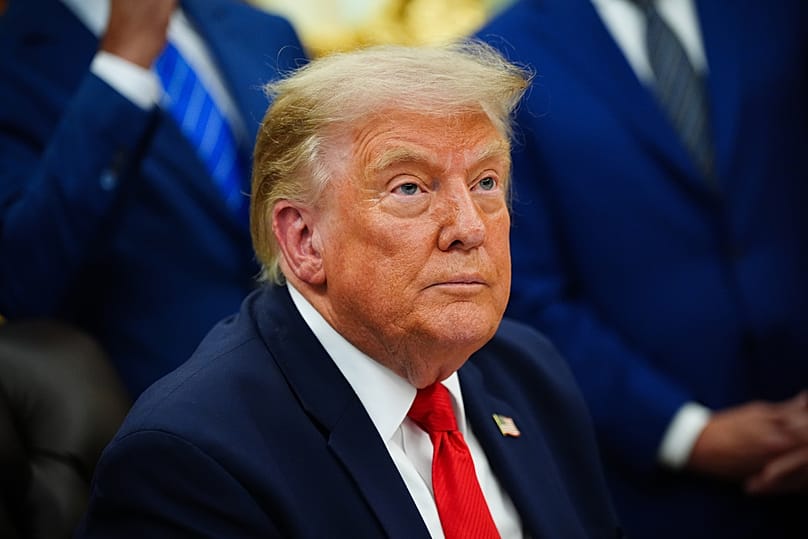
President Donald Trump speaks in the Oval Office of the White House, in Washington, Wednesday, July 29, 2026
President Donald Trump speaks in the Oval Office of the White House, in Washington, Wednesday, July 29, 2026 Julia Demaree Nikhinson/Copyright 2026 The AP. All rights reserved.

The US president says the deal will put to action the implementation of his 20-point peace plan in “carefully structured phases”.

Trump’s 20-point ceasefire plan calls on the Gaza-based group to surrender its weapons and destroy its vast network of tunnels. It also envisions the arrival of a new technocratic Palestinian government, led by former UK Prime Minister Tony Blair, who will lead Gaza’s rebuilding efforts.

Once disarmament is complete, Trump said Israel will then withdraw its forces out of the territory and hand over policing duties to a new “International Stabilisation Force”, which will work alongside Palestinian police to safekeep Gaza.

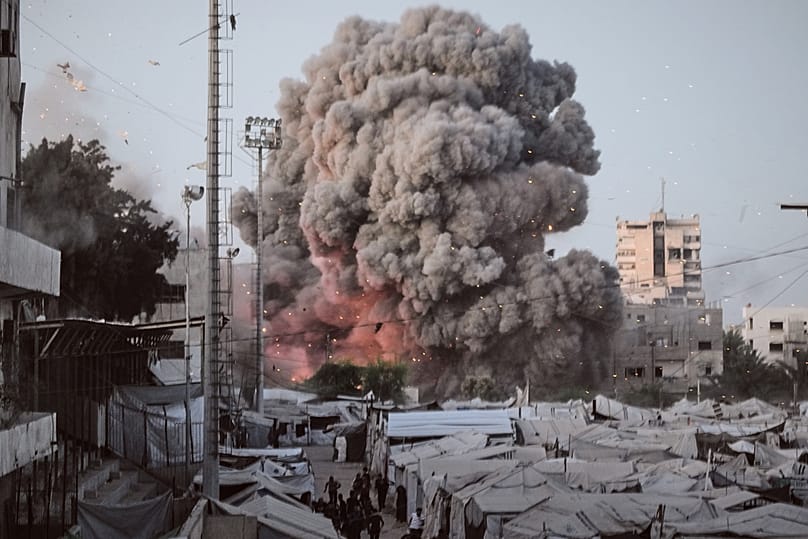
Smoke rises following an Israeli military strike in Gaza City, Tuesday, July 28, 2026
Smoke rises following an Israeli military strike in Gaza City, Tuesday, July 28, 2026 Jehad Alshrafi/Copyright 2026 The AP. All rights reserved.

Rumoured timeline

US and Board of Peace officials, describing the deal to reporters on condition of anonymity under guidelines set by the White House, gave an extremely optimistic assessment of the agreement.

The officials were unable to offer specific timelines for the disarmament of Hamas or other groups that operate in Gaza, such as Palestinian Islamic Jihad, but said the Gaza police force would turn over weapons to the technocratic Board of Peace-backed Gaza administration in the next two weeks.

The Gaza police force, however, does not include the vast majority of Hamas militants and heavy weaponry is not included in that part of the agreement, according to the officials.

Instead, the surrender of heavy weapons and the decommissioning of Hamas tunnels and other infrastructure are to come later in a process that could take between 200 and 350 days, a Board of Peace official said.

Israel remains sceptical

A US official said Israel, which has been deeply sceptical about Hamas’ willingness to give up its guns or relinquish at least behind-the-scenes control of Gaza, had been consulted at every step of the negotiation.

However, the official said Israel was not being asked to do anything more than what it had initially committed to when it agreed to Trump’s 20-point plan, which essentially involves withdrawing its forces from Gaza and committing to ending airstrikes on the territory.

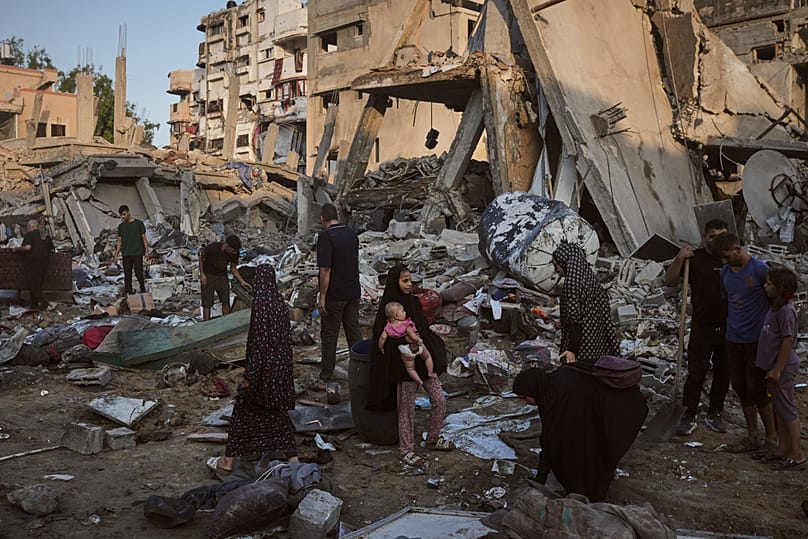
Palestinians salvage their belongings from the rubble of a building and tents destroyed in an Israeli airstrike in Gaza City, Thursday, July 30, 2026
Palestinians salvage their belongings from the rubble of a building and tents destroyed in an Israeli airstrike in Gaza City, Thursday, July 30, 2026 Jehad Alshrafi/Copyright 2026 The AP. All rights reserved.

The official added that Trump would be “very, very disappointed” if Israel didn't adhere to the agreement.

The US president reiterated in his post on social media that not allowing Hamas to possess the strength it once did to pose a threat to Israel, remains a central part of the deal, adding that the new government will work to represent and serve its people.

Israel’s war on Gaza, which started in response to Hamas’ 7 October, 2023 incursion into southern Israel, killed at least 73,000 Palestinians, according to medical sources in the territory, including those killed since the ceasefire, Gaza’s Health Ministry said.

Displaced Palestinian children lineup to receive donated food at a community kitchen in Khan Younis, southern Gaza Strip, Thursday, July 23, 2026
Displaced Palestinian children lineup to receive donated food at a community kitchen in Khan Younis, southern Gaza Strip, Thursday, July 23, 2026 Abdel Kareem Hana/Copyright 2026 The AP. All rights reserved

Trump and Israeli Prime Minister Benjamin Netanyahu met at the White House on Tuesday, but neither said much about what was discussed in their first face-to-face meeting since jointly launching the war against Iran.

Hamas announced earlier this month that it had dissolved its government in the enclave and was preparing to transfer power to a technical committee backed by the United Nations as part of the ceasefire deal.

The Israeli Defence Forces currently control more than half of Gaza, leaving Palestinians confined to squalid tent camps and heavily damaged urban neighbourhoods. The UN has repeatedly warned of dire living conditions across Gaza since the ceasefire came into effect.

Rift deepens as US walks out of UN over French criticism of Trump

United States diplomats walked out of a United Nations Security Council meeting on Monday as their French counterparts were speaking, after Paris criticised the Trump administration’s human rights record and backed a second term for human rights chief Volker Turk. The move underlined the growing strain in relations between Washington and one of its closest European allies.


Issued on: 29/07/2026 - RFI

US Ambassador to the United Nations Mike Waltz speaks to reporters on 7 May. Getty Images via AFP - SPENCER PLATT

The walk-out, during a meeting on Ukraine, came days after the UN General Assembly overwhelmingly supported Turk’s reappointment as UN High Commissioner for Human Rights for another four years, despite opposition from the US.

The vote on Friday was 144-10 in favour, with 13 abstentions. France supported Turk, while the US was among those who voted against him.

As the UN human rights chief is not chosen by the Security Council, the US cannot use its veto to block the appointment. Washington can vote against Turk, lobby other countries and make its objections clear – but it cannot stop his reappointment on its own.

The walkout, however, reflects more than a dispute over a single UN post.

It comes amid wider tensions between US President Donald Trump and French President Emmanuel Macron – as well as broader unease between the US and Europe over NATO, possible changes to American troop deployments in Europe and Trump’s stated desire to control Greenland, a territory belonging to NATO member Denmark. Trump has also complained that European allies did not help the US during the Iran war.

Amid those tensions, Macron has sought to strengthen Europe’s military capacity and promote the idea of a nuclear umbrella, with France one of the continent’s two nuclear powers alongside the United Kingdom.


'French grandstanding'


The trigger for Monday’s walk-out was a post on social media platform X by France’s UN mission in Geneva, criticising Washington’s opposition to Turk’s reappointment.

“The US used to be a beacon of human rights. Not anymore. Today, it stands alongside North Korea, Nicaragua, Mali & Russia, isolated. And the world no longer listens to it,” the French mission wrote last Friday.

Mike Waltz, the US ambassador to the UN, responded by accusing France of coddling “some of the worst human rights abusers” and voting for someone who, he said, had been “lecturing” democracies such as the US, the UK and Israel while “cosying up to the world’s worst oppressors”.


After Monday’s incident, deputy US ambassador Dan Negrea accused France of feigning “moral outrage” and pretending to lecture the world on every issue, including human rights.

“The United States has stood by France in every conflict where its freedom has been imperiled,” he said, adding that Washington had tolerated French “grandstanding” out of “a sense of camaraderie and mutual respect”.

But, he said, that patience had run out. “Today, I remind them that it is the United States that remains the beacon of liberty for the world,” Negrea said.

“As such, we will not be affording them the benefit of listening to their politicised drivel until they renounce their condescending and disrespectful rhetoric and behave in a manner commensurate with their seat on this council.”

France’s UN ambassador, Jerome Bonnafont, did not refer directly to the walk-out when he later took the floor.

Instead, he noted that France – which helped the US in its war of independence – had taken part in celebrations marking America’s 250th anniversary on 4 July.

“The United Nations was created with the goal of working towards international peace and security, human rights and development,” Bonnafont said.

“All of that forms the spirit in which France works within the United Nations ... to preserve this institution, its independence, its ability to act in service of the charter and act to serve human rights and peace.”

Volker Turk at the opening of the 61st session of the UN Human Rights Council at the United Nations office in Geneva, 23 February. AFP - FABRICE COFFRINI


Turk at centre of dispute


Turk’s role as UN High Commissioner for Human Rights is, by its nature, sensitive. The job requires him to speak out against abuses committed by the governments that make up the UN’s membership – including the most powerful ones.

He has sharply criticised both Russia’s 2022 full-scale invasion of Ukraine and Israel’s war in Gaza.

He also urged a “massive rethink” of US immigration policy before the World Cup, warning against “racial profiling, surveillance and immigration enforcement”.

In a recent interview with RFI, Turk defended the importance of international law at a time of worsening conflicts and growing pressure on civilians, from Iran to Sudan.

International law remained “our compass”, he said, adding that violations by powerful states did not make the rules obsolete. “If someone drives through a red light or drives at much higher speeds, that does not mean the Highway Code is no longer valid,” he said.

(with newswires)


UK's Burnham pledges new drone tech to Ukraine in Zelensky meeting

British Prime Minister Andy Burnham pledged new drone-jamming technology to Ukraine on Monday, using his first meeting with a foreign leader since taking office to underline Britain's continued military backing for Kyiv.


Issued on: 28/07/2026 - RFI

Britain's Prime Minister Andy Burnham and Ukraine's President Volodymyr Zelensky speak to troops on board the Royal Navy aircraft carrier HMS Queen Elizabeth during their visit to HM Naval Base in Portsmouth on the south coast of England on 27 July 2026. 
AFP - SIMON JONES

The two leaders met on Monday at the Portsmouth naval base in southern England, speaking on the dockside before boarding the aircraft carrier HMS Queen Elizabeth.

"We are with Ukraine 100 percent. I am personally with you 100 percent, Mr President," Burnham told Zelensky after the pair, dressed in similar dark casual clothing, shook hands beside the ship.

Zelensky thanked the new prime minister for what he called an "important signal of support" and said he had invited him to visit Ukraine. The two leaders had already spoken by telephone within hours of Burnham taking office.

Burnham promised to honour every commitment previously made by Britain to Ukraine and announced that London would share details of a new electronic jamming capability known as "Stone Cloak".

The tablet-sized, military-grade devices can be fitted to Ukrainian drones to make it harder for Russian air defence systems to track and target them during flight.

"We are providing new, home-grown jamming technology to protect Ukrainian drones," Burnham said. "It will help them to hit their targets and help save Ukrainian lives. It also shows the kind of innovation our industries can deliver together."

Zelensky later said the electronic warfare technology would "certainly be useful on the battlefield" and thanked Britain for the decision.

Britain's Prime Minister Andy Burnham walks with Ukraine's President Volodymyr Zelensky as they take part in a welcoming ceremony, during their visit to HM Naval Base in Portsmouth on the south coast of England on 27 July 2026. 
AFP - SIMON JONES


New frontline technology

Thousands of Stone Cloak jammers have already been supplied to Ukraine, according to Downing Street, after being developed under the 100-year partnership agreement signed between the two countries.

The technology has been tested in combat conditions and could now be produced on a larger scale inside Ukraine. Britain also plans to incorporate it into a future generation of its own long range strike systems.

"Stone Cloak is the best of home grown British innovation and proven on the frontline," Burnham said. "It will be vital to protecting our security in both our countries."

The announcement comes as Russia and Ukraine intensify their use of drones and missiles. More than 390 Ukrainian drones targeted the Moscow region overnight into Tuesday, according to the Russian capital's mayor, while Russian forces have continued large scale attacks on Ukrainian cities and ports.

Burnham and Zelensky also discussed expanding joint defence production, particularly in drone and electronic warfare technology.

Britain says its total support for Ukraine since Russia launched its full scale invasion in February 2022 has reached over €29 billion, including almost €19 billion in direct military assistance.


Zelensky heads to Washington


The Portsmouth meeting came on the eve of Zelensky's latest attempt to secure US President Donald Trump's support, with the Ukrainian president due at the White House at 9.30am local time on Tuesday.

"We are preparing for a meeting with the president of the United States and his team," Zelensky said, adding that he hoped Washington would "continue to support Ukraine" and help secure "a dignified peace".

Relations between Zelensky and Trump have often been difficult. Their exchanges have ranged from a televised Oval Office argument in February 2025 to warmer encounters in recent months.

During their latest meeting in Turkey earlier in July, Trump praised Zelensky for doing "an amazing job" and indicated that Ukraine could be allowed to manufacture US designed Patriot air defence systems, which Kyiv urgently needs to counter Russian missile attacks.

Trump has largely ended direct US weapons deliveries to Kyiv since returning to power in January 2025, instead supporting a system under which European countries buy American equipment before transferring it to Ukraine.

The United States nevertheless remains a crucial ally, supplying intelligence and access to the Starlink satellite network used by Ukrainian troops.

Diplomatic efforts to end the war remain stalled, however, largely because of disagreements over Ukrainian territory occupied or claimed by Russia. US attention has also been diverted by the war in the Middle East.

(with newswires)


Zelensky visit White House in test to Maga's 'significant shift towards' Kyiv

Issued on: 28/07/2026 - FRANCE24

Ukrainian President Volodymyr Zelensky is expected at the White House on July 28 for talks with US counterpart Donald Trump, as Kyiv seeks to win fresh diplomatic and military support in its fight against Russia. Zelensky is also in the US to attend US senator Lindsey Graham's funeral, an important support of Ukraine inside the Republican party. FRANCE 24's Fraser Jackson tells us more from Washington.

Video by: Fraser JACKSON


DRC court clears path to change a constitution that says it can't be changed

The Democratic Republic of Congo's Constitutional Court has approved a referendum law that critics say could pave the way for President Felix Tshisekedi to seek a third term in office, prompting a coalition of opposition parties to reject the ruling and vow to fight the change.


Issued on: 30/07/2026 - RFI

Congolese political figures are opposing the constitutional reform, including Moïse Katumbi. © Photos AFP & AP - Montage RFI

The C64 opposition coalition is voicing its anger against the Constitutional Court ruling that validated a law on organising a referendum about the DRC's constitution that could extend the rule of President Felix Tshisekedi.

The coalition brings together figures such as Martin Fayulu, Jean-Marc Kabund, Moïse Katumbi, Augustin Matata Ponyo and Delly Sesanga.

Following a consultation on Wednesday, they denounced what they called "high treason" and reaffirmed their opposition to any revision of the constitution.

They believe the court now lacks credibility and legitimacy for having paved the way for a constitutional amendment.

"The court's ruling confirms the plot against the constitutional order and paves the way for the Balkanisation of the Republic," Dieudonné Bolengetenge, secretary-general of Katumbi's party, said, as one of RFI's correspondents in Kinshasa reported.

"The C64 reiterates that this ruling constitutes a judicial rebellion by the Constitutional Court against the sovereign people, who will ultimately defeat it," he added. "The Congolese people will accept neither the circumvention of the constitution, nor the personalisation of institutions, nor a change to the constitution, nor a third term."


A third term

The Congolese constitution limits the president to two terms and stipulates that it cannot be amended.

Tshisekedi, 63, has been in power since 2019 and under the current constitution has to step down at the end of his second five-year term at the end of 2028.

The head of state and his supporters have for months been preparing public opinion for a constitutional change, without explicitly stating that he will seek a third term.

They have called for this revision of the constitution that they say is "out of step with the expectations of the population".

Tshisekedi maintained that he has "not sought a third term" but at a rare press conference in early May he stated: "If people want me to have a third term, I will accept".


'Prohibited subjects'


The Constitutional Court on Tuesday approved a bill that would make it possible to alter the constitution's "prohibited subjects of revision" in the event of "major dysfunction" paralysing state institutions, at the president's initiative.

To do so, the head of state would have to convene a panel of experts whose conclusions would be submitted to a constituent assembly.

That assembly could then approve them by a three-fifths majority, before putting the bill to a public vote.

The judiciary and legislature are widely regarded as lacking independence in DRC, and opponents of the bill doubt that they could genuinely stand up to those in power.

A new constitution could equally reset the presidential term count for Tshisekedi.

Ongoing conflict in the east

The referendum is all the more controversial as voters in the eastern provinces might not go to the polls due to the ongoing conflict in North and South Kivu between the army and the anti-government M23 group, backed by Rwanda. The group has seized swathes of territory in the eastern regions.

Fighting is ongoing despite a peace accord signed in Washington in December between DRC and Rwanda.

The conflict has also "generated a powerful wave of nationalism which, at least temporarily, strengthens the political position of Tshisekedi against a backdrop of populist discourse", the Ebuteli research institute said.

Sixty percent of Congolese people questioned believe their country is going in the "wrong direction" but more than 80 percent gave a favourable opinion of the president, according to an Ebuteli survey published in June.

The DRC's political opposition emerged weakened and fragmented from the 2023 presidential elections that Tshisekedi won by a wide margin.

In recent months, it has regrouped in the coalition nicknamed "C64" to oppose the change to the constitution, but its ability to mobilise remains uncertain.

Civil society "is clearly more fragmented than 10 years ago", the Ebuteli institute said, and has succumbed to "a certain weariness after years of political struggle".

The international community, it added, could send a "strong signal" by clearly opposing the proposed reform.

The opposition is also urging a national dialogue to begin before 15 August, or it says the government would face protests.

(with AFP)
Uganda health minister declares end to latest Ebola outbreak

Uganda's health minister on Tuesday declared the country Ebola-free, following the latest outbreak of the viral haemorrhagic disease which infected 20 people and killed two in the country.


Issued on: 29/07/2026 - RFI

The Director-General of the World Health Organisation (WHO) Tedros Adhanom Ghebreyesus, visited the Mulago National Referral Hospital Isolation Unit, in a suburb of Kampala, Uganda, on 8 June, 2026. © Abubaker Lubowa / REUTERS

Health Minister Chris Baryomunsi said the announcement followed the "successful completion of the mandatory 42-day monitoring period which began after the discharge of the last Ugandan national, a locally transmitted patient, on 16 June 2026".

"Enhanced surveillance has detected no unexplained community transmission," he added in a statement published on social media earlier on Tuesday.

The last Ebola patient in Uganda, a Congolese national, was discharged on 22 June.

The World Health Organization requires a 42-day waiting period to declare the end of an outbreak.

Confirmed cases

Of the 20 confirmed cases discovered during the outbreak, 18 were discharged while two people died from the virus, both of whom were from the Democratic Republic of Congo.

"Throughout this period the Ministry of Health maintained intensive surveillance nationwide and no new Ebola cases have been detected," Baryomunsi said.

Uganda has suffered multiple outbreaks of Ebola since 2000, when it recorded its first epidemic, and officials say that over the years the country has gained expertise it has used to bring recent infections under control quickly, with limited community spread.

Most of the 15 cases declared in Uganda since mid-May were people infected in the DRC, the epicentre of the epidemic, where the number of confirmed cases now stands at more than 3,200

Vulnerable to outbreaks

Officials say Uganda's many tropical forests, which teem with fruit bats, natural reservoirs for the virus, make it vulnerable to frequent outbreaks.

The virus is transmitted through contact with infected bodily fluids and tissue, and symptoms include headache, vomiting blood, muscle pain and bleeding.

It is the fastest spreading outbreak in history, according to the Africa Centres for Disease Control and Prevention. In comparison, the 2018 outbreak in the DRC took around 235 days to reach more than 1,000 cases.

This latest Ebola outbreak is the third-largest on record. Substantial cuts to global health aid, particularly the dismantling of the US Agency for International Development and the withdrawal of US funding from the WHO, have significantly weakened prevention systems, according to the UN.

Renault to face criminal trial in France over 'dieselgate' emissions scandal

Renault will face a criminal trial in France on aggravated fraud charges over accusations that devices in its diesel cars were designed to cheat clean air laws, the public prosecutor's office told French news agency AFP.


Issued on: 29/07/2026 - RFI

Renault is the second carmaker referred to the criminal courts over the emissions scandal. AP - Christophe Ena

The French carmaker will be the second referred to criminal court in France after Volkswagen over what has become known as the 'dieselgate' scandal.

The scandal erupted in September 2015 when German automaker Volkswagen admitted fitting millions of vehicles with software to make engines appear less polluting in regulatory tests than in real driving conditions.

It caused waves in the global car industry, ensnaring several other top carmakers and leading to legal action in multiple countries, including the United Kingdom, France, South Korea and the United States.

The order sending the case to trial was signed on Friday and the decision communicated to the parties on Monday.

An investigating judge is still reviewing a similar request by prosecutors to send Peugeot-Citroen and Fiat Chrysler – now part of Stellantis – to trial.

The first procedural hearing for the Renault trial is scheduled for April 2027.

"Renault Group will defend its innocence, as well as the professionalism and ethics of its 100,000 employees, before the criminal court," the company said in a statement.


It pointed to a recent decision by the High Court in London that largely exonerated Renault and four other carmakers from charges that the devices were designed to cheat clean air laws.

"The operating limits of the emission control systems strictly reconcile emissions reduction with driver safety," said the carmaker. "Renault Group firmly disputes having committed any wrongdoing."

It alleged that foreign hedge funds were behind the investigation, in the hope of financial gain.

To date, Volkswagen has paid more than €32 billion in penalties over the scandal, mostly in the US.

The prosecutor's office said in documents reviewed by AFP that Renault vehicles sold between 2009 and 2017 were equipped with devices that allowed them to detect emissions tests and meet the regulatory thresholds, but emitted more pollutants under normal driving conditions.

It said such devices contributed to higher atmospheric pollution of nitrogen oxides that are suspected of "provoking the development of respiratory diseases in humans".

(with newswires)
NAKBA II

Palestinian shot during settler march through West Bank towns


Nablus (Palestinian Territories) (AFP) – One Palestinian was shot and wounded during an Israeli settler march through several West Bank Palestinian towns Friday that sparked clashes with locals, first responders, the army and an AFP journalist said.


Issued on: 31/07/2026 - RFI

© Zain JAAFAR / AFP

"Our crews in Nablus are treating a young man who was shot with live ammunition in the abdomen during an Israeli army and settler raid on the al-Junaid area," the Palestinian Red Crescent said.

Israeli settlers organised a march Friday morning in the northern West Bank in memory of two Israelis killed last week during clashes in the Palestinian town of Tell, near Nablus, during which four Palestinians were also killed.

An AFP journalist at the scene said that between 100 and 150 settlers including women and children came near Tell from the west, the direction of Havat Gilad, the home settlement of one of the killed Israelis.

The settlers, roughly ten of whom were armed, marched through fields near Tell, through the nearby town of Sarra and the Nablus neighbourhood of al-Junaid, while army troops stationed along the route periodically dispersed settlers and Palestinians when clashes occurred, the AFP journalist said.

The journalist saw settlers raiding at least one building in Tell, and four in al-Junaid, where a clash broke out with Palestinian youth, before the army dispersed the crowd, firing tear gas.

© Zain JAAFAR / AFP

In a statement, the army said that in al-Junaid "Palestinians in the area hurled rocks at the Israeli civilians, and an Israeli civilian fired warning shots into the air."

"IDF soldiers who had been deployed in the area ahead of their arrival responded to disperse the gathering and evacuate the civilians from the area," the statement said.

The army said a Palestinian was shot in a later incident in the area, when Palestinians threw rocks at soldiers.

"The soldiers responded by initiating the suspect apprehension protocol, which included firing toward a primary instigator," the army said.

Israel has occupied the West Bank since 1967, but in recent years the number of settlements in the Palestinian territory -- which are illegal under international law -- has soared.

Excluding east Jerusalem, more than 500,000 Israelis live in settlements in the West Bank, home to around three million Palestinians.

Israel's Prime Minister Benjamin Netanyahu announced that, following the deaths of two Israelis in Tell, he would allow the establishment of more settlements in the region.

© 2026 AFP


Profits surge at US oil giants amid Iran war supply shock

New York (AFP) – US petroleum giants ExxonMobil and Chevron released blowout profits Friday, reflecting a major lift in business conditions from the Middle East war that easily offset negative effects at both companies.


Issued on: 31/07/2026 - RFI

US oil giants reported massive jumps in profit, but the rise in gasoline prices above $4 a gallon in the United States has strained consumers © SPENCER PLATT / GETTY IMAGES NORTH AMERICA/AFP/File

ExxonMobil's second-quarter profits more than doubled to $14.5 billion on surging oil prices and record refining margins due to the US-Iran war.

At Chevron, profits for the three-month period were $12.1 billion, more than five times the level in the year-ago quarter.

The results come on the heels of massive profits reported by other petroleum giants in the aftermath of Iran's virtual shutdown of the Strait of Hormuz, a key waterway for crude oil and liquefied natural gas shipments.

While both companies returned billions of dollars in dividends and share repurchases, pleasing investors, the profits arrive at a sensitive time in the United States, where gasoline prices sit above the psychologically important $4 per gallon level and polling has shown US President Donald Trump increasingly vulnerable on economic issues.

With revenues of $116 billion, up 42 percent, ExxonMobil pointed to higher oil prices as a factor but described the level as "within historical ranges," citing the effects of reduced refining capacity and crude inventory releases as offsets that kept crude prices from rising more.

But refining margins, the profit from gasoline and other products minus crude oil costs, "reached record levels in the quarter," ExxonMobil said in prepared remarks that cited a nearly nine percent drop in global capacity because of war-related dislocations.

"The market environment was clearly supportive. But market conditions alone do not explain results," said the company, which also touted "reliable operations, optimization in advantaged assets and high-value products across our businesses."

While the effects from the war mostly benefited ExxonMobil, damage to key liquefied natural gas assets in Qatar dented output.

Chevron's results also benefited from increased refinery margins as well as higher crude prices, which came in at an average of $96.41 a barrel on international assets, up 64 percent from the year-ago period.

Another boost compared with the year-ago period came from increased upstream production after Chevron completed the acquisition of Hess in July 2025.

But Chevron also experienced some negative impacts from the war, pointing to reduced petroleum output from the "Partitioned Zone" between Saudi Arabia and Kuwait due to the war.

Results were also dented by reduced international refining runs because of a 10 percent drop in crude oil inputs.

The soaring profits come as polling has shown Trump increasingly vulnerable on pocketbook issues ahead of the November midterm elections. Roughly two-thirds of voters said that Trump's policies have worsened economic conditions, according to a CNN poll this week.

Trump, a strong supporter of fossil fuel interests, has lashed out over gasoline prices, announcing in June that he was directing the Department of Justice to investigate any "gouging" perpetrated by the industry.

ExxonMobil shares fell 1.5 percent in pre-market trading while Chevron dipped 0.3 percent.

© 2026 AFP


Renowned Nepali mountaineer Nirmal Purja among missing climbers after avalanche on Broad Peak


By Malek Fouda
Published on

Nepal’s Nirmal Purja, who led the expedition of 10 climbers, set a world record in 2019, becoming the first person ever to climb all 14 of the world’s highest peaks surpassing the 8,000 metre mark, in just 189 days.

Rescuers searching for 10 climbers missing after an avalanche on Pakistan's Broad Peak located four bodies on Friday and were continuing to search for the other six, according to officials.

Renowned Nepali mountaineer Nirmal Purja is among those missing in northern Pakistan where he was leading a climbing expedition, the Alpine Club of Pakistan said.

According to the Alpine Club, the expedition included five Nepali climbers, Pakistani mountaineer Sohail Sakhi from Hunza, Omani climber Nathira, American climber Mallory Geis, a Chinese climber identified only as Wang, and another foreign climber.

China's foreign ministry spokeswoman Mao Ning said they were "urgently working to verify and understand the situation" and said Beijing was willing to provide assistance to Pakistan.

Efforts were underway to retrieve the bodies of the four climbers despite the harsh weather. Officials familiar with the matter, who spoke on the condition of anonymity because they were not authorised to speak to the media, did not immediately identify whose bodies were found.

The climbers lost contact with their base camp after the avalanche struck while they were attempting to scale the mountain, said Karrar Haidri, vice president of the Alpine Club of Pakistan.

“The team has been out of communication since Thursday,” said Haidri, adding that army helicopters were deployed to assist aerially in the search and rescue operations.

Purja, a Nepal-born former soldier in the British army widely known as Nims Dai, climbed the world’s 14 highest peaks in a record 189 days in 2019, an achievement featured in the Netflix documentary, “14 Peaks: Nothing is Impossible.” His record was surpassed in 2023.

In 2021, Purja completed the first winter ascent of K2 along with a team of nine other Nepalese climbers.

Moving Mountains, a travel company based in Pakistan, announced late last month that the expedition team was on its way to the small town of Askole and wished them a safe journey climbing Broad Peak.

The company said this was Geis’ first try at an 8,000-metre peak in Pakistan, while it was expected to be Sakhi’s final one.

Sakhi is a guide for the company, as well as a geographer and high-altitude photographer, and has climbed some of the world’s major peaks, according to Moving Mountains’ website. Geis, 39, lives in San Antonio and is an avid traveller who loves being outdoors, according to her Instagram page.

She announced on social media earlier this year that she was closing her Pilates studio to take “a giant leap of faith into the unknown to see where life goes. I have a sneaking suspicion there will be lots of helmets, harnesses, and crampons involved.”

Broad Peak, at 8,047 metres, is the world’s 12th-highest mountain. It lies in Pakistan’s Karakoram range, home to five of the world’s 14 peaks above 8,000 metres, attracting climbers from around the globe.

Accidents are common during climbing expeditions in northern Pakistan because of avalanches and rapidly changing weather, and rescue missions are often difficult due to the complex terrain surrounding the peaks.