Sunday, August 09, 2026

Donald Trump as a Failed Borscht Belt Performer


 August 7, 2026

The rail network in the Catskills with summer resorts, ca. 1901 – Public Domain

Several weeks after the White House Correspondents’ Dinner, I finally sat down to watch Trump’s performance. The Dinner is one occasion when the President is expected to be entertaining as well as presidential. What I saw was a very poor imitation of Borscht Belt comic performers like Sid Caesar, Rodney Dangerfield and Henny Youngman. While many psychologists have analyzed Trump’s behavior, the Catskills’ comedy tradition offers another way of understanding him as a failed performer.

The Borscht Belt was a region just north of New York City in the Catskills Mountains. In its heyday, it was a retreat for up-and-coming Jews from New York City as well as the incubator of famous comedians like Jerry Lewis, Jack Benny and Don Rickles and singers like Barbra Streisand, Tony Bennett and Eddie Fisher. Like many young New York comics of his generation, Woody Allen also worked the Catskills circuit in the 1960s. For decades, Grossinger’s and the Concord were the place to be for a very special clientele. (My uncle, Dr. Ben, took me there twice.)

All of the famous comedians who performed there had a special flair; New York wise-guy Jewish humor. There was the precision of Henny Youngman, often mixed with self-deprecating Rodney Dangerfield or the stinging aggression of a Don Rickles. It was all very New York; it was all very in with a certain in-crowd.

Donald Trump was not part of that crowd. I doubt if he ever spent a Singles Weekend at Jennie Grossinger’s retreat in Sullivan County. Yet Trump’s public style borrows many of the rhythms of that New York comic tradition, even if he was never truly part of it. The only problem at the Waldorf Astoria on July 24, 2026, was that Trump wasn’t onstage at Grossinger’s entertaining a very particular crowd. He was the President of the United States speaking on national television to the entire country and the world.

Whether intentionally or not, Trump’s public style shares features commonly associated with that tradition—cadence, exaggeration, insult and audience interaction—even if his performance lacks the craftsmanship that made the great Borscht Belt comics successful.

The Borscht Belt comics usually shared several qualities. They were funny. They understood timing. They mocked themselves as readily as they mocked others. And they knew the difference between performance and reality. Trump lacked the discipline or self-awareness that made those comics effective.

Henny Youngman could get a laugh in ten words. “Take my wife…please.” Trump often repeated the same point three or four times, explaining it long after whatever humor it possessed had evaporated. Great comedians know when to stop talking; Trump can’t.

Rodney Dangerfield built his reputation on self-deprecating humor. His signature line, “I don’t get no respect,” always made himself the butt of the joke. Trump’s comedy worked in precisely the opposite direction. Throughout his Correspondents’ Dinner speech, he repeatedly boasted that the United States had become “the hottest country” under his presidency. Where Dangerfield invited the audience to laugh at him, Trump invited them to admire him.

Don Rickles built his reputation on razor-sharp insults that were both funny and theatrical. However savage his remarks sounded, audiences understood that everyone—including the target—was part of the act. (One of his famous lines was “Nice to see you… now go home.”) Trump’s jab at Kaitlan Collins—“Kaitlan, do you ever smile? Smile. You have a nice position. You’re at CNN fake news. You should be a happy person. So smile, Kaitlan, just smile.”—lacked both the wit and the theatricality that made Rickles’ insults work.

And finally, Trump told a joke that was met with little or no laughter. The room was largely silent. Trump immediately tried to explain the joke—a sure sign that it had failed.

The joke was:  “The other day, a senator I knew got a text, a great guy, from his wife. And she said, ‘When you get home, I wanna have you immediately come up the stairs and make love to me.’ And he said, ‘I can’t do both.’”

Trump then asked the audience: “Does anybody get that one?”

One of the cardinal rules of stand-up is: Never explain a joke.

Youngman got right to the point. Dangerfield’s insecurity was a comic invention. Rickles’ insults were theatrical. Audiences understood that the three men were playing characters. Trump, by contrast, presents no such separation between performer and person. His boasts, grievances and insults are offered not as a comic persona but as authentic expressions of himself. That is why the conventions of Borscht Belt comedy fail him. The audience is never quite sure whether it is being invited to laugh—or simply to agree.

A president can be presidential and humorous at the same time. Barack Obama and his speechwriters nailed it at the April 2011 Dinner, although not in the Borscht Belt spirit. Referring to the “birther” conspiracy questioning whether he had been born in the United States, Obama said: “Now, I know that he’s taken some flak lately, but no one is happier, no one is prouder to put this birth certificate matter to rest than The Donald. And that’s because he can finally get back to focusing on the issues that matter — like, did we fake the moon landing? What really happened in Roswell? And where are Biggie and Tupac?” Touché. Told with Rickles-like sting.

The joke was sharp without being personal. It mocked Trump’s conspiracy theories rather than Trump’s appearance or character. Unlike Trump’s own performance fifteen years later, the humor was economical, disciplined, with great timing, and left the audience laughing without requiring explanation.

Why does all this matter in the context of a president speaking and relating to the general public? Telling jokes is the hardest part of public speaking. Being president and being humorous are not simply combined. At the recent Correspondents’ Dinner, Donald Trump bombed as a comic, just as he is failing as a president.

Daniel Warner is the author of An Ethic of Responsibility in International Relations. (Lynne Rienner). He lives in Geneva.


 Donald Trump Gives Decline New Meaning

 August 7, 2026


It wasn’t so very long ago that there were three great powers reasonably ascendant on planet Earth. I’m thinking, of course, about the greatest power of that moment, the United States, but also Russia (in the wake of the Soviet Union’s collapse), and a distinctly rising China. In the future, there may only be one — at the moment, the quietest and least aggressive of them — China.

Let’s start with the obvious: Vladimir Putin’s Russia is on the downhill slope. In February 2022, the Russian leader made the grim mistake of invading Ukraine, a far smaller officially unaligned nation that his country bordered and a seemingly obvious target at a moment when NATO appeared to be spreading its wings in Russia’s direction. (In 2014, of course, Russia had already seized the Crimean peninsula from Ukraine.)

Almost four and a half years later, however, what a disaster it’s proven to be for Putin who, despite taking some Ukrainian territory, still can’t seem to imagine making peace. And all of this at a moment when the spread of artificial intelligence and drones (and the increasing Ukrainian skill in producing ever greater numbers and more devastating versions of them) are changing the very nature of war — and not in Russia’s favor either. Only recently, Ukrainian drones even struck that nation’s capital, Moscow.

By now, though Putin has refused to negotiate a peace, his country has had an estimated 450,000 of its troops killed (more, according to the New York Times, “than U.S. fatalities in all wars combined since World War II”) and perhaps nearly a million more wounded in its war with Ukraine. In addition, significant parts of Russia, including Moscow, Saint Petersburg, and especially the power grid in Crimea, have been clobbered by those Ukrainian drones, which, among other things, have been going after the country’s energy infrastructure.

Someday, it will undoubtedly be all too clear that the invasion of Ukraine was the moment when Russia relegated itself to a distinctly less than great-power status on this planet.

The Rise and Fall of Donald Trump’s America

As for the United States, from the moment in 1945 when it emerged totally victorious from World War II as the only nuclear-armed nation on the planet, in the (all too literal) wake of the atomic bombings of the Japanese cities of Hiroshima and Nagasaki, for endless decades it would be the greatest of all powers ever. And it would, in the end, also prove to be an imperial force unlike any other in history in the fully globalized nature of its power and its alliances across significant parts of the planet from NATO in Europe to SEATO in Southeast Asia. Over the years, it would only emphasize its imperial stature by establishing a staggering 800 or more military bases in countries around much of the planet. And yet strangely enough, from the Korean War in the early 1950s on, it proved incapable of imposing its will militarily on country after country from Korea and Vietnam to Afghanistan, Iraq, and today Iran, despite its staggering military power, the stunning amounts of money it poured into that military, and its powerful weaponization.

Even at this very moment, its military budget remains almost three times that of the next most powerful country on the planet (China) and five times Russia’s. And mind you, that was before President Donald Trump called on Congress to raise the nearly trillion-dollar Pentagon budget by another half-trillion dollars a year (yes, a year!). And yet we’re also talking about the country whose people, as if intent on making a point about how their country had entered an era of decline, did indeed elect Donald Trump (yes, Donald Trump!) twice as president of the — as of now — anything but United States of America.

Can there be any question that he gives the very image of decline new meaning? After all, it’s hard historically to find examples of great powers, even in full-scale decline, putting a figure quite like him in the position of ultimate authority. And it certainly tells you something that, as the New York Times reported recently, the man who “presided over the largest business empire of any president in modern U.S. history” in his first term in office (with revenue of $594 million in 2017 alone) has now left that record in the dust of history by helping his revenue to surge to $2.24 billion in the second year of his second term in office. His financial rise, of course, should also be considered the definition of American imperial decline.

And strikingly enough, every step he takes and every act he engages in seems to involve (or do I mean devolve?) further decline nationally and globally. To put all of that in context, just imagine such an imperial head of state refusing to even acknowledge, no less take into account the fact — and it is a fact — that this planet, thanks to the pouring of fossil fuels into the atmosphere and the stunning nature of the phenomenon known as climate change, is itself going down (at least as a habitable place for humanity) at a reasonably rapid pace. In fact, he’s done everything he can to intensify that phenomenon — and it certainly is intensifying.

Only recently, for instance, literally hundreds of thousands of people in Spain and France had to be evacuated from their homes due to a summer of record-breaking heat and wildfires, while in the United States, the third “heat dome” in a single month only recently hit with temperatures in the desert Southwest expected to reach an unprecedented 120 degrees.

In short, Donald Trump’s America is undoubtedly going to give imperial decline new meaning, while just one major power seems to be on top (so to speak) of the situation in any way whatsoever. And that power is, of course, China.

The Rise and Fall of Planet Earth

Now, just to keep things in perspective, note that no country on earth pours fossil fuels into the atmosphere the way China has in its rise to preeminence on this planet. Still, as what might indeed now be considered the singular rising power on planet Earth, it also seems to be blazing a distinctly new imperial path on a changing planet. As a start, with the exception of some skirmishes with India in 2020 and 2021, it has so far proven historically unique among imperial powers in not going to war during its rise (not even as yet trying to take Taiwan, despite its repeated claims to that island). And wars in our age are distinctly dangerous not just for all the obvious reasons but for the way they pour greenhouse gases into the atmosphere.

Admittedly, in that same rise, while China has indeed put more fossil fuels into the atmosphere than any other country (35% of the global total in 2023 alone), it has also finally begun leveling off its use of fossil fuels, while taking control of the global production and sale of green energy equipment in a remarkable fashion. As of this moment, in fact, it produces the vast majority of all the solar panels, batteries, and wind turbine equipment on this planet and has led the way in a nearly monopolistic fashion in the production and sale of electric vehicles globally, accounting for more than 70% of them.

And in a world that itself is changing in a striking fashion (and at a remarkable speed), China has risen to a kind of quiet global preeminence in a uniquely peaceable fashion (if you leave aside how it has treated some of its ethnic minorities) by becoming economically and climatically, not militarily, a one-of-a-kind country. And that should be considered no small thing on a planet where any kind of military activity pours greenhouse gases into the atmosphere in a genuinely unnerving fashion.

With wars from Ukraine to the Middle East to Africa still raging and putting ever more fossil fuels into the atmosphere, however, it remains a distinctly open question whether humanity can stop itself from essentially making full-scale war on Planet Earth and so, in a deeply unnerving fashion, on ourselves. If we can’t, then count on this: the rise and fall of great powers could indeed be superseded by the distinct fall of this very world of ours in a fashion and ways that we probably can’t yet truly imagine.

This piece first appeared on Tom’s Substack.

Tom Engelhardt is a co-founder of the American Empire Project and the author of The United States of Fear as well as a history of the Cold War, The End of Victory Culture. He is a fellow of the Nation Institute and runs TomDispatch.com. His latest book is Shadow Government: Surveillance, Secret Wars, and a Global Security State in a Single-Superpower World.


Source: Originally published by Z. Feel free to share widely.

The edifice complex of the Trump administration is proving to be an aggressive one.  As with previous presidents, the current occupant is keen to leave his architectural mark.  And it promises to be an exceedingly vulgar one.  In keeping with his abominable sense of taste, President Donald Trump has his sights on a large White House ballroom, valued at US$400 million and intended to cover 90,000 square feet over the area formerly occupied by the now demolished East Wing.  With a degree of inventiveness that only comes with the deranged, the decision to build this beastly addition has been justified as a necessary security, even military measure.

The National Trust for Historic Preservation took against the project, convincing the district court to grant them a preliminary injunction halting construction on work on the ballroom taking place above ground.  The order did not extend to halting construction to underground facilities, including the “national security features”.  The White House appealed. In a two-to-one ruling, the US Court of Appeals for the District of Columbia Circuit found against Trump’s unilateral decision, citing the need for Congressional authority.  In their joint majority opinion, Judges Patricia Millett and Bradley Garcia (both appointees under Democratic administrations), pointed to the sheer gravity of the move: “Executive actions that take control of that property out of the hands of the people’s representatives while irreparably harming the historical and visual architecture of perhaps the most prominent public building in the United States seriously intrude on the public interest.”

The judgment is speckled with reproach and reminders. “Each President is a temporary tenant, not the owner, of the White House and its Executive Resident,” the majority ruling states curtly.  “The President has no – and claims no – constitutionally assigned authority over that property, which is designed and maintained for the use of all Presidents, current and future, and for the American people.”  One senses a sharp intake of breath from the justices in their reprobation of Trump’s view that the ballroom was just another one of those “alterations and improvements” justified by statute.  This would grant “the President unilateral authority to carry out any construction project – up to and including demolishing and replacing the entire White House – with any source of funding he can identify.”

The justices were clear that they did not hold a position on “whether the proposed ballroom is desirable or not, as a matter of policy.” (This was a sentiment poorly concealed.)  The ruling did not even mean that the ballroom could not be constructed.  “What it does mean is that the Defendants may not do so during the district court’s expeditious litigation without securing Congress’s authorization, as the Constitution and laws require.”  The Executive’s assertion that it could act lawlessly, “destroying treasured national landmarks and harming the interests of individuals, and that no court can stop it flouts our constitutional order.”  

In the Trump lexicon, words such as “authorization” – especially when it comes to a Congress foundering in impotence – have no place.  Ditto the “Constitution” and “laws”, decorative features of a lost age.  This is hardly a flippant suggestion; the two justices recoiled at the suggestion from the defendants “that even if they are acting without authority and lawlessly, no court – not the district court, this court, or the Supreme Court – has the power to stop them since the East Wing has already been destroyed.”  The highest magistrate in the age of the Reality Television President is nothing if not despotic, even if that despotism has no clear form or philosophy.

Judge Neomi Rao, in an obedient dissenting judgment, showed what judicial independence looks like in US courts by agreeing with Trump’s expansive, capricious authority.  He had, after all, put her on the bench, and loyalism comes before the law.  The National Trust, and her fellow judges, were also taken to task.  The district court’s grant of an injunction “was a blatant abuse of discretion.”  It had “no jurisdiction because the Trust has no standing to stop construction at the White House.”  The lower court had also “elevated the aesthetic displeasure of a single passerby over the government’s security interest in the ballroom and the security risks of leaving an open construction site at the President’s home and office.”  And who, pray, was the buffoon who created that construction site to begin with?

Trump was left fuming, champing at the bit to take the matter to the country’s highest court.  “This unjust decision must be overturned by the Supreme Court in its entirety,” he bellowed on Truth Social.  Here was a ruling “horrendous, politically motivated, and unlawful”.  Again, the security canard was cited, with this “unlawful ruling” being “a National Security threat to our Nation in that the entire Complex is being built for the protection of our Country and, additionally, all future Presidents.”  History chokes with instances where power was abused and subsequently justified on shaky grounds of principle and security.

The ruling against the President is the second one in a week to question his architectural judgment and his megalomaniac tendencies.  The National Park Service also found Trump’s proposed 250-foot-tall (76 metre-tall) triumphal arch, to be built near the National Mall, a potentially blighting construction.  Dozens of historic sites in the area, notably the key connection between the Lincoln Monument and Arlington House, former home of the Confederate General Robert E. Lee, would suffer an unwarranted interference as a result.  “The bridge alignment and associated ceremonial landscape,” the report by the service notes, “were intended to physically and symbolically unite North and South through a coordinated monumental composition extending across the Potomac River.”  The White House sees it differently: adding the arch would be a “fitting addition to the monumental axis between the Lincoln Memorial and Arlington House.”  More litigation, contentious disputation, and gaudy construction projects await.Email

Binoy Kampmark was a Commonwealth Scholar at Selwyn College, Cambridge. He lectures at RMIT University, Melbourne.


Source: futureschools.substack.com

The AFT national convention meets next week and will consider several resolutions about tech, AI, labor and the economy. Yet, the more fundamental danger that is inseparable from this discussion is being obscured, one in which AFT is directly implicated: A publicly-funded, privately controlled school system has emerged in NYC. It is built on data, and it is the harbinger of what both parties have planned for our future.

A deep dive into the battle unfolding in NYC over its school budget, contesting funding of the tech portal of New Visions for Public Schools reveals the extraordinary degree to which neoliberal assumptions have become embedded in education policy and funding, a reality unrecognized and unchallenged by most education workers though it has been furthered by our unions. We missed the original nexus of datafication and privatization – with standardized testing. We can’t afford to miss this new project building on that harmful status-quo, one that AFT and NEA are deeply complicitous, in developing and sustaining.

NEW VISIONS FOR PUBLIC EDUCATION REDEFINED “PUBLIC” – AT KIDS’ EXPENSE

So far the New Visions portal is being challenged primarily on privacy grounds. An audit by the New York State Comptroller found that the city school system did not understand or control the data it collect, nor does it have a complete inventory of software used across schools. The audit leaves little doubt schools and service providers are collecting whatever data they want and their collection is untracked or regulated. Yet, New Visions’ evolution captures something more dangerous, the evolving relationships between school privatization, profits from data, standardized testing, and other neoliberal education reforms pushed by both parties for decades.

In 1989 New Visions announced its aim: securing “private sector support for innovative programs in NYC public schools.” This deceptive and seductive formulation answered by the argument that we can’t turn down private support for schools when we need more funding that’s not forthcoming, masked the project’s larger purposes, privatizing public education and weakening teachers unions, as had been done in the global South. New Visions’ method of promoting privatization was unique in one sense – it swallowed a much-respected progressive movement with NYC roots, one that embodied progressive ideals about teaching, learning, and school organization, “small schools movement.” Understandably frustrated by the schools’ bureaucracy, which hindered their inability to teach in the ways they believed all students deserved, including centering relationships with students and families, small-school advocates bought the idea of establishing their own network of schools, separate from and independent of the system that thwarted change. They bought into the city schools’ restructuring, worked for and endorsed New Visions, funded by the Gates Foundation.

In another sense New Visions captures how neoliberal reforms succeeded in co-opting ideals of social justice and pedagogical ideals. Activists and reformers committed to creating better schools for kids who had been “left behind” missed the economic and political terrain of neoliberal education policy privatizing schools, in the service of big money. Critics who saw the tech connections warned about its use in public/private partnerships.[i] Foundations and individuals, most with ties to the Right and/or tech, poured vast sums into research promoting “evidence-based performance,” using “data” to drive and assess instruction and learning. Yet, critical researchers early on explained how privatization undercut school equity and some flagged New Visions as an example of school reforms implemented in the guise of equity that increased inequality, intensifying segregation and stratification by social class, as well as creating huge, new sources of profit. [ii]

What we missed for too long is how standardized testing served as the nexus between big money’s drive to control curriculum and reap huge profits in privatizing schools. A complete explanation of that process requires analysis of standardized testing goes far beyond the scope of this article. [iii] But a simple formula, “ data collection in schools+ private/public partnerships = huge new profits” captures the history of neoliberal ed policy and current dangers with AI. Standardized testing’s capture of learning and teaching with increased use of apps and platforms has been augmented with data collection about social and emotional health gathered by private contractors who, as New Visions has now done, link data from city agencies that provide a range of services to students and families, including housing, health, and jobs. The newest tech innovations, like use of chatbots for therapy and AI used for everything expand the surveillance and privatization in almost unimaginably expanded ways.

Absence of control and regulation, and even adequate tracking of data, combined with the stunning sprawl of services New Visions provides and for which it collects student data, show the portal is a privatized tech management system that is the nerve center of a new neoliberal publicly-funded, privately controlled school system. It is at the very least a stalking horse, and more likely, a model of reforms to be well beyond NYC. New Visions receives money from a breathtaking array of organizations, including institutions that we fund with our tax dollars, as well as host of foundations and NGO’s, liberal, neoliberal, and far Right and NGO’s, including Educators for Excellence, a front group for the billionaires, who advance a Right wing agenda, which includes replacing teachers unions. [iv]

Though they no longer do, at one point the presidents of the (UFT), United Federation of Teachers, the union representing education workers in NYC, and its national parent, the American Federation of Teachers, (AFT) sat on the New Visions board of directors. Neither has discussed their departure from the New Visions board. But their presence shows they helped advance reforms that were a trojan horse for the current privatization with data. (Neither Mulgrew nor Weingarten has made a public statement about NYC funding the tech portal, which members should demand they do.)

Given Weingarten’s uncritical, public embrace of tech moguls’ aims in pushing AI, which, as I explain elsewhere, is inseparable from her campaign to link education to the economy and ignores great threats posed by this strategy, serving on the New Visions board was a springboard to more ambitious aims. Not satisfied with being a participant in an NGO privatizing schools, Weingarten now wants to sit at the table herself, with the big money funding Trump and the Democrats.

Though Weingarten presents herself as a partner, she is not even a guest at the table. She is serving up public education and our profession as the meal. As her being featured in the largest, most influential neoliberal media outlet shows, our enemies realize this. They’re using her – and us.

Delegates to the national convention, which will be tightly orchestrated, will face an uphill struggle to make floor discussions real debates, let alone to win a change in policy that can be enforced. However, the submission of numerous resolutions about AI signals that Weingarten and the machine she controls are unable to dismiss opposition, public and internal, to the tech moguls project of pushing AI.

At the very least, we need to push for a moratorium on AI as well as scrutiny of contracts that are held by private companies and NGOs that engage in data collection. The broader campaign of political education in which we must engage is having NEA, AFT, their state affiliates, and our locals explain that we have not a cent to spare for private companies to make money off our kids.

They’re too precious, to us and our future.

[i] An exchange about legislation that created community schools, the critique explaining the nexus of privatization with data, and the rejoinder that the legislation created opportunities that could create a new balance of power, may look different in hindsight, given what we know about AFT and NEA involvement in supporting privatization of schools with tech.

[ii]For critical analysis that explains the role of New Visions in advancing privatization and the neoliberal agenda, see Jessica Shiller, Marketing New Schools for a New Century: An Examination of Neoliberal School Reform in New York City and Ken Saltman, The Gift of Education. Public Education and Venture Philanthropy. Saltman’s book explains the convergence of ideological, political, and economic assumptions that supported universities and foundations promotion of the neoliberal reforms, including use of data. See for example this study of New Visions’ role in curriculum and standards, and the importance of data, from Harvard’s Family Research Project, https://eric.ed.gov/?id=ED510231.

[iii] For almost three decades scores on standardized tests, sold to us as “scientific” and “objective measures” have become virtually the only acceptable method to assess student learning, for schools and researchers. In fact, standardized tests are, at best, a crude, intrinsically biased measure of a narrow stratum of learning. The scores continue to be the mainstay of research about achievement. Although Trump’s racist, retrograde, anti-intellectual politicization of research is being attacked, as it should be, a version of this politicization of research occurred -and was not criticized by either party – when the Institute for Education Science was created under Bush. Peer review of education research was replaced by dictates about “What works” – based on test scores.

[iv] See the Educators for Excellence program and its Board of Directors, which includes the president and founder of the National Parents Union, which represents the Walton Foundation, not parents. Maurice Cunningham documents this background in several articles, including this correction of an article in the NYT.


This article was originally published by futureschools.substack.com; please consider supporting the original publication, and read the original version at the link above.


Source: How Things Work

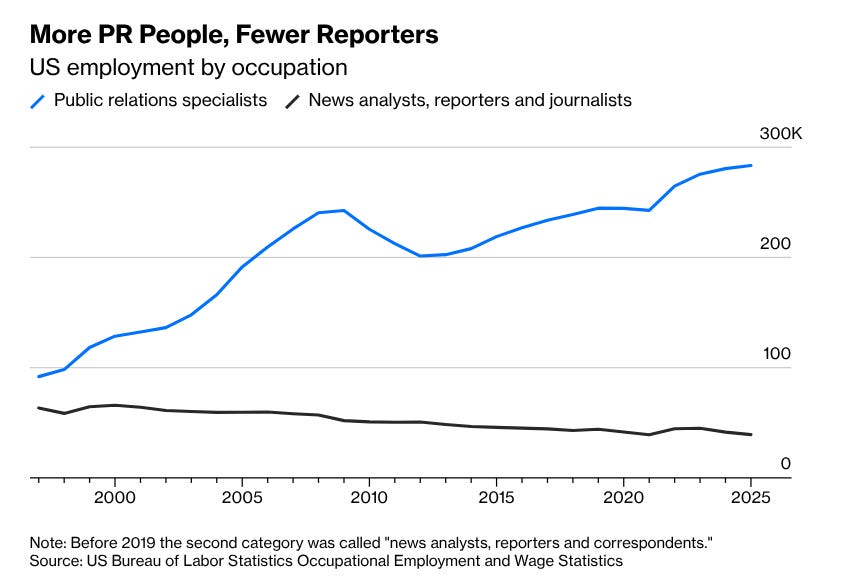
Many people have a vague sense that there is less professional journalism than there used to be. But they may not understand quite how much of a crisis or we’re in, or how it is going to make their own lives worse. This chart, from a recent Justin Fox column at Bloomberg, is one clarifying way to see where we are:

The number of people who want to consume news continues to rise. The number of people who want to manipulate the news continues to rise. Yet the number of people who are actually employed in reporting and writing and publishing the news is declining. Why?

A very short history of the journalism industry in the past half century is: It was very profitable during the newspaper era, because newspapers were little local advertising monopolies, and this profitability produced a large quantity of journalism—nationally, at the state level, and locally. Thus, for a century plus, ubiquitous news coverage was a happy side effect of the business circumstances of news companies. Many people assumed that this was a state of nature, and that journalists would always be present everywhere to help to provide transparency and keep the power of the government and other institutions in check by telling the public what they were doing.

Not true! The internet was invented and advertising money went online, and advertising revenue was consolidated in large part by a handful of huge tech companies like Google and Facebook, which offered unprecedented scale and targeting. Local and regional advertising, as an income stream sufficient to fund entire news organizations, disappeared. Newspapers across America collapsed. News organizations of all sorts laid off tens of thousands of journalists. And here we are. I am leaving out details here, of course, but this is basically what has happened in the past two decades. The public demand for journalism still exists, and the civic need for journalism still exists, but the economic model that made it possible to have the number of journalists necessary to provide the level of news coverage that the public was used to in the 20th century has been utterly smashed by big tech. The combined value of the entire United States newspaper industry today is about $20 billion, while the combined net worth of the two guys who started Google is $345 billion. These things are related.

Though the big tech companies have accrued great wealth that they could use to fund journalism, they have not done so. Why? Because they are not in the journalism business. They are in the attention business. They are agnostic about how they get your attention, in order to sell it to advertisers. News is one way to get it, but producing journalism requires paying journalists. With the advent of social media, these companies found that they could easily put all of us to work, for free, producing content that would capture our attention. They don’t need to spend the money to produce news. Besides, journalists are annoying and tend to write critical stories about huge companies and their CEOs. From the perspective of the tech companies, the outcome is perfect: They have figured out how to get all of the money from the news business, without having to create any news.

Who loses in this new paradigm? Everyone! Journalists lose their jobs. News organizations go out of business. More importantly, there are fewer reporters in statehouses and city halls across the country, and the public knows less about what is happening, and corruption can flourish more easily. There are also fewer reporters to write about the high school volleyball game and the strike at the local factory and the school board and the business community and the military and everything else. There is also a narrower breadth of opinion writing, and debates that are informed by fewer facts. Civic life suffers. The public has less information. It is flat out bad for democracy.

As a counterweight to this gloomy scenario, some point to the large number of quasi-journalism stuff that has arisen online. Sure. But if you look closely at all of those Youtube commentator shows and politics influencers and whatnot, you will see that in aggregate they are much more tilted towards commentary and opinion than towards news and reporting. Nothing wrong with that, in a vacuum—I like commentary and opinion, too. The problem is we end up with an expanding universe of commentary that is about a shrinking universe of actual information. If you cut in half the number of journalists reporting new information and double the number of people writing opinions about that information, you have created an information environment that is objectively less valuable for citizens.

The way in which the production of journalism—a public good—has been wrecked by private corporations is not that different from what happens to other public goods under our capitalist system. Health care? Transportation? Housing? Each industry has its own characteristics, but all are examples of the ways that privatization of public goods ends up producing huge profits for private companies while leaving the public with less access to what they need. In each case, a rational democratic nation that genuinely wanted to produce the highest quality of life for its citizens would intervene to (at least partly) remove these public goods from predatory private markets, and prioritize public funding in order to meet the public need.

This is why I have written before that, until we get drastic changes in our economy, we need public funding for journalism. For the same reason we need public funding of health care. They are public goods, and they are too important to be left to the private market, which will prioritize profitability over the quality of the good itself. The proof of this is: America as it exists today. One of my personal projects for the next year is to try to rally support in my own union—which has seen many of our journalists members laid off in recent years—to push for public funding of journalism in an organized way. We’re all mad at bad bosses and greedy companies, but we also have to recognize that we face a structural problem that demands organized intervention at a national scale. Republicans tend to hate real journalism in general; Democrats tend to make the mistake of only celebrating journalism that is kind to them; and journalists themselves tend to shy away from financial support from the government because they fear being compromised. The result of this is that everyone is worse off and journalism continues to disappear as tech billionaires get richer. We all need to grow up and solve this for the good of everyone.

What Can You Do?

I try, whenever I write about big structural problems, to encourage personal action as well. Otherwise it becomes very easy to just lay back on our couches and say “Wow, the problems are big,” while doing nothing. We have a half century-long crisis of economic inequality, and we need significant new corporate regulations and labor law changes and tax increases in order to try to bend that curve. But also, you can do something about it by unionizing your own workplace. You and I are not just powerless victims of global trends. We are participants in the world and we can make it better.

When it comes to the decimation of American journalism because tech companies sucked all the ad money out of it, one thing that many journalists including me have done is to go independent. Some have gotten together in small groups and launched new publications and others, like me, have launched our own solo publications. Most of these new independent publications seek to overcome the collapse of ad revenue by funding ourselves via subscription revenue instead. In the newspaper era, subscription revenue was always a minor part of big publications’ income. They made a large majority of their money by selling ads. Forsaking all that ad revenue and trying to make it work with only subscriber money, therefore, is a heavy lift.

An unfortunate outcome of more and more journalists going this route is that readers find themselves faced with an ever-increasing number of appeals for money. That can be annoying. It can also leave everyone worse off. When you read three independent publications, it’s easy to pay for them all; when you read thirty, and they all ask for money, it’s easier to just say “ugh” and not pay for any of them. Indeed, I have heard a good deal of anecdotal evidence that writers here on Substack have seen their paid subscriber figures peak, something that is likely caused, in large part, by an increasingly crowded landscape here. I have seen it in the paid subscriber numbers here at How Things Work, as well—over the past six months, even though the number of people reading for free continues to rise, the number of people paying to support the site has not.

I’m using myself as an example here, but my situation applies to many, many journalists who are trying to keep independent journalism alive in the current unforgiving business environment. If it becomes harder to get readers to become paid subscribers, what are my options? I can turn on ads to try to fill the hole that way—this option is the reason why you see many of your favorite websites evolve into unrecognizable hellscapes of pop-ups and flashing banners. I can put up a paywall, which would effectively bar everyone who cannot afford to pay from reading me, contributing to the larger harmful trend of making public information into a luxury good. Or I can try to cultivate more people with the financial means to make larger donations to support me. I am profoundly grateful to the few people who have done this over the years, and I would love to find more people like that (email me, if that person is you), but this is a thin and chancy reed upon which to rest an entire publication’s future.

The other option—which is broader, and more difficult, but ultimately more sustainable—is to work to create norms around paying for journalism that are suited to the world that we live in now. Most adults today grew up in a world where news seemed more or less free. That was an illusion; we paid for it with our own time, which was packaged and sold to advertisers. But in a new journalism world that requires direct payment to make up for those disappeared ads, there is a natural aversion to rousing ourselves to pay money for something that felt free not so long ago. Fewer than ten percent of the people who read How Things Work pay for it, and that number is normal for publications like mine.


Source: hamiltonnolan.com

The most salient quality of the future is that it hasn’t happened yet. It is a book whose pages are unwritten. Its authors will be those who decide to work to make their will into reality. Those who just lay back and try to guess what will happen have made their own choice, to be the audience of what the others try to enact. There is nothing especially wrong with this choice except for the fact that many who make it do not realize that they could have made a different one.

Predicting the future is so alluring precisely because it is impossible. Mathematicians can tell you that predictions grow more complex with the number of variables involved. When we are dealing with the real world, the number of variables, and therefore the number of possible outcomes, branches quickly towards infinity. Our most powerful supercomputers can only forecast the weather for about a week before it becomes unknowable. And that involves only quantifiable physics. Add in questions of humanity’s wild hearts and minds, and the task of even knowing what the variables are transcends our grasp.

Sitting around and making educated guesses about the impenetrable future is an engaging pastime, a natural playing field for intellectual showoffs. Yet, unless you are guessing about things that don’t matter too much, you will quickly be faced with the question: “Wouldn’t it be more useful to spend your time trying to make the future that you want, instead of amusing yourself to death trying to prophesize what those who do decide to make the future will do?” You will, after all, have to suffer through the future that comes, whether you like it or not. Might as well do whatever you can do to make it better.

Woe to the misguided prophets! They wallow in a world that others create. No prophecy is so tragic as a self-fulfilling one. Whether you believe that you can change the future or not, you are certain to be correct.

There is nothing as dispiriting as someone who has talked themselves out of their own beliefs because they fear they aren’t achievable. These people’s pessimism signs them up for a diminished life. Polls tell us that most Americans want a better, fairer, more just country. They want healthcare for all, they want to tax the rich, they want to fight climate change, they want to give more foreign aid, they want to have a union. Yet the political system delivers none of those things to them. It’s trivial to say that that is because moneyed interests have bought power in politics; yes, they have, but that is no different from saying that one team is always trying to win over another. What are the mechanisms that allow the interests of the rich to overcome the interests of many, many more regular people? How does the accumulated power of all of those people who want a better world get neutralized? How are they prevented from organizing themselves into what would be an unstoppable force towards humane progress?

The rich cannot fight everyone. They have to convince everyone not to fight. What they need to inculcate in the public is not a sense of rage, but rather a sense of futility. They are like a prison guard with one bullet. Their material weapons cannot overcome the numbers against them; their real weapon is the idea that they create inside every single mind that overcoming them is too risky, too foolish, too unrealistic.

The most popular national elected official in America is Bernie Sanders. Yet when he ran for president, he could not defeat his less liked, more institutional opponents. During those campaigns, from people that I knew to have strong progressive values, I heard time and again the explanation that Bernie simply could not win, and that therefore supporting him would be an indulgent fantasy, a waste of time and money and a vote. On the opposite side, a candidate who was objectively much more extreme and whose success was much more far-fetched by the standards of conventional wisdom inspired a cult of personality, and won. Twice. After watching this for a full decade, many Democratic voters and many Democratic strategists steeped in the religion of triangulation and centrism have still failed to update their beliefs about what is and is not possible. This is a shame. It is a shame that has caused great human suffering within America and around the world. And it is made more shameful by the fact that it could be different if more good people just had the courage to vote for their own values.

Fortunately, the future is a renewable resource. There will be at least one more election. We get another chance. The aperture of possibility is widened. There is organizing, and there are candidates, and the kind of world that you want to see is there, on the menu, somewhere. There is no reward for those who volunteer to forgo their right to try to make their vision of the world come true in full. The prize for asking for less is less. Understanding that, alone, could change so much.


This article was originally published by hamiltonnolan.com; please consider supporting the original publication, and read the original version at the link above.Email
Hamilton Nolan is a labor writer for In These Times. He has spent the past decade writing about labor and politics for Gawker, Splinter, The Guardian, and elsewhere. More of his work is on Substack.