
Many people have a vague sense that there is less professional journalism than there used to be. But they may not understand quite how much of a crisis or we’re in, or how it is going to make their own lives worse. This chart, from a recent Justin Fox column at Bloomberg, is one clarifying way to see where we are:
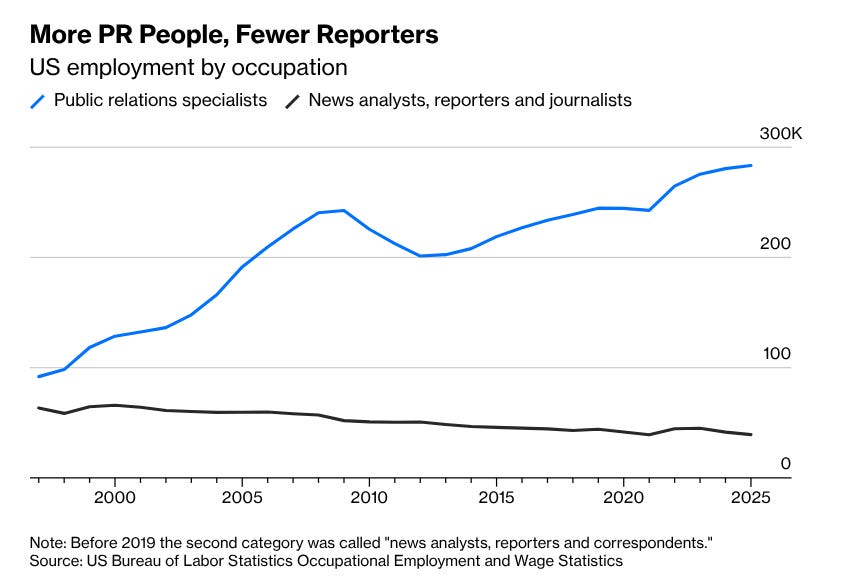
The number of people who want to consume news continues to rise. The number of people who want to manipulate the news continues to rise. Yet the number of people who are actually employed in reporting and writing and publishing the news is declining. Why?
A very short history of the journalism industry in the past half century is: It was very profitable during the newspaper era, because newspapers were little local advertising monopolies, and this profitability produced a large quantity of journalism—nationally, at the state level, and locally. Thus, for a century plus, ubiquitous news coverage was a happy side effect of the business circumstances of news companies. Many people assumed that this was a state of nature, and that journalists would always be present everywhere to help to provide transparency and keep the power of the government and other institutions in check by telling the public what they were doing.
Not true! The internet was invented and advertising money went online, and advertising revenue was consolidated in large part by a handful of huge tech companies like Google and Facebook, which offered unprecedented scale and targeting. Local and regional advertising, as an income stream sufficient to fund entire news organizations, disappeared. Newspapers across America collapsed. News organizations of all sorts laid off tens of thousands of journalists. And here we are. I am leaving out details here, of course, but this is basically what has happened in the past two decades. The public demand for journalism still exists, and the civic need for journalism still exists, but the economic model that made it possible to have the number of journalists necessary to provide the level of news coverage that the public was used to in the 20th century has been utterly smashed by big tech. The combined value of the entire United States newspaper industry today is about $20 billion, while the combined net worth of the two guys who started Google is $345 billion. These things are related.
Though the big tech companies have accrued great wealth that they could use to fund journalism, they have not done so. Why? Because they are not in the journalism business. They are in the attention business. They are agnostic about how they get your attention, in order to sell it to advertisers. News is one way to get it, but producing journalism requires paying journalists. With the advent of social media, these companies found that they could easily put all of us to work, for free, producing content that would capture our attention. They don’t need to spend the money to produce news. Besides, journalists are annoying and tend to write critical stories about huge companies and their CEOs. From the perspective of the tech companies, the outcome is perfect: They have figured out how to get all of the money from the news business, without having to create any news.
Who loses in this new paradigm? Everyone! Journalists lose their jobs. News organizations go out of business. More importantly, there are fewer reporters in statehouses and city halls across the country, and the public knows less about what is happening, and corruption can flourish more easily. There are also fewer reporters to write about the high school volleyball game and the strike at the local factory and the school board and the business community and the military and everything else. There is also a narrower breadth of opinion writing, and debates that are informed by fewer facts. Civic life suffers. The public has less information. It is flat out bad for democracy.
As a counterweight to this gloomy scenario, some point to the large number of quasi-journalism stuff that has arisen online. Sure. But if you look closely at all of those Youtube commentator shows and politics influencers and whatnot, you will see that in aggregate they are much more tilted towards commentary and opinion than towards news and reporting. Nothing wrong with that, in a vacuum—I like commentary and opinion, too. The problem is we end up with an expanding universe of commentary that is about a shrinking universe of actual information. If you cut in half the number of journalists reporting new information and double the number of people writing opinions about that information, you have created an information environment that is objectively less valuable for citizens.
The way in which the production of journalism—a public good—has been wrecked by private corporations is not that different from what happens to other public goods under our capitalist system. Health care? Transportation? Housing? Each industry has its own characteristics, but all are examples of the ways that privatization of public goods ends up producing huge profits for private companies while leaving the public with less access to what they need. In each case, a rational democratic nation that genuinely wanted to produce the highest quality of life for its citizens would intervene to (at least partly) remove these public goods from predatory private markets, and prioritize public funding in order to meet the public need.
This is why I have written before that, until we get drastic changes in our economy, we need public funding for journalism. For the same reason we need public funding of health care. They are public goods, and they are too important to be left to the private market, which will prioritize profitability over the quality of the good itself. The proof of this is: America as it exists today. One of my personal projects for the next year is to try to rally support in my own union—which has seen many of our journalists members laid off in recent years—to push for public funding of journalism in an organized way. We’re all mad at bad bosses and greedy companies, but we also have to recognize that we face a structural problem that demands organized intervention at a national scale. Republicans tend to hate real journalism in general; Democrats tend to make the mistake of only celebrating journalism that is kind to them; and journalists themselves tend to shy away from financial support from the government because they fear being compromised. The result of this is that everyone is worse off and journalism continues to disappear as tech billionaires get richer. We all need to grow up and solve this for the good of everyone.
What Can You Do?
I try, whenever I write about big structural problems, to encourage personal action as well. Otherwise it becomes very easy to just lay back on our couches and say “Wow, the problems are big,” while doing nothing. We have a half century-long crisis of economic inequality, and we need significant new corporate regulations and labor law changes and tax increases in order to try to bend that curve. But also, you can do something about it by unionizing your own workplace. You and I are not just powerless victims of global trends. We are participants in the world and we can make it better.
When it comes to the decimation of American journalism because tech companies sucked all the ad money out of it, one thing that many journalists including me have done is to go independent. Some have gotten together in small groups and launched new publications and others, like me, have launched our own solo publications. Most of these new independent publications seek to overcome the collapse of ad revenue by funding ourselves via subscription revenue instead. In the newspaper era, subscription revenue was always a minor part of big publications’ income. They made a large majority of their money by selling ads. Forsaking all that ad revenue and trying to make it work with only subscriber money, therefore, is a heavy lift.
An unfortunate outcome of more and more journalists going this route is that readers find themselves faced with an ever-increasing number of appeals for money. That can be annoying. It can also leave everyone worse off. When you read three independent publications, it’s easy to pay for them all; when you read thirty, and they all ask for money, it’s easier to just say “ugh” and not pay for any of them. Indeed, I have heard a good deal of anecdotal evidence that writers here on Substack have seen their paid subscriber figures peak, something that is likely caused, in large part, by an increasingly crowded landscape here. I have seen it in the paid subscriber numbers here at How Things Work, as well—over the past six months, even though the number of people reading for free continues to rise, the number of people paying to support the site has not.
I’m using myself as an example here, but my situation applies to many, many journalists who are trying to keep independent journalism alive in the current unforgiving business environment. If it becomes harder to get readers to become paid subscribers, what are my options? I can turn on ads to try to fill the hole that way—this option is the reason why you see many of your favorite websites evolve into unrecognizable hellscapes of pop-ups and flashing banners. I can put up a paywall, which would effectively bar everyone who cannot afford to pay from reading me, contributing to the larger harmful trend of making public information into a luxury good. Or I can try to cultivate more people with the financial means to make larger donations to support me. I am profoundly grateful to the few people who have done this over the years, and I would love to find more people like that (email me, if that person is you), but this is a thin and chancy reed upon which to rest an entire publication’s future.
The other option—which is broader, and more difficult, but ultimately more sustainable—is to work to create norms around paying for journalism that are suited to the world that we live in now. Most adults today grew up in a world where news seemed more or less free. That was an illusion; we paid for it with our own time, which was packaged and sold to advertisers. But in a new journalism world that requires direct payment to make up for those disappeared ads, there is a natural aversion to rousing ourselves to pay money for something that felt free not so long ago. Fewer than ten percent of the people who read How Things Work pay for it, and that number is normal for publications like mine.
The most salient quality of the future is that it hasn’t happened yet. It is a book whose pages are unwritten. Its authors will be those who decide to work to make their will into reality. Those who just lay back and try to guess what will happen have made their own choice, to be the audience of what the others try to enact. There is nothing especially wrong with this choice except for the fact that many who make it do not realize that they could have made a different one.
Predicting the future is so alluring precisely because it is impossible. Mathematicians can tell you that predictions grow more complex with the number of variables involved. When we are dealing with the real world, the number of variables, and therefore the number of possible outcomes, branches quickly towards infinity. Our most powerful supercomputers can only forecast the weather for about a week before it becomes unknowable. And that involves only quantifiable physics. Add in questions of humanity’s wild hearts and minds, and the task of even knowing what the variables are transcends our grasp.
Sitting around and making educated guesses about the impenetrable future is an engaging pastime, a natural playing field for intellectual showoffs. Yet, unless you are guessing about things that don’t matter too much, you will quickly be faced with the question: “Wouldn’t it be more useful to spend your time trying to make the future that you want, instead of amusing yourself to death trying to prophesize what those who do decide to make the future will do?” You will, after all, have to suffer through the future that comes, whether you like it or not. Might as well do whatever you can do to make it better.
Woe to the misguided prophets! They wallow in a world that others create. No prophecy is so tragic as a self-fulfilling one. Whether you believe that you can change the future or not, you are certain to be correct.
There is nothing as dispiriting as someone who has talked themselves out of their own beliefs because they fear they aren’t achievable. These people’s pessimism signs them up for a diminished life. Polls tell us that most Americans want a better, fairer, more just country. They want healthcare for all, they want to tax the rich, they want to fight climate change, they want to give more foreign aid, they want to have a union. Yet the political system delivers none of those things to them. It’s trivial to say that that is because moneyed interests have bought power in politics; yes, they have, but that is no different from saying that one team is always trying to win over another. What are the mechanisms that allow the interests of the rich to overcome the interests of many, many more regular people? How does the accumulated power of all of those people who want a better world get neutralized? How are they prevented from organizing themselves into what would be an unstoppable force towards humane progress?
The rich cannot fight everyone. They have to convince everyone not to fight. What they need to inculcate in the public is not a sense of rage, but rather a sense of futility. They are like a prison guard with one bullet. Their material weapons cannot overcome the numbers against them; their real weapon is the idea that they create inside every single mind that overcoming them is too risky, too foolish, too unrealistic.
The most popular national elected official in America is Bernie Sanders. Yet when he ran for president, he could not defeat his less liked, more institutional opponents. During those campaigns, from people that I knew to have strong progressive values, I heard time and again the explanation that Bernie simply could not win, and that therefore supporting him would be an indulgent fantasy, a waste of time and money and a vote. On the opposite side, a candidate who was objectively much more extreme and whose success was much more far-fetched by the standards of conventional wisdom inspired a cult of personality, and won. Twice. After watching this for a full decade, many Democratic voters and many Democratic strategists steeped in the religion of triangulation and centrism have still failed to update their beliefs about what is and is not possible. This is a shame. It is a shame that has caused great human suffering within America and around the world. And it is made more shameful by the fact that it could be different if more good people just had the courage to vote for their own values.
Fortunately, the future is a renewable resource. There will be at least one more election. We get another chance. The aperture of possibility is widened. There is organizing, and there are candidates, and the kind of world that you want to see is there, on the menu, somewhere. There is no reward for those who volunteer to forgo their right to try to make their vision of the world come true in full. The prize for asking for less is less. Understanding that, alone, could change so much.


No comments:
Post a Comment