It’s possible that I shall make an ass of myself. But in that case one can always get out of it with a little dialectic. I have, of course, so worded my proposition as to be right either way (K.Marx, Letter to F.Engels on the Indian Mutiny)
Thursday, August 13, 2026
Engine Room Fire Breaks Out Aboard Reefer Ship Dole Colombia
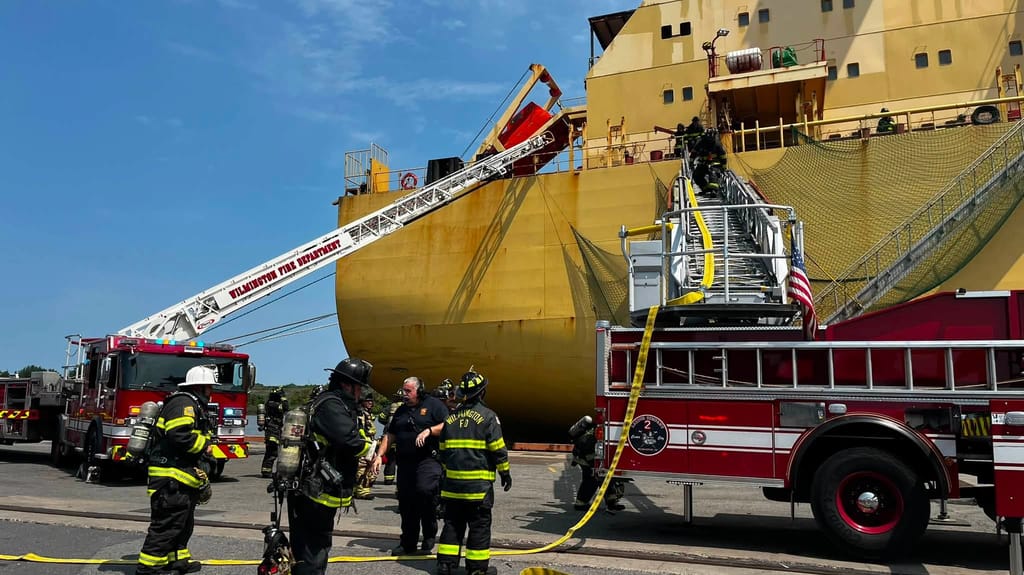
On Monday, a fire broke out in the engine room aboard a reefer ship at the Port of Wilmington, Delaware. The blaze has been brought under control, according to the local fire department.
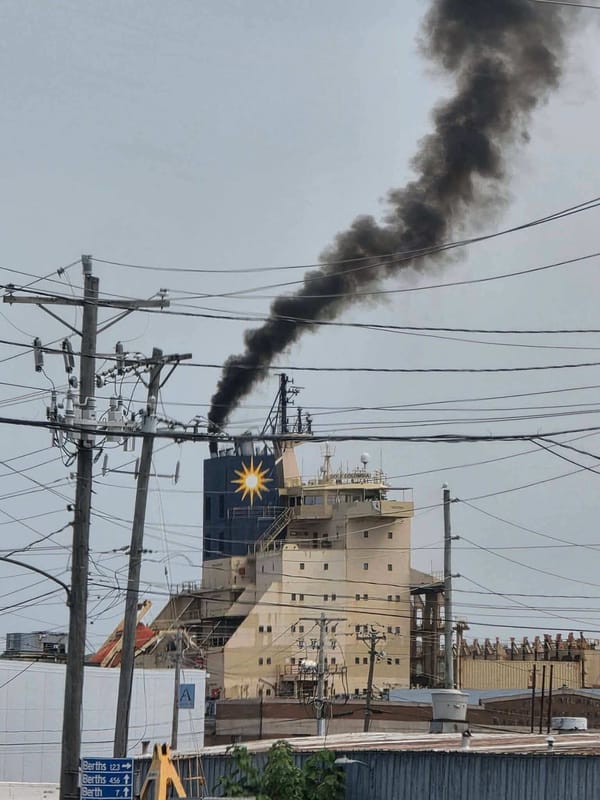
On Monday morning, the Wilmington Fire Department received a call reporting a fire on the reefer Dole Colombia at the port's Berth 5. Smoke was coming out of the ship's stacks, and the master reported a fire affecting a generator in the engine room. The department sounded a second alarm to bring in all available units and to ask for assistance from nearby departments.
Courtesy Wilmington Fire Department
The master of the vessel confirmed that the engine room had been sealed up and that the fixed firefighting system had been discharged into the space. All crewmembers were safe and accounted-for, leaving only an incident-monitoring role for the fire department's responders. After a period of checking boundary temperatures and standing by with hoses, the fire department began to stand down the response and return units to their normal duties.
Dole Colombia is an 850-TEU open-top containerized reefer ship, built in 1999 specifically for the fruit trade. She is self-unloading, with specialized adaptations for banana transport. She has single-screw propulsion and five diesel generators to power the large electrical load needed for cooling. Her PSC inspection record is spotless.
It is the second time that Dole Colombia has suffered an engine room fire at the Port of Wilmington. The ship sustained a fire in June 2021 as she was getting under way from the pier, forcing her to return to her berth to combat the blaze. At the time, a Coast Guard spokesperson said that the fire originated in the ship's main engine, and that the fixed firefighting system was used to bring it under control. As tugs were already alongside, the ship had no trouble returning to the pier, and the fire was out before any significant damage to internal compartments.
Last November, another banana ship - Chiquita Voyager - sustained an engine room fire at Port of Wilmington, injuring four crewmembers. The blaze began with a generator and grew quickly. Local firefighters helped evacuate crewmembers, and when all was ready the master activated the fixed firefighting system to bring the fire under control.
Panama Canal Auction Prices Soar as Wait Builds and Water Level Falls
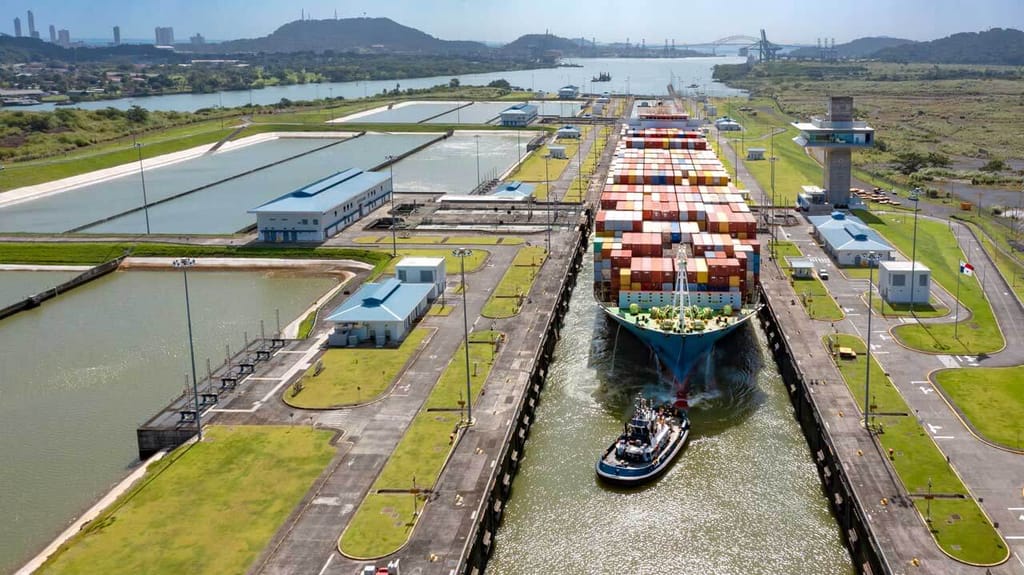
A containership reportedly bid nearly $4 million for a transit slot at the Neopanamax locks (Panama Canal Authority)
The price shipowners and operators are willing to pay to transit the Panama Canal is once again on the rise as delays at the vital waterway are building. This week was the second time this year there have been reports of record prices being bid at the transit auctions as volumes have increased at the canal due to Asian demand for U.S. energy exports and the closure of the Strait of Hormuz and disruptions in the Red Sea.
A containership is reported to have bid nearly $4 million this week to “jump the line” at the Pacific entrance to the Panama Canal. Bloomberg reports the vessel Seaspan Benefactor (119,000 dwt) placed the bid, marking the first time since April that auction prices have jumped to these levels.
Seaspan’s website lists Ocean Network Express (ONE) as the charterer of the containership, which is 337 meters (1,106 feet) in length with a capacity of 10,100 TEU. It is unclear if the vessel is behind schedule on its trip from Asia. ONE’s online schedule shows the ship due to transit the Canal on August 16–17 and then to proceed to Houston and Mobile, before returning to the Canal for a return transit on September 6–7.
Data indicates the Seaspan Benefactor is currently traveling at a 13.8-meter (45.3-foot) draft. As such, it has to transit the Neopanamax locks, which currently a taking vessels with a draft of up to 49 feet.
Argus is reporting that this high bid is the latest in a series of high bids driving the average price up. It calculates that the average bid for the Neopanamax locks has reached $2.5 million. Argus reports the high since late July is $3.78 million for the Neopanamax locks and $2.63 million at the original Panamax locks. It reports that the average prices “have surged more than 16-fold compared to the same period last year.”
At play may be concerns that the Panama Canal Authority, starting in late August, will lower the maximum draft for the Neopanamax locks by half a foot and then, in September, another half a foot. In late July, it was also reported that they would be temporarily suspending some of the close-in auction slots, which are offered 96 to 48 hours before the transit time.
The Panama Canal Authority’s online dashboard shows the number of booked vessels waiting for transit has risen to 78 total, including 19 booked Neopanamax and 11 non-booked. There are, as of August 12, 32 non-booked vessels waiting for transit. The average days wait for non-booked vessels is also climbing. Currently, it is just under 8 days northbound (Pacific to Atlantic) and nearly 10 days southbound.
The pressure is building as the Panama Canal Authority is taking steps to increase its water management as the anticipated El Niño phenomenon builds and reduces rainfall. The Panama Canal Authority reported a five percent increase in the number of transits between October and June. So far, it is maintaining the number of transits at around 35 per day, but during the last drought it was forced to reduce the number of daily transits.
As the restrictions build, shipowners and operators will face the choice of diverting or reducing their loads. During the last drought, large containerships were required to offload a portion of their cargo and transship the containers across the Isthmus by train.
Water levels in Gatun Lake have slipped slightly in early August down to a current 84.3 feet. The current forecast shows that by mid-October it could be at 82.8 feet. Gatun Lake’s lowest five-year average water level was just under 84 feet, recorded in the month of May. However, in 2023, during the last significant drought, starting in June and through until October, the lake was measured at just over 79 feet as the authority imposed limits on the number of vessels and their drafts.
India fuels global growth in planned coal mining capacity, report says
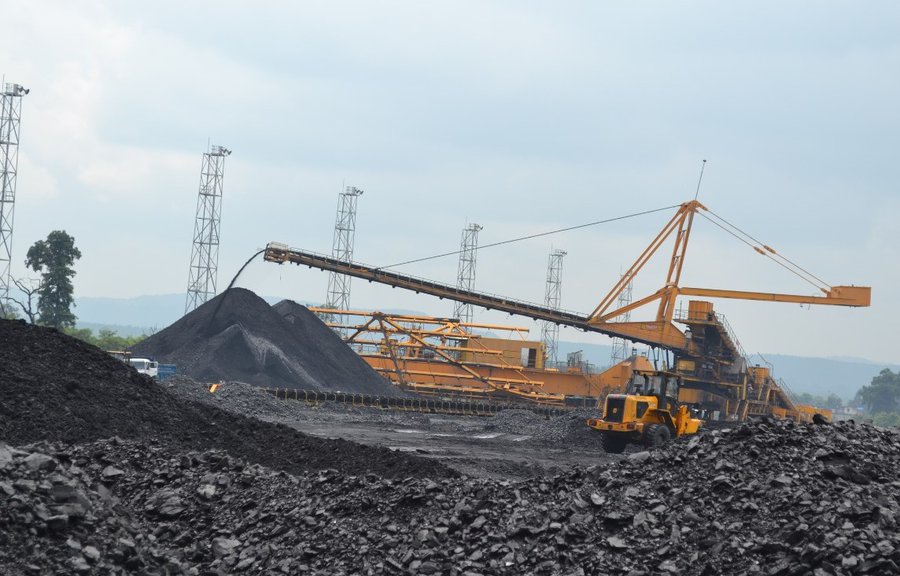
India nearly doubled its planned coal mining capacity in 2025, fuelling a global rise in proposed coal mine developments, a report by Global Energy Monitor showed.
India’s proposed coal mine capacity rose to 638 million metric tons per annum (mtpa) from 329 mtpa a year earlier, accounting for almost all of the growth in the global coal project pipeline, which expanded 11% to 2,521 mtpa.
The increase highlights New Delhi’s efforts to boost domestic coal production to meet rising power demand, even as renewable energy capacity expands rapidly and analysts expect global coal demand growth to slow.
The increase in planned capacity comes despite International Energy Agency forecasts that global coal demand will plateau by 2030. Wind and solar overtook coal in the global electricity mix for the first time in 2025, the U.S.-based energy research group said.
Most of India’s proposed new capacity is concentrated in the eastern states of Jharkhand and Odisha, as the government targets coal production of nearly 1.15 billion metric tons in fiscal 2025/26 and 1.5 billion tons by 2030.
However, the rapid growth in planned mining capacity could leave producers exposed if coal demand weakens faster than expected, the report said.
While coal mine proposals increased, new capacity additions fell nearly 40% in 2025 to 113 mtpa, driven by declines in China and Australia, the report said.
(Reporting by Sethuraman NR. Editing by Mark Potter)
India seeks to curb states’ powers to tax minerals, mining
India’s Prime Minister Narendra Modi. (Image by the World Economic Forum, Flickr.)
India’s federal government plans to curb states’ powers to regulate or tax mineral rights and ore-bearing land, seeking to make rules uniform across the country.
Prime Minister Narendra Modi’s government has introduced a bill in Parliament that would amend laws to give it greater control over mining. This will allow New Delhi to set conditions and limits on taxes, as well as other levies imposed by regional authorities on minerals, according to the proposed legislation.
The cumulative impact of levies should not become disproportionate to the mine’s economic value and profitability, the government said in the amendment proposal. “There is also a risk of an increase in imports of minerals despite having sufficient local mineral resources as domestic mineral supply becomes expensive,” it added.
The move risks heightening tensions between New Delhi and regional governments by curbing a potentially important source of revenue for mineral-rich areas, just two years after the Supreme Court settled a long-running constitutional dispute over mineral taxation in states’ favor. Relations were already strained after the federal government unexpectedly cut consumption taxes last year, reducing states’ revenues.
“Overall, the proposal appears aimed at strengthening fiscal coordination between the center and states, creating a more consistent taxation framework across jurisdictions,” said Rajib Maitra, partner at Deloitte India. This will reduce fiscal uncertainty and also any retrospective liabilities for the mining sector, he added.
The central government controls mines and mineral development, but state administrations were allowed to collect additional levies from miners, based on the quantity of a mineral extracted. In August 2024, the Supreme Court had upheld the states’ right to impose levies on mining, in addition to royalties.
The amendment is aimed at providing stability and predictability in the fiscal regime for the mining sector, according to the bill. Uneven and high taxes are hindering investments in the sector by pushing up costs for miners and making operations unviable.
The amendment is seeking to change the fiscal balance, said Rohit Chandra, assistant professor at School of Public Policy, Indian Institute of Technology Delhi. “States from across the political spectrum will have a problem with this.”
When President Donald Trump met with Japanese Prime Minister Sanae Takaichi in March at the White House, little attention was paid to their discussions about a tiny Japanese island in the Pacific Ocean, barely big enough for human visitors but inhabited by dangerous snails.
Minamitorishima, a pancake-flat speck of land about the size of a few city blocks with little more than a weather station and a runway, lies over 1,000 miles southeast of Tokyo. It also sits astride deep-sea rare earth deposits — ones that could “meet centuries’ worth of industrial demand,” a US-Japan statement about cooperation to consider mining them heralded after the summit.
The response was widespread skepticism. Despite decades of global seabed exploration and mapping, no such mining projects have reached commercial scale and international guidelines are still debated. Minamitorishima’s bounty, encased in mud, also happens to be some of the deepest considered for extraction, at around six kilometers (3.7 miles) beneath the ocean’s surface.
“Minamitorishima is an ambitious project, but one that could enable Japan and the US to possess a fully closed-loop, mine-to-magnet rare earths supply chain, helping to break China’s leverage over them,” said William Chou, a senior fellow at the Hudson Institute.
Plans now appear to be taking shape for how the Minamitorishima project might proceed. Japan’s Cabinet Office recently reported back the results of test samples retrieved earlier this year, showing significant levels of yttrium, gadolinium and dysprosium – so-called heavy rare earths that China is particularly dominant in producing. More test drilling is planned, with a target of developing a plan.
A handful of North American companies, including Houston-based Deep Reach Technology, have expressed interest in the project to extract the Minamitorishima deposits, according to people familiar with the situation, although those conversations are at a very early stage. Work so far has been entirely handled by Japan, which has advanced deep sea exploration capabilities, but the heft of US companies with experience in oil and gas drilling would likely become part of the solution.
American support has become all the more significant as China shows its own interest in the seabed deposits, in the form of repeated visits from oceanographic survey ships near Minamitorishima. A Bloomberg News analysis of commercial tracking data from one Chinese research ship shows it has conducted surveying of the seabed in recent years right up to Japan’s exclusive economic zone — the area of sea 200 nautical miles from a coastline that guarantees the nation sole exploration and exploitation rights for resources.
For Beijing and Tokyo alike, the challenges would be formidable. Offshore oil drilling projects to date only reach around half the depth of the Minamitorishima seabed. Water pressure at the site is around 600 times greater than at sea level and little is known about life forms that could be impacted by commercial mining. If successful, the project would likely require billions of dollars of investment over more than a decade to produce rare earths at around three times the cost of land-based extraction in China, according to one private sector estimate.
Under any other Japanese prime minister, the project might have been viewed as mostly aspirational given its cost, complexity and long timeline. But for Takaichi, it has become a core part of her plan to wean Japan off its reliance on China and something she has been passionate about since her time as Japan’s economic security minister for two years through 2024.
In a national election stump speech earlier this year, she touted her involvement in pushing the project forward: “This means Japan won’t have to worry about securing rare earths — not for our generation, and not for the next generation either.”
China’s throttling of rare earth supplies to Japan since late last year as punishment for remarks Takaichi made about Taiwan has only added to her determination. Her long-term growth strategy anticipates around $5.7 billion in public and private sector funding by 2040 for deep sea resource development, including the Minamitorishima project.
In Trump, she has found a partner with a similar desire to lessen China’s leverage over the US in rare earths and open up seabed mineral exploration and mining for US businesses. In April, the Republican leader ordered federal agencies to quickly review and issue licenses and permits for projects in the US and internationally.
There are other reasons Takaichi has sought to bring the US into the project. As a conservative who views Japan’s alliance with the US as an important asset in defending national interests from China, joint production of rare earths from Minamitorishima would help her bind the two countries closer together by creating supply chain security for materials China otherwise has a stranglehold on.
In doing so, it would send a clear strategic message to Beijing — in an area where Chinese interests stretch far back.
Decades ago, China secured exclusive rights for deep sea exploration in blocks near to Minamitorishima and the US territory of Guam from the International Seabed Authority, the United Nations affiliated organization that manages the mineral resources of the seabed beyond national jurisdiction. The recent survey ship activity suggests Beijing’s interest in mineral exploration in the area is growing, as does a growing volume of research papers published in China about the region, according to Tokyo University professor Kentaro Nakamura, who is part of a team that has studied the area.
In June 2025, events became more ominous when one of China’s aircraft carriers entered the Minamitorishima EEZ, the first time any Chinese naval vessel had been in the area. The visit was brief and wasn’t a breach of international law, but Tokyo was alarmed and protested to Beijing. It recently moved an anti-ship missile battery to the island for live-fire training and is working on plans to add more radar and other defense facilities nearby to monitor Chinese and Russian military activity.
“That felt almost like someone pointing a blade at us,” Shoichi Ishii, the program director for the Minamitorishima rare earth project at Japan’s Cabinet Office, said of the Chinese carrier approach.
In response to questions from Bloomberg, the Spokesperson’s Office of the Chinese Ministry of Foreign Affairs said China’s marine scientific research activities “serve peaceful purposes and strictly abide by relevant provisions of international law.” It also said “China consistently pursues a defensive national defense policy, and the activities of Chinese warships in the relevant waters are entirely in accordance with international law and international practice.”
From samples retrieved by Japanese survey ships, Nakamura and his colleagues estimated in 2018 that mud on the seabed south of Minamitorishima contained more than 16 million tons of rare earth minerals, the vital ingredients of modern economies, essential for everything from semiconductors to electric vehicle motors to missile guidance systems. Deposits of one of the elements, yttrium, used in LED screens and semiconductor equipment, were sufficient to meet 780 years of global demand, they forecast.
After some initial excitement, progress was slow in considering how to retrieve the minerals. But by the time Trump and Takaichi met in March, the hunt for rare earth supplies had rocketed up the priority list for both governments. In retaliation for Trump’s trade tariff offensive, China imposed export controls on rare earths to the US, using its leverage as the supplier of around 90% of the minerals globally. Beijing used the same tactic against Takaichi.
Trump’s interest in Minamitorishima was sparked by the scale of the potential supply it offered after Takaichi first raised it with him on a visit to Tokyo in October 2025, according to people familiar with his response. Then before Takaichi traveled to Washington in March this year, Japan made it clear that it wanted the matter to be high on the agenda, these people said.
Little has been said publicly by the US since the two countries signed a memorandum of understanding for deep sea mining after the March summit. However, Deep Reach Technology, an offshore engineering consultancy and project management company, has held initial meetings with Japanese officials, according to Jim Wodehouse, vice president of projects at the company.
Deep Reach is already working on a separate project related to the extraction of polymetallic nodules – avocado-sized clusters of cobalt and other critical minerals found on the seabed – in the Minamitorishima EEZ. “I’m positive about research in the Minamitorishima EEZ,” Wodehouse said in an interview. “The rare earths are very rich and include important heavy elements, as well as having low levels of radioactivity.”
Among elements found in the Minamitorishima mud are so-called heavy rare earths such as dysprosium and terbium that are among the most tightly controlled by China and also some of the most essential industrial inputs. Exports from China to Japan of dysprosium and terbium, used by Japanese firms to make high-performance magnets for electric vehicles, have been at zero all year.
Another advantage of the Minamitorishima deposits is that while extracting heavy rare earths from traditional surface mines often releases potentially harmful radioactive elements, samples from Minamitorishima were not found to have significant levels of radiation, making them easier to process.
Nakamura and the University of Tokyo team estimate around 3,500 tons of mud could be retrieved each day through a suction pump system used in deep-sea oil mining, but there isn’t a consensus yet on an effective extraction method. Deep Reach holds patents in both the US and Japan for technologies that could be used in sea bed mining. Refining and processing of ores is a field dominated by China but Japan is developing its own capabilities, and Nakamura said these could be scaled up.
“There aren’t any major technical obstacles,” Nakamura said, arguing that test extractions have shown that the depth of the deposits isn’t a significant obstacle. “It’s just about political will and the challenge from China.”
Japan has already had some success in reducing its dependency on China for rare earths, after Beijing restricted shipments to Japan during a political spat in 2010 following a boat collision near disputed islands in the East China Sea. Still, despite investing in a rare earth separation facility in France and long-term financial backing for Australian miner Lynas Rare Earths Ltd., Tokyo still imports around two-thirds of its total rare earths from China and almost all of the heavy rare earth elements.
Off limits
Up until recent years, the island of Minamitorishima wasn’t widely known among Japanese. A central government proposal to bury waste from Japan’s nuclear reactors on the island as well as the rare earth discovery thrust the tiny outpost into the news.
The EEZ around the island is a circle larger in area than the entire landmass of the Japanese archipelago, giving Tokyo rights to a huge area of ocean for exploration.
The island is off limits to ordinary citizens and the only travel method there is a six-hour Japanese C-130 military transport flight to the island once a week that delivers supplies to weather observation station staff and military officials responsible for maintaining the runway.
Masahito Tanaka, a 50-year old Navy pilot who was commander of the Minamitorishima military detachment for a year through March 2022, said in an interview that one of the challenges was keeping the runway clear of huge numbers of migratory birds. Staff also had to be careful of fist-sized giant African snails on the island that appear after heavy rains and can carry parasites, he said.
On a visit to the nearby island of Iwoto, also known as Iwojima, in March, Defense Minister Shinjiro Koizumi warned of a “security vacuum” among lightly defended islands on Japan’s Pacific side. Since then, the Defense Ministry has created a new team of officials responsible for bolstering surveillance of foreign ships and aircraft and defense of the islands. Plans under consideration include the deployment of new radar systems, runway extensions and new harbor facilities for ships.
In June, a Type 12 Surface-to-Ship Missile launcher arrived in Minamitorishima along with an electronic warfare system and Scan Eagle II drone, a deployment described by defense officials as intended for live-fire testing of missiles into the sea.
Lasting US interest?
Despite geopolitical frictions over Japan’s Pacific islands, the deep sea exploration is pushing ahead.
A full-scale mining test lasting one month is planned for February 2027 that will include refining and smelting, with an aim to complete an assessment of the feasibility of commercializing domestically produced rare earths in Japan a year later. If successful, it would be Japan’s only rare earths mine, enabling it to close the loop on rare earths magnet production, said William Chou of the Hudson Institute.
Privately, some Japanese government officials acknowledge that there’s no prospect of the project getting up and running during the remainder of the Trump presidency. That could raise questions about sustained US backing as Washington looks for other solutions to tackle China’s dominance of rare earths in the more immediate future.
But while the prospects for a successful project remain unclear, the message it sends to China also resonates for the US as it remains locked in a stand-off with Beijing.
“You can make the argument that the American enthusiasm for Minamitorishima is also part deterring China and trying to convince them that ‘We are not entirely reliant on you,” Chou said. “We have options, too.’ “
(By Alastair Gale, Akemi Terukina and Yoshiaki Nohara)
Marine Corps Picks Up Drones for Surveying the Surf Zone
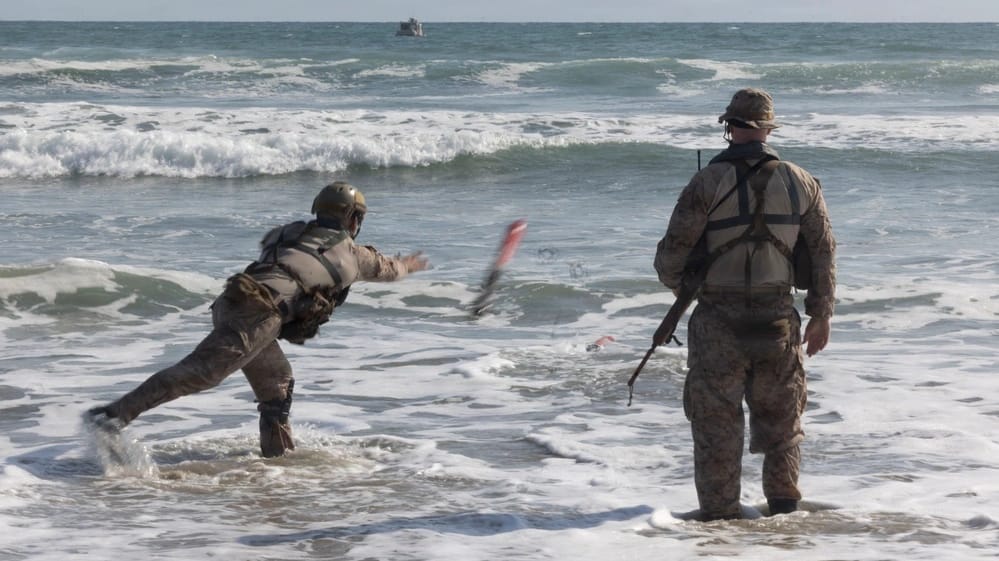
Marines practice the simple deployment of a Jaia survey drone, Camp Pendleton, 2026
The U.S. Marine Corps is working with a robotics contractor to field small submersible drones for use near shore, bringing automation to one of the more dangerous jobs in the service - amphibious reconnaissance.
The Marine Corps' signature mission is over-the-horizon amphibious assault, launching from a specialized Navy vessel in armored amphibious vehicles and motoring ashore through surf, beach obstacles and enemy fire. But it is not done without preparation. In advance of a large operation, commanders need to know what the beach and the surf zone look like, so they send a small handful of amphibious reconnaissaince Marines to look. Beyond basic observation, these teams are trained to survey and map the battlespace in advance. The Marine Corps' capabilities for this task overlap with the U.S. Navy SEALs' mission set, and both share a similar WWII origin story.
Traditional recon methods (USMC file image)
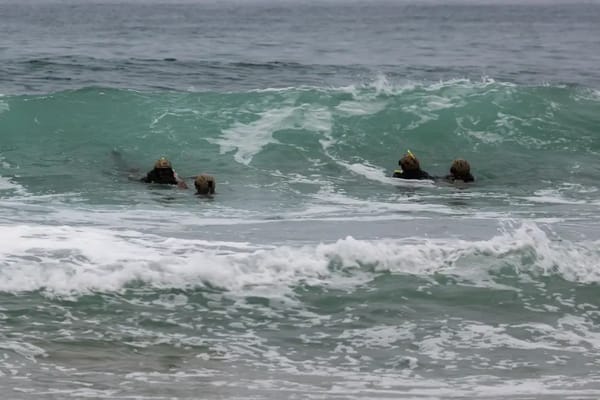
USMC trial of Jaia drones in surf (USMC)
"The way that the Marines do this is that 24 Marines jump off a big ship into a rubber boat. The rubber boat transits quite a long way. Two miles out, the Marines get out, they swim, and they go into the surf zone, and they spend eight hours characterizing the conditions in the surf zone," explained CEO and co-founder Ian Owen in an interview with Marine Technology earlier this year. "JaiaBots, eight of them can do in 30 minutes to one hour a complete characterization of the surf zone, and then they can sit there providing real-time data back to the user."
By handing off that part of the recon mission to a robot, when and where appropriate, the Marine Corps can reduce the risk of casualties and free up its units to work elsewhere. “Sending Marines into the surf zone to manually collect data takes time and exposes them to unnecessary risk. JaiaBot gives us the opportunity to put autonomous systems in harm’s way instead and collect critical information faster," said Josh Mickles, a former USMC staff sergeant and current VP of Customer Success at Jaia.
The Marine Corps likes the idea enough that it is spending $6 million to buy more and cover the cost of training. U.S. Army customers are also using the device to plan river crossings, a similar application. Work on an acoustic bathymetry variant is under way, supported by the U.S. Army Corps of Engineers.
Video: SMIT Helps Egyptian Port Authority Refloat FSRU After Drone Strike
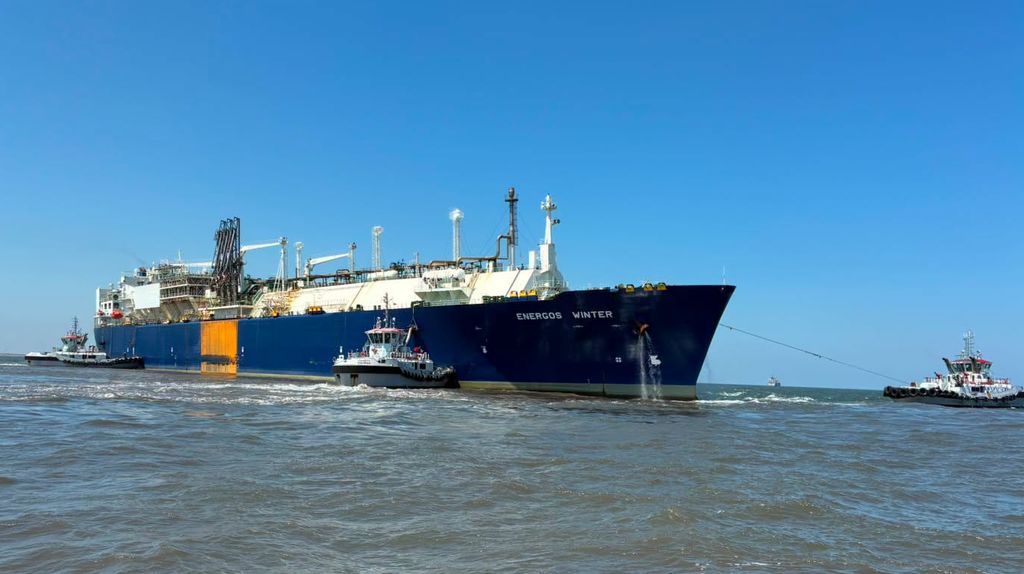
In conjunction with SMIT Salvage, the staff of the Damietta Port Authority have completed a delicate operation to refloat the LNG FSRU Energos Winter and remove it to a safe anchorage.
Energos Winter was attacked by a drone from an unknown adversary on July 29, causing a blast and a fire on board. The blaze spread to a second nearby LNGC, the GasLog Salem. Both fires were brought under control, and no injuries were reported. Egyptian authorities confirmed that the casualty was caused by a drone strike, but have not identified the suspected perpetrator.
At about 1400 hours on the day of the attack, Energos Winter left her berth in the inner harbor and ran aground just outside of the entrance channel, roughly 1000-2000 yards offshore. The grounding was not publicized at the time, and the cause was not disclosed.
The Damietta Port Authority and the shipowner brought in SMIT to handle the salvage work of refloating the ship. SMIT formulated a salvage plan after careful examination and calculations, and the joint team prepared for a refloat and towing operation.
On August 6, the day planned for the refloat, surface conditions on scene were rough but the team decided to proceed anyways. The senior pilots and administrators boarded the vessel, despite difficult conditions for a transfer, and four tugs got into position on either side of the hull. The crew of the Energos Winter pumped off ballast, and the tugs pushed and pulled.
While initially successful in shifting the vessel's position, it could not be refloated completely due to a large surface area and high winds. Two more large tugs were called in to add more bollard pull to the job, bringing the total available power to 360 tonnes BP. To adapt to the effects of the wind conditions, the salvors switched to pulling astern, in a direction at 90 degrees to the navigation channel. This strategy worked and the ship came free from the bottom, ready for towing into deeper water. At about 2000 hours, the vessel went to anchor about 10 nm offshore at a designated anchorage. All work was completed by about 2200, 14 hours after the task began.
China Continues Gulf of Aden Security Mission by Dispatching 49th Fleet
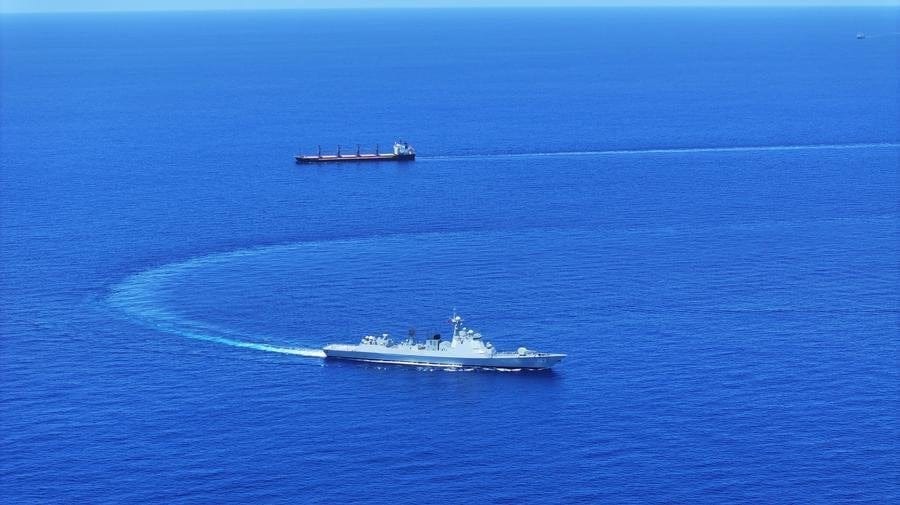
Chinese guided-missile destroyer Jiaozuo in 2024 in the Gulf of Aden (Xinhua Chinese state media)
China’s Ministry of National Defense reported on August 11 that it will continue its escort mission in the Gulf of Aden and Somali waters. It said preparations are underway for the 48th fleet to depart, continuing a mission that started in December 2008.
When the mission was launched 18 years ago, China said it was in support of the UN Security Council and to support security in the region. It was reported to be the first time that China sent military forces overseas to safeguard the nation’s strategic interest, as well as the first organized maritime company force to fulfill international humanitarian obligations.
Shortly after arriving in the region, in January 2009, they reported saving a Greek merchant ship from pirates. They also reported joint exercises with the Russian Navy. In 2015, the force was used to evacuate Chinese and foreign citizens from Yemen, and by the conclusion of the first decade, they reported that Chinese warships had escorted more than 6,600 vessels. Now they are reported to have escorted over 7,000 vessels, conducting rescue, protection, and assistance missions.
The mission consists of three vessels: a guided-missile destroyer, a guided-missile frigate, and a supply ship. The 49th fleet will include the Kunming, a 6,500-ton displacement destroyer commissioned in 2014, the Yueyang, a 3,600-ton displacement frigate commissioned in 2013, and a supply ship, Luomahu.
The new fleet is expected to depart in mid-August, relieving the 48th fleet, which departed China on October 11, 2025. They relieved the 47th fleet, which spent 368 days in the region escorting 102 vessels and traveling over 140,000 nautical miles.
The Chinese ships will be in addition to a new multinational force that Saudi Arabia reports it is organizing. It announced the formation at the end of July with 14 nations participating, and last week announced the appointment of Rear Admiral Abdullah bin Salem Al-Shehri to command the force. They will be conducting a planning meeting on August 12-13 to finalize its institutional framework. They also expect additional countries to join the initiative.
It is in addition to EUNAVFOR Aspides, which has been in the region now for 30 months. The EU emphasizes that it is a defensive operation, but said it has supported 2,260 commercial vessels. Also, it said that since its formation, it has intercepted 19 UAVs, 12 USVs, and four missiles targeting merchant ships. It also aided in the rescue of 128 sailors from vessels that were attacked or distressed.
IMO and Pakistan Denounce Deadly Attack as Houthis Threaten Saudi Assets
Cargo ship on fire after the attach with at least two missiles (Colonel Waddah Al-Dobish)
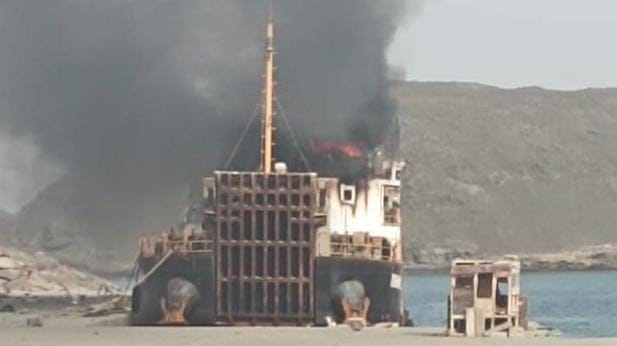
A political controversy is swirling after the attack on a small deck cargo ship that killed at least six people and injured as many as 10 others from the crew and the Yemen Coast Guard. The IMO, the government of Yemen, and Pakistan each issued statements condemning the attack while the Houthis took credit and said they would continue to strike assets linked to Saudi Arabia.
In the latest incident in the long-running civil war, both sides traded accusations and threats after the attack. The Houthis said their armed forces “will continue their operations targeting all Saudi mobilizations.” At the same time, Colonel Waddah Al-Dobish, the spokesperson for the Yemeni Joint Forces, lashed out, saying the government forces could target two ferries the Houthis operate between the mainland port of Salif and the near-shore island of Kamaran. He said they were refraining despite the use of transporting military supplies to the island, because the vessels also are involved in the movement of citizens and their daily needs.
(Houthi propaganda video posted on social media)
The reported circumstances of Monday’s attack vary between the two sides. The Houthis claim the vessel was used to transport Saudi military equipment and was in the Bab al-Mandab when it was struck. The government says the vessel was at anchor in the port of Mocha for engine repairs and maintenance. The pictures show the vessel at a dock with no signs of any military equipment onboard.
“The ferry Tihama is a civilian ferry affiliated with a private company, officially licensed to operate maritime transport, and is used to ferry passengers and civilians between Aden, Djibouti, Somalia, and Socotra on round-trip routes,” wrote Al-Dobish on social media. “It has previously participated in rescue operations and the transport of civilian supplies, including provisioning Socotra Island with gas. One of the Arab news channels had previously filmed it and covered its entry into Socotra.”
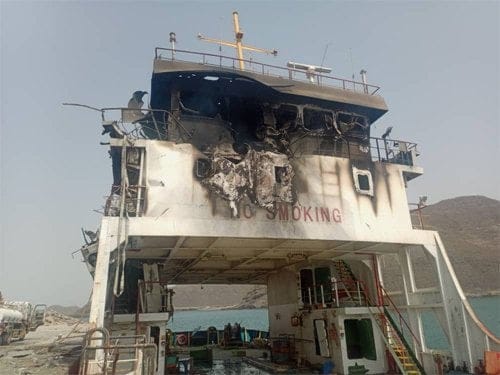
Damage pictures posted by Colonel Waddah Al-Dobish
He asserts the vessel was struck by a missile that started a fire, which the photos show destroyed the bridge and small deckhouse. There was a crew of 11 aboard. Three, two from Pakistan and one from Indonesia, died in the initial attack. The Yemen Coast Guard went to the vessel’s aid, and then it was struck by a second missile. A third crewmember was killed, and two from the Coast Guard were also killed. At least seven others were injured during the evacuation, with two hospitalized and the other five reporting minor injuries.
The Coast Guard says it later intercepted an explosive-laden drone that approached the vessel about three hours after the initial attack.
The Secretary-General of the International Maritime Organization (IMO), Arsenio Dominguez, issued a statement calling the incident “particularly troublesome” as it was yet another one in the Red Sea / Gulf of Aden area.
“These continued attacks on shipping only serve to escalate tensions and threaten global supply chains on which everyone depends,” said Dominguez. “I reiterate my call for shipowners and ship operators to?thoroughly?assess risks?before?transiting this and other regions and follow appropriate best management practices.?Seafarers?deserve to be protected and allowed to do their jobs in safety and security.”
Pakistan’s Foreign Minister also condemned the Houthi attack, saying such attacks “constitute a violation of international law.” So far, there has been no comment from the Saudi or Indonesian governments. The ship was registered in Tanzania, and reports say it is owned by a company in Egypt.
The Houthis announced their blockade against Saudi Arabia on July 20 as possible negotiations in Yemen have dragged on. Saudi Arabia backs the current legally recognized government. In addition to claiming attacks on several Saudi tankers in the Red Sea, the Houthis on Sunday and Monday launched a series of attacks on the port of Mocha. They also claimed to have attacked a Saudi encampment and a regional Saudi airport just over the border with Yemen.
Saudi Arabia reported that it would be convening a second planning session today, August 12, for its new multinational coalition to protect shipping interests. The reports said the two-day meeting would finalize the institutional framework of the new 14-nation effort, and the Saudis expect other nations to join their new Gulf of Aden security initiative.
US(TRUMP)investor group taps Glencore in bid for Sherritt
A U.S. investor group that includes Glencore (LSE: GLEN) is offering to recapitalize Sherritt International (TSX: S) and acquire control of the beleaguered miner whose survival is in doubt following the suspension of its Cuban operations. The stock surged.
The consortium, which also includes London-based Kyma Capital, Brevan Howard Asset Management co-founder Trifon Natsis and an unidentified U.S.-based anchor investor, submitted its bid to Sherritt on June 26, according to a statement issued Monday. The offer includes immediate equity funding at 12¢ a share without a third-party debt-financing condition and gives eligible existing shareholders the right to invest at the same price as the consortium.
“This is a funded, inclusive proposal at a price with no discount, from investors who know this company, with a credible path to the noteholder consent any transaction must have and with constructive engagement already underway in Washington,” the U.S. investor group said in the statement. We are not asking the board to abandon its process. We are asking it to compare proposals — and to let the better transaction win on the merits.”
The proposal comes as Sherritt faces an acute liquidity crunch following the halt of its Cuban joint venture in May due to sweeping U.S. sanctions and the subsequent shutdown of its nickel and cobalt refinery in Fort Saskatchewan, Alta.
The consortium is touting its proposal as an alternative to a deal that Sherritt has been negotiating with Gillon Capital. That proposal involves a warrant that could ultimately give Gillon control of the company, rather than providing immediate equity capital. Discussions with Gillon are ongoing, Sherritt has said.
Sherritt shares jumped 24% to 15¢ apiece Monday morning in Toronto, valuing the company at about $105 million (US$75 million). The stock has traded between 6¢ and 25¢ in the past year.
Majority stake
Under deal terms disclosed Monday, Sherritt is to be acquired by a U.S.-based structure that would hold at least 55% of the company on a fully diluted basis at completion.
U.S. authorities have already confirmed in writing that the State Department and the Treasury Department don’t object to the consortium negotiating with Sherritt, according to the investor group’s statement.
If a deal is completed, the U.S. consortium says it will work with Sherritt to stabilize its capital structure and liquidity; preserve and enhance Fort Saskatchewan and the company’s North American nickel and cobalt processing capability; and establish a “compliant pathway” for the business to serve critical-minerals supply chains. A dedicated sanctions, national security and compliance committee of the board will also be created.
Credible alternatives
On Friday, a group of Sherritt bondholders who own most of the company’s 9.25% notes due in 2031 called on the company’s board to engage immediately “with all credible alternatives.”
Any attempt by Sherritt to present debt investors “with a take-it-or-leave-it transaction after outcomes have effectively been predetermined” will be rejected, the bondholder group warned. “Meaningful engagement with noteholders must occur before key economic and governance terms are finalised in any transaction requiring noteholder consent.”
Sherritt suspended its direct participation in its Cuban joint venture activities on May 7 after U.S. President Donald Trump’s administration expanded sanctions against Cuba. Although Sherritt has not been formally designated under the U.S. order, the measures materially altered the company’s ability to operate normally.
The Moa joint venture, a 50-50 partnership with Cuba’s state-owned General Nickel, has historically formed the core of Sherritt’s nickel and cobalt business. The vertically integrated operation mines and processes ore in Cuba, with the resulting material refined in Fort Saskatchewan. The Alberta facility is the only significant cobalt refinery and one of only three nickel refineries in North America, according to Sherritt.
Difficult conditions
Sherritt’s problems predate the latest Cuban crisis. Moa struggled with lower-than-expected production during 2025. Sherritt attributed the decline to lower ore volumes, unplanned maintenance and difficult operating conditions in Cuba.
Last month, Sherritt said it required significant new capital to fund a restart and warned that constrained liquidity created material uncertainty about its ability to continue as a going concern. It also said the cost of restarting had increased because of sharply higher sulphur prices.
The U.S. consortium argues its proposal would bring not only fresh capital but also strategic and operating expertise to Sherritt’s nickel and cobalt platform. Glencore would provide relevant technical, refining, marketing and critical-minerals expertise, the group says.
Sherritt is scheduled to release second quarter results Wednesday after market close. The company has said it won’t hold a quarterly conference call that day.