Wednesday, August 19, 2026

Warnings sent to French taxpayers after hackers allegedly sell stolen data

More than 670,000 French taxpayers are being notified that their personal and tax information has been stolen in cyber attacks on the French tax office and allegedly sold online.


Issued on: 18/08/2026 - RFI

Information from the online tax accounts of nearly 700,000 French taxpayers was stolen by hackers, who have allegedly sold it. AFP

The Directorate-General for Public Finance (DGFiP) began sending individual warning emails on Monday evening, following an emergency interministerial meeting called by Prime Minister Sébastien Lecornu. The messages will be sent throughout the week.

The DGFiP confirmed last week that hackers had gained access to its systems during two intrusions, one in late June and another in late July.

Data from at least 678,000 individuals and businesses was stolen, along with information linked to around 200,000 accounts in the office’s land registry databases.

The stolen information may include names, tax identification numbers, contact details, tax circumstances and reference tax incomes, among other data. In fewer than 250 cases, hackers may also have accessed messages exchanged between taxpayers and the tax administration.

The DGFiP said passwords, tax returns and tax notices were not compromised. It also said the stolen information cannot be used to access or operate taxpayers’ online accounts.

However, the amount of detail in the stolen files has raised concerns about targeted scams.

The warning letters being sent to affected taxpayers urges them to be particularly cautious about anyone claiming familiarity based on data from the breach. Taxpayers are being encouraged to ignore requests for information made via email or telephone, and to regularly monitor their bank accounts.

“The DGFiP will never ask you to provide information outside your secure online account,” the office said in a social media post.

'Easy to hack'

The government said access points used by the hackers were closed after the incidents, and that the security of tax accounts has been strengthened.

Lecornu ordered the National Agency for Information Systems Security to conduct an “in-depth audit to establish the exact circumstances and causes” of the attacks. In addition, the Paris prosecutor’s office has opened an investigation into “fraudulent extraction of data” and “criminal conspiracy”.

Lecornu also called for faster implementation of a wider plan to strengthen the security of government computer systems, many of which have been the target of cyber attacks and hacks in recent months.

The cybercriminal group ZeroBytes, which claims to be made up of two French hackers, said it had sold the stolen data.

Speaking to French news agency AFP via the Telegram messaging service, the group alleged that two people bought the information for “thousands of euros” and that the data remains for sale.

Before targeting the tax office, ZeroBytes claimed on dark web forums to have hacked the Intermarché supermarket chain and the French Handball Federation.

The group also claimed to have stolen data over the summer from a major French telecommunications operator and a hotel group – neither company has confirmed an attack.

ZeroBytes says French organisations are frequent targets because they are “easy to hack”.

(with AFP)
Southwest France steps up mosquito control after 20 chikungunya cases

Mosquito control operations are being stepped up across southwestern France after more than 20 locally contracted cases of the chikungunya virus were recorded since the beginning of August, with infections reported in three departments.


Issued on: 19/08/2026 - RFI

A city employee sprays a solution against mosquitos in Saint Denis, Reunion Island, where nearly 100,000 people are thought to have been infected with chikungunya last year. © Adrien/AP

The chikungunya cases are described as “autochthonous”, meaning the virus was contracted in France rather than brought back by someone from abroad.

The largest-known outbreak of 16 cases is in Prignac-et-Marcamps, north of Bordeaux, where authorities have carried out insecticide treatments in parks and gardens.

They are also removing stagnant water where the invasive tiger mosquito lays its eggs.

Ideal conditions

The tiger mosquito, known scientifically as Aedes albopictus, is originally from Southeast Asia and can transmit chikungunya as well as dengue and Zika.

First detected in mainland France in 2004, it is now present across most of the country. The first locally acquired chikungunya case in Gironde was detected in summer 2025, in a five-year-old child.

The mosquito’s advance has been fuelled by warmer summers, urbanisation and increased international travel, which together create ideal conditions for both the insect and the viruses it can transmit.

Health authorities have been urging residents to remove stagnant water from gardens, balconies and around their homes, as even small amounts of water can become breeding sites.

Similar prevention measures have been introduced in the east of the Tarn department after two chikungunya cases were detected, following a case reported at the start of August.

Door-to-door visits

In Haute-Garonne, the towns of Cugnaux, Seysses and Brax, near Toulouse, were treated overnight on 10 August following several reports of cases.

The Regional Health Agency of Nouvelle-Aquitaine has stressed the importance of investigating confirmed infections.

“As soon as a confirmed case of dengue or chikungunya is reported, an epidemiological investigation is launched,” it said in a statement.

It added that health teams are carrying out field investigations, including door-to-door visits, in affected neighbourhoods in order to identify other cases and raise awareness on preventing mosquito bites to limit the spread of the diseases.

Residents have been advised to seek medical attention promptly if they develop symptoms, which include a high fever, joint or muscle pain, fatigue, headaches or a skin rash.
INTERVIEW

How degradation and drought are threatening the land that feeds us


Desertification is not the spread of deserts. It is the slow degradation of fertile land – a process that now affects 40 percent of the Earth's land surface and leaves around 100 million hectares of healthy land unproductive every year. As governments gather in Mongolia this week for the UN's Cop17 desertification summit, scientists say restoring soil health is becoming critical for food security, livelihoods and climate resilience.


Issued on: 19/08/2026 - RFI


Agricultural workers prepare a zaï field in Burkina Faso's Yatenga Province in 2007. The traditional technique involves digging small pits that capture rainwater and concentrate nutrients, helping crops survive in dry conditions. © Edmond Hien/IR


The summit's theme is "Restoring Land, Restoring Hope" and delegates are expected to discuss ways to tackle drought and land degradation, including the Riyadh Global Drought Resilience Partnership launched at Cop16 in Saudi Arabia in 2024.

Under the initiative, €10.3 billion was pledged over seven years to help 74 vulnerable countries cope with drought and restore degraded land.

Jean-Luc Chotte, a soil expert at France's National Research and Development Institute (IRD) and chair of the French Scientific Committee on Desertification, spoke to RFI about the causes of land degradation and why agroecology is increasingly being seen as part of the solution.

RFI: What does the term "desertification" actually mean?

Jean-Luc Chotte: Desertification is not the advance of the desert. It refers to soil degradation – the deterioration of the soil’s physical, chemical and biological properties – observed in areas with arid, semi-arid and dry sub-humid climates.

But these places are not deserts: farmers, herders and many other people live there. The term "desertification" is therefore misleading.

RFI: What is the difference between aridity and drought?

JLC: Aridity describes a type of climate – and is therefore a long-term phenomenon – in terms of water availability. It refers to areas where potential evapotranspiration is between 1.5 and 20 times greater than the average amount of rainfall.

A drought is an exceptional period of water scarcity affecting ecosystems and human populations. It is attributed to below-average rainfall compared with seasonal norms, high temperatures, wind, a lack of water in the soil which limits the growth of crops and pasture, lower water levels and reduced flow rates in watercourses, and a drop in the levels of reservoirs and groundwater tables.

Jean-Luc Chotte, chair of the French Scientific Committee on Desertification. © Jean-Luc Chotte

RFI: Since Cop16 in 2024, France has officially been included on the list of countries affected by desertification. Why is this?

JLC: France attaches great importance to this issue. In 1997, three years after the UN Convention to Combat Desertification (UNCCD) came into force, it set up a scientific committee on desertification (CSFD) to understand what is happening and to take action based on the most up to date scientific evidence.

In preparation for this decision, the CSFD worked with Data Terra and the NGO Nitidae to identify the parts of mainland France subject to arid, semi-arid and dry sub-humid climates.

This corresponds to the Mediterranean coastline, representing just under 2 percent of French territory. Of this area, approximately 0.14 percent is degraded, according to the three indicators recognised by the parties to the UNCCD, which define land degradation: trends in land use (agricultural, urban, etc), trends in productivity and soil carbon stocks.

These three indicators were then applied across the whole of France. In mainland France, 3 percent of the land area is degraded.

However, these three indicators reflect only part of the degradation processes. We therefore expanded the study by adding other relevant indicators, based on French research expertise, such as erosion (by wind or water), metal pollution, loss of biodiversity, decline in vegetation, salinisation and landslides. As a result, 77 percent of soils across France are degraded

RFI: What are the physical symptoms of desertification in an arid climate?

JLC: These include soils that are dry on the surface and do not allow water to seep in; soils subject to wind erosion, with particles of dust or sand carried over distances from one plot to another or from one continent to another; yellowing plants lacking water and nitrogen, and a landscape stripped of trees. If you dig a hole, there is no life – the roots of the remaining vegetation are shallow. Ultimately, this is also evident in a decline in agricultural yields.

RFI: What are the causes?

JLC: This land degradation is mainly due to the misuse of land through human activities.
Map showing land degradation in mainland France based on indicators from the UN, the European Soil Data Centre and the Joint Research Centre. © Nitidae/CSFD

RFI: What constitutes poor land use?

JLC: It is pushing the land’s productive capacity beyond its natural resources. This is done through ploughing, monoculture, applying too much fertiliser, or reducing the stock of organic matter in the soil. The model of intensive agriculture. In livestock farming, if animals are no longer free-ranging on pastoral lands, or if the stocking density exceeds the land’s capacity to provide forage, we are on a path towards degradation. The situation will worsen if these practices are not changed. That is why issues such as herders’ mobility, crop rotation, the role of trees in the landscape and agroforestry are fundamental.

These harmful practices are exacerbated by climate change. As temperatures rise, there is greater evapotranspiration. Similarly, if rainfall is distributed very differently over the course of the season this exacerbates the effects of land degradation, because farmers will adopt more intensive farming practices in order to feed themselves and generate an income.

Furthermore, soils are the largest terrestrial carbon sink on a global scale. By degrading them, we find ourselves in a vicious circle where the harmful effects of land misuse accelerate climate change.

RFI: What are the economic consequences for local populations?

JLC: When we consider the decline in crop yields and the nutritional needs of populations, which are set to rise, we are heading towards a rather significant gap. It will be vital to meet these needs in order to prevent migration. Not just between Africa and Europe. The largest migration flows occur between rural and urban areas, within a country or between neighbouring countries.

That is why, at the 1992 Earth Summit in Rio, Africans called for a convention on desertification that would highlight the challenges they face.

RFI: How can this be remedied?

JLC: The key factor in combating soil degradation is the organic matter in the soil, which creates the conditions for its fertility, productivity and ability to retain groundwater. The more organic matter there is, the more space the minerals leave, which can be filled with water and living organisms such as bacteria, fungi and nematodes. Many agricultural practices therefore involve adding organic matter to the soil.

It is perfectly possible to be in an arid region and adopt practices that prevent soil degradation, or even restore the soil. In mid-April, I was in the Ferlo, in northern Senegal, where the Fulani, a nomadic pastoralist people, live. There are areas that are not degraded. The soils are low in organic matter, but there is still vegetation, and trees are intermingled with crops or livestock.

The flagship Great Green Wall project was set up to restore all these lands south of the Sahara. It was not intended to act as a bulwark against the advance of the desert with a uniform 7,000-kilometre hedge of a single tree species stretching from Dakar to Djibouti, as some might have imagined. The Sahara is hardly advancing at all.

One might criticise this project, which has not lived up to its ambitions. But it is a tremendous African initiative that also combats climate change, even though African countries have emitted fewer greenhouse gases than others.

RFI: Agroecology, a sustainable approach to farming that works with nature, has been presented as the solution to desertification, with a view to achieving a sustainable food system. Yet it is struggling to establish itself as a model. Why is this?

JLC: The term "agroecology" first appeared a few years ago. It is becoming increasingly widespread, and I do not see any rejection of agroecology. We are on the right track.

The term has emerged because, on the one hand, civil society organisations have done a tremendous job of raising awareness and lobbying, and on the other hand, because scientific research has produced data showing that agroecological practices improve a number of indicators.

RFI: So what are the obstacles to widespread adoption of this? Is it the fact that it has never been tested on a large scale in terms of productivity and profitability?

JLC: I believe that the obstacle to practising agroecology on a large scale is entirely linked to the fact that we only take into account one of the soil’s functions – namely production and generating income. We must also consider other aspects, such as carbon sequestration in soils, the maintenance of biodiversity, combatting land degradation, farmers’ incomes, efficiency and organic matter stocks. The UN's Food and Agriculture Organization (FAO) lists the 10 elements of agroecology.

However, it is not a model that can simply be copied and pasted without considering whether it is suited to the socio-economic constraints of the regions: land ownership issues, limited access to finance, markets or technical support, inconsistent public policies and so on. It is all of these factors that delay scaling up.

Policy-makers then wonder how they can verify the positive impact of its implementation. And this is where we need to be able to encourage policymakers to consider other aspects.

There are an increasing number of tools available for documenting agroecological practices. The FAO’s digital tool, Tape, has been adopted by public authorities and farmers. At IRD, we are developing our own tool, Bio Functool, but this is easier when you are a research laboratory than when you have the resources of an NGO.

RFI: Is there a country where agroecology is already well established?

JLC: In 2019, Senegal launched Dytaes – an initiative by civil society and scientific organisations that have documented agroecological practices across the country in order to use them as a political lever.

We have been working in [the Senegalese village of] Diohine for 10 years, alongside the villagers. We have reintroduced certain practices, such as planting Faidherbia albida groves. This tree, which is well-suited to the region, sheds its leaves during the rainy season.

This means that the crops grown beneath these trees do not compete for light, as the tree no longer has any leaves. It also has deep roots capable of drawing water from the water table and bringing it up at night to release it back to the surface. Farmers can therefore diversify their crops: watermelon, sorghum and millet. They are also increasingly careful to allow young Faidherbia shoots to grow rather than uprooting them, as was the case in the past.

There are a great many agroecological projects in West Africa – such as Sustain Sahel – which aim not only to slow down soil degradation or restore degraded soils, but also to provide an income for local farmers and establish value chains for the marketing of their produce. There are also such projects in Ethiopia.

RFI: The Cop16 on desertification, held in Saudi Arabia, ended in failure. What makes you think this one will yield better results?

JLC: Without downplaying the fact that we are often very disappointed by the progress made, these international meetings are essential. They are where major environmental challenges are discussed, bringing together researchers, civil society organisations and public and private decision-makers. They also enable me, as a scientist, to better understand how the knowledge and data I produce can inform and guide policy-making.

The failure of the Cop in Riyadh is mainly due to the fact that states were unable to agree on the role of drought within this convention. Science had already done its part beforehand within the Intergovernmental Panel on Drought. Now, it is clearly a political issue, and we are all aware of the current state of global geopolitics.

This article has been adapted from the original interview in French by Géraud Bosman-Delzons.
The Impossible Homecoming: Christopher Nolan’s Odyssey And The Trauma Of War – OpEd


Odysseus and his soldiers fighting the Cicones —allies of the Trojans— during the sacking of their city. After seizing goods and women, the Greeks are driven back by allies of the Cicones. This act of land-based piracy is the opening episode of the Odyssey. Credit: Theodoor van Thulden - Rijksmuseum, Wikipedia Commons


August 18, 2026
 IDN
By Sam Ben-Meir


Key Takeaways:

Nolan’s Odysseus is complicated not as a pure action hero but through the trauma of war: he longs for home yet repeatedly delays return, revealing the veteran’s paradox of wanting Ithaca while seeking oblivion from the man war has made him.

True homecoming is impossible because war transforms both the warrior and the household; Agamemnon’s fate and Odysseus’s violent reclamation of Ithaca show that the battlefield follows him home, making reconciliation through slaughter a hollow restoration.

The lotus and Sirens represent opposing escapes—forgetting the past or fantasizing its recovery—while real return demands bearing irreversible memory without repeating violence or fleeing into oblivion.


Emily Wilson begins her celebrated translation of Homer’s Odyssey with an imperative that has become almost as famous as the poem itself: “Tell me about a complicated man.” Christopher Nolan has acknowledged the importance of that formulation to his own adaptation of Homer. Yet in her fierce review of Nolan’s film, “An Uncomplicated Man,” Wilson argues that this is precisely what Nolan has failed to give us. His Odysseus, in her reading, is essentially an action hero who feels bad about being an action hero, a psychologically flattened version of one of literature’s most elusive figures.

I did not see the film that way at all. Nolan’s Odysseus is complicated not because he reproduces every contradiction of Homer’s hero, but because Nolan has reorganized those contradictions around one of the oldest and most difficult questions posed by the Odyssey: what does it mean to come home from war? The answer, Nolan suggests, is that strictly speaking one cannot.

When War Becomes Home

This is why Odysseus’s longing for Ithaca must be understood alongside his extraordinary capacity to postpone his return. He wants nothing more than to see Penelope and Telemachus again. Home is the fixed point around which his wandering consciousness revolves. Yet he remains with Calypso for seven years. More significantly in Nolan’s telling, he willingly consumes the lotus, surrendering himself to oblivion. He wants to forget Troy, his companions, his guilt, perhaps even the man he has become.

The contradiction is only apparent. These are the two desires of the traumatized veteran: I want to go home; I want to cease being the man who must go home. Nolan understands something here that Kathryn Bigelow understood in The Hurt Locker: war is a drug. Its addictive quality does not lie simply in violence. War reorganizes experience. Terror, comradeship, exhaustion, danger, purpose and the constant proximity of death establish an intensity against which ordinary existence can come to seem strangely insubstantial. Once that intensity disappears, something must fill the void.

Uberto Pasolini’s The Return (2024), another recent reimagining of Odysseus’s arrival on Ithaca, makes the point with brutal economy. Ralph Fiennes’s exhausted Odysseus observes that “war becomes home.” The phrase captures the terrible paradox at the center of nostos. Odysseus is homesick for Ithaca, but war has become another home. The journey from Troy is therefore never merely geographical. The deeper question is whether the man produced by Troy can still inhabit Ithaca.

Wilson is surely right that Homer’s Odysseus possesses a multiplicity that cannot easily be reduced to modern psychological categories. He is warrior and liar, husband and adulterer, victim and perpetrator, king and beggar, strategist and fool. But adaptation need not reproduce every Homeric contradiction to discover a genuine contradiction of its own. Nolan’s “strong misreading,” if we want to call it that, locates the complexity of Odysseus in traumatic return.


Between Memory and Oblivion

This is precisely why Calypso and the lotus matter so much. The lotus is not merely temptation. It offers release from biography. To eat it is to relinquish the burden of being the person who did what Odysseus has done. Troy disappears. His dead companions disappear. Penelope and Telemachus disappear. The terrible continuity between the warrior and the returning husband disappears. For a man haunted by what he has seen and done, there is mercy in such oblivion. But there is also annihilation. If Penelope represents the possibility of memory endured, the lotus represents memory extinguished. Odysseus is suspended between them. He can remember his way home, or he can forget why he ever wanted one.

That is hardly an uncomplicated man. Nor does Nolan allow Odysseus’s dilemma to exist in isolation. His use of Agamemnon’s return as a counterpoint is crucial. Agamemnon, too, goes home from Troy. His nostos is shorter and, geographically speaking, more successful. But arriving home does not save him. He returns carrying Troy with him and is murdered within the household to which he believed he had returned.

Agamemnon’s fate exposes the illusion contained in the very idea of homecoming. The warrior imagines home as something preserved in his absence: the same house, the same relationships, the same identity waiting to receive him when history has finished with him. But history does not leave home untouched. Nor does it leave the warrior untouched. The man who returns is not the man who departed, and the household to which he returns is not the household he left.

Agamemnon reaches home and discovers that home no longer exists in the form he imagined. Odysseus takes ten years longer to make the same discovery. In this respect Thomas Wolfe’s famous formulation—You Can’t Go Home Again—could serve almost as a subtitle to the Odyssey. Homecoming contains an impossible demand. It asks not merely that we return to a place but that time itself reverse direction. Restore the wife I left. Restore the child I knew. Restore the kingdom I ruled. Above all, restore the self who departed.

But there is no restoration. Penelope has spent twenty years without Odysseus. Telemachus has become a man in the absence of his father. Ithaca has been transformed by political disorder. And Odysseus has become someone whom the king who sailed for Troy might scarcely recognize. The deepest obstacle between Odysseus and Ithaca is therefore not Poseidon. It is time. And this is where Nolan’s emphasis on violence becomes particularly important. For when Odysseus finally returns, he does not simply put war behind him. He brings its grammar home.
When the Battlefield Enters the Home

The great irony of the Odyssey is that the warrior restores domestic order through slaughter. The skills that allowed Odysseus to survive Troy and the long journey home become the means by which he reclaims his household. Bow, cunning, disguise, calculation and killing—the instruments of war become instruments of reconciliation.

But what kind of reconciliation is achieved through massacre? Agamemnon returns from war and is murdered at home. Odysseus returns from war and murders at home. Their stories differ radically, yet Nolan’s juxtaposition of them illuminates the same terrible truth: the boundary between battlefield and household is far more porous than the warrior would like to believe. War follows him across the threshold.

That is why the Odyssey remains perhaps the greatest tale of homesickness ever written. And it is one reason it stands so close to the foundations of Western civilization. If the Iliad plunges us into the world of war—glory, rage, mortality, comradeship, revenge—the Odyssey asks the question that follows: what happens to the warrior afterward? How does the killer become a husband again, the soldier a father? How does a human being habituated to violence recover ordinary time? And can violence ever truly be left behind?

These questions reach far beyond Homeric Greece. They belong to every society that sends people to war and then expects them somehow to resume ordinary existence when they return. We speak casually of veterans “coming home,” as though geographical relocation accomplished the return. But the deeper homecoming—the recovery of intimacy, ordinary time, trust, vulnerability and a tolerable relation to memory—is infinitely more difficult.


The desire for Ithaca therefore cannot simply be opposed to the desire for war. Odysseus wants home desperately precisely because he has been transformed by its opposite. Yet the longer he remains away, the more impossible the object of his longing becomes. Ithaca gradually ceases to be merely a geographical place and becomes an image of reconciliation: the fantasy that the fragments of a life divided by war might somehow be made whole again.
The Pain of an Irrecoverable Past

This is why nostalgia is never simply memory. It is memory charged with desire—the longing not merely for what was, but for what can no longer be recovered. The word nostalgia itself preserves the wound: nostos, homecoming, joined to algos, pain. The desire for home is inseparable from the knowledge that the home one desires no longer exists.

Nolan’s Sirens give this nostalgia its most seductive form. Here he departs sharply from Homer. In Book XII, the Sirens tempt Odysseus with knowledge: they know what happened at Troy and promise access to what can otherwise remain hidden from mortal understanding. Nolan transforms their temptation into something more psychological. Their song reveals that “what you most want is what you most can’t have”: what you desire most is “what you already had . . . and lost.” The Sirens therefore offer not knowledge but restoration—the fantasy that what time has taken might somehow be recovered. If the lotus promises escape from the past through forgetting, the Sirens promise escape from it through nostalgia. One says: erase what happened. The other: return to what was. Both tempt Odysseus with the same impossibility—the refusal to accept that time is irreversible.

And here lies the spiritual crisis diagnosed by the Odyssey. Western civilization has repeatedly imagined history through departure and return: exile and promised land, fall and redemption, alienation and reconciliation, revolution and restoration. We leave home and dream of coming back transformed but intact. Homer knew better.

There is no return without transformation because time itself makes literal return impossible. The question is not whether Odysseus can recover the world he lost. He cannot. The question is whether he can establish a relationship with what remains. That distinction matters. Reconciliation is not restoration.

The past survives precisely because it cannot be repaired. Nolan’s Odysseus therefore faces something more difficult than monsters. He must learn whether memory can be borne without either repeating what it remembers or fleeing into oblivion. The lotus offers one answer: forget. War offers another: repeat. Ithaca demands something harder: remember and nevertheless live. That is the real homecoming.
The Greater Ordeal of Coming Home

Wilson’s criticism of Nolan ultimately rests not on fidelity alone. She has explicitly defended adaptations that radically transform their sources. Her deeper complaint is that Nolan’s transformation produces an Odysseus without sufficient psychological, emotional or ethical depth—that the complicated man has been converted into a conventional action hero.


But that judgment overlooks the contradiction around which Nolan has constructed his protagonist. His Odysseus longs for precisely what he repeatedly flees. He wants Penelope and chooses oblivion. He seeks peace but carries within himself the habits of war. He desires home while no longer knowing whether he is capable of inhabiting it. He survives because of the qualities that make reconciliation most difficult. The action hero normally defeats his enemies and returns home. Odysseus discovers that returning home is the greater ordeal.

That is why the lotus and the Sirens matter. One reveals how attractive the destruction of memory can become when memory itself is unbearable; the other, the equally seductive fantasy that what has been lost might somehow be restored. And that is why the violence on Ithaca matters. It demonstrates that Troy cannot simply be left behind on the other side of the sea.

Nolan’s Odysseus is not Homer’s Odysseus in every respect. No adaptation could be. But he is hardly uncomplicated. He is divided between memory and oblivion, war and domesticity, guilt and survival, the man who left and the man who returns. His tragedy is not that he cannot find his way home. It is that he finds it. And discovers that homecoming has only just begun.


Sam Ben-Meir teaches philosophy at the City University of New York, College of Technology. He is the author of Ethical Interanimality: Toward a Relational Philosophy of Nature (Westphalia Press, 2026).


About IDN
IDN-InDepthNews offers news analyses, features, reports and viewpoints that impact the world and its peoples. It has been online since 2009. Its network spans countries around the world.
View all posts by IDN →


New Set Of International Rules Needed To Protect Health Of Fishing Stocks

Trawler Fishing Boat Sea Fishing Boat Birds Gulls Ocean

Key Takeaways

  • New research argues that protecting global fishing stocks requires an array of distinct, complementary international legal rules—each with clear objectives—rather than a single comprehensive set of laws covering all maritime sustainability issues. 

  • The WTO Agreement on Fisheries Subsidies (FSA), which entered into force in September 2025, is a significant advance as the first WTO treaty centred on environmental sustainability and targeted at harmful subsidies, illegal fishing and overexploitation, yet it remains incomplete (for example on fuel subsidies) and has an unwieldy dispute-settlement mechanism. 

  • Future rules should complement one another and existing international law of the sea, create a workable division of responsibilities, and address the limitations of largely voluntary fishery regimes so that sustainability goals can be planned and enforced more effectively.

The global community should work at establishing an array of new international legal rules to protect the health of fishing stocks, new research says.

Rather than one set of laws covering all possible maritime sustainability issues, there should be a range of different rules, each with their own distinct objectives and mandates.

Change is necessary because the World Trade Organization Agreement on Fisheries Subsidies in its current form fails to satisfactorily address several important issues, the study says.

Any new international legal rules should complement not only one another and the existing international law of the sea. They should permit a division of responsibilities conducive to the effective planning and execution of sustainability-oriented practices.

The study says the FSA offers a great deal of hope for the much-needed regulation of fishery subsidies but must overcome several outstanding problems. These include an incomplete formulation of fishery subsidies, such as those destined for fuel, and an unwieldly dispute settlement mechanism.

The FSA, adopted by the World Trade Organization (WTO) in 2022, was subject to considerable negotiations and revisions, coming into effect on September 15, 2025. It was designed to target illegal, unregulated, and unreported fishing; the overexploitation of fishery stocks; and reinforce the important regulatory roles of Regional Fishery Management Organisations.

It was an effort to integrate fishery regulations into existing international regimes despite the challenges arising from the traditional territorial structures of international law.

The analysis was carried out by I-Ju Chen, from the University of Exeter.

Dr Chen said: “The FSA recognises the importance of environmental sustainability for economic stability, food security, and ocean health and is thus the first WTO treaty to have, at its core, the goal of environmental sustainability. Because the WTO itself is focused primarily not on fishery sustainability but on effective free trade, the WTO’s FSA is an excellent example of how environmental-sustainability goals can be integrated into existing international law.

“In some key ways, the FSA is more suitable than other international fishery regulations owing to its streamlined focus on the often destructive role played by fishery subsidies in the ongoing depletion of fishery stocks around the world.

“But while international fishery regulations have contributed to fishery sustainability, especially through their adoption of rights and obligations governing the fishing activities of states and fishers, they remain finite because of their voluntary structure.”

Moscow’s 1520mm Railway Gage ‘Empire’ Long A Source Of Influence Losing Ground To China Inside Russia Itself – OpEd


Industrial freight trains in Kaliningrad, Russia. Photo Credit: Angelina Zhang, Pexel


Moscow has long viewed the 17 countries using the Russian 1520 mm railway gauge (former Soviet republics, Baltic states, Finland, and Mongolia) as the “1520 Empire,” a costly-to-change network that binds them economically and strategically to Russia.

Finland and the Baltic states have taken limited steps toward the international 1435 mm standard, while former Soviet republics remain on the Russian gauge despite Chinese pressure to add dual-gauge tracks for easier trade.

The greatest threat is now inside Russia itself: recent concessions allowing Chinese-standard tracks in the Far East may encourage other 1520 mm countries to switch, potentially ending Moscow’s “empire” rhetoric.

Moscow officials and Russian nationalists have long referred to the 17 countries – the 12 former Soviet republics, the three once-occupied Baltic states, Finland and Mongolia – which use the Russian railway gage of 1520 mm rather than the international gage of 1435 mm as “the 1520 Empire.”

Moscow commentator Igor Shumeyko is the latest to do so and like others points that that this special “empire” ties these countries together and sets them apart from others who must change carriages when they cross its border (fondsk.ru/news/2026/08/16/imperiya-1520-rossiyskaya-zheleznodorozhnaya-koleya.html).

He notes that from the beginning in the 19th century, Russian leaders have viewed this “empire” as something which helps Russia both economically and in terms of national security and that despite all the political changes in 1991 and thereafter, these countries have remained within it because it is enormously expensive to change the gage of railways.


Finland and the three Baltic countries have taken some steps in the direction of moving away from the Russian gate to the international one but mostly remain on the Russian standard (euroweeklynews.com/2025/05/07/finnish-railway-gauge-to-be-changed-to-that-of-sweden/ and ft.com/content/0fe9d0fb-23a8-4935-a2e9-2637f444c8ba?syn-25a6b1a6=1).

The former Soviet republics also remain on the Russian standard and thus allow Moscow to speak of the “1520 Empire,” Shumeyko says. But some of these countries are under pressure from China to lay international standard width tracks within existing Russian standard lines to ease trade.

But the biggest current threat to this “empire” is from China and it is within the Russian Federation itself. A decade ago, Moscow bowed to Chinese pressure and agreed to build a international gage track between the Chinese border and a Russian port (windowoneurasia2.blogspot.com/2016/04/bowing-to-china-moscow-for-first-time.html).

And earlier this year, Russia again made a special concession to China on the gage of a new track in the Russian Far East to increase trade and reduce costs of having to change the carriages of trains at the border (tkrus.pro/jd-koleya-china-russia/?ysclid=msxrniep1416903527,объясняем.рф/articles/news/rossiya-i-kitay-dogovorilis-o-stroitelstve-zheleznoy-dorogi/ and railjournal.com/freight/russia-and-china-increase-cross-border-capacity/).

As Russia gives ground to China on this issue, the other countries which still use the Russian gage undoubtedly will become more ready to do the same thing and for the same reasons. If they do, Moscow may eventually have to stop talking about the “1520 mm Empire” its railroads have helped it build and maintain even when political borders change.

Earthquakes Shake The Ionosphere, That Doesn’t Mean It Predicts Them – OpEd


Post-earthquake ionospheric disturbances detected by GNSS are established science, but claims of pre-earthquake TEC precursors remain unproven and face high scrutiny.

Apparent pre-quake signals often arise from analysis choices, natural ionospheric variability, or traveling disturbances that also occur on non-earthquake days, as shown by large control studies and re-examinations.

Genuine precursors require frozen analysis rules set in advance, rigorous negative controls, and prospective testing that distinguishes them from ordinary background behavior before they can be treated as early-warning tools.


Post-earthquake ionospheric disturbances are established science. Pre-earthquake precursor claims face a harder test: they must beat ordinary ionospheric variability, analysis choices, and untouched control data.

A large earthquake does not stop at the ground. The rupture launches acoustic and gravity waves upward through the atmosphere, and minutes later the ionosphere can register the event as traveling disturbances in electron density. Dense GNSS networks have imaged these effects after major earthquakes, including the 2011 Tohoku-Oki event. In some cases, the ionosphere has even been used to infer properties of the seismic source after rupture.

That part is established science. The scientific trouble begins when the arrow of time is reversed.


If the ionosphere responds after a major earthquake, could it also change before one? Could total electron content, or TEC, measured from GNSS signals become an earthquake precursor? The possibility is attractive for an obvious reason: short-term earthquake prediction remains one of geophysics’ most difficult problems, while GNSS networks continuously monitor the ionosphere over large areas.

The debate became especially visible after the 2011 Tohoku-Oki earthquake. Later that year, geodesist Kosuke Heki reported a positive TEC anomaly beginning roughly 40 minutes before the magnitude-9 event and argued that similar behavior might occur before other very large earthquakes. The claim was unusually testable because the underlying GNSS observations were public and the proposed anomaly had a specific temporal and spatial form.

Then came the difficulty that defines precursor science: the same data can look different depending on how the background is constructed. Masashi Kamogawa and Yoshihiro Kakinami argued that the apparent pre-earthquake enhancement could instead arise from the choice of reference curve and from a post-earthquake ionospheric depletion associated with the tsunami. Heki and others continued to defend a precursor interpretation. The disagreement was not about whether the ionosphere changed. It was about what portion of that change belonged before the earthquake, what counted as the baseline, and whether the feature was physically exceptional.


This distinction matters because an anomaly is not yet a precursor. A precursor is a prediction claim.

To deserve that name, a signal must do more than look unusual when plotted around a known earthquake. It must occur often enough before earthquakes, rarely enough when earthquakes do not follow, and under an analysis rule fixed before the outcome is known. Otherwise a researcher is asking a retrospective question: can I find something unusual before this event? Given the natural variability of the ionosphere, the answer will often be yes.

The ionosphere is a difficult place to make retrospective anomalies carry predictive meaning. Solar activity, geomagnetic storms, atmospheric waves, tides, traveling ionospheric disturbances, local time, season, latitude, and the geometry of the GNSS measurement can all change TEC. An apparent pre-earthquake feature therefore has to beat not only random noise but a moving background full of real geophysical structure.

That is why large-control studies matter. In 2017, Jeremy Thomas and colleagues examined Global Ionospheric Map TEC around 1,279 magnitude-6-or-larger earthquakes between 2000 and 2014. Their analysis did not find statistically significant evidence that TEC changes before earthquakes differed from the control behavior strongly enough to establish a useful global precursor relation. That result did not prove that no seismo-ionospheric precursor could ever exist. It showed how much weaker a pattern can become when the denominator includes many earthquakes and many ordinary days.

The issue remains active. Researchers continue to publish studies reporting statistical or event-specific ionospheric anomalies before earthquakes. But a 2026 re-examination by Kai Koyama and Yoshihiro Kaneko illustrates why the burden of proof remains high. They revisited reported TEC anomalies before large earthquakes and found that the signal observed before the Tohoku-Oki event was more plausibly explained as a large-scale traveling ionospheric disturbance passing over Japan than as a localized anomaly generated by the future rupture. Their analysis also found similar disturbances on days without a major earthquake.


That last comparison is the critical one. A signal that appears before an earthquake can still be scientifically interesting. But prediction requires knowing how often the same signal appears when nothing happens.

Three rules would make this field easier to interpret.

First, freeze the detector before the earthquake sample is evaluated. The time window, spatial window, smoothing, detrending method, geomagnetic exclusions, anomaly threshold, and decision rule should be declared using development data or prior theory. If those choices change after the target earthquake is inspected, the resulting pattern is exploratory, not confirmatory.

Second, publish untouched negative controls. An earthquake day should be evaluated beside ordinary days matched for local time, season, solar and geomagnetic conditions, and measurement geometry. The key number is not simply how often an anomaly appears before an earthquake. It is how much better the rule discriminates earthquake-linked periods from the ordinary behavior of the ionosphere.

Third, keep post-event sensing and pre-event prediction separate. Coseismic ionospheric disturbances have real scientific and potentially operational value. They can illuminate atmospheric coupling and, under appropriate conditions, contribute information about the event after it begins. None of that evidence automatically raises the probability that a similar-looking feature before the rupture was a precursor.

These standards are not designed to kill an unconventional hypothesis. They are how an unconventional hypothesis earns the right to become useful. A genuine precursor should become stronger when tested prospectively, when the analyst loses the freedom to choose the best-looking baseline after the fact, and when the method is forced to survive ordinary non-earthquake days.

The distinction is important beyond one corner of geophysics. Modern sensors and machine-learning systems can scan enormous physical datasets for anomalies. That makes it easier than ever to discover correlations near consequential events. It also makes control data, frozen analysis windows, and prospective validation more important. The more places a system can look, the less impressive one retrospective anomaly becomes.

The ionosphere clearly feels major earthquakes after they happen. Whether it reliably whispers beforehand remains unresolved. Until a proposed precursor survives prospective testing against the ordinary behavior of the ionosphere, it should be described for what it is: a hypothesis, not an early-warning signal.


About Burak Oktenli
Burak Oktenli holds an MBA and a Master of Professional Studies in Applied Intelligence from Georgetown University. His research addresses the governance of authority in autonomous and AI-enabled systems, and his writing has appeared at the Modern War Institute at West Point, RUSI, RealClearDefense, RealClearMarkets, and Geopolitical Monitor. He is the author of Authority Architectures for Autonomous Systems, a ten-volume series on how authority in autonomous systems is delegated, monitored and recovered, at authority-architecture.me.
View all posts by Burak Oktenli →
IMPERIALISM, TOO
Proposed US-Led Tech Hub In The Philippines Will Secure Supply Chains, Create Jobs – Analysis


Manila, Philippines. Photo by Alvin js5, Wikimedia Commons.


August 19, 2026

RFA

By Jason Gutierrez


Key Takeaways:

The U.S. plans to build a major critical technology hub under the Pax Silica initiative in New Clark City, Philippines—on land that was part of the former Clark Air Base—focusing on semiconductors, AI, and rare earths.

Supporters highlight massive economic benefits (up to 200,000 jobs and $70 billion in investment) and stronger U.S.-Philippine alliance, while critics warn of sovereignty risks, environmental harm, and potential Chinese retaliation.

Philippine President Marcos frames participation as purely practical and economic, open to beneficial deals from any partner, while analysts see it as part of Washington’s “friend-shoring” strategy to secure supply chains against Chinese influence.


A U.S. plan to build a critical technology hub in the Philippines is a symbolic return to the site of one of its largest overseas former bases, experts in the country told Radio Free Asia.

The hub will be part of the U.S.-led Pax Silica initiative, aimed at shoring up supply chains for semiconductors, AI and rare earth elements. It will be built in New Clark City, north of Manila, on land that was part of a U.S. military reservation complex that included Clark Air Base, until the Philippines voted to take control of it in 1991.


Supporters of the plan tout its potential economic benefits – the project will create around 200,000 jobs and up to US$70 billion in investment – but critics say that the plan is cedes too much control to Washington, and could be potentially harmful to the environment.

Either way, the historical significance of a major U.S. project on the grounds of the former base is not lost on observers.

“I see the symbolic value of the U.S. returning to Clark,” Chester Cabalza, founder of the Manila-based think tank International Development and Security Cooperation, told RFA. “It centers on an historic reversal of geopolitical fortunes, transforming a symbol of post-Cold War retreat into a modern monument of the ironclad U.S.-Philippine alliance.”

The battlefield has evolved since the Cold War era, but just as Clark Air Base was a key cog in the U.S.’ Asian containment strategy of that era, the Pax Silica hub is intended to secure technology supply chains for Washington and its allies, even as China has launched its own global AI framework.


Chinese President Xi Jinping in July launched the Shanghai-based World Artificial Intelligence Cooperation Organization, or WAICO, promoting a Beijing-led AI ecosystem and analysts say that Washington may soon ask countries to choose Pax Silica over Xi’s group.


‘Purely Practical’


Though analysts see a global tug of war between Beijing and Washington spilling over into the technology arena, Philippine President Ferdinand Marcos Jr., while addressing a forum of the Foreign Correspondents Association of the Philippines Friday said that the Philippines’ involvement in the plan is economic in nature and is “purely practical” rather than political.

The Philippines has territorial disputes with China in the South China Sea, which Beijing claims in its entirety, but which Manila claims in part. Marcos acknowledged the dispute, but said the Philippines’ Pax Silica plans were more about fostering an economic partnership.

“All of these…conflicting claims in the West Philippine Sea simply did not enter into that discussion,” he said, referring to the part of the sea that lies within Manila’s exclusive economic zone. “And so, the idea that we are somehow distancing ourselves from China is quite the contrary.”

Manila, he said, was open to investment opportunities from anyone interested “as long as it is to the mutual benefit of all parties involved” and will grab the opportunity “no matter where it comes from.”

“As long as we are able to move the economy forward and to better the lives of our people, then that is something that we will certainly examine,” Marcos stressed. “And if it turns out that this is a beneficial agreement or arrangement, then certainly we will become part of it.”


Though the tech hub will create jobs, it will facilitate the entry into the Philippines of U.S. military personnel and compromise its sovereignty, Teddy Casino, leader of the nationalist Bayan group that has been protesting Pax Silica, told RFA.

“The promise of economic development under U.S. patronage is the same deception that U.S. imperialism has been peddling in the past 128 years of its colonial and neocolonial rule in the Philippines,” he said. “Under Pax Silica, Filipinos are once again being told the lie that surrendering greater economic and strategic space to the US is synonymous with development.”

Raffy Tulfo of the Philippines Senate, who heads the committee on the environment has filed a resolution seeking to investigate the project to determine its economic, environmental, social, technological, and national security implications.

Tulfo said there were many legitimate concerns about the project, despite its touted benefits.

“While such investments may contribute significantly to economic growth, technology transfer, innovation, and job creation, they have likewise generated public concerns and policy questions,” he said in his resolution.

Among the concerns raised in the resolution are land use and urban planning, water consumption, resource allocation, and environmental sustainability, as well as the project’s potential impact on the rights, welfare, cultural integrity, and ancestral domains of indigenous peoples and local communities.

But the benefits outweigh the risks, Cabalza said.

“This strategic investment, when wisely planned, will bring an influx of financing infrastructure and economic defense in the digital supply chain,” he said,

But he acknowledged that the Philippines’ participation in Pax Silica could provoke China to retaliate with economic pressure.

“For China, with the advent of the US-led AI investment through the Pax Silica, the more they will tighten their economic and security grip in the Philippines,” he said, pointing out that one of the measu
res Beijing may employ is restricting Philippine agricultural and raw materials exports.

Defense vs. malign influence

More than anything, the Washington-designed Pax Silica is seen as a defense against malign Chinese influence, Vincent Kyle Parada, a defense analyst at the De La Salle-College of Saint Benilde in Manila, told RFA.

“Dealing with Chinese firms is simply too big of a risk for Manila. Beijing’s reach extends far,” he said. “That’s really why the US introduced Pax Silica to begin with. The distinction between economics and security is fast disintegrating, and Washington needs to secure its supply chains from any form of malign interference.”


The proposed Philippines Pax Silica hub is part of Washington’s “friend-shoring” strategy – transferring production to “friendly” countries in order to mitigate risks, he said.

“Manila is Washington’s only treaty ally in Southeast Asia. It is not a part of the China-led WAICO and is, therefore, not as deeply embedded into China’s AI and semiconductor supply chain compared to its neighbors,” Parada said. “That makes it the perfect candidate for Pax Silica, while at the same time, benefitting Manila by providing Washington more skin in the game in its continued commitment to the US-Philippine alliance.”

The Philippines participation is an expression of its own strategic autonomy, Arnaud Leveau, president of the Paris-based Asia Center, told RFA.

He said that while the Philippines needed to diversify some of its dependencies, including in areas such as semiconductors, “it should not mean exchanging dependence on China for excessive dependence on another external partner.”

“The central issue, in my view, is whether the Philippines can use this initiative to strengthen its own technological and industrial sovereignty rather than simply becoming a geographical platform within somebody else’s supply chain,” said Leveau, who also teaches at the Paris Dauphine University.

But he warned that a complete technological or economic disengagement from China would be extremely difficult and probably undesirable.

“China is not simply a geopolitical competitor. It is also one of the world’s major industrial and technological ecosystems,” Leveau stressed. “Chinese companies are increasingly important in AI, batteries, electric vehicles, telecommunications, renewable energy and advanced manufacturing.”


About RFA
Radio Free Asia’s mission is to provide accurate and timely news and information to Asian countries whose governments prohibit access to a free press. Content used with the permission of Radio Free Asia, 2025 M St. NW, Suite 300, Washington DC 20036.
View all posts by RFA →
IMPERIALISM

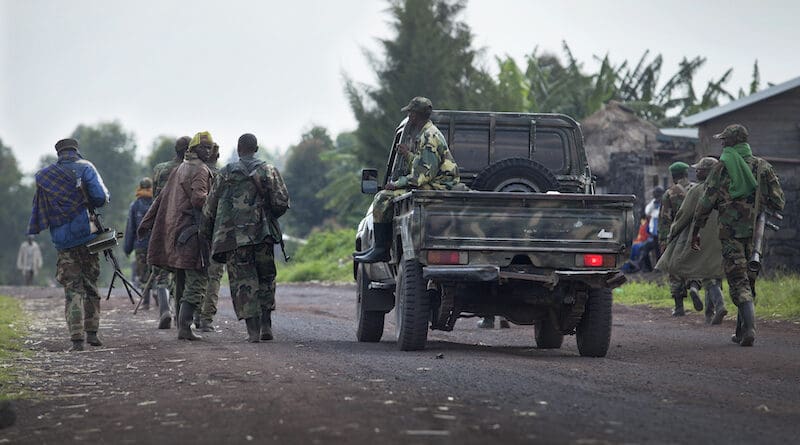
Chinese Weapons Fuel Both Sides Of DRC Conflict


File photo of M23 rebels in Democratic Republic of the Congo (DRC). Photo Credit: MONUSCO/Sylvain Liechti, Wikipedia Commons

August 19, 2026
By Africa Defense Forum

Key Takeaways:

Despite Beijing’s official neutrality in the eastern DRC conflict, Chinese-made weapons, equipment, and uniforms are appearing on both sides—especially in the hands of M23 rebels.

Most of these arms reach M23 indirectly through Rwanda, a major Chinese weapons customer long accused by the UN of backing the militia, while China also supplies the Congolese government.

China’s large mining investments and growing role as Africa’s top arms supplier make its non-interference stance increasingly difficult to maintain as the conflict threatens its commercial interests.


Beijing’s official stance of neutrality and nonintervention in the paramilitary M23’s rebellion against the Congolese government is increasingly being challenged by the reality on the ground: a proliferation of Chinese-made weapons on both sides.

China has several billion-dollar investments in cobalt, coltan and copper mines in the eastern Democratic Republic of the Congo. It also supplies weapons to the DRC and neighboring Rwanda, which has been accused by the United Nations of backing the M23 militia.

“China presents itself as a mediator in the region, and its embassy denies any arms sales to armed groups,” independent news website Beto wrote in a July 18 editorial. “Its professed neutrality is a commercial position, profitable for both sides while Congo burns.”


Government officials in the DRC reportedly are incensed over the flow of Chinese weapons and military equipment into the hands of M23 fighters after being sold to Rwanda. Defense analyst Jean-Jacques Wondo said there have been numerous examples of the Congolese military (FARDC) recovering Chinese weapons and military equipment from M23 fighters in eastern DRC.

“The M23 weapons seized by the FARDC are almost all of Chinese manufacture,” he told Beto in 2022.

Wondo has spent years tracking these weapons: Kalashnikov-style light machine guns, assault rifles, mortars and 40-millimeter anti-tank rocket launchers. There also is photographic evidence of a Chinese-made 107-millimeter gun in use by M23 as well as a Chinese variant of a Russian guided artillery shell. There is also evidence of M23 fighters operating a Chinese Yitian armored vehicle near Goma, the North Kivu province capital they have held since January 2025.

In the past two decades, the Rwanda Defence Force has purchased Chinese artillery, anti-tank missiles and armored vehicles, according to the Stockholm International Peace Research Institute. An independent panel of U.N. experts in 2022 concluded that Rwanda has armed the M23 militia, which by appearance looks more like a well-equipped army than the kind of ragtag armed groups roaming eastern DRC.


“These weapons do not come directly from Beijing,” the Beto editorial said. “They originate from the Rwandan arsenal, largely supplied by China, which then flows into the hands of the M23. Rwandan forces are equipped with Chinese equipment at almost every level, including air defense systems from the state-owned Norinco group.”

In a recent article, intelligence analyst Mustapha Bature Sallama noted that M23 fighters also are outfitted in Chinese-made uniforms, bulletproof vests and tactical helmets. Wondo and Beto have connected much of the recovered M23 gear to Chinese state-owned export company Xinxing, which describes itself as Beijing’s officially recognized and exclusive exporter of military supplies and logistical equipment.

“Whether through the deliberate diversion risk Beijing has long been aware of in its Rwanda sales, or through more direct channels involving state-owned exporters like China Xinxing, the weapons recovered from M23 positions tell a story that China’s diplomatic statements have yet to reconcile,” Sallama wrote in a July 13 article for Modern Ghana website. “For a conflict that has already displaced millions and claimed the two provincial capitals of Kivu, the question of who is arming the M23, and with whose knowledge, deserves far more scrutiny than it has so far received.”

Despite plentiful evidence of its involvement in the M23 conflict, however indirect, China insists that it adheres to a policy of noninterference in other countries’ internal affairs. This approach to diplomacy and business has backed China into a corner, said Zhou Yuyuan, a professor at the Shanghai Institutes for International Studies.

With China recently eclipsing Russia as the largest arms dealer on the continent, researcher Peter Smith believes Beijing’s approach to conflicts like the M23 revolt in eastern DRC could become an untenable position.

“Although China has shown little interest in previous African conflicts, its vast commercial interests in the continent at present could result in greater levels of future involvement,” he wrote in a 2024 post for global conflict analysis blog Between the Lines. “Given the substantial mark it has left by arming various actors throughout Africa, these conflicts could intensify greatly moving forward, further forcing China to pick sides as it seeks to protect the substantial investments it has made to date.”

NATO’s Drone Wall Has A Sensor Deception Problem – Analysis


August 19, 2026

By Burak Oktenli

Key Takeaways:

NATO’s expanding counter-drone architecture must address not only hardware integrity but also “perception integrity”—the risk that genuine sensors can still be fed a fabricated battlespace through spoofing, decoys, or manipulated data.

Recommended safeguards include continuous confidence scoring of sensor inputs, heterogeneous multi-sensor corroboration, and linking perception confidence to operational authority so that uncertain tracks automatically reduce system autonomy.

Future NATO exercises and certification standards should test systems against deliberate deception (false GNSS, phantom tracks, conflicting reports) to ensure false pictures do not propagate across allied networks.


As NATO connects drones, radars, sensors, and command systems across its eastern flank, hardware integrity solves only half the problem. A genuine sensor can still be shown a fabricated battlespace.

NATO is spending heavily to build a more integrated counter-drone architecture. At the Ankara Summit in July, Allies announced more than $40 billion in counter-drone investment over the next five years. From August 3 to 14, Exercise Baltic Trust 26 in Latvia is testing how UAS and counter-UAS systems perform together under realistic conditions, with emphasis on interoperability, command coordination, and suppression tactics.

That work is necessary because the Alliance increasingly depends on a chain that runs from sensor to command-and-control system to effector. NATO’s Technical Interoperability Exercise 26 already evaluates track stability, sensor-to-C2 integration, identification performance, and engagement-chain effectiveness. The next test requirement should ask a harder question: what happens when every component in that chain is genuine, yet the picture of the battlespace is false?


Modern security architectures are good at proving component integrity. Hardware roots of trust, signed firmware, and device attestation can help establish that a system is genuine and has not been modified. Those controls address counterfeit components, unauthorized software changes, and supply-chain tampering. They do not establish that the physical environment being observed is truthful.

A valid receiver can process a false navigation signal. NATO already treats GNSS jamming and spoofing as a real and growing operational problem and has tested sensors designed to detect and locate intentional attempts to deceive satellite-navigation systems. The same structural problem extends beyond navigation. A radar can be intact while responding to a decoy. A sensor-fusion layer can receive technically valid reports that correspond to a manipulated scene. A command system can therefore ingest data that passes integrity checks while still representing an adversary-shaped picture of reality.

For a layered counter-drone network, this is a perception-integrity problem.

The distinction matters because NATO is explicitly connecting radars, radio-frequency sensors, command systems, and effectors from multiple nations and vendors. Interoperability increases the value of the network, but it also means that a convincing false track can travel farther once accepted. A bad observation that remains local is a sensor problem. A bad observation that is normalized, fused, and distributed across an Alliance network can become a shared operational belief.


NATO should therefore add adversarial perception to the testing regime it is already building.

The first requirement is continuous confidence scoring at the input layer. A sensor report should carry more than an object label and coordinates. Systems should also estimate how consistent that report is with the sensor’s normal distribution, timing characteristics, and recent behavior. Sudden changes can be benign, but they are measurable and should affect confidence.

The second requirement is heterogeneous corroboration. Independent sensing modes should be asked to confirm events that matter. Radar, electro-optical, infrared, acoustic, radio-frequency, and other sources have different strengths and failure modes. Agreement across genuinely independent channels raises confidence. Disagreement should lower it and trigger additional observation before an autonomous system escalates its response. Agreement is evidence, not proof, because a sophisticated adversary may target several channels at once.

The third requirement is to connect perception confidence to operational authority. Today, uncertainty is often displayed as an alert for an operator to interpret. In autonomous and semi-autonomous systems, that is too weak. If confidence in the observed environment falls, the system’s authority should contract in a predefined way. A questionable track might remain under observation rather than trigger an autonomous engagement. A navigation anomaly might force a vehicle into a conservative mode. A cluster of inconsistent observations might require human confirmation before the system crosses an irreversible decision threshold.

For NATO, there is also an interoperability consequence. A multinational counter-drone network needs a common way to communicate confidence, not simply a common track format. One national sensor may mark an observation as low confidence while another C2 system treats the same track as operationally established. If uncertainty is stripped away as data crosses interfaces, technical interoperability can accidentally amplify false certainty. NATO should define minimum confidence metadata and rules for preserving it across sensor-to-C2 exchanges, so that an uncertain observation does not become more authoritative merely because it crossed an Allied network boundary.


This principle can be tested. Baltic Trust and NATO’s other experimentation ranges are designed to bridge the gap between emerging technology and long-cycle modernization. Red teams should inject deception into the environment while leaving the hardware untouched: false GNSS signals, plausible phantom tracks, timing anomalies, decoys, and conflicting sensor reports. Evaluators can then measure whether the network detects the inconsistency, how quickly confidence changes, whether the false picture propagates through C2, and whether autonomous authority falls as designed.

The test should also include adaptive adversaries. Fixed statistical boundaries can be studied. A patient attacker will try to approach them slowly or create anomalies that remain individually plausible. NATO’s standard should therefore reward architectures that combine multiple indicators, update baselines, and preserve uncertainty instead of forcing every ambiguous observation into a binary classification.

This is compatible with NATO’s current direction. The Alliance’s July demonstrations of uncrewed and autonomous systems already emphasized advanced sensing, navigation, reliability in challenging conditions, and systems that can operate without satellite positioning. The missing step is to treat deliberate manipulation of perception as a first-class operational condition rather than a niche cybersecurity scenario.

The $40 billion counter-drone commitment will buy more sensors, effectors, software, and integration. NATO’s marketplace will also seek systems that are NATO-tested and NATO-compatible. Those labels should eventually mean more than the ability to connect and exchange tracks. They should mean that the system has been tested while an adversary is actively trying to make genuine sensors agree with a false world.

NATO is moving quickly to build a layered drone defense. Its testing architecture should move just as quickly from asking whether the hardware can be trusted to asking whether the picture can be trusted. In an autonomous battlespace, the decisive deception may arrive through a sensor that passes every integrity check.


About Burak Oktenli

Burak Oktenli holds an MBA and a Master of Professional Studies in Applied Intelligence from Georgetown University. His research addresses the governance of authority in autonomous and AI-enabled systems, and his writing has appeared at the Modern War Institute at West Point, RUSI, RealClearDefense, RealClearMarkets, and Geopolitical Monitor. He is the author of Authority Architectures for Autonomous Systems, a ten-volume series on how authority in autonomous systems is delegated, monitored and recovered, at authority-architecture.me.
View all posts by Bura