Friday, September 11, 2026

Trump absent as New York marks 25 years since 9/11 with first Muslim mayor

New York marks the 25th anniversary of the Sept. 11 attacks on Friday, with President Donald Trump attending a ceremony at the Pentagon while Vice President JD Vance and four former presidents join commemorations at Ground Zero, where victims’ relatives will read the names of those killed.

Issued on: 11/09/2026 -
By: FRANCE 24

The 9/11 attacks killed almost 3,000 people, most of them at the World Trade Center in New York © JOHN MOORE, AFP

New York commemorates the 25th anniversary of the devastating September 11, 2001 attacks Friday with a ceremony marked by US President Donald Trump's absence and right-wing outrage at the attendance of the city's first Muslim mayor.

Trump will pay his respects at the Pentagon, not New York, where hijacked planes destroyed the World Trade Center and killed most of the 2,977 total victims on that world-altering day.

Vice President JD Vance and Trump's four living predecessors -- Republican George W. Bush, who was in office during the attacks, and Democrats Joe Biden, Barack Obama and Bill Clinton -- are all expected at the "Ground Zero" site in lower Manhattan.

No one will give speeches at the ceremony, while bereaved family members will read out the names of all of those killed and a bell rung to mark major moments during the attack.

"Memorials like this and discussions about those events are an important part of keeping it alive and understanding how we prevent tragedies like this from ever happening again," said Robert Kafka, a Chicagoan in his 60s visiting the 9/11 Memorial.

01:55

Alongside the former presidents will be Democratic Mayor Zohran Mamdani, the Big Apple's first Muslim mayor, despite a campaign urging him to stay away spearheaded by the right-wing New York Post and former mayor Rudy Giuliani.

A petition, which has gathered more than 100,000 signatures, accuses Mamdani of associating with unspecified individuals who are "dismissive of American institutions or insufficiently critical of extremist ideologies."

"It's concerning to me that the mayor is being treated differently simply because he is Muslim," city council member Shahana Hanif told CNN.

Mamdani won plaudits however for recently revealing thousands of documents showing what city officials knew about toxicity levels of the air in Lower Manhattan following the attacks.

After the initial dust cloud that followed the collapse of the World Trade Center, months of pollution and lingering dust ensued, causing cancers from which thousands of New Yorkers still suffer today.

'Toxic air'

"People got sick because the leaders they trusted lied and told them they were safe to breathe in toxic air," Mamdani said Tuesday.

Nineteen Al-Qaeda operatives hijacked four planes on that nearly cloudless day in 2001. Two jets slammed into the World Trade Center's Twin Towers, causing the iconic 110-story buildings to collapse.

A third plane struck the Pentagon, while a fourth crashed into a field near Shanksville, Pennsylvania, after passengers fought back.

Beyond those killed on September 11, more than 9,400 other people have died from 9/11-related illnesses, according to the federal program established to provide medical care to those affected.

Some 100 million Americans were not even born or are too young to remember the tragic events.

Logan Miller, 32, lost his uncle during the attacks, and his grandfather to 9/11-related illness in the aftermath.

"I think the next generation just can't fathom what actually transpired and how someone could be impacted by that, and so I actually find them asking more questions," he told AFP.

Huge crowds are expected to gather in Lower Manhattan for the memorial service.

The Secret Service has erected a security ring of steel around the site of the 9/11 Memorial and Museum.

Police commissioner Jessica Tisch said an anti-drone team would be deployed as a precaution, but stressed there was no intelligence of a specific threat to the gathering.

Al-Qaeda meanwhile has marked the anniversary by releasing a video showing images of late leader Osama bin Laden and his son Hamza, who Trump said in 2019 had also been killed.

Ahead of the memorial, a drone show with 2,977 lights rose above New York Harbor, one for each person killed in the attacks.

(FRANCE 24 with AFP)


25 years on, 9/11 continues to cast a long shadow over the US

The aftermath of the 9/11 attacks on New York's World Trade Center
Copyright Alexandre Fuchs/Copyright 2021 The AP. All rights reserved


By Simon Ormiston
Published on


Alongside the thousands of Americans killed on 9/11, dozens of Europeans lost their lives that day — and 25 years on, some of the people accused of being behind the attacks have still not faced justice.

A quarter of a century after hijacked planes struck New York, Washington and Pennsylvania, the attacks of 11 September 2001 remain lodged in the American psyche more firmly than almost any other event of the past 25 years.

A new Ipsos poll finds that roughly half of US adults, unprompted, name 9/11 among the most significant events of their lifetime — ahead of the Covid-19 pandemic, the elections of Barack Obama and Donald Trump, and Hurricane Katrina of 2005.

Nine in ten say the attacks changed the country "a great deal" or "quite a bit," and most Americans can still recall exactly where they were when they heard the news.

Yet despite that lasting wound, only around one in ten plan to actively mark Friday's anniversary - for those that do a moment of silence and the flying of the flag are the most common gestures.

Two planes flew into the World Trade Center in New York on 9/11 killing 2,977 people. 11 September, 2001. Chao Soi Cheong/Copyright 2026 The AP. All rights reserved

Confidence in the government's ability to prevent another attack has also declined steadily since the record highs recorded in the days after 2001.

What's planned for the 25th anniversary?

Commemorations will unfold across the three sites. In New York, victims' relatives will gather on the Memorial plaza to read aloud the names of those killed, punctuated by seven moments of silence — one more than in previous years, added to honour those who have since died of 9/11-related illnesses.

Ceremonies will also take place at the Pentagon in Arlington and at the Flight 93 National Memorial in Shanksville, Pennsylvania.

People were forced to flee as the streets around lower Manhattan were covered in a thick ash after the twin towers collapsed. 11 September, 2001. SUZANNE PLUNKETT/2001 AP

Trump will not attend the New York ceremony this year, opting to speak at the Pentagon instead.

Vice President JD Vance will go to Ground Zero - the area where the first search for survivors in began - while former presidents Joe Biden, Barack Obama, Bill Clinton and George W. Bush are also expected to attend the New York event.

Why is it called 9/11?

For some, the shorthand can seem puzzling. The date was the eleventh day of the ninth month but the American convention of writing dates with the month-first leads to "9/11" which also mirrors how the emergency number 911 is dialled in the US.

How many Europeans died in 9/11?

While nearly 3,000 Americans died in the event, hundreds of foreign nationals were also among the dead. Estimates place the number of non-American victims at roughly 372, drawn from around 60 countries.

Britain suffered the heaviest toll of any country besides the US, with 67 nationals killed. Germany, Italy, Ireland and other European states also lost citizens, many of them financial workers employed at or visiting the World Trade Center.

Over 2,600 pieces of the World Trade Center were distributed across the US and 11 other countries including this display in London. FILE AP Photo


American financial services firm Cantor Fitzgerald occupied floors 101 through 105 of the World Trade Center's North Tower, directly above the impact zone of American Airlines Flight 11.

The company employed a number of Europeans and in total 658 employees were killed that day - the largest loss of life of any individual firm.

Number of Europeans killed in 9/11 attacks:

  • United Kingdom — 67
  • Germany — 11
  • Italy — 10
  • Ireland — 6
  • Poland — 6
  • Portugal — 5
  • France — 4
  • Romania — 4
  • FR Yugoslavia (Serbia and Montenegro) — 2
  • Sweden — 2
  • Switzerland — 2
  • Belarus, Belgium, Lithuania, Moldova, Netherlands, Russia, Spain, Ukraine - 1 per country

What happened to the perpetrators?

All 19 hijackers died carrying out the attacks - 15 were Saudi nationals, two from the United Arab Emirates, and one from Egypt and one from Lebanon.

Behind them stood the wider terrorist al-Qaeda network who claimed direct responsibility for the attacks. Osama bin Laden, the group's leader, evaded capture for almost a decade before being killed by US special forces in Pakistan in 2011.

His eventual successor, Ayman al-Zawahiri, was killed in a drone strike in Kabul in 2022.

The self-described "mastermind" of the plot, Khalid Sheikh Mohammed, was captured in Pakistan in 2003 and has been held at Guantánamo Bay since 2006 charged with the first-degree murder of 2,977 people.

A US military judge has now set his long-delayed trial to begin in June 2028, alongside several alleged co-conspirators, following a collapsed 2024 plea deal that would have seen the men admit guilt in exchange for the death penalty being removed from sentencing options.

Proceedings have dragged for over two decades amid disputes over evidence obtained through the use of torture, including waterboarding, at secret CIA sites.


On 25th anniversary of 9/11, New York remembers victims poisoned by debris


On the 25th anniversary of the 11 September attacks on the World Trade Center, the official 9/11 ceremony in New York will for the first time include a moment of silence dedicated to the thousands who have since died from illnesses linked to their exposure to pollution released when the Twin Towers fell.


Issued on: 11/09/2026 - RFI

The Twin Towers of the World Trade Center burn behind the Empire State Building in New York, on 11 September 2001. © AP - Marty Lederhandler

On 11 September 2001, Al-Qaeda hijackers seized control of two planes that struck the two World Trade Center towers in downtown New York City.

A third hijacked jet smashed into the Pentagon, and a fourth plane that appeared to be headed for the US Capitol or the White House crashed in woodland near Shanksville, Pennsylvania, after passengers fought back and seized control.

The attacks claimed the lives of 2,977 people, mostly in the collapse of the Twin Towers on the site now known as Ground Zero.

But in the last 25 years, thousands of people who escaped or participated in rescue operations have developed serious illnesses associated with exposure to toxic dust and debris.

Seventh silence

More than 9,400 have died from illnesses linked to their exposure to contaminated air at or near Ground Zero, the Pentagon and related sites, according to a federal medical monitoring programme.

It is with these people in mind that organisers at the National September 11 Memorial & Museum have added a seventh moment of silence to the annual ceremony on Friday.

Previous commemorations have featured six moments of silence corresponding to the times the four planes hit and the moment each tower fell.

The new observance will occur after the reading of the victims' names and is intended to recognise others who were affected in the years after the attacks, including firefighters, police officers, construction workers, volunteers, local residents, office workers and students.
Police, firemen and a civilian carry the body of New York City Fire Department chaplain Mychal Judge after he was killed in the collapse of the south tower at the World Trade Center in New York, 11 September 2001. @ REUTERS/Shannon Stapleton/Files


New disclosures

This year's commemorations coincide with the release of tens of thousands of documents showing New York City officials did not disclose all they knew about air toxicity after 9/11.

"These are documents that show what the city knew about the toxic air around Ground Zero, when they knew it, and how they acted to limit liability," New York Mayor Zohran Mamdani told a news conference on Tuesday.

The release of the 170,000 pages of documents is part of an agreement with 9/11 Health Watch, a victims' advocacy group that had taken legal action to compel the city to make the documents public. More are due to be published online over the next 12 months.

"For 25 years, four different mayoral administrations kept from the public, the US Congress and the city council documents showing what the city actually knew about the danger of the toxic chemicals in lower Manhattan and western Brooklyn after the World Trade Center collapse, even as city officials continued messaging to the public that the air was 'safe and acceptable'," the group's director, Benjamin Chevat, said in a statement.

The documents stand to implicate two former New York mayors: Rudy Giuliani, in office at the time of the attacks, and Michael Bloomberg, mayor from January 2002 to December 2013.

"This goes across a multitude of those that New Yorkers have trusted," Mamdani said. "People got sick because the leaders they trusted lied and told them they were safe to breathe in toxic air."

Firemen work in the remains of the World Trade Center, 11 September 2001. @ Reuters/Peter Morgan


Trump stays in DC


As well as the official ceremony for the victims, other commemorations are taking place in New York and other venues.

They include the Tribute in Light: two beams of light representing the Twin Towers, which will illuminate the New York skyline from dusk on 11 September until dawn on 12 September.

Breaking with tradition, US President Donald Trump will pay his respects on Friday at the Pentagon in Washington rather than Ground Zero. Instead, Vice-President JD Vance will attend the New York ceremony.

Trump's four living predecessors – Democrats Joe Biden, Barack Obama and Bill Clinton, as well as Republican George W Bush, who was president at the time of the attacks – are all expected at Ground Zero.

(with newswires)

9/11: Remembering The CIA’s Failure To Protect America – OpEd


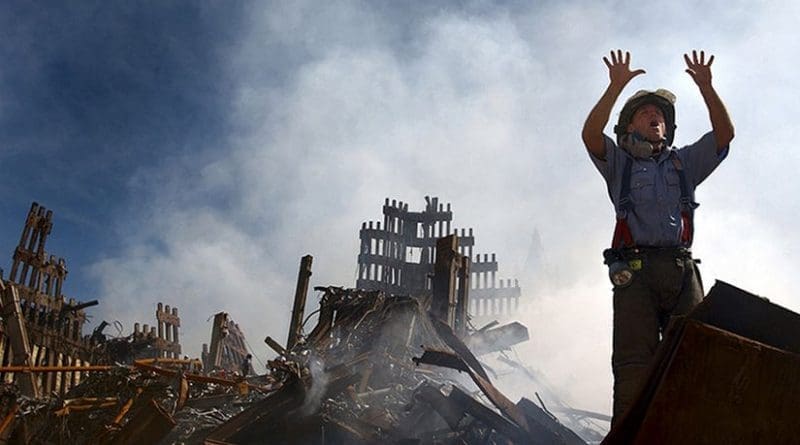
A New York City fireman calls for 10 more rescue workers to make their way into the rubble of the World Trade Center site of the 9/11 attacks. U.S. Navy Photo by Journalist 1st Class Preston Keres, Wikipedia Commons.


September 10, 2026

By K. Lloyd Billingsley


Key Takeaways:

The author marks the 25th anniversary of 9/11 by arguing the CIA—and the FBI—failed to stop the attacks that killed nearly 3,000 people, including 24 Canadians.

John Brennan’s memoir is cited as evasive (Pentagon “attacked,” Pennsylvania plane “crashed,” little on the World Trade Center).  
After the failure, the piece notes bigger CIA budgets and no clear account of bosses being fired; Tenet and Mueller kept their jobs.

Homeland Security and later CIA years are tied to later U.S. attacks. The author backs Angelo Codevilla’s call to abolish FISA, reform the FBI, and break up the CIA—presented as overdue congressional work, not a finding of new 9/11 facts.


On Sep. 11, 2001, al Qaeda terrorists flew hijacked airliners into the World Trade Center and the Pentagon, killing nearly 3,000 people from many nations, including 24 Canadians. On the 25th anniversary, the people might recall the U.S. agency that failed to stop the worst attack on the United States since Pearl Harbor in 1941.

“At the CIA, our mission is to preempt threats and further U.S. national security objectives,” claims the secretive agency, whose budget is classified. Consider this account of the 9/11 events from John Brennan, a CIA officer since 1980 and CIA director from 2013 to 2017.

“We learned that the Pentagon had been attacked and that a plane had crashed in Shanksville, Pennsylvania,” wrote Brennan. “George [CIA director George Tenet] called his senior staff back into the room to coordinate actions that the CIA would need to take as the attack against our homeland was unfolding,” starting with the evacuation of the CIA building.

That is from Brennan’s Undaunted: My Fight Against America’s Enemies, at Home and Abroad, published in 2020. The author, Tenet’s chief of staff on 9/11, doesn’t explain how, exactly, the Pentagon was “attacked.” The former CIA boss also fails to mention the hijackers’ primary target, the World Trade Center, where most of the nearly 3,000 victims perished.

In a similar evasive style, the Pennsylvania plane had only “crashed,” with no mention of the heroic passengers who took down the airliner in a field before it could reach its target in New York or Washington. After this colossal failure, Brennan writes, the CIA “demonstrated its agility by “deploying officers to Afghanistan,” where the terrorists were hiding in caves.

The former CIA director is “absolutely certain” that al Qaeda “would have succeeded in carrying out devastating attacks against the United States after 9/11, including in the homeland, had it not been for the outstanding work of CIA officers around the world.” The people have cause to wonder if those are the same “outstanding” officers who failed to see 9/11 coming in the first place.

After 9/11, Brennan notes, the CIA budget was “significantly increased,” which implies that the problem was not enough money. So in the best bureaucratic tradition, the failure to prevent 9/11 earned a financial reward, but there was more to it.


George Tenet remained CIA director until 2004, and Brennan does not say if any CIA bosses were disciplined, demoted, or dismissed after 9/11. To be fair, the Federal Bureau of Investigation also failed to prevent 9/11, and director Robert Mueller held the top post until 2013, the longest span since J. Edgar Hoover. On the watch of Mueller and Tenet, other bureaucratic failures were in the works.

George W. Bush, president on 9/11, oversaw the creation of the Department of Homeland Security. In the style of the CIA and FBI, the DHS failed to prevent terrorist attacks at Fort Hood (2009), the Boston Marathon (2013), San Bernardino (2015), and Orlando in 2016, when John Brennan was still running the CIA and targeting enemies “at home.”

If friends and loved ones of the 9/11 victims thought the CIA was a failure at its duly appointed tasks, it would be hard to blame them. Those in search of a solution should consider the late Angelo Codevilla, author of Informing Statecraft: Intelligence for a New Century.

As a staffer on the Senate Intelligence Committee, Codevilla was one of the few to see everything on the CIA’s wish list. In 2020, the same year as Brennan’s Undaunted, Codevilla made a strong case to abolish FISA, reform the FBI, and “break up” the CIA. On the 25th anniversary of 9/11, Congress should get started on those long-overdue reforms.

This article was also published in The American Spectator

About K. Lloyd Billingsley
K. Lloyd Billingsley is a Policy Fellow at the Independent Institute and a columnist at The Daily Caller.
View all posts by K. Lloyd Billingsley →


THE ORIGINAL CIA 9/11


 LA REVUE GAUCHE - Left Comment: Search results for ALLENDE CHILE


 LA REVUE GAUCHE - Left Comment: Search results for ALLENDE CHILE 9/11


 LA REVUE GAUCHE - Left Comment: Search results for PINOCHET


 LA REVUE GAUCHE - Left Comment: Search results for CYBERSYN

Thursday, September 10, 2026

India's LOHUM ships first ore from Zimbabwe lithium deposits valued at $7bn

India's LOHUM ships first ore from Zimbabwe lithium deposits valued at $7bnFacebook
By bne IntelliNews September 10, 2026

Indian critical minerals producer LOHUM has dispatched its first tranche of lithium ore from newly acquired mining blocks in Zimbabwe's Matabeleland South province, marking the start of production at its first mining operation outside India.

Reuters and the Press Trust of India reported the September 9 shipment, which moves a company until now focused on battery recycling and refining into upstream mining.

LOHUM has secured rights to 10 spodumene-bearing blocks covering about 1,100 hectares, which it estimates hold 30mn-40mn tonnes of ore capable of supporting around 300,000 tonnes of lithium carbonate equivalent over their operating lives.

The company, founded in 2018 by Chief Executive Rajat Verma, also holds an option over as many as 90 adjacent blocks. LOHUM puts the gross in-situ value of the initial deposits at about $7bn at current lithium prices, while cautioning that this is neither a project valuation nor a forecast of returns.

LOHUM is targeting annual output of about 30,000 tonnes of lithium carbonate within two to three years. It plans to mine and carry out initial beneficiation in Zimbabwe before sending material to India, where it is building a dedicated lithium refinery whose location has not been disclosed.

"We are approaching Zimbabwe as a long-term partner, building processing capability locally rather than shipping ore out," Verma said.

Developing concentration capacity locally aligns with Harare's drive to capture more mineral value onshore. Zimbabwe, Africa's largest lithium producer, plans to ban lithium concentrate exports from January 2027 to force deeper domestic processing, after banning exports of unprocessed lithium ore in 2022.

For India, the venture advances a wider effort to secure critical mineral supplies abroad. The country remains almost entirely dependent on imports for its lithium, while the government's seven-year National Critical Mineral Mission, with INR163bn ($1.70bn) in proposed government expenditure and INR180bn ($1.88bn) in expected investment by public-sector companies and other stakeholders, aims to secure at least 50 overseas mining assets by 2031.

LOHUM says the Zimbabwe blocks are its first directly owned mining assets abroad, extending a business that already spans refining, advanced materials and battery recycling.

Volkswagen restructuring tests Europe's automotive model and Central Europe's role

Volkswagen restructuring tests Europe's automotive model and Central Europe's role
Volkswagen says it has more than 500,000 units of excess production capacity at its European factories as it embarks on a major restructuring. / VolkswagenFacebook
By IntelliNews September 9, 2026

Volkswagen's decision to cut another 50,000 jobs and reshape its European production network is a warning of the scale of the adjustment facing Europe's car industry, including in Central Europe, where auto assembly and parts manufacturing has been a crucial part of the growth story over the last three and a half decades. 

The Volkswagen Group supervisory board approved its "Future Plan 2030" last week, setting out one of the most extensive restructurings in the company's history as it seeks to restore competitiveness in the face of weak demand, excess capacity and intensifying Chinese competition.

The group says it has more than 500,000 units of excess production capacity at its European factories. It cannot guarantee production allocations for its plants in Emden, Zwickau, Hannover and Neckarsulm beyond 2030 and is examining alternative uses for the sites. The additional 50,000 job cuts will come on top of a previously announced reduction of around 50,000 positions. Volkswagen also plans to halve its model range by 2035 and reduce complexity by around 75%, concentrating production on fewer, higher-volume models.

The aim is to sell 9mn vehicles a year and raise its operating margin to 9% by 2030, from 3.8% in the first half of 2026. Volkswagen plans to invest €135bn ($157bn) in capital expenditure and research and development between 2027 and 2031, focusing on technology, its brands and competitiveness.

Given how embedded Volkswagen and other major automakers are to the European automotive supply chains, the impact of the restructuring goes beyond Germany’s borders to the broader European automotive production system, with potentially important consequences for countries such as Czechia, Slovakia, Poland and Hungary.

For Central Europe, the immediate picture is mixed. Plants in the region have some of the cost advantages that Volkswagen needs, while their established supply chains and proximity to Germany make them natural candidates for production that is shifted away from higher-cost German facilities. At the same time, plants will increasingly have to compete for a smaller number of models, particularly electric vehicles, while suppliers face pressure to adapt to a rapidly changing technology mix.

Potential upside 

Slovakia is one of the clearest examples of the potential upside. The country is the world's largest car producer per capita and hosts a major Volkswagen plant in Devínska Nová Ves near Bratislava. Analysts surveyed by Slovak state broadcaster STVR have suggested that the German restructuring could ultimately bring more production to Slovakia.

"I see in this whole optimalisation of processes a chance that other models would come to Slovakia," Pavol Prepiak, vice president of the Slovak Union of Automobile Industry, told STVR. 

That possibility reflects the changing economics of Volkswagen's European production network. Some of the German facilities under review are heavily focused on electric vehicles, and production could potentially be reallocated to plants where costs are lower.

"Let's be aware that for instance in two of the plants which are being shuttered 100% electricity vehicles are made today," Prepiak said.

German media have previously reported that production of a luxury electric SUV could potentially be launched at the Devínský Nová Ves plant, though this has not been confirmed.

Poland is similarly positioned to gain from the reshuffling of Volkswagen production. Even before the group's restructuring was formally approved, Polish media pointed to the possibility that some production could move eastwards from Germany.

According to Polish news outlet Biznesalert.pl, production of Volkswagen's new family of electric vans, provisionally designated B-Space (T8) and planned for around 2028, is to be relocated to Poznań. That would give Volkswagen's Polish operation a new electric model at a time when the group is reducing production capacity in Germany.

Poland has spent decades building up an automotive manufacturing base that combines relatively competitive labour costs with a substantial network of suppliers and access to the German market. However, the immediate employment picture remains uncertain, and Polish media reported after Volkswagen's announcement that no decision had been taken on job cuts at Volkswagen Poznań or its Września plant.

Better insulated 

Czechia appears relatively well insulated from the immediate effects of the Volkswagen restructuring. Martin Vejdělek, spokesperson for Škoda Auto, told the Czech Press Agency that Volkswagen's plans would have no direct impact on Škoda's activities, reiterating the carmaker's statement from July. Czech suppliers are also not expecting a dramatic immediate impact.

"Thanks to the diversification of the portfolio of customers we are able to largely absorb the negative impacts caused by the instability of the automotive market," Jiří Heteš, staff manager at air-conditioning supplier DENSO Manufacturing Czech, told CTK.

DENSO supplies products to Volkswagen as well as Land Rover, Porsche, Mercedes, Audi, Škoda, Suzuki, Toyota, Ford and Lamborghini. Its broad customer base illustrates one of the most important factors determining how Central European suppliers will fare as the industry restructures.

Companies supplying several manufacturers, technologies and markets have greater scope to absorb changes in production at any one customer. Smaller companies heavily dependent on one vehicle programme or one propulsion technology are considerably more vulnerable.

Czech automotive manufacturing has also continued to grow despite the wider problems facing European producers. The country produced 780,378 passenger vehicles in the first half of 2026, 4.4% more than a year earlier, according to the Association of the Czech Automotive Industry. Electric vehicles accounted for 41% of domestic production.

Hungary shows the risks

Hungary illustrates why Central Europe's position is not automatically secure. Audi's plant in Gyor, western Hungary, could be exposed to Volkswagen's restructuring, according to German investigative outlet Correctiv, although no decision has been made to close the factory and Volkswagen has not confirmed the report.

Audi Hungaria employs more than 12,000 people and is the largest employer in the region. It produced a record 200,000 vehicles last year, driven by models including the Audi Q3 and Cupra Terramar, but its traditional engine business is under pressure from the transition to electric vehicles.

Audi Hungaria CEO Michael Breme told Telex in July that the workforce needed to adapt to the changing industry. "The new reality in the automotive industry is that job security is no longer a given; rather, it must be earned through concessions from employees," he said. Workers who spent much of their careers in engine production are increasingly being moved into electric motor manufacturing and vehicle assembly. The company has also reduced administrative staffing and imposed a hiring freeze, while unions have agreed to wage restraint.

Gradual decline

The changes at Volkswagen are ultimately a symptom of a much larger problem. Europe's automotive sector has been one of the foundations of the continent's industrial economy for decades. It supports millions of direct and indirect jobs and accounts for more than 7% of EU GDP, according to a paper by think-tank Shaping Europe titled “The slow decline of the European car industry”.  

“The European automotive sector has been struggling for some time now, for a variety of reasons such as the slow transition to electric vehicles, competition from China, and unrealistic climate targets,” the paper says. 

European consumers have been reluctant to embrace vehicles that remain expensive relative to conventional cars, while manufacturers have struggled to produce affordable models in sufficient volumes. At the same time, Chinese manufacturers have developed strong positions in electric vehicles and their supply chains, combining scale, relatively low costs and rapid product development.

A new model 

Central Europe’s automotive success was built on integration with Western European manufacturers. Czechia, Slovakia, Poland and Hungary became major production locations because they offered lower costs while remaining close to Germany and other large European markets. That model has worked extremely well. But it also created a dependence on decisions taken by multinational companies headquartered elsewhere.

The Vienna Institute for International Economic Studies (wiiw) has warned that the broader Central and Eastern European growth model is now reaching its limits as geopolitical fragmentation changes global trade and investment.

"The old growth model is over, and a new one is emerging," Richard Gieveson, wiiw's deputy director, said in February, as quoted in an IntelliNews article.

The region still has a significant advantage in manufacturing. Its integrated supply chains, competitive costs and proximity to Germany remain valuable assets. However, it needs greater investment in research and development, batteries, software, electric drivetrains and other technologies that will determine where future production is located.

Contributions from IntelliNews reporters in Budapest, Prague and Warsaw. 

Porsche exits stake in Croatia's Rimac in €1bn deal

Porsche exits stake in Croatia's Rimac in €1bn deal
British explorer and tech entrepreneur Chris Brown drove the Rimac Nevera 2,700 kilometres from North Yorkshire to Trogir on the Dalmatian Coast. / RimacFacebook
By IntelliNews September 10, 2026

A consortium led by US investment firm HOF Capital has completed the acquisition of Porsche's stakes in Croatian electric vehicle group Rimac Group and its Bugatti Rimac joint venture, Rimac said on September 9. Porsche AG Group said it will receive proceeds of approximately €1bn from the deal.

The transaction, announced in April and completed following regulatory approval, transfers Porsche's 21% holding in Rimac Group and its 45% stake in Bugatti Rimac to the consortium, which includes BlueFive Capital as its largest investor and other institutional investors from the United States and Europe.

Rimac Group retains its 55% controlling stake in Bugatti Rimac, the joint venture established by Porsche and Rimac in 2021 to oversee the Bugatti hypercar brand and Rimac's automotive operations.

"This is an important step for Bugatti Rimac and the entire Rimac Group," said Mate Rimac, founder and president of Rimac Group and chief executive of Bugatti Rimac.

"I am delighted that HOF Capital and its consortium are becoming our partners in the next phase of our Group's development, and I look forward to working together to realize the full potential of our companies," he said.

The transaction was announced alongside changes to Bugatti Rimac's management. Rimac will become president of Bugatti Automobiles, taking over from Christophe Piochon, who is stepping down as president and chief operating officer of Bugatti Rimac.

Marko Brkljačić, formerly chief operating officer of Rimac Technology, is expected to join the Bugatti Rimac leadership team as chief operating officer, while current Bugatti Automobiles managing director Hendrik Malinowski is due to become chief commercial officer.

The changes follow the opening of Bugatti's new La Manufacture production facility in Molsheim in July and the final stages of testing for its Tourbillon model.

Rimac said the developments were part of a 10-year strategy for Bugatti established under Mate Rimac's leadership in 2021.


Cosmic radiation at flight altitudes rises when the sun is less active


The Hebrew University of Jerusalem


What if the amount of radiation you encounter on a flight depends not just on how high you fly, but on what the Sun is doing? A new study using high-altitude balloons over southern Israel found that cosmic radiation at commercial flight altitudes rises as solar activity falls, with levels potentially increasing by 40% to 60% during solar minimum conditions. The findings could help improve how radiation exposure is assessed for aircrew and frequent flyers.

[Hebrew University of Jerusalem]– Radiation from space is constantly entering Earth’s atmosphere, but how much of it reaches the altitudes used by commercial aircraft depends not only on height and location, but also on the activity of the Sun. A new study based on high-altitude balloon measurements over southern Israel has mapped these changes through the atmosphere and found that radiation levels at aviation altitudes rise as solar activity falls.

The study, published in the Journal of Geophysical Research: Atmospheres, was conducted by Dr. Roy Yaniv of Hebrew University of Jerusalem and Sheba Medical Center; Prof. Yoav Yair of Reichman University and Prof. Colin Price of Tel Aviv University.

The researchers analysed measurements collected during six balloon launches from southern Israel between 2014 and 2016. The balloons, equipped with radiation sensors, climbed as high as approximately 35 kilometres, allowing the team to understand atmospheric ionization and radiation changed from near the ground to well above the altitudes used by passenger aircraft.

The measurements revealed a clear vertical pattern. Radiation increased as the balloons climbed, reaching its highest levels at around 17 to 20 km above Earth before declining again. This peak, known as the Regener-Pfotzer maximum, is created as high-energy cosmic rays entering the atmosphere collide with atmospheric particles and produce cascades of secondary particles.

At approximately 10 km, around the altitude at which commercial aircraft typically cruise, the researchers measured gamma-equivalent radiation dose rates of roughly 0.9 to 1.3 microsieverts per hour. The relatively low levels measured over Israel compared with some higher-latitude regions are consistent with the stronger geomagnetic shielding found in the Eastern Mediterranean.

But altitude was only part of the story. The team also found that radiation levels changed during the solar cycle.

When solar activity is high, the Sun’s magnetic influence helps shield the solar system from harmful galactic cosmic rays. During periods of lower solar activity, more of these energetic particles can reach Earth’s atmosphere. Accordingly, the researchers observed higher radiation levels when solar activity was lower. The measured relationship showed a negative correlation of r = -0.71, although the researchers stress that the limited number of observations means that this correlation should be considered indicative rather than statistically definitive.

Extrapolating the relationship to solar-minimum conditions suggested that radiation levels at commercial aviation altitudes could rise by approximately 40% to 60% compared with solar-maximum conditions, although the authors caution that this estimate is based on extrapolation rather than direct measurements under those extreme conditions.

“We tend to think of the atmosphere above us as relatively stable, but the radiation environment at flight altitude is continuously shaped by processes taking place far beyond Earth,” the reserachers said. “Our measurements show that the solar cycle has a measurable effect on the radiation environment experienced at aviation altitudes. By combining direct balloon observations with atmospheric radiation models, we can better understand when and where these levels change and improve the tools used to assess long-term exposure for aircrew and frequent flyers.”

The researchers also compared their balloon measurements with the EXPACS/PARMA atmospheric radiation model. The measured values closely matched the model’s predicted electromagnetic radiation component, generally within about 10% to 15%. The model showed, however, that electromagnetic radiation represents only part of the total radiation environment at flight altitude. Neutrons account for roughly 40% to 45% of the modeled total ambient dose, while photons, electrons and positrons account for approximately 35% to 40%.

That distinction is important. The Geiger-Müller detectors carried by the balloons were primarily sensitive to photons and charged particles and had little direct sensitivity to neutrons. The reported measurements therefore should not be interpreted as the total radiation dose received by an airline passenger or crew member, but rather as a reliable indicator of the electromagnetic component of the atmospheric radiation field.

The findings have particular relevance for aviation, where pilots, cabin crews and frequent flyers spend extended periods at altitudes where atmospheric protection from cosmic radiation is considerably weaker than at ground level. The researchers note that continued monitoring is important for understanding cumulative occupational exposure, particularly as radiation levels vary according to altitude, geographical location and solar conditions.

Beyond aviation, the work provides a clearer picture of how radiation from space interacts with Earth’s atmosphere. By combining relatively inexpensive balloon-borne measurements with established radiation models, the researchers say similar approaches could help track changes in the atmospheric radiation environment as solar conditions evolve.