Tuesday, September 22, 2026


The SCO Comes Out Of The Shadows – OpEd


Group photo of the heads of delegations participating in the Shanghai Cooperation Organisation (SCO) Heads of State Council Meeting in Bishkek. Photo Credit: Kremlin.ru

September 10, 2026

By Michael Harrison

Key Takeaways:

The author says the Sept. 1 SCO summit in Bishkek did not create an anti-Western alliance, but the enlarged group (now 10 members, including India, Pakistan, Iran, Belarus) looked more intent on turning talk into tools—AI and port centers, 100 tech projects, charter changes, new security and anti-drug bodies.

War in Ukraine, Iran’s sanctions and conflict with the U.S. and Israel, and doubts about U.S. staying power have made those tools more useful. The Bishkek Declaration condemned strikes on Iran and criticized sanctions, while India’s Quad ties keep the SCO from being a simple anti-U.S. bloc.

Weaknesses remain: consensus vetoes, India–Pakistan and India–China rivalry, no SCO development bank, and most real economics still running through China’s Belt and Road. The group’s value is hedging—cheaper ways to say no to Washington—not replacing NATO or the dollar.


For most of its 25-year history, the Shanghai Cooperation Organization was easy to underestimate. Founded by China, Russia, and four Central Asian states, it gave Beijing and Moscow a forum for managing security concerns and expanding ties across Eurasia. But on economics and institution-building, the SCO often lived in the shadow of the overlapping BRICS group—of Brazil, Russia, India, China, and South Africa—which produced a development bank and a more visible platform for emerging powers.

That is what made the SCO summit in Bishkek on September 1 different. The SCO did not suddenly become a cohesive anti-Western alliance this month. But it looked less like a diplomatic holding pen and more like an organization trying to turn political convergence into practical cooperation.

The change comes from two directions at once. The SCO itself has expanded and begun building new mechanisms. Meanwhile, the geopolitical environment around it has made those mechanisms more valuable.

From Forum to Infrastructure

The organization that met in Kyrgyzstan is much larger than the one created in 2001. It now has 10 members, including India and Pakistan, which joined in 2017, Iran, which became a full member in 2023, and Belarus, which joined in 2024. Last year’s Tianjin summit also approved a 2026–2035 development strategy and new cooperation platforms in energy, green industry, the digital economy, science and technology, education, and vocational training.

Bishkek added another layer. Chinese President Xi Jinping proposed an international center for artificial-intelligence applications, a China-SCO port-economy cooperation center in Tianjin, and 100 joint technology projects over the next three years. The summit also approved 28 documents, including amendments to the SCO Charter and regulations for new security and anti-drug bodies.

These measures are modest compared with the European Union or even the New Development Bank of the BRICS. Still, they matter because they suggest movement from declarations toward an infrastructure of cooperation.

Geopolitics Gives the SCO New Weight

The external environment has changed even faster. Russia’s rupture with the West as a result of the war in Ukraine pushed Moscow toward Asian markets and institutions. Iran entered the SCO after years of U.S. sanctions and now participates while fighting a direct conflict with the United States and Israel. Donald Trump’s return to the White House has reinforced doubts in many capitals about the durability of U.S.-led economic and security arrangements.

That context gave the Bishkek Declaration more significance than a routine summit communiqué. SCO members condemned military strikes on Iran and criticized sanctions on member states. The statement did not transform the group into a military alliance, but it showed that governments with very different relationships with Washington could still agree on limits to U.S. coercive power.

India is the most important caveat—and the clearest reason not to label the SCO an anti-American bloc. New Delhi works with Washington in the Quad, competes strategically with China, and has resisted efforts to turn non-Western institutions into explicitly anti-Western coalitions. Its participation instead reflects a broader pattern of multialignment. Major powers want room to work with the United States where interests overlap while preserving alternatives when they do not.

The Limits Are Real

Those alternatives should not be exaggerated. The SCO’s biggest weakness is institutional. Its charter requires decisions to be made by consensus, which gives every member a potential veto. India and Pakistan remain rivals; India and China have unresolved strategic disputes; and Russia and China do not always support the same economic architecture in Central Asia. The long-running failure to establish an SCO development bank is a reminder that slogans about integration are easier than pooled money and shared rules.


Even the economic case for the SCO requires nuance. China’s Belt and Road Initiative, bilateral trade corridors, and national payment systems do much of the practical work often attributed to the organization. A recent Carnegie assessment of the Bishkek summit argues that strategic rivalries and weak cross-border institutions still obstruct meaningful regional integration.

In other words, the SCO may be becoming more useful without becoming strong.


A More Plural Order, Not a Replacement Hegemon

That distinction is precisely why Washington should pay attention. The SCO does not need to replace NATO, the World Bank, or the dollar to alter the balance of power. It only needs to make it easier for member states to hedge—to find diplomatic backing, trade routes, technology partnerships, security forums, and payment channels that reduce the cost of saying no to the United States.

For U.S. policymakers, the lesson from Bishkek is not that American power has vanished. The United States still possesses unmatched military reach, deep alliances, and enormous financial influence. The lesson is that coercion now operates in a more crowded institutional landscape. Sanctions, tariffs, asset freezes, and military pressure can still impose costs, but they can also increase the value of organizations designed to provide political and economic alternatives.

For two decades, the SCO could be dismissed as a talking shop whose ambitions exceeded its capacity. Bishkek did not erase those weaknesses. It did, however, show an organization trying to convert its enlarged membership and a favorable geopolitical moment into practical relevance.

The SCO has not emerged as the new center of world order. It has simply come out of the shadows. In a more fragmented international system, that may be consequential
enough.

This article was also published at FPIF

About Michael Harrison
Michael Harrison is an independent writer focusing on politics, history, and global affairs. His work offers a critical perspective that goes beyond headlines, exploring the deeper forces shaping international events and public discourse. He can be reached on X at @M_Harrison93
View all posts by Michael Harrison →
The Next Front In The AI Race Is Institutional Speed – OpEd


Image: ChatGPT


September 10, 2026

By Burak Oktenli


Key Takeaways:

The author says this week’s fights—U.S. accusations of Chinese model “distillation” and OpenAI’s call for mandatory safety rules—show the same gap: models update on a product calendar while governments still move on a legislative one.

Governance is treated as part of the export stack. Buying U.S., Chinese, or EU AI also imports who logs incidents, who can inspect or pause a system, and whose standards travel. Washington sells a full stack; Beijing a Global South standards club; Europe a slow, legal market-access model.

Proposed fix: aviation-style two clocks—parliaments set durable red lines; regulators issue narrow, expiring directives from shared incident reports and pooled tests—so middle powers can demand audit and rollback rights instead of becoming rule-takers.


Washington is exporting an AI technology stack, Beijing is building a governance coalition, and Europe is revising its timetable. Strategic advantage will belong to states that can turn new evidence into legitimate rules before the next model generation arrives.

Within forty-eight hours, the AI race exposed two of its least settled rules. On September 8, Washington accused six Chinese developers of using distillation to extract capabilities from American models; Beijing rejected the charge as an attempt to suppress competition. On September 9, OpenAI said that voluntary commitments were no longer sufficient for increasingly capable systems and called for mandatory, capability-based national rules covering testing, independent assessment, cybersecurity and incident reporting.

One dispute concerns how models learn from rivals; the other concerns how governments learn from models. Together they reveal a strategic constraint. Developers can alter capabilities on a release calendar, while public institutions still respond on a legislative one. Industry proposals warrant scrutiny because incumbents can shape rules to their advantage, but the underlying mismatch is difficult to dismiss. A country may lead in chips, models and data centers yet surrender strategic initiative if it cannot convert new capabilities and new failures into credible rules before the next generation arrives.


Washington already describes artificial intelligence as a geopolitical contest. The official US AI strategy says that the country with the largest ecosystem will set global standards and collect economic and security benefits. A White House order promoting full-stack American AI exports packages hardware, cloud services, data systems, models, cybersecurity and applications for allies and partners and explicitly seeks worldwide adoption of American standards and governance models.

Beijing is building a competing route to influence. At July’s World Artificial Intelligence Conference in Shanghai, participants from more than one hundred countries and international organizations endorsed “agile governance,” faster revision of standards and their mutual recognition. The meeting also marked the signing of an agreement to establish the World Artificial Intelligence Cooperation Organization in Shanghai, with an explicit mission to support development and governance capacity in the Global South.

Europe offers a third model, built around legal obligations and market access. The EU AI Act is now in force, but its rules for many high-risk uses were moved to December 2027, while obligations for systems embedded in regulated products were extended to August 2028 so that standards and other implementation tools could be completed. The European Commission’s current timetable is defensible. It also illustrates the strategic cost of governing a moving target: a law can be comprehensive and still arrive after the systems it was drafted around have changed.

Governance Is Part of the Stack


These approaches are usually compared as regulation: permissive America, rules-first Europe and state-directed China. That comparison misses the harder geopolitical point. Governance is becoming part of the technology stack itself.

When a government, bank, hospital or military imports an AI platform, it also adopts assumptions about what counts as an incident, which logs are retained, who may inspect the system, how a model update is disclosed and when service can be suspended. Those choices become embedded in procurement contracts, professional routines and data architecture. Hardware can sometimes be replaced faster than an institutional workflow can be rebuilt.

For states across Eurasia, the Middle East, Africa and Southeast Asia, the choice is therefore larger than vendor selection. They are choosing an update authority. Who decides that a newly discovered capability requires different safeguards? Whose evidence is accepted? Can a local regulator pause a system, or must it wait for a foreign provider? Will an incident in one country trigger review elsewhere? The answers determine how much sovereignty remains after deployment.

The geopolitical contest will turn partly on whose governance model travels. The United States cannot export confidence if it lacks a trusted way to investigate failures at home. China can use standards cooperation to build influence even where its most advanced hardware is not dominant. Europe’s regulatory pull weakens when compliance dates move or practical guidance lags behind legal ambition. Speed alone does not create legitimacy, but persistent lag erodes both safety and influence.

The Necessary Slow Loop

Two calendars show the problem. A leading developer’s public rulebook for model behavior was revised repeatedly between February 2025 and August 2026 as deployments generated new lessons. Over the same period, Europe’s high-risk implementation schedule moved because the standards needed to apply the law were unfinished. The comparison is not an indictment of Europe or an endorsement of corporate self-regulation. It measures two different responsibilities.

Technical learning has a short loop: deploy, observe, correct and release. Institutional learning has a longer one because it must investigate, hear affected parties, establish facts others will accept, assign authority and preserve avenues for challenge. Those steps are not bureaucratic decoration. They are how a rule acquires the right to bind people who did not write it.

The failure comes when one layer is expected to supply both legitimacy and rapid correction. Statutes then describe systems that no longer exist; companies become the only actors with current knowledge; and private specifications become the operational law because public institutions cannot update theirs in time. A uniform national framework can reduce fragmentation, as the White House legislative framework argues. Without a rapid learning mechanism inside it, however, uniformity merely replaces several slow loops with one.

What Aviation Actually Offers


Aviation offers a useful institutional architecture, not a claim that an AI model is an aircraft. Its learning system combines several tempos. NASA’s Aviation Safety Reporting System gathers protected voluntary reports and uses them to identify system deficiencies. The National Transportation Safety Board conducts investigations under a mandate for institutional independence. The Federal Aviation Administration can issue legally enforceable airworthiness directives to correct specific unsafe conditions, including through emergency procedures.

The slow layer grants authority, protects rights and defines jurisdiction. The fast layer gathers evidence and issues narrow corrections within those boundaries. Neither is asked to perform the other’s job.

AI governance needs the same separation. Legislatures should establish durable red lines, reporting powers, due process and judicial review. Regulators and technical bodies should be able to respond to specified capabilities and failure modes with provisional measures that are evidence-based, appealable and designed to expire. The objective is not permanent emergency rule. It is a lawful route from a new fact to a temporary safeguard while the slower process catches up.

Build an Adaptive Governance Stack

First, create a common incident grammar. Reporting thresholds should be tied to consequences unauthorized system access, circumvention of controls, material deception, physical harm or loss of human override rather than to product names that may disappear. Protected channels should encourage early disclosure, while anonymized findings should travel across borders.


Second, pool independent assessment capacity. Every state will not build a frontier laboratory, and it should not have to. Allies and regional organizations can share technical teams, recognize one another’s findings and maintain common testing environments. This gives middle powers access to credible evidence without making them dependent on a vendor’s account of its own failure.

Third, authorize narrow provisional directives. A regulator should be able to require extra monitoring, restrict a tool connection, suspend a capability or order a rollback when a defined risk is demonstrated. Each measure should state its evidence, scope and expiration date. Sunset clauses force review and prevent yesterday’s emergency from becoming tomorrow’s obsolete rule.

Fourth, export governance with technology. A full-stack offer should include shared incident formats, audit access, disclosure of material model changes, rollback procedures and joint crisis exercises. Recipient states should retain the practical ability to inspect and suspend systems operating in sensitive sectors. A package that exports capability without a correction loop creates dependency; one that exports both can create durable alignment.

Finally, make revision ordinary. High-risk rules and standards should be dated, versioned and tied to review triggers such as new tool use, greater autonomy or deployment in critical infrastructure. Public archives of material changes would allow regulators and researchers to compare what a system was allowed to do with what it later did.

A Strategic Choice for Middle Powers


Middle powers should negotiate these institutional terms as seriously as they negotiate data localization, financing and access to compute. Procurement agreements can require reciprocal incident notification, local audit rights, continuity plans and participation in shared testing. Regional bodies can operate incident clearinghouses and recognize evidence without copying an entire American, Chinese or European regulatory model.

This is a chance to avoid becoming passive rule-takers. A state that cannot build the most powerful model may still shape how models are tested, updated and trusted across a regional market. In a fragmented international system, that capacity is a source of bargaining power.

This week’s policy signals point in the same direction from different starting points. A leading American developer says voluntary commitments are insufficient. Washington wants its technology and governance model adopted abroad. Beijing is organizing a standards coalition around agile governance and the Global South. Europe has adjusted its schedule to align law with the tools needed to enforce it. All are acknowledging that the institutional calendar has become a strategic variable.

The states that govern fastest will not be those that legislate most often or discard deliberation. They will be those that separate durable authority from rapid correction, build trusted evidence loops inside lawful institutions and make those loops interoperable with partners. The next global standard-setter may not be the country with the single most powerful model. It may be the one whose rules can learn quickly enough to remain credible.


About Burak Oktenli
Burak Oktenli holds an MBA and a Master of Professional Studies in Applied Intelligence from Georgetown University. His research addresses the governance of authority in autonomous and AI-enabled systems, and his writing has appeared at the Modern War Institute at West Point, RUSI, RealClearDefense, RealClearMarkets, and Geopolitical Monitor. He is the author of Authority Architectures for Autonomous Systems, a ten-volume series on how authority in autonomous systems is delegated, monitored and recovered, at authority-architecture.me.
View all posts by Burak Oktenli →
Guinness Meditations And Fine Retreats: The Drunken Poet Turns Twenty – OpEd


The Drunken Poet website homepage. Image source: Screenshot from thedrunkenpoet.com.au


September 21, 2026

By Binoy Kampmark

Key Takeaways:

Johnson’s inn, Melbourne edition. The author quotes Samuel Johnson (March 1776) on taverns as happiness machines, then says most pubs have become TV-and-pokies tombs. Opposite Queen Victoria Market, the Drunken Poet—turning twenty—bans screens and poker machines.

Siobhán’s pour. Owner Siobhán Dooley treats the Guinness settle as liturgy and rolls kegs that “giant men” cannot. Portraits of writers, live music, speeches, poetry; people read and take notes; men even queue for the loo.

The house books. Passed-around notebooks catch one-liners—“It’s hard to learn the easy way,” “I don’t like homework”—and a mix of farm boys, cooks, first dates, and cider drinkers. Author’s toast: a midpoint between home and the funeral, still holding time still.


Ale house readings, spiritual zest, and the inevitable crapulous effect: a pub, the public house, the inn, the tavern, that home that functions between your actual home and the funeral rites that lie ahead, a space where so much living is done, the indifferent years passing in unnoticed flow. “There is no private house in which people can enjoy themselves so well as at a capital tavern,” the garrulous lexicographer Samuel Johnson is documented as saying in March, 1776. “There is nothing which has yet been contrived by man by which so much happiness is produced as by a good tavern or inn.”

Despite Johnson’s fine assessment, few drinking places necessarily achieve that existential midpoint of living and imbibing and carousing. They are often sullen abodes, desperate retreats, despairing hives. In the last three decades, they have become residences for the dead on an extended holiday, wasting away before multiple television screens and that life destroying device known as the poker machine. Get thee to death, and in the afterlife awaits a ghastly screen of flickering images on an infernal loop.

Melbourne’s Irish establishment known as the Drunken Poet (so assuredly apt), located opposite that venerable agora, the Queen Victoria Market, singularly towers in opposition to that grim reality. There are no screens to distract and lobotomise. There are no poker machines to gull and pilfer. There are largely solemn portraits of poets and writers hung in a venue that evokes wood and reliability. There are advertisements for upcoming bands. There is bubbling, even flooding conversation. There are people who – and this is unusual – read books and take notes in comforting ecstasy. Also unusual and sociologically enchanting: male queues for the lavatory on a busy Friday and Saturday night.


The Poet is the product of Siobhán Dooley, a petite sample of human perfection who knows how to pour a Guinness with studied detail and religious commitment. The eager drinker, yearning to slake a crippling thirst, will be chided for prematurely reaching out for the glass as it foamily broods at the bar. “You must wait,” she growls. It’s all about the wait, and what arrives for those who do so. This cherished publican is also singular in handling those monsters known as kegs, repositories of the Guinness that must be rolled, dragged and pushed each week for the thirsting throng. Giant men have wept in attempting to move these imposing beasts; Siobhán does so with aplomb, so much so she sends hearts racing for those perched on mahogany ridge (the bar, for the unfamiliar).

Beyond the art of the pour – she is the Delphic priestess who instructs, with unmatched care, those she employs – comes the cultural scene the Poet metaphorically feeds and clothes. In this regard, the pub acts as incubator and transmitter, turning the embryo of suggestion into the child of genuine living. (The recent, modish suggestion is that this is a form of Irish soft power. This is a misnomer: such venues are bastions of generous, firm influence.) Gatherings for music, gatherings for speeches, poetry and comic interludes. Many miles are covered by those making the journey to a place where they know civilization heaves for the better.


The accounts of those who have passed through this home away from home fill notebooks that are passed around the patrons. These are the inn chronicles of life, the record keeping of human engagement. A sense of wonder appears across their faces when meeting a virgin sheet upon which they will mark a memory and scratch a rumination. “It’s hard to learn the easy way,” writes one from August this year. “A happy reprieve from a Tasmanian winter,” pens another from May. “Go where the mind blows, under the blue skies of Melbourne, into the depths of earth, never have I ever, needed a glass of Guinness this much,” reflects yet another punter about to pipe her eye and put lips to rim. “My name is Alex,” scribbles Alex. “I don’t like homework.” Who does?

There are boys from the rural reaches of this ancient country, the arid hinterland of the world’s second driest continent, craving the Guinness of this establishment like moist manna, finding its cream and lengthy taste fortifying, their memories of better times restored in each sip. There are Latin American cooks of smouldering beauty, and Irish chefs giving off the divine, nose tingling smell of wakame after a shift. They are first dates with thumping hearts, fools and knaves finding their bearings in a world without bearings. There are the fresh initiates who have never had anything quite so distinct as this dark brew, braving a pint as their eyes widen upon the taste. There are those who simply opt for the Kilkenny or some inferior local brew. There are cider chasers, whisky devotees and computer geeks, the sexually confused and the sexually charged, the miracle seekers and the dream builders. There are simply those who enjoy the fact that time, however artificially, is held in check by the comforting sense of the familiar.


There are those of various faiths, beliefs and persuasions who find, even in the boisterous atmosphere, a sanctuary. This is the midpoint retreat, a barricade against the unpleasant. Perhaps, as the doomed planetary species known as humanity passes into self-inflicted oblivion, it would be a fitting tribute to this finest of institutions, turning twenty today, to say that this was one of its finer achievements, created by one of its finer exponents.


About Binoy Kampmark
Binoy Kampmark was a Commonwealth Scholar at Selwyn College, Cambridge. He lectures at RMIT University, Melbourne. Email: bkampmark@gmail.com
View all posts by Binoy Kampmark →
Astronomers Discovered A Giant Planet Acting Strangely That Will Soon Disappear From view


Artist’s impression of hot Jupiter-like planets. After around 2033, planet TOI-1355 b will disappear from view as it must pass between the star and Earth to be seen. There would be no major changes for the planet itself. But astronomers will become unable to observe its transits to characterize the planetary nature for hundreds of years. © ESA/Hubble, N. Bartmann CC-BY

September 20, 2026

By Eurasia Review


Key Takeaways:

A hot Jupiter on a sprint. University of Tokyo researchers Noriharu Watanabe and Norio Narita report TOI-1355 b: a Jupiter-class world circling a star at ~8,400°C (Sun ~5,500°C) in about two Earth days, on an unusually oval path.

How they caught it. TESS saw periodic dimming; a secondary eclipse came earlier than a circular orbit would allow, so they fitted mass and eccentricity from the light curve. Hot-star planet hunts lag cooler-star surveys.

A short window. High eccentricity fits “dynamic migration” then tidal circularization. Watanabe: the orbit will be hard to watch after about 2033. Next: tilt vs. the star’s spin, and a hoped-for JWST look.


A team of researchers including those from the University of Tokyo spotted a rare kind of planet that’s unusually hot and eccentric. TOI-1355 b orbits its star TOI-1355, which is also much hotter than our sun, in a strange way and incredibly quickly at around two Earth days. This unusual orbit could provide a rare opportunity to study this class of planet and how they move and evolve. But the evolving orbit of the planet means it won’t be possible to observe it after around 2033.

Project Researcher Noriharu Watanabe and Professor Norio Narita from the Graduate School of Arts and Sciences at the University of Tokyo and their international team explore extra-solar planets and are especially interested in those very unlike anything we find in our own solar system. They’ve recently discovered TOI-1355 b, a so-called hot Jupiter, which, as the name of the class suggests, is a Jupiter-like planet that orbits very close to its host star. In this case, the star is much hotter than our own, at 8,400 degrees Celsius, as opposed to 5,500 degrees Celsius at the surface for our sun. And TOI-1355 b orbits in a peculiar elliptical way that’s enticed the team.

“Planet surveys around stars as hot or cooler than the sun are flourishing, and thousands of planets have been discovered around such stars. But planet surveys around hotter stars are still not advanced,” said Watanabe. “In this project, we hunted for planets around hot stars to examine the diversity of exoplanets more broadly. When we investigated the change in brightness of TOI-1355 from prior data, we found that the secondary eclipse, a phenomenon in which a planet passes behind a star, occurred faster than the timing assumed for a circular orbit. This was unusual for hot Jupiters around hot stars, and this is why we began to research this planet in detail.”


NASA’s Transiting Exoplanet Survey Satellite (TESS) space telescope recently found periodic dimming of the star TOI-1355 and Narita’s team determined this was due to a planetary transit. They measured the planetary mass and orbital eccentricity — the amount of deviation from a circular orbit — from the change in the stellar and planetary brightness observed by TESS.

The discovery of a hot Jupiter with a highly eccentric orbit is important as it supports a theory that hot Jupiters around hot stars can have very dramatic histories involving dynamic migration, perhaps due to planets interacting through gravity and altering each other’s orbits. This kind of interaction is predicted to cause a high eccentricity that will later become more circularized with time.

“It is considered that the planetary orbit had become highly elliptical, initially due to the gravitational interaction with other celestial bodies, such as other giant planets, and shrunk gradually later due to the tidal effect of its host star,” said Watanabe. “The biggest challenge so far has been to measure the planetary mass from the brightness change in the TESS data. We had to derive more complex model equations due to its elliptical orbit. We are preparing another paper about our investigation into how much the planetary orbit is inclined relative to the stellar rotation. We are also planning a proposal for an observation using NASA’s James Webb Space Telescope.”

Devastation Could Disrupt World’s Largest ‘Rain Machine:’ The Amazon


Deforestation in Brazil's Amazon. Photo Credit: POLÍCIA FEDERAL/DIVULGAÇÃO

September 21, 2026
 ABr
By Tâmara Freire*

Key Takeaways:

Flying rivers. Moisture from the ocean rains on the forest; trees pull it up and breathe it out; wind carries the vapor across South America. Julia Valentim Tavares: one mature Amazon tree can put 200–300 liters a day into the air; ~400 billion trees would look like rivers in the sky. Marielos Peñaclaros (Scientific Panel for the Amazon): the forest is the region’s water, nutrient, and carbon backbone—and beyond it.

The machine is already slipping. Mining, trafficking, cutting, and fire break connectivity. Deforestation in the Brazilian Amazon is tied to less rain in parts of Brazil and Bolivia; cleared land runs hotter and drier. Tavares works the southern “arc of deforestation,” watching trees’ internal “ropes” snap when soil and air pull both ways. 2024: worst drought on record with El Niño; 88% of the basin felt it; Bogotá short of water, Quito blackouts; smoke reached Brazil’s Southeast; fires at record levels.

What they want next. A stronger El Niño this year is expected; last time rivers dried in ways few had imagined. Drought plus fire can flip the forest from carbon sink to source.


 Peñaclaros: cut greenhouse gases, restore connectivity, rehab production land—or risk a break that is not only Amazonian. They spoke at TEDxAmazônia in Ecuador in late August.

A silent machine works constantly to ensure that millions of people in South America have access to water, rivers, and crops. This mechanism is called the Amazon, and it works as follows – moisture from the ocean produces rain over the forest; the water is absorbed from the soil by the trees and released back into the atmosphere as vapor; the wind then spreads this vapor across the entire continent, causing rain in various regions.

Researcher Julia Valentim Tavares explains that this is South America’s primary water infrastructure and the largest “rain machine” on the planet. A mature tree in the Amazon can release 200 to 300 liters of water into the atmosphere every day.


“Imagine 400 billion of them working together every day. If we could visualize that moisture, we’d see giant rivers flying through the sky. That’s what we scientists call ‘flying rivers.’”

Marielos Peñaclaros, co-chair of the Scientific Panel for the Amazon – an organization that brings together more than 350 scientists dedicated to studying the biome – emphasizes that the forest is the backbone of water, nutrient, and carbon cycles at the local, regional, and global levels.

“In other words, the Amazon sustains life – not only in the Amazon region but on the planet as a whole.”

The two specialists participated in the latest edition of TEDxAmazônia, held in late August in Ecuador. TEDxAmazônia stems from a commitment to listening deeply to this region. It is the only TEDx event dedicated to a single biome. The conversations that emerge at these gatherings “cross borders, connect knowledge, and bridge the local and the global,” a text on the TEDx website reads.
Warning

In addition to emphasizing the importance of this water system, the scientists issued a warning – the devastation of the Amazon is already affecting the “rain machine,” and its breakdown would be catastrophic for the entire planet.


Activities such as mining and drug trafficking, combined with deforestation and wildfires, have directly impacted Amazonian connectivity – a key factor for the conservation of the biome, Marielos noted.

“The Amazon is a living mosaic of interconnected terrestrial and aquatic ecosystems, home to a great diversity of cultures. These communities have a deep and interdependent relationship with the ecosystems through their ways of life, management practices, and knowledge.”

The effects on the climate are already measurable, she said, with evidence that deforestation in the Brazilian Amazon results in less rainfall in regions of Brazil and Bolivia. In deforested areas, temperatures have risen, and dry seasons are becoming more intense and longer.

Julia Valentim Tavares is also measuring these effects from within the trees along the southern edge of the Amazon – a region known as “arc of deforestation” – where rainfall has already decreased and temperatures have risen over the past decade. She is investigating how long these trees can withstand droughts before their internal “ropes” are damaged.

“If the soil has water, this rope remains intact. During a dry season, the soil loses its water, and this rope becomes taut. The atmosphere pulls it upward, the soil pulls it downward, until the rope finally snaps. If this happens repeatedly in various parts of the tree, the tree literally begins to die of thirst.”
Global warming

In recent years, the region has also suffered from the effects of global warming. In 2024, the Amazon faced the worst drought in its history as a result of El Niño – a natural phenomenon involving the warming of Pacific Ocean waters that alters atmospheric circulation and has been growing in intensity.

Marielos points out that 88 percent of the Amazon basin felt the effects of this drought, which also disrupted the “rain machine.” Bogotá, the capital of Colombia, located in the Andes region, suffered from water shortages. In Quito, Ecuador – which is also outside the Amazon – water shortages led to power outages.


“The question we should all be asking is, where does the water for countless Latin American cities come from? Where does the water we use in agriculture, industry, and food production come from?” asked the co-chair of the scientific panel for the Amazon.

The drought also rendered the Amazon more vulnerable to wildfires, which reached record levels that year. Julia Valentim Tavares notes that smoke from the fires spread across the country, reaching as far as the Brazilian Southeast.

“This casts light on two key issues – first, the Amazon has never been far away. What happens in the forest does not stay in the forest. And second – millions of people depend on the Amazon, yet they still do not feel connected to it.”

The forecast that a super El Niño will occur this year has alarmed the scientists. “When these droughts occur, the forest either faces mortality due to water stress, or stops growing – plus wildfires. As a result, the Amazon ceases to function as a carbon sink and becomes a source of emissions, contributing to global warming,” she warned.

“We’re expecting it to be as strong as or stronger than in 2024, but the main difference is that last time, things happened that no one was expecting. How could a river dry up in the Amazon? Now everyone is talking about it,” Marielos noted.

In her view, a definitive solution will only be achieved through a drastic reduction in greenhouse gas emissions, which depends heavily on replacing fossil fuels with less polluting energy sources.

“We also have to invest in connectivity – restoring degraded areas, rehabilitating those that were deforested for production, and reestablishing this ecological connectivity, because the Amazon is already approaching the point of no return, and because the total loss of this connectivity would be catastrophic for the entire world.”

*The reporter attended TEDxAmazônia at the invitation of the event organizers.


About ABr
Agência Brasil (ABr) is the national public news agency, run by the Brazilian government. It is a part of the public media corporation Empresa Brasil de Comunicação (EBC), created in 2007 to unite two government media enterprises Radiobrás and TVE (Televisão Educativa).
View all posts by ABr →
Industry Groups Call For Governments Commitment For Nuclear Growth


(Image: NEA)

September 21, 2026

By World Nuclear News

Key Takeaways:

Paris, 17–18 Sept. OECD NEA and the U.S. DOE hosted the fourth Roadmaps to New Nuclear. OECD Secretary-General Mathias Cormann: ~80 GW under construction in 15 countries (a fifth of today’s fleet); five U.S. advanced reactors reached criticality this summer; Washington aims to quadruple capacity by 2050; 38 countries back tripling global nuclear by 2050. He tied the turn to Hormuz, Ukraine, and rising electricity demand after ~15 years of flat use in rich countries.

From talk to build. NEA chief William Magwood: the job is implementation—workforce, supply chain, finance, fuel, regulation, delivery. Nine industry groups (CNA, GIFEN, JAIF, KAIF, NEI, NIA, Nucleareurope, WNA, and a ninth named in the release) signed a joint line: keep plants running safely, sell power and heat, expand for security and climate.

What they want from governments. Life extensions, uprates, restarts, new builds; long-term “attribute-based” energy policy; finance access; regulatory cooperation; trusted supply chains; skills. Nucleareurope’s Emmanuel Brutin: geopolitical uncertainty is the case for peaceful nuclear, not a pause.

Nine industry associations participating in the Roadmaps to New Nuclear conference in Paris have reaffirmed the industry’s commitment to advancing the peaceful use of nuclear technology and called on governments to support this growth.

The OECD Nuclear Energy Agency (NEA) and the US Department of Energy co-hosted the 4th Roadmaps to New Nuclear conference in Paris, France, on 17-18 September. This annual event brings together government and industry leaders to address the most pressing issues for delivering new nuclear energy construction at the scale and pace required to meet the growing global expectations for nuclear energy.

In the opening session, Mathias Cormann, Secretary-General of the Organisation for Economic Co-operation and Development (OECD) said: “Today we are at the start of a nuclear resurgence. Almost 80 GW of new nuclear capacity is under construction across 15 countries, including emerging economies, from Egypt to Türkiye. That is equal to a fifth of today’s global capacity. In the United States, five new advanced reactors reached criticality this summer alone and the United States aims to quadruple its nuclear capacity by 2050 and 38 countries now support tripling global nuclear capacity by 2050. This new commitment to nuclear power comes not a moment too soon. The disruption in the Strait of Hormuz – a chokepoint for a quarter of the world’s seaborne oil trade – and the war in Ukraine have both shown why we need stronger energy security and a diverse energy mix … but this is not just about energy security. It is also about growing energy needs. Electricity demand in advanced economies is rising again after nearly 15 years of stagnation.”


Delivering new nuclear capacity at scale presents significant challenges, the NEA says, including workforce development, supply chain readiness, financing, fuel supply security, regulatory preparedness and project delivery. Roadmaps to New Nuclear 2026 aimed to focus on addressing these challenges, sharing recent experiences and identifying practical solutions.

In a press conference during the event, NEA Director-General William Magwood said: “The world has changed. The world has turned to nuclear energy as a big part of the solution to the energy security challenge of the future, and now we are moving from discussion and planning into implementation – that’s really the phase we are moving into now. There are challenges, but we are here now to discuss them and face them and to deal with them as quickly as possible so we can turn these ambitions to scale. The fuel for this is going to be important analysis and data, a common understanding about what it will take to bring nuclear to scale around the world.”

During the meeting, nine industry associations issued a joint statement reaffirming their commitment to “advancing the peaceful uses of nuclear technology for the benefit of all humanity”.


The statement said: “Amid a shifting geopolitical environment and growing energy security concerns, we remain committed to: continuing operation of nuclear facilities in a safe and efficient manner; providing reliable, affordable, and resilient electricity and heat to strengthen industrial competitiveness and drive economic growth; and supporting the expansion of clean nuclear energy as countries seek greater energy security and independence and to meet their climate change goals.

“We encourage governments to take steps that enable greater use of nuclear energy including through nuclear plant life extensions, capacity uprates, restarts of nuclear plants, and deployment of new nuclear energy facilities in support of their economic, energy security and environmental objectives.”

According to the statement, governments need to take action to: pursue attribute-based, consistent long-term energy policies; safeguard energy security and resilience; facilitate access to finance; strengthen international regulatory cooperation; strengthen resilient and trusted nuclear supply chains; and build skills, industrial capability and innovation.

It concludes: “Nuclear energy can make an important and unique contribution to energy security, reliability, economic competitiveness, industrial capability and environmental performance. The nuclear industry therefore supports an attribute-based, predictable and durable policy environment in which nuclear energy can compete fairly and be valued for its full contribution to the energy system and wider economy. International cooperation should strengthen regulatory efficiency, access to finance, skills, innovation and resilient supply chains, enabling countries to deploy the nuclear technologies that best support their national priorities.”

The statement was signed by the heads of the Canadian Nuclear Association, GIFEN, Japan Atomic Industrial Forum, Korean Atomic Industrial Forum, Nuclear Energy Institute, Nuclear Industry Association, Nucleareurope and World Nuclear Association.


“Amid geopolitical uncertainty and growing energy security concerns, nuclear energy can support global economic growth, decarbonisation and the stability of our energy systems,” said Emmanuel Brutin, Director General of Brussels-based nuclear trade body Nucleareurope. “With our sister associations, we therefore call on governments to take steps to enable greater peaceful use of nuclear technologies through long-term operation of existing facilities and deployment of new nuclear capacity.”


About World Nuclear News
World Nuclear News is an online service dedicated to covering developments related to nuclear power. Established in 2007, WNN has grown rapidly to welcome over 40,000 individual readers to the website each month, while its free daily and weekly emails both reach more than 16,000 people. These figures represent a broad audience that includes not only nuclear professionals but also journalists, researchers, opinion leaders, policy-makers, and the general public.
View all posts by World Nuclear News →
Contract Awards Accelerate Golden Dome Satellite Development


A SpaceX Falcon 9 rocket launches from Vandenberg Space Force Base with 21 satellites as part of the Proliferated Warfighter Space Architecture Tranche 1, supporting the Golden Dome for America missile defense system. VANDENBERG SPACE FORCE BASE

September 21, 2026

By Sentry

Key Takeaways:

$1.75bn for 36 birds. SDA awards (announced July 2026) buy 36 Tranche 3 Accelerated Missile Defense (AMDT3) satellites for Golden Dome’s tracking layer in the low-Earth PWSA constellation. Space Force will operate and sustain them. Stated goal: global stereo missile warning, tracking, and defense.

Who builds what. L3Harris: $955 million for 18 hypersonic/ballistic-tracking, missile-defense-variant spacecraft on two planes. Sierra Space: $798 million for 18 missile-warning/tracking variants on two planes. Infrared sensors, low-latency links, data over tactical networks from LEO.

The stack. PWSA Tranche 1: ~155 satellites, 63 up as of July 2026. Tranche 2: 270 in production. Tranche 3: 104 in all. December 2025 already placed 72 Tranche 3 birds with L3Harris, Lockheed Martin, Northrop Grumman, and Rocket Lab; this batch is aimed at a 2028 launch. Officials: June 2026 directed-energy test autonomously handled simulated drones and cruise missiles. Program claims, not a battlefield score.


The Space Development Agency (SDA) has awarded contracts worth $1.75 billion to build 36 satellites to support the Golden Dome for America missile defense system. The awards, announced in July 2026, consists of two agreements that will support Golden Dome’s space-based capabilities. The United States Space Force will be responsible for future operations and sustainment, according to an SDA news release.

The satellites will be part of Tranche 3 of SDA’s Accelerated Missile Defense (AMDT3) space vehicles (SV) to proliferate missile warning/missile tracking and missile defense sensors as part of the tracking layer of the Proliferated Warfighter Space Architecture (PWSA), a low-Earth orbit satellite constellation developed by SDA as a foundational layer of Golden Dome.

The awards align with SDA plans for a “hybrid missile defense architecture to pursue global stereo coverage and access of missile warning/missile tracking and missile defense capabilities,” according to the news release.


“With these awards, SDA is accelerating the deployment of the tracking layer to provide the homeland, our deployed forces, and allies with global, persistent indications, detection, identification warning, tracking, and defense against advanced and evolving missile threats,” GP Sandhoo, Space Force Portfolio Acquisition Executive for Missile Warning and Tracking and SDA Director, said in the news release. “AMDT3 expands upon SDA’s previous and current tracking layer generations — Tranches 1, 2 & 3 — marking another milestone in delivering a resilient, global missile warning, missile tracking and missile defense capability.”

Tranche 1 of PWSA consists of about 155 satellites, with 63 deployed as of July 2026. Tranche 2 architecture is currently in production and will consist of 270 satellites. Tranche 3 ultimately will consist of 104 satellites.

The AMDT3 contract calls for 36 SVs across four orbital planes, awarded to two U.S. firms, according to the SDA news release:Under a $955 million agreement, L3 Harris will provide 18 hypersonic and ballistic tracking space sensor-like missile defense variant SVs across two orbital planes.

Sierra Space will receive $798 million to produce 18 missile warning/missile tracking variant SVs across two orbital planes.

“SDA’s Tracking Layer forms a global constellation of missile warning/missile tracking and missile defense satellites, equipped with infrared sensing payloads, that will integrate with a low-latency communication network,” according to the news release. “These satellites will provide mission data directly over tactical data links from low Earth orbit.”

The Space Force awarded initial contracts for Tranche 3 in December 2025 to L3Harris, Lockheed Martin, Northrop Grumman and Rocket Lab for a total of 72 satellites. This final batch of satellites are expected to be delivered in time for a 2028 launch.

U.S. officials said they first successfully tested Golden Dome’s capability in June 2026 after a directed-energy system autonomously detected, targeted and defeated multiple simulated incoming threats, including drones and cruise missiles.


About Sentry
Sentry is a professional military magazine published by the Commander of United States Strategic Command to provide a forum for national security personnel.
View all posts by Sentry →
Ukraine’s Military Expertise Is Going Abroad, Along With Questions About Accountability – OpEd


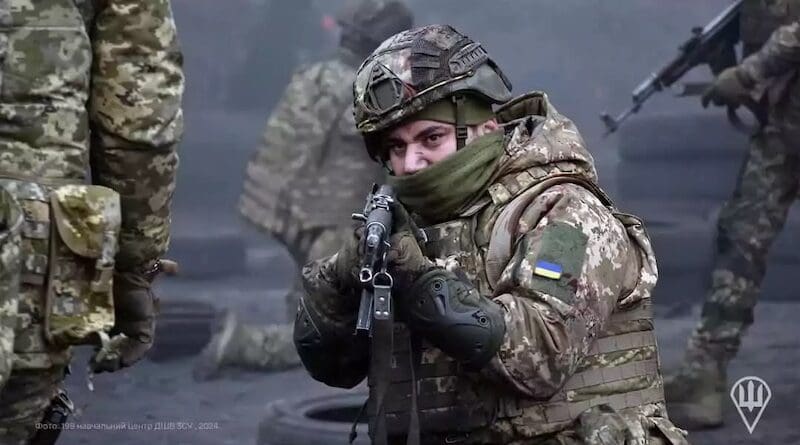
Ukrainian soldiers. Photo Credit: General Staff of Ukraine's Armed Forces


September 21, 2026

By Alan Callow

Key Takeaways:

Unproven at home. Texty alleged abuse in the 225th Assault Regiment; the commander denied “pits,” admitted one beating. Drapatyi ordered an inspection. Babel alleged mistreatment in the 425th “Skelya”; SBI and the ombudsman opened files. No verdicts yet.

Know-how abroad. RFI: 200-plus Ukrainians alleged training Libyan forces on drones. India arrested six Ukrainians and one American; NIA alleges Myanmar drone training and a civilian-aircraft strike. No public link to those units.

Who vets the trainers? Author: export of EW and drone skills needs a chain of command and a check on records—until then, allegations stay allegations.


Investigations into alleged abuses within Ukrainian assault units are raising questions about how servicemen accused of serious misconduct are vetted before being sent abroad to train foreign armed groups.

After more than four years of war, Ukraine has accumulated extensive battlefield experience — from drone warfare and electronic warfare to small-unit operations and rapid tactical adaptation. That expertise is increasingly attracting international interest.

But as Ukrainian military knowledge travels abroad, questions are also emerging over who is being entrusted with passing it on.

Ukrainian media have published investigations documenting allegations of beatings, unlawful detention, threats of execution and other forms of violence in at least two prominent assault units. Ukrainian authorities have responded with inspections and investigations into some of the allegations.

At the same time, reports have emerged of Ukrainian military specialists operating abroad.

In April, French public broadcaster RFI, in a report cited by Euronews, reported the presence of more than 200 Ukrainian military specialists in Libya and alleged that Ukrainian personnel were training Libyan forces in the use of drones. Ukraine and the Libyan government did not respond to RFI’s requests for comment, according to the report.

In Myanmar, meanwhile, Indian investigators have alleged that six Ukrainian nationals and one U.S. citizen arrested in India were linked to training involving drone warfare, drone assembly, operations and jamming technology for ethnic armed groups in Myanmar. The Indian National Investigation Agency later made further allegations concerning the group’s activities.

There is no evidence that every Ukrainian instructor operating abroad has been involved in wrongdoing. Nor is there publicly available evidence establishing that the Ukrainians detained in India belonged to any of the Ukrainian units currently under investigation.

But the reports raise a broader question: how thoroughly are personnel vetted before they are entrusted with sensitiv
e military technologies and combat experience for use by foreign armed forces?

The 225th Separate Assault Regiment

One of the most detailed investigations concerns Ukraine’s 225th Separate Assault Regiment.

On July 30, Ukrainian investigative outlet Texty published an investigation based on six months of reporting and interviews with dozens of current and former servicemen, personnel from attached units and relatives of missing soldiers. The investigation alleged beatings, improvised detention sites known as “pits”, threats of execution and other forms of violence.

According to Texty, at least six independent sources described the alleged use of what they called a “tree of truth”, where soldiers were allegedly tied to trees and beaten. The investigation also reported accounts of soldiers being held under guard between combat missions and published a photograph of an unidentified serviceman apparently handcuffed to a tree.

The regiment’s commander, Oleh Shyriaiev, denied the existence of “pits” and blocking detachments at the regiment’s base. He nevertheless acknowledged that at least one case of beating had occurred and said the servicemen involved had been removed from their positions and referred to the Military Law Enforcement Service.

On Aug. 4, Ukrainian Armed Forces Commander-in-Chief Mykhailo Drapatyi ordered the Military Law Enforcement Service to inspect the regiment following the investigation. The Armed Forces said allegations of unlawful orders and violence would be examined and that those responsible would be held accountable if the allegations were confirmed.

The allegations remain allegations unless established through an official investigation or court proceedings.

The 425th Separate Assault Regiment “Skelya”

Similar questions have emerged around the 425th Separate Assault Regiment “Skelya”.

In June, Ukrainian publication Babel published an investigation based on testimony from more than 30 people, including servicemen and relatives. It reported allegations of beatings and mistreatment at training facilities and examined a series of deaths among personnel undergoing training. One former serviceman interviewed by Babel described severe injuries that he said he sustained after escaping from the regiment.

The allegations prompted scrutiny from Ukrainian authorities, including a pre-trial investigation by the State Bureau of Investigation and a review by the Ukrainian ombudsman’s office, according to the reporting.

These cases make the question of how servicemen are selected for sensitive overseas missions more significant.

Ukraine Becomes an Exporter of Military Expertise


Ukraine is no longer only a recipient of foreign military assistance and expertise. The war has turned it into a source of military knowledge.

Ukrainian forces have accumulated extensive experience in the use of drones, electronic warfare and battlefield adaptation under conditions of intensive conflict. Tactics can evolve directly on the battlefield, and new techniques can be introduced far more rapidly than under peacetime conditions.

Reports about Ukrainian specialists operating in Libya and the allegations concerning Ukrainians detained in India suggest that this expertise may now be travelling well beyond Ukraine’s own battlefield.

That raises several questions.

Who selects these specialists? Are they active-duty servicemen? Are their backgrounds and service records vetted? Are commanders or foreign partners aware of allegations against them? And, when they operate outside Ukraine, are they subject to a clear military chain of command and oversight?

There is also a more fundamental question: who is accountable if a foreign armed group is trained by a person who later faces serious allegations of unlawful violence?


What Ukrainian Instructors Could Mean for Myanmar

The Myanmar case is particularly significant because of the role drones now play in the country’s fragmented conflict.

In March, Indian authorities arrested six Ukrainian nationals and one U.S. citizen. Indian investigators alleged that the group had entered Myanmar illegally through India’s northeastern state of Mizoram and had been involved in planned training for ethnic armed groups.

The National Investigation Agency later told a Delhi court that the seven foreigners were allegedly involved in drone-warfare training, including drone operations, assembly and jamming technology. In September, the NIA also alleged that the group was connected to ethnic armed organizations in Myanmar and said it had received information concerning the involvement of Ukrainian and U.S. nationals in a drone attack on a civilian aircraft in Myanmar. These remain allegations made in the course of an investigation.

Myanmar has been the scene of a complex armed conflict involving the military government, ethnic armed organizations and other resistance forces.

Drones have become increasingly important in that conflict. They allow relatively small armed groups to conduct reconnaissance and attacks at comparatively low cost.

Foreign training can therefore have consequences beyond the immediate instruction of individual fighters.

Knowledge of drone assembly, autonomous operation, electronic countermeasures and battlefield targeting can directly expand the capabilities of armed groups.

In Myanmar, that could be particularly consequential. Giving non-state armed organizations access to advanced drone expertise could expand their ability to conduct surveillance, coordinate attacks and strike targets that would previously have required substantially larger or more technologically sophisticated forces.

This does not mean that the presence of Ukrainian instructors is, by itself, a cause of escalation in Myanmar. But transferring modern battlefield expertise and technology in the middle of an ongoing civil war can affect the capabilities of the parties to the conflict and potentially change the character of warfare.

That is why the identity and professional background of foreign instructors matter.

If a person accused of torture or unlawful violence in one conflict is later given an opportunity to train fighters in another, the issue goes beyond individual responsibility. It raises questions about institutional vetting, oversight and accountability.
The Accountability Question

Serious allegations against Ukrainian servicemen require credible and comprehensive investigation. Until such investigations establish the facts, allegations should not be treated as proven.

But unresolved allegations take on additional significance when military personnel move between frontline units and overseas missions involving the training of foreign armed forces.

For Ukraine, exporting military expertise could become an increasingly important element of international cooperation. Experience in drone warfare, electronic warfare and battlefield adaptation is likely to remain in demand.

But military expertise also comes with responsibility for the people who transmit it.

If Ukrainian specialists are sent to countries such as Libya or Myanmar, recipients need confidence that those personnel have undergone appropriate vetting and operate within a clear system of command and oversight.

For Kyiv, the stakes are significant. Unresolved allegations of serious misconduct, combined with the movement of personnel between frontline roles and overseas training missions, could raise questions about Ukraine’s ability to present itself as a responsible military partner.

Myanmar illustrates the potential consequences particularly clearly. Advanced drone expertise provided to armed groups involved in a prolonged civil war could expand their capabilities and contribute to changes in the way the conflict is fought.

The central question, therefore, is not whether Ukraine should share the military expertise it has developed during the war. It is whether that expertise is being exported with adequate safeguards, vetting and accountability mechanisms.


About Alan Callow
Alan Callow was born in Japan, graduated from Western Mindanao State University (Philippines). He is a freelance journalist with experience in writing about the Asia Pacific region.
View all posts by Alan Callow →
How Drones, Mines, And Missiles Contained Russia’s Black Sea Fleet – Analysis


Screenshot of Ukrainian military video showing attack on the Russian Navy large landing ship, the Caesar Kunikov, in the Black Sea near Russia-occupied Crimea on February 14, 2024.

September 21, 2026

By Kayvan Amyot-Ariya

Key Takeaways:

Missiles first. After 2014 Ukraine had little navy. By Feb 2022 it had mines, coastal guns, and few Neptunes—no USVs until 29 Oct 2022. Early hits (Moskva, Saratov, Admiral Essen, Bekh) still pushed Russian ships off the northwest Black Sea and helped reopen Odessa before the July 2022 Grain deal.

USVs stretched range. Port raids at Sevastopol and Novorossiysk (from Nov 2022) did not empty the sea. Author: they plus July 2023 Kerch/Sevastopol strikes made grain inspections less tolerable; most of the fleet, including subs, moved to Novorossiysk by Oct 2023. Ships at berth were easier to find.

Not a safe fleet-in-being. CDS ship counts (Aug 2022–Apr 2025): Russia still massed for Kalibr salvos. Mines and missiles buy littoral denial; USVs buy some control effects—not a surface fight. July 2026 “shadow fleet” hits were mostly tankers. A port in USV range of an enemy coast is no longer automatically safe.


Introduction

Ukraine’s experience of sea denial in the Black Sea has highlighted the potential of Uncrewed Surface Vehicles (USVs) as the striking platform to support land-based systems. While anti-ship missiles and naval mines remain the centerpieces of littoral denial, USVs, particularly when operating in confined spaces, can expand the denial area, and lead long range strikes against fixed or slow moving targets, with potential ramifications for the strategic concept of the fleet-in-being, Corbett’s active inferior force based in the safety of a port. Although these land-based systems can only ever add costs to an adversary’s operations in an area, their joint use can have strategic effects, such as the reopening of Sea Lines of Communications (SLOCs).

Achieving Basic Denial


In 2019, in the aftermath of the 2014 Russian annexation of Crimea, which saw the loss of 75% of Ukraine’s naval personnel and 70% of its ships and infrastructure, the Naval Forces of the Armed Forces of Ukraine (Ukrainian Navy) published a strategy that relied on the concept of a “mosquito fleet.” The fleet would emphasize proactive asymmetric action by a small, modern, and agile force that would be cost-effective for short-range operations. Although the planned expansion until 2035 was not complete by the time war broke out in 2022, progress was made in the first phase of the strategy, which emphasized intelligence, surveillance, and reconnaissance (ISR) coverage of coastal environments, and basic sea denial investments such as coastal artillery and naval mines.

Therefore, when Russian forces declared a navigation prohibition zone on February 24, 2022, in the northwest Black Sea and the Sea of Azov, the Ukrainian Navy had no submarines, a minimal surface fleet, and a land-based system designed to prevent immediate amphibious landings. They thus began deploying mines to prevent coastal landings, but otherwise suffered heavy losses as most of their warships were either sunk, damaged, or scuttled, including the fleet’s flagship, the Hetman Sahaidachny.


The most potent land-based weapon in Ukraine’s arsenal, its Neptune anti-ship cruise missiles (ASCMs), were only available in short supply. Indeed, the Ukrainian Navy had only obtained its first Neptune’s in 2021, and had few in service at the war’s outset. Furthermore, although USVs are now ubiquitous with the war in the Black Sea, it is important to recall that these were not a factor for the first few months, only being developed over the summer of 2022, and being effectively used for the first time in the October 29, 2022 attack on the port of Sevastopol.

Regardless of these material shortcomings, the Ukrainian Navy successfully hit over a dozen boats and ships from February to October 2022, by relying on its prewar stockpiles and early allied donations. Although most of the sinkings used Uncrewed Aerial Vehicles (UAVs) to target small Raptor-Class patrol boats, several vessels of higher tonnage, including the famous cruiser Moskva, were damaged or sunk in this period by using anti-ship missiles or mines.

Even if it is possible that the Moskva was only sunk due to lack of Russian preparation, the effect of the strikes remains the same. In conjunction with missile strikes against the Saratov landing ship, the Admiral Essen Frigate, and later the Spasatel Vasiliy Bekh Rescue Tug, the Russian Navy was forced to operate its warships from a significant standoff distance, lest they be at high risk of attack by land-based ASCMs. These early successes also helped spur allied donations of Harpoon ASCMs in the following months, which only solidified Ukraine’s littoral defenses.

These effects forced the Russian Navy to reduce its resupply operations to Snake Island and led to the eventual withdrawal of the Russian garrison on July 30, which reopened Ukrainian SLOCs around Odessa. The easing of Russia’s blockade was formalized in this period by the signing of the Black Sea Grain initiative on July 22, months prior to the first USV strike.

The Advent of USVs

On October 29 in Sevastopol, and on November 18 in Novorossiysk, USVs proved their range and potential danger by attacking Russian ships at port. Although these attacks did not sink any ships, they did successfully hit several vessels, including the Admiral Makarov Frigate, which forced the Russian fleet to take additional defensive precautions.

The many limitations of USVs notwithstanding, they were an integral part of the expansion of the Ukrainian sea denial range. Some have even suggested that the shift in the naval balance that longer range USV strikes provided may have served as a reason for Ukraine’s strikes on Sevastopol and the Kerch bridge in July 2023, just days before the Grain Initiative was set to renew. Although the Grain Initiative had allowed Ukrainian ships to pass without being attacked, Russian ships were allowed to inspect, monitor, and delay Ukrainian commercial vessels, which was a hindrance that no longer needed to be tolerated. This would mean that the uncrewed platforms successfully extended the gains that anti-ship missiles had achieved, and protected the SLOCs to Odessa, in a similar manner to a degree of sea control.

The lethality of the Ukrainian Navy’s new long-distance strike capabilities was also a likely cause of the October 2023 transition of large parts of the Black Sea fleet from Sevastopol to Novorossiysk, including nearly all submarine operations. The known position of ships at port generally allowed USVs to strike at long ranges, as they did not require real-time targeting information or to waste fuel looking for targets. These realities would repeat themselves in 2025 and 2026 as the port of Novorossiysk itself became a recurring target of USVs.

Was the Russian Navy Truly Denied?

Mines, missiles, and uncrewed systems can hinder a fleet’s willingness to operate within an area but can not decisively face it in the same way a surface fleet would. Fundamentally, if a fleet enters an area within range of enemy ASCMs, knowing the risks and facing them regardless, has it been denied? Perhaps, it has. It has likely been forced to forgo many smaller operations due to cost-benefit analysis, and has only massed when necessary, and even then, at considerable risk. This is precisely the trend that can be observed in the graph below, mapping the number of Russian ships and boats at sea during a large part of the conflict.
The above graph was created by manually compiling the Daily Reports by the Centre for Defence Strategies such as this one, and tracking the number of ships mentioned in the Black Sea and Sea of Azov. The assembled dataset covers August 2022 to April 2025. The graph tracks ships and boats, as patrol boats are frequently sighted as part of the ships on duty, particularly in the early stages of the war.

The primary take-away from the graph appears to be that although Ukrainian denial expanded and generally reduced Russia’s seagoing presence, the Russian Navy maintained the ability to mobilize its fleet when needed and fire its own massed sea-launched Kalibr missile salvos, as it did in November and December 2024. Therefore, it is important to remember that a fleet that has restricted its operations at sea due to increased threats in a denial environment, nonetheless often retains the ability to mass if it accepts the risk.

Moreover, the safety of Ukrainian SLOCs to Odessa can easily be overstated. Despite the increased distance at which the Russian Navy is compelled to operate, it can still target Ukrainian shipping at a distance if it so chooses, and its very presence imposes additional costs on Ukrainian commerce. Nonetheless, the object of denial is to dissuade operations within an area and not the sinking of enemy ships nor the safe escort of commercial vessels. The former being achieved by mines and missiles, and the later, partially so by USVs, the Ukrainian denial experience can serve as a reference for similar confined sea denial planning, such as in the North Sea.

Implications of Active Land-Based Denial at Range

As has been discussed, the Ukrainian Navy has been able to execute long-range USV attacks, especially against ships at port. Its land-based ASCMs successfully pushed back warship operations to a standoff distance of around 100 km and its USVs increasingly targeted its fleet at port. The maps below show the approximate location of hits on Russian ships with over 1,000 full displacement tons and tell the story of these movements, and the precarious position of the fleet at Novorossiysk


The above maps show an estimated location of Russian ships when damaged or destroyed by using an amalgamation of Black Sea News’ database of Russian Losses, Hi Sutton’s Timeline of the Ukraine Invasion at Sea, and various news outlets overlaid over Google Earth screen shots. The ships sailing registered as having been hit, and those which are depicted as sinking are registered as destroyed. A square around the ship represents it as having been at port when struck.

The final map reflects strikes recorded through May 2026; it does not yet incorporate the early July 2026 coordinated strikes against the Russian Shadow Fleet, which were directed at auxiliary and commercial vessels rather than combatants and would not materially alter the pattern depicted.

The trends from these maps can be understood quite clearly. In 2022, the Admiral Essen was struck operating outside Odessa, and the Moskva and Vasily Bekh were hit off Snake Island. These were large ships hit by missile when operating near Ukrainian ISR networks. In 2023, the Russian fleet stopped operating as frequently in the Sea of Azov and pulled back its ships in the Black Sea to a standoff distance. Nonetheless, USVs led attacks against ships at port in Sevastopol, Feodosia, Novorossiysk and even struck the Askold while in preparing for her maiden voyage out of Zaliv Shipyard. It also successfully struck several vessels on the approaches to Sevastopol with Naval mines, damaging three ships. The trend of long-range strikes against ships immobile at or near port continued through to 2026 and highlights the difficulties of defending stationary ships against long-range USV attacks.

The intriguing exception is the 2023 USV hit against the Russian Intelligence ship Ivan Khurs(marked), which was operating in the open sea 400 km away from any Ukrainian coastline. The Russian ship was supposedly monitoring the Turkish Stream pipelines in the area, although, as highlighted by Tayfun Ozberk, it did not have the capacity to defend the pipeline as an intelligence ship and the excessively long-range of the strike remains puzzling. However, it is possible that if the ship truly was operating in the same area to monitor something, whether it be the Turkish Stream pipelines or otherwise, then it may have been operating in a relatively small area for several days in a row, and so potentially making it easier to estimate its position ahead of a USV strike.

The impact of long-range USV strikes are significant. In traditional naval doctrine, the maintenance of a fleet-in-being at port was said to have strategic consequences by tying up enemy forces to monitor it in case the fleet left. This relied heavily on the idea that ships were safe from attack at port, a notion that has not held true for Russian forces in the Black Sea. Indeed, they have been under so much pressure, despite moving their fleet to Novorossiysk that some have suggested the possibility of a withdrawal to the Caspian Sea, which would represent a total withdrawal from the theater, and a tacit acknowledgement that the Black Sea Fleet’s operations would have become a liability rather than net benefit.

Although the figure does not consider the early July 2026 Ukrainian coordinated strikes on the Russian Shadow Fleet, the drawn conclusions remain unchanged. The strikes, which were largely conducted against oil tankers and other non-warships, highlight the effectiveness of high endurance UAVs at hitting moving targets at sea.

Furthermore, the large number of strikes by UAVs, but the absence of sinkings against these large vessels supports the claim that UAVs are primarily effective at destroying small boats, distracting the defences of larger warships, and imposing a cost on other ships operating in the denied space by forcing them to accept a certain risk of damage.

That is not to say that all fleets at port are equally vulnerable, but ports within USV range of an adversary’s coast may increasingly find themselves in a riskier position than in previous conflicts.

Conclusion

Altogether, denial based on land and augmented by USVs can effectively attrite an adversarial force over time and reduce its activities in a contested sea. However, it can not fully prevent it from going to sea and launching sea-launched missile salvoes if it chooses to accept the threat.

As the war in the Black Sea has shown, coastal denial, and the immediate protection of littoral commerce can be achieved by land-based ASCMs in conjunction with naval mines. USVs, having only joined the conflict after immediate denial had been secured, were able to grow the range of Ukraine’s denial system and increasingly act offensively to grant Ukraine some of the benefits of sea control.

The vessels struck by these USVs were primarily at port, and the continued success of strikes against ships at port has had strategic implications for Russia’s dispositions, first forcing the fleet’s move from Sevastopol to Novorossiysk, and now a potential complete withdrawal to the Caspian Sea.


About Kayvan Amyot-Ariya

Kayvan Amyot-Ariya is a Strategic Studies student at Concordia University, focusing on maritime security and naval warfare, and has appeared in the Maritime Operations Center (Center for Maritime Strategy). His current primary interest is the tracking and analysis of open-source data on the Russo-Ukrainian War, with a focus on Black Sea naval losses and strike patterns.
View all posts by Kayvan Amyot-Ariya →
Russia’s Starlink Rival Faces Problems In Orbit And Threats On The Ground – Analysis


September 21, 2026

By RFE RL

By Yauhen Lehalau, Valentin Baryshnikov and Ivan Gutterman


Russia is building its own version of Starlink — Elon Musk’s constellation of satellites in low-earth orbit that can provide fast Internet access anywhere in the world.

Until earlier this year, Ukraine and Russia used Starlink for command-and-control on the ground, as well as for piloting explosive-laden drones to their targets hundreds of kilometers away.

In February, Starlink cut off access for terminals in Ukraine, except for a whitelist approved by Ukraine’s Defense Ministry. Russia’s battlefield performance suffered immediately; the number of assaults launched by Moscow’s forces declined, and a Pentagon report linked Russia’s loss of satellite communications to Ukraine recapturing hundreds of square kilometers of territory earlier this year.


A prominent pro-invasion Telegram channel said the loss of Starlink “sets communications and battlefield command-and-control in the Russian Armed Forces back a couple of years, to old technologies many had already forgotten about: wired Internet, Wi-Fi, and radio communications.”

Most traditional military communications systems are designed primarily for voice, says Jakub Janovsky, an analyst at Oryx, an outfit that tracks military equipment losses. This makes them ill-suited for the modern battlefield, where large volumes of data, such as video feeds from drones, need to be exchanged constantly. “That is precisely why Starlink and similar systems are virtually indispensable for the military,” Janovsky told RFE/RL.


How Do Satellite Communications Work, And Why Isn’t Russia’s Current Constellation Enough?

The higher a satellite is in orbit, the more area it can cover on the ground. The trade-off is latency: the amount of time it takes the data to travel from a device on the ground to the satellite and vice-versa. For a satellite beaming a movie down to a dish connected to a television, this doesn’t matter, but for a drone operator making decisions in real time, a slow connection could mean missing a target.

To ensure low latencies, satellites providing fast Internet communications fly relatively low, with much of Russia’s Rassvet-3 constellation, developed by Russian aerospace company Bureau 1440, currently in orbit at approximately 500 kilometers above the Earth, although their planned altitude is 800 kilometers. Meanwhile, television satellites are often in geostationary orbit — meaning they stay fixed above the same point on Earth as it spins — at around 36,000 kilometers from the surface.

Lower-flying satellites, on the other hand, don’t match the speed of the Earth’s rotation and don’t stay fixed above the same point on the ground. This means any single satellite can only provide a short window of connectivity above a given area as it flies by. For the constellation to provide constant communications, it needs to have enough satellites so that one or more are always above that point.

That means the existing constellation is enough to provide only limited windows of communication to Russia’s forces in Ukraine. Rassvet terminals have not been found on Russian drones or missiles as of yet.
Moscow, We Have A Problem

Bureau 1440 launched its first three satellites, Rassvet-1, in June 2023, successfully testing them in space.

The next batch, three Rassvet-2 satellites, were launched in May 2024 and immediately reached their target altitude of 800 kilometers, successfully testing transmitting data between one another and to Earth.


Things haven’t gone as smoothly for the first batches of Rassvet-3 satellites, which are no longer test versions. An initial launch of 16 was planned for 2025, but this was delayed until March this year. After being delivered to an altitude of about 300 kilometers by a rocket, the craft were meant to use their own power to climb to 800 kilometers.

None of them have reached this level so far: one started to descend and burned up in the atmosphere, 13 are in orbit at 510 kilometers and two are at approximately 360 kilometers.

Some analysts believe Bureau 1440 decided to keep the satellites permanently at a lower altitude than originally planned due to problems with their engines. While this is likely to somewhat affect the area each satellite can effectively cover, it does not mean they are not fit for purpose: Starlink has also lowered the orbital altitudes of many of its satellites over time.

The second, latest group of 16 was launched in July and faces similar issues: 13 of them are rising at similar rates to the first group, but three have fallen to altitudes of 300 or less kilometers and may not end up being operational.

While losing a certain percentage of satellites is normal, with early Starlink prototypes reportedly suffering failure rates of up to 13 percent, space expert Anatoly Zak believes the level of failures experienced by Rassvet is “very painful” and “probably close to unacceptable.” The satellites from the second launch that are ascending are doing so “rather chaotically” at different speeds, with some moving in an orderly chain that others did not join.

Grand Plans, Tight Deadlines

Bureau 1440 has filed two potential plans with the International Telecommunication Union (ITU), the UN agency that coordinates the use of radio frequencies and satellite orbits.

According to one, it would have 292 satellites in orbit at an altitude of 800 kilometers, while the other plan would see a total of 1,350 Rassvet satellites flying at an altitude of 600 kilometers.

Zak says the company is not likely to be able to meet its target of 292 satellites by the end of 2027, the figure most often cited by Russian officials, and that setting unrealistic deadlines is a common practice in the Russian space industry.

According to Janovsky, in the most optimistic case the company might have enough satellites to provide nonstop communications over Ukraine by 2028, but delays may mean it takes until 2030.

An Even Bigger Problem?

Ground terminals may be an even bigger problem.

SpaceX has produced and sold millions of Starlink terminals, while Russia’s Rassvet system is due to begin commercial operations in 2027 and there is still no public evidence of large-scale terminal production.

Analysts argue that terminals could become a key bottleneck. Their phased-array antennas are expensive and Russia lacks the necessary component base, meaning some parts may have to come from China.

Because Rassvet satellites are less densely deployed and operate farther away from Earth than Starlink satellites, its terminals may also need to be larger, heavier, and more powerful, making them less suitable for drones and harder to supply in the large numbers the Russian military would require.

A New Target For Ukraine

A fully deployed constellation will require its own ground-control infrastructure.

Ukraine has repeatedly struck Russia’s Dubna satellite communications center outside Moscow, and in August Ukrainian drones headed toward the Plesetsk cosmodrome before a planned launch. According to Zak, Plesetsk had previously been targeted around other launches, including the March launch of the first batch of Rassvet-3 satellites. Ukraine has also hit the Progress Rocket and Space Center, a plant involved in producing the Soyuz rockets that have carried Rassvet satellites into orbit.

The satellites themselves also depend on a sprawling industrial supply chain, and some critical components may come from only a small number of producers. Zak points to Kaliningrad-based OKB Fakel, a manufacturer of spacecraft propulsion systems, as one likely supplier of engines needed to maneuver satellites and keep them in their intended orbits. Russia has been expanding production of spacecraft engines at the plant.

That leaves Russia with a challenge extending far beyond getting enough satellites into space. Rassvet will also need to launch vehicles, ground stations, terminals, specialized components and factories capable of producing them at scale — a chain in which disruption at a relatively small number of points could slow the expansion of the constellation.

Destroying the facilities where the satellites themselves are assembled would also be technically possible, Janovsky says. Russia could respond by moving production farther beyond the reach of Ukrainian drones, he adds, but establishing new production lines would take time.

In a war in which access to Starlink has already shown how quickly satellite communications can affect the battlefield, the race to build Russia’s alternative may increasingly be fought on the ground as well as in orbit.


This story was adapted from the original article in Russian by Ivan Gutterman, Yauhen Lehalau is a correspondent for RFE/RL’s Russian Service.

Valentin Baryshnikov is a correspondent for RFE/RL’s Russian Service in Moscow.
Ivan Gutterman is a data journalist for RFE/RL’s Central Newsroom in Prague.

About RFE RL
RFE/RL journalists report the news in 21 countries where a free press is banned by the government or not fully established.
View all posts by RFE RL →