Saturday, August 08, 2026


Pentagon war game exposed a critical US aluminum risk months before Iran attacks
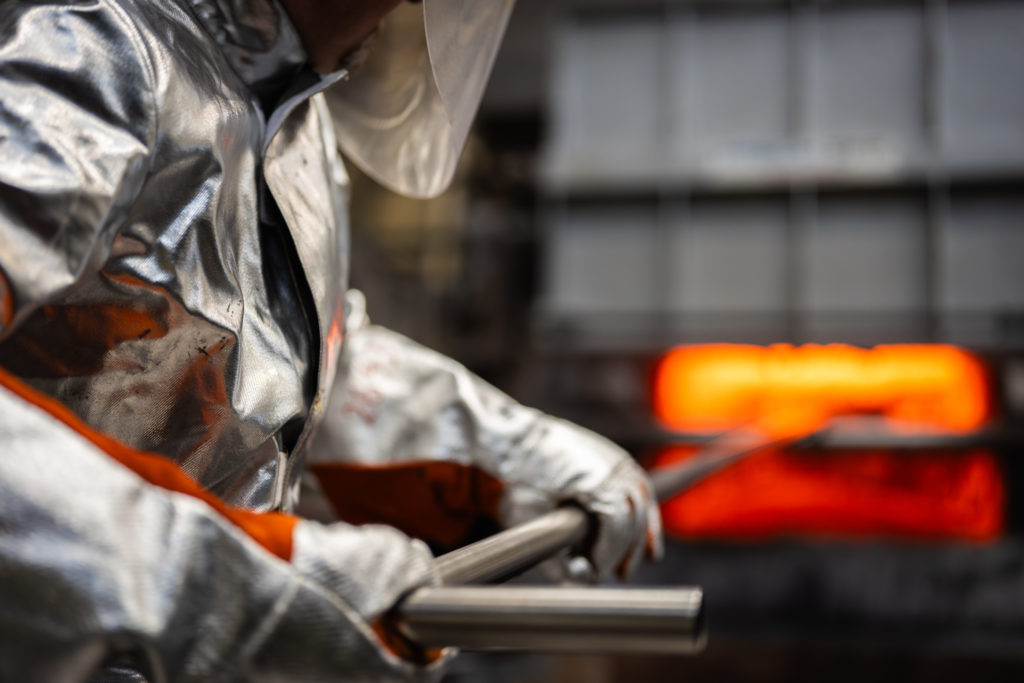
Aluminum smelter. Stock image.

Last summer, about 80 government officials and industry executives gathered in Washington to answer a key question: How would the US aluminum supply chain hold up in the event of a major global conflict?

The answer: potentially not well. That’s according to an analysis of the war simulation exercise, the details of which have not previously been reported. High-purity aluminum — an ultra-refined form used by the military for fighter jets and armored vehicles — emerged as a critical vulnerability. The metal is a niche, specialty material that accounts for a small share of the overall market but is crucial for defense and the aerospace industry.

The report noted that while China is the world’s dominant aluminum producer, the United Arab Emirates is a crucial supplier of the high-purity variety to the US. It provides about 90% of American imports of that metal, according to people with direct knowledge of the matter. Any hostilities that disrupt UAE aluminum production, then, threaten deliveries to the US. The report didn’t go into detail about how US aluminum supply would fare overall. 

Seven months after the Pentagon war game, the US attacked Iran. Iranian drone strikes damaged major plants in the UAE and Bahrain in March, driving prices for the metal to a four-year high. While the UAE facility has since restarted, it will take months to return to full capacity. The closure of the Strait of Hormuz, meanwhile, has made it harder to get aluminum shipments to global buyers.

War-driven bottlenecks are amplifying concern that years of falling US aluminum production have eroded vital supply chains, putting them at risk despite the Trump administration’s tariffs and other efforts to rebuild domestic manufacturing.

The Iran war has laid bare a key weakness in the US defense industrial base: America effectively no longer makes high-purity aluminum. The nation’s sole large-scale producer shut down in 2022 because of soaring energy costs, leaving the government dependent on foreign suppliers.

That reliance on imports comes at an inopportune moment. The US military is racing to replenish high-purity aluminum stockpiles after months of war, while a global surge in defense spending is intensifying competition for the materials that underpin modern weapons production.

The attacks on Persian Gulf aluminum producers show that facilities essential to Defense Department logistics are increasingly at risk of targeted strikes, according to Bill Greenwalt, a senior fellow at the American Enterprise Institute.

“It’s a huge wake-up call for the department to be looking at supply chains in all areas around the world to ensure that they’re not especially vulnerable to attack or sabotage,” said Greenwalt, who served as Deputy Undersecretary of Defense for industrial policy during the George W. Bush administration.

Companies that sell high-purity aluminum for US military use are rushing to pin down supply as the Iran war boosts defense spending. The ultra-refined metal has exceptionally low iron and silicon content, which means it can be used to produce alloys engineered for the strength and durability that’s required for fighter jets buffeted by extreme aerodynamic forces. 

While the high-purity aluminum market is not in a true shortage, it remains tight and it’s unclear how much metal these suppliers can secure, according to people familiar with the matter.

High-purity aluminum trades about 5 to 10 cents a pound above the so-called US Midwest premium, industry consultant Greg Wittbecker said. The Midwest premium, or the surcharge added to global price benchmarks to deliver aluminum to that region, surged in June to record highs in data going back to 2003 as the Iran war roiled supply, though prices have since pared some gains.

Regular suppliers of high-purity metal include Tennessee-based Kaiser Aluminum Corp., France’s Constellium SE and Apollo Global Management’s Arconic Corp., according to one trader. The companies are the top three providers of the ultra-refined metal to defense contractors including Lockheed Martin Corp. and Boeing Co. 

A spokesperson for Kaiser declined to comment. Spokespeople for the Defense Department, Constellium and Arconic didn’t immediately respond to requests  for comment. 

Much of the supply is likely to come from Emirates Global Aluminium PJSC. It’s the dominant supplier to the US, providing about 75,000 to 85,000 metric tons of high-purity aluminum per year for military needs, according to a person with direct knowledge of the matter. Whether the three manufacturers can obtain enough material now hinges on uninterrupted shipments from the Middle East and how fast EGA’s damaged plant can restart, they added. Aluminum stockpiles held by EGA in the US are running low, they said.

A spokesperson for EGA declined to comment.

“This is a very specific type of aluminum product that is very much business to business, so it’s not something that you can go and pick up from a distributor,” Uday Patel, senior research manager for global aluminum markets at Wood Mackenzie, said in an interview. “We’re in a situation where there is no solution. Much will depend on how much stocks are in the pipeline.”

‘Large-scale combat’

The Pentagon war game unfolded over two days in July of last year, according to a report from the nonprofit Institute for Defense Analyses, which oversaw the exercise. 

The government officials and executives gathered were presented with a task: Increase the capacity of the US aluminum industry before and after a “major large-scale combat operation” that would curtail imports in 2027. A second event, such as a cyberattack leading to the loss of a smelter, would occur at the same time.

The participants were given cards representing actions they could take, like enforcing a “Buy American” rule, along with the estimated cost. They had to stick to specific budget scenarios ranging from $12 billion to $1 billion. Using wall charts, they wrote down their actions on sticky notes placed along a timeline.  

At the end of the exercise, the participants made a series of recommendations for government agencies and policymakers. They advised amassing a domestic stockpile of high-purity aluminum and related products, as well as expanding US production of the metal and investing in new equipment. They also suggested improving access to low-cost, reliable power sources, which they said could be done by reopening old coal-fired plants or opening new nuclear reactors and natural gas generators.

The war game was part of a broader effort to identify strategic dependencies. That’s an area where Washington has made far more progress diagnosing the problem than fixing it, according to Michael O’Hanlon, the Philip H. Knight Chair in defense and strategy at the Brookings Institution, a Washington think tank.

The Pentagon frequently lacks information about subcontractors who are multiple steps removed from prime Defense Department contractors like Lockheed Martin, meaning dependencies become fully apparent only after a disruption occurs, according to O’Hanlon. Though the president can invoke the Defense Production Act — a federal law that grants emergency powers to control domestic industries — to prioritize the use of aluminum for the military, that would mean less supply for civilian consumption.

“If you start prioritizing for the military, then you’re going to deprioritize for somebody else,” O’Hanlon said.

As part of an effort led by Deputy Secretary of Defense Stephen Feinberg, the Pentagon has been working to gain better visibility into its supply chain, including for sub-tier suppliers many rungs below the primary contractors.

Treasury Secretary Scott Bessent in late June called for assessing supply-chain vulnerabilities across various industries and expanding domestic capacity to ensure the US is never at the mercy of foreign chokepoints.

The Defense Department’s war game “makes clear that America’s military readiness is inseparable from America’s industrial readiness,” Charles Johnson, chief executive officer of the Aluminum Association industry group, said in an emailed statement. 

Johnson said the Aluminum Association is urging the Senate to advance the provisions in the House-passed National Defense Authorization Act that would strengthen the US domestic aluminum supply chain. The legislation would direct the Defense Department to submit a report to Congress on the supply chain, including an analysis of opportunities to increase aluminum production in the US.

Falling short

US policy efforts have so far fallen short, however.

In the clearest acknowledgment yet that President Donald Trump 50% tariffs on foreign aluminum haven’t boosted domestic manufacturing as intended, his administration recently unveiled an incentive program aimed at bringing aluminum smelting back to the US. The plan offers to halve duties on imports of the metal for companies building domestic plants.

Despite “the benefits from the aluminum tariff regime, the domestic production and supply of primary aluminum, which is critical to the US economy and defense industrial base, is still in insufficient supply,” according to a White House proclamation. 

Trump’s tariffs have also hindered domestic stockpiling of aluminum. That’s because they’ve helped drive up US prices, forcing manufacturers to buy only what they need as costs rise. 

The Pentagon’s Defense Logistics Agency has sought to procure high-purity aluminum on its own. Last year, it put out a tender seeking a contractor to provide the metal, with a stringent requirement: The material had to come from a US supplier. That’s a common provision in Defense Department contracts.

The agency later withdrew the tender without explanation. While Arconic makes the ultra-refined metal at its plant in Davenport, Iowa, the facility uses feedstock that’s partly imported. And the output is on a small scale and is only for the company’s internal consumption.

Artificial intelligence is a growing threat to US aluminum manufacturing, albeit an indirect one. Aluminum production, among the most energy-intensive industries, is struggling to compete with power-hungry data centers for cheap electricity. 

Before it was shut in 2022 due to high energy costs, Century Aluminum Co.’s Hawesville, Kentucky, smelter was identified by the Commerce Department as the only high-purity aluminum producer in the US to meet military demand. Century Aluminum sold the site earlier this year to TeraWulf Inc., a company that plans to build a data center there for AI behemoth Anthropic.

The US military can still get the high-purity aluminum it needs if it’s willing to pay a higher price, according to Eugene Gholz, an associate professor of political science at the University of Notre Dame. The metal can be produced elsewhere, although at elevated cost or with delays, he said. 

“If the government really wants the high-purity aluminum, they’re going to get it,” said Gholz, who served as senior adviser to the Deputy Assistant Secretary of Defense for Manufacturing and Industrial Base Policy from 2010 to 2012.

Still, supply-chain adjustment is neither immediate nor inexpensive. New production can take years to develop, especially in defense industries where permitting and investment are lengthy processes. That will remain a challenge for the US as it seeks to diversify its sources of high-purity aluminum and other critical materials, according to Jerry McGinn, director of the Center for the Industrial Base at the Center for Strategic and International Studies in Washington.

“These markets migrated out of the U.S. in the ’80s and ’90s because of market forces,” McGinn said. “Bringing them back is a hard thing to do.”

(By Yvonne Yue Li)


Glencore’s energy trading profits soar on Iran war 


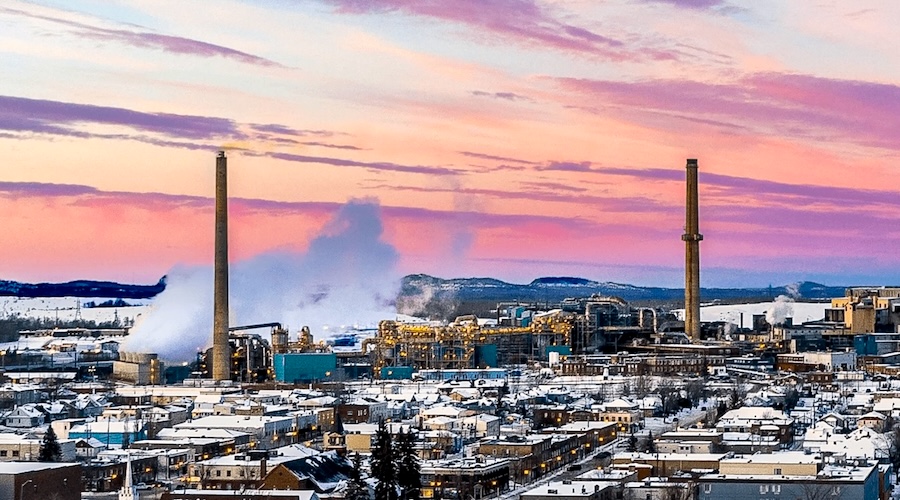
A view of the Horne smelter. (Image courtesy of Glencore Canada.)

Glencore (LON: GLEN) earned 66 times more from energy trading in the first half of 2026 than it did a year earlier, joining other major commodity traders profiting from market turmoil created by the Iran war.

Glencore booked $2.66 billion in first-half adjusted earnings before interest and taxes (EBIT) from trading on Wednesday, up from just $40 million a year earlier.

U.S. President Donald Trump on Monday accused oil majors ExxonMobil XOM.N and Chevron CVX.N of making “too much money” with high gasoline prices a risk for his Republican Party as it seeks to retain control of Congress in November midterm elections.

Glencore joins the trading desks of European oil majors BP BP.L, Shell SHEL.L, TotalEnergies TTEF.PA and rival trading house Trafigura in reaping billions in profits this year.

Trafigura reported $4.1 billion in net profit for the six months through March. 

Crude, fuel and LNG prices hit all-time record or multi-year highs earlier this year as the Iran war effectively halted tanker traffic leaving the Gulf.

“The Oil and Gas department was the primary contributor, which benefited from significant dislocations across LNG, oil and shipping markets,” Glencore CEO Gary Nagle said.

Its first-half results put it on track to rebound from three straight years of lower earnings from energy marketing.

Its trading volumes surged to around 5.2 million barrels per day of crude and fuels, about 24% more than its 2025 average, Glencore’s results showed on Wednesday.

Looking ahead to the second half, Glencore said that significant inventory drawdowns had left oil markets increasingly sensitive to disruptions.

Glencore shares were up 3.4% at 1130 GMT.

(Reporting by Robert Harvey; editing by Jason Neely)

Sasol’s wartime windfall revives debate over coal’s future


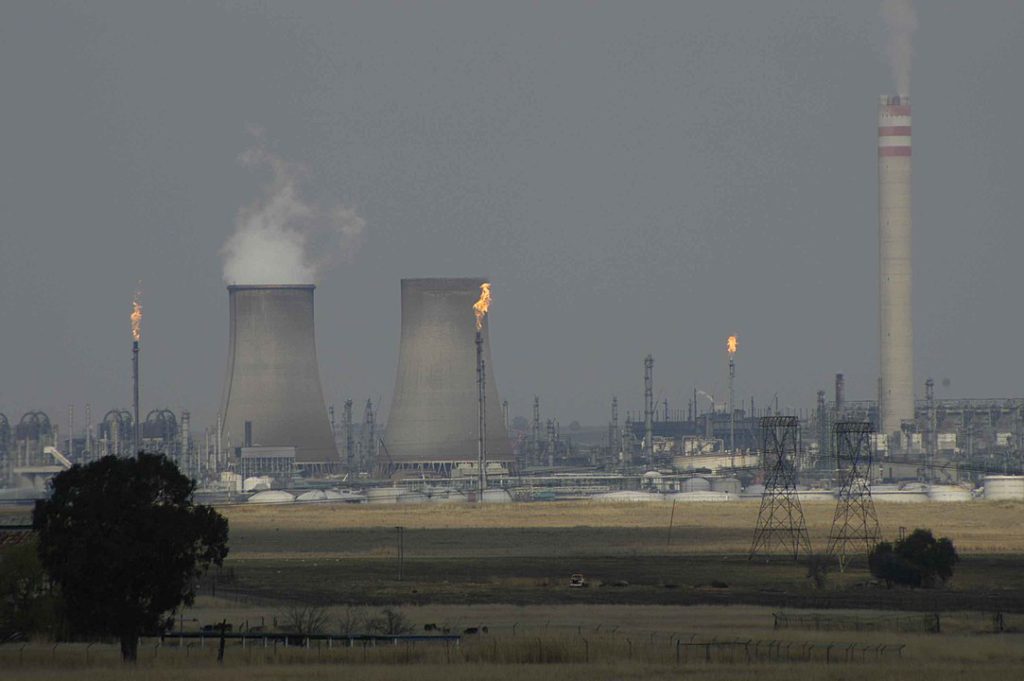
Sasol’s Secunda synthetic fuel plant. Credit: Wikipedia

Sasol Ltd., the world’s largest producer of fuel from coal, is reaping the benefits of a surge in fuel prices due to the Iran war, while helping shield its home market of South Africa from the resulting supply shock.

Chief Executive Officer Simon Baloyi has increased his focus on coal-to-liquids fuel output, along with production from its crude refinery, at an opportune time.

“Sasol continues to play a very key and meaningful role into what I will call the national security of the country,” Baloyi said in an interview in Bloomberg Johannesburg office on Tuesday. The company needs to preserve the Fischer-Tropsch process technology “to make sure that we can produce the required critical chemicals during a time like this,” he said.

The company expects to report earnings before interest, taxes, depreciation and amortization of as much as 62 billion rand ($3.8 billion) in the year ended June 30, Sasol said in a filing on Wednesday. That compares with 52 billion rand in the same period a year earlier.

Sasol’s coal-to-liquids technology makes it one of South Africa’s largest greenhouse gas emitters, putting it at odds with environmental groups. Investors, however, are weighing the long-term sustainability of the business against its plan to cut emissions 30% by 2030. 

Under Baloyi, the company has doubled down on its synthetic-fuels operations while seeking to lower carbon intensity by maximizing production, reducing coal used for power generation and increasing its use of renewable energy.

Sasol has built about 500 megawatts of renewable-energy capacity, secured more than twice that amount, and plans to procure 2,000 megawatts over time. The company is also pursuing carbon-offset projects, Baloyi said.

At the same time, the company’s Secunda hub increased production to the highest in five years, according to a business update last month, helping South Africa plug a gap left by fuel imports from the Middle East that are stuck in the Strait of Hormuz, along with imported oil products from the US.

South Africa’s refining sector shrank by about half in the years before the war due to under-investment and accidents that closed plants. That’s left Sasol with nearly two-thirds of operational fuel-making capacity in the country. A unit of Glencore Plc owns the only other working refinery. 

Sasol was left with buying all the crude to run the 108,000 barrel-a-day Natref refinery after then-partner Prax Group went into business administration last year.

“We were fortunate because we can run all of it ourselves while refinery margins are extremely high,” Baloyi said, adding that full ownership of a refinery isn’t always beneficial. “In some instances it can be a bad thing.”

Prax’s stake is being sold in a process that is expected to conclude by the end of the year, he said.  

With the war pushing oil prices beyond $100 a barrel, Sasol’s been realizing a healthy profit considering its $50 breakeven level. The conflict has also taken a toll, however. Operations at the Oryx gas-to-liquids plant in the Persian Gulf that it owns with QatarEnergy were first halted days after the start of the conflict.

Production almost resumed at one point, Baloyi said. “We were busy with startup activities, then the war flared up, then we shut down,” he said. 


Mosaic phosphate pains highlight Hormuz fertilizer disruption


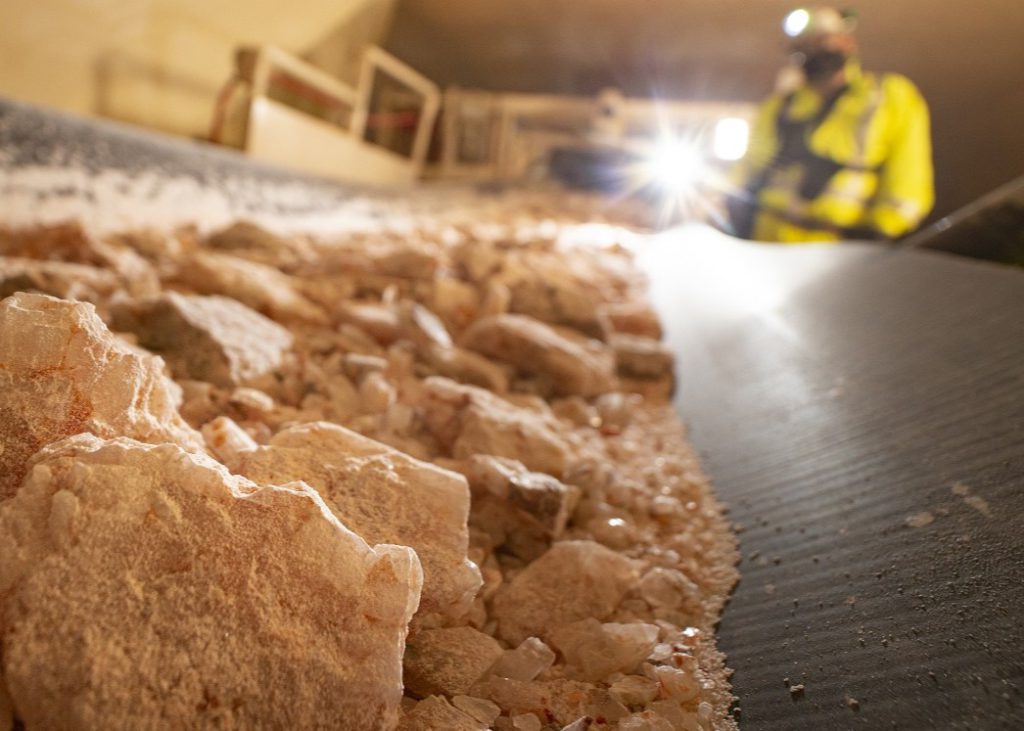
Image: Mosaic

Mosaic Co.’s pullbacks in fertilizer production haven’t been enough to alleviate the impact of surging input costs from the war in Iran.

Skyrocketing prices for the sulfur required for phosphate fertilizer production caused a swing to a net loss for the Tampa-based company’s second quarter, from a year-earlier profit. Mosaic is the US’s largest phosphate producer, and nearly half of the world’s sulfur trade is linked to countries exposed to disruptions in the Strait of Hormuz.

“The ongoing Strait of Hormuz closure and the more recent Kazakhstan blockade continue to impact the global flow of sulfur, and spot prices remain unsustainably high,” Chief Executive Officer Bruce Bodine said on a call with analysts. “We have curtailed production in the US and Brazil simply because phosphate industry economics cannot accommodate current sulfur prices.”

The company’s plant in Faustina, Louisiana, remains completely idled, while its Bartow, Florida, facility is running at 40% of its targeted annual operating rate, the company said. The producer earlier this year also took about a million tons of phosphate production offline in Brazil, and pulled back further in July.

Mosaic, along with other North American fertilizer producers, has faced headwinds as inflation-pressed farmers defer the use of key crop nutrients. But peers Nutrien Ltd. and CF Industries Holdings Inc. have fared better as they produce more nitrogen fertilizers, which do not require sulfur, and last quarter reported a windfall as prices spiked.

Those soaring fertilizer prices have prompted the Trump administration to ramp up antitrust scrutiny of the industry. The White House also in June suspended duties on Moroccan phosphate for eight months or until the declared emergency over fertilizer availability ends, in a bid to address affordability for farmers. Those levies had been issued about five years ago following a petition from Mosaic.

The suspension has not yet impacted US phosphate prices, and elevated prices elsewhere in the world create “little incentive for producers to send fertilizer to the US,” Bodine said. He added that the company is “confident” the duties should continue once the suspension ends. 

Mosaic posted a $104 million operating loss in its phosphate segment. That compares to an $8 million loss a year earlier. Sulfur costs in the second quarter averaged $522 per long ton, up from $379 in the first quarter. Those prices are set to rise further, as Mosaic settled third-quarter contracts for the input at $705 per long ton.

New Orleans spot diammonium phosphate prices are at the highest levels in about a year, according to data from Bloomberg Green Markets as of July 31.

(By Ilena Peng)

AU

Ariana Resources targets 2028 gold production from rare Zimbabwe greenfield mine


(Image courtesy of Ariana Resources.)

London-listed Ariana Resources expects to start producing gold from its greenfield project in Zimbabwe in 2028, the company’s managing director Kerim Sener said on Thursday.

Ariana’s Dokwe project, about 110 kilometres (68 miles) north-west of Zimbabwe’s second-largest city Bulawayo, is the first large-scale greenfield project in the country in decades. 

The southern African country has a long history of gold production, but has struggled to attract significant investment since international mining firms including Rio Tinto, Delta Gold and Kinross exited the country more than two decades ago amid a political and economic crisis.

A handful of mid-tier miners and a host of small-scale operators lifted Zimbabwe’s annual gold production to 46.7 metric tons in 2025 from a low of 3 tons in 2008, mostly by reviving and expanding old mines.

The country’s top miners include the foreign-listed Caledonia Mining Corporation and Namib Minerals , state-backed Mutapa Gold Resources and a unit of the locally owned Padenga. 

With Dokwe’s 1.13 million ounces of reserves, Ariana forecasts open pit mine output to peak at 100,000 ounces per year over a 20-year project lifespan, according to a pre-feasibility study.

A definitive feasibility study is expected to be completed in the first quarter of 2027.

“With a fair wind, I’d like to think that we’re pouring our first gold in 2028,” Sener told Reuters.

Ariana finds the Dokwe greenfield deposit’s qualities compelling, he said, bucking the established trend of acquiring brownfield assets.

“Dokwe represented an opportunity to tackle what is the largest undeveloped gold deposit in Zimbabwe at the present time,” Sener said.

“The other thing is the metallurgy. It looks to be fairly straightforward, a large part of the gold is amenable to gravity recovery,” he added.

Sener said there was an ongoing shift in foreign investor sentiment towards Zimbabwe under the administration of President Emmerson Mnangagwa, who took over from long-time leader Robert Mugabe after a 2017 coup.

(Reporting by Nelson Banya, Editing by Kirsten Donovan)

LBMA suspends Shandong Gold refinery over US labour list


(Stock image by pla2na.)

Shandong Gold Smelting Co. Ltd has been suspended from the London Bullion Market Association’s Gold and Silver Good Delivery Lists after the refiner was added to a US forced labour blacklist.

The suspension takes effect Aug. 5 and follows Shandong Gold Smelting’s inclusion on the US Uyghur Forced Labor Prevention Act (UFLPA) Entity List. The London-based body, which oversees the Good Delivery accreditation system for precious metals refiners, said it has launched an incident review process and that the suspension is an interim measure pending the outcome.

“LBMA remains focused on a transparent and rigorous approach and will advise of further updates in due course,” the association said. It added that the review will involve consultation with a range of stakeholders.

Company response

Shandong Gold Smelting told the LBMA it “firmly rejects” its inclusion on the UFLPA Entity List and welcomes “a fair, independent and objective review by LBMA under the Good Delivery Rules and Responsible Sourcing Programme.”

The suspension underscores the growing impact of US trade and human rights measures on global precious metals supply chains, with Good Delivery accreditation remaining a key benchmark for refiners seeking access to international bullion markets.

AU

WGC, OMM partner to advance artisanal and small-scale gold mining


Artisanal gold miners in the Democratic Republic of Congo. (Image by Robert Carruba, Deutsche Gesellschaft für internationale Zusammenarbeit (GIZ) GmbH – The Extractive Industries Transparency Initiative (EITI), Flickr.)

The World Gold Council (WGC), OCIM Metals and Mining SA (OMM) announced on Wednesday a Memorandum of Understanding (MoU) to support the formalization of artisanal and small-scale gold mining (ASGM). 

This partnership combines WGC’s experience in standards development, best practices and gold market infrastructure with OMM’s operational experience in centralized processing plants. The goal is to improve conditions in the ASGM sector, reducing illicit activity and creating opportunities for more legitimate ASGM production to enter the formal global supply chain. 

The agreement comes at a moment where there’s increasing pressure to control illicit trade, mercury pollution and unsafe labour practices. 

Together, they plan to develop a global standard for ASGM processing plants, which includes practicing due diligence, traceability and environmental and safety performance. The standard will also support WGC’s gold processing initiative, which aims to pilot formalization models in host countries. 

They also plan to build blueprint frameworks to guide policymakers, investors and others on responsible processing infrastructure, with hopes that with more upstream control, there will be less harm associated with the sector.

Both organizations have a shared commitment to foster practical and scalable solutions that can support miners, governments and the industry to build more transparent and sustainable gold supply chains. 

WGC’s plan for ASGM formalization focuses on three aspects: origin verification, centralized processing plants and stronger participation by legitimate buyers to combat illicit mining practices. OMM, on the other hand, has formalized partnerships with over 200 small-scale mining operations in Peru, being expected to produce 1,000 kg of gold by the end of this year.

These facilities have the capacity to produce 100,000 tons a year, meaning that they will be able to scale operations while still ensuring full traceability and banking-grade compliance through the ASGM value chain. 

CU

Codelco’s El Teniente two-year setback deepens copper fears


El Teniente underground. (Image courtesy of Codelco | Flickr.)

Suspended development of the Andes Norte section at Codelco’s flagship El Teniente mine could last as long as two years, according to a union leader, compounding production challenges at the world’s largest underground copper mine and tightening an already strained global copper market.

The expansion pause follows new geological studies showing greater seismic risks than previously understood. The Chilean copper giant said the decision was made to protect workers after six months of analysis identified an emerging seismic phenomenon associated with the greater depth of the Andes Norte project.

“The available evidence is consistent with the possible existence of an emerging risk associated with the greater depth of the Andes Norte project,” the company said. “These analyses have identified the existence of an emerging seismic phenomenon with characteristics different from the risks that have historically been known and managed in the operation.”


The project is adjacent to the Andesita and Teniente 7 mining areas, where a rockburst on July 31, 2025, killed six workers and halted production across parts of El Teniente. The collapse, equivalent to a magnitude-4.2 earthquake, remains under criminal, regulatory and technical investigation.

Supply squeeze

The latest setback comes as Codelco is already struggling to restore production after output fell to a 25-year low. El Teniente’s copper production was about 27% lower year over year in the first five months of the year, while the company’s new chairman has acknowledged its goal of returning to 1.7 million tonnes of annual copper production by 2030 is no longer achievable.

The disruption adds to mounting concerns over global copper supply. Miners worldwide are pushing deeper underground as ageing operations become depleted, increasing exposure to geotechnical risks similar to those emerging at El Teniente, a century-old mine with more than 4,500 km of tunnels beneath the Andes.

At the same time, physical copper markets are tightening. CRU’s latest Copper Monitor warned of a growing risk of a near-term squeeze on the London Metal Exchange, citing low on-warrant inventories, dwindling visible Chinese stocks and heavy US imports ahead of a possible tariff decision. The report also noted that one participant now controls between 50% and 79.99% of live LME copper warrants, while nearby futures positions are concentrated among a handful of long investors.

The tightening supply outlook helped lift Comex September copper to an intraday record of $6.7045 per pound ($14,781 per tonne), surpassing the previous high set in May. 

The contract later traded at $6.683 per pound, up 0.6% on the day, 7.3% over the past month and more than 50% from a year earlier. Chile, meanwhile, has just reported its weakest second-quarter copper production in almost two decades.

Copper markets are increasingly being driven by supply risks rather than demand, with Codelco’s prolonged disruption adding fresh uncertainty as inventories remain historically tight and traders continue to shift metal into the US ahead of potential import tariffs.

Codelco halts El Teniente mine expansion over seismic risk

El Teniente operation. Photo by Codelco.

Chile’s state-run copper miner Codelco has paused one of its expansion projects at its flagship El Teniente mine a year after a deadly collapse, saying recent studies show greater seismic risk than initially thought.

An accident on July 31, 2025, killed six workers and forced Codelco to halt production throughout various sections of El Teniente, the world’s biggest underground copper mine, just as it was grappling with lifting production from quarter-century lows.

Codelco said it opted to put expansion works within the Andes Norte section of the mine on hold to ensure worker safety, citing analyses over the past six months that point to seismic risks related to the depth of the deposit, different from those that had been previously identified and monitored.

“The available evidence is consistent with the possible existence of an emerging risk associated with the greater depth of the Andes Norte project,” Codelco said in a statement, adding that it would continue to study the issue.

“These analyses have identified the existence of an emerging seismic phenomenon with characteristics different from the risks that have historically been known and managed in the operation,” it said.

Andes Norte sits near the Andesita and Teniente 7 sections that were most affected by the collapse, which packed an impact equivalent to a 4.2-magnitude earthquake. Codelco faces criminal, regulatory and technical investigations and is still investigating the precise cause of the disaster.

Mining companies worldwide are increasingly turning to very deep underground operations in an attempt to boost output, in some cases compensating for aging, depleted mines.

El Teniente, which is more than a century old, spans more than 4,500 kilometers (2,800 miles) of tunnels and underground galleries in the Andes mountains. It sits about 75 kilometers (47 miles) southeast of Chile’s capital Santiago.

(Reporting by Daina Beth Solomon in Mexico City and Fabian Cambero in Santiago, Editing by Iñigo Alexander and Lisa Shumaker)

Copper market crunch brews as US and China compete for metal

Stock image.

The copper market is tightening fast, with a surge in shipments to the US and rising orders in China setting the stage for a rally that could take global benchmark prices to all-time highs. 

Futures in London this week pushed past $14,000 a ton, a ceiling that had only been breached on a handful of days this year, and many traders see prices soon surging past the record $14,500-plus level reached briefly during a bout of speculative buying in China at the end of January. 

This time around, the upswing has more to do with trade dislocations caused by the gravitational pull of the world’s two largest economies. While an unprecedented hoarding of copper on US shores has sped up in anticipation of a tariff decision, traders have been stepping up shipments to China to alleviate tightness there. 

The flows to China come on top of an arbitrage trade that’s encouraging cargoes to the US and drove futures on New York’s Comex to a record on Wednesday. That has been going on since last year but has accelerated to the fastest pace in at least 12 years as traders await a White House decision on whether to extend duties on semi-finished copper products to raw metal. 

There’s been no indication when or whether US President Donald Trump plans to announce a decision on tariffs, which have been a core policy tool in his effort to shore up industrial supply chains.

The president will be holding a meeting with mining executives on Friday in Washington, in a bid to showcase efforts to help spur critical minerals development and processing, with plans to unveil a handful of a deals and memoranda of understanding.

(By Julian Luk)

China’s copper smelting grip worries veteran metallurgist


Metallurgist and Canadian Mining Hall of Fame inductee Phillip Mackey. (Image courtesy of The Northern Miner Podcast.)

China has built a commanding grip on global copper processing that could take the West decades and billions of dollars to challenge, veteran metallurgist Phillip Mackey has warned.

China now smelts about 60% of the world’s copper and refines a similar share after a 25-year expansion that has left Western miners shipping concentrate to the very country their governments are trying to rely on less. 

Mackey, a copper smelting specialist with more than five decades in the industry and a past president of the Metallurgy and Materials Society of the CIM, said China produces about 12 million to 13 million tonnes of refined copper annually, compared with roughly 26 million tonnes worldwide, using about 45 smelters, several among the largest ever built. Chile, the world’s largest copper producer, now operates four after closing capacity.

“They’re the Saudi Arabia of copper smelting, if you like,” Mackey said on The Northern Miner Podcast. “They control the market.”

China mines only about 8% of global copper but processes well over half of it, importing concentrate from Chile, Peru and other producers to feed a smelting industry that now dictates processing economics across the sector. The imbalance underscores how Western governments remain dependent on Chinese refining even as they push to secure domestic critical mineral supply chains.

Decades-long build

Mackey said China’s dominance was built steadily beginning around 2000 by combining proven smelting technology with state-backed financing and massive industrial scale rather than technological breakthroughs. During the same period, the US reduced its copper smelting fleet from about a dozen facilities to just two as environmental permitting, soaring capital costs and decade-long construction timelines discouraged investment.

The result has been a collapse in treatment and refining charges as Chinese smelting capacity outpaced concentrate supply. Those fees, which miners pay smelters to process concentrate, have fallen to near zero and at times below zero, leaving Chinese overcapacity—not Western competition—to determine pricing. Mackey said the economics are unlikely to remain sustainable indefinitely, but they continue to reinforce China’s market power.

Slow rebuild

Mackey said rebuilding Western smelting capacity is achievable but would require long-term political commitment and substantial financial support.

“We’re mining the copper and then shipping it to China to be smelted and refined and then bringing it back,” he said. “It doesn’t make sense in the long term.”

A modern copper smelter costs several billion dollars and typically requires close to a decade to permit, build and commission. While governments have introduced critical minerals initiatives and supply-chain policies, Mackey said they have yet to match those ambitions with the funding and permitting reforms needed to support large-scale domestic smelting projects.

He compared the situation with rare earths, arguing that although copper remains abundant and widely traded, the strategic vulnerability is similar because Western countries continue exporting raw materials while importing higher-value refined products. He identified copper recycling as one area where North America and Europe retain an advantage because scrap can be processed at smaller scale and lower cost than building new smelters, although recycling alone cannot eliminate the processing gap.

Demand for copper continues to rise as electrification, renewable energy and data centres expand, making new refining capacity increasingly important. Mackey said the technology and concentrate supply already exist, but governments and industry must decide whether they are prepared to invest the time and capital needed to compete with China’s established dominance.

“It’s going to take, I think, an effort by governments and industry to move it along,” Mackey said. “There’s a lot of interest, but interest and doing are two different things.”


Zambia miners eye election with hopes for support for copper expansion

Konkola Copper Mines smelter. (Photo: Vedanta)

For mining firms in Zambia, priorities for next week’s elections include stronger incentives for processing minerals, reviving exploration and expanding power generation, measures they say are needed to deliver the country’s goal of tripling copper output.

Africa’s second-largest copper producer is targeting annual output of 3 million metric tons, nearly triple current levels, as it seeks to capitalize on growing demand for the metal used in EV, power networks and construction.

That demand has spurred a more than 40% jump in benchmark copper future prices in the past year to $14,000 a ton.

“The ambition to triple copper production will require stronger incentives for exploration, local manufacturing and value addition, alongside major infrastructure investments,” said Ayo Sopitan, chief executive of mid-tier miner Metalex Commodities.

Sopitan said Zambia also needed stronger rule of law and dispute-resolution mechanisms, while export duties on concentrates continued to weigh on producers without refining capacity.

Anthony Malenga, president of Zambia’s Chamber of Mines said high investor confidence through tax reforms and closer engagement with miners has helped attract more than $10 billion in investment since the 2021 election.

He said policy discussions between government and miners are helping address most outstanding issues on competitiveness, but Zambia’s growth ambitions now depend on maintaining a robust exploration pipeline.

“The mining industry needs real growth and this can only happen with increased spending on greenfield exploration,” Malenga said, adding that licensing reforms should ensure exploration permits are held by companies with the capacity to develop projects.

Over 8 million Zambians to vote

Mining is the backbone of Zambia’s economy, contributing about 9% of GDP, generating 72% of export earnings and accounting for nearly half of government revenue.

More than 8 million Zambians are registered to vote on August 13 to elect a president, lawmakers and local government representatives.

Analysts expect President Hakainde Hichilema to secure re-election in a peaceful poll, pointing to broad policy continuity for investors.

A senior industry source said Zambia had introduced several significant reforms over the last four years, including currency regulations, local-content rules and fuel-cost measures.

While investors expect limited changes to the fiscal regime after the election, Menzi Ndhlovu, lead analyst at Signal Risk, said power shortages and labour pressures pose the biggest threats to Zambia’s copper growth ambitions.

Power generating capacity may be inadequate to support major mining expansion without significant new investment while labour unions could seek wage increases amid rising mining activity, Ndhlovu said.

Zambia’s mines ministry did not respond to a Reuters request for immediate comment.

Industry executives estimate Zambia needs at least 2,000 megawatts of additional capacity to support its production targets, though recent investments should ease supply pressures.

(By Chris Mfula and Maxwell Akalaare Adombila; Editing by Jason Neely)


The next mining supply shock won’t start at a mine: study


The weakest link isn’t the mine—it’s everything around it. (Image of EW plant courtesy of Codelco | Flickr)

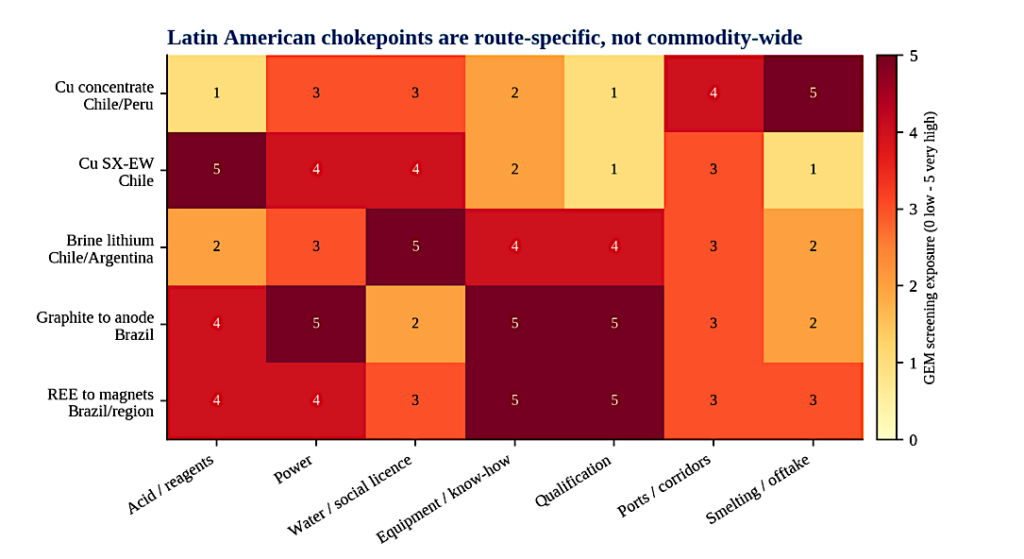
Processing plants, chemical supplies and logistics—not mines—are the most likely source of the next critical mineral supply shock, according to a GEM Mining Consulting study that challenges conventional mine-focused planning.

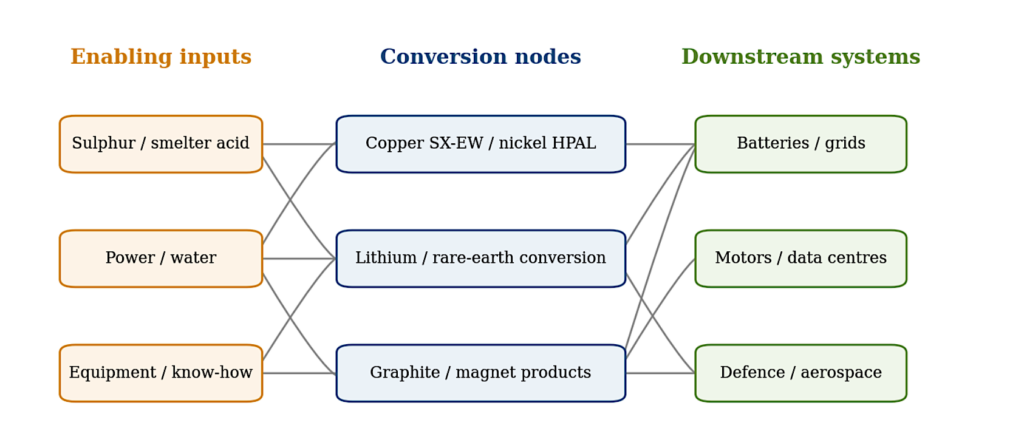
The study argues that usable supply can fail even as mines continue operating because bottlenecks develop elsewhere in the value chain. A shortage of sulphuric acid, an unqualified anode production route, a missing furnace, equipment export restrictions, a smelter closure or constraints on power and water can remove far more supply than the apparent size of the disruption suggests.

Rather than forecasting specific outcomes, the report develops stress scenarios to illustrate the scale of disruptions that operators and policymakers should be testing. The analysis starts with about 3.6 million tonnes per year of copper produced through acid-leach routes, a 72% battery-grade graphite supply gap outside the dominant producer and an announced diversified rare-earth magnet pipeline of roughly 18,000 tonnes of rare-earth content.

“The next mining supply shock may start in a reagent tank, a furnace, a port, a laboratory or an equipment order book,” GEM said. “Resource security is produced by a network. The orebody matters, but so do the systems that convert it into qualified, continuous supply.”

The findings highlight a broader shift in how critical mineral supply risk should be assessed. While governments and industry have focused on developing new mines, processing capacity, chemical inputs, equipment availability and customer qualification increasingly determine whether production can reach end users.

Acid constraint

The report identifies sulphuric acid as one of the industry’s largest hidden vulnerabilities because it supports copper solvent extraction-electrowinning operations, nickel high-pressure acid leach projects, cobalt co-production, hard-rock lithium conversion, rare-earth processing and battery precursor manufacturing.

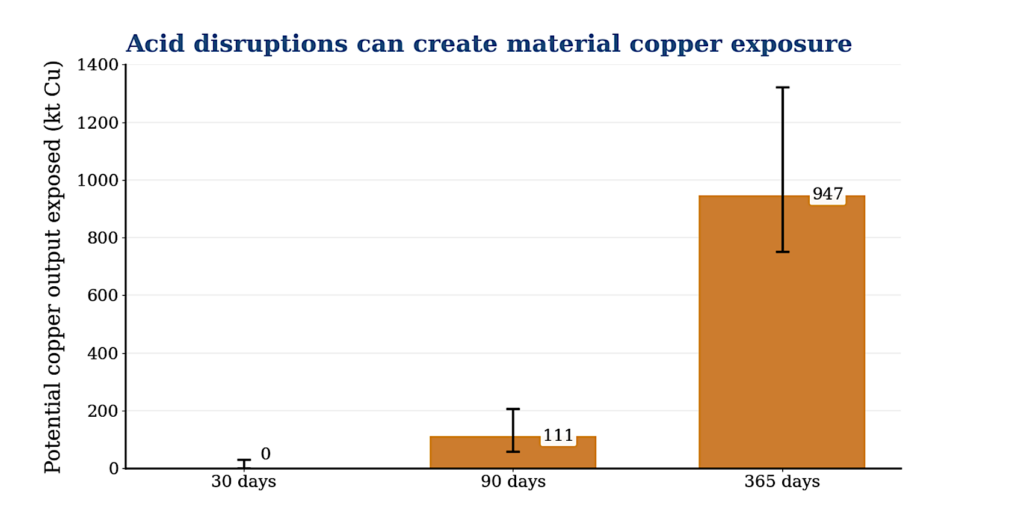
GEM estimates that more than 15% of global primary copper production, or about 3.6 million tonnes annually, depends on acid-leach routes. Under its central stress case, a 90-day acid disruption would expose roughly 111,000 tonnes of copper production, while a year-long disruption could affect about 947,000 tonnes.

The analysis notes that roughly half of seaborne sulphur trade passes through the Strait of Hormuz, while China halted sulphuric acid exports in May 2026 as sulphur markets tightened. It concludes that producers should treat acid availability as a production constraint rather than simply a reagent cost, incorporating separate monitoring of sulphur feedstock, burner acid and smelter by-product acid into production planning.

Graphite and rare-earth magnets present a different challenge. Existing inventories can cushion short-term disruptions, but they do little to resolve structural processing bottlenecks. Alternative mines cannot quickly produce qualified battery-grade anode material or permanent magnets because purification, graphitization, coating, separation, metallization, specialized equipment, technical know-how and customer qualification all require time.

GEM estimates that with 28% N-1 inventory coverage, a one-year disruption would still leave about 60% of annual battery-grade graphite demand outside the dominant supplier uncovered after a 60-day inventory buffer. It also estimates that one- to two-year delays affecting 25% to 50% of the planned 18,000-tonne diversified rare-earth magnet pipeline could defer between 4,500 and 18,000 capacity-years.

The report also identifies route-specific vulnerabilities across selected Latin American mineral supply chains, arguing that exposure varies significantly depending on the processing pathway rather than the location of the orebody alone.

The study concludes that future supply resilience will depend as much on strengthening processing networks, chemical supply and industrial infrastructure as on discovering new mineral deposits.

Colombia oil, mining industries upbeat on new (RIGHT WING) government, seek swift changes 


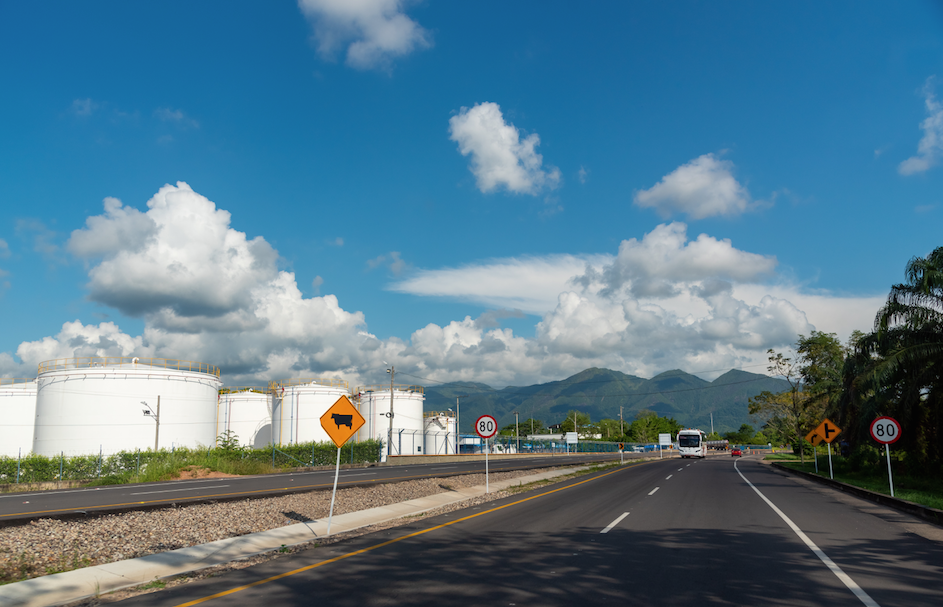
Oil storage in Colombia. Stock image.

 Mining and ​oil companies are ready to invest billions of dollars in Colombia after four years of paralysis in ‌new exploration, but the incoming government needs to act quickly to remove regulatory and security obstacles, industry executives and analysts said.

Right-wing President-elect Abelardo De La Espriella will be sworn in on Friday, replacing leftist Gustavo Petro, who banned new hydrocarbon exploration contracts and locked horns with multinational ​coal companies.

De La Espriella has pledged to revive exploration and could use decrees to simplify and shorten permitting ​processes, including public consultations.

That carries legal risks, while other sought-after measures, such as approving technical ⁠parameters for fracking, changing the royalty system, altering contract structures and introducing tax incentives, would require approval from a ​divided Congress, where he will face opposition from Petro’s party.

“We need to unblock all the bottlenecks that are closely tied to ​prior consultations, administrative decisions and delays in environmental licensing,” said Luz Stella Murgas, president of Colombia’s natural gas association Naturgas.

Major gas developments include the offshore Sirius project in Colombia’s Caribbean, a joint venture between state-controlled Ecopetrol and Brazil’s Petrobras. Production is expected to begin in 2030, ​but the project still requires the completion of 120 prior consultations with local communities.

Between 2023 and 2025, foreign investment ​in mining and oil fell 34% to about $6.9 billion, while Colombia’s oil output declined 4% to an average 746,000 barrels per day and ‌crude ⁠reserves dropped by 54 million barrels. Natural gas imports soared to 31% of domestic consumption from just 3% in 2023, industry data show.

Security is another key concern.

The Colombian Petroleum Association (ACP) said 580 attacks and blockades on oil infrastructure were recorded in 2025, causing losses exceeding 2.4 trillion pesos, about $749 million.

“The measures have to be comprehensive, aggressive and swift,” ACP president Frank ​Pearl said. “If one of the ​key variables is missing ⁠from the investment environment, it will not be attractive and we may fail to draw those resources.”

Nelson Castañeda, president of industry association Campetrol, also called for urgent government action, as “every ​decision we make today will be reflected in five, 10 and 15 years.”

Billions in mining investment stalled

In mining, ⁠Colombia has five gold, copper, coal and nickel projects that have completed exploration or obtained licenses but have not moved into construction because of legal and political uncertainty under Petro, said Juan Camilo Nariño, head of the Colombian Mining Association.

“The investments are ⁠on the ​verge of materializing and could amount to between $3.6 billion and $4 billion over ​the next four years,” Nariño said.

Efforts to accelerate permitting processes are highly likely to face legal challenges, said consultancy Colombia Risk Analysis.

“There will be no ​viable legal path to simplify, speed up or eliminate prior consultations,” it said.

(Reporting by Nelson Bocanegra, editing by Andrei Khalip)