War Zones In Nigeria Leave Disabled People Behind; In the US, We’re Doing It Too
The system that has failed Disabled people during Nigeria’s security crisis is the same system that fails us here in not just natural disasters like hurricanes or wildfires, but active shooter situations, and immigration detention as well.
The system that has failed Disabled people during Nigeria’s security crisis is the same system that fails us here in not just natural disasters like hurricanes or wildfires, but active shooter situations, and immigration detention as well.
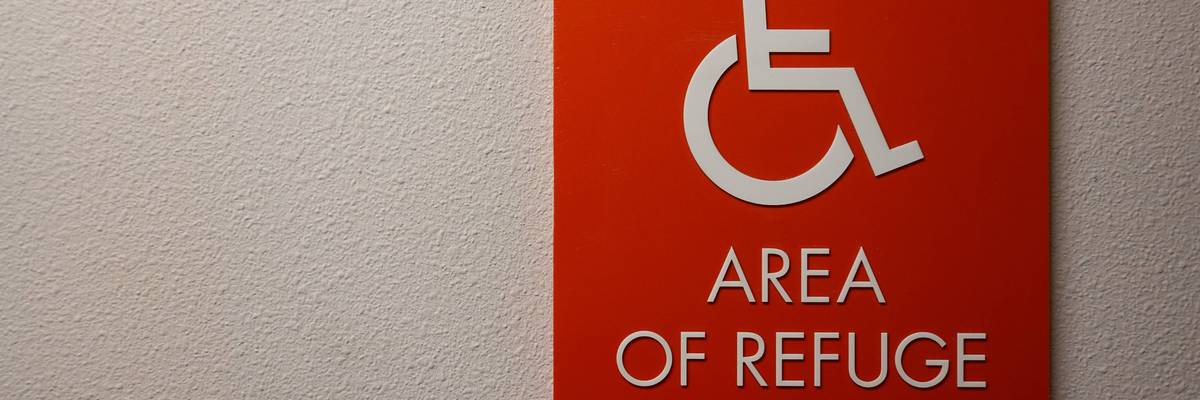
A sign in a hallway in an apartment complex says, “Area of Refuge” with a wheelchair symbol on it, indicating it is an emergency gathering area for disabled people.
(Photo by Getty Images)
Sean Kelly
Aug 09, 2026
Common Dreams
Hurricane season is upon us, and for many Disabled people across the US, it means a renewed sense of insecurity and uncertainty around their well-being. So often, Disabled folks are too often left behind in emergency preparedness and response efforts, and are ultimately treated as afterthoughts. With the 21st anniversary of Hurricane Katrina approaching and a continued climate crisis with no end in sight, this glaring oversight is ever present in the minds of Disabled people nationwide.
This isn’t an issue that’s unique to the US, however. It’s something that Disabled communities face on a global scale, and it’s time we took a hard look at what countries across the world can do to center Disabled people in ensuring the safety and security of their citizens.
Take Nigeria, for example. A new investigation from Deaf Nigerian filmmaker and journalist Alexander Ogheneruemu, “Forgotten People,” tells, in part, the story of Ayoade Beyioku-Alase, a Deaf man who was nearly killed as a child in Kano because the violence closing in on his house came with no siren, no interpreter, no warning he could access. “A Deaf person can walk right into the middle of danger,” he says in the piece.
It’s easy for those of us in the US to read a story like this and feel far away from it. It’s easy to think, ,“This isn’t us.” The truth is that, whether we want to accept it or not, it is us. It just looks a little different.
Disabled people in the United States are two to four times more likely to die or be critically injured in a disaster than nondisabled people.
As a Disabled person who has worked in this space for many years, I can tell you that the system that has failed Disabled people during Nigeria’s security crisis is the same system that fails us here in not just natural disasters like hurricanes or wildfires, but active shooter situations, and immigration detention as well. The threat might be different, but we have more in common with these failings than you’d be led to believe.
The alarm itself is the most direct parallel. Federal guidance from the Department of Justice acknowledges that most emergency warning systems in this country were built for people who can hear and see. Sirens, radio, television, flashing lights are all assumed to be visible to everyone. Tornado sirens across the Midwest and South are audio only, offering nothing to a Deaf person indoors when weather becomes a threat. The National Association of the Deaf has told emergency management agencies for years that mass notification systems don’t reach people who rely on video instead of standard calls. This is a serious and blatant example of ableism, where Disabled people are treated as an afterthought in emergency planning.
In Ogheneruemu’s “Forgotten People,” produced by the Disability Justice Project, the journalist says that 4,654 lives were lost in Nigeria’s insecurity crisis last year. Our own numbers are just as alarming. Research compiled by the Center for American Progress and the Partnership for Inclusive Disaster Strategies puts it bluntly: Disabled people in the United States are two to four times more likely to die or be critically injured in a disaster than nondisabled people.
During Hurricane Katrina, people over 60 years old, who included many Disabled folks, made up 73% of storm-related deaths in Louisiana. According to the National Council on Disability, 68 of those victims died in nursing homes, some abandoned by staff who left rather than arrange evacuation. Twenty years later, not much has changed. When the Eaton Fire tore through Los Angeles in January of 2025, at least 3 of the 27 people killed were Disabled, and NBC News reported that Disabled people displaced by disaster are almost twice as likely not to return home.
Then there’s our own man-made violence. Nigeria’s crisis comes from armed conflict, and ours also often comes from gun violence. More than 100 US school shootings have happened since Sandy Hook in 2012, and the response drilled into an entire generation of children is to run and hide. Inherently, this completely excludes Disabled kids. The Washington Post and The Mighty have both documented children left alone in hallways, forgotten in therapy rooms, and locked out of safe zones during lockdowns because there wasn’t a plan that accounted for them. New Jersey only recently passed legislation forcing districts to build disability-specific evacuation plans after families spoke out. The message we’re sending to Disabled kids here is that they’re on their own.
The Disability Justice Project’s own reporting has already shown us what this looks like at our own border: a Deaf asylum-seeker was held for five months in Immigration and Customs Enforcement detention without a sign language interpreter, ultimately unable to explain to anyone why he was afraid to go home. If disability access can vanish inside a US federal detention facility, we have no standing to act shocked that it vanishes during a flood or a fire.
This isn’t the kind of thing that’s unknowable, either. The data is out there, and the stories are plentiful. It’s simply not prioritized by those in power, and more often than not it’s unfunded. Disability still makes up just 2% of philanthropy, despite Disabled people comprising about 25% of the US population. Every dollar that goes toward disaster response, school safety, or immigration oversight without disability at the center is putting more Disabled folks in harm’s way. And even if that isn’t you, it could be your mother, father, child, friend, or neighbor. That’s why funding disability is more important than ever. We don’t need another report to tell donors and policymakers that Disabled people die preventable deaths in emergencies.
Instead, we need them to stop treating that fact as new information every single time it happens. Funders, just like lawmakers and others in positions of power, need to wake up and see for themselves just what the disability community is up against.
If we can learn one thing from the security crisis in Nigeria, it’s that Disabled people deserve the same protections and safeguards that nondisabled people have in dangerous and precarious situations. It’s already too late, but in the US, in Nigeria, and in countless other countries, there’s still time to save many more Disabled lives.
Our work is licensed under Creative Commons (CC BY-NC-ND 3.0). Feel free to republish and share widely.
Sean Kelly
Sean Kelly is a writer, editor, journalist, and communications professional based in Savannah, Georgia, where he lives with his wife and two kids. His work spans disability advocacy and journalism, including with New Disabled South and the Inevitable Foundation, and he co-founded The Savannahian. He is also the author of the book White Noise & Lightning: The Continental Drifters Story.
Full Bio >
Hurricane season is upon us, and for many Disabled people across the US, it means a renewed sense of insecurity and uncertainty around their well-being. So often, Disabled folks are too often left behind in emergency preparedness and response efforts, and are ultimately treated as afterthoughts. With the 21st anniversary of Hurricane Katrina approaching and a continued climate crisis with no end in sight, this glaring oversight is ever present in the minds of Disabled people nationwide.
This isn’t an issue that’s unique to the US, however. It’s something that Disabled communities face on a global scale, and it’s time we took a hard look at what countries across the world can do to center Disabled people in ensuring the safety and security of their citizens.
Take Nigeria, for example. A new investigation from Deaf Nigerian filmmaker and journalist Alexander Ogheneruemu, “Forgotten People,” tells, in part, the story of Ayoade Beyioku-Alase, a Deaf man who was nearly killed as a child in Kano because the violence closing in on his house came with no siren, no interpreter, no warning he could access. “A Deaf person can walk right into the middle of danger,” he says in the piece.
It’s easy for those of us in the US to read a story like this and feel far away from it. It’s easy to think, ,“This isn’t us.” The truth is that, whether we want to accept it or not, it is us. It just looks a little different.
Disabled people in the United States are two to four times more likely to die or be critically injured in a disaster than nondisabled people.
As a Disabled person who has worked in this space for many years, I can tell you that the system that has failed Disabled people during Nigeria’s security crisis is the same system that fails us here in not just natural disasters like hurricanes or wildfires, but active shooter situations, and immigration detention as well. The threat might be different, but we have more in common with these failings than you’d be led to believe.
The alarm itself is the most direct parallel. Federal guidance from the Department of Justice acknowledges that most emergency warning systems in this country were built for people who can hear and see. Sirens, radio, television, flashing lights are all assumed to be visible to everyone. Tornado sirens across the Midwest and South are audio only, offering nothing to a Deaf person indoors when weather becomes a threat. The National Association of the Deaf has told emergency management agencies for years that mass notification systems don’t reach people who rely on video instead of standard calls. This is a serious and blatant example of ableism, where Disabled people are treated as an afterthought in emergency planning.
In Ogheneruemu’s “Forgotten People,” produced by the Disability Justice Project, the journalist says that 4,654 lives were lost in Nigeria’s insecurity crisis last year. Our own numbers are just as alarming. Research compiled by the Center for American Progress and the Partnership for Inclusive Disaster Strategies puts it bluntly: Disabled people in the United States are two to four times more likely to die or be critically injured in a disaster than nondisabled people.
During Hurricane Katrina, people over 60 years old, who included many Disabled folks, made up 73% of storm-related deaths in Louisiana. According to the National Council on Disability, 68 of those victims died in nursing homes, some abandoned by staff who left rather than arrange evacuation. Twenty years later, not much has changed. When the Eaton Fire tore through Los Angeles in January of 2025, at least 3 of the 27 people killed were Disabled, and NBC News reported that Disabled people displaced by disaster are almost twice as likely not to return home.
Then there’s our own man-made violence. Nigeria’s crisis comes from armed conflict, and ours also often comes from gun violence. More than 100 US school shootings have happened since Sandy Hook in 2012, and the response drilled into an entire generation of children is to run and hide. Inherently, this completely excludes Disabled kids. The Washington Post and The Mighty have both documented children left alone in hallways, forgotten in therapy rooms, and locked out of safe zones during lockdowns because there wasn’t a plan that accounted for them. New Jersey only recently passed legislation forcing districts to build disability-specific evacuation plans after families spoke out. The message we’re sending to Disabled kids here is that they’re on their own.
The Disability Justice Project’s own reporting has already shown us what this looks like at our own border: a Deaf asylum-seeker was held for five months in Immigration and Customs Enforcement detention without a sign language interpreter, ultimately unable to explain to anyone why he was afraid to go home. If disability access can vanish inside a US federal detention facility, we have no standing to act shocked that it vanishes during a flood or a fire.
This isn’t the kind of thing that’s unknowable, either. The data is out there, and the stories are plentiful. It’s simply not prioritized by those in power, and more often than not it’s unfunded. Disability still makes up just 2% of philanthropy, despite Disabled people comprising about 25% of the US population. Every dollar that goes toward disaster response, school safety, or immigration oversight without disability at the center is putting more Disabled folks in harm’s way. And even if that isn’t you, it could be your mother, father, child, friend, or neighbor. That’s why funding disability is more important than ever. We don’t need another report to tell donors and policymakers that Disabled people die preventable deaths in emergencies.
Instead, we need them to stop treating that fact as new information every single time it happens. Funders, just like lawmakers and others in positions of power, need to wake up and see for themselves just what the disability community is up against.
If we can learn one thing from the security crisis in Nigeria, it’s that Disabled people deserve the same protections and safeguards that nondisabled people have in dangerous and precarious situations. It’s already too late, but in the US, in Nigeria, and in countless other countries, there’s still time to save many more Disabled lives.
Our work is licensed under Creative Commons (CC BY-NC-ND 3.0). Feel free to republish and share widely.
Sean Kelly
Sean Kelly is a writer, editor, journalist, and communications professional based in Savannah, Georgia, where he lives with his wife and two kids. His work spans disability advocacy and journalism, including with New Disabled South and the Inevitable Foundation, and he co-founded The Savannahian. He is also the author of the book White Noise & Lightning: The Continental Drifters Story.
Full Bio >

No comments:
Post a Comment