DuckDuckGo Releases ‘Normal Sunglasses’ to Troll Meta’s AI-Powered ‘Pervert Glasses’
“These are the first smart glasses guaranteed to never record nude videos of you and send them to random people. I never thought I’d have to guarantee that, but here we are.”
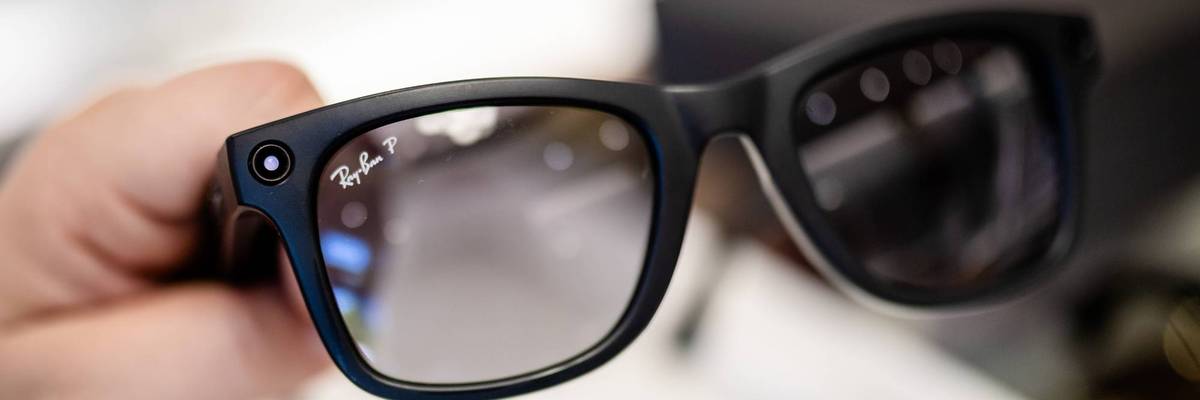
A woman is holding a pair of smart glasses from Ray-Ban Meta in her hand at an eyewear store in Stuttgart, Germany on July 22, 2026.
(Photo by Christoph Schmidt/Picture Alliance via Getty Images)
Stephen Prager
Aug 07, 2026
COMMON DREAMS
As Meta faces heat for selling artificial intelligence-powered sunglasses that record people without their knowledge, the web browser DuckDuckGo responded with what it called “the world’s most innovative anti-surveillance sunglasses”... otherwise known as normal sunglasses.
Meta, the Big Tech behemoth that owns Facebook and Instagram, likely did not expect to become the subject of relentless scorn and mockery over its new line of “Meta Glasses,” which retail for upwards of $299 and have been plugged by the likes of Kylie Jenner.
But internet users have saddled the shades with the nickname “pervert glasses.” For good reason: among other high-tech bells and whistles, the latest version is equipped with photo and video technology that some of the clientele have used to discreetly film strangers.
As the Los Angeles Times chronicles, some women have been approached by bespectacled creeps only to later find a recording of the encounter posted online, entirely without their consent. Although the glasses have a white light to indicate that recording is in progress, some elite-tier perverts have found ways to disable it.
DuckDuckGo, a company that has billed itself as an alternative to its data-mining, privacy-violating competitors, responded to the backlash against Meta by partnering with the eyewear company Knockaround and selling its own pair of glasses whose primary gimmick is that they do absolutely nothing but sit on your face.
“No camera, no microphone, no AI, no battery, no electronics of any kind,” reads the website, “Just a beautifully crafted pair of matte black sunglasses with a glossy DuckDuckGo logo, designed to block the sun and never send data to the cloud.”
“We’re obsessed with innovation. So when Big Tech started putting cameras in smart glasses, we asked ourselves a radical question: What if we just didn’t do that?” a July 30 social media post from DuckDuckGo said. “These are the first smart glasses guaranteed to never record nude videos of you and send them to random people. I never thought I’d have to guarantee that, but here we are.”
This was not merely a hyperbolic what-if. It’s been reported that Meta’s AI glasses have recorded videos of users having sex and using the bathroom that were then viewed by Kenyan subcontractors involved in manually training Meta’s AI systems.
Internal documents have also revealed plans by Meta to embed facial recognition technology into the glasses, which dozens of rights groups, including the American Civil Liberties Union, warned “would allow anyone wearing them to identify by name any strangers in their vicinity—including at protests, medical clinics, and businesses.”
After being secretly implemented for a brief period without being accessible to consumers, the technology was rolled back. But concerns remain that it could be added again, and there have been growing calls from lawmakers and privacy groups in the US and Europe to ban the glasses.
One British activist group called Everyone Hates Elon has begun a viral guerrilla marketing campaign against the Meta glasses.
One satirical ad, placed at a bus stop in London, shows the infamous sex criminal Jeffrey Epstein wearing the frames, with the tagline “glasses for people who don’t do consent” next to the Meta logo.
“These glasses feel like they’re making perverts’ and abusers’ lives easier when we should actually be making women’s lives easier. They are pervert glasses,” a spokesperson for the group told The Times of London. “We wanted to use Jeffrey Epstein to highlight who these glasses will be used by, and it’s powerful men and abusers.”
In this environment, it’s perhaps not a surprise that DuckDuckGo’s tech-free alternative has been a hit. The company said that within a week, the shades, which cost $35 a pair, had sold out.
“These are the first smart glasses guaranteed to never record nude videos of you and send them to random people. I never thought I’d have to guarantee that, but here we are.”
A woman is holding a pair of smart glasses from Ray-Ban Meta in her hand at an eyewear store in Stuttgart, Germany on July 22, 2026.
(Photo by Christoph Schmidt/Picture Alliance via Getty Images)
Stephen Prager
Aug 07, 2026
COMMON DREAMS
As Meta faces heat for selling artificial intelligence-powered sunglasses that record people without their knowledge, the web browser DuckDuckGo responded with what it called “the world’s most innovative anti-surveillance sunglasses”... otherwise known as normal sunglasses.
Meta, the Big Tech behemoth that owns Facebook and Instagram, likely did not expect to become the subject of relentless scorn and mockery over its new line of “Meta Glasses,” which retail for upwards of $299 and have been plugged by the likes of Kylie Jenner.
But internet users have saddled the shades with the nickname “pervert glasses.” For good reason: among other high-tech bells and whistles, the latest version is equipped with photo and video technology that some of the clientele have used to discreetly film strangers.
As the Los Angeles Times chronicles, some women have been approached by bespectacled creeps only to later find a recording of the encounter posted online, entirely without their consent. Although the glasses have a white light to indicate that recording is in progress, some elite-tier perverts have found ways to disable it.
DuckDuckGo, a company that has billed itself as an alternative to its data-mining, privacy-violating competitors, responded to the backlash against Meta by partnering with the eyewear company Knockaround and selling its own pair of glasses whose primary gimmick is that they do absolutely nothing but sit on your face.
“No camera, no microphone, no AI, no battery, no electronics of any kind,” reads the website, “Just a beautifully crafted pair of matte black sunglasses with a glossy DuckDuckGo logo, designed to block the sun and never send data to the cloud.”
“We’re obsessed with innovation. So when Big Tech started putting cameras in smart glasses, we asked ourselves a radical question: What if we just didn’t do that?” a July 30 social media post from DuckDuckGo said. “These are the first smart glasses guaranteed to never record nude videos of you and send them to random people. I never thought I’d have to guarantee that, but here we are.”
This was not merely a hyperbolic what-if. It’s been reported that Meta’s AI glasses have recorded videos of users having sex and using the bathroom that were then viewed by Kenyan subcontractors involved in manually training Meta’s AI systems.
Internal documents have also revealed plans by Meta to embed facial recognition technology into the glasses, which dozens of rights groups, including the American Civil Liberties Union, warned “would allow anyone wearing them to identify by name any strangers in their vicinity—including at protests, medical clinics, and businesses.”
After being secretly implemented for a brief period without being accessible to consumers, the technology was rolled back. But concerns remain that it could be added again, and there have been growing calls from lawmakers and privacy groups in the US and Europe to ban the glasses.
One British activist group called Everyone Hates Elon has begun a viral guerrilla marketing campaign against the Meta glasses.
One satirical ad, placed at a bus stop in London, shows the infamous sex criminal Jeffrey Epstein wearing the frames, with the tagline “glasses for people who don’t do consent” next to the Meta logo.
“These glasses feel like they’re making perverts’ and abusers’ lives easier when we should actually be making women’s lives easier. They are pervert glasses,” a spokesperson for the group told The Times of London. “We wanted to use Jeffrey Epstein to highlight who these glasses will be used by, and it’s powerful men and abusers.”
In this environment, it’s perhaps not a surprise that DuckDuckGo’s tech-free alternative has been a hit. The company said that within a week, the shades, which cost $35 a pair, had sold out.
“We cannot allow Meta to put its short-term profits above the emotional well-being of our kids,” said Sen. Bernie Sanders.

A teen girl uses her cellphone in this undated stock photo.
(Photo by dragana991/iStock via Getty Images Plus)
Brett Wilkins
Aug 07, 2026
COMMON DREAMS
A New Mexico court on Thursday ruled that Meta must pay an additional $567 million fine on top of the $375 million a jury fined the tech giant in March for harms caused to teens and children who use its Instagram and Facebook social media platforms.
First Judicial District Judge Bryan Biedscheid said in his 68-pager ruling that “significant numbers of people in New Mexico experience harm from Meta’s products due to risks of sexual exploitation, interference with education, and adverse mental health outcomes.”
“The harm to the impacted New Mexicans is not doubtful, eventual, or contingent, but an immediate, temporally connected, and highly probable result of Meta’s actions,” he continued.
“The youth mental health crisis has inflicted significant and widespread harm in New Mexico in terms of the number of youth suffering mental health harms, the profound suffering they and those in their families suffer, and the resulting interferences with the functioning of the schools, law enforcement, [and] healthcare systems in New Mexico,” the judge added.
The case centered on allegations that Meta knowingly designed and operated Facebook and Instagram in ways that exposed children to harmful content, encouraged excessive use, and failed to adequately protect minors from exploitation. New Mexico officials argued that internal company knowledge and outside warnings showed Meta was aware of risks associated with its platforms but did not act sufficiently to address them.
Most of the new fine—$420 million—will go toward funding youth treatment services, while the rest is designated for awareness and prevention, screening services, and other costs.
Biedscheid’s order also compels Meta to make changes to its platforms in New Mexico, including removing “like” counts and only showing them to minors with parental consent, and prohibiting overnight push notifications for users under age 18.
“Regardless of whether it is labeled as an ‘addiction’ or ‘problematic use,’ the evidence at trial proved that design elements, such as autoplay, infinite scroll, ‘like counts,’ and push notifications create a product that, particularly for adolescent users, is highly rewarding psychologically and neurochemically,” he wrote. “As a result, for many, it is irresistibly compelling to start scrolling and very difficult to stop or abstain from its use.”
“In addition,” the judge added, “algorithmic content recommendations can create harmful feedback loops and ‘rabbit hole’ users. Within a similar vein, ‘like counts’... can provide a potentially harmful focus for adolescent users.”
Meta spokesperson Andy Stone said the company would appeal the ruling, claiming: “We work hard to keep people safe on our platforms and have been transparent about the challenges of identifying and removing bad actors and harmful content. We remain confident in our record of protecting teens online and will continue to defend ourselves against claims that misrepresent the facts.”
New Mexico Attorney General Raúl Torrez hailed the ruling, saying that “Meta built products it knew would fuel addiction, deepen a youth mental health crisis, and expose children to sexual exploitation, then lied to parents and policymakers about the danger. Today, it pays for that choice.”
At Fairplay—a children’s advocacy group—executive director Josh Golin hailed the “landmark ruling” as “the clearest indication yet that the tide is turning when it comes to protecting kids from social media.”
“For the first time, Meta is being compelled by a court to change its dangerous and harmful design,” he continued. “And with so many states lined up to sue Meta and other social media companies, we should expect to see a lot more injunctive relief to make online platforms used by young people safer.”
“This ruling also clearly indicates why families need the Kids Online Safety Act,” Golin added, referring to a controversial bill advanced this week by the Senate Commerce Committee. “The judge said it was up to Congress to address the addictive features on Instagram and other social media platforms. KOSA’s duty of care against compulsive use is the key to ensuring that Meta and other social media companies stop designing for addiction, as addictive design is the root of all social media harms.”
Justin Mazzola, deputy director of research at Amnesty International USA, said in a statement: “This verdict is an important step towards creating safer social media for children and young people. For years, Amnesty International has warned that major social media platforms have been designed to maximize engagement and profit, while failing to adequately protect children’s rights.”
“Crucially, the court went beyond imposing a financial penalty,” he continued. “By ordering changes to platform features, including removing ‘like’ counts for people under 18 and restricting overnight notifications, the ruling recognizes that the harms children experience online are often the result of deliberate design choices.”
“Amnesty has been calling for exactly this kind of action,” Mazzola added. “Child safety must be built into platforms from the start, not added as an afterthought once harms are identified. This decision sends a clear message that social media companies cannot continue to prioritize engagement at the expense of children’s well-being and rights.”
Congresswoman Pramila Jayapal (D-Wash.) said on Bluesky: “This is good news. For far too long, Big Tech corporations have put their bottom lines ahead of the health and safety of kids on their platforms.”
“Congress must continue to push for accountability and real guardrails for companies like Meta as tech giants continue to grow,” added Jayapal, who was critical of the Kids Internet and Digital Safety Act approved by the House of Representatives in June.
US Sen. Bernie Sanders (I-Vt.) also welcomed the ruling, posting on X that billionaire Meta CEO Mark Zuckerberg’s “greed is fueling a youth mental health crisis in America.”
“Today, a judge ordered Meta to pay a $567 million fine for the damage it has done to our kids,” Sanders added. “Good start. We cannot allow Meta to put its short-term profits above the emotional well-being of our kids.”
A New Mexico court on Thursday ruled that Meta must pay an additional $567 million fine on top of the $375 million a jury fined the tech giant in March for harms caused to teens and children who use its Instagram and Facebook social media platforms.
First Judicial District Judge Bryan Biedscheid said in his 68-pager ruling that “significant numbers of people in New Mexico experience harm from Meta’s products due to risks of sexual exploitation, interference with education, and adverse mental health outcomes.”
“The harm to the impacted New Mexicans is not doubtful, eventual, or contingent, but an immediate, temporally connected, and highly probable result of Meta’s actions,” he continued.
“The youth mental health crisis has inflicted significant and widespread harm in New Mexico in terms of the number of youth suffering mental health harms, the profound suffering they and those in their families suffer, and the resulting interferences with the functioning of the schools, law enforcement, [and] healthcare systems in New Mexico,” the judge added.
The case centered on allegations that Meta knowingly designed and operated Facebook and Instagram in ways that exposed children to harmful content, encouraged excessive use, and failed to adequately protect minors from exploitation. New Mexico officials argued that internal company knowledge and outside warnings showed Meta was aware of risks associated with its platforms but did not act sufficiently to address them.
Most of the new fine—$420 million—will go toward funding youth treatment services, while the rest is designated for awareness and prevention, screening services, and other costs.
Biedscheid’s order also compels Meta to make changes to its platforms in New Mexico, including removing “like” counts and only showing them to minors with parental consent, and prohibiting overnight push notifications for users under age 18.
“Regardless of whether it is labeled as an ‘addiction’ or ‘problematic use,’ the evidence at trial proved that design elements, such as autoplay, infinite scroll, ‘like counts,’ and push notifications create a product that, particularly for adolescent users, is highly rewarding psychologically and neurochemically,” he wrote. “As a result, for many, it is irresistibly compelling to start scrolling and very difficult to stop or abstain from its use.”
“In addition,” the judge added, “algorithmic content recommendations can create harmful feedback loops and ‘rabbit hole’ users. Within a similar vein, ‘like counts’... can provide a potentially harmful focus for adolescent users.”
Meta spokesperson Andy Stone said the company would appeal the ruling, claiming: “We work hard to keep people safe on our platforms and have been transparent about the challenges of identifying and removing bad actors and harmful content. We remain confident in our record of protecting teens online and will continue to defend ourselves against claims that misrepresent the facts.”
New Mexico Attorney General Raúl Torrez hailed the ruling, saying that “Meta built products it knew would fuel addiction, deepen a youth mental health crisis, and expose children to sexual exploitation, then lied to parents and policymakers about the danger. Today, it pays for that choice.”
At Fairplay—a children’s advocacy group—executive director Josh Golin hailed the “landmark ruling” as “the clearest indication yet that the tide is turning when it comes to protecting kids from social media.”
“For the first time, Meta is being compelled by a court to change its dangerous and harmful design,” he continued. “And with so many states lined up to sue Meta and other social media companies, we should expect to see a lot more injunctive relief to make online platforms used by young people safer.”
“This ruling also clearly indicates why families need the Kids Online Safety Act,” Golin added, referring to a controversial bill advanced this week by the Senate Commerce Committee. “The judge said it was up to Congress to address the addictive features on Instagram and other social media platforms. KOSA’s duty of care against compulsive use is the key to ensuring that Meta and other social media companies stop designing for addiction, as addictive design is the root of all social media harms.”
Justin Mazzola, deputy director of research at Amnesty International USA, said in a statement: “This verdict is an important step towards creating safer social media for children and young people. For years, Amnesty International has warned that major social media platforms have been designed to maximize engagement and profit, while failing to adequately protect children’s rights.”
“Crucially, the court went beyond imposing a financial penalty,” he continued. “By ordering changes to platform features, including removing ‘like’ counts for people under 18 and restricting overnight notifications, the ruling recognizes that the harms children experience online are often the result of deliberate design choices.”
“Amnesty has been calling for exactly this kind of action,” Mazzola added. “Child safety must be built into platforms from the start, not added as an afterthought once harms are identified. This decision sends a clear message that social media companies cannot continue to prioritize engagement at the expense of children’s well-being and rights.”
Congresswoman Pramila Jayapal (D-Wash.) said on Bluesky: “This is good news. For far too long, Big Tech corporations have put their bottom lines ahead of the health and safety of kids on their platforms.”
“Congress must continue to push for accountability and real guardrails for companies like Meta as tech giants continue to grow,” added Jayapal, who was critical of the Kids Internet and Digital Safety Act approved by the House of Representatives in June.
US Sen. Bernie Sanders (I-Vt.) also welcomed the ruling, posting on X that billionaire Meta CEO Mark Zuckerberg’s “greed is fueling a youth mental health crisis in America.”
“Today, a judge ordered Meta to pay a $567 million fine for the damage it has done to our kids,” Sanders added. “Good start. We cannot allow Meta to put its short-term profits above the emotional well-being of our kids.”

No comments:
Post a Comment