The Catholic principle guiding popes through tech upheavals, from the Industrial Revolution to AI
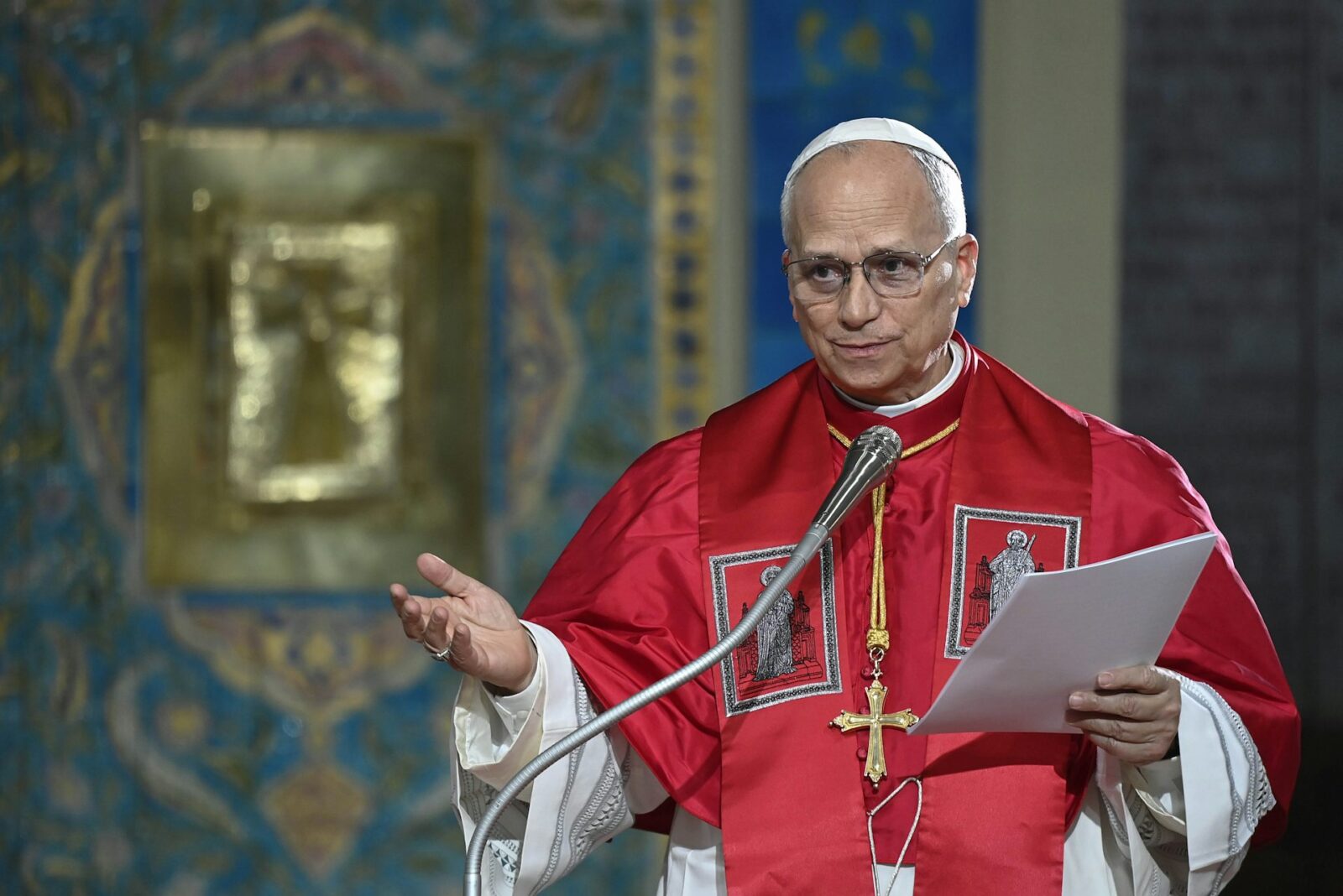
(The Conversation) — Pope Leo XIV recently found himself in a position many of today’s students can relate to: having his writing tested for signs of artificial intelligence use.
Proudly Human, a tech company that analyzes creative work, announced July 21, 2026, that it had reviewed a collection of Leo’s speeches. In general, algorithms to sniff out AI aren’t always accurate. Fortunately for the pope, though, the company declared his writing to be “human-authored.”
In a way, it was fitting. Since the start of his papacy, Leo has spoken about the risks AI presents for broad swaths of society. As a computer scientist interested in how Catholic teachings can shape digital technology, I’ve followed his statements closely. In May 2026, he released his first encyclical,“Magnifica humanitas” – “Magnificent humanity” – which describes how the Catholic Church should respond to the AI era.
While the technology might be new, the principles guiding the pope’s perspectives have deep roots. In particular, the encyclical invokes the concept of “subsidiarity,” a core tenet of Catholic social teaching that has guided the church’s response to technological upheavals for almost a century.
Simply defined, subsidiarity means that, whenever possible, decisions should be made by the people most affected by them. In the United States, for instance, the Department of Education may set federal assessment guidelines, but cities and states are in charge of many aspects of public education.
AI increasingly shapes the lives of Americans, whether we want it or not. Yet platforms such as Gemini, Claude and ChatGPT are proprietary black boxes, under full control of the corporations behind them. What “Magnifica humanitas” suggests is putting control of AI at the “closest level possible to the persons involved” in its use.
Tech revolution
Subsidiarity has a long history in Catholicism, extending back to Pope Pius XI. In 1931, he released an encyclical called “Quadragesimo anno,” or “In the 40th year.”
The title was a reference to the first encyclical on Catholic social teaching, written by Pope Leo XIII in 1891. Although the earlier encyclical did not mention subsidiarity by name, it advocated for harmony between different levels of society – an idea that Pius would further develop into the full-fledged concept.
Both texts were responding to their era’s own technological inflection point: the Industrial Revolution. Church leaders were deeply troubled by a new, unrestrained form of capitalism that left laborers with few options other than working on mechanized assembly lines, under harsh terms set by corporate managers. In Pius’ words, “Free competition has destroyed itself; economic dictatorship has supplanted the free market; unbridled ambition for power has likewise succeeded greed for gain; all economic life has become tragically hard, inexorable, and cruel.”
Pius feared that this new economic system undermined human flourishing and the common good, and drew on the Catholic Church’s intellectual tradition for solutions. Writings by St. Thomas Aquinas laid the groundwork for subsidiarity back in the 13th century, but the Industrial Revolution prompted theologians to refine the idea and develop Catholic social teaching.

Pope Piux XI, seated on the right, inaugurates the first radio station at the Vatican in 1931. Inventor Guglielmo Marconi stands on the left.
Bettmann/Getty Images
“Quadragesimo anno” recommended that societies be restructured to prevent entire economies from falling into the hands of just a few very powerful corporations. This involved fair wages, workers’ participation in decision-making, and eliminating unfair competition that squeezed small- and medium-sized businesses out of the market.
In 1932, when Franklin D. Roosevelt was running for president, he embraced the encyclical’s call for subsidiarity. During a speech in Detroit, he declared the pope’s encyclical “as radical as I am.” Quoting Pius’ words, he rejected a world where “immense power and despotic economic domination are concentrated in the hands of a few” – views that trickled into his New Deal policies, although Roosevelt himself belonged to the Episcopal Church.
Other politicians looking to give more voters a voice in technology and the economy embraced subsidiarity as well. In Europe, political parties affiliated with the Christian democracy movement incorporated it as a major plank of their platforms.
Human dignity
In recent years, the Vatican has continued developing the idea of subsidiarity to respond to AI and the concentration of Silicon Valley power behind it.
Toward the end of his papacy, Pope Francis became concerned about AI, which he believed would “increasingly influence the way we live, our social relationships and even the way we conceive of our identity as human beings.” The Vatican’s department of culture and education convened a group of scholars at the beginning of the AI boom to discuss its impact.
The book they published in 2023 sees subsidiarity as a way for people on the margins of society to help shape AI instead of being harmed by it. AI labs frequently fail to account for the needs of customers with disabilities and train their systems with massive datasets organized and annotated by low-paid workers in the developing world.
The book also argues that subsidiarity can decrease the threat of moral deskilling: degrading our own decision-making by relying on chatbots. For example, a chatbot could be configured to not provide guidance if users ask it to make decisions about their personal relationships.
Similar ideas worked their way into “Antiqua et nova,” – meaning “Ancient and new” – a Vatican document issued in 2025. Harkening back to Pope Pius’ encyclical, published almost 100 years before, “Antiqua et nova” condemns the monopolization of AI by powerful corporations. It recommends that everyday users, nonprofits, governments and international organizations also have a voice in creating technology that “promotes human dignity” and “the common good.”
“Magnifica humanitas” is the most recent attempt to reconcile AI systems with Catholic social teaching. AI should “not be imposed from above in an opaque and unilateral manner,” Leo writes, “but instead be directed toward the common good with transparency, accountability and meaningful forms of participation.”
Subsidiarity in practice
In a practical sense, what does this look like?
On the business side, I believe subsidiarity would require alternatives to Silicon Valley’s offerings. Some AI startups, such as the Catholic company Longbeard, align their values with particular faith communities. Truly open-source AI projects could give users transparent and reconfigurable access to the technology. For example, a parent could turn off the platform’s ability to do a child’s homework or to generate sexually suggestive imagery.

Subsidiarity might look like tools that let parents control whether their child can use AI while doing homework.
Morsa Images/DigitalVision via Getty Images
Some faith leaders and computer scientists, including my own team, are developing frameworks for how software engineering and product design could be guided by subsidiarity. Developing AI products typically involves harvesting training data by pervasively monitoring users, which many people are unaware is occurring. But it’s possible to train platforms in less invasive ways that give users more control, such as by using only information in the public domain or Creative Commons data.
These efforts highlight how subsidiarity could give more people a voice in a world that AI is rapidly changing.
(Walter Scheirer, Collegiate Professor of Engineering, University of Notre Dame. The views expressed in this commentary do not necessarily reflect those of Religion News Service.)
This historic divinity school is offering the first doctoral degree in ‘AI and Moral Agency’

(RNS) — At the end of the Civil War, a Union soldier and Baptist minister founded a school in Raleigh, North Carolina, to provide formerly enslaved people with religious literacy.
Now that same school — Shaw University — wants to provide literacy of a new kind: AI literacy.
Starting next year, Shaw’s divinity school plans to offer a new degree track: a Doctor of Education (or Ed.D) in Artificial Intelligence and Moral Agency.
As the AI spreads and performs more and more tasks traditionally done by humans, the divinity school wants to get ahead of the curve and probe its moral implications.
“We say Shaw was created to provide leadership in building literacy,” said Mark Harden, dean of Shaw University Divinity School. “We ( half)joke this is our second calling because we’re building AI literacy for vulnerable communities with an emphasis on social justice and ethics.”

Mark Harden, dean of Shaw University Divinity School. (Photo courtesy of Shaw Divinity School)
In June, the divinity school secured the go-ahead from the regional accrediting body, the Southern Association of Colleges and Schools Commission on Colleges. It is now working on receiving a seal of approval with the Commission on Accrediting at the Association of Theological Schools, a network of 280 graduate schools of theology across the United States and Canada.
Shaw’s AI degree would be the first among the ATS network in either the master’s or doctoral level, said Chris Meinzer, ATS’s chief operating officer. Several divinity schools have begun offering solo classes in AI and ethics.
In December, Notre Dame’s Institute for Ethics and the Common Good received a $50 million Lilly Endowment grant to support the so-called DELTA network that will provide practical resources for pastors, churches and schools to navigate challenges posed by AI. DELTA stands for dignity, embodiment, love, transcendence and agency — which it believes are the core Christian values. (RNS also receives grant support from Lilly Endowment.)
“Almost everybody we’re talking with and working with in higher education right now is just getting really serious about how issues involving artificial intelligence are really shaping a lot of the ethical questions that we want to study going forward, and a lot of the formation work that we need to do with our students,” said Meghan Sullivan, a philosopher and director of the Institute for Ethics and the Common Good at Notre Dame.
Sullivan said schools of theology are especially good places to study the ethics of AI.
“One of the most fundamental questions in Christianity is, we were given this power to choose and to develop our consciences and to develop our agency, and we absolutely have the power to use it for good or to misuse it,” Sullivan said. “A theological school, which has been deeply rooted in 2,000 years of reflection about what the Christian world thinks about that question of human agency, is going to have a whole lot to say about how we should navigate a world where, for the first time, people have the ability to offload many decisions to commercial software.”
Reflection on AI was given a big boost earlier this year when Pope Leo XIV published an encyclical, or letter, “Magnifica Humanitas,” in which he sought to protect human dignity and agency in a time when AI threatens to replace humans in many professional and social roles.
The pope especially wanted to avoid having tech firms establish the ethics for artificial intelligence.
RELATED: In his first encyclical, Pope Leo XIV says AI must serve humanity, not the powerful few
That kind of critical engagement with AI is growing in divinity schools. Philip Butler, an associate professor at Iliff School of Theology in Denver, helped start an AI institute there in 2018. He teaches a class on AI and theology that looks critically at who AI developers have in mind for their technology and who benefits and who loses from those decisions.
“We raise what does it mean to be human in relation to technology broadly,” said Butler. “Who’s the intended user? What kind of human is that?” That’s because, he said, when developers make AI “something for everybody, you could also argue you make something either for specific groups of people or nobody.”
Those issues are especially important for divinity schools like Shaw, a historically Black theological institution or HBTI.
Shaw University played an important role in the Civil Rights era, educating many of the leaders who shaped the movement. Those included Ella Baker, who co-founded the Student Nonviolent Coordinating Committee on its campus in 1960. SNCC, as it was known, supported student-led sit-ins and nonviolent direct action against racial segregation.
“We have a history of civic mindedness from the beginning that carried its way, even through the 1960s, and so it seemed like a natural outgrowth for us to do that,” Harden said.
So far at least 66 people have expressed an interest in the doctoral degree program, which will begin in January, Harden said. The divinity school, with about 65 students, currently offers two master’s degree programs — a Master of Arts in Theology and Ministry and a Master of Divinity.
The school will accept candidates who have a master’s degree in arts or divinity. It also requires five years of professional experience in pastoral ministry or related fields such as social work. Most students will be bi-vocational, Harden said, meaning that they support themselves with a non-church job. Since COVID, the divinity school has been offering all of its classes online.
The divinity school is now hiring for a few positions for the degree program. Most of its teaching staff will have certificates in AI.
Harden said it would take three to four years to complete the degree.

No comments:
Post a Comment