The 'literal slavery' behind Trump's economic policies

Matthew Rozsa

Matthew Rozsa
August 09, 2026
ALTERNET
President Donald Trump’s tariffs are already unpopular and deemed illegal by the Supreme Court, but a man who claims to have been wrongly imprisoned for murder argues that his claim to target nations that engage in forced labor is hypocritical. By his account, America engages in literal slavery by forcing prisoners to work for the profits of large companies.
“The Trump administration’s claim that tariffs are needed to punish those 59 countries and the European Union, which it says are too permissive of forced labor” is hypocritical, wrote MS NOW's Jeremy Busby, a writer and activist incarcerated in Texas for murder (he claims it was self-defense) and founder of the nonprofit JoinJeremy, on Sunday. “I write this from Texas, a state that has kept me incarcerated for nearly three decades and is one of the country’s biggest beneficiaries of forced labor.”
Busby described that he has “seen guards attack a man for his refusal to chop grass. I have seen countless others pepper sprayed for refusing to perform work details. Some of my college classmates were expelled from religious and educational programs for failing to show up for prison-mandated work. On any given day, nearly 2 million people are behind bars in this country. More than half of them, approximately 1.2 million, are held in state or federal prisons, where work is compulsory.”
In his essay, Busby argued that prisons effectively enslave their inmates in order to provide cheap goods and services for wealthy corporations.
“Those assigned to agribusiness operations harvest some of the same crops — like cotton — that enslaved people once did,” Busby argued. “They work under an armed guard on horseback, following the ‘same marching orders as their predecessors,’ the Texas Observer reported. In 2022 alone, Texas prisons raked in $58 million from sales of industrial products — such as soap and stainless steel tables — produced through forced labor. That sum was completely separate from the reported $51 million in earnings that same year from agriculture.”
He added, “Incarcerated workers have a long history of inhumane treatment for any type of work stoppage. In 1908, Frank Pinkard received 39 lashes after refusing to continue digging a ditch in Texas. Other incarcerated workers were killed for disobeying work orders, according to historian Robert Perkinson, author of ‘Texas Tough: The Rise of America’s Prison Empire.’”
Busby listed the punishments given to prisoners who refuse to work including “long-term placement in solitary confinement, which requires confiscation of all personal property” and loss of “privileges like family visitation, telephone calls or the good-time credits needed for release can be stripped away. Commissary, entertainment and recreational access can be suspended.”
He ultimately concluded, “If tariffs are an appropriate response to countries looking away from forced labor, then other countries would be justified in placing tariffs on us.”
Speaking to AlterNet in July, economist Dr. Ed Gresser, the Vice President and Director for Trade and Global Markets at the liberal-leaning think tank Progressive Policy Institute, characterized Trump’s tariffs as a “big-government” move despite his claim to be a small government president. Economist Dr. Robert Shapiro, who served as a top economic adviser to President Bill Clinton, argued they harm the American economy by creating “uncertainty. Every investment is based on an assessment of the likely future demand for whatever you're investing in, and how much it's going to cost to produce it.”
He added, “So there are assumptions about labor costs, material costs and other input costs — and again, about demand. If you have a set of arrangements that give you some confidence about the price of your inputs coming from Mexico or Canada, or about demand for goods in Canada — and don't forget, we have virtually no trade deficit with Canada; we have enormous trade, and it goes in both directions — so it's certainly right, and it's not just about investments based on these probabilities that the trade agreement can help reduce uncertainty about.”
President Donald Trump’s tariffs are already unpopular and deemed illegal by the Supreme Court, but a man who claims to have been wrongly imprisoned for murder argues that his claim to target nations that engage in forced labor is hypocritical. By his account, America engages in literal slavery by forcing prisoners to work for the profits of large companies.
“The Trump administration’s claim that tariffs are needed to punish those 59 countries and the European Union, which it says are too permissive of forced labor” is hypocritical, wrote MS NOW's Jeremy Busby, a writer and activist incarcerated in Texas for murder (he claims it was self-defense) and founder of the nonprofit JoinJeremy, on Sunday. “I write this from Texas, a state that has kept me incarcerated for nearly three decades and is one of the country’s biggest beneficiaries of forced labor.”
Busby described that he has “seen guards attack a man for his refusal to chop grass. I have seen countless others pepper sprayed for refusing to perform work details. Some of my college classmates were expelled from religious and educational programs for failing to show up for prison-mandated work. On any given day, nearly 2 million people are behind bars in this country. More than half of them, approximately 1.2 million, are held in state or federal prisons, where work is compulsory.”
In his essay, Busby argued that prisons effectively enslave their inmates in order to provide cheap goods and services for wealthy corporations.
“Those assigned to agribusiness operations harvest some of the same crops — like cotton — that enslaved people once did,” Busby argued. “They work under an armed guard on horseback, following the ‘same marching orders as their predecessors,’ the Texas Observer reported. In 2022 alone, Texas prisons raked in $58 million from sales of industrial products — such as soap and stainless steel tables — produced through forced labor. That sum was completely separate from the reported $51 million in earnings that same year from agriculture.”
He added, “Incarcerated workers have a long history of inhumane treatment for any type of work stoppage. In 1908, Frank Pinkard received 39 lashes after refusing to continue digging a ditch in Texas. Other incarcerated workers were killed for disobeying work orders, according to historian Robert Perkinson, author of ‘Texas Tough: The Rise of America’s Prison Empire.’”
Busby listed the punishments given to prisoners who refuse to work including “long-term placement in solitary confinement, which requires confiscation of all personal property” and loss of “privileges like family visitation, telephone calls or the good-time credits needed for release can be stripped away. Commissary, entertainment and recreational access can be suspended.”
He ultimately concluded, “If tariffs are an appropriate response to countries looking away from forced labor, then other countries would be justified in placing tariffs on us.”
Speaking to AlterNet in July, economist Dr. Ed Gresser, the Vice President and Director for Trade and Global Markets at the liberal-leaning think tank Progressive Policy Institute, characterized Trump’s tariffs as a “big-government” move despite his claim to be a small government president. Economist Dr. Robert Shapiro, who served as a top economic adviser to President Bill Clinton, argued they harm the American economy by creating “uncertainty. Every investment is based on an assessment of the likely future demand for whatever you're investing in, and how much it's going to cost to produce it.”
He added, “So there are assumptions about labor costs, material costs and other input costs — and again, about demand. If you have a set of arrangements that give you some confidence about the price of your inputs coming from Mexico or Canada, or about demand for goods in Canada — and don't forget, we have virtually no trade deficit with Canada; we have enormous trade, and it goes in both directions — so it's certainly right, and it's not just about investments based on these probabilities that the trade agreement can help reduce uncertainty about.”
‘Trump Is Tanking the US Economy’: Dismal Report Shows 23,000 Jobs Lost, Slowing Wage Growth
“However the White House tries to spin these numbers, their talking points ring hollow for people who are actually experiencing Trump’s weak economy.”

Job seekers receive information from a employer representatives at a job fair in Los Angeles, California on July 29, 2026.
(Photo by Patrick T. Fallon/AFP via Getty Images)
Jake Johnson
Aug 07, 2026
“However the White House tries to spin these numbers, their talking points ring hollow for people who are actually experiencing Trump’s weak economy.”
Job seekers receive information from a employer representatives at a job fair in Los Angeles, California on July 29, 2026.
(Photo by Patrick T. Fallon/AFP via Getty Images)
Jake Johnson
Aug 07, 2026
COMMON DREAMS
Federal data released Friday shows the US economy shed 23,000 jobs last month, but one analyst said that figure was “only the beginning of the bad news” for the country’s job market under the leadership of President Donald Trump.
“This is a bleak jobs report,” said Heather Long, the chief economist at Navy Federal Credit Union, noting that the unemployment rate fell slightly in July—but primarily because more people left the labor force—and year-over-year hourly wage growth slowed to 3.2%, not keeping up with inflation.
Breyon Williams, the Groundwork Collaborative’s top economist, said in response to the new Labor Department numbers that “regardless of having a job or not, everyone is paying high prices from Trump’s chaotic tariffs and war with Iran.”
“Today’s report shows a patchwork economy that is fraying at the seams,” said Williams. “Trump’s economic mismanagement has injected so much uncertainty into the economy that employers are not confident enough to add more people, but also have not initiated massive layoffs, creating a frozen job market where those with jobs are afraid to leave them and those without are stuck on the sidelines.”
Rep. Pramila Jayapal (D-Wash.) wrote on social media that “Trump is tanking the US economy.”
In addition to the loss of 23,000 jobs last month—far worse than forecasters’ expectation of an increase of 80,000 jobs—the Bureau of Labor Statistics (BLS) revised job growth downward for both May and June. BLS said job growth in May was actually 20,000 (down from the earlier estimate of 57,000), and job growth in June was 63,000 (down from 129,000). The healthcare sector has accounted for a disproportionate share of US employment growth this year.
“This economy is running on fumes,” said Angela Hanks, a former Labor Department official who now works as chief of policy programs at The Century Foundation. “However the White House tries to spin these numbers, their talking points ring hollow for people who are actually experiencing Trump’s weak economy.”
White House spin efforts began almost immediately after the release of the new figures.
Kevin Hassett, director of the National Economic Council, claimed during a Fox Business appearance that the dismal job numbers were a testament to the success of Trump’s mass deportation campaign, even though the largest job losses in July occurred in state and local government.
“Because we have a tight border and because we’ve been deporting folks who aren’t citizens, then that puts downward pressure on what the sort of breakeven job number is,” said Hassett.
Speaking to reporters outside the White House, Hassett also blamed the “end of the World Cup,” which “meant that a lot of hospitality workers were then laid off.”
“Is this the ‘Golden Age’ that Donald Trump and JD Vance keep talking about?” asked Kendall Witmer, the Democratic National Committee’s rapid response director, following publication of the BLS report. “Trump’s disastrous economic agenda has caused irreparable damage to the job market, as layoffs mount and it’s nearly impossible to find a job.”
“Working families are already drowning under the weight of skyrocketing costs on everyday goods like groceries, gas, and healthcare, and their paychecks aren’t keeping up,” said Witmer. “Americans are barely keeping their heads above water—and Trump can’t even be bothered to care.”
Federal data released Friday shows the US economy shed 23,000 jobs last month, but one analyst said that figure was “only the beginning of the bad news” for the country’s job market under the leadership of President Donald Trump.
“This is a bleak jobs report,” said Heather Long, the chief economist at Navy Federal Credit Union, noting that the unemployment rate fell slightly in July—but primarily because more people left the labor force—and year-over-year hourly wage growth slowed to 3.2%, not keeping up with inflation.
Breyon Williams, the Groundwork Collaborative’s top economist, said in response to the new Labor Department numbers that “regardless of having a job or not, everyone is paying high prices from Trump’s chaotic tariffs and war with Iran.”
“Today’s report shows a patchwork economy that is fraying at the seams,” said Williams. “Trump’s economic mismanagement has injected so much uncertainty into the economy that employers are not confident enough to add more people, but also have not initiated massive layoffs, creating a frozen job market where those with jobs are afraid to leave them and those without are stuck on the sidelines.”
Rep. Pramila Jayapal (D-Wash.) wrote on social media that “Trump is tanking the US economy.”
In addition to the loss of 23,000 jobs last month—far worse than forecasters’ expectation of an increase of 80,000 jobs—the Bureau of Labor Statistics (BLS) revised job growth downward for both May and June. BLS said job growth in May was actually 20,000 (down from the earlier estimate of 57,000), and job growth in June was 63,000 (down from 129,000). The healthcare sector has accounted for a disproportionate share of US employment growth this year.
“This economy is running on fumes,” said Angela Hanks, a former Labor Department official who now works as chief of policy programs at The Century Foundation. “However the White House tries to spin these numbers, their talking points ring hollow for people who are actually experiencing Trump’s weak economy.”
White House spin efforts began almost immediately after the release of the new figures.
Kevin Hassett, director of the National Economic Council, claimed during a Fox Business appearance that the dismal job numbers were a testament to the success of Trump’s mass deportation campaign, even though the largest job losses in July occurred in state and local government.
“Because we have a tight border and because we’ve been deporting folks who aren’t citizens, then that puts downward pressure on what the sort of breakeven job number is,” said Hassett.
Speaking to reporters outside the White House, Hassett also blamed the “end of the World Cup,” which “meant that a lot of hospitality workers were then laid off.”
“Is this the ‘Golden Age’ that Donald Trump and JD Vance keep talking about?” asked Kendall Witmer, the Democratic National Committee’s rapid response director, following publication of the BLS report. “Trump’s disastrous economic agenda has caused irreparable damage to the job market, as layoffs mount and it’s nearly impossible to find a job.”
“Working families are already drowning under the weight of skyrocketing costs on everyday goods like groceries, gas, and healthcare, and their paychecks aren’t keeping up,” said Witmer. “Americans are barely keeping their heads above water—and Trump can’t even be bothered to care.”
Bennito L. Kelty
August 6, 2026
RAW STORY
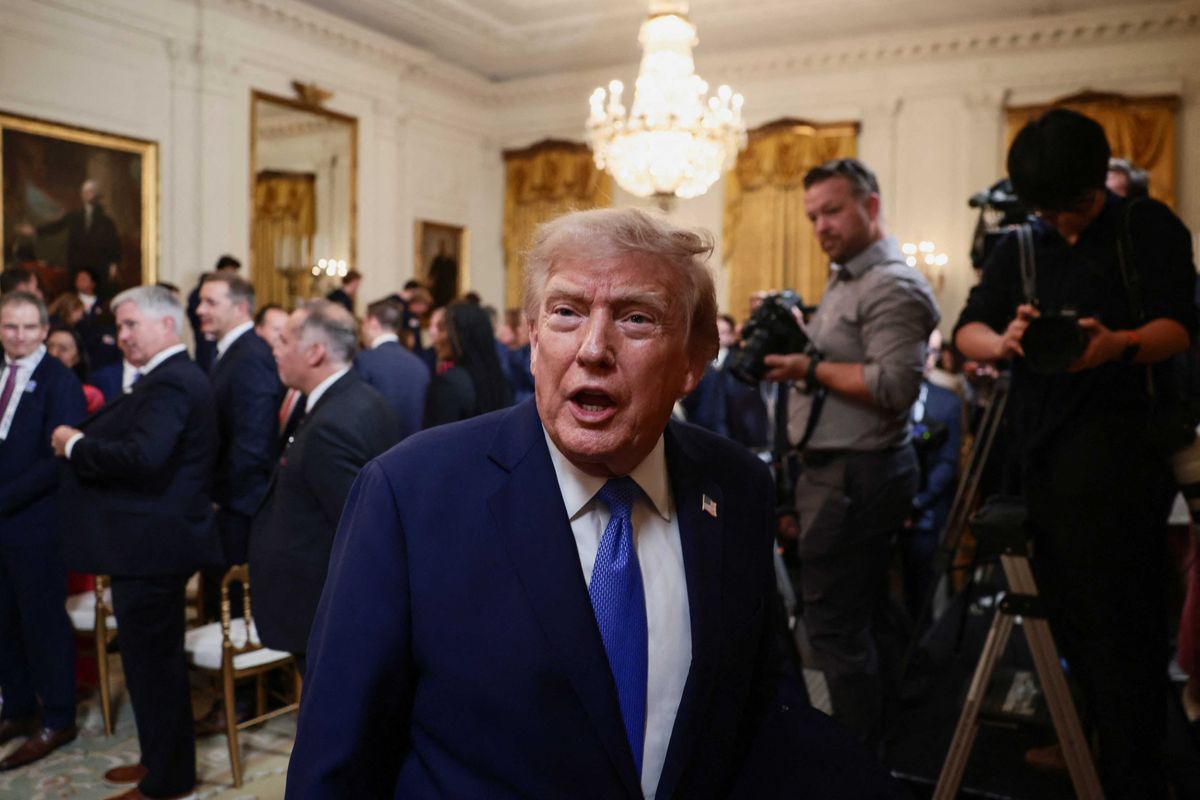
U.S. President Donald Trump speaks to the media as he leaves after a Team USA reception hosting athletes who competed for Team USA at the 2026 Winter Olympic and Paralympic Games in Milano Cortina, Italy, in the East Room at the White House in Washington, D.C., U.S., August 6, 2026. REUTERS/Evelyn Hockstein
An economist sounded the alarm on the Trump administration's "desperate attempt" to avoid "blaring warnings" from financial markets.
In a Thursday opinion column published by The New York Times, economist Eswar Prasad explained why President Donald Trump and the U.S. Treasury were interested in buying billions of dollars' worth of Japanese yen and intervening in the country's currency policy.
"But they are tied together by one big problem: unsustainably high levels of government debt," Prasad wrote. "Currency market intervention is a desperate attempt by Tokyo and Washington to evade the blaring warnings from financial markets."
Prasad noted, "It's rare for the United States to intervene in another country's currency policy," and "it usually happens because there is a crisis."
However, the Trump administration has been propping up the currencies in allied countries to reward friends and push its agenda.
"It seems risky and expensive to buy another country's currency or even offer to temporarily swap dollars for that currency, especially one whose value is falling," Prasad wrote. "The administration has U.S. economic interests in mind but is also keen to propagate its policies and reward its allies."
Prasad pointed out that the Trump administration "propped up the Argentine peso" in October and discussed similarly intervening in the United Arab Emirates.
"None of those countries had reached the level of emergency usually required," he wrote. "None of these actions were born of benevolence."
According to Prasad, the Trump Treasury is also interested in buying yen to stop it from falling because a weak yen means pricier imports and higher debt costs for Japan, but it also erases Trump's tariffs. However, the U.S. can't outrun its debt, and "with no sign of any discipline on fiscal matters, it will probably result in Washington digging itself into an even deeper debt hole," Prasad wrote.
U.S. President Donald Trump speaks to the media as he leaves after a Team USA reception hosting athletes who competed for Team USA at the 2026 Winter Olympic and Paralympic Games in Milano Cortina, Italy, in the East Room at the White House in Washington, D.C., U.S., August 6, 2026. REUTERS/Evelyn Hockstein
An economist sounded the alarm on the Trump administration's "desperate attempt" to avoid "blaring warnings" from financial markets.
In a Thursday opinion column published by The New York Times, economist Eswar Prasad explained why President Donald Trump and the U.S. Treasury were interested in buying billions of dollars' worth of Japanese yen and intervening in the country's currency policy.
"But they are tied together by one big problem: unsustainably high levels of government debt," Prasad wrote. "Currency market intervention is a desperate attempt by Tokyo and Washington to evade the blaring warnings from financial markets."
Prasad noted, "It's rare for the United States to intervene in another country's currency policy," and "it usually happens because there is a crisis."
However, the Trump administration has been propping up the currencies in allied countries to reward friends and push its agenda.
"It seems risky and expensive to buy another country's currency or even offer to temporarily swap dollars for that currency, especially one whose value is falling," Prasad wrote. "The administration has U.S. economic interests in mind but is also keen to propagate its policies and reward its allies."
Prasad pointed out that the Trump administration "propped up the Argentine peso" in October and discussed similarly intervening in the United Arab Emirates.
"None of those countries had reached the level of emergency usually required," he wrote. "None of these actions were born of benevolence."
According to Prasad, the Trump Treasury is also interested in buying yen to stop it from falling because a weak yen means pricier imports and higher debt costs for Japan, but it also erases Trump's tariffs. However, the U.S. can't outrun its debt, and "with no sign of any discipline on fiscal matters, it will probably result in Washington digging itself into an even deeper debt hole," Prasad wrote.

No comments:
Post a Comment