Cuba’s Caregiving Despite the Blockade
During the same historical period that the United States has targeted Cuba with blockades that last for decades– and now a full blown naval blockade of all energy to Cuba in hopes of collapsing the society at large– Cuba has instead targeted medical cures for stage four lung cancer, radical improvements in diabetic treatments, several Cuban developed vaccines for Covid19 to work around the medical blockade of the island, and most personally for me, improving dementia in general and Alzheimer’s (as well as Parkinson’s) in particular.
Cuba made a turn towards research and development of new medical treatments and other scientific breakthroughs in health during the hard days of the Special Period that followed the dissolution of the USSR and corresponding trade deals. It has borne the most heartening advances in treating the most painful of conditions.
Trying to involve myself in solidarity with Cuba at this moment of extreme US interference and imposed suffering already, accepting the chance to meet and learn from top researchers and scientists about such remarkable stories of hope was an easy decision.
I was my mother’s caregiver when she developed and lived with vascular dementia for almost a decade beyond her independence. Like other caregivers, it profoundly shaped my psyché, my way of seeing the world and my understanding of human values. So too has my time in Cuba over ten visits during the last 27 years.
Researching their breakthroughs showed me incredible data– 84% of those patients on a trial (of over 3 years) have either had their symptoms stabilize (stop declining) or improve, with 54 of the 84% in the improvement category.
Being shown this, in the clearly loved and prioritized medical research facility Centro Immunologico Molecular by teams of almost exclusively women (the top scientists in Cuba are 80% women) helped me understand intellectually– and 9 times out of 10, that’s exactly what I’m going for.
The pie charts used to explain things with the advent of yet another PowerPoint presentation? It worked; I was able to understand enough from my non-scientific perspective to extol the virtues of this treatment to others in a similar boat.
But that’s where my investigation was lacking, and I needed more. I am not a researcher, but even after death, once one becomes a caregiver to someone with dementia? You stay that way forever. That’s the primary lens that the world is seen through.
With or without NeuralCIM, Cuba has always shown rhetorical and real-world priority towards elders and others who are more vulnerable. But I can’t really internalize the effectiveness of the ‘Magic Drops’ without talking to those people who live it.
By live it, I don’t mean the elder or loved one who has been afflicted with dementia. I mean the family, the caregivers, the people around them who see every little tiny variance in their behaviour.
When you are a caregiver, you not only mentally plot their decline, you memorize immediately what just happened prior when something goes better than anticipated. When a bit more of the personality of the individual you look after shows up, however briefly, you examine the music, the room temperature, the food, the drink, medications, company, lighting– all of it. Surely, something that just happened helped that moment exist?
This is the life of a caregiver: you lose track of yourself and become their stand-in. You are a bodyguard, yes… but you are also a brainguard and a heartguard.
So in June, when I returned to Cuba to further research NeuralCIM and bring supplies to assist civilian survival during this oil blockade, what I needed the most was a chance to speak to other caregivers. The family members who live with the patients who are now months or years into taking the medication that slows, stops, and sometimes reverses dementia itself.
For example, I simply cannot trust the second-hand statements of a doctor—or even a scientist– about whether or not the drug reduces stress. Sure, they can explain to me how the ‘monoclonal antibodies’ are being targeted. If they explain it slow enough, I can fake understanding what that means long enough to get out of the uncomfortable moment. But they simply can’t tell me what it’s like to see someone who fought about everything from meals to medications re-learn that they are actually safe and okay, and be able to calm down.
When the test scores around competence return to scores of well above 25 out of 30 on the “mini-mental ” (I, through lessons from experts with long degrees), can understand that means that legally they are able to look after themselves, but when someone who had lost their job goes back to work and is able to be productive and plan a future again? That’s what I emotionally understand, as that is beyond a dream through all of the years of memory markers in caring for my mother.
So when I interview caregivers who say:
“Well, before she started the treatment, I didn’t realise that months earlier she had been getting aggressive. We went to the house with my husband. After she started the treatment, after a couple of months, I noticed that it hadn’t happened again; she has remained stable.”
What I hear from them is great hope. Those were the words of a daughter whose mother had declined to the point of fighting over meals, medication, clothing changes, and more. In other words, someone I understood instinctively.
When a person tries to think, and it doesn’t work, anxiety becomes all-consuming, and this is where the fights between caregivers and those looked after begin. If you can’t understand the need for changing your clothes, you only know that someone is trying to forcibly take them off you, and no sweet-sounding words will change that. The mere dream of gaining stability– no further declines, and a chance to adjust within your current mind– was something too grand, too far into dreamworld to even entertain.
See, I can’t give the terms that are “clinically used,” for example it wasn’t until many years after my mother had been living with me I learned that when many people with dementia, placed in unfamiliar surroundings, will try to go home. The ‘experts’ want me to call it “exit seeking” but I bristle. This doesn’t happen at home, so it’s not mere exits being sought. They are trying to go home.
Dealing with the conflict that arises when an elder has a conviction of an incorrect moment is enough– no joke here– stress to help provoke dementia later in life for the caregiver. So for someone who had previously become aggressive and unable to be alone, to move towards this:
“There are things that sometimes she doesn’t remember, where I put this, where I put that. Well, now, for example, we have a small café in the house, and I know that I cannot leave her in charge, neither selling nor anything like that.
But, well, I say to her: ‘Look, here you have a notebook, you have a pencil. If a neighbour comes looking for something, you tell them to write it down there, and then when I come back…’
Do you understand?
So that if she forgets, she already has it written down there. Because I know that at some point she is going to forget something.”
This type of thing– using mental tricks like leaving yourself notes– is something I am familiar with as someone with Attention Deficit Hyperactivity Disorder to just get through a day, but more importantly, as a caregiver, it is something I tried to do from the first day my mother came home. I had made plans for the telephone company to come over to our home and make installations.
Mom was relaxing in the bedroom, one she knew well. I explained to her multiple times that someone was coming over, and that this note was for them, and to please have them call me if there was an issue and so on. I discussed it with her multiple times. I even got her to say back to me what was going to happen, and then a friend and I went to finish putting other items into storage.
I received a call about an hour later, from the phone company telling me that the woman (my mother) who answered the door was completely convinced that no one was coming, was uninterested in the various explanations going on, and that my friend had to apologize to the worker and rush back to the apartment.
Without the possibility of NeuralCIM types of intervention, this was the first in a line of shocking moments where things went horribly wrong, and stress-filled anxiety took over the home.
My ADHD and stress-addled mind had trouble recalling things for my own life, and now had to remember everything for two entire lives.
Even right from the beginning, being able to deal with the little gaps in between safe and dangerous as a team would have been a transformational gift for the home.
I also spoke with another caregiver, this time of her husband. I asked her how they got involved with NeuralCIM, and why.
“They started doing all the studies on him because I brought him here because I saw that anomaly. In 2024 [two years prior to this interview] they started doing a study, a deep neurological study, MRIs, a lumbar puncture, quite a few tests. And that was when his state was seen, and that is why I see the improvement he has had, because I see that he is maintaining it.”
“Well, he remains as I brought him. I observe that he has never completely lost his mind. Because I brought him here when he was always saying: “I forgot this”, “I forgot that”, “where did I leave it?”.
At the moment, he says: “oh, I forgot,” “let’s go and look for it”. And he finds it.
He continues doing his blacksmithing work, because he is a blacksmith; People still come to look for him, and he still does jobs. He knows who I am, he hasn’t lost his mind, he recognises me. We have our dialogues, our conversations.
There are times when he says to me: “No, why you?”, and I say to him: “No, because I…” normal marriage things. And well, I see that he has maintained his state, that he has had a small improvement, but you could say it is stable. It is stable. He is stable. I don’t see anything else out of the ordinary. He is stable.”
Two years of being able to maintain doing work, going out into the community, remembering the person you married, and so on. These descriptions, revealed to me matter-of-factly, are the baseline of a miracle. To be many years into Alzheimer’s and yet be able to maintain such relations with the society you live in is precisely what caregivers like myself were cautioned to never dream of.
“No matter how well you take care of them, they will keep getting worse.” This is the mantra given to the caregiver at the outset of the journey. It’s a mercy to try and stop you from believing in false miracles. But, thanks to these discoveries, they are no longer false.
So the procedure to get the NeuralCIM treatment must be cumbersome, complicated, and take place in a sterile office several times a week, right? If you took your loved one to Cuba– especially given the current oil blockade of the country– you’d be forced to stay there and make a go of life while the United States is starving the country of basic needs?
“At the moment, through Cuban Medical Services, there are two sites where patients can go. In other words, patients outside of Cuba can go there with the aim of inquiring about the treatment for Alzheimer’s disease (mild or moderate), which is what the use of NeuralCIM is indicated for. These are La Pradera, which is an international health centre, and CIREN, or the International Centre for Neurological Restoration, which is also a centre that has this— this possibility [in western Havana– MS].”
“So there are the two centres for the attention for non-Cuban people. So you can do the procedures via the website, and we will send you the procedure for that, perhaps. And you can be in communication with doctors, and get the orientation for that.”
I asked specifically about international patients– people like my mother ten years ago, what would she need someone like me to do for her?
“Also about the possibility of receiving treatment with NeuralCIM through the commercial department. Which is another route. Because the intention is also to try to expand a little the possibility of other sites being able to provide the treatment with NeuralCIM. Other sites in Cuba that have that possibility, right? To provide service internationally.”
In July of 2026, Marco Rubio and the US regime took direct aim at the Cuban medical system itself. Along with the decades-old lies calling the Cuban doctors who work in other countries serving people in conditions most Western doctors would never endure, Cuba also offers some of these types of medical interventions unavailable elsewhere to international patients. While, unlike for Cuban citizens, it is not free, it most certainly is cost-effective and does two things: It provides hope for families in the most heartbreaking situations, and it provides capital for the population of Cuba to secure needed food, medicines, and multiple other resources.
This is why the US government targets the Cuban medical system itself. For most of us, myself included, this means our needed efforts are to bring much-needed resources into the country and help civilians survive this brutal siege. For family members who desperately need the hope and treatments that Cuba is now offering?
They need to be able to travel to the country, visit with the experts at La Padera, and to begin the process that allows their elders to see them in the eye, recognize them, and say “Thank you.” And we thank Cuba by helping them feed their children, hydrate their elders, and defend their independence.
Cuba: Where is the Russian oil? The truth that Moscow silences

First published in Spanish on Eduardo Miguel Álvarez Estévez’s Facebook. Translation by Jackson Remple for LINKS International Journal of Socialist Renewal.
Russia says it is Cuba’s strategic ally. They repeat it at every summit. In every communiqué. On every anniversary of our bilateral relations. But the oil is not arriving. The ships do not appear. And the electric power blackouts continue to happen.
You asked me to find out why. This is what I have found.
The fact: The oil supply has collapsed
Since May, the flow of Russian oil to Cuba has virtually disappeared. The Anatoly Kolodkin arrived in Matanzas carrying 730,000 barrels thanks to a humanitarian exemption that Washington granted sparingly. It was the last Russian tanker to reach Cuba. The Universal, which was following the Kolodkin with 270,000 barrels of diesel, was left adrift in the Atlantic for weeks. It finally unloaded its cargo in Venezuela. The Sea Horse diverted to Trinidad and Tobago. The shipping companies that had previously transported Russian crude to Cuba simply stopped doing so.
This was no accident. It was a decision.
The reason: The US naval blockade
On May 30, United States Secretary of State Marco Rubio issued a warning that reverberated throughout the world’s ports. Any vessel, flying any flag, that was carrying Russian oil to Cuba would be sanctioned. Not just the ship. But also the shipping company, the insurer and the bank that was financing the operation. Everyone.
The US did not send its Navy to intercept the ships. It did not need to. It was enough for it to threaten the companies that were involved in international maritime trade. No shipping company is prepared to risk being cut off from the dollar-based financial system for the sake of a single shipment to Cuba.
Russia knows this. That is why its ships are not arriving in Cuba.
The uncomfortable truth: Moscow is not prepared to escalate
This goes to the heart of the question. Militarily, Russia has the means to escort an oil tanker to Matanzas. It has nuclear submarines and frigates carrying hypersonic missiles. It also has long-range bombers. But it is not sending its tankers to Cuba with military escorts. Not because it cannot, but because it does not want to pay the political and military price of a direct confrontation with the US Navy in the Caribbean.
As far as Russia is concerned, Cuba is a pawn on the geopolitical chessboard. It is a means of applying pressure on Washington. A base for strategic bombers. An anti-imperialist symbol that helps Russia gain prestige in the Global South. But Cuba is not a vital priority for Russia. It is not Ukraine. It is not the Arctic. It is not on Russia’s immediate border.
When the going gets tough, Moscow chooses its battles. And the battle to supply oil to Cuba is not on its list of priorities.
The Kremlin’s silence
What is most revealing is not what Russia says but what it does not say. It has not forcefully condemned the US oil blockade in the United Nations Security Council. It has not threatened to retaliate against Washington. The Kremlin has not declared a statement saying that “we will guarantee supplies to our strategic ally whatever the cost may be.”
Instead, a diplomatic silence prevails. Meanwhile, the official communiqués continue to speak of “strategic cooperation” and “brotherhood between peoples”. But those lovely words will not turn a stove on or keep a hospital running.
What I believe
Your question is a fair one. The answer is harsh. Russia stopped sending oil to Cuba because the US banned the rest of the world from doing it, and Moscow is not willing to defy that ban with actions, only with words.
Is Russia a strategic ally of Cuba? In speeches, yes. In practice, when sanctions bite, everyone fends for themselves.
I am not writing this out of anger. I am writing it out of realism. Because long ago the Cuban Revolution learned that international solidarity is important, but only we can guarantee our own survival.
If Russian oil does not arrive, we will manage without it. Just as we managed in the 1990s, when the Soviet Union vanished overnight and they said that Cuba would fall within weeks. We did not fall then. We will not fall now.
Because our strength does not lie in Moscow. It lies within us.
Fatherland or Death. We shall prevail.
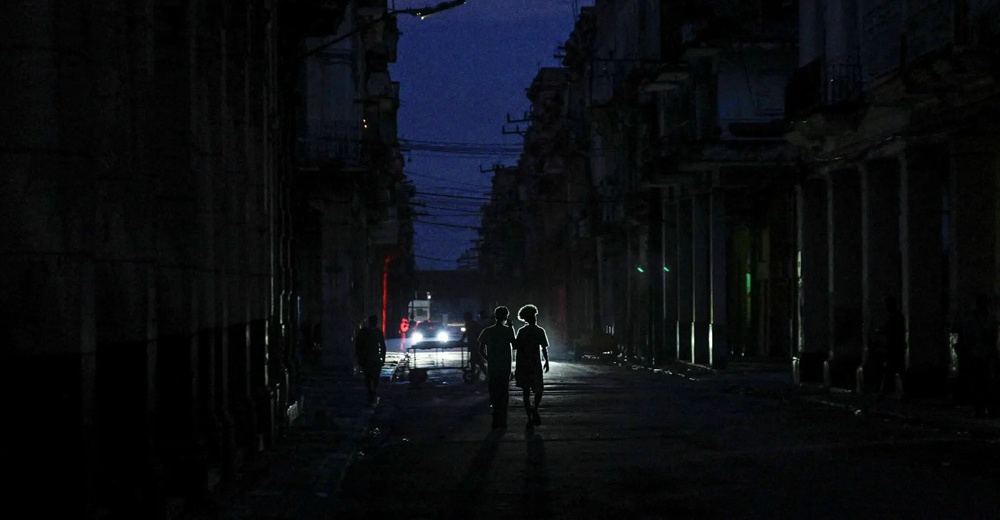
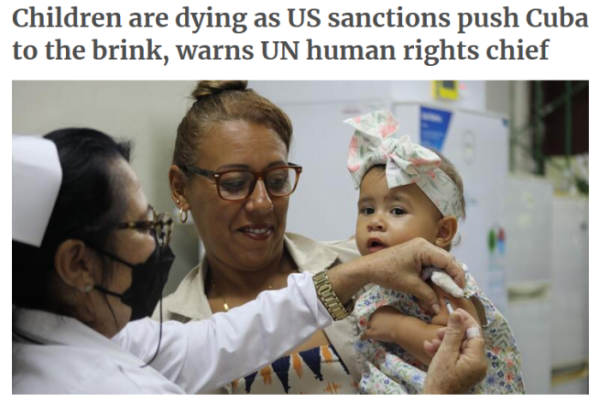
The energy blockade that the Trump administration has imposed on Cuba is hammering the island. As UN High Commissioner for Human Rights Volker Türk (UN News, 6/8/26) recently pointed out:
The fuel restrictions imposed since early 2026 and recent tightening of extraterritorial sanctions, taken together, are directly harming Cubans, especially the most vulnerable. Children are dying because doctors lack access to essential medical supplies and medicines…. These sanctions must be lifted immediately.
Broad swaths of the US media’s chattering class have taken a different angle, suggesting that the Cuban government is the primary—if not the sole—cause of the pain being inflicted on the country. The function of such propaganda is to justify the US’s economic warfare: If the Cuban government can’t run the country, the logic goes, then the US is right to try and bring it down.
It’s the same narrative pushed by US officials and Cubans in exile, who together constitute the large majority of sources in news coverage of Cuba from prominent US outlets, as a recent FAIR study (7/15/26) showed.
Much of the US commentariat is also pretending that the Cuban revolution’s extraordinary achievements have not occurred. Acknowledging them would, of course, get in the way of the narrative that Cuban leaders are so malign and incompetent that the US is obligated to bring about a counter revolution.
‘A golden opportunity’
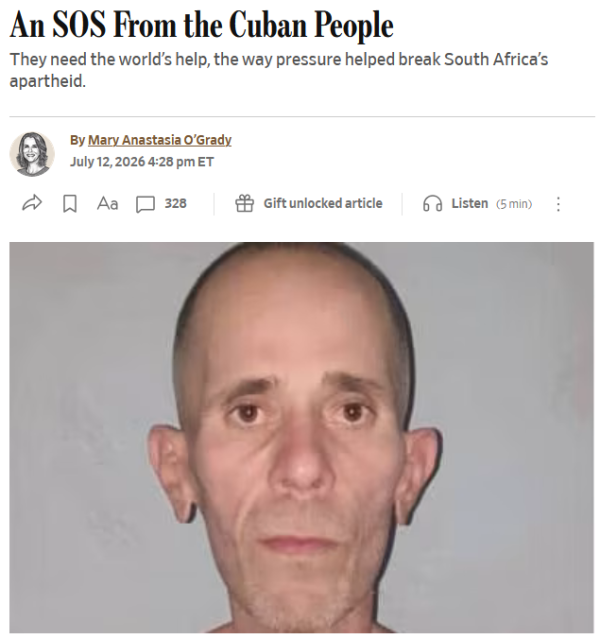
At times, the punditry is explicit in its support for regime change in Cuba. In the Wall Street Journal (7/12/26), Mary Anastasia O’Grady wrote:
Once South Africa ceased to be a Cold War pawn, the economic costs of sanctions imposed by countries across the globe broke the government’s resistance…. Cubans aren’t likely to escape tyranny without a similar leg up from the outside.
The South African apartheid analogy is absurd: Upon taking power, the Cuban revolution made fighting racial discrimination a priority (Black Perspectives, 3/8/16), and Cuba played a crucial part in supporting South Africa’s struggle against apartheid.
But what’s most relevant here is O’Grady’s suggestion that “the outside” is inflicting “the economic costs of sanctions” so that Cubans can “escape tyranny.” As Türk pointed out, this anti-“tyranny” plan involves killing children by depriving them of “access to essential medical supplies and medicines.”
The Washington Post’s editorial board (2/6/26) sounded impressed by the effects of Trump’s siege. “Washington’s pressure on Havana is working,” it wrote:
Cuba looks ready to implode. The island suffers from food shortages, energy blackouts and looming economic collapse. President Donald Trump’s decision to remove Venezuelan dictator Nicolás Maduro from power has cut off the Cubans from what has historically been their main source of oil. Having successfully pressured the Mexican government to also slash oil supplies, Trump has effectively created a blockade that has brought the regime to its knees.
With such extraordinary leverage, it would be unwise to settle for anything less than dramatic change on America’s terms: economic, personal and political freedom for all Cubans.
The paper, in short, cheered the US blockade creating “food shortages, energy blackouts and looming economic collapse” so that Cuba would be forced to make “dramatic change on America’s terms.”
The editors’ assertions relied on a simplistic caricature of personal and political life in Cuba, and on what appears to be an assumption that their readers won’t notice that depriving people of food, energy and even minimal economic security—as the blockade does—also denies them economic and personal freedom. However, the more salient point is probably that the US has no right under the UN Charter to interfere in Cuba’s affairs, let alone to use food as a weapon to restore capitalism, which, as any conservative will tell you, is what “economic freedom” means.
In an op-ed for the Washington Post (2/11/26), former New York Times reporter Lizette Alvarez claimed that “Trump’s love of the deal and Cuba’s imminent collapse present a golden opportunity to finally drive meaningful change on the island.”
Even before the Trump administration intensified the energy blockade at the start of the year, as UN special rapporteur Alena Douhan (11/21/25) noted, the “golden opportunity” created by the embargo had resulted in “the widespread inaccessibility of 69% of medicines to Cubans, including medicine against cancer, heart diseases, repellents, tests for dengue and other infections.”
Alvarez contended that the US “could lift the embargo,” but that “Cuban President Miguel Díaz-Canel would have to agree to deadline-driven reforms,” including “eliminating restrictions that hamper private investment and business.” At no point did the author spell out why she believes that the US is entitled to “drive” change in Cuba, much less deprive Cubans of medicine until they allow “private investment and business” to operate unimpeded.
‘No ring of Navy warships’
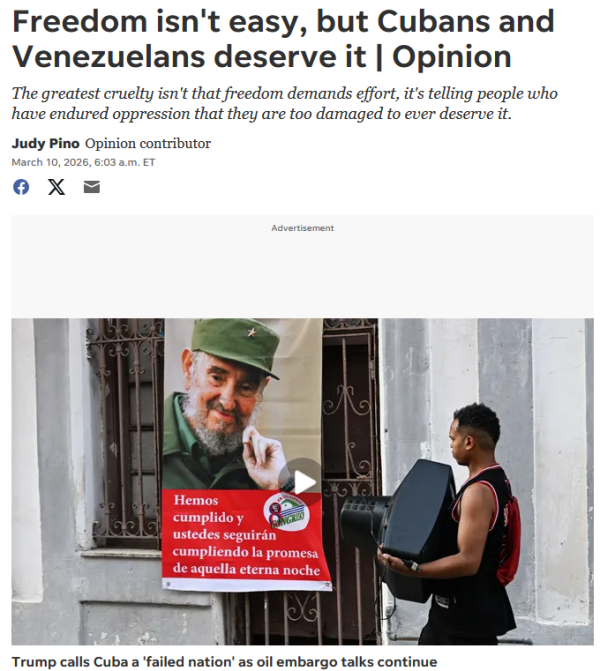
The US began to impose a blockade on Cuba in 1960 to “decrease monetary and real wages, to bring about hunger, desperation and overthrow of government.” Rather than recognize such factors in Cuban suffering, many voices in the corporate media have embraced the political and economic equivalent of flat Earthism.
For instance, Judy Pino (USA Today, 3/10/26) euphemistically referred to Trump’s aggression against Cuba as “pressure on the regime” and said that “daily life [in Cuba] shows the cost of [the Cuban government’s] repression and chronic mismanagement.” In 2018, the UN estimated that the embargo had cost Cuba’s economy $130 billion (Reuters, 5/8/18)—from a country whose entire GDP, according to the World Bank, is $107 billion—but Pino wrote as though that’s not a leading cause of the challenges Cubans are facing.
A Wall Street Journal editorial (7/9/26) wrote that US Ambassador to the United Nations Mike Waltz
took apart the claim that the US blocks Cuba’s access to world markets. “If there’s an embargo, a blockade, whatever name they want to put on it, how did humanitarian aid from Belize, Canada, Chile, China, Colombia, the European Union, Mexico, Spain, Russia, Uruguay and the UN itself reach the country just in the last few months?” Mr. Waltz asked. “There is no ring of Navy warships sitting around this island blocking trade or humanitarian aid going into Cuba. It’s fake. It’s false. It’s a lie. Period.”
Economic blockades don’t require naval encirclements, of course. The Journal gaslit its readers, denying US subversion and writing as if allowing smatterings of aid into Cuba to mitigate the effects of that subversion is the same as permitting Cuba to participate in the global economy.
‘Facts tell a different story’
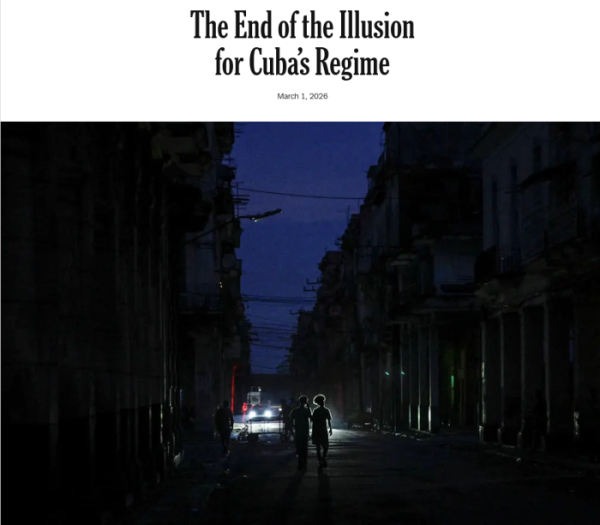
O’Grady (Wall Street Journal, 6/21/26) wrote that “the [Cuban] dictatorship’s excuse for the widespread misery is the same as it ever was: Washington’s Cuba policy. The facts tell a different story.”
The US-based Center for Economic and Policy Research has marshaled quite a few facts that refute O’Grady’s view. CEPR (4/27/26) pointed out that, because the US tightened the embargo during Trump’s first term and the Biden government did next to nothing to ease it, Cuban medical importers have been unable
to obtain at affordable prices many basic medical supplies, such as syringes, inhalers, and even saline solution; more sophisticated medical equipment, such as imaging and ultrasound systems; and inputs for the manufacturing of pharmaceuticals. The redesignation of Cuba as a State Sponsor of Terrorism in 2021 has made it extremely challenging to obtain financing for the purchase of these goods—at any price—or to simply execute international payments to purchase them. The end result of these multiple barriers generated by these sanctions has been massive shortages of medical goods— supplies, equipment, medicines.
Thus, CEPR concluded that “the primary cause” of an
unprecedented rise in Cuba’s [infant mortality rate], and the crisis in its once robust health care system, is almost certainly the hardening of US sanctions that began in 2017 and increased steadily in the years thereafter, with only a minor easing during the Biden administration.
In the New York Times (3/1/26), economist Mauricio de Miranda Parrondo asserted that
the [Cuban] leadership prioritizes political control over the needs of the population. The Cuban economy has suffered greatly for it. The country is no longer capable of producing the basic goods it needs; today it imports most of the food it consumes, despite the fertility of its lands and its long agricultural tradition.
This view ignores US sabotage, a rather significant factor. For instance, a team of UN Special Rapporteurs and Independent Experts pointed out that the US’s groundless decision to classify Cuba as a “State Sponsor of Terrorism” worsens problems in Cuba’s agricultural production
by exerting directly or indirectly more pressure on States and businesses trading with Cuba. In particular, access from abroad to agricultural inputs, including fertilisers, is almost completely blocked, as is the case for spare parts for the maintenance or repair of agricultural machinery and infrastructure.
Thus, the American “leadership prioritizes political control [of Cuba] over the needs of the [Cuban] population.”
Erasing Cuba’s accomplishments
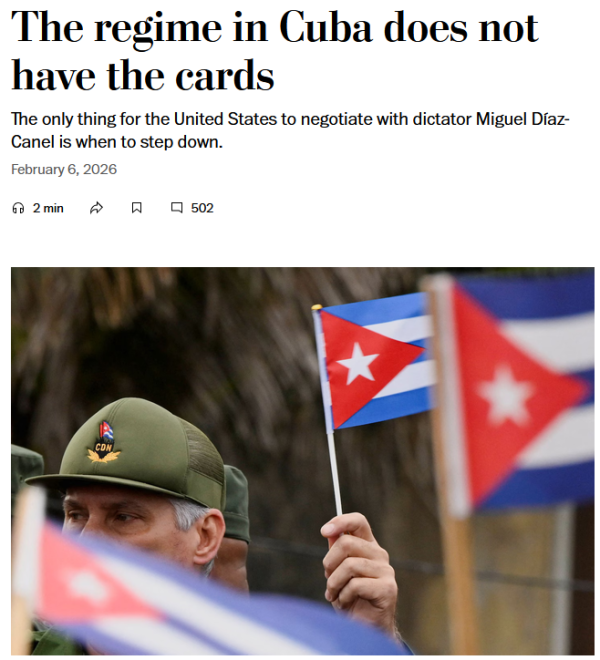
Corporate media outlets rarely admit that Cuban socialism achieved a great deal despite US aggression.
The Washington Post (2/6/26) argued that Cuba’s “67-year experiment with Communism has been an abject failure.” Consider the most recent rankings from the UN Human Development Index (HDI), which measures long-term progress in three key dimensions of human development: a long and healthy life, access to knowledge, and a decent standard of living. Based on 2023 data, Cuba was classified as having a high level of human development and ranked 97th out of 193 countries and territories. While conditions in Cuba appear to have deteriorated since the US enacted the oil blockade earlier this year, faring well on the HDI very recently makes clear that it’s absurd to say that Cuba’s last 67 years have been nothing but an “abject failure.”
Alvarez (Washington Post, 2/11/26) said Cuba has an “unworkable Communist economic system.” But it wasn’t long ago that Cuba had the same rate of infant mortality as Canada, and a better one than the United States. That suggests that it’s the US that has an unworkable capitalist economic system, particularly when one considers that Cuba successfully cared for its infants under the US embargo, and the US itself faced no such aggression.
George Will of the Post (6/24/26) claimed that “the only good [Communist Cuba’s] evil ever produced” is the memoir of Armando Valladares, an opponent of Fidel Castro’s government who later served as US ambassador to the United Nations during the Reagan and first Bush administrations.
For Will, it seems, it was “evil” to provide vital support to Haiti, Indonesia and Pakistan after devastating earthquakes hit each of these countries (Al Jazeera, 2/16/10). It was “evil” to fight Ebola in West Africa (Time, 11/5/14) and Covid-19 in Italy (Reuters, 3/22/20) at the peak of the pandemic nightmare. Helping liberate Angola, Namibia and South Africa from colonialism, imperialism and apartheid (Warscapes, 4/11/16; Jacobin, 5/20/22)? That’s “evil” too, apparently.
‘Disastrous policies of the socialist experiment’
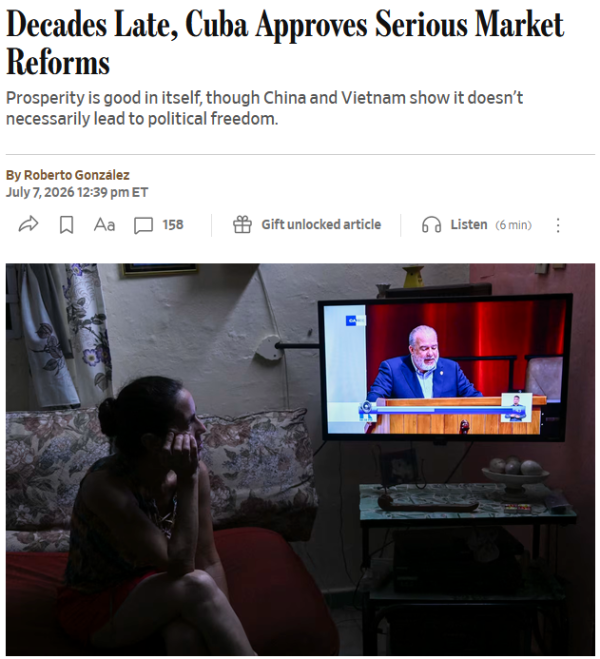
In the Wall Street Journal (7/7/26), Roberto González declared, “For more than six decades, Cuba has been one of the few places on Earth where the disastrous economic policies of the socialist experiment persisted.” Yet in Subalternity vs. Hegemony: Cuba’s Outstanding Achievements in Science and Biotechnology, 1959–2014 (Springer, 2016), the scholars Angelo Baracca and Rosella Franconi noted that
the Cuban government had an unusual level of commitment to scientific and technological development, and a long-term vision to support health biotechnology, despite difficult economic conditions.
Through the “crusade the [Cuban] government has carried out in favor of more education and scientific research,” the country had developed “innovative, world-class products,” Barracca and Franconi noted. By 2018, Cuba held 1,200 international biopharmaceutical patents, and sold medicine and equipment to more than 50 countries (Institute for New Economic Thinking, 3/5/18). But there’s no room for such non-disasters in Gonzalez’s narrative.
It’s easy to tell that none of these commentators sincerely wanted Cubans to overcome the challenges they’re facing. If they did, they’d call for the simplest way to quickly enable the country to build on its past successes. That, to state the painfully obvious, is to end both Trump’s energy blockade and the longer-term embargo.
Instead, they stuck to a cruel, reactionary script: simultaneously gloss over the misery that the US is subjecting Cuba to, and all the good that Cuba has done for itself and the world, to create the impression that Cuba needs to be liberated by its US torturers.

No comments:
Post a Comment