Wednesday, August 19, 2026

When Machines Search For Discoveries, Science Has To Count The Search – OpEd


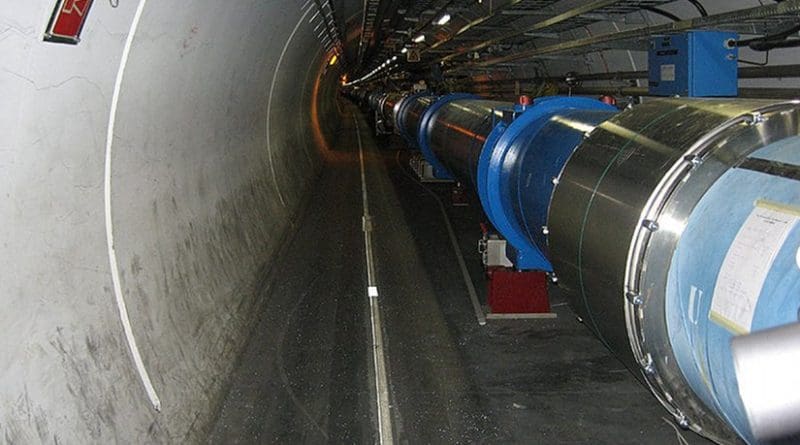
A section of the LHC (Large Hadron Collider). Photo by alpinethread, Wikipedia Commons.

August 19, 2026

By Burak Oktenli

Key Takeaways:

The 750 GeV LHC photon excess illustrated the classic “look-elsewhere effect”: a locally impressive anomaly can lose significance once the full breadth of a search is accounted for.

Adaptive AI pipelines amplify this problem because they generate and prune hypotheses during the search, making the true multiplicity hard to see if only the winning result is reported.

Robust AI-assisted discovery requires logging the full search trace, calibrating against realistic null replays, freezing rules before final confirmation, and disclosing search history so machine-scale exploration remains scientifically accountable.

AI systems can scan millions of hypotheses before surfacing one anomaly. The statistical evidence must account for the search that produced it.

In late 2015, physicists at CERN found something irresistible in the new data from the Large Hadron Collider: an excess of photon pairs near 750 GeV, where no known particle was expected. ATLAS reported a local significance approaching four sigma for one interpretation of the bump. CMS saw a smaller compatible excess. For a few months, the possibility of a new particle became one of the hottest questions in high-energy physics.

Then the 2016 data arrived. The bump did not. CERN concluded that the much larger data set had failed to reproduce the excess and that it appeared to have been a statistical fluctuation.


The episode was a vivid lesson in a problem particle physicists know well: the look-elsewhere effect. A peak can look impressive at one location while becoming much less surprising once you account for all the places a search could have found a peak. The local question is, “How unusual is this result here?” The global question is, “How often would a search this broad find something at least this unusual somewhere?” Those are different probability questions. In the 750 GeV case the gap between them was public at the time. Against its local figure approaching four sigma, ATLAS reported a global significance of roughly 2.3 sigma once the range of masses the search covered was taken into account, and the CMS global number was lower still.

That distinction matters more now because the searching is no longer at human scale.

Machine-learning systems increasingly sweep scientific archives for rare events, faint patterns, useful materials, unusual spectra, and unexpected correlations. An adaptive pipeline can change its next move after seeing its last result. It can alter a time window, choose a new frequency band, retrain a model, change preprocessing, generate a new hypothesis, and discard unpromising branches before a human ever sees the final candidate.


Adaptive search does not repeal classical multiple-testing theory. It makes the object that theory must account for much harder to see.

Bonferroni corrections, false-discovery-rate methods, trial factors, selective inference, and related tools remain valuable. But a correction needs a defensible account of the family or search process. In an adaptive AI pipeline, that family may be generated while the search is running. The effective number of opportunities for a favorable anomaly may be buried in the trajectory of the search rather than written in a methods section.

A pipeline that reports only its winning anomaly and a local p-value can therefore make a machine-scale search look like a single prespecified test. The failure lies in the reporting rather than in the searching, when a machine-scale search is presented afterward as though it had looked only once.

Science has confronted a related problem before. Genome-wide association studies test enormous numbers of genetic variants for association with disease and other traits. The field eventually converged on an unusually stringent convention, roughly P < 5 x 10^-8 for common-variant GWAS, precisely because a conventional 0.05 threshold would be absurd when a study searches across the genome. The family is not perfectly independent, but the multiplicity is visible enough to be priced.

AI-assisted discovery complicates that bargain. A machine may not start with one fixed list of a million hypotheses. It can create new branches from the data itself. Multiplicity, in that setting, should be measured rather than casually assumed.


Three practices would go a long way.

First, log the search. A scientific AI pipeline should preserve the realized search trace: which data slices it inspected, which preprocessing choices it tried, which models and hyperparameters it tested, which branches it abandoned, and which decisions caused new branches to be created. Search history is part of the evidence. The same four-sigma-looking anomaly means something different after ten opportunities than after ten million.

Second, when independent confirmation is unavailable, replay the full search on a defensible null. Run the same adaptive policy on signal-free, permuted, time-shifted, simulated, or otherwise scientifically justified null data and record the most extreme result produced by each complete search. That can empirically price the breadth of an adaptive procedure without pretending that every branch is independent or forcing a fictional count of “effective tests.” The null must reproduce the features of the real search that determine what can become reportable.

That last condition matters. Null replay is not magic. A beautifully computed global p-value is only as trustworthy as the null model and calibration behind it. If the noise distribution, dependence structure, preprocessing, or instrument state has drifted, a stale threshold can be confidently wrong.

Third, freeze the rule before the final evidence is inspected. If the discovery threshold, search policy, or calibration changes after the result disappoints, the change itself becomes another look. The statistical bar has to travel with the process that generated the claim.

There is also an important escape hatch. If a machine searches freely on development data, freezes one hypothesis, and that hypothesis is tested exactly once on genuinely untouched evidence, the exploratory search need not contaminate the final test. The problem returns when the same evidence helps select and confirm the winner, when the holdout is queried repeatedly, or when no independent confirmation exists.

That is why the solution is not to make scientific AI timid. Search aggressively. Let machines explore parameter spaces humans could never enumerate. Let them generate hypotheses and chase strange corners of data. But separate the freedom to explore from the authority to claim discovery.

Journals already ask increasingly sophisticated questions about reproducibility. Is the data available? Is the code available? Can the analysis be rerun? AI-assisted science suggests a natural next line in that checklist: search availability.

A discovery paper should disclose not only the winning analysis but the search capable of producing it. Show the search family or trace. State whether the final evidence was untouched. Report the multiplicity target. Identify the null calibration. Preserve failed branches when they were eligible to become the headline result.


Disclosure of that kind is what makes machine-scale exploration scientifically legible, and it is worth the paperwork it costs.

Five sigma was never a law of nature. It was a social technology: a convention built to protect extraordinary claims against the search practices of its era. The search practices are changing. The machines now look farther, faster, and more adaptively than any collaboration of humans could.

That is good news for discovery. But the evidence conventions must keep up. The machine looked everywhere. The paper should say so.


About Burak Oktenli

Burak Oktenli holds an MBA and a Master of Professional Studies in Applied Intelligence from Georgetown University. His research addresses the governance of authority in autonomous and AI-enabled systems, and his writing has appeared at the Modern War Institute at West Point, RUSI, RealClearDefense, RealClearMarkets, and Geopolitical Monitor. He is the author of Authority Architectures for Autonomous Systems, a ten-volume series on how authority in autonomous systems is delegated, monitored and recovered, at authority-architecture.me.
View all posts by Burak Oktenli →
What Does Scaling Down Joint Military Drills By US With South Korea Mean For East Asian Security? – Analysis


File photo of the 2025 US-South Korea Ulchi Freedom Shield exercise. Photo Credit: Army.mil

August 19, 2026

By Dr. Rajaram Panda

Key Takeaways:

The US and South Korea launched the Ulchi Freedom Shield 2026 exercises (17–27 August), expanding focus beyond conventional scenarios to counter drones, GPS disruption, electronic warfare and cyberattacks in response to North Korea’s evolving capabilities.

Pyongyang’s military experience in Ukraine, closer ties with Russia, and continued missile and nuclear development have intensified the perceived threat, while constitutional changes formalize South Korea as a separate hostile state.

President Trump’s simultaneous announcement of plans to “substantially reduce” the joint drills, citing costs and his relationship with Kim Jong-un, has unsettled Seoul and raised broader questions about alliance reliability and deterrence on the peninsula.

The United States and South Korea commenced their annual Ulchi Freedom Shield (UFS) exercise from 17 to 27 August 2026, incorporating exercises to counter drones, GSP disruption and cyberattacks as they adapt to North Korea’s evolving capabilities. The allies said in a joint statement that the UFS will test operations and support the South Korean government’s emergency readiness drills. The exercise reflects the changing character of war, including the growing use of unmanned systems, electronic warfare and cyber operations.

The perceptions in both the US and South Korea about threats from North Korea has intensified in recent times after Pyongyang established close relations with Russia following Russian President Vladimir Putin’s visit to Pyongyang in June 2024 and Kim Jong-un’s deployment of North Korean soldiers to fight Russia’s war in Ukraine. This experience by North Korea has helped to further develop and expand its nuclear and missile capabilities and taking an increasingly confrontational position towards South Korea. It transpires therefore that the involvement of North Korean soldiers in Russia’s war against Ukraine is a factor in the changing threat environment.

The drills therefore are intended to focus on sophisticated North Korean threats to the Korean Peninsula and the defence of South Korea. The drills would reflect the growing importance of unmanned systems, electronic warfare and cyber operations. In the drills, about 18,000 South Korean troops took part, a scale similar to previous exercises. The exercise will also test South Korea’s ability to maintain government operations and emergency preparedness during a crisis. This year, the military exercise is intended to go beyond conventional battlefield scenarios.

In view of the gains North Korea earned in warfare technology from its Ukraine experience, both the US and South Korea now feel compelled to prepare for a conflict that may no longer be dominated by traditional artillery and missile exchanges. Disruption of communications, GPS systems, military networks and critical infrastructure could become equally important elements of a future confrontation. North Korean forces return from Ukraine with new battlefield knowledge. Russia too has been providing addition military or technological assistance, thereby helping Pyongyang improve aspects of its own military doctrine and capabilities. For the US and South Korea, this new situation creates a more complicated security environment.

Despite innumerable sanctions imposed against North Korea because of its relentless pursuit of nuclear and missile development programs and marching towards further sophistications, North Korean leader Kim Jong-un is not bothered. Kim knows that nuclear deterrence is the only means of regime survival and in no way is willing to barter away for any incentives. Kim is aware of the fate that Iraq’s Saddam Hussain and Libya’s Mohammad Gadafy and would not like to face a similar fate. Maintaining its nuclear weapons programs and expanding ballistic and cruise missile capabilities, artillery systems and other conventional weapons are the only guarantees for keeping the regime afloat.


North Korea has demonstrated to the world that expanding ballistic and cruise missile capabilities, artillery systems and other conventional weapons are unstoppable. In early August 2026, North Korea fired a short-range ballistic missile banned by the United Nations towards the sea, underscoring its continued testing and development of missile systems. Pyongyang has repeatedly condemned US-South Korean military exercises as provocative and has historically described them as preparations for an invasion. Washington and Seoul, however, maintain that the exercises are defensive and designed to strengthen their ability to respond to an attack.

The on-going drills are likely to reinforce the familiar cycle on the peninsula: North Korean weapons development prompts greater military preparedness by the allies. At the same time, these exercises provide Pyongyang with further justification for expanding its own military capabilities. Interestingly, the exercises are taking place at a time when both Koreas have hardened ties following Pyongyang abandoning previous references to reconciliation and reunification and now define South Korea as a separate and hostile entity. Pyongyang revised its constitution recently and removed references to reunification and defined North Korean territory as bordering South Korea.

At the same time, Pyongyang describes itself as a “responsible nuclear weapons state” and committed to continuing the development of its nuclear capabilities. While this shift represents more than rhetorical escalation, it indicates and vindicates Pyongyang’s views that its nuclear arsenal as a permanent element of its national security strategy rather than simply a bargaining tool for negotiations.


The larger question is, why this US-South Korea joint military exercise is important and what purpose it serves?

One thing remains undisputed, that the exercises extend beyond the number of troops participating. The exercise reflects a broader transformation in how South Korea and the US prepare for a potential conflict when that occurs. For South Korea, the stakes are particularly high. Its densely populated territory and proximity to North Korean artillery and missile systems leave little room for error during a crisis. Seoul takes comfort that the US maintains a major military presence on the peninsula and regards the defence of South Korea as a central element of its Indo-Pacific security commitments.

The truism is that the exercises risk reinforcing the security dilemma that has defined relations on the peninsula for decades. While the US and South Korea view military drills as necessary deterrence, Pyongyang interprets them as evidence of hostile intentions and responds by strengthening its own military capabilities. The latest bonhomie between North Korea and Russia further complicates the matter. This larger geopolitical realignment poses bigger challenge to both Washington and Seoul.

Trump scaling down drills upsets Seoul

Amid the ongoing joint military drills, US President shocked Seoul with his announcement that the US shall “substantially reduce” joint military exercises with South Korea, citing his “very good relationship” with North Korea’s Kim Jong-un. This was his way to punish Seoul after South Korea declined to join the US in the “denuclearisation” of Iran. Trump reasoned that the exercises are not only costly, with much of these costs paid for by the US but sends a signal that is totally inappropriate and hostile. While Trump posted an old photograph of himself and Kim from June 2019, writing the two were great friends, thereby hinting his willingness to have a fourth summit with Kim anytime soon, South Korea’s presidential Blue House said it would continue diplomatic consultations on military cooperation with the US related to the Strait of Hormuz.

The US walking back from the drills was never an option as the same would have carried high cost with relatively little benefit. In order to maintain peace and stability and stem tensions in the Korean peninsula, it is essential for the military forces of both the US and South Korea to remain in perpetual readiness. Therefore Trump has taken the risk of scaling down the drills, which can damage alliance coordination, slow the process of South Korea taking on greater responsibility for its own defence, and weaken deterrence against possible conflicts in Asia. While Trump need to understand that the cost saving from downsizing drills would be marginal, the diplomatic benefits for relations with Pyongyang are doubtful. Seoul would take comfort that about 28,500 American military personnel are stationed in South Korea.

Seoul faces a critical dilemma. Seoul is seized of the fact that Trump was the first ever sitting US President to set foot in North Korea when he visited seven years ago and had two summits with Kim, first in Singapore and then in Hanoi, both yielding with no result. He also crossed the DMZ a fourth time symbolically to please Kim. This time around, Seoul takes a mixed message from Trump’s statement on Kim. If Trump is really keen to bring back Kim to the table, Seoul would be too happy to support. But what would worry Seoul more is Trump’s displeasure that Seoul was unwilling to make direct military or logistical contributions to the US hostilities with Iran. At the same time Seoul would not be too disappointed given that other US allies such as Japan, France and the UK expressed unwillingness to get involved in Trump’s war with Iran.


Seoul is also aware that Trump’s move to downsize joint military exercises with South Korea is not without precedent. Trump had suspended the exercises entirely in 2018, during denuclearisation negotiations with Kim during his first term, saying that the drills were provocative towards North Korea. The exercises were again scaled back in 2020 during the Covid-19 pandemic. It was not surprising therefore when this time too Trump announced to scale down the drills.

Trump’s downscaling threat is a part of the larger US agenda. For quite some time, Trump has been putting pressure on both allies in East Asia – Japan and South Korea – to spend more on their defences and increase their share in security burden, as he feels that the US is providing security to the allies without getting much in return. Seoul has tried to allay US concerns and committed $350 billion investment in the US.

Kim’s larger gambit is to have another summit with Kim Jong-un as soon as possible, as negotiations with Iran falter. He has asked his officials to work out a summit meeting with Kim as early as in November during the Asia-Pacific Economic Cooperation (APEC) summit in Shenzhen, China. Trump may be still aiming at his goal for a Nobel by securing a deal with Kim on dismantling North Korea’s nuclear program.

However, Trump’s desire to have a summit with Kim is likely to remain as a pipedream as Kim’s nuclear arsenal and missile capabilities have expanded since the 2018 Singapore summit and 2019 Hanoi summit. Both talks collapsed after Trump rejected Kim’s demand for sanctions relief without an agreement to dismantle all of North Korea’s nuclear activities. It is estimated that North Korea has around 60 nuclear warheads and enough fissile material for as many as 90. Pyongyang maintains these as its deterrence ability and as insurance for regime survival, and is unlikely to surrender in any circumstance.

Even when talks for a possible summit with Kim are doing the round, Trump’s downsizing the joint military drill is keenly watched by Japan, Russia and China. In particular, China and Russia are dissecting Trump’s foreign policy and how easily the US President could abandon the US allies in East Asia. The defence community in the US have expressed disappointment with Trump’s decision to scale down the drills. Even if Trump is honestly trying to have another summit with Kim, its fate could not be any different than the outcomes of Singapore and Hanoi. The collateral damage would have been he would have lost trust as a dependable ally of South Korea and Japan, compelling both to explore other ways to secure their security. There are also talks that scaling down exercises is a precondition to talks with Kim. As of now, the claim cannot be verified. At a time when both Japan and South Korea host around 54,000 and 28,500 US troops, respectively, Trump’s demands that both cough up more cash for defense, besides issuance of onerous tariffs, and now downsizing the military drills would inevitably fuel doubts about Washington’s commitment to Asia. Kim has shown virtually no interest for talks with Trump, much less on denuclearisation.


About Dr. Rajaram Panda

Dr. Rajaram Panda is former Senior Fellow at Pradhanmantri Memorial Museum and Library (PMML). Earlier Dr Panda was Senior Fellow at MP-IDSA and ICCR Chair Professor at Reitaku University, JAPAN. His latest book "India and Japan: Past, Present and Future" was published in 2024 by Knowledge World. E-mail: rajaram.panda@gmail.com
View all posts by Dr. Rajaram Panda →

THE GRIFT

TRUMP SEC unveils new crypto rules hailed as a win for the digital asset industry

FILE. The seal of the US Securities and Exchange Commission at SEC headquarters in Washington, June 2015
Copyright AP Photo

By Quirino Mealha
Published on

The US Securities and Exchange Commission has proposed a sweeping new framework for crypto assets, offering firms two clear paths to raise money without full securities registration. Industry groups have broadly welcomed the plan, calling its terms considerably more generous than anticipated.

The SEC announced on Tuesday that it had filed a proposal titled "Regulation Crypto Assets", giving crypto entrepreneurs a clearer, considerably lighter route to raising capital under federal securities law, according to the press release published by the regulat

It is the agency's first formal rulemaking dedicated to crypto asset offerings, building on broader interpretive guidance the SEC issued in March, and would spare qualifying issuers the costly registration process required of most public offerings.

At the centre of the proposal sit two new exemptions.

The "startup exemption" would let an issuer raise up to $5 million (€4.3mn) over a four year period without registering the offering.

A second, the "fundraising exemption", would permit raises of up to $75 million (€64.7mn) within any 12 month stretch, though issuers relying on it would still need to publish financial statements and meet ongoing reporting duties.

Both routes ask companies to give investors narrative, principles based disclosures, rather than the dense legal filings typically demanded of public listings.

The proposal also sets out a conditional safe harbour that could eventually place certain tokens outside the legal definition of a security, once an issuer has finished, or permanently abandoned, the managerial efforts it promised investors.

It would also override conflicting state registration rules for offerings made under the exemptions, sparing issuers from having to comply separately with individual state securities regimes.

SEC Chairman Paul Atkins described the package as a "minimum effective dose" of oversight, protecting investors while leaving builders maximum room to innovate.

The reception of the proposal has been largely warm.

Summer Mersinger, CEO of the Blockchain Association, said the move finally delivers the tailored regulatory clarity the sector has sought for years. Cody Carbone, CEO of the Digital Chamber, likewise praised the plan, pledging support in helping the industry expand within the US rather than abroad.

However, the proposal is far from final. It stays open for public comment for 60 days once published in the Federal Register, meaning its provisions could still change, or be scrapped, before any final rule is adopted.

US Senate stalls, regulator steps in

The SEC's move comes roughly a week and a half after the US Senate left Washington for its summer recess without advancing the Digital Asset Market CLARITY Act (H.R. 3633), the industry's flagship bill, which would split oversight of digital assets between the SEC and the US Commodity Futures Trading Commission.

US Senate Majority Leader John Thune filed a cloture motion on the bill on 7 August, but lawmakers departed before a vote was held. That motion is now due to come up again on 15 September, a procedural hurdle rather than a final vote, once senators return.

SEC Chairman Paul Atkins has argued on more than one occasion that only Congress can deliver a lasting, "future-proofed" framework able to survive changes in political leadership, and the Commission says it still backs the bill's passage.

Even so, with its timetable slipping into autumn, the regulator appears to have decided not to wait, instead using powers it already holds to offer the industry some certainty while lawmakers prepare to resume the debate next month.


Unstable hours, unequal health: The hidden health cost of unpredictable work

Workers who juggle volatile work hours that change from week to week may experience adverse health effects that impact their ability to work.
Copyright AP Illustration / Peter Hamlin/AP Photo/AP Illustration / Peter Hamlin


By Giedre Peseckyte
Published on

For workers, unpredictable schedules may be more than an inconvenience. New research suggests that large swings in working hours are associated with poorer health — but the effects differ sharply between men and women.

A new study adds a new dimension to the debate over precarious employment: it may not only be how much people work, but how unpredictably those hours change, that affects he

The study, published in SSM – Population Health, examined over 61,000 working-age Americans using linked data from the US Current Population Survey. It finds that volatile working hours are associated with a greater likelihood of health deterioration among men who remain employed. For women, the health cost is more likely to appear through reduced work, absence or leaving employment for health reasons.

“Job quality matters and involves not only pay, benefits or total hours, but also the work schedule stability and resulting health outcomes — an area that has been underexplored in much of the prior research,” said the study author Sinyee Qianyi Lu.

The study included data on workers who decreased their work hours, interrupted or terminated employment due to health strains — a group that prior studies often excluded.

“Expanding the sample beyond the continuously employed ‘survivors’ brings into focus the broader population that is also at risk,” Lu said.

Participants’ self-rated health status and their month-to-month work hours. Stable workers had relatively consistent schedules, while those whose hours shifted sharply were considered highly volatile.

One example involved a worker whose hours changed from 20 in one month to 60 in the next, stayed at 60 for another month and then fell back to 20.

Differences between men and women

Among men, such a level of volatility was associated with a predicted probability of health deterioration of 38%, compared with 28% for a worker maintaining a stable 40-hour week.

Likewise, the probability of stable health declined steadily, from about 46% to 38%, while the predicted probability of improved health changed little.

“It’s quite loud and clear that it’s not about the absolute amount of work hours,” Liao said. “The problem is more with the proportional change — one week up, next week down.”

“Perhaps people can adjust to the total amount of change, but not to the sudden ups and downs. That’s a different story.”

For women, however, the pattern was different.

Among women who remained employed, researchers found no statistically clear link between volatile hours and worsening self-rated health. But when the analysis included workers who reduced, suspended or left work because of health problems, a different relationship appeared.

The predicted probability of a health-related work limitation increased from about 2.5% to nearly 8% as work-hour volatility rose from its lowest to highest observed levels.

That distinction matters because studies focusing only on people who remain employed can overlook workers whose health has deteriorated enough to affect their employment.

This is known as the “healthy worker survivor effect.” Workers who become too sick to continue working may leave the workforce, leaving behind a healthier group and making workplace risks appear smaller than they actually are.

“The gender-stratified modeling we created in this study confirms sharp differences in the health pathways for men and women: Volatility in employees’ work hours is reflected in on-the-job health deterioration among men — especially at higher weekly work hours — and in health-related work limitations or withdrawal from active employment by women,” Lu said.

“Instability in work hours is not merely a scheduling inconvenience but a gendered, population-level health risk, and that’s why we should care about it.”

Who is automotive giant Stellantis and why did it recall nearly 1 million cars?

FILE - In this file photo taken on Jan. 19, 2021, the Stellantis sign is seen outside the Chrysler Technology Center, Tuesday,, in Auburn Hills, Mich.
Copyright Copyright 2021 The Associated Press. All rights reserved.


By Una Hajdari
Published on

The world's fourth-largest carmaker is recalling nearly 1 million vehicles — its third major safety campaign this year.

Stellantis, the multinational carmaker behind Jeep, Fiat and Peugeot, is recalling almost 955,000 vehicles worldwide after a software fault left rearview cameras unable to display on some models.

The recall is the latest setback for one of the world's biggest carmakers, which is only just emerging from a bruising 2025 marked by heavy losses, a leadership shake-up and thin profit margins.

It also lands just months after two other major recalls at the company, raising fresh questions about how well its sprawling network of brands is integrated behind the scenes.

A merger of giants

Stellantis was formed in January 2021 through the merger of Italian-American Fiat Chrysler Automobiles (FCA) and France's PSA Group, the parent company of Peugeot and Citroën.

The deal, approved by the European Commission the previous December, created what was then the world's fourth-largest carmaker by sales.

The merger was years in the making. FCA's late chief executive, Sergio Marchionne, had been searching for a partner since 2015, arguing that carmakers needed greater scale to absorb the costs of electrification, autonomous driving and tightening emissions rules.

Fiat Chrysler first pursued a tie-up with Renault in 2019, but that deal collapsed amid political concerns from the French government and resistance from Renault's alliance partner, Nissan.

They then turned to PSA, and the two companies agreed to merge in December 2019, targeting annual cost savings of around €3.7 billion.

The combined group brought together some of Europe's most recognisable carmakers under one roof, including Vauxhall in the UK, Opel in Germany, and Peugeot and Citroën in France, alongside Fiat Chrysler's American and Italian brands.

It remains substantially family-controlled. The Agnelli family, which founded Fiat, and the Peugeot family are both major shareholders, alongside the French state's investment bank.

The company is headquartered in the Netherlands, though chief executive Antonio Filosa runs day-to-day operations from Auburn Hills, Michigan.

Stellantis controls 14 brands spanning Abarth, Alfa Romeo, Chrysler, Citroën, Dodge, Fiat, Jeep, Maserati, Opel, Peugeot, Ram and Vauxhall, among others.

It employs around 250,000 people across more than 30 countries and sold 5.4 million vehicles in 2024, generating revenues of roughly €156.9 billion. It remains one of Europe's largest carmakers by market share and one of its biggest industrial employers.

A camera glitch, not a hardware fault

The latest recall stems from radio software, not the cameras themselves. Stellantis found that a fault in the infotainment system could stop the rearview camera image from appearing on the media screen when a vehicle is shifted into reverse.

Of the total, 848,511 vehicles are affected in the US, spanning the 2026 and 2027 model years.

The recall covers the Chrysler Pacifica, Pacifica Plug-in Hybrid and Voyager, the Dodge Charger, several Jeep models including the Cherokee, Compass, Gladiator, Grand Cherokee and Wrangler, and Ram's 1500, 2500 and ProMaster ranges.

A further 82,869 vehicles are affected in Canada, about 7,969 in Mexico, and 15,736 across other markets — though it remains unclear whether any of those fall within Europe.

Stellantis says it has not received reports of accidents or injuries linked to the fault.

The company plans to fix the issue with a free over-the-air software update, meaning most owners will not need to visit a dealership.

A prompt will appear on the vehicle's screen once the update is ready, and written recall notices are expected to reach owners by post from September.

Part of a wider pattern

This is Stellantis's third major US recall of 2026. In June, the company recalled more than 1 million Jeep Wrangler and Gladiator models over a power-steering wiring defect linked to a fire risk.

In July, it recalled a smaller batch of Grand Wagoneer and Wagoneer L SUVs over faulty brake software that could disable electronic stability control.

Backup cameras have also become a recurring headache across the wider car industry.

Since the US mandated the safety feature on all new passenger vehicles under 4,500 kg in 2018, camera-related faults have led to recalls covering roughly 21 million vehicles nationwide, according to an analysis by Bloomberg.

Stellantis has now traced at least three separate rearview camera failures back to radio software rather than the cameras themselves in recent years, pointing to deeper issues in how the company integrates its infotainment systems across brands.

For now, Stellantis is advising affected drivers to rely on their side and rear-view mirrors when reversing until the software fix reaches their vehicle.

MURDERERS INVESTIGATE THEIR MURDEROUS ACTS

Israel opens criminal probes into killings of Hind Rajab and Palestinian medics

Mourners gather around the bodies of eight Red Crescent responders in Deir al-Balah, Gaza, on 31 March 2025.
Copyright (AP Photo/Abdel Kareem Hana,File)

By Greta Ruffino
Published on

Criminal investigations are not being opened into three other incidents involving aid workers from World Central Kitchen and Doctors Without Borders.

The Israeli military said on Wednesday it would open criminal investigations into two high-profile incidents involving the killing of Palestinians during the war in Gaza, including five-year-old Hind Rajab and members of her family, as well as 15 Palestinian paramedics.

The announcement came after the military completed reviews of 150 incidents involving the conduct of Israeli troops in Gaza, with decisions reached in five cases.

The statement did not address several other high-profile killings that the military had previously pledged to investigate, including Israeli strikes on a hospital in southern Gaza in August 2025 that killed five journalists.

The military said it would not pursue criminal investigations into three other incidents involving aid workers from World Central Kitchen and Doctors Without Borders.

How did the killings unfold?

Both Rajab’s killing in February 2024 and the killing of 15 Palestinian medics in May 2025 drew international attention.

Rajab was travelling with six relatives as they tried to flee Gaza City when Israeli troops opened fire on their vehicle. Her 15-year-old cousin, Layan Hamada, called the Palestinian Red Crescent, saying a tank was approaching and that her family had been killed.

Seconds later, further gunfire could be heard before Layan’s screams stopped, according to a recording released by the Red Crescent.

Hind initially survived the attack and remained in contact with the Red Crescent as it sought permission from the Israeli military to reach her. 12 days later, she, her relatives and two medics sent to rescue her were found dead.

The 15 paramedics were killed in Rafah after Israeli troops opened fire on ambulances and other emergency vehicles responding to casualties and searching for a missing ambulance, according to phone footage and the sole survivor.

Their bodies and damaged vehicles were subsequently buried in a mass grave. UN and rescue workers recovered the remains about a week later.

The Israeli military initially said the vehicles were “advancing suspiciously” without headlights or emergency signals. It later revised its account after footage showed the emergency vehicles moving with flashing lights and visible Red Crescent and Civil Defence markings.

“We are not obligated to prove the truth because it is already proven to the whole world,” Eid Azizi, a Palestinian Red Crescent spokesperson, told news agency AP. “We shouldn’t have reached this point if they respected and followed the international humanitarian law.”


At least 100 people may have died after gold mine collapsed in Central African Republic

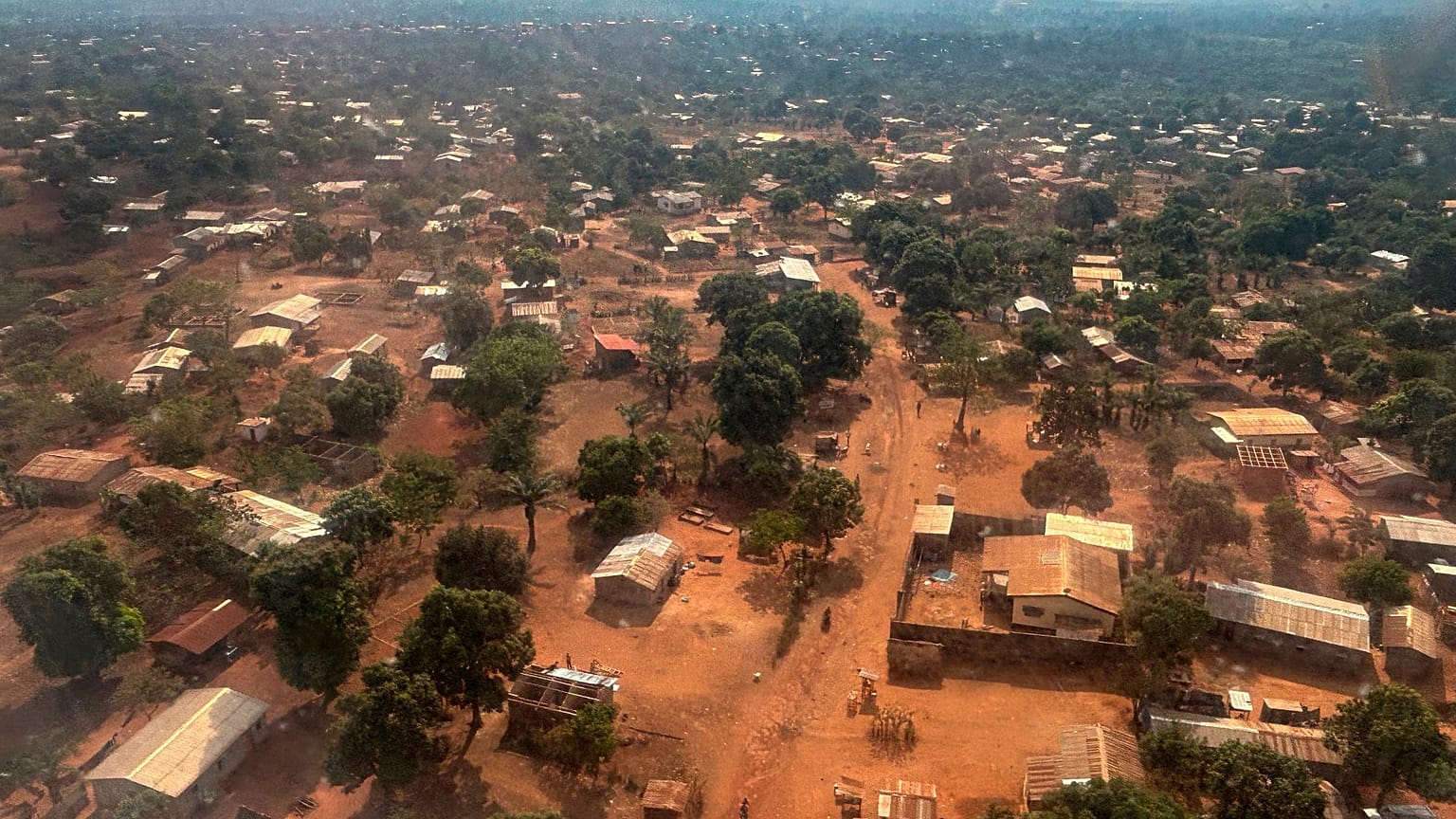
An arial view of Bangui, Central African Republic, is seen on March. 8, 2024.
Copyright Copyright 2024 The Associated Press. All rights reserved

By Nathan Rennolds & AFP
Published on

According to the Baboua public prosecutor, the incident is believed to have been caused by "the collapse of several underground tunnels in which miners were operating."

At least 100 people may have been killed after a landslide at a gold mine in the Central African Republic on Tuesday, local sources have told the AFP news agency.

Search and rescue operations are still ongoing at the Zamboye mining site, near the CAR's border with Cameroon.

Video footage posted to social media appears to show a large mound of earth break away from the side of the mine and slide down into a mass of people, burying some of them.

"At this stage it's difficult for us to establish a formal toll," Laurent Ngon Baba, an elected official from the town of Baboua, told AFP on Wednesday

According to the Baboua public prosecutor, the incident is believed to have been caused by "the collapse of several underground tunnels in which miners were operating."

One miner at the site described the incident as "catastrophic".

"The ground completely collapsed and buried people," he said.

The governor of the eastern Cameroon region, Gregoire Mvongo, said on CRTV radio that Cameroon was "working in close collaboration with our Central African colleagues to deal with the aftermath of this tragedy."


ICC hits back after US announces fresh sanctions on senior court figures

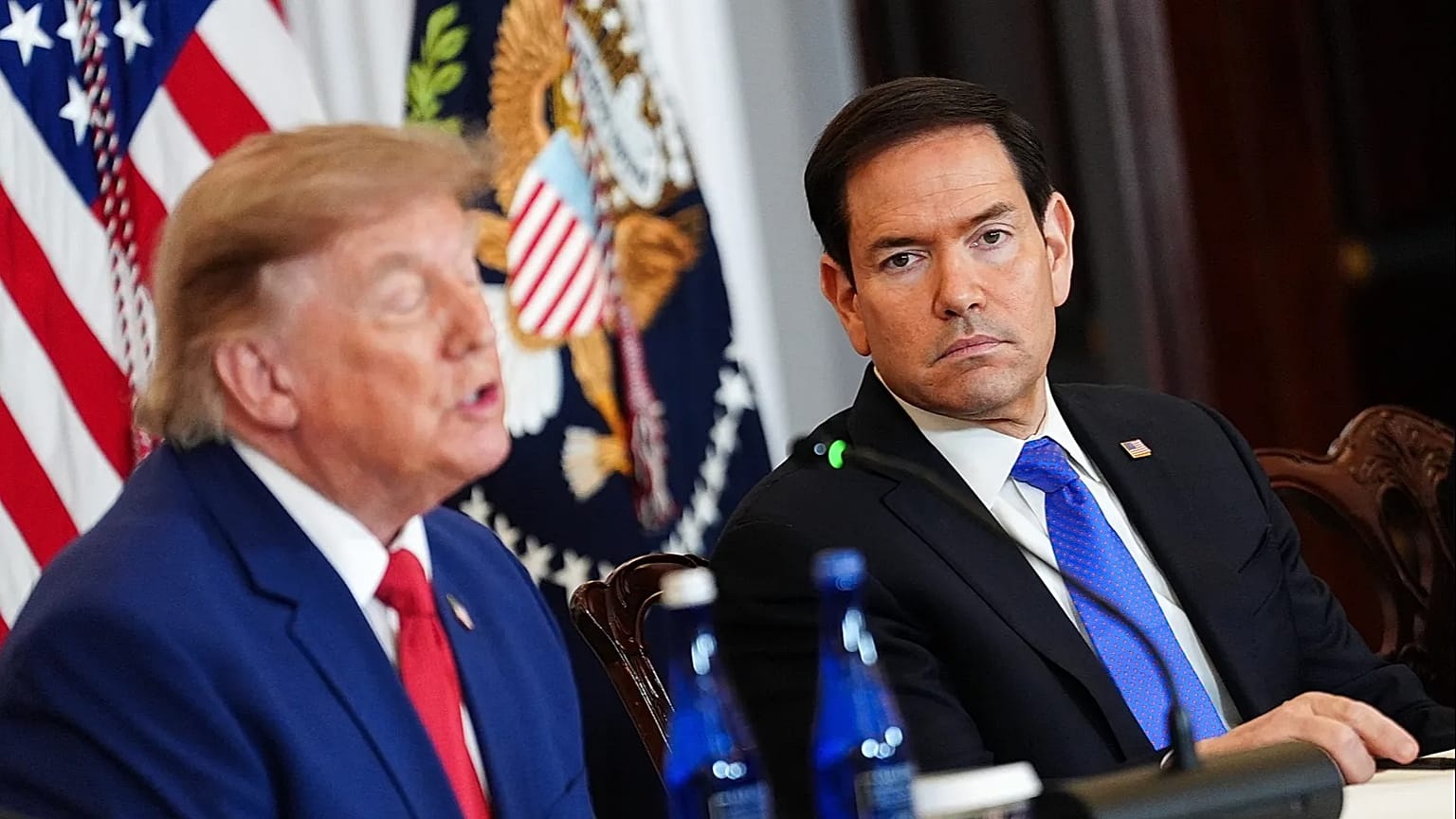
Secretary of State Marco Rubio listens as President Donald Trump speaks during a roundtable on the American mining industry, Friday, Aug. 7, 2026, at the State Department.
Copyright Copyright 2026 The Associated Press. All rights reserved.

By Nathan Rennolds
Published on

Responding to the US' move in a statement, the ICC reportedly said the new sanctions "undermine the rule of law."

Washington on Tuesday announced sanctions against the president of the International Criminal Court (ICC), as the Trump administration ramps up its efforts to "dismantle" the organisation.

In a statement, US Secretary of State Marco Rubio said the US was sanctioning ICC President Tomoko Akane as well as senior trial lawyer Abdoulaye Seye, accusing them of "directly" engaging "in efforts by the ICC to investigate, arrest, detain, or prosecute officials whose government has not consented to ICC jurisdiction."

Rubio, who called the ICC a "corrupt and fatally politicised supranational court," added that it had "maliciously abused its authority and exceeded its mandate," saying it had "repeatedly attempted to assert authority over nationals of the United States and other countries that have not consented to its jurisdiction or ratified the Rome Statute."

Washington has repeatedly accused the ICC of "politicised actions" and of "targeting Israel." The ICC issued an arrest warrant for Israeli Prime Minister Benjamin Netanyahu in November 2024 relating to the war in Gaza.

Responding to the US' move in a statement, the ICC reportedly said the new sanctions "undermine the rule of law."

"When judicial actors are threatened for applying the law, it is the international legal order itself that is placed at risk," it said.

In July, the State Department announced plans to embark on a campaign to bring down the court and "systematically disable" its "ability to operate."

It said actions it could take included increased sanctions and visa revocations, as well as travel bans on ICC personnel.

The US had already imposed sanctions against several members of the court, including a number of judges.


EU leaders rally behind International Criminal Court after fresh US sanctions


By Mared Gwyn Jones
Published on

EU leaders have thrown their support behind the Hague-based International Criminal Court after US Secretary of State Marco Rubio announced new sanctions on senior figures investigating alleged Israeli war crimes.

The presidents of the European Commission and Council, Ursula von der Leyen and António Costa, have issued words of support for the Hague-based International Criminal Court (ICC) after the US administration announced it would sanction top officials investigating Israel's actions in Gaza

"The ICC helps deliver justice to the victims of some of the world’s most horrific crimes," both EU leaders said in a statement.

"To carry out this essential work, its judges and officials must be able to act independently and without external pressure," they added.

On Tuesday, US Secretary of State Marco Rubio announced that the US would sanction the ICC's president, Japan's Tomoko Akane, and senior lawyer Abdoulaye Seye of Senegal, who was tasked with probing war crimes allegedly committed by Israel in its war in Gaza.

Rubio described the court as a "corrupt and fatally politicised supranational court that has maliciously abused its authority and exceeded its mandate", adding that the US would "not tolerate its assault on state sovereignty".

He went on to allege that both officials had engaged in efforts to "prosecute officials whose government has not consented to ICC jurisdiction".

While neither Israel nor the US are member states of the ICC, Palestine has been a member since 2015, allowing the court to examine crimes allegedly committed on its territory.

Earlier on Wednesday, the Netherlands scathingly criticised the US's move, with Foreign Minister Tom Berendsen saying that his government "disapproves" of the sanctions.

A German government spokesperson has also said Berlin stands by the ICC, adding that the court "has held accountable those guilty of the gravest crimes" and is "fulfilling its mandate exactly as intended".

The ICC has described the sanctions as a "flagrant attack" on the court's independence.

The Tuesday sanctions are the latest in a series of recent attempts by the Trump administration to discredit the Hague-based institution.

The US has already sanctioned as many as 11 top court officials, including its former chief prosecutor Karim Khan.

Rubio has previously spoken of the US's wish to "dismantle" the court "brick by brick", and has said he would urge the court's member states to withdraw from the court's Rome Statute.

Venezuela and Chad recently became the latest countries to announce they would pull out of the institution.

The previous Hungarian government led by Viktor Orbán also announced its intention to leave the ICC, before the decision was revoked following Prime Minister Péter Magyar's landslide electoral win in April.

All 27 EU member states are ICC member states.

Yet, the court's arrest warrant for Benjamin Netanyahu continues to draw mixed and often ambiguous reactions from European officials, with countries including France, Germany and Italy refusing to commit publicly to enforcing the warrant should Netanyahu step on their territories.

Some senior MEPs called on the EU to go further in its condemnation of the new sanctions on Wednesday.

The president of the Socialists and Democrats group in the European Parliament, Iratze García, urged the bloc to activate the so-called Blocking Statute, a legal shield that would make it illegal for EU-based companies and banks to comply with the sanctions.

US sanctions have had a profound impact on the daily lives of ICC judges.

French judge Nicolas Guillou told Euronews ealier this year that the lack of European alternatives for crucial services meant that the restrictions he faced would be similar to "true civil death" for a younger European.