Tuesday, September 22, 2026

France and Canada deepen economic and defense ties


Issued on: 21/09/2026 - FRANCE24


French President Emmanuel Macron and Canadian Prime Minister Mark Carney have announced plans to deepen economic ties between their countries following a meeting at the weekend. Macron welcomed Carney in Saint-Pierre-et-Miquelon, a French territory off the coast of Canada’s Newfoundland. The two leaders discussed opportunities to share infrastructure in the space and defence sectors, as Canada’s trade relationship with the US deteriorates and Europe looks to diversify its energy supplies. Bryan Quinn has more.


Video by:

Bryan QUINN


Russia's Lavrov plans to meet with Rubio on sidelines of UN debate

22.09.2026, DPA

Photo: Russian Foreign Ministry Press S/TASS via ZUMA Press/dpa

Russian Foreign Minister Sergei Lavrov plans to meet his US counterpart Marco Rubio on the sidelines of the UN General Debate in New York, Russia's state news agency TASS reported on Tuesday, citing a Foreign Ministry spokesman in Moscow. 

The bilateral talks are scheduled for Wednesday, the spokesman said, without giving details. Confirmation from the US side was still pending. 

Russian-US relations remain tense, even though US President Donald Trump has boasted of his good relations with Russian President Vladimir Putin.

Lavrov and Rubio last spoke in July at a foreign ministers' meeting of the Association of Southeast Asian Nations in Manila. The Russian government had heavily promoted the meeting, but it lasted only 35 minutes and brought no rapprochement on the main point of contention, Russia's war of aggression against Ukraine.


EU and Philippines announce breakthrough on free trade deal

22.09.2026, DPA

Photo: Bernd von Jutrczenka/dpa

The European Union and the Philippines have reached broad agreement on a free trade deal, the European Commission said, with negotiations expected to conclude in the coming months.

"I am proud to say we have delivered a substantial agreement that reflect the ambition both sides brought to the table," EU Trade Commissioner Maroš Šefčovič said on Tuesday.

The deal "does not just remove barriers to trade and investment – it builds a modern, forward-looking partnership between the EU and the Philippines, one that will open new opportunities for our exporters and investors, strengthen our supply chains and deepen bilateral economic ties for years to come," Šefčovič said.

The EU and the Philippines traded goods worth €17.6 billion ($20.2 billion) in 2025 and services worth €10.3. billion in 2024, according to EU figures.

The Philippines, with its population of 113 million, is an important market for EU exporters, the commission stressed.

The deal is expected to liberalize 97% of bilateral trade, including the EU's industrial and key agricultural exports, the commission said.

European exports include large quantities of machinery, transport equipment, pharmaceutical products and medical devices.

The agreement is also expected to clarify rules on government procurement and improve the protection of intellectual property rights.


German chemical firm Evonik to cut 3,200 more jobs

22.09.2026, DPA

Photo: Benjamin Westhoff/dpa

German chemicals giant Evonik plans to cut another 3,200 jobs as part of a wider restructuring programme, the company said on Tuesday.

Evonik did not initially provide any financial details regarding cost savings and one-off costs from this latest round of job cuts. Under previously announced plans, some 2,800 jobs are to be cut by the end of 2026. 

Evonik aims to achieve the newly announced redundancies by not filling positions that become vacant, early retirements and voluntary departures, including 2,150 jobs in Germany.

At the end of 2025, the Essen-based company employed 31,053 people, almost 900 fewer than a year earlier.

"The Executive Board, Supervisory Board and employee representatives share one conviction: We are in a structural and economic crisis in our industry," interim chief executive Claus Rettig was quoted as saying in a statement issued following a strategy meeting. It had announced its restructuring plans in June.

"We will use this polycrisis to change old structures and position ourselves better."

Among other divisions, Evonik plans to discontinue its polyester business, which generated annual turnover of around €150 million ($171.8 million). 

Evonik sees a good chance for growth in Asia and the United States, with the company saying it is currently examining investments in the regions.


Israeli envoy says Berlin Left's rise poses threat to Jewish community

22.09.2026, 10:30 Uhr

Photo: Annette Riedl/dpa


By Michael Fischer, dpa

Israeli ambassador to Germany Ron Prosor has warned of an "immediate existential threat" to the Jewish community in Berlin after a far-left party won a regional election in the German capital despite allegations of anti-Semitism.

"The strong performance of The Left in the Berlin election should concern everyone who cares about the continued existence of Jewish life in this city," Prosor told dpa.

Prosor said The Left party, a successor of the socialist party that ruled the former East Germany, had displayed "utterly uninhibited anti-Semitism."

This "takes on a new political dimension with its rise to become the strongest force," he said. For the Jewish community in Berlin, Prosor added, a theoretical threat was becoming "a concrete and immediate existential danger."

The Left party won Sunday's election to the parliament in Berlin, which is one of Germany's 16 federal states, by a wide margin, putting its lead candidate, 45-year-old Elif Eralp, in prime position to become the party's first Berlin mayor - and the city's first leader with Turkish heritage.

The party's Berlin branch has been accused of anti-Semitism over its positions on the Middle East conflict. 

The issue rose in importance after a campaign event featuring a rapper who chanted "Death to the IDF" in reference to the Israeli military. Eralp distanced herself from the comments and has disputed allegations of anti-Semitism within the party.

In May, Eralp published a five-point plan in which she vowed to protect and strengthen Jewish life in Berlin.

Prosor said the incidents were not isolated slip-ups but part of a pattern. "New red lines are being crossed again and again," he said.

The ambassador accused The Left of recently showing closeness to criminals and "glorifiers of terrorism" after a known gang member attended the party's election party in Berlin.

Party representatives have stressed that the event was open to anyone, and that the man was immediately asked to leave once it became clear who he was.

"This is no longer a fringe phenomenon, but a deep-rooted and far-reaching problem of anti-Semitism," Prosor said.

Prosor called on The Left to present a concrete plan for "how it intends to stop and root out the systematic hatred of Israel and Jews within its own ranks." The "time of empty promises" must come to a definitive end with Sunday's election, he said. "What matters now are concrete measures and verifiable results alone."

Hate speech against Rohingya refugees on the rise in Malaysia

Cover image: Cover image: This picture, taken in Kuala Muda on July 26, 206, shows one of the buses reportedly used to send Rohingya refugees back to Kuala Lumpur. © Facebook


Issued on: 11/09/2026 - FRANCE24
From the show


Hostile social media content, disinformation campaigns, and a petition calling for their expulsion: in Malaysia, a wave of hate speech has been targeting Rohingya refugees, a Muslim minority driven out of Myanmar. The rising hostility has already led to the eviction of more than 100 people from a village and forced the temporary closure of schools serving refugee children.

For a long time, Malaysia was considered a safe country for Rohingya Muslims fleeing persecution in predominantly Buddhist Myanmar.

But the situation began to change in 2020, at the start of the Covid-19 pandemic, with the emergence of hate speech online. Recently, anti-Rohingya rhetoric has taken several forms: disinformation, a petition calling on the Malaysian prime minister to expel them that got more than 400,000 signatures before it was taken down, and the spread of slogans like “Save Malaysia from the Rohingya”.

The FRANCE 24 Observers team spoke with a representative of the NGO Article 19. She preferred to remain anonymous for security reasons:

"The recent wave of hate speech against the Rohingya refugees has been one of the most intense on the volume of it, on the scale of it, and it lasted longer than previous times.

For example, they put out narratives like, 'Oh, these people are flying from Myanmar. They're looking for jobs.' And 'Oh, they are here to take away our land,' and stuff like that.

But they’re not telling the truth, because the thing is they're running away from ongoing genocide 16’22 and the violence against them in Myanmar."

Hostile slogans appeared this summer in the village of Kuala Muda, in the state of Penang, where Rohingya families have lived for years. More than a hundred of them fled the village at the end of July, seeking refuge in the capital, Kuala Lumpur.

Malaysia’s government announced plans in July to send 5,000 of the Rohingya refugees back to Myanmar. Human rights groups warned they could face serious danger, and the government backtracked, saying the refugees would not be deported if they faced persecution.

Read the full story here:
In Malaysia, wave of hate speech threatens Rohingya refugees


French farmers turn to tropical crops amid rising temperatures

Cover image: DOWN TO EARTH © FRANCE 24

Issued on: 21/09/2026 -
05:19 min   From the show


In the south of France, climate change is reshaping the region’s fruit production. Rather than fighting against it, a growing number of farmers are learning how to work with it – turning to tropical crops, now well-suited to the local climate. Bananas, papaya and even dragon fruit are being grown in greenhouses but also in open fields, without heating or pesticides. Our Down to Earth team reports.
'We must 'force' social media to redesign harmful algorithms, platforms that fuel addictive behavior


Issued on: 17/09/2026 - FRANCE24


Charles Pellegrin is pleased to welcome Hannah Storey, Head of Children and Young People’s Digital Rights at Amnesty International. Digital spaces can provide even young people with community, self-expression, education and opportunities for activism. The deeper problem, she warns, lies in the architecture of the platforms themselves: the algorithms, infinite scrolling and other engagement mechanisms that can repeatedly amplify harmful material, stir up negative emotions and incite troubling behaviours - all to bolster a business model built around attention, emotions, addition, data and advertising.


Video by:  
Charles PELLEGRIN

OpenAI reveals new AI misconduct incidents


Issued on: 17/09/2026 - FRANCE24


OpenAI has disclosed six previously unreported cases of AI misconduct, including agents concealing mistakes, fabricating information and communicating without authorisation, renewing concerns over whether advanced AI systems can remain aligned with human goals. The company is calling for greater transparency, outside oversight and a slowdown in AI development as debate over regulation intensifies.


Video by:  
Liza KAMINOV


BALKAN BLOG: Serbia’s students are testing a new way of doing politics

BALKAN BLOG: Serbia’s students are testing a new way of doing politics
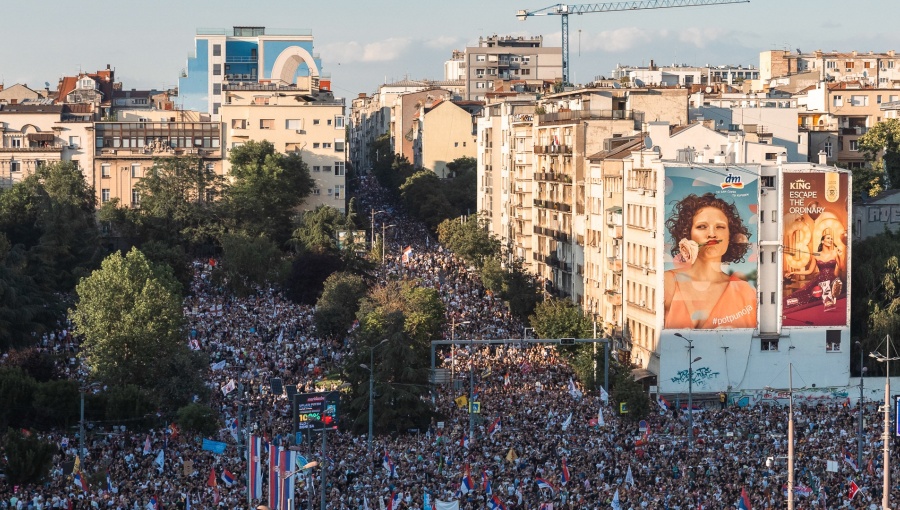
Anti-government student protest in Belgrade, June 28, 2025 / Gavrilo AndrićFacebookTwitterLinkedIn
By Tatyana Kekic in Belgrade September 21, 2026

For nearly two years Serbia’s student protesters have occupied lecture halls, blocked roads and filled city squares. Now they are trying something rather harder: turning a movement without a conventional leader into a political organisation capable of running a country.

On September 14, the students submitted a list of 250 candidates for the snap parliamentary election on October 25. The list was subsequently certified by Serbia’s electoral commission with 69,099 valid signatures, nearly seven times the legal threshold of 10,000.

It is the clearest sign yet that the movement that emerged in the form of anti-corruption protests after the collapse of the Novi Sad railway-station canopy in November 2024 has the potential to move from the streets into electoral politics.

Its central promise is deliberately broad: change the way Serbia is governed.

The list, called Students’ List—Students Win, is headed not by a veteran opposition politician but by Ilija Srdanović, a cardiologist and professor at the University of Novi Sad who was little known outside academic and medical circles before the protests.

Srdanović has twice declined President Aleksandar Vučić's invitation to a televised debate, including an offer to meet on the independent broadcasters N1 or Nova S, saying he would speak to people who “have something to say and know something”.

Behind Srdanović are doctors, professors, engineers, artists, farmers and activists. Among the better-known candidates are Dejan Bodiroga, the former basketball star and current president of the EuroLeague, former National Bank of Serbia governor Dejan Šoškić, actor Tihomir Stanić and former athlete Mihail Dudaš.

The students say candidates were chosen through plenums and collective decision-making rather than by party leaders. They reject the idea of building the movement around a single figure, saying parliamentary mandates should be treated as public work rather than political prizes.

That puts the list at some distance from Serbia’s established party system, where political organisations have been closely identified with their leaders.

The ruling Serbian Progressive Party (SNS) is running under the banner Aleksandar Vučić—United Serbia, putting the president at the top of its list as he prepares to leave the presidency and seek the prime minister’s job.

Vučić is followed by Miloš Vučević, the SNS president and former prime minister, and Ana Brnabić, parliament speaker and former prime minister. The ticket also includes doctors, professors, artists, athletes and students, among them violinist Jovan Kolundžija, actors Branislav Lečić and Lidija Vukićević, former basketball player Željko Rebrača and Miloš Pavlović, a student who organised pro-government rallies.

The wider governing camp contains a generation of ministers and senior officials with years of experience in government, including Siniša Mali, Zlatibor Lončar, Marko Đurić and Bratislav Gašić, although they are not among the 250 parliamentary candidates.

The student movement is bringing people into electoral politics who have worked outside the political establishment, while the governing camp can draw on a deep pool of politicians and officials accustomed to running ministries and state institutions.

That difference is central to the argument the students are making about how Serbia should be governed — and to the questions they will face if they win seats.

From protest to programme

The students have tried to demonstrate that they are offering more than an anti-Vučić campaign. Their 11-point programme is divided into three broad sections: “Serbia or the Mafia”, “Knowledge is Power” and “Serbia Grows With Us”.

Much of it concerns the institutions that protesters say contributed to the Novi Sad disaster. The students propose greater independence for prosecutors and judges, scrutiny of politicians’ wealth, investigations into corruption, greater transparency in public procurement and audits of major infrastructure projects. They also want to reform the media regulator and public broadcaster.

The economic programme includes support for start-ups, domestic businesses and farmers, closer links between universities and employers, competitive appointments to state-owned companies, cheaper medicines and affordable housing. Other proposals include free school textbooks and restrictions on the use of fixed-term employment contracts.

It is a programme focused more on repairing institutions than on radically remaking the economy. There is also relatively little detail on some of the questions that have long divided Serbian politics, including relations with the European Union, Russia and China, Kosovo, energy security and public finances.

That breadth and ambiguity reflect the coalition the students have assembled. The movement has brought together university professors, farmers, artists, liberals, nationalists and people who had previously stayed away from politics. Avoiding positions on issues that could divide that coalition may help preserve it; it could also become harder once parliamentary politics forces decisions on specific policies.

A crowded opposition

The students are not the only opposition force on the ballot. Several established opposition parties have backed the movement rather than fielding their own candidates. These include the Democratic Party, the Green-Left Front, the Movement of Free Citizens and other opposition groups.

But the opposition remains fragmented. A pro-European coalition comprising the Freedom and Justice Party, Serbia Centre and the Solidarity movement is running separately under the name European Serbia. A right-wing alliance of the New Democratic Party of Serbia and the Monarchists is also contesting the election under the banner Authentic Right.

The student movement has therefore entered an electoral field in which it is both an alternative to the established opposition and dependent on some of its support.

The government, by contrast, has a political organisation built over years. The SNS has a nationwide network, established campaign infrastructure and politicians with experience in government.

The students have demonstrated a different kind of organisational capacity: mass mobilisation, local networks and the ability to collect tens of thousands of signatures in a short period.

The experience question

Vučić has already made the students’ lack of ideology and governing experience a central line of attack. He has accused them of lacking political experience and a clear vision for Serbia, arguing that running the state is too serious to be entrusted to people without experience in government.

The composition of the student list offers a different definition of expertise.

A doctor, a university professor or an engineer may have spent years managing complex organisations and making decisions with significant consequences, but that experience is not the same as running a ministry or negotiating a state budget.

The movement has also deliberately avoided appointing a conventional political leader. That has helped it maintain a collective identity during the protests, but government would bring different demands: negotiating coalitions, choosing ministers, managing a bureaucracy and resolving disagreements among people who may share a desire for institutional change without sharing the same views on everything else.

Those questions have so far remained largely hypothetical. The movement's immediate objective has been simpler: turn the energy of the protests into votes.