Tuesday, September 22, 2026

Romania Probes Far-Right Former Presidential Candidate Georgescu For Fraud


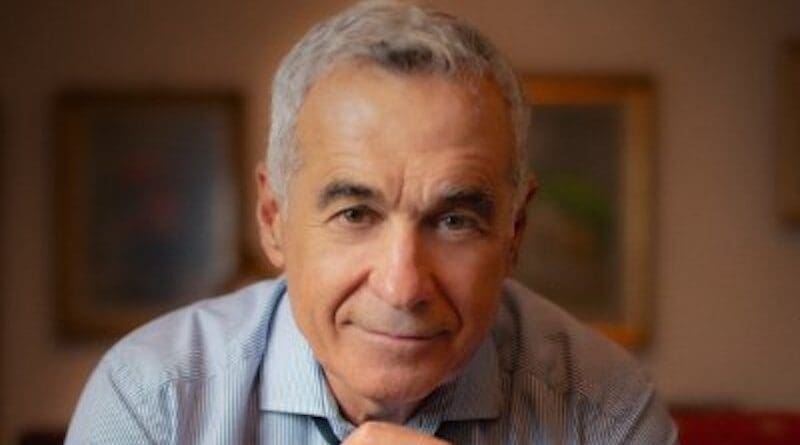
Romania's Calin Georgescu. Photo Credit: Calin Georgescu, X


Key Takeaways:

Romanian police detained far-right politician Călin Georgescu on Monday and anti-fraud teams searched his home and other sites in a DIICOT case alleging he and two others defrauded a businessman of more than €1 million.

Prosecutors say that from September 2021 the group promised a €6 million loan for a guarantee, took about €1 million, then sought another guarantee for a €15 million loan and received €100,000 more; the loan never came. Georgescu has not commented on this case; ally George Simion called it a dictatorship.

It is his third criminal file, alongside probes over fascist rhetoric and a trial for alleged constitutional subversion, false information, and founding an antisemitic group—charges he denies. He won the Nov. 2024 presidential first round, was barred from the 2025 rerun after a court cited foreign influence, and Nicușor Dan later won.


Romanian police on Monday detained far-right politician Calin Georgescu and anti-fraud investigators searched his home and other locations as part of an investigation in which he faces charges of defrauding a Romanian businessman of more than 1 million euros, according to judicial authorities.

“We carried out five residential searches … in a case in which three people acted with the aim of obtaining undue financial benefits,” said Romania’s Directorate for Investigating Organised Crime and Terrorism, DIICOT.

Prosecutors allege that from September 2021, a group allegedly led by Georgescu convinced the businessman that he could obtain a loan of 6 million euros in exchange for providing a guarantee. The victim then allegedly transferred some 1 million euros.

Subsequently, the suspects allegedly told him that the loan could be increased to 15 million euro, but an additional guarantee was required, after which the businessman allegedly transferred another 100,000 euros. The promised loan never materialised.

Georgescu has not issued any statement on this issue but he has previously claimed he was being investigated by the authorities because of his political activities.

His political ally, George Simion, who heads the far-right Alliance for the Unity of Romanians, AUR, condemned the move. “Any of us could be next. Stop the abuses! Romania is a dictatorship!” he wrote on Facebook.

Hundreds of Georgescu’s supporters gathered outside DIICOT headquarters, where he and other people were to arrive for questioning. Authorities have installed protective barriers and deployed gendarmerie units in the area.

This would be the third criminal case against Georgescu. He is already under investigation for endorsing fascist ideas in interviews, online posts and public appearances and also faces trial for complicity to undermine the constitutional order, spreading false information and founding an anti-Semitic organisation.

He denies all the charges.

After he unexpectedly won the first round of the Romanian presidential elections in November 2024, the Constitutional Court ordered a rerun of the vote, citing alleged manipulation of public opinion by a “foreign state”, likely referring to Russia.

Georgescu was banned from participating in the re-run in May 2025, which was ultimately won by centrist Nicusor Dan.
‘Modern Day Slavery:’ Myanmar’s Military Swells Ranks Through Corruption And Deceit – Analysis

 
New recruits from Military Service Training Batch No. 24 upon completing their training in April 2026. (MOI)

September 22, 2026
By RFA

Key Takeaways:

An RFA Burmese investigation, citing more than 30 families and defector Maj. Naung Yoe of MDSI, says Myanmar’s junta has filled post-coup manpower gaps since reviving a 2010 conscription law in February 2024 by capturing and selling young men into service—what he calls “modern day slavery.”

Quotas fall hardest on the poor; substitutes sell for about 10–30 million kyat ($2,500–$7,500). Families describe job lures and street abductions, new IDs to fill other townships’ quotas, ransoms that sometimes fail, and cases such as Zin Win Paing, sold then killed fighting the Arakan Army in May 2026.

MDSI estimates more than 130,000 recruits since 2024. The UN IIMM is examining enforced disappearances as possible crimes against humanity; even a USDP MP in Mandalay called the trade trafficking. Junta officials say unlawful summons will be punished; RFA got no reply from the recruitment body or a junta spokesperson.


The Myanmar military junta’s recruitment practices are “modern day slavery,” an expert from the volatile Southeast Asian country told Radio Free Asia. An investigation by RFA Burmese shows that for more than two years, thousands of young men in Myanmar have been captured, sold, and conscripted in ways that rights groups say may be crimes against humanity.

Ever since the military junta seized power in the 2021 coup, it has faced a growing armed resistance and significant personnel shortages. To fill the gap, the military has resorted to a conscription system, based on a 2010 law, that has resulted in mass human trafficking.

RFA interviewed more than 30 families of people they say were trafficked into the military. Their testimonies reveal that trafficking networks operate at the grassroots level—where young people are captured in every possible way and sold to recruiters for millions of kyat (thousands of U.S. dollars). The scheme involves various actors that include the junta’s low-level administrative officials, immigration officers, police and military officers, ex-soldiers and criminals who have links with the authorities according to interviewees.


“This is modern day slavery,” Maj. Naung Yoe, the military affairs official at the Myanmar Institute for Peace and Security, or MDSI, and a former military officer who defected and joined the anti-coup Civil Disobedience Movement or CDM, told RFA Burmese.

“They are trading people like goods. They are forcibly capturing these people for their own financial gain, treating them like slaves,” he said. “If they refuse to join the army, they are beaten all night.”

The MDSI tracks military recruitment, and said the system provides financial incentives for funneling the country’s youth into active-duty service.

“Once they agree to join, they are held, and then sold to the necessary locations for exorbitant fees,” said Naung Yoe. “We can call this modern human trafficking, a modern slave market.”
Soldiers for sale

The military’s conscription order demands a specific quota of recruits from each village, ward, or township proportional to its population. Findings show that the burden falls disproportionately on the poor. Though technically all men of conscription age – between 18 and 35 – are vulnerable, young men from wealthy families that get the call can pay to make poorer youth serve in their place.


The market price starts at 10 million kyat per person (about $2,500). Those who are healthy and pass the medical examination for military service can fetch up to 30 million kyat ($7,500), according to those who have purchased substitutes.

The people who were interviewed for the RFA Burmese investigation shared details about how the conscription scheme worked.

Ko Kaung, a youth from a suburb of Yangon whose real name is changed here for safety reasons, was working odd jobs to support his family in the volatile post-coup economic situation, a member of his family told RFA.

One day, a friend told him he could get a job loading construction materials for 40,000 kyat (about $10) per day. Ko Kaung accompanied him, hoping to land the job. The friend was actually working with traffickers and Ko Kaung was sold into military recruitment.

“They came to get him, saying there was a job in North Okkalapa township loading construction materials for 40,000 kyat a day,” Ko Kaung’s family member said. “Because there was no other work, he went. We lost contact completely. It was 18 days later that we finally made contact as he joined the military training where he could use a phone. We then learned he had been sold.”

Ko Kaung told his family he was sold to someone in Zayatkwin, Hlegu township in Yangon region; from there he was transported to Kyaing Tong, eastern Shan state bordering the Golden Triangle region, an area at the convergence of the borders of Myanmar, Thailand and Laos that is notorious for human and drug trafficking. It was August 2, 2026 when he could contact the family informing them that he was at military training.


The friend who recruited Ko Kaung allegedly has connections with the military, and currently is stationed at the No. 11 Infantry High-Level Training School, Ko Kaung’s family member said.

The People’s Military Service Law was first introduced and enacted by the previous junta led by Sr. Gen. Than Shwe, on November 4, 2010 in order to address the recruitment shortage in the possible future.

In February 2024, the current junta, led by Sr. Gen. Min Aung Hlaing, implemented the law and formed the Central Body for Summoning People’s Military Servants which would oversee all recruitment activities across the country.

Ko Kaung was recruited by an unknown individual recruitment group and transported to a military training camp under the body.

When RFA contacted the central body for the CBSPMS to inquire about Ko Kaung’s disappearance and illegal forced recruitment on August 17, 2026, no one answered.

Ko Kaung is not alone. Many others were also trafficked and conscripted under similar circumstances.

Zin Win Paing was abducted and sold as a new recruit for military service, his family told RFA. He was captured by a group of people as he came back from work to his home while waiting for a bus in South Dagon Township, Yangon, on March 5, 2025.

According to the family, Zin Win Paing was sold for 15 million kyat ($3,800). He was sent to Infantry Battalion 213 in Hlegu Township, Yangon, and subsequently to the front lines. He was killed in battle against the Arakan Army in Kyaukphyu, Rakhine State, on May 18, 2026.

Aung Ko Ko (a pseudonym) from Htantabin Township, Yangon, was also abducted and sold, his family told RFA. Aung Ko Ko was a welder in the Shwe Lin Ban Industrial Zone of Yangon and was captured while returning home on May 3. The family said he was sold for 12 million kyat ($3,000) to serve in the military for the Maubin Township area of Ayeyarwady Region.
Government corruption

Under the conscription law, every jurisdiction has a recruitment quota proportional to its population, but some of the youth were trafficked to fill the quota of nearby jurisdictions. This requires a change in registration and the issuance of a new national ID to count toward the second jurisdiction’s quota.

Such a change would have been impossible without the participation of government officials.

Zin Win Paing, who died in a battle in Rakhine state, is originally from Insein Township, but was sold to serve under South Dagon Township. Similarly, Aung Ko Ko, from Htantabin Township, was sold to serve for Maubin Township, Ayeyarwady Region. Both received new IDs prior to their conscription.


Interviews conducted by RFA with family members and village representatives reveals a belief that government officials of all levels are working together in collusion at every step of the scheme.

A village administrator from Mandalay Region, who wished to remain anonymous for safety reasons, told RFA that military authorities work together with trusted brokers to make the scheme work.

Pro-junta militia groups and others associated with the military “capture suspicious people or criminals and persuade them to join the army. They hand these kids over to the broker. The military (officers) give the order. The (brokers) then give (the captured recruits) to the administrators,” the local administrator told RFA.

“Since they are captives taken by the military-affiliates, they can be bought for 4,000,000 to 5,000,000 kyat (about $1,000 to $1,250). The middlemen handle the talking, the shifting, and the persuading, then they resell them for around 15 million kyat ($4,000)” the local administrator told RFA.

The local administrator admitted that he, too, had sourced recruits from brokers every three months to fill the conscription quota for his village. If the recruit is from a different township, immigration officials immediately issue a new ID card, receiving payments from the brokers for doing so.

While abductions are carried out directly by the military and police, or by junta-appointed administrators and their associates, the end result is always the same: they are forced into military service.

If families want to avoid their loved ones being sold, they sometimes have to pay hundreds of thousands of kyat in ransom to get them back. A family from Sinbaungwe Township, Magway Region, paid 20 million kyat (about $5000) to release their son after he was abducted last month.

“It is heartbreaking to have to buy back our own lives in our own country,” a family member of one of the victims said. “There is no one to rely on. We have no hope for justice from the leaders or the law because they are the ones openly doing this.”

In some cases, even after paying the ransom, the person is not released and is still sent to military training, resulting in the loss of both the person and the money. These incidents are widespread in areas where military control is strong, including Yangon, Mandalay, and Naypyidaw.

The money is simply too good for many government officials to resist, a lawyer in Yangon, who requested anonymity for security reasons, told RFA.

“I see this as using the law for business profit. This is not a military matter; it is forced, illegal coercion,” the lawyer said. “It is not part of the military service law. If subordinates are abusing this law, the military leaders should investigate and take severe action.”

RFA contacted Daw Khaing Khaing Soe, spokesperson for the former coup leader Min Aung Hlaing, but there was no response.


In state and local parliaments, questions on incidents of forced disappearance and illegal recruitments have been raised but the resulting discussions are often not highlighted by the junta-controlled media.

Meanwhile, the police often do not act on these cases because military officials are involved, Aung Ko Lin Han—a former deputy police inspector in Yangon who defected to the anti-coup Civil Disobedience Movement after serving until late 2025, told RFA.

“Retired army captains and active-duty military personnel—along with what you might call thugs or, essentially, their henchmen—collude to carry out these acts,” he said. “It is true that victims can be ransomed back. If one has the means, they can secure a release based on what they can afford to pay.”

Aung Ko Ling Han said that there have been cases where the police arrested traffickers.

“But we were unable to take action against those belonging to the active-duty military,” he told RFA.
Swelling the ranks

Since the implementation of the Military Service Law in 2024, thousands of young people across the country have been sent to 28 military training centers each month, So far, 28 batches of trainees have been recruited.

MDSI estimates that the military has recruited more than 130,000 new soldiers since the law went into effect, based on a newly imposed national quota of 5,000 recruits per week that was announced in April. RFA was not able to determine exactly how many of these 130,000-plus young people have been subjected to trafficking.

“Myanmar security forces have carried out abductions or detentions without informing families about where they are or their condition,” the United Nations Independent Investigative Mechanism for Myanmar, or IIMM, stated on August 29.

“Their families and loved ones live in uncertainty and anxiety. The Mechanism is investigating reports related to enforced disappearances. Under international law, if enforced disappearances are committed as part of a widespread or systematic attack directed against any civilian population, it may constitute a crime against humanity.”

Concerns about human trafficking have even been raised by politicians who support the military.

In the Mandalay Regional Parliament on August 4, Ko Ko Htwe, a regional member of parliament from the pro-military Union Solidarity and Development Party (USDP), criticized these activities, calling them a massive human trafficking ring.

“Since the initial call-up began, levies labeled as ‘military service fees’ have been collected from every household in the neighborhood, leading to financial issues and corruption,” he said. “Furthermore, these collected funds are being used to ‘purchase’ young people for military service—a practice akin to human trafficking. Consequently, young residents of Mandalay and migrant workers from other regions no longer feel safe.”


When questioned about these issues in the Naypyidaw parliament in July, the Deputy Minister of Home Affairs, Maj. Gen. Min Thu, claimed they were acting systematically and that they would punish those acting outside the law.

“On behalf of the Chairman, and based on the coordinated responses from the Ministry of Defence and the Sagaing Region Government, I state that the People’s Military Service Summoning Body is issuing strict instructions at all levels to prevent summons that do not comply with the law, and that effective action will be taken against any activities that exceed the scope of the law and its bylaws,” the deputy minister said.

USDP spokesperson Hla Thein told RFA that it was necessary to take strict action against the perpetrators.

“If the authorities take action, these things will eventually disappear,” he said. “If people file complaints with concrete evidence, as has appeared in the newspapers, and if it is true, they will take action.”

About RFA
Radio Free Asia’s mission is to provide accurate and timely news and information to Asian countries whose governments prohibit access to a free press. Content used with the permission of Radio Free Asia, 2025 M St. NW, Suite 300, Washington DC 20036.
View all posts by RFA →
France and Canada deepen economic and defense ties


Issued on: 21/09/2026 - FRANCE24


French President Emmanuel Macron and Canadian Prime Minister Mark Carney have announced plans to deepen economic ties between their countries following a meeting at the weekend. Macron welcomed Carney in Saint-Pierre-et-Miquelon, a French territory off the coast of Canada’s Newfoundland. The two leaders discussed opportunities to share infrastructure in the space and defence sectors, as Canada’s trade relationship with the US deteriorates and Europe looks to diversify its energy supplies. Bryan Quinn has more.


Video by:

Bryan QUINN


Russia's Lavrov plans to meet with Rubio on sidelines of UN debate

22.09.2026, DPA

Photo: Russian Foreign Ministry Press S/TASS via ZUMA Press/dpa

Russian Foreign Minister Sergei Lavrov plans to meet his US counterpart Marco Rubio on the sidelines of the UN General Debate in New York, Russia's state news agency TASS reported on Tuesday, citing a Foreign Ministry spokesman in Moscow. 

The bilateral talks are scheduled for Wednesday, the spokesman said, without giving details. Confirmation from the US side was still pending. 

Russian-US relations remain tense, even though US President Donald Trump has boasted of his good relations with Russian President Vladimir Putin.

Lavrov and Rubio last spoke in July at a foreign ministers' meeting of the Association of Southeast Asian Nations in Manila. The Russian government had heavily promoted the meeting, but it lasted only 35 minutes and brought no rapprochement on the main point of contention, Russia's war of aggression against Ukraine.


EU and Philippines announce breakthrough on free trade deal

22.09.2026, DPA

Photo: Bernd von Jutrczenka/dpa

The European Union and the Philippines have reached broad agreement on a free trade deal, the European Commission said, with negotiations expected to conclude in the coming months.

"I am proud to say we have delivered a substantial agreement that reflect the ambition both sides brought to the table," EU Trade Commissioner Maroš Šefčovič said on Tuesday.

The deal "does not just remove barriers to trade and investment – it builds a modern, forward-looking partnership between the EU and the Philippines, one that will open new opportunities for our exporters and investors, strengthen our supply chains and deepen bilateral economic ties for years to come," Šefčovič said.

The EU and the Philippines traded goods worth €17.6 billion ($20.2 billion) in 2025 and services worth €10.3. billion in 2024, according to EU figures.

The Philippines, with its population of 113 million, is an important market for EU exporters, the commission stressed.

The deal is expected to liberalize 97% of bilateral trade, including the EU's industrial and key agricultural exports, the commission said.

European exports include large quantities of machinery, transport equipment, pharmaceutical products and medical devices.

The agreement is also expected to clarify rules on government procurement and improve the protection of intellectual property rights.


German chemical firm Evonik to cut 3,200 more jobs

22.09.2026, DPA

Photo: Benjamin Westhoff/dpa

German chemicals giant Evonik plans to cut another 3,200 jobs as part of a wider restructuring programme, the company said on Tuesday.

Evonik did not initially provide any financial details regarding cost savings and one-off costs from this latest round of job cuts. Under previously announced plans, some 2,800 jobs are to be cut by the end of 2026. 

Evonik aims to achieve the newly announced redundancies by not filling positions that become vacant, early retirements and voluntary departures, including 2,150 jobs in Germany.

At the end of 2025, the Essen-based company employed 31,053 people, almost 900 fewer than a year earlier.

"The Executive Board, Supervisory Board and employee representatives share one conviction: We are in a structural and economic crisis in our industry," interim chief executive Claus Rettig was quoted as saying in a statement issued following a strategy meeting. It had announced its restructuring plans in June.

"We will use this polycrisis to change old structures and position ourselves better."

Among other divisions, Evonik plans to discontinue its polyester business, which generated annual turnover of around €150 million ($171.8 million). 

Evonik sees a good chance for growth in Asia and the United States, with the company saying it is currently examining investments in the regions.


Israeli envoy says Berlin Left's rise poses threat to Jewish community

22.09.2026, 10:30 Uhr

Photo: Annette Riedl/dpa


By Michael Fischer, dpa

Israeli ambassador to Germany Ron Prosor has warned of an "immediate existential threat" to the Jewish community in Berlin after a far-left party won a regional election in the German capital despite allegations of anti-Semitism.

"The strong performance of The Left in the Berlin election should concern everyone who cares about the continued existence of Jewish life in this city," Prosor told dpa.

Prosor said The Left party, a successor of the socialist party that ruled the former East Germany, had displayed "utterly uninhibited anti-Semitism."

This "takes on a new political dimension with its rise to become the strongest force," he said. For the Jewish community in Berlin, Prosor added, a theoretical threat was becoming "a concrete and immediate existential danger."

The Left party won Sunday's election to the parliament in Berlin, which is one of Germany's 16 federal states, by a wide margin, putting its lead candidate, 45-year-old Elif Eralp, in prime position to become the party's first Berlin mayor - and the city's first leader with Turkish heritage.

The party's Berlin branch has been accused of anti-Semitism over its positions on the Middle East conflict. 

The issue rose in importance after a campaign event featuring a rapper who chanted "Death to the IDF" in reference to the Israeli military. Eralp distanced herself from the comments and has disputed allegations of anti-Semitism within the party.

In May, Eralp published a five-point plan in which she vowed to protect and strengthen Jewish life in Berlin.

Prosor said the incidents were not isolated slip-ups but part of a pattern. "New red lines are being crossed again and again," he said.

The ambassador accused The Left of recently showing closeness to criminals and "glorifiers of terrorism" after a known gang member attended the party's election party in Berlin.

Party representatives have stressed that the event was open to anyone, and that the man was immediately asked to leave once it became clear who he was.

"This is no longer a fringe phenomenon, but a deep-rooted and far-reaching problem of anti-Semitism," Prosor said.

Prosor called on The Left to present a concrete plan for "how it intends to stop and root out the systematic hatred of Israel and Jews within its own ranks." The "time of empty promises" must come to a definitive end with Sunday's election, he said. "What matters now are concrete measures and verifiable results alone."

Hate speech against Rohingya refugees on the rise in Malaysia

Cover image: Cover image: This picture, taken in Kuala Muda on July 26, 206, shows one of the buses reportedly used to send Rohingya refugees back to Kuala Lumpur. © Facebook


Issued on: 11/09/2026 - FRANCE24
From the show


Hostile social media content, disinformation campaigns, and a petition calling for their expulsion: in Malaysia, a wave of hate speech has been targeting Rohingya refugees, a Muslim minority driven out of Myanmar. The rising hostility has already led to the eviction of more than 100 people from a village and forced the temporary closure of schools serving refugee children.

For a long time, Malaysia was considered a safe country for Rohingya Muslims fleeing persecution in predominantly Buddhist Myanmar.

But the situation began to change in 2020, at the start of the Covid-19 pandemic, with the emergence of hate speech online. Recently, anti-Rohingya rhetoric has taken several forms: disinformation, a petition calling on the Malaysian prime minister to expel them that got more than 400,000 signatures before it was taken down, and the spread of slogans like “Save Malaysia from the Rohingya”.

The FRANCE 24 Observers team spoke with a representative of the NGO Article 19. She preferred to remain anonymous for security reasons:

"The recent wave of hate speech against the Rohingya refugees has been one of the most intense on the volume of it, on the scale of it, and it lasted longer than previous times.

For example, they put out narratives like, 'Oh, these people are flying from Myanmar. They're looking for jobs.' And 'Oh, they are here to take away our land,' and stuff like that.

But they’re not telling the truth, because the thing is they're running away from ongoing genocide 16’22 and the violence against them in Myanmar."

Hostile slogans appeared this summer in the village of Kuala Muda, in the state of Penang, where Rohingya families have lived for years. More than a hundred of them fled the village at the end of July, seeking refuge in the capital, Kuala Lumpur.

Malaysia’s government announced plans in July to send 5,000 of the Rohingya refugees back to Myanmar. Human rights groups warned they could face serious danger, and the government backtracked, saying the refugees would not be deported if they faced persecution.

Read the full story here:
In Malaysia, wave of hate speech threatens Rohingya refugees


French farmers turn to tropical crops amid rising temperatures

Cover image: DOWN TO EARTH © FRANCE 24

Issued on: 21/09/2026 -
05:19 min   From the show


In the south of France, climate change is reshaping the region’s fruit production. Rather than fighting against it, a growing number of farmers are learning how to work with it – turning to tropical crops, now well-suited to the local climate. Bananas, papaya and even dragon fruit are being grown in greenhouses but also in open fields, without heating or pesticides. Our Down to Earth team reports.
'We must 'force' social media to redesign harmful algorithms, platforms that fuel addictive behavior


Issued on: 17/09/2026 - FRANCE24


Charles Pellegrin is pleased to welcome Hannah Storey, Head of Children and Young People’s Digital Rights at Amnesty International. Digital spaces can provide even young people with community, self-expression, education and opportunities for activism. The deeper problem, she warns, lies in the architecture of the platforms themselves: the algorithms, infinite scrolling and other engagement mechanisms that can repeatedly amplify harmful material, stir up negative emotions and incite troubling behaviours - all to bolster a business model built around attention, emotions, addition, data and advertising.


Video by:  
Charles PELLEGRIN