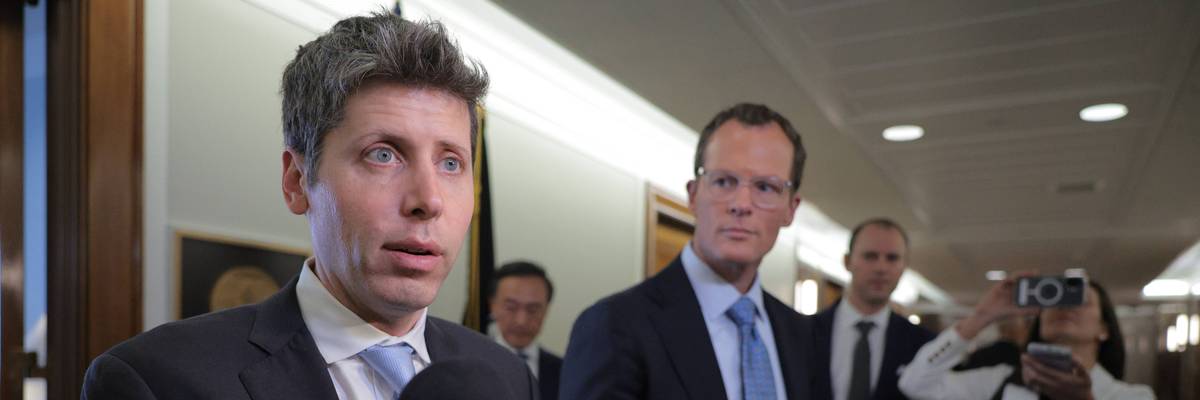
“We believe the consent decree fails to meaningfully address or mitigate the harms that will be caused by this monopoly merger.”
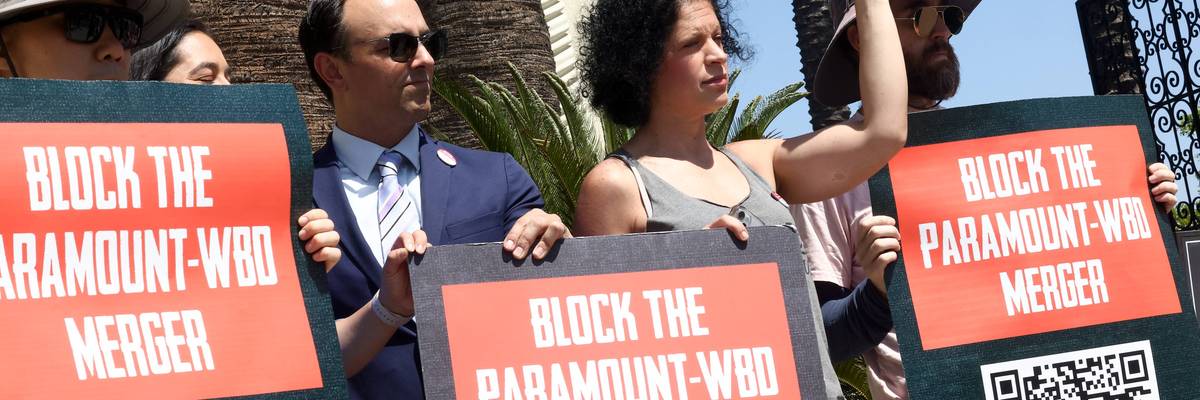
Demonstrators protest the proposed merger of Paramount and Warner Bros. Discovery at Paramount Pictures Studio on September 3, 2026 in Los Angeles, California.
(Photo by Tommaso Boddi/Variety via Getty Images)
Jake Johnson
Sep 24, 2026
COMMON DREAMS
A coalition of advocacy groups fighting the Paramount-Warner Bros. Discovery merger said Thursday that the judge overseeing the case granted their emergency motion to allow opponents of the combination to file briefs against a settlement reached earlier this week by Paramount and a dozen state attorneys general.
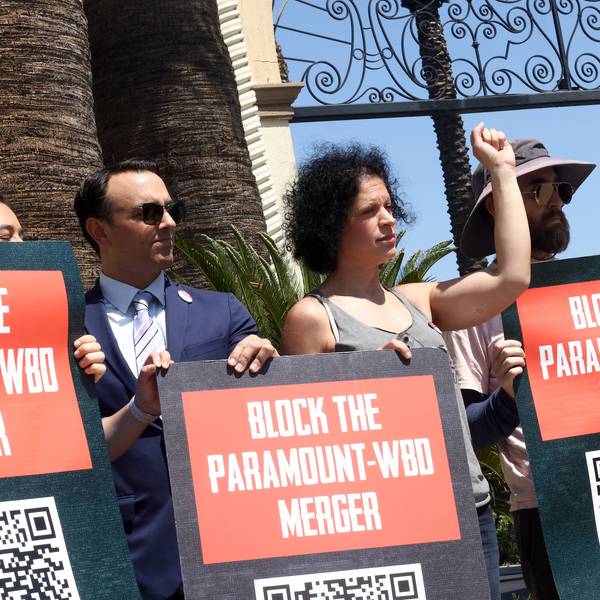
‘Don’t You Dare’: Alarm as State AGs Weigh Deal to Advance Paramount Megamerger
‘Massive Betrayal’: Fury at Newsom and Bonta Over Merger Deal With Paramount
“The consent decree the state AGs agreed to in a backroom deal is weak, unenforceable, and leaves workers, journalists, and consumers in the dust,” members of the anti-merger coalition said in a statement. “The settlement fails to address the grave dangers this merger poses—and no amount of spin can change that. Judge Araceli Martínez-Olguín’s ruling will allow the public to weigh in on this important issue and ensure the interests of those who will actually pay the price for the Ellisons’ sweetheart deal that the AGs failed to adequately represent are heard. We look forward to explaining that in further detail in our brief due at midnight tonight.”
Earlier:
Opponents of Paramount’s proposed acquisition of Warner Bros. Discovery filed an emergency motion in federal court on Thursday asking the judge overseeing the merger proceedings to grant them an opportunity to formally oppose a settlement deal that Paramount reached earlier this week with a coalition of state attorneys general, led by California’s Rob Bonta.
The merger opponents’ filing asks Judge Araceli Martínez-Olguín of the US District Court for the Northern District of California to give them “an opportunity to be heard” before she rules on the proposed consent decree between Paramount and the 12 state attorneys general—a deal that drew widespread outrage. The anti-merger coalition—which includes Free Press, the Committee for the First Amendment, the Future Film Coalition, and other groups—described the tentative deal as “dangerous for democracy.”
The coalition’s filing was submitted shortly before a court hearing that’s scheduled to begin at 2:00 pm ET. Martínez-Olguín set the hearing to “address certain outstanding questions regarding the factual and legal underpinnings of the parties’ proposed consent decree.”
Mara Verheyden-Hilliard, a constitutional rights litigator who serves on the steering panel for the Committee for the First Amendment, said in a statement that “we believe the consent decree fails to meaningfully address or mitigate the harms that will be caused by this monopoly merger to the entertainment industry, diverse storytelling, independent filmmaking, consumer interests, a free press, First Amendment rights, and fundamentally, democracy.”
“It does not serve to benefit anyone except the owner family of Paramount and those holding political power, who will use this corporate consolidation as a proxy force for First Amendment suppression of disfavored expression and viewpoints,” Verheyden-Hilliard added.
Paramount is headed by David Ellison, the son of billionaire Oracle co-founder Larry Ellison, one of the richest people in the world and a megadonor to President Donald Trump.
If Martínez-Olguín approves the proposed consent decree and the merger is finalized, Paramount would control both CBS and CNN, as well as other major media properties such as HBO.
As part of the consent decree, Paramount committed to “News Editorial Independence Boards” for CBS and CNN comprised of five “established journalists.” Critics, including the Freedom of the Press Foundation (FPF), have characterized the proposed editorial independence boards as “worthless” and a potential “First Amendment nightmare.”
“The solution for the Ellisons letting Donald Trump and [Federal Communications Commission Chair] Brendan Carr police journalism is not to let attorneys general and judges police journalism too,” said Seth Stern, chief of advocacy at FPF, part of the anti-merger coalition.
“It’s to keep the government out of the newsroom, period,” Stern added. “No one seriously believes the Ellisons (or their rumored new investor Elon Musk) will do that, with or without a self-appointed sham editorial board, which is why this merger cannot proceed.”
The League of United Latin American Citizens and a group of religious leaders filed a separate motion on Thursday asking Martínez-Olguín to “defer entry of the decree” to “ensure this court has sufficient opportunity to consider the important issues raised” in the case.
“The proposed consent decree raises grave doubts whether the parties’ settlement adequately addresses the harms alleged in the plaintiff states’ complaint,” the filing reads.
Billionaire Trump Suck-Ups Owning More News Outlets Is an Existential Threat
This is critical stuff: no democracy can survive the assault of what Jefferson referred to as “an artificial aristocracy founded on wealth and birth, without either virtue or talents” when only one family or political perspective dominates the media.
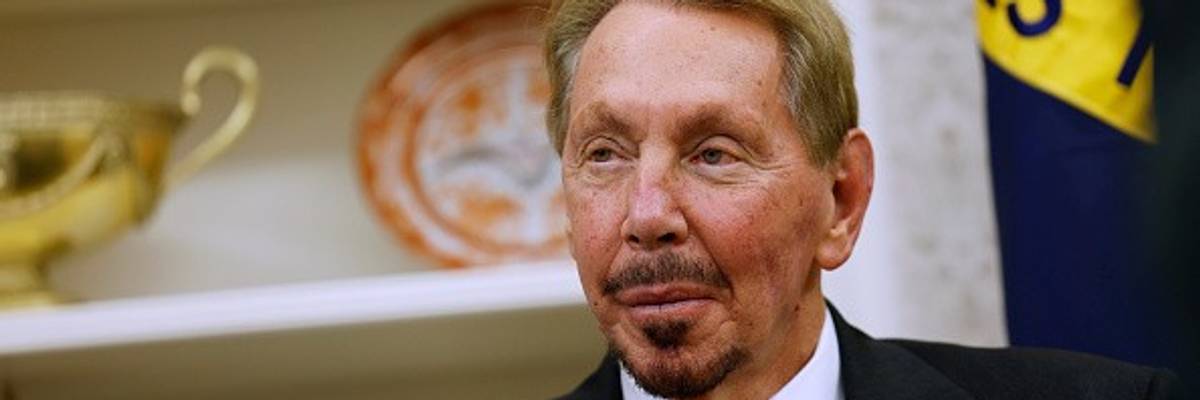
Oracle co-founder, CTO, and executive chairman Larry Ellison listens as US President Donald Trump speaks to reporters in the Oval Office of the White House on February 3, 2025, in Washington, DC.
(Photo by Anna Moneymaker/Getty Images)
Thom Hartmann
Sep 24, 2026
Common Dreams
A CNN insider told Variety magazine yesterday that the mood inside CNN right now is “like a funeral.” Nepo-baby David Ellison, bankrolled by his father who’s one of the richest men in the world and a major Trump suck-up and donor (and is in the Epstein Files), is on the verge of taking over the company that owns the news network.
The day-before-yesterday, California Attorney General Rob Bonta and a group of Democratic state attorneys general rolled over and agreed to stop trying to block the $111 billion takover of Warner Bros. Discovery, now to be almost 50% funded by rightwing dictatorships in the Middle East who’ve given billions in gifts, loans, and investments to Trump and his family.
California Governor and presidential hopeful Gavin Newsom hailed the agreement, saying it would both protect California jobs and preserve CNN’s “editorial independence.”
If you believe that, I’ve got a bridge for you in Brooklyn.
As The Lever reported yesterday, the fine print tells the entire story:
Going forward, CNN and CBS will be overseen by an “editorial independence board” composed of people hand-picked by the Ellisons and their agents. When Rupert Murdoch took over The Wall Street Journal from the Bancroft family back in 2007, he ran the same scam, as CBS News then reported:
“As part of the deal package that cemented Rupert Murdoch’s longstanding effort to acquire Wall Street Journal publisher Dow Jones & Co., the two sides agreed to create an editorial board that would act as a buffer between the media mogul and the newspaper…”
That worked out real well, right?
There are also squishy promises for movies and jobs that are not backed up with any meaningful enforcement mechanism, and all of Ellison’s commitments can be set aside via a force majeure clause that lets Paramount off the hook in the event of “strikes, labor disruptions, [or] economic recessions.” So, all Trump has to do is extend the Iran war another few months to crash our economy and the oligarchs are free to do what they want!
And if that doesn’t happen, there’s still the sunset clause that ends all their commitments in five years. Lee Hepner of the American Economic Liberties Project called it “a countdown to a cliff.”
These are the same billionaires who handed Trump a check for $16 million to “settle” a frivolous lawsuit against 60 Minutes, then cancelled Stephen Colbert’s show days after he referenced that as a “big fat bribe,” then reportedly offered the Trump White House up to $20 million in free “public service announcements” and installed a Trump-humping “ombudsman” at CBS News to police “bias” at the network.
The simple reality is that in every country that’s slid from democracy into strongman rule over the past half-century, the first step was capture of the media by friends of the regime.
And the FCC, run by Trump’s favorite brown-noser Brendan Carr, has blessed Saudi Arabia, the UAE, and Qatar taking a 49.5 percent equity state in the new entity that will control two of the three most important news networks in America.
Don’t expect any future analysis of Saudi involvement in 9/11, critical exploration of what Trump gave up in exchange for a $400 million 747 jet, or the billions that have gone to Kushner and the Trump boys, Uday and Qusay.
Because of momentous decisions made by presidents Reagan and Clinton, freedom of the press in America is now as much an economic issue as a political one. As I laid out in The Hidden History of Monopolies (with a foreword by Ralph Nader), when Reagan came into office 90 percent of the American media landscape was scattered among over 50 companies; now a mere five conglomerates dominate that 90 percent of the media Americans consume.
Reagan stopped enforcing the Sherman Anti-Trust Act (and others) in 1983, leading to the “M&A Mania” of mergers and acquisitions that characterized the late 1980s and 1990s. As a result, there’s not a single major industry in America that’s not dominated by a handful of companies that generally behave like cartels, and the average American family pays an annual “monopoly tax” — in additional costs for pretty much everything — of around $5,000, according to economist Thomas Philippon.
Cell phone service that costs $15 a month in France or $12 a month in Australia bills out at an average of $61.85 per month in the United States. High-speed broadband that’s a bit over $31 a month in France or $36 in Germany (for higher speeds and better reliability than almost anywhere in the United States) averages nearly $70 per month in the US.
Similar metrics are found with pharmaceuticals, airfares, and medical costs, among dozens of other product and service categories.
But it’s most deadly to democracy when it comes to the media.
Since Bill Clinton signed the Telecommunications Act of 1996 — which eliminated most of the rules about how many outlets one family or company could own — oligarchic monopoly of the media has spread its cancerous tentacles into politics, as well, destroying the ability of government to make policy that allows free people to make their own decisions about their own lives.
As Teddy Roosevelt, the great trust buster, said:
“There can be no effective control of corporations while their political activity remains. To put an end to it will be neither a short nor an easy task...”
And as Adam Smith wrote, in Wealth of Nations,
“...the monopoly which our manufacturers have obtained...like an overgrown standing army, they have become formidable to the government, and upon many occasions intimidate the legislature.”
And this is no small project by billionaires who explicitly distrust democracy and want complete control over America and her people. I’ve seen how this works up-close and personal when a Republican billionaire came after a media business I helped start.
In 2003, Louise and I had sold our last business and were retired in Vermont; that Thanksgiving, we drove to Michigan to visit my family for the holidays and all the way there I kept tuning across the radio dial looking for an intelligent conversation to occupy my mind while driving. In city after city, all I could find was Sean Hannity.
The outcome of that trip was my writing the initial business plan for Air America Radio and starting the radio show I’m still hosting 23 years later as a “proof of concept.” We were leasing stations from Clear Channel and reached over 90 percent of America; many credited Obama’s 2008 victory to our being on the air.
So, of course, billionaire Mitt Romney — with an eye to running for president in 2012 — had his company Bain Capital buy up all of the Clear Channel radio stations and, one at a time, take us off the air until we didn’t have enough of a signal to make money selling advertising. The network died in 2010 (and Romney lost).
The people who own the media pipes, in other words, get to decide what flows through them.
Remember when Uber was offering rides for half the price of taxis, until they’d put so many of the taxi companies out of business? Or Walmart offering goods at little to no margin just to drive local competitors out of business? Monopolists and wannabe monopolists understand exactly how this works.
While Rupert Murdoch reportedly lost an average of $80 to $90 million a year for about five years before Fox News turned a profit, he never viewed that as a loss: it was an investment. Economists Stefano DellaVigna and Ethan Kaplan later did the math and found that Fox News succeeded in shifting 3 to 8 percent of its audience toward the Republican Party, which in Florida alone in the 2000 election was worth more than 10,000 votes for George W. Bush in a state he carried by fewer than 600.
Had there been no Fox “News,” in other words, there would have been no war in Iraq or Afghanistan, and thousands of Americans and millions of Iraqis and Afghans would still be alive. And there would have been no Bush tax cuts, so our national debt would be nowhere near so bad. And Al Gore would have done something about the environment.
This is critical stuff: no democracy can survive the assault of what Jefferson referred to as “an artificial aristocracy founded on wealth and birth, without either virtue or talents” when only one family or political perspective dominates the media.
Franklin D. Roosevelt — the Bernie Sanders of his day — saw all of this coming. On April 29, 1938, in his Message to Congress on the Concentration of Economic Power, he told the country what fascism actually is:
“The first truth is that the liberty of a democracy is not safe if the people tolerate the growth of private power to a point where it becomes stronger than their democratic state itself. That, in its essence, is fascism—ownership of government by an individual, by a group, or by any other controlling private power.”
FDR understood that when a monopolized industry gets big enough, its main rival then becomes the government itself because only the government has enough remaining power to break it up. Adam Smith made the same point in Wealth of Nations in 1776, writing that the East India Company and its allies had, “like an overgrown standing army,” become “formidable to the government” and could “intimidate the legislature.”
The simple reality is that in every country that’s slid from democracy into strongman rule over the past half-century, the first step was capture of the media by friends of the regime.
— Four days after Vladimir Putin was inaugurated in May, 2000, ICE-like masked agents raided the offices of Media-Most, the company that owned Russia’s largest independent national TV network (NTV). They threw its owner, Vladimir Gusinsky, in prison on fraud charges and confiscated his stake in Gazprom, then took over the network with the deal finalized in April of 2001. That same year Boris Berezovsky was forced to sell his share of the ORT network to Roman Abramovich, a fellow oligarch but one who’d pledged his total loyalty to Putin. Within a few years, every national channel in Russia was in the hands of the state or a Putin-friendly billionaire, and still are.
— Viktor Orbán’s people were slightly more sophisticated in 2018, having his oligarch buddies buy up media properties after he sued dissenters into bankruptcy by claiming libel. By the following year, the media monitor Mérték estimated that 77.8 percent of Hungary’s news media was directly or indirectly controlled by Orbán’s party, which is why when Péter Magyar successfully ran against Orbán he had to visit virtually every city and town in the country to get around the media blackout on his candidacy.
— In Egypt, el-Sisi was less elegant in his approach to the media. He had his version of the FBI — the General Intelligence Service — use a front company called Eagle Capital to buy up virtually every TV network, radio station, and newspaper in the country. Reporters Without Borders found that a dozen once-powerful media owners were pushed to sell to intelligence-linked companies, while the handful of businessmen who backed Sisi got to keep theirs. The spy agency’s media group now owns the ON, CBC, Al-Hayah, and DMC networks, and those Egyptian journalists who dared criticize the regime all went to prison.
— Rodrigo Duterte in the Philippines used regulatory power the same way Trump lickspittle Brendan Carr’s FCC does. The country’s largest newspaper, the Philippine Daily Inquirer, was forced to sell to a billionaire Duterte ally under threat of imprisonment for breaking “media rules.” Duterte’s rightwing buddies in Congress then refused to renew the broadcast franchise of ABS-CBN, the nation’s biggest network, which had made the mistake of exposing the extrajudicial killings of his so-called drug war. Eleven thousand people lost their jobs, and Nobel laureate Maria Ressa’s little opposition newspaper The Rappler was ordered shut.
Almost without exception, this is the process autocrats use to destroy democracies, as documented brilliantly by people like Timothy Snyder and Ruth Ben-Ghiat.
First the strongman’s friends acquire the newsrooms, then the coverage softens, then the elections start experiencing “anomalies,” and by the time most people notice, there’s nobody left on the air to expose the oligarchs and fascists.
As Thomas Jefferson wrote in 1786:
“Our liberty depends on the freedom of the press, and that cannot be limited without being lost.”
So, here we are. Bonta and Newsom have caved, and only the attorneys general of New York, Connecticut, Massachusetts, and Minnesota tried to hold out. You may want to call your own state attorney general and ask where they were on this case; you should be able to easily find their number with a quick internet search.
We should also contact our members of Congress (202-224-3121) and demand hearings on the FCC’s corrupt behavior, restoration of our anti-trust laws, and a return to the media ownership limits that Clinton blew up in 1996.
And please share this piece and hartmannreport.com with anyone who still thinks it can’t happen here. It has already happened everywhere else that’s seen their democracy disintegrate, and the first thing to go into oligarchic hands was always the news.
Our work is licensed under Creative Commons (CC BY-NC-ND 3.0). Feel free to republish and share widely.
Thom Hartmann
Thom Hartmann is a talk-show host and the author of "The Hidden History of Monopolies: How Big Business Destroyed the American Dream" (2020); "The Hidden History of the Supreme Court and the Betrayal of America" (2019); and more than 25 other books in print.
Full Bio >
A CNN insider told Variety magazine yesterday that the mood inside CNN right now is “like a funeral.” Nepo-baby David Ellison, bankrolled by his father who’s one of the richest men in the world and a major Trump suck-up and donor (and is in the Epstein Files), is on the verge of taking over the company that owns the news network.
The day-before-yesterday, California Attorney General Rob Bonta and a group of Democratic state attorneys general rolled over and agreed to stop trying to block the $111 billion takover of Warner Bros. Discovery, now to be almost 50% funded by rightwing dictatorships in the Middle East who’ve given billions in gifts, loans, and investments to Trump and his family.
California Governor and presidential hopeful Gavin Newsom hailed the agreement, saying it would both protect California jobs and preserve CNN’s “editorial independence.”
If you believe that, I’ve got a bridge for you in Brooklyn.
As The Lever reported yesterday, the fine print tells the entire story:
Going forward, CNN and CBS will be overseen by an “editorial independence board” composed of people hand-picked by the Ellisons and their agents. When Rupert Murdoch took over The Wall Street Journal from the Bancroft family back in 2007, he ran the same scam, as CBS News then reported:
“As part of the deal package that cemented Rupert Murdoch’s longstanding effort to acquire Wall Street Journal publisher Dow Jones & Co., the two sides agreed to create an editorial board that would act as a buffer between the media mogul and the newspaper…”
That worked out real well, right?
There are also squishy promises for movies and jobs that are not backed up with any meaningful enforcement mechanism, and all of Ellison’s commitments can be set aside via a force majeure clause that lets Paramount off the hook in the event of “strikes, labor disruptions, [or] economic recessions.” So, all Trump has to do is extend the Iran war another few months to crash our economy and the oligarchs are free to do what they want!
And if that doesn’t happen, there’s still the sunset clause that ends all their commitments in five years. Lee Hepner of the American Economic Liberties Project called it “a countdown to a cliff.”
These are the same billionaires who handed Trump a check for $16 million to “settle” a frivolous lawsuit against 60 Minutes, then cancelled Stephen Colbert’s show days after he referenced that as a “big fat bribe,” then reportedly offered the Trump White House up to $20 million in free “public service announcements” and installed a Trump-humping “ombudsman” at CBS News to police “bias” at the network.
The simple reality is that in every country that’s slid from democracy into strongman rule over the past half-century, the first step was capture of the media by friends of the regime.
And the FCC, run by Trump’s favorite brown-noser Brendan Carr, has blessed Saudi Arabia, the UAE, and Qatar taking a 49.5 percent equity state in the new entity that will control two of the three most important news networks in America.
Don’t expect any future analysis of Saudi involvement in 9/11, critical exploration of what Trump gave up in exchange for a $400 million 747 jet, or the billions that have gone to Kushner and the Trump boys, Uday and Qusay.
Because of momentous decisions made by presidents Reagan and Clinton, freedom of the press in America is now as much an economic issue as a political one. As I laid out in The Hidden History of Monopolies (with a foreword by Ralph Nader), when Reagan came into office 90 percent of the American media landscape was scattered among over 50 companies; now a mere five conglomerates dominate that 90 percent of the media Americans consume.
Reagan stopped enforcing the Sherman Anti-Trust Act (and others) in 1983, leading to the “M&A Mania” of mergers and acquisitions that characterized the late 1980s and 1990s. As a result, there’s not a single major industry in America that’s not dominated by a handful of companies that generally behave like cartels, and the average American family pays an annual “monopoly tax” — in additional costs for pretty much everything — of around $5,000, according to economist Thomas Philippon.
Cell phone service that costs $15 a month in France or $12 a month in Australia bills out at an average of $61.85 per month in the United States. High-speed broadband that’s a bit over $31 a month in France or $36 in Germany (for higher speeds and better reliability than almost anywhere in the United States) averages nearly $70 per month in the US.
Similar metrics are found with pharmaceuticals, airfares, and medical costs, among dozens of other product and service categories.
But it’s most deadly to democracy when it comes to the media.
Since Bill Clinton signed the Telecommunications Act of 1996 — which eliminated most of the rules about how many outlets one family or company could own — oligarchic monopoly of the media has spread its cancerous tentacles into politics, as well, destroying the ability of government to make policy that allows free people to make their own decisions about their own lives.
As Teddy Roosevelt, the great trust buster, said:
“There can be no effective control of corporations while their political activity remains. To put an end to it will be neither a short nor an easy task...”
And as Adam Smith wrote, in Wealth of Nations,
“...the monopoly which our manufacturers have obtained...like an overgrown standing army, they have become formidable to the government, and upon many occasions intimidate the legislature.”
And this is no small project by billionaires who explicitly distrust democracy and want complete control over America and her people. I’ve seen how this works up-close and personal when a Republican billionaire came after a media business I helped start.
In 2003, Louise and I had sold our last business and were retired in Vermont; that Thanksgiving, we drove to Michigan to visit my family for the holidays and all the way there I kept tuning across the radio dial looking for an intelligent conversation to occupy my mind while driving. In city after city, all I could find was Sean Hannity.
The outcome of that trip was my writing the initial business plan for Air America Radio and starting the radio show I’m still hosting 23 years later as a “proof of concept.” We were leasing stations from Clear Channel and reached over 90 percent of America; many credited Obama’s 2008 victory to our being on the air.
So, of course, billionaire Mitt Romney — with an eye to running for president in 2012 — had his company Bain Capital buy up all of the Clear Channel radio stations and, one at a time, take us off the air until we didn’t have enough of a signal to make money selling advertising. The network died in 2010 (and Romney lost).
The people who own the media pipes, in other words, get to decide what flows through them.
Remember when Uber was offering rides for half the price of taxis, until they’d put so many of the taxi companies out of business? Or Walmart offering goods at little to no margin just to drive local competitors out of business? Monopolists and wannabe monopolists understand exactly how this works.
While Rupert Murdoch reportedly lost an average of $80 to $90 million a year for about five years before Fox News turned a profit, he never viewed that as a loss: it was an investment. Economists Stefano DellaVigna and Ethan Kaplan later did the math and found that Fox News succeeded in shifting 3 to 8 percent of its audience toward the Republican Party, which in Florida alone in the 2000 election was worth more than 10,000 votes for George W. Bush in a state he carried by fewer than 600.
Had there been no Fox “News,” in other words, there would have been no war in Iraq or Afghanistan, and thousands of Americans and millions of Iraqis and Afghans would still be alive. And there would have been no Bush tax cuts, so our national debt would be nowhere near so bad. And Al Gore would have done something about the environment.
This is critical stuff: no democracy can survive the assault of what Jefferson referred to as “an artificial aristocracy founded on wealth and birth, without either virtue or talents” when only one family or political perspective dominates the media.
Franklin D. Roosevelt — the Bernie Sanders of his day — saw all of this coming. On April 29, 1938, in his Message to Congress on the Concentration of Economic Power, he told the country what fascism actually is:
“The first truth is that the liberty of a democracy is not safe if the people tolerate the growth of private power to a point where it becomes stronger than their democratic state itself. That, in its essence, is fascism—ownership of government by an individual, by a group, or by any other controlling private power.”
FDR understood that when a monopolized industry gets big enough, its main rival then becomes the government itself because only the government has enough remaining power to break it up. Adam Smith made the same point in Wealth of Nations in 1776, writing that the East India Company and its allies had, “like an overgrown standing army,” become “formidable to the government” and could “intimidate the legislature.”
The simple reality is that in every country that’s slid from democracy into strongman rule over the past half-century, the first step was capture of the media by friends of the regime.
— Four days after Vladimir Putin was inaugurated in May, 2000, ICE-like masked agents raided the offices of Media-Most, the company that owned Russia’s largest independent national TV network (NTV). They threw its owner, Vladimir Gusinsky, in prison on fraud charges and confiscated his stake in Gazprom, then took over the network with the deal finalized in April of 2001. That same year Boris Berezovsky was forced to sell his share of the ORT network to Roman Abramovich, a fellow oligarch but one who’d pledged his total loyalty to Putin. Within a few years, every national channel in Russia was in the hands of the state or a Putin-friendly billionaire, and still are.
— Viktor Orbán’s people were slightly more sophisticated in 2018, having his oligarch buddies buy up media properties after he sued dissenters into bankruptcy by claiming libel. By the following year, the media monitor Mérték estimated that 77.8 percent of Hungary’s news media was directly or indirectly controlled by Orbán’s party, which is why when Péter Magyar successfully ran against Orbán he had to visit virtually every city and town in the country to get around the media blackout on his candidacy.
— In Egypt, el-Sisi was less elegant in his approach to the media. He had his version of the FBI — the General Intelligence Service — use a front company called Eagle Capital to buy up virtually every TV network, radio station, and newspaper in the country. Reporters Without Borders found that a dozen once-powerful media owners were pushed to sell to intelligence-linked companies, while the handful of businessmen who backed Sisi got to keep theirs. The spy agency’s media group now owns the ON, CBC, Al-Hayah, and DMC networks, and those Egyptian journalists who dared criticize the regime all went to prison.
— Rodrigo Duterte in the Philippines used regulatory power the same way Trump lickspittle Brendan Carr’s FCC does. The country’s largest newspaper, the Philippine Daily Inquirer, was forced to sell to a billionaire Duterte ally under threat of imprisonment for breaking “media rules.” Duterte’s rightwing buddies in Congress then refused to renew the broadcast franchise of ABS-CBN, the nation’s biggest network, which had made the mistake of exposing the extrajudicial killings of his so-called drug war. Eleven thousand people lost their jobs, and Nobel laureate Maria Ressa’s little opposition newspaper The Rappler was ordered shut.
Almost without exception, this is the process autocrats use to destroy democracies, as documented brilliantly by people like Timothy Snyder and Ruth Ben-Ghiat.
First the strongman’s friends acquire the newsrooms, then the coverage softens, then the elections start experiencing “anomalies,” and by the time most people notice, there’s nobody left on the air to expose the oligarchs and fascists.
As Thomas Jefferson wrote in 1786:
“Our liberty depends on the freedom of the press, and that cannot be limited without being lost.”
So, here we are. Bonta and Newsom have caved, and only the attorneys general of New York, Connecticut, Massachusetts, and Minnesota tried to hold out. You may want to call your own state attorney general and ask where they were on this case; you should be able to easily find their number with a quick internet search.
We should also contact our members of Congress (202-224-3121) and demand hearings on the FCC’s corrupt behavior, restoration of our anti-trust laws, and a return to the media ownership limits that Clinton blew up in 1996.
And please share this piece and hartmannreport.com with anyone who still thinks it can’t happen here. It has already happened everywhere else that’s seen their democracy disintegrate, and the first thing to go into oligarchic hands was always the news.
Our work is licensed under Creative Commons (CC BY-NC-ND 3.0). Feel free to republish and share widely.
Thom Hartmann
Thom Hartmann is a talk-show host and the author of "The Hidden History of Monopolies: How Big Business Destroyed the American Dream" (2020); "The Hidden History of the Supreme Court and the Betrayal of America" (2019); and more than 25 other books in print.
Full Bio >
‘Massive Betrayal’: Fury at Newsom and Bonta Over Merger Deal With Paramount
“Today, billionaires have yet again bribed, censored, and bullied their way to the top.”
“Today, billionaires have yet again bribed, censored, and bullied their way to the top.”
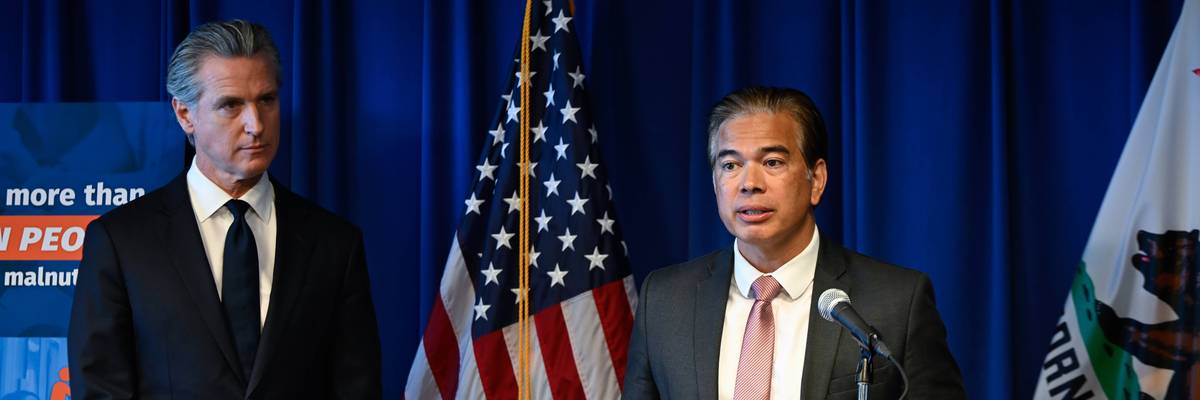
California Gov. Gavin Newsom and Attorney General Rob Bonta speak during a press conference in Sacramento, California, United States on October 28, 2025.
(Photo by Tayfun Cokun/Anadolu via Getty Images)
Jake Johnson
Sep 21, 2026
C0MMON DREAMS
A coalition of state attorneys general led by California’s Rob Bonta reportedly reached a deal on Monday to let Paramount’s acquisition of Warner Bros. Discovery proceed, an outcome that press freedom advocates and antitrust campaigners condemned as a disaster for journalism, entertainment industry workers, and American democracy.
The deal, which is set to be formally announced later Monday, will pave the way for the creation of one of the largest media conglomerates in the world, helmed by the son of a billionaire megadonor to President Donald Trump and the Republican Party.
If the merger is finalized, the resulting media behemoth would control nearly 30% of both wide-release theatrical film distribution and basic cable channel licensing in the US. The combination would also put CNN under Ellison’s control, heightening press freedom concerns that have intensified since Paramount’s takeover of CBS.
“The AGs’ capitulation marks a new low.”
“Today, billionaires have yet again bribed, censored, and bullied their way to the top,” Alvaro Bedoya, senior adviser at the American Economic Liberties Project, said in a statement. “As a result, a billionaire media conglomerate closely allied with the president will soon own one of its closest rivals, including some of the nation’s most critical news outlets. Saudi Arabia’s sovereign wealth fund will co-own those outlets, too.”
Bedoya criticized Bonta and California’s Democratic governor, Gavin Newsom, who privately pushed the state attorney general’s office to settle the lawsuit out of court. Xavier Becerra, the frontrunner to succeed Newsom, also called for a settlement, citing Paramount’s threat to leave California if its proposed acquisition of Warner Bros. was blocked.
“People want champions who are not afraid of rich bullies. Newsom, Becerra, and Bonta did not meet that mark,” said Bedoya. “The people who work in the film and TV industry and the small businesses who support it will suffer as a result. And so will everyone who values dissent in our democracy.”
Jessica González, co-CEO of the advocacy group Free Press, also denounced Bonta for reneging on “his promise to enforce the law and protect consumers and workers.”
“Hundreds of thousands of people called on our state AGs to stand up to the Ellisons, who have engaged in a campaign of corruption and extortion to pave the way for this unlawful merger. We can no longer rely on the federal government to enforce the law and protect regular people. That much is clear. But the AGs’ capitulation marks a new low. It’s a sad day for all of us who have been opposing this merger because it will cut jobs and raise prices, all as it consolidates the media even more to enable authoritarians.”
Actor Mark Ruffalo, an outspoken opponent of the merger who was subjected to what critics called a corporate “smear campaign” because of his stance, trained his ire on California’s governor in response to news of the settlement.
“Gavin Newsom hands huge win to Trump and his billionaire cronies,” Ruffalo wrote on social media.
The trial was scheduled to begin in March of next year. In its original lawsuit against the proposed merger—filed shortly after the Trump Justice Department dropped its investigation of the proposed purchase—the coalition of 12 attorneys general warned the deal would “combine two of Hollywood’s five major film distributors and two of the five major basic cable channel owners, extinguishing competition between Paramount and Warner Bros. and inflicting substantial harm on movie theaters, basic cable distributors and, ultimately, audiences nationwide.”
The settlement deal reached Monday also reportedly includes the lawsuit filed by the Writers Guild of America, which represents TV screenwriters and others in the entertainment industry.
Bloomberg reported that the attorneys general of New York, Connecticut, and other states that had pushed back during settlement talks were able to secure “independent editorial boards for CBS and CNN as part of the deal”—though it’s unclear how such boards would function.
“The terms are said to include a financial penalty if the company fails to make good on a promise to distribute 30 films per year in theaters,” Bloomberg added.
The Los Angeles Times noted that Paramount’s purchase of Warner Bros. “will be heavily leveraged.”
“The company’s bankers have lined up nearly $80 billion in debt to finance the merger. [Paramount CEO David] Ellison’s father, billionaire Larry Ellison, late last year agreed to backstop the $47-billion in equity needed to complete the acquisition. Royal families from Saudi Arabia, Qatar and Abu Dhabi have agreed to chip in $24 billion for an equity stake by assuming some of Ellison’s financial commitments.”
González of Free Press warned Monday that “consolidating the media in the hands of friendly oligarchs is right out of the authoritarian playbook.”
“What’s exceedingly clear is that our laws and our political system are not strong enough to resist the pressure and manipulation of corrupt billionaires,” said González. “We need to strengthen democratic systems of government, including getting money out of politics, and pass laws that break up big media conglomerates. We need to ensure that a few billionaires can’t drown out the masses to dictate bad policy.”
‘Outrageous’: Sanders Slams FCC for Approving Saudi and UAE Ownership of Paramount-Warner Bros.
“We don’t need Middle East dictators to control American media.”
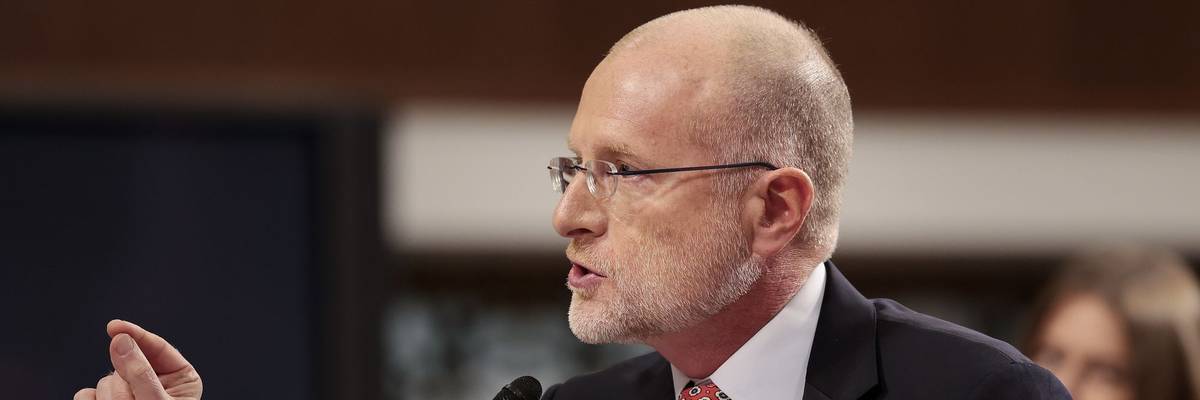
Brendan Carr, commissioner of the Federal Communications Commission, speaks at the Senate Commerce, Science, and Transportation Committee oversight hearing in the US Capitol Building on December 17, 2025 in Washington, DC.
(Photo by Heather Diehl/Getty Images)
Jessica Corbett
Sep 18, 2026
COMMON DREAMS
US Sen. Bernie Sanders on Friday joined a growing chorus of critics angered by the Federal Communications Commission’s approval of foreign investment in the company that would be created if Paramount Skydance and Warner Bros. Discovery are allowed to merge.
Led by Chair Brendan Carr, an appointee of President Donald Trump, the FCC on Thursday approved Paramount’s petition to allow foreign investors to hold over 25% of ownership. The commission concluded it would be in the “public interest” to greenlight a plan for 49.5% foreign ownership, including 38.5% from investment funds based in Qatar, Saudi Arabia, and the United Arab Emirates (UAE).
“Trump’s FCC just approved Trump pal David Ellison’s deal to allow Saudi Arabia, Qatar, and the UAE to own nearly 50% of a merged Paramount-Warner Bros,” Sanders (I-Vt.) wrote on social media Friday, referring to Paramount’s chair and CEO—and the son of billionaire Republican megadonor Larry Ellison.
The merged company would include CBS, CNN, HBO, the Discovery Channel, BET, Fandango, MTV, Nickelodeon, Paramount, PlutoTV, Showtime, TBS, The CW, TNT, Warner Bros., and more, the senator noted. He added: “Outrageous: We don’t need Middle East dictators to control American media.”
Anna Gomez, the sole Democratic commissioner, was similarly critical: “The FCC just let some of the most repressive governments in the world indirectly control nearly all of a combined Paramount-Warner Bros. An investment this large in one of America’s biggest media companies doesn’t just buy equity, it secures influence over what gets said and made.”
“That’s why I called for this new and novel issue to go to a full commission vote given what’s at stake,” she noted. “Instead, the FCC snuck this ruling out as a staff-level decision, with no public vote and no accountability for a call of this magnitude.”
Welcoming Gomez’s comments, Michael Sozan pointed to his and Andrew Miller’s June article for the Center for American Progress highlighting that “the three Middle Eastern authoritarian regimes have deep financial relationships with Trump and his family, and... long records of human rights abuses and engage in media censorship.”
“These autocracies could leverage Paramount’s news outlets and other media properties to advance their own interests at the expense of the United States’ national security and foundational rights, including press freedoms,” the pair warned. “Given these factors, these foreign ownership levels are another reason why regulators must rigorously review this merger and take all lawful actions to block it.”
As the Los Angeles Times reported:
Several groups, including the 1st Amendment nonprofit Free Press, asked the FCC to consider additional safeguards to shield the news organizations—CNN and CBS—from foreign control. One suggestion was to spin off CBS and CNN into a subsidiary that would be wholly owned by Americans.
Paramount and the FCC were dismissive, arguing “the concerns raised in the record... are speculative and unsupported,” according to the FCC ruling.
While a Paramount spokesperson welcomed the FCC’s decision not to block the plan—and pointed out that “when the proposed transaction with Warner Bros. Discovery closes, the Ellison family and RedBird will collectively hold the largest equity stake in the combined company and 100% of the voting shares, with no other equity participant having any governance rights”—fresh outrage mounted over the already widely criticized $111 billion merger.
Lee Hepner, an antitrust lawyer and senior legal counsel for the American Economic Liberties Project, addressed the questions: “But it’s just indirect equity interests, right? What about the condition that the Saudis, UAE, and Qatar cannot interfere with or even comment on any decisions related to content?”
As he explained: “The only way that firewall is conceivably enforceable is if the FCC assigns an independent monitor to sit in on every meeting, taps every burner phone, and is invited to every Signal chat between any representative of Paramount and its new financial backers. The point is not that that should happen, but that this condition is patently unenforceable. Which is all to say, the FCC just approved the sale of a crown jewel of the entertainment and media industry to foreign interests that relish in exercising economic, political, and regional military leverage over the United States. All based on a pinky promise.”
“The reality is that ownership alone, even of nonvoting, indirect equity interests, creates its own financial leverage and influence,” he warned. “To the extent Paramount’s new owners are prohibited from exercising influence, it’s patently paradoxical. Paramount won’t approve anything that risks losing half of its financial backing, including criticizing a regime that not too long ago ordered the execution of a Washington Post columnist, Jamal Khashoggi, who became an international figurehead for politically persecuted journalists.”
“Does anyone think CBS’ new leadership has the will, much less fortitude, to prioritize truth over financial ruin?” he added. “If this all sounds like a total mess, that’s because it is. And it only becomes doubly worse if Paramount acquires Warner Bros.-Discovery.”
Due to legal pushback from state attorneys general and unions, the merger—which some opponents have condemned as an “existential” threat—is on hold until the outcome of a trial scheduled to begin in March.
“We don’t need Middle East dictators to control American media.”
Brendan Carr, commissioner of the Federal Communications Commission, speaks at the Senate Commerce, Science, and Transportation Committee oversight hearing in the US Capitol Building on December 17, 2025 in Washington, DC.
(Photo by Heather Diehl/Getty Images)
Jessica Corbett
Sep 18, 2026
COMMON DREAMS
US Sen. Bernie Sanders on Friday joined a growing chorus of critics angered by the Federal Communications Commission’s approval of foreign investment in the company that would be created if Paramount Skydance and Warner Bros. Discovery are allowed to merge.
Led by Chair Brendan Carr, an appointee of President Donald Trump, the FCC on Thursday approved Paramount’s petition to allow foreign investors to hold over 25% of ownership. The commission concluded it would be in the “public interest” to greenlight a plan for 49.5% foreign ownership, including 38.5% from investment funds based in Qatar, Saudi Arabia, and the United Arab Emirates (UAE).
“Trump’s FCC just approved Trump pal David Ellison’s deal to allow Saudi Arabia, Qatar, and the UAE to own nearly 50% of a merged Paramount-Warner Bros,” Sanders (I-Vt.) wrote on social media Friday, referring to Paramount’s chair and CEO—and the son of billionaire Republican megadonor Larry Ellison.
The merged company would include CBS, CNN, HBO, the Discovery Channel, BET, Fandango, MTV, Nickelodeon, Paramount, PlutoTV, Showtime, TBS, The CW, TNT, Warner Bros., and more, the senator noted. He added: “Outrageous: We don’t need Middle East dictators to control American media.”
Anna Gomez, the sole Democratic commissioner, was similarly critical: “The FCC just let some of the most repressive governments in the world indirectly control nearly all of a combined Paramount-Warner Bros. An investment this large in one of America’s biggest media companies doesn’t just buy equity, it secures influence over what gets said and made.”
“That’s why I called for this new and novel issue to go to a full commission vote given what’s at stake,” she noted. “Instead, the FCC snuck this ruling out as a staff-level decision, with no public vote and no accountability for a call of this magnitude.”
Welcoming Gomez’s comments, Michael Sozan pointed to his and Andrew Miller’s June article for the Center for American Progress highlighting that “the three Middle Eastern authoritarian regimes have deep financial relationships with Trump and his family, and... long records of human rights abuses and engage in media censorship.”
“These autocracies could leverage Paramount’s news outlets and other media properties to advance their own interests at the expense of the United States’ national security and foundational rights, including press freedoms,” the pair warned. “Given these factors, these foreign ownership levels are another reason why regulators must rigorously review this merger and take all lawful actions to block it.”
As the Los Angeles Times reported:
Several groups, including the 1st Amendment nonprofit Free Press, asked the FCC to consider additional safeguards to shield the news organizations—CNN and CBS—from foreign control. One suggestion was to spin off CBS and CNN into a subsidiary that would be wholly owned by Americans.
Paramount and the FCC were dismissive, arguing “the concerns raised in the record... are speculative and unsupported,” according to the FCC ruling.
While a Paramount spokesperson welcomed the FCC’s decision not to block the plan—and pointed out that “when the proposed transaction with Warner Bros. Discovery closes, the Ellison family and RedBird will collectively hold the largest equity stake in the combined company and 100% of the voting shares, with no other equity participant having any governance rights”—fresh outrage mounted over the already widely criticized $111 billion merger.
Lee Hepner, an antitrust lawyer and senior legal counsel for the American Economic Liberties Project, addressed the questions: “But it’s just indirect equity interests, right? What about the condition that the Saudis, UAE, and Qatar cannot interfere with or even comment on any decisions related to content?”
As he explained: “The only way that firewall is conceivably enforceable is if the FCC assigns an independent monitor to sit in on every meeting, taps every burner phone, and is invited to every Signal chat between any representative of Paramount and its new financial backers. The point is not that that should happen, but that this condition is patently unenforceable. Which is all to say, the FCC just approved the sale of a crown jewel of the entertainment and media industry to foreign interests that relish in exercising economic, political, and regional military leverage over the United States. All based on a pinky promise.”
“The reality is that ownership alone, even of nonvoting, indirect equity interests, creates its own financial leverage and influence,” he warned. “To the extent Paramount’s new owners are prohibited from exercising influence, it’s patently paradoxical. Paramount won’t approve anything that risks losing half of its financial backing, including criticizing a regime that not too long ago ordered the execution of a Washington Post columnist, Jamal Khashoggi, who became an international figurehead for politically persecuted journalists.”
“Does anyone think CBS’ new leadership has the will, much less fortitude, to prioritize truth over financial ruin?” he added. “If this all sounds like a total mess, that’s because it is. And it only becomes doubly worse if Paramount acquires Warner Bros.-Discovery.”
Due to legal pushback from state attorneys general and unions, the merger—which some opponents have condemned as an “existential” threat—is on hold until the outcome of a trial scheduled to begin in March.