It’s possible that I shall make an ass of myself. But in that case one can always get out of it with a little dialectic. I have, of course, so worded my proposition as to be right either way (K.Marx, Letter to F.Engels on the Indian Mutiny)
Tuesday, April 15, 2025
Iran Withdraws From the Red Sea
Moudge-class frigate IRIS Dena (file image courtesy Fars Media / CC BY 4.0)
With two US Carrier Strike Groups (CSGs) now operating in the area, it appears that the regular Iranian Navy (Nedaja) has withdrawn from the Red Sea and Gulf of Aden station.
The Nedaja has maintained a continuous presence in the Red Sea and Gulf of Aden area since 2008. Typically, deployments have consisted of a Moudge or Bayandor Class frigate, supported by a Bandar Abbas logistics vessel, or a Hengham Class landing ship operating in a logistics role. Deployments have usually been of 90 days duration, sometimes either shorter or longer, and have often involved a port call in Salalah on the way home. Returns to port have usually been greeted by a senior Nedaja commander and a press announcement, with details given of the flotilla that has deployed to replace the incoming vessels.
Since the 99th Flotilla, comprised of IRINS Dena (F75) and IRINS Bushehr (K422), completed its deployment at the end of last year, the 100th Flotilla may have visited the Gulf of Aden. But the primary mission of the 100th Flotilla was to take 200 cadets from the Imam Khomeini Naval University on their annual winter training cruise, and in this role the flotilla made a port call to Mumbai in late February.
There has been now been no word of Nedaja ships in the Red Sea or Gulf of Aden for several months, so it appears that after over 80 flotillas having successively deployed to the area, the Nedaja has at least temporarily withdrawn its presence. What should have been the Nedaja’s 101st Flotilla has not been seen in the area. If the Nedaja has cunningly succeeded in evading surveillance, it would only have been able to do so by withdrawing from the shipping lanes which hitherto had been its responsibility to patrol, or by redesigning its presence strategy.
The hypothesis that the Nedaja has pulled back is supported by the higher than normal numbers of frigates and support vessels seen in recent months alongside in the Naval Dockyard in Bandar Abbas. For example, on March 18, five frigates plus the intelligence collector IRINS Zagros (H313) were alongside. On March 28, imagery identified four Alvand/Moudge and one Bayandor frigates, together with all three operational Hengham Class landing ships were alongside, together implying that there were no long-range flotillas out of home waters at that point.
Recent satellite imagery has also shown that two of the Nedaja’s three Kilo Class submarines are in dry dock in the Bandar Abbas harbour; the one remaining operational Kilo is not, as of this morning and on the basis of poor quality imagery, at its normal berth. The Kilo could be expected to be attempting to shadow the Carl Vinson CSG in the Gulf of Oman, and IRINS Zagros (H313) with other vessels are likely also to be attempting a similar mission.
If confirmed, the withdrawal of the Nedaja from the Red Sea and Gulf of Aden waters would be of significance. The Houthis are known to have relied on the Nedaja and ships of the IRGC Navy to provide intelligence to support their anti-shipping campaign. The Nedaja appears to have withdrawn when the Houthi need for support, under airstrikes mounted from the two US CSGs, is at its most acute.
Russian Ambassador Says Subsea Tampering off UK is No Cause for Concern
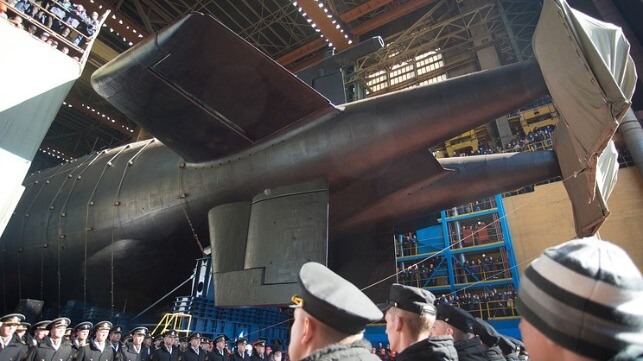
Launch of the Belgorod, the world's longest submarine. The twin-screw leviathan is likely designed to carry minisubs for covert operations, as well as Russia's nuclear-tipped torpedo (Russian Ministry of Defense)
After recent reports of Russian vessels planting subsea listening devices in waters near the UK, Russia's ambassador to London told BBC that there was no reason for concern - though he did not deny that the Russian military has been at work on Britain's seabed.
"I am not going to deny it, but I wonder whether we really have an interest in following all the British submarine with very old outdated nuclear warheads," Ambassador Andrei Kelin said in an interview. "All these threats are extremely exaggerated . . . absolutely, there is no threat at all from Russia to the UK."
The devices in question are acoustic monitors, believed to be designed to track the movements of the Royal Navy's Vanguard-class nuclear ballistic missile submarines. The UK is one of the few nations that maintain an at-sea nuclear deterrent patrol, and while a submarine is the most survivable nuclear launch platform, its edge depends upon stealth. At least three nations - the U.S., China and Russia - maintain subsea listening networks in an attempt to track adversaries' submarines; some of these efforts are well-documented and elaborate, like the U.S. Navy's SOSUS listening station system.
More than a dozen former military officials told The Times that Russia is using its subsea expertise in an attempt to track the Vanguard-class patrols. The report explains the Royal Navy's sudden interest in acquiring two offshore vessels for subsea monitoring and intervention, RFA Proteus and RFA Stirling Castle.
"We are seeing phenomenal amounts of Russian activity," one senior British official told The Times. "There should be no doubt, there is a war raging in the Atlantic."
The most concerning threat is Russia's singular capability to wage subsea warfare. Russia's military has a dedicated and separate subsea branch, the Main Directorate of Deep-Sea Research (GUGI), with its own fleet of ultra-deep-diving minisubmarines. These miniature nuclear-powered vessels are among the most secretive subs in the world, and are purpose-built for tapping communications cables, cutting lines or planting explosives in the ocean's depths. If used for attacks on the UK's subsea power cables, offshore gas pipelines and data cables, these capabilities could in theory be used to cause significant economic disruption - like disabling the UK power grid, or cutting off the data connection between London's banking sector and New York.
Even more concerning, "there are cables that are not public," one military official told The Times. "The Russians have the capability to cut military cables."
After IMO Carbon Deal, Activists & States Say They'll Return for More
The IMO's new greenhouse gas fee is not quite a full-scale carbon levy, since it is only charged on some emissions, and not quite a green-fuel mandate, as it allows a long economic runway for biofuels. It is a compromise measure, and passed with less consensus than usually found at IMO: 63 nations voted for it, with 16 opposed and 24 abstaining. The U.S. delegation walked out midway through the talks, and threatened retaliation against any levy that would raise costs for American shipping.
IMO secretary general Arsenio Dominguez noted that for all its compromises, the draft agreement is still a remarkable breakthrough. As the world's first industry-wide tax on carbon, it will significantly reduce shipping's emissions in the long run - assuming that the administrative details are worked out and that enough nations sign the final draft at the next MEPC meeting.
"The approval of draft amendments to MARPOL Annex VI mandating the IMO net-zero framework represents another significant step in our collective efforts to combat climate change, to modernize shipping and demonstrates that IMO delivers on its commitments," said Dominguez in a statement.
Many participants - opponents, proponents, and brokers who helped craft the agreement, including Dominguez - expect that it will be revisited and strengthened in the future.
"We are not done. We will be back," said Ambassador Albon Ishoda of the Marshall Islands, an advocate of a much stricter levy. "Still standing. Still steering."
"The work is not over, with much detail on emissions calculation methods and how near-zero emissions fuels will be rewarded needed before and after formal adoption of these measures in October to ensure a level playing field for green fuels," noted Green Hydrogen Organization CEO Jonas Moberg.
Many climate activists were appalled by the comparatively low fee structure and the five-year time gap before emissions will begin to decline. John Maggs, Clean Shipping Coalition’s leader at IMO, called the deal "a total shipwreck." Transport & Environment's Faig Abbasov suggested that it is now time for nation-states and regional blocs to bypass IMO and begin implementing their own carbon rules, as the EU has done.
The Pacific island states - along with allies in the Caribbean, Africa, the Seychelles, Great Britain and Central America - had proposed a universal levy on all GHG emissions from shipping, the solution proposed by most climate researchers and analysts (including Maersk and bunker trader Trafigura). In a joint statement, island state negotiators said that MEPC's deal was "too little, too late to cut shipping emissions." They expressed their disappointment by abstaining from the vote.
"We came as climate vulnerable countries — with the greatest need and the clearest solution. And what did we face? Weak alternatives from the world’s biggest economies — alternatives that won’t get us on a pathway to the 1.5 degrees C temperature limit," said Simon Kofe, Minister for Transport of the Solomon Islands. "They asked us to settle for less, while we are the ones losing the most. We will not negotiate away our future."
“Let us be clear about who has abandoned 1.5°C. Saudi Arabia, the US and fossil fuel allies pushed down the numbers to an untenable level and blocked progress at every turn. These countries – and others – failed to support a set of measures that would have gotten the shipping industry onto a 1.5 degree C pathway. And they turned away a proposal for a reliable source of revenue for those of us in dire need of finance to help with climate impacts," said Ralph Regenvanu, Minister of Energy and Climate Change Adaptation for Vanuatu.
If anyone stands to do well from the agreement, shipbuilders can expect to benefit. Han Seung-han, a research analyst at SK Securities, told South Korean media that East Asian yards will probably see a boost in clean-ship orders sooner rather than later because of the timeline for construction. "Currently, the order backlog at shipyards worldwide is around 3 years and 8 months. Even if orders for new builds are placed immediately, the earliest delivery will be in at least 3 years," he said.
Though it went nearly unnoticed in the fierce debate about carbon, MEPC 83 also passed an agreement to create the world's largest emissions control area (ECA). The new Northeast Atlantic zone will extend from Portugal to the Bay of Biscay, the English Channel, North Sea and the GIUK Gap - bigger than any other ECA yet designated. Once implemented, it will cut sulfur dioxide emissions by 82 percent and particulate matter emissions by 64 percent, improving health-related air quality in Northern Europe.
The expansion of the European Union Emissions Trading System (EU ETS) to include the maritime industry has introduced significant financial and operational hurdles for all shipowners who are voyaging to or through EU ports. Shipowners must now purchase European Union Allowances regardless of the ship’s nationality.
European Union Allowances are market-driven instruments and must be purchased through one of the regulated carbon exchanges. The prices of the allowances fluctuate like other types of securities and have been highly volatile since its inception. Market analysts predict that the prices will increase dramatically over the next five years.
The first deadline for complying with this new obligation is September 2025, which means shipping companies have just 6 more months to calculate and purchase the required allowances to cover their 2024 emissions in order to comply and avoid penalties.
This article features insights and trends from Frederic Bouthillier, who is the Head of Shipping at Vertis Environmental Finance (STX), one of the largest ETS traders and market makers.
Bouthillier speaks to the importance of having a structured approach to allowance purchasing, exploring alternative fuels, and implementing technological solutions like Cyanergy’s real time emissions monitoring system — which will help ensure compliance while maintaining a competitive edge in an increasingly regulated market.
Impact of EU Emissions Trading System on Shipowners: Rising and Fluctuating Prices
The EU ETS is designed to drive carbon prices higher over time, making compliance an increasing financial burden for shipowners. "In 2-3 years from now, the price could be above €100," Bouthillier warns. "The structural pricing mechanism is organized in a way that the price will keep rising."
In addition, price fluctuations add complexity to cost management. The European Union Allowances price gained 15% in January before retracing downward in February. These fluctuations make cost forecasting a challenge for shipowners and force companies to adapt quickly to avoid excessive financial exposure.
Companies that underreport emissions risk fines of €100 per missing metric ton, plus the obligation to purchase the shortfall allowances at market rates. Additionally, non-compliance can lead to regulatory investigations, public disclosure of violations, and even suspension from the ETS.
Accuracy Is Critical: The Role of Technology
Accurate emissions reporting is essential for shipowners to comply with the EU ETS and manage costs effectively. Since allowances must be verified by independent auditors, errors in reporting—whether under or overestimating emissions—can have costly consequences.
The need for precise emissions monitoring goes beyond CO2, as other greenhouse gases like N2O and CH4 have significantly higher emissions factors. "That’s why it’s so important to ensure your emissions are monitored by volume and type in a very accurate way," Bouthillier stresses. "If you're short, it might cost you a lot of money. The first element is to have a system on board that allows you to monitor your emissions by volume and type."
Cyanergy's CE² Monitor, which collects engine and gas data every minute, enabling more accurate measuring and reporting. Courtesy of Cyanergy.
A Strong Incentive to Seek Competitive Solutions
With rising costs and regulatory risks, shipowners must seek ways to optimize their emissions strategy. Companies that fail to adapt risk falling behind competitors who are proactively managing compliance.
"If you don’t move, you will fall behind because the competition might be moving, and you will put yourself out of the game," warns Bouthillier.
Shipping companies that leverage technology to monitor emissions in real time can gain a competitive edge by making informed decisions about when to purchase ETS allowances and how to optimize their fuel consumption.
The Importance of Real-Time Emissions Monitoring
In this volatile market, proactive emissions management is critical. "Under these circumstances, what is of paramount importance is to be proactive,” Bouthillier explains. “By getting a system like Cyanergy on board, looking at the market, optimizing— you’re going to mitigate the damage compared to someone who is waiting until the last minute. All the tools are there."
Real-time emissions monitoring solutions, such as those offered by Cyanergy, provide shipowners with the accuracy and insight needed to navigate the complexities of the EU ETS. For shipowners looking to secure their compliance strategy and minimize costs, investing in advanced emissions monitoring technology is no longer optional—it’s a necessity.
Navigating EU ETS with Smart Solutions
Real-time emissions monitoring systems empower shipping companies with accurate data to optimize allowance purchasing, avoid penalties, and stay ahead of rising carbon costs. By investing in advanced monitoring solutions and proactive compliance strategies, shipowners can not only mitigate financial risks but also strengthen their position in an increasingly regulated industry.
This article is sponsored by Cyanergy, providing cutting-edge solutions for emissions monitoring and compliance. Learn more about their innovative technology here.
The opinions expressed herein are the author's and not necessarily those of The Maritime Executive.
Seafarers Win Critical Updates to ILO’s Maritime Labour Convention
Key changes incorporated in revisions of master labor agreement for seafarers (IMO file photo)
Shipowners, governments, and labor unions agreed to a sweeping series of changes to the master agreement known as the Maritime Labour Convention, a global agreement that establishes minimum standards for the working and living conditions of seafarers. The updates, which are being called groundbreaking for the industry, come as the modern MLC prepares to mark its 20th anniversary after the consolidation of 37 conventions into the MLC in 2006.
Many of the issues that were presented during the meeting in Geneva last week emerged during the pandemic when seafarers were trapped at sea. The International Chamber of Shipping (ICS) took the lead in representing seafarers during the negotiations after being at the forefront as an advocate during the pandemic to get seafarers designated as key workers and create greater freedom for shore leave, crew changes, and travel.
Under the auspices of the International Labour Organization, the Special Tripartite Committee on the MLC meets every three years to review the master contract. The ILO’s maritime tripartite regulatory structure brings together national governments, alongside a global shipowners group co-ordinated by ICS and a global seafarers group co-ordinated by ITF. It is highlighted that the ILO is the only tripartite UN agency through which national governments alongside sectoral social partners (employer and worker representatives) establish labor standards and policies, through open debates and negotiations.
“We have been able to deliver some significant improvements to seafarers’ rights in collaboration with our government and social partners,” said Tim Springett, Chair of the ICS Labour Affairs Committee and Spokesperson for the Shipowners’ Group at the ILO meeting. “The accomplishments of STC prove that – whatever the issue facing our industry – when we come together, we can work it out.”
Among the amendments agreed to improve the working and living conditions of seafarers on board ships were provisions for seafarers to be designated as key workers. They also agreed to strengthen requirements to support seafarer repatriation, new mandatory measures to ensure that seafarers have access to shore leave without needing a visa or special permit, and enhanced protections against bullying and harassment.
THE ICS says recognizing that seafarers are among the most isolated people on earth when it comes to medical care, the ILO also approved new MLC provisions recommending carriage of the ICS International Medical Guide for Seafarers and Fishers on board ships. The first edition of the International Medical Guide for Seafarers and Fishers was published in March 2023 and is specifically designed for use by those responsible for medical care on board ships, rather than shore-based professionals. The guide was developed through a collaborative effort led by the ICS, with the support of the International Transport Workers’ Federation (ITF) and the International Maritime Health Association (IMHA).
The meeting also agreed to a package of complementary resolutions, one of which established a framework for a future joint meeting between the ILO tripartite partners and Member States of the International Maritime Organization (IMO), to review and potentially align overlapping seafarer hours of work and rest provisions, within the remit of conventions overseen by both organizations.
The new measures adopted by the ILO are expected to be rubberstamped in Geneva, during the 113th Session of ILO’s International Labour Conference in June. They are then expected to enter into effect two years later in December 2027.
The text of MLC amendments as adopted can be accessed online. The next STC meeting is set to take place in April 2028.
Explainable AI for ship navigation raises trust, decreases human error
New AI model explains the basis for its decisions and the intention behind actions
Credit: Yoshiho Ikeda, Professor Emeritus, Osaka Prefecture University
The Titanic sunk 113 years ago on April 14-15, after hitting an iceberg, with human error likely causing the ship to stray into those dangerous waters. Today, autonomous systems built on artificial intelligence can help ships avoid such accidents, but could such a system explain to the captain why it was maneuvering a certain way?
That’s the idea behind explainable AI, which should help human actors trust autonomous systems more. Researchers from Osaka Metropolitan University’s Graduate School of Engineering have developed an explainable AI model for ships that quantifies the collision risk for all vessels in a given area, an important feature as key sea-lanes have become ever more congested.
Graduate student Hitoshi Yoshioka and Professor Hirotada Hashimoto created the AI model so that it explains the basis for its decisions and the intention behind actions using numerical values for collision risk.
“By being able to explain the basis for the judgments and behavioral intentions of AI-based autonomous ship navigation, I think we can earn the trust of maritime workers,” Professor Hashimoto stated. “I also believe that this research can contribute to the realization of unmanned ships.”
The findings were published in Applied Ocean Research.
###
About OMU
Established in Osaka as one of the largest public universities in Japan, Osaka Metropolitan University is committed to shaping the future of society through “Convergence of Knowledge” and the promotion of world-class research. For more research news, visit https://www.omu.ac.jp/en/ and follow us on social media: X, Facebook, Instagram, LinkedIn.
Eroded remnant of the Adams Bay mound site – The Adams Bay mound has eroded rapidly in the 21st century; most dramatically after 2015. Shown here are the final remnants of the mound and an artificial oyster shell reef made from recycled shell by the Coalition for Coastal Louisiana (CRCL), who maintains the reef.
Humans have always lived by coasts and waterways, and thus these locations are rich with archeological sites. Natural and cultural resource management are conducted separately, despite the fact that climate change, sea level rise, and extreme weather threaten them both. Jayur Mehta and colleagues argue a synergy of both approaches is required to protect coastal archaeological landscapes. The authors used LiDAR digital elevation models, site location data, and NOAA sea level rise models to define impacts and inundation of archaeological sites for the US Gulf coast regions of the Florida Big Bend and the Mississippi River Delta. In Florida’s Big Bend region, 11 Indigenous sites are already at or below sea level and a further 142 mound and midden sites could be submerged in the next century—including a monumental mound site known as Garden Patch. In the Mississippi River Delta, 11 Indigenous sites are at or below sea level and a further 107 mound and midden sites are at risk—including the Magnolia Mounds complex and the Bayou Grand Cheniere site. Similar risks exist for prehistoric sites in low-lying parts of the Netherlands, cultural heritage sites in Oceania, and archaeological sites in coastal Peru. In Peru, the rapid pace of agricultural expansion further exacerbates threats to cultural resources. The authors call for policies integrating coastal ecosystem management with archaeological and historical resource preservation, using Indigenous traditional ecological knowledge, and cultural- ecosystem services approaches. According to the authors, coastal archaeological resources provide coupled ecosystems resilience in biocultural landscapes and that an integrated approach is necessary for preservation and restoration.
The La Butte earthen mound near Cocodrie, Louisiana, is one of many ancient earthworks across the U.S. Gulf Coast. This mound has been repurposed as a historic cemetery.
Credit
Liz Chamberlain
Journal
PNAS Nexus
Article Title
Preserving coastal environments requires an integrated natural and cultural resources management approach
Article Publication Date
15-Apr-2025
Amount of sunlight reaching Earth’s surface varies over decades, researchers report
Institute of Atmospheric Physics, Chinese Academy of Sciences
An atmospheric physics and atmospheric environment observation station in Xianghe, Hebei Province, China. It is operated by the Institute of Atmospheric Physics, Chinese Academy of Sciences.
The sun may rise every morning, but the amount of sunlight reaching the Earth’s surface can substantially vary over decades, according to a perspectives article led by an international research team. The article, published on March 15 in Advances in Atmospheric Science, suggests that stages of “dimming” and “brightening” correspond with increased air pollution and implementation of clean energy solutions, respectively.
“The amount of sunlight — which is solar radiative energy — we receive at the Earth’s surface is not necessarily stable over the years but can undergo substantial decadal variations, as documented in the long-term historical solar radiation measurements we examined,” said corresponding author Martin Wild, professor with the Institute for Atmospheric and Climate Science, Swiss Federal Institute of Technology (ETH Zürich). “These indicate declining solar radiative energy in large parts of the world from the 1950s to the 1980s — known as global dimming — and a partial recovery thereafter, known as brightening, at many observation sites.”
After reviewing the existing scientific literature on dimming and brightening research, which dates to the early 20th century and spans the globe, the researchers focused on regional-scale trends of solar radiative energy in China.
“China provides a conducive environment for understanding aerosol radiative effects — or how air pollutants impact the amount of solar radiative energy reaching Earth’s surface,” Wild said. “China has well-organized, long-term and spatially uniform surface observations, making the country one of the most intensively studied world regions in terms of dimming and brightening, as reflected in an impressive number of related publications.”
Across the previous studies, the researchers found that the decadal variations in solar energy reaching the Earth’s surface were particularly pronounced in China. Solar energy substantially declined from the 1960s to the 1990s, and the trend appeared to begin to reverse in the 2000s with a slight recovery in more recent years.
“The causes for these dramatic changes are thought to be primarily due to increasing air pollution in the ‘dimming’ phase, and due to the successful implementation of air pollution mitigation measures in the ‘brightening’ phase,” Wild said.
Air pollution from the increasingly used fossil fuels and exacerbated carbon emissions over the years can literally intercept incoming solar radiation and prevent it from reaching the planet’s surface, Wild explained. The more pollution in the atmosphere, the less sunlight reaches Earth’s surface. Now that China has started to reverse this trend by reducing air pollution, more sunlight is researching the surface, which could have compounding benefits.
“If China fully recovers from the dimming phase and reverts to the clean atmosphere levels of the 1960s, the country could make substantial gains in solar power production,” Wild said. “These decadal changes of dimming and brightening in the available solar energy are not only crucial for various aspects of climate and environmental change, but are also of significant importance for resource assessments in the rapidly growing sector of solar power production. The availability of solar energy at the Earth’s surface is such a critical factor for so many relevant ecological and societal aspects, as well as for the existence of life in the first place, that it deserves a sustained investment into its investigations as well as its long-term monitoring both from the surface and space.”
There are challenges, however, the researchers said, in fully understanding the dimming and brightening phenomenon’s magnitude, causes, predictability and implications in a wide range of applications. The study authors recommend that researchers in the field work together and focus on optimally combining the diverse information contained in their different but complementary data sources, remedying remaining inconsistencies, to allow for the best possible understanding of variations in sunlight reaching Earth’s surface.
Other collaborators include Yawen Wang, Ocean University of China, Qingdao; Kaicun Wang, Peking University; and Su Yang, China Meteorological Administration.
This paper was solicited by Advances in Atmospheric Sciences after the researchers presented their work at the International Radiation Symposium in China in June of 2024. The Swiss National Science Foundation and the Federal Office of Meteorology and Climatology MeteoSwiss, within the framework of Global Climate Observing System Switzerland, supported this work.



.jpg)