Tuesday, July 21, 2026

MULTIPOLAR WORLD

China ally Solomon Islands invites US Coast Guard patrols

Washington (United States) (AFP) – The Solomon Islands will sign a deal for the US Coast Guard to patrol its waters with local police aboard, Prime Minister Matthew Wale said on a visit to Washington.


Issued on: 21/07/2026 - FRANCE24

Solomon Islands Prime Minister Matthew Wale is visiting Washington and Tokyo © Hilary Wardhaugh / AFP

The Solomons became China's closest security partner in the South Pacific after signing a secret security pact in 2022, blocking a US Coast Guard vessel from making a port call the same year.

Wale, who pledged to bring change after he was elected in May, met with US Coast Guard vice commandant Admiral Thomas Allan in Washington on Monday.

He also met with US Deputy Secretary of State Christopher Landau on deepening bilateral ties, said a State Department readout.

A "ship rider agreement" will be signed in the capital Honiara next week to strengthen joint maritime enforcement and surveillance, a Solomon Islands statement said.

"Prime Minister Wale highlighted the urgent need to enhance security across the Pacific region, noting the increasing threats of drug trafficking, human trafficking, and illegal, unreported and unregulated fishing," it added.

The US Coast Guard has expanded patrols of the South Pacific in recent years, assisting "ship riders" -- local Pacific police -- to cover millions of kilometres of ocean to inspect for illegal fishing fleets.

Ship riders on a US Coast Guard vessel boarded Chinese fishing boats in Vanuatu and Kiribati in 2024, prompting Chinese officials to protest when some vessels were found to be fishing illegally.

The Solomons has a vast 1.5 million square kilometre exclusive economic zone and like many South Pacific countries counts tuna fishing as a major industry.

James Batley, a former Australian diplomat in the Solomons, said the US Coast Guard deal was a significant shift and showed Wale was acting on his pledge to deliver change.

"There is a lot of anxiety around the Pacific about transnational criminal movement of drugs, with 'narco subs' turning up in Solomon Islands, so I think the US could mount a persuasive case they could help on that front," he said.

Wales' meeting with Landau included talks of potential investment, including Bina Harbour, where the Solomons wants to develop a factory to process tuna for export.

Reported Chinese interest in developing Bina Harbour has previously sparked concern from Australia about the potential it could be used as a dual-purpose military and civilian port.

Wale and Landau signed a letter of intent to return Peace Corps to Solomon Islands, the State Department readout said, adding that it would provide $6 million in new funding to widen its unexploded ordnance removal program.

Wale will next travel to Tokyo to meet with Prime Minister Sanae Takaichi, his office said.

© 2026 AFP

The darkside of 10-minute delivery: Inside India's quick commerce revolution


In 2025, urban youth unemployment stood at 13.6%, far above the national average of 3.1%, pushing many young people into platform-based work for lack of alternatives.

The rise of instant delivery has become one of the clearest symbols of India’s new consumer economy, where speed is marketed as a service. But it also raises deeper questions about the quality of the jobs being created – and who is really paying the price for that convenience.

India's opposition leader calls for Modi to step down as youth-led 'Cockroach' protests press on

Rahul Gandhi, India's opposition leader, called for Prime Minister Narendra Modi to resign on Tuesday "for destroying the future" of the country's youth. The youth-led Cockroach movement continued their protests in New Delhi, refusing to leave their sit-in site a day after police used tear has and batons to disperse demonstrators marching towards parliament.


Issued on: 21/07/2026 
By: FRANCE 24
Video by: Delano D'SOUZA

Cover image: India's opposition leader Rahul Gandhi stands with hands tied as he participates in a sit-in protest outside Modi's residence in New Delhi on July 21, 2026. © Shekhar Yadav, AP
01:47


India's main opposition leader, Rahul Gandhi, demanded on Tuesday that Prime Minister Narendra Modi step down over the police crackdown against student protests demanding reforms in the education system.

Modi must resign "for destroying the future of India's youth", the Congress Party leader said in a post on social media as he led a march with other MPs towards the prime minister's residence in New Delhi.

"The government doesn't want to take any accountability, nor does it want to have a debate on it in parliament," said Gandhi.

Along with dozens of his Congress party lawmakers, Gandhi staged a sit-in protest outside Modi's residence. Several were seen fastening zip ties around their wrists.

Gandhi's comments came after police said 60 protesters were injured in clashes with security forces in the heart of New Delhi on Monday, marking the biggest street rally in the capital for about five years.

Thousands of protesters had gathered to demand the resignation of Education Minister Dharmendra Pradhan, following an appeal by the Cockroach Janta Party (CJP) online movement.

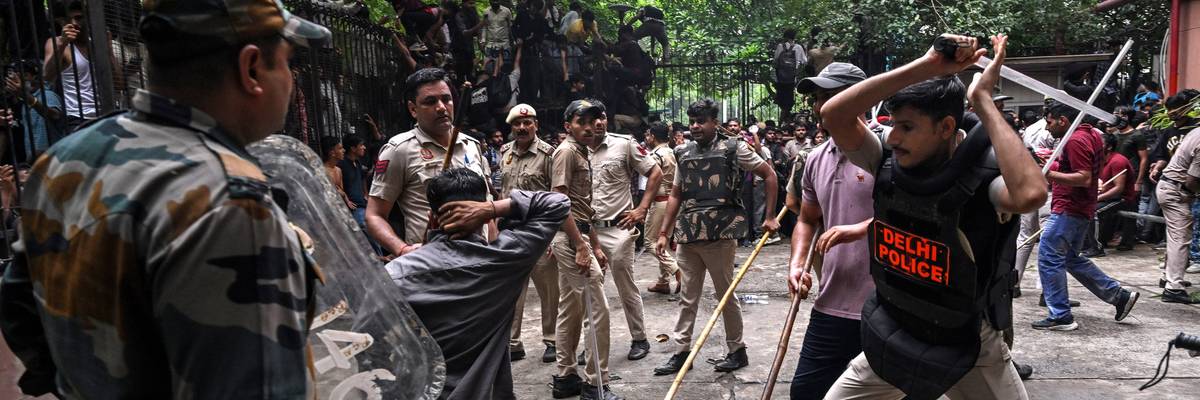
Police fired tear gas and charged with batons at protesters, who responded by pelting stones. At least 118 police personnel were also injured, Delhi Police said.

The CJP vowed to press on with its demands for Pradhan's removal as hundreds of protesters remained camped at Delhi's Jantar Mantar protest site on Tuesday, many of them calling for changes to the wider education system.

The CJP has won millions of followers on social media since its launch in May, fuelling one of the biggest challenges to Hindu-nationalist leader Modi since he won his third term in office in 2024.

'Shameful day'


"We won't stop. Pradhan has to be sacked," CJP spokesman Ashutosh Ranka said on social media.

There were far fewer protesters at Jantar Mantar than on Monday, when the CJP mobilised huge crowds to march on India's parliament.

CJP founder Abhijeet Dipke urged protesters on Tuesday not to lose hope.

"They want to break our spirit," he said, perched on top of a lorry. "Do not let them silence you."

Protest organisers condemned the "high-handedness" of the authorities and said hundreds of protesters had been injured.

"It's a shameful day in the history of Indian democracy that people, honest students, who had come for a genuine issue were brutally beaten by the Delhi police," Ranka told AFP.

Ranka, who met senior minister JP Nadda on Monday, said the government had yet to respond to their demands.

Protesters said they would not relent.

"We have become even more fearless now," said 25-year-old law student Chandra Pratap Sishwi.

"When I saw people being beaten up by the police like that, my blood boiled."

Parliament was adjourned on Tuesday after the opposition benches demanded a discussion on the alleged "brutality unleashed on students".

Despite rapid economic growth, millions of people in the world's most populous nation still struggle to find stable and well-paying jobs, fuelling discontent.

The protests follow a series of examination scandals that have shaken confidence in India's testing system.

Some 2.2 million aspiring medical students sat for a re-examination under tight security last month after the previous test was scrapped following the leak of a question paper.

That came on top of another scandal related to the online marking of tests taken by nearly two million high school students.

Parliamentary Affairs Minister Kiren Rijiju defended the government on Tuesday, saying it had acted swiftly after the exam paper leaks by arresting several people.

He said Modi had called for a "foolproof system" to prevent irregularities in the future at a closed-door meeting with his allies on Tuesday.

Modi has yet to comment directly on the protests.

(FRANCE 24 with AFP and AP)


‘Black Day for Democracy’: Indian Police Bash and Gas Youth-Led ‘Cockroach’ Protesters

“It’s just shocking to see that the people we elected have turned a blind eye to youth dying,” said one protester.


Delhi police officers beat Cockroach Janta Party protesters during a July 20, 2026 protest in New Delhi demanding the resignation of India’s education minister.
(Photo by Arun Sankar/AFP via Getty Images)

Brett Wilkins
Jul 20, 2026
C0MM0N DREAMS

Indian protesters rallying Monday in New Delhi under the banner of the youth-led Cockroach Janta Party were brutally attacked by police as they marched toward the country’s Parliament demanding the resignation of the country’s education minister and denouncing the right-wing government of Prime Minister Narendra Modi.

Tens of thousands of protesters took to the streets of the Indian capital despite police bans, barricades, internet shutdowns, and a heavy security presence. Police, some of them in plain clothes, attacked the overwhelmingly peaceful demonstrators with baton charges and tear gas. Delhi police are controlled by the Bharatiya Janata Party (BJP)-ruled central government.

The Wire reported that thousands of people were injured—some seriously—by police. Despite video footage and photos showing officer brutality, Delhi Police denied “sporadic use of violence” against protesters.


The protesters are seeking the resignation of Education Minister Dharmendra Pradhan following repeated leaks of National Eligibility Entrance Test papers that have upended the lives of millions of students by forcing them to retake the grueling exams and delaying university admissions. Protest organizers say more than 20 students have killed themselves over the matter.

Late last month, Pradhan dismissed the protesters as “the B-team of terrorists.”

“Already more than 20 students have died by suicide, but this government is not done yet,” Cockroach Janta Party (CJP) founder Abhijeet Dipke said on social media. “This government has resorted to hooliganism now.”

Protester Rhythm Katoch told The Guardian on Monday: “They are calling this protest illegal, they are calling us anti-national. But I am 22 years old, and I am standing here to fight for our education system, for the rights of the young people, and for our democracy. Is it too much to ask for the government to listen to us?”

The CJP and other student groups have been leading hunger strikes at the Jantar Mantar, an 18th-century astronomical observatory designated as the protest site. Three students from the leftist All India Students’ Association ended their fast on Monday, while environmentalist Sonam Wangchuk, who has been on a hunger strike since June 28, was taken by authorities on Saturday to Safdarjung Hospital, where he continues his fast.

“I am touched and moved by how the youth have held on to peace despite provocation,” Wangchuk said Monday.

The movement began in May after Chief Justice of India Surya Kant reportedly compared unemployed young people to “cockroaches.” The protesters satirically reclaimed the slur as the symbol of a movement that has grown into a broader challenge to Modi’s increasingly authoritarian Hindu nationalist rule, which has seen mounting repression of protest and dissent, including restrictions on journalists and activists, and the use of legal measures to target critics.

On Monday, protesters chanted “Go, Pradhan, Go, Saat Mein Modi Ko Bhi Lo! (Take Modi along with you too!),” banging plastic bottles on the ground to keep the beat.

“It’s just shocking to see that the people we elected have turned a blind eye to youth dying… because of their incompetency,” Sajal, a 22-year-old law student, told The Straits Times.


Another protester, yoga instructor Jyoti Rajput, told The Associated Press that she joined the demonstration because “this rotten system refuses to take action.”

“It cannot see the pain of students, and that’s why so many people have joined this movement,” she added.

Amid Monday’s demonstration, CJP leaders met Union Minister JP Nadda at his Delhi home.

“The minister assured us he will discuss this at the appropriate level,” CJP spokesperson Saurav Das said on social media. “However, no commitments have been made so far.”

Responding to the brutal crackdown, Amnesty International India board chair Aakar Patel said in a statement that “the images and reports emerging from the protest at Jantar Mantar show how peaceful dissent is being suppressed in India.”

“The role of the authorities is to protect and facilitate peaceful protests, not to suppress them,” he continued. “The right to freedom of peaceful assembly is recognized under international human rights law and the Indian Constitution.”

“The Delhi Police’s actions raise serious questions about whether their response met the requirements of legality, necessity, and proportionality under international human rights standards,” Patel added. “We call on the Delhi Police to exercise restraint and immediately cease the use of unlawful force against peaceful protesters. Authorities must ensure that all allegations of unlawful conduct, including the reported excessive use of batons, tear gas, and stone-throwing by police personnel, are promptly, independently, and impartially investigated.”


India's Cockroach party leads thousands of youth in protest to parliament

Issued on: 21/07/2026  - FRANCE24

Demonstrators in the Indian capital have marched to parliament as they demand the sacking of the country's education minister. The youth-led Cockroach movement, started as a satirical youth platform, but has morphed into something larger. Protesters are more galvanised after a hunger-striking social activist was forcibly moved to hospital, against his will.

Video by:  Delano D'SOUZA


India's Cockroach protests vow to continue despite police crackdown


Issued on: 21/07/2026 - FRANCE24

The leaders of India's youth-led Cockroach movement are vowing to continue protesting a day after police cracked down on demonstrators. They have been demanding the country's education minister, Dharmendra Pradhan, resign amid repeated leaks for entrance tests to medical schools. While two of the movement's members met with a government minister on July 20th, India's prime minister, Narendra Modi, is failing to address the issue for now. Delano D'Souza reports.

Video by: Delano D'SOUZA


Indian police shift Cockroach Party activist on hunger strike to hospital against his wish


Indian police on Saturday forcibly moved environmentalist Sonam Wangchuk to hospital after his health deteriorated during a weeks-long hunger strike in New Delhi. Wangchuk, a prominent activist tied to the viral, opposition Cockroach Janata Party, is seeking education reforms. His family has denounced the “lack of transparency" and trust in Indian authorities.

Issued on: 18/07/2026 - 
By: FRANCE 24
Video by: 
Navodita KUMARI

Cover image: Abhijeet Dipke, founder of the Cockroach Janta Party, center, talks to activist Sonam Wangchuk, on an indefinite hunger strike in New Delhi, July 10, 2026. © Manish Swarup, AP
04:20


Police forcibly transferred a prominent activist to a hospital in New Delhi on Saturday after his health deteriorated during a 20-day hunger strike tied to India’s viral Cockroach Janta Party movement for education reform.

Authorities tightened security around New Delhi’s Jantar Mantar, a designated public protest ground enclosed by police barricades, where activist Sonam Wangchuk has been camped along with students and Cockroach Party activists who demand the resignation of India's Education Minister Dharmendra Pradhan, after allegations that exam papers were leaked in advance.

The movement also seeks sweeping reforms to the examination system and compensation for families of students who died by suicide over the leaks or exam results.

The 59-year-old engineer and education reformer’s strike has become a rallying point for the party, which began in May after Supreme Court Chief Justice Surya Kant compared some unemployed young people to “cockroaches” during a hearing on another issue. Supporters embraced the insult as a badge of resilience, turning it into a satirical political campaign that amassed more than 21 million Instagram followers in a few days.


Delhi Police said Wangchuk was taken to hospital after his health worsened during the hunger strike, and that a brief commotion occurred when some protesters tried to block the move.

Sachin Sharma, a deputy commissioner of police, said Wangchuk’s hospitalisation was carried out following medical advice and a court directive.

“Mr. Sonam Wangchuk has been taken from here to an appropriate government hospital, a much-needed medical intervention, under medical supervision,” Sharma said.

The Cockroach Party said in a social media post that the government “forcefully abducted” Wangchuk “without his or his family’s consent” two days before their planned march to India’s Parliament.

Saurav Das, chief spokesperson of the Cockroach Party, disputed the police account, saying the court had not ordered Wangchuk’s forcible removal. He questioned the medical grounds for the move, noting that no doctor had examined him shortly before he was taken away, and alleged that authorities were trying to curb a protest movement that had been gaining momentum.

Shortly after the incident, Abhijeet Dipke, a Boston University student and founder of the Cockroach Party, announced he would begin a hunger strike and called for nationwide protests.


Dipke told The Associated Press at the protest ground that police used force while removing Wangchuk and alleged that he was “kidnapped by the police like criminals and goons” after “covering him in sheets".

The party founder reaffirmed the movement’s plan to march to India’s Parliament, scheduled for Monday, when its session begins.

“The resolve and the movement will only get stronger from here,” Dipke said.

Meanwhile, Wangchuk’s wife, Gitanjali J. Angmo, in a letter to Delhi’s Safdarjung Hospital, said “lack of transparency has shaken their trust” and sought her husband be shifted to a medical centre of their choice. She said nothing should be given to Wangchuk orally or intravenously without her consent.

Authorities deployed additional police and paramilitary soldiers and erected barricades around Jantar Mantar. Police said the heightened security measures were precautionary and urged protesters to cooperate with authorities.

(FRANCE 24 with AP)


How India's youth-led 'Cockroach' movement challenges Modi

Murali Krishnan in New Delhi
DW
21/07/2026

What started as a satirical protest against exam leaks in India has grown into a wider movement voicing young Indians' anger over jobs and education.

The Cockroach Janta Party accused police of a brutal crackdown following the New Delhi protest
Image: Manish Swarup/AP Photo/picture allianc


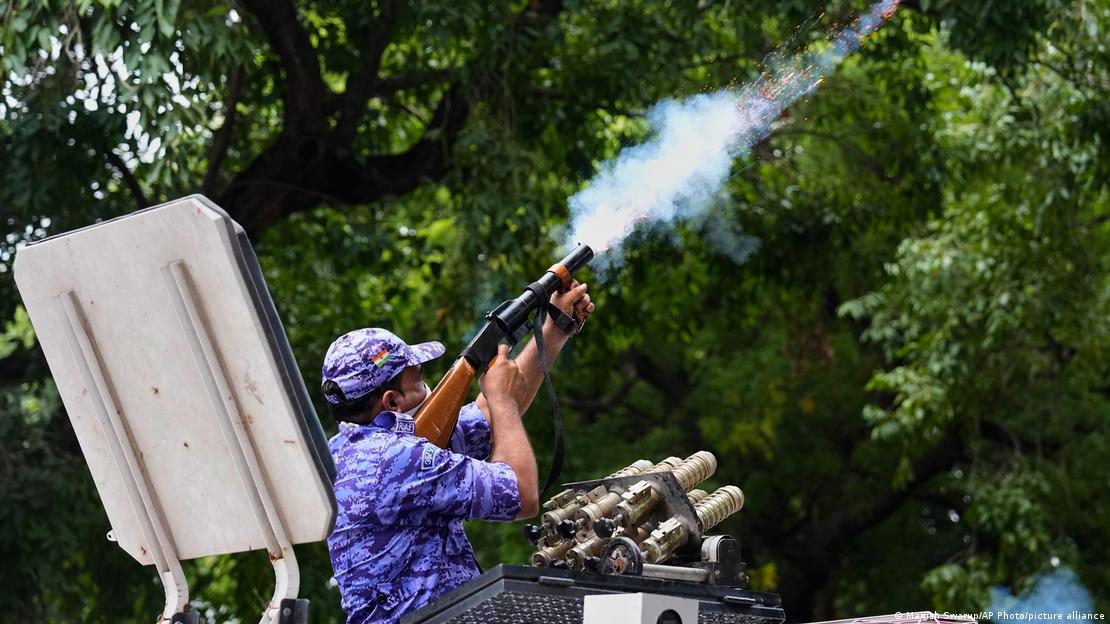
Riot police fired tear gas and used batons in New Delhi as tens of thousands of supporters of the satirical Cockroach Janta Party (CJP) marched towards India's Parliament on Monday (July 20).

Police in the Indian capital said 60 protesters and 118 police officers were injured in the clashes between demonstrators and security forces. Mobile internet was suspended in parts of the city, including around the Jantar Mantar protest site, during the violence.

Protesters are demanding the resignation of Education Minister Dharmendra Pradhan. Earlier this year, authorities canceled the high-stakes NEET medical entrance exam over a leaked question paper, affecting millions of students and sparking outrage across India.
What is India's Cockroach Janta Party?

The CJP began as an online campaign in May and rapidly evolved into a Gen Z street movement, giving a voice to a generation frustrated by unemployment, shrinking opportunities and a failing education system.


The protesters attempted to march toward India's ParliamentImage: Manish Swarup/AP Photo/picture alliance

The youth-led "Cockroach" party is now posing an unexpected challenge for Prime Minister Narendra Modi's government, prompting a response that combines political outreach with police action.

Modi's rivals have also tried to step in and take advantage of the youth's frustrations.

"Is this how a government behaves? Using tear gas and baton charges against students? This is a worthless government," Renuka Chowdhury, an MP from India's opposition Congress party, told DW.


Lessons from earlier protests in India


The CJP movement gained fresh momentum over the weekend after veteran reform activist Sonam Wangchuk, whose three-week hunger strike has become a symbol of the protests, was forcibly taken to a hospital by police.

It is not the first time India has experienced major protest movements. Hunger strikes, famously used by Mahatma Gandhi, remain a common and peaceful form of protest in India.

India Against Corruption (IAC) led by veteran activist Anna Hazare, managed to mobilize millions in 2011 and reshape the country's political landscape. A decade later, yearlong farmers' protests forced Modi to repeal controversial farm laws. However, a 2023 Olympic wrestlers' protest over allegations of sexual harassment achieved few of their goals, despite widespread sympathy.

Analysts say the CJP lacks a nationwide organizational network, which the farmers had at their disposal. Yet like the IAC movement, it has tapped into a broader public mood.

"This protest is different because it reflects a much broader cross-section of Indian society," said Yamini Aiyar, an analyst and senior visiting fellow at Brown University. "They are expressing their frustration with a country whose long-atrophied education system has left them with very little hope of a better future."

"Like the IAC movement, it has drawn the middle class onto the streets," Aiyar told DW. "But this is a far more coercive political environment. From the anti-citizenship protests to the farmers' movement, citizens have increasingly looked beyond political parties to hold governments to account."

Police response sparks backlash among Indian protesters

This week's clashes have done little to quell the anger among India's Gen Z.

"Like many young people across India, I am angry about a lack of jobs and an education system that crushes my aspirations. Even though my family supports the BJP, I managed to get away," Rukmini Singh, a student from Meerut, told DW.

"This was an attack against our children. I saw many young boys and girls hurt and bleeding. They will never forget it but the courage these people displayed gives me hope," Vasundara Singh, a teacher from Bihar, told DW.

As during the farmers' protests, leftist parties and student organizations have become visible on the ground, helping mobilize supporters and giving the movement organizational backing.

"After 50 years, youth have occupied the road to parliament," political activist Yogendra Yadav told DW. "This energy by the students shows that the path to parliament goes through the streets. It is remarkable."
Can CJP mobilize India's villages as easily as its cities?

The surge in protest numbers forced the government to engage with the movement after weeks of dismissing it.

Alongside the police action, senior ministers opened talks with CJP leaders. Home Minister Amit Shah met cabinet colleagues while Health Minister J P Nadda held discussions with representatives of the movement.

"We will decide on how best to address the students' demands," a senior Bharatiya Janata Party (BJP) MP, told DW on condition of anonymity.

Most CJP support appears to come from students and India's urban middle class. The BJP's strongest electoral base remains in rural India and smaller towns, where the CJP has yet to prove that its message resonates with young voters.

However, some experts believe that the CJP will do just fine beyond India's urban centers.

"This movement is likely to resonate beyond India's cities because the aspirations of young people in small towns and villages are no different," political analyst Radhika Ramaseshan told DW.

India's 'cockroach' protests meet with batons and tear gas  02:24


"For a generation that saw education as the route to a better life, the failure of the education system has become a deeply political issue," she said.

"Young people in rural India no longer see farming or traditional occupations as their only future. Whether the CJP itself survives is another matter, but the anger and frustration it has tapped into have the potential to reshape politics."

'The anger is now directed at the government'

A movement focused on India's cities may generate headlines without altering the BJP's political fortunes. But if the CJP spreads to rural youth, it could become a much broader political challenge.

"I don't think this will remain an urban movement," said commentator Apoorvanand.

"People constantly move between villages and cities, and those who witnessed the police action will carry those experiences home," Apoorvanand told DW.

"The anger is now directed at the government. Whether it becomes a broader political movement depends on the CJP's ability to widen its appeal."

For now, the CJP has already achieved something unusual. It has transformed satire into sustained street mobilization, forced the government into talks, and ensured that the concerns of India's young people remain firmly in the national spotlight.

"This is a long fight. We will have to engage in a very long struggle for this. Because you have to change an entire system, the nexus of that system is very deep-rooted," said Saurav Das, CJP's chief spokesperson.


Edited by: Keith Walker


Murali Krishnan Journalist based in New Delhi, focusing on Indian politics, society and business@mkrish11


China's Xi urges global cooperation on AI, warns against single-country dominance


Chinese President Xi Jinping said on Friday artificial intelligence should not be dominated by any single country, calling for greater international cooperation on AI development and governance at a major conference in Shanghai. His remarks come as Chinese AI firms challenge US rivals and concerns grow over AI's military, cyber and terrorist misuse.


Issued on: 17/07/2026 
By: FRANCE 24

Chinese President Xi Jinping, China on July 1, 2026 © Maxim Shemetov, Reuters


Artificial intelligence should not be dominated by a single country, China's President Xi Jinping said Friday, urging international cooperation on its development at a major conference in Shanghai.

Chinese AI models are catching up to the most powerful US offerings, while attracting global users with lower costs.

But how to govern the booming sector has become a key topic, as concerns over the deployment of AI in military combat, or its use by hackers and terrorists grow.

"AI development should not be a solo performance by a single country, but a symphony of international cooperation," Xi said at the opening of the World Artificial Intelligence Conference.

"We should jointly oppose overstretching the national security concept in the field of AI or placing one country's security over that of others," Xi added.

The United States and European Union have imposed restrictons on Chinese tech imports, citing national security concerns, while recent tussles between Washington and American AI labs have raised questions on who controls access to top technology.

The WAIC conference is "the most important annual event for understanding the direction of China's AI industry", said Poe Zhao of analysis publication Hello China Tech.

"The United States retains a clear lead in advanced chips, frontier computing infrastructure and the most capital-intensive model development," Zhao told AFP.

But "China is its closest and most comprehensive competitor".


'Under human control'

The four-day WAIC draws more than 1,000 of China's tech firms together with officials, researchers and industry figures.

Around 3,000 products are on display, from powerful semiconductor systems for AI computing to a smartphone that can autonomously operate apps.

But eyes were first on Xi's vision of how the world should handle the potential impact of AI on cybersecurity and conflict, as well as on jobs and the world economy.

"We should put in place laws and regulations, technological monitoring, early warning, and emergency response systems, in order to ... ensure AI is always under human control," Xi told the conference, calling for a "people-centric" approach.

On Thursday, foreign minister Wang Yi and representatives from 29 countries including Russia, Pakistan and Indonesia signed an agreement establishing an intergovernmental AI cooperation group.

The World Artificial Intelligence Cooperation Organization, headquartered in Shanghai, aims to promote consultation and collaboration between members to ensure the "healthy and orderly" development of AI, state media reported.

Leaders including UN chief Antonio Guterres, Cambodia's Hun Manet and Thailand's Anutin Charnvirakul are attending WAIC, which lays out the cutting edge of Chinese tech.

Early on Friday, the Beijing-based startup Moonshot AI released a powerful new flagship model, Kimi K3, whose performance could reportedly rival some of the best, if not top, US offerings.


Mega AI consumption


Other highlights at this year's WAIC are MiniMax's M3 model, the first mass-produced phone equipped with an autonomous AI agent, and Huawei's Atlas 950 "supernode", an AI architecture for learning and reasoning.

"The main theme will be the transition from AI models to systems that can be deployed at scale" in everyday life, said Hello China Tech's Zhao.

AI agents – tools capable of conversing with users, managing software or performing complex tasks – are also taking centre stage.

AI has become a strategic pillar of China's industrial policy, driven by state investment aimed at building a domestic ecosystem, from chip production to consumer use.

Daily consumption in China of "tokens" – the industry unit of AI usage – has increased a thousandfold over the past two years, according to state media citing officials.

The Chinese market was valued at 1.2 trillion yuan in 2025 ($177 billion), and is expected to grow more than 30 percent this year, according to official data.

China has more patent filings for generative AI than any other country, according to the World Intellectual Property Organisation (WIPO), which recorded more than 43,000 such filings between 2024-25.

A growing number of companies abroad – like Siemens this year – are adopting Chinese open-source AI models, attracted by their performance, lower cost and ability to customise, in contrast to the closed systems of US giants such as OpenAI and Anthropic.

(FRANCE 24 with AFP)
BANS DONT WORK

'France wants to lead the way' with under-15s social media ban

FRANCE24
Issued on: 21/07/2026 


French lawmakers are expected to pass a bill on July 21st banning social media access to children under 15. If approved, France would follow Australia's lead, where the world's first ban ​for under-16s ‌on platforms including Facebook, Snapchat, TikTok and YouTube came into ⁠force in December, as concerns grow over the impact social media has on the health and safety of minors.

Video by:  Clovis CASALI

Microsoft strikes 'multibillion-dollar' deal with French AI firm Mistral

Microsoft and French startup Mistral said Tuesday they had signed a "multibillion-dollar" deal for the US tech giant to use the AI developer's computing infrastructure in Europe.


Issued on: 21/07/2026
By: FRANCE 24

This file photo shows an ad for French AI firm Mistral in a New York City subway station. © Shannon Stapleton, Reuters

Microsoft has agreed to spend billions of dollars on Mistral’s computing infrastructure in Europe under a deal that will also expand distribution of the French AI startup’s technology through the US cloud and software giant, ​the companies said ‌on Tuesday.

As part of the agreement, Microsoft Azure customers will be able to develop software ⁠using Mistral’s data centres in France, giving Microsoft more capacity in Europe and regulated industries an alternative to US-controlled infrastructure.

Mistral, meanwhile, has added its AI models called Medium 3.5 ‌and OCR 4 to Microsoft’s app builder known as Foundry. Microsoft Copilot Studio has brought on ⁠Medium 3.5 as well.

Finally, businesses with independent data centres that access Microsoft services via Azure Local will have the option to run Mistral’s “open” models, which give customers license to develop AI as their own.

The deal underscores ​growing interest in Europe and elsewhere to reduce dependence on US technology so other countries may ‌have greater say in their future society and economy. It may also help Microsoft meet rising demand for open models.

Though the push for “sovereign” AI is now years old, a US decision last month to pause foreign access to two advanced models from San Francisco-based Anthropic ‌has made technology independence a more urgent issue in Europe.

In a joint interview with Reuters, Microsoft President Brad Smith and Mistral CEO Arthur Mensch said the partnership aimed to deliver ​such sovereignty while allowing access to US software and security features.

“By putting Mistral’s models on Azure Local and on Mistral’s computational capacity, we can combine American and European technology and do it in a way that provides continuous and assured ​access,” Smith said.

The AI lab behind the Claude chatbot is also in talks for a deal worth billions to use infrastructure belonging to Facebook and Instagram parent Meta, according to media reports.

Staying in the AI race

Decoupling Europe from US technology would be a tall order. Nvidia chips powering the global ​AI boom, also key to Mistral’s data-center buildout, are American-designed. Nvidia, like Microsoft, is a ​Mistral investor.

Smith said the deal announced on Tuesday did not include any new financial stake in the startup, and Mensch declined to comment on a Bloomberg News report that ​Mistral was in talks to raise around €3 billion ($3.4 billion) at a €20 billion valuation.


Cover image: BUSINESS © FRANCE 24
05:00


The Paris-based lab has come to represent one of Europe’s top hopes in AI. So far it has targeted manufacturing, financial services and defense sales and has won business from France’s armed forces. Its valuation remains dwarfed by US peers such as Anthropic.

Still, Mensch said the deal showed how Microsoft and Mistral were “working together ⁠on closing the gap on the infrastructure side in Europe”.

Mistral is targeting 1 gigawatt of compute capacity by 2030, and the Microsoft agreement – specifics of ⁠which Mensch declined to provide – ​validates its strategy.

The companies are working on a joint go-to-market plan, they added.

“This is going to help both of our companies grow our businesses, unquestionably," Smith said.

(FRANCE 24 with Reuters and AFP)

What's at stake for the EU's carbon market blueprint

Cover image: Spotlight © France 24

Issued on: 18/07/2026 
Play (14:14 min)


The European Commission has confirmed it will allow EU industries to continue emitting planet-warming CO₂ gases well into the 2040s.

The move comes as part of an overhaul of the bloc's Emissions Trading System. Starting in 2036, the Commission will give industries the option of buying carbon credits from outside the EU to offset their emissions. That means the carbon price could be lowered and give industries more options to pollute if EU carbon allowances run out. In this edition, we speak to Michael Bloss, a European MEP from the Greens/European Free Alliance and Wijnand Stoefs of the non-profit research organisation Carbon Market Watch.


OUR GUESTS

Michael BLOSS  German MEP, The Greens/EFA 

Wijnand STOEFSEU policy lead, Carbon Market Watch


How state actors are exploiting climate crises to spread disinformation

The number of extreme weather events is on the rise, and some states are taking advantage of these climate crises to spread disinformation. A report by France's Institute for International and Strategic Affairs (IRIS) says that climate disinformation has become a “tool for destabilisation”.


Issued on: 20/07/2026 
By: The FRANCE 24 Observers/
Aurélia ABDELBOST

Foreign actors are taking advantage of extreme weather events to share destabilising disinformation. This was the case during recent heatwaves in France (archival image, at left) as well as during deadly floods in Spain (at right). © AP (montage by FRANCE 24)

The number of heatwaves is on the rise in France, which endured its third major heatwave in mid-July. Climate disinformation is on the rise, too – as exemplified by this tweet, which insinuates that heatwaves in Europe may have been triggered by work done by the American scientific endeavour HAARP (High-frequency Active Auroral Research Program), based at the University of Alaska-Fairbanks.


This tweet insinuates that the US program to study the ionosphere, HAARP, might be causing heatwaves in Europe. © X

It refers to an old conspiracy theory that the antennae used by HAARP – a scientific project that aims to study the ionosphere, the layer of atmosphere located at an altitude of between 80 and 640 kilometres – are actually being used to manipulate the global climate.

There is no scientific basis for this theory. And yet this disinformation, which is being spread by a pro-Russian account called @camille_moscow, is far from the only fake narrative about the climate being pushed by a foreign actor.

Mathilde Jourde, a researcher at French think tank IRIS, explains:

"Information warfare latches onto issues that are polarising within societies. Climate change is becoming an increasingly central issue within our societies, especially in Europe. So foreign actors are starting to use the climate as a tool for destabilisation, as a strategic lever."
The United States and Russia, two state actors spreading climate disinformation in Europe

The researcher, who is head of the Climate, Environment and Security programme at IRIS, is the co-author of the report “Climate Disinformation and Information Warfare: State Interference and Security Implications”, published in May 2026. The study focuses on climate disinformation spread by two state actors in particular: Russia and the United States.

"The data we have shows that these are actors targeting Europe,” Jourde says.

Jourde says that much of the disinformation centres on European climate and energy policy, like the European Green Deal, a roadmap launched in late 2019 to make Europe the first carbon-neutral continent by 2050.

The United States and Russia are both fossil fuel exporters, which means they could benefit from a reduction in the EU’s decarbonisation goals, the IRIS report says. But Jourde says the aims of this kind of disinformation could be much wider:


"The disinformation itself might not be the main objective. For Russia, for example, this could serve as a strategic objective amid ongoing tensions in Europe surrounding the war in Ukraine."
‘Participation in the chaos’: the example of the 2024 floods in Valencia, Spain

In this context, foreign actors are increasingly taking advantage of climate events, like, for example, the 2024 floods that killed more than 200 people in Valencia, Spain.

"Some of the disinformation around the event came from Russian sources,” the researcher says. The campaign was focused on amplifying false content already circulating online:


"Many false emergency numbers circulated online. There were also fake reports of the number of people killed by these floods. That sowed a type of mistrust in the authorities among the population, which added to the chaos and, in the long term, perhaps weakened people’s support for Europe’s position regarding Ukraine.”
Why severe climate events are a 'blessing’ for those carrying out the information wars

In 2023, a Russian disinformation campaign spread the false narrative that the US government was prioritising spending money on Ukraine instead of on those affected by the wildfires that raged across Maui, Hawaii. Extreme weather events are a “precious blessing for those who perpetrate information warfare because you can play on people’s fears with very little effort. Things take off quickly,” Jourde says.

Russian disinformation is certainly spread by state media outlets like Russia Today, which has been banned by the European Union since 2022, but it is often concealed, according to the report. It is often spread by channels aligned with the state such as Portal Kombat, a vast network of disinformation sites discovered in 2024 by Viginum, the French service combating foreign digital interference.
This diagram from the IRIS report shows the different channels of Russian climate disinformation aimed at Europe. © Institute for International and Strategic Affairs
US disinformation

On the other hand, climate disinformation from the United States is more blatant, especially since the start of President Donald Trump’s second term in the White House. The narrative is often relayed by official channels, Jourde says:


"We saw fake numbers in a report published by the US Department of Energy on the climate crisis. On official government sites, you see questions being raised about the human impact on the changing climate."

Moreover, a number of government sites have also censored words like "climate change” or “green”.

Climate disinformation is also spread by those with links to the government, like conservative think tanks that can coordinate campaigns against environmental policy in Europe. One such body is the Heartland Institute, according to the IRIS report. The organisation is openly sceptical of climate change and “receives funding from companies such as ExxonMobil and from Republican donors”. The Heartland Institute opened an office in London in 2024 with the aim of influencing European energy policy.
Strategies of influence: China on the defensive

Other state actors are also spreading climate disinformation, though perhaps less aggressively. China, for one, “won’t deny that climate change is happening, nor its seriousness, but it will promote certain narratives to defend its position”, the researcher said.

The country seeks, for example, to highlight its response to climate change and minimise its responsibility, instead insisting on the role of Western nations. The IRIS report notes that “certain points of convergence can be identified” between China and Russia. China also took part in influence operations during the Hawaii wildfires in 2023 and during the floods in Spain in 2024.

This article has been translated from the original in French by Brenna Daldorph.
Climate justice in Africa: floods, fossil fuels and the fightback


Issued on: 07/07/2026 
Play - 33:15  
SPOTLIGHT ON AFRICA

This week in Spotlight on Africa, we look at climate change, environmental justice and the challenges of adaptation. While Europe's heatwaves make headlines, temperatures are also climbing across Africa, with parts of the Sahel approaching 50°C. West Africa is also experiencing severe flooding caused by climate change. Yet Africa is also a source of innovation and solutions, as we'll be discussing today.

One of eWaka's latest electric motorbike models, in Nairobi, Kenya, 7 May, 2026. © RFI / Melissa Chemam

Heatwaves in Europe are getting a lot of attention from the media, as they break records, but temperatures are also on the rise in Africa, with 50°C reported in the Sahel since March. And West Africa is facing unprecedentedly violent floods, especially in Ghana, parts of Nigeria and in Côte d'Ivoire. All due to global warming and climate change.


But if Africa is often seen as a victim of climate disasters - it’s also the source of solutions.

Climate change is directly linked to oil and other fossil fuel use, which also causes environmental pollution.

Somalis displaced by a drought, receive food distributions at makeshift camps in the Tabelaha area on the outskirts of Mogadishu, Somalia on 30 March 2017. AP - Farah Abdi Warsameh

In May 2026, Shell and other major oil companies held their annual general meetings, a tense moment for the victims of decades-long pollution by the companies. In the case of Shell, it might be able to shed its duty to clean up the region by selling some of its assets to another group named Renaissance.

Ahead of and after the annual meeting, local communities in Nigeria organised to act, as they see a critical opportunity to amplify scrutiny of Shell's continued fossil fuel expansion. The goal is to show the company's failure on climate accountability and environmental justice.

The pollution also affects other parts of Africa, and many actors, investors and campaigners are organising to make their demands heard.

Fire burns on the Shell Petroleum Development Company Trans Niger pipeline at Mogho, Gokana, Rivers state, Nigeria, on 5 January, 2017 REUTERS - Afolabi Sotunde

A month after the Africa Forward summit in Nairobi, and ahead of the 11th Global Summit on Climate Change in Paris on 30-31 July 2026, this week we hear from three people building the future.


Emem Okon is the executive director of Kebetkache Women Development & Resource Centre – a frontline leader on gender, oil pollution and community rights in the Niger Delta. She tells us how the communities are fighting for accountability.

Yuma Sasaki, from Japan, is Dodai's CEO, working from Addis Ababa. Dodai is an electric mobility company based in Ethiopia. They recently raised $13 million (the largest fundraiser ever in Ethiopia) to scale up electric bikes.

Ethiopia, like Kenya, has emerged as a hub for electric vehicles given progressive government policy. It was the first country in the world to ban the import of fuel vehicles.

With abundant and cheap hydropower, Ethiopia could make e-bikes commercially advantageous as well as environmentally beneficial.


And Bim Adisa, CEO of Beacon Power Services, explains how artificial intelligence can help improve the reliability of electricity grids. Lagos-based BPS helps operators stabilise electricity grids – already impacting over 100 million people worldwide, including in West Africa.

This episode was mixed by Erwan Rome.
Project 'Afrika’: Inside Russia's propaganda machine


Cover image: Project 'Afrika’: Inside Russia's propaganda machine © France Médias Monde graphic studio
Issued on: 17/07/2026 
12:16 


After a leak of confidential documents revealed how Russian agents have been placing hundreds of articles in French-speaking media outlets in West and Central Africa, FRANCE 24 travelled to Dakar, Senegal, to investigate this secret operation.


"When you read articles like this, you definitely get the impression they are intended to manipulate opinion," says Ibrahima Lissa Faye, the Head of Publication at the Senegalese media outlet PressAfrik. He learned from our team last March that his news site had published 13 articles featuring Russian propaganda.

These 13 articles are part of a vast Russian influence campaign on the African continent. A leak of confidential documents revealed the existence of “Project Afrika”, a Russian operation aimed at using African online media outlets to spread Russia’s strategic agenda – from anti-France and anti-Ukraine positions to blatant disinformation.
644 articles published, $300,000 spent in just a few months

Pan-African media outlet The Continent received these leaked documents, which were then analysed by a consortium of media outlets including FRANCE 24 and led by Forbidden Stories. The documents belong to a Russian structure known as Africa Politology – though, internally, it is known as the “Company”. First created by the Wagner Group, it was taken over by Russia's secret services in 2023.

According to the documents, the Company managed to place 644 articles containing propaganda or disinformation in at least 35 media outlets across central and west Africa between June and November 2024. The campaigns cost more than $300,000.


FRANCE 24 travelled to Dakar, Senegal, to follow the trail of these Russian influence operations preying on the country’s media outlets. The Company has been directly targeting Senegal, hoping to bring it more firmly into its zone of influence.

This investigation takes us into the opaque world of articles that have been placed in media outlets by local intermediaries, some of whom we’ve identified, as part of a system where articles are “ordered” and delivered “ready-to-publish”. Our reporting shows how these sites are dependent on ads and seek to publish as much content as possible – elements that make them especially vulnerable and porous.


Among others, we identified Cameroonian journalist Jérôme Ebossama. When contacted, he declined to answer our questions regarding the 18 articles listed in the Company's documents, which he had allegedly published in a West African media outlet. However, he stated that the documents published by Africa Confidential – including invoices showing his involvement in an online blogging campaign – are “fake” and “not [his]”, adding that he was the “victim of a manipulation campaign”.

Report by Nathan Gallo and Derek Thomson, with footage by Aminatou Diallo.