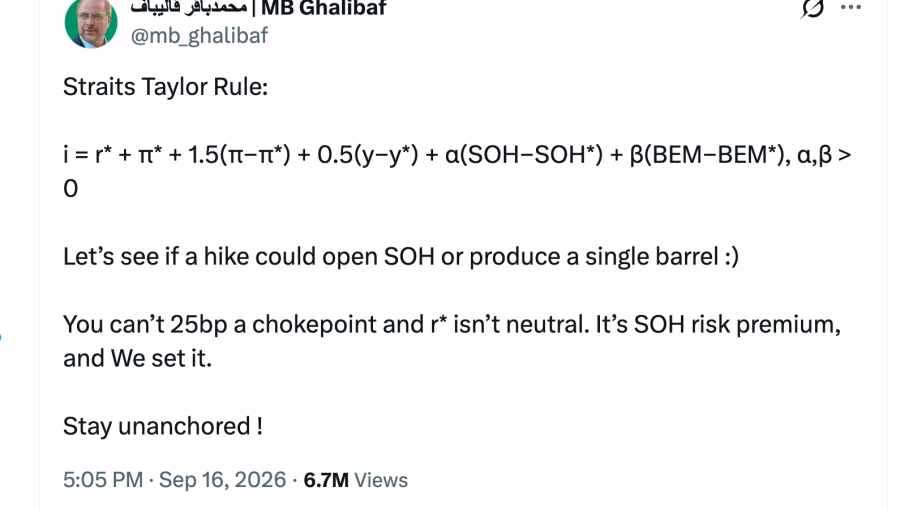
Iran's parliament speaker mocked the prospect of a US interest rate rise with a rewritten Taylor rule carrying maritime chokepoint terms, in a post on September 16, hours before the Federal Reserve raised rates by a quarter of a percentage point.
Mohammad Bagher Ghalibaf headed it the "Straits Taylor Rule": i = r* + π* + 1.5(π-π*) + 0.5(y-y*) + α(SOH-SOH*) + β(BEM-BEM*), with α and β both positive. SOH is the Strait of Hormuz, BEM is Bab el-Mandeb. "Let's see if a hike could open SOH or produce a single barrel," he wrote. "You can't 25bp a chokepoint and r* isn't neutral. It's SOH risk premium, and We set it."
Removing the two chokepoint terms leaves the algebraic form of John Taylor's 1993 rule. It is a policy benchmark, not a formula the Fed mechanically follows. Taylor's original calculation used GDP-deflator inflation; substituting consumer prices gives an illustration rather than a like-for-like application.
US consumer price inflation ran at 3.4% y/y in August, against 2.4% stripped of food and energy, the Bureau of Labor Statistics reported on September 11. Assuming a 2% neutral real rate, a 2% inflation target and a zero output gap, substituting the headline CPI figure gives a policy rate of 6.1% and the core figure 4.6%. The Fed set 3.75%-4.00%. These calculations do not estimate the actual output gap or the current neutral rate. The decision was announced on September 16.
The 1.5-percentage-point difference between these illustrative readings reflects the one-point gap between headline and core inflation, multiplied by 1.5. It cannot be assigned entirely to energy: core excludes food as well. The energy index was up 16.3% y/y and petrol 27.4%, while food rose 2.7%.
Only three commercial vessels were recorded transiting Hormuz on September 16, against a 10-day average of about 17, roughly 82% below that average, according to preliminary Kpler data cited by Reuters and IntelliNews. Untracked vessels mean actual traffic could have been higher. Iran has asserted control of the strait, through which about a quarter of seaborne oil trade passes, since the war began on February 28, and has charged vessels for passage while the US Navy escorts traffic through.
Gulf central banks raised their own rates a quarter point on September 16 in line with their dollar pegs, Kuwait the only holdout. Higher borrowing costs compound disruption around the same chokepoint affected by the war.
Iran's actions had shifted the inflation outlook but Tehran was "not 'setting' US interest rates", Susannah Streeter of Wealth Club told Al Jazeera, while IG Group's Chris Beauchamp called the post "a spectacular bit of agitprop from Iran".
Commentator Arnaud Bertrand, writing on X on September 17, said he had "never seen a country threaten another with a math equation before", and read the post as Ghalibaf "telling them that Iran is - in a very real way - setting American monetary policy".
The illustrative 6.1% rate is 2.225 percentage points above the Fed target range midpoint, equivalent to roughly nine quarter-point increases. That comparison is arithmetic, not a forecast or a recommendation.


No comments:
Post a Comment