It’s possible that I shall make an ass of myself. But in that case one can always get out of it with a little dialectic. I have, of course, so worded my proposition as to be right either way (K.Marx, Letter to F.Engels on the Indian Mutiny)
Thursday, August 13, 2026
Offshore Wind Installation Vessels
Cadeler Orders Two More WTIV Vessels Citing Continued Strong Sector Demand
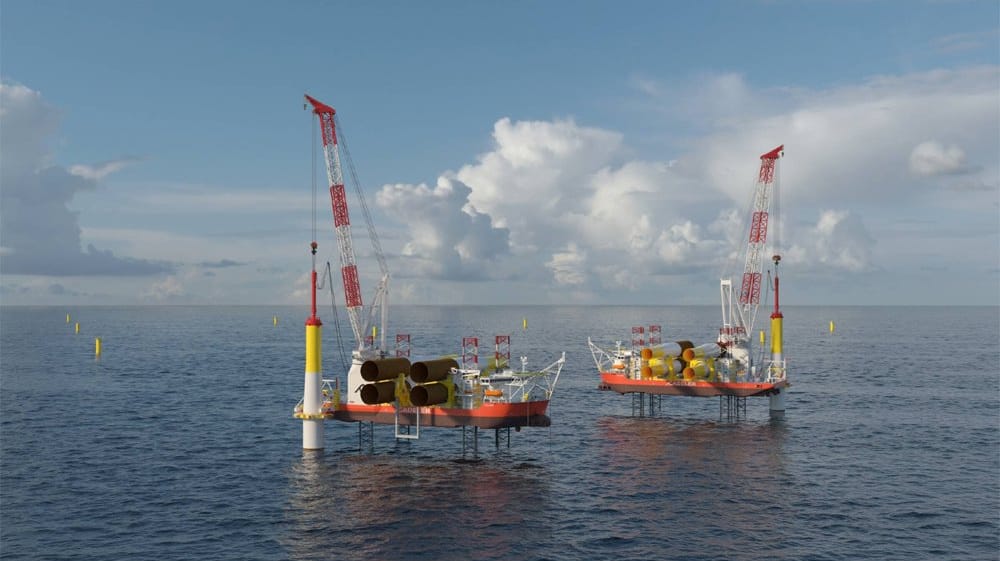
Cadeler ordered two large WTIV to expand its fleet to 14 vessels by 2031 (Cadeler)
Cadeler, which already says it has the industry’s largest fleet of jack-up offshore wind installation vessels, reported that it has placed a new construction order for two more vessels. The company is continuing its relationship with COSCO Shipping Offshore shipyard in Qidong, China, reporting the value of the new contract at approximately €805 million (US$930 million).
The company recently took delivery of its eleventh vessel, also from the shipyard in China, and still has one more vessel under construction due for delivery in the first half of 2027. It says its strategy is to become the preferred offshore wind installation partner of the industry. It already reports a strong list of projects for the fleet.
The two new ships will be part of what it is calling T-class offshore wind installation vessels, scheduled for delivery in 2030 and 2031. The new T-class series vessels, it says, have been engineered to be the largest and most capable vessels ever introduced to this market, incorporating breakthrough technologies and operational capabilities that extend well beyond current industry standards. The recently introduced A-Class has a deck space of 5,600 square meters, a payload exceeding 18,000 tonnes, and a main crane capable of lifting above 3,300 tonnes at 39 meters. It says the current class can transport and install up to six sets of XXL monopile foundations per load. The A-Class was also designed to be capable of conversion from the installation of XXL foundations to the installation of wind turbine generators.
It did not provide details on the capabilities of the T-Class. However, it said, “Designed to tackle increasingly complex projects with greater efficiency, versatility, and performance, they are expected to open access to new opportunities while reinforcing Cadeler's long-term competitive advantage and commitment to innovation.”
The new Wind Ace is currently undergoing commissioning, and then it will be deployed on ScottishPower Renewables’ East Anglia Two offshore wind farm in the UK. Cadeler will provide the transportation and installation of both foundations and wind turbines for the project. Wind Ace will be joined by one of Cadeler’s O-Class vessels at the site when offshore work commences in 2027.
As of the end of March, Cadeler reported an order backlog at EUR 2,705 million (more than $3.2 billion). The company reports that 82 percent of its backlog relates to projects where clients have already taken final investment decisions.
Vestas Shares Surge as Wind Turbine Orders Rebound
Shares in Danish wind turbine maker Vestas Wind Systems surged more than 20% after the company raised its full-year profit guidance and announced a €400 million share buyback, signaling a sharp recovery for the wind industry.
Vestas said turbine orders jumped to 3.35 gigawatts (GW) worth €3.4 billion in the second quarter, up from 2 GW worth €2.2 billion a year earlier. Its total turbine backlog has now reached 32.5 GW, valued at €36 billion.
The company reported adjusted operating profit of €446 million for the quarter, compared with just €57 million a year earlier. Its operating margin reached 9.4%, putting Vestas close to its long-term target of a 10% margin.
All of the orders booked during the quarter were for onshore turbines, while offshore orders remain more volatile because projects are larger and take longer to develop.
Vestas said the improvement reflects stronger demand for wind projects as governments and developers become more willing to pay higher prices for new capacity. The industry has also benefited from easing supply-chain pressures and a recovery in turbine manufacturers' profitability following a difficult period in 2022 and 2023.
The €400 million buyback is the latest in a series of shareholder returns announced as Vestas recovers from years of rising costs and supply-chain disruptions.
Vestas remains the world's largest wind turbine manufacturer by installed capacity, although Chinese competitors have overtaken it in annual turbine deliveries.
DESANTISLAND
Port Everglades Uses Visit of Largest Boxship to Urge Channel Improvements
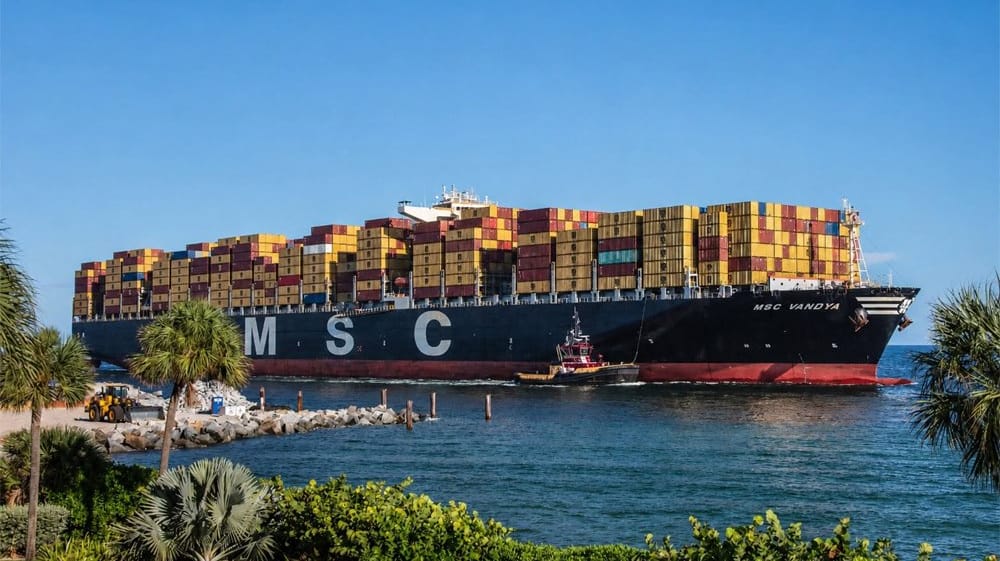
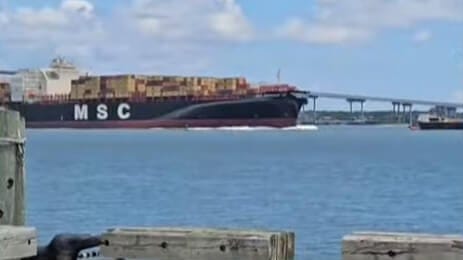
MSC Vandya became the largest containership to call at Port Everglades, and officials used the opportunity to highlight the importance of the planned navigational improvement project (Port Everglades)
Port Everglades celebrated the arrival of the largest cargo ship to ever visit the port on August 12. While highlighting the continued growth in the port’s cargo operations, officials also used it as an opportunity to urge progress on the Port Everglades Navigation Improvements Project (PENIP), which was approved by the U.S. Congress a decade ago.
The MSC Vandya (182,000 dwt) made a brief port stop during which the port expected to offload approximately 1,300 TEU and load additional boxes bound for Asia. Built in 2012, the ship is 1,200 feet in length and has a maximum capacity of 13,050 TEU. The MSC Vandya stopped in Port Everglades as part of MSC’s Dragon Service to the Far East, and departed on Wednesday afternoon.
“Ships today are being built larger and more sustainable because they can carry more containers in fewer trips, thereby reducing their carbon footprint,” said Port Everglades CEO and Port Director Joseph Morris. “The MSC Vandya is a good example of why Port Everglades continues to operate at a disadvantage. Until we deepen and widen our navigational channel, ships will arrive lightly loaded or will be forced to call on another port, adding time and cost to the transportation of goods.”
The port achieved its best cargo year in FY 2025 with 1,167,552 TEUs, setting a new Port Everglades record. However, officials highlight that currently 8,000 TEUs is the highest number of TEUs that a ship coming into Port Everglades can carry due to current water depth restrictions.
MSC Vandya maneuvering in the port (Port Everglades)
They highlighted that for the past 30 years, the U.S. Army Corps of Engineers has been working on the Port Everglades Navigation Improvements Project (PENIP) to deepen and widen Port Everglades navigation channels to enable the safe passage of newer, larger, and more sustainable ships.
The PENIP calls for deepening the main channel from 42 feet to 48 feet with two feet extra overdepth for a total of 50 feet and widening the Intracoastal Waterway by the U.S. Coast Guard Station where there is a chokepoint. The project was authorized by Congress in December 2016.
Port Everglades reports it is continuing to work with its federal and state partners to move this project forward. It emphasized that the project remains critical to retaining global business partners and reducing delays in the supply chain that feeds, clothes, and fuels in South Florida.
Florida's Governor Backs New Shipyard Proposal in Pensacola
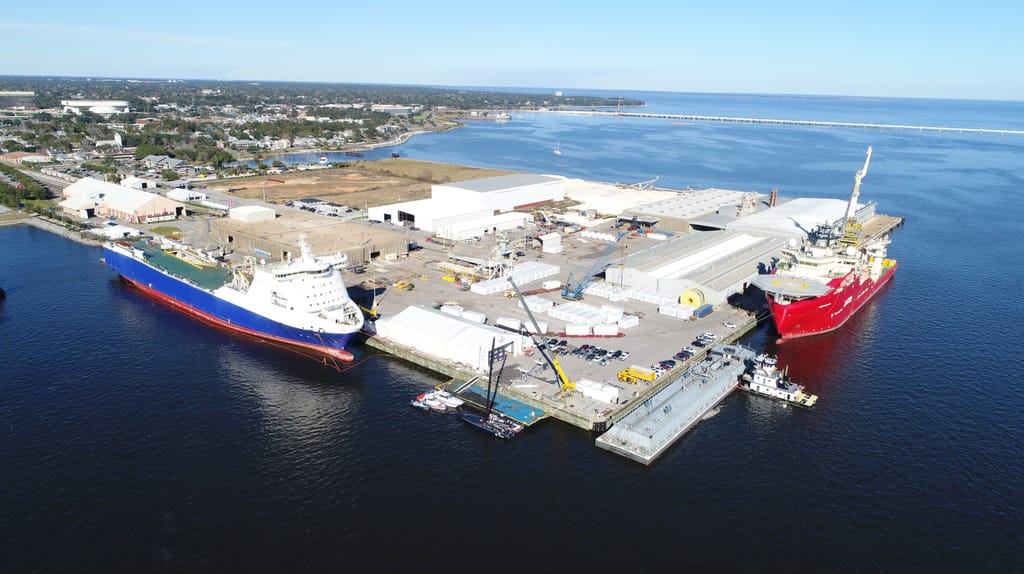
The current Port of Pensacola main site (Press handout image courtesy Port of Pensacola)
On Wednesday, the Pensacola shipyard proposal known as "Project Maeve" received a meaningful gesture of support from Florida Gov. Ron Desantis' administration: a $9 million city grant for infrastructure improvements related to the creation of the brand-new enterprise.
"We’re [making] a $9 million investment to support the construction of two boatbuilding facilities at the Port of Pensacola. These facilities will produce complex Navy ship modules for submarines and surface ships, and they are projected to create 2,000 jobs for Floridians in shipbuilding and maritime manufacturing," said DeSantis in a statement.
The grant underwrites site development, utilities and construction for two new shipbuilding facilities at Port of Pensacola. The port has also applied for $76 million in funding from the BP Deepwater Horizon settlement to help support the proposed operator, Australian defense shipbuilding firm Birdon. The total project cost is estimated at about $275 million in two phases: first, a panel line and module fabrication facility, followed by an assembly bay and office complex to support ship construction.
The envisioned project would be a significant Tier 2 operation with 400,000 square feet of new manufacturing space to support the U.S. Navy's distributed-shipbuilding enterprise. It would be the biggest single addition of new jobs in Pensacola's history, and would add new hiring demand in a competitive market for skilled welders and shipfitters on the Gulf Coast, drawing from the same labor pool as Ingalls Shipbuilding (80 miles to the west), Austal USA (50 miles to the west) and Eastern Shipbuilding (100 miles to the east).
In addition to modules, the Project Maeve site would be equipped to build vessels of up to 400 feet in length - an appropriate size for the Navy's MUSV unmanned-vessel program, which Birdon has joined in conjunction with Mythos AI. The consortium is one of seven finalists in the recently restructured MUSV competition.
The new shipyard project would be a big economic lift for Pensacola: it would bring in about 1,440 onsite jobs paid at an average of $68,000 a year, plus another 560 professional positions paying about $112,000 a year. In a city with a median household income of about $74,000 per year, that would be a big boost. "This project will change the trajectory of our city for generations to come," said Mayor D.C. Reeves in a statement earlier this year.
Vietnam gold firms face fresh scrutiny after inspection findings
Vietnamese inspectors have uncovered more historical violations at major gold companies involving tax reporting, anti-money-laundering rules and gold-bar sales, as authorities step up oversight as part of wider industry reforms.
Bao Tin Manh Hai Jewelry JSC was accused of accepting deposits for gold bars without immediately delivering the bullion, in breach of its license, while also underreporting taxes and failing to meet some anti-money-laundering reporting and customer-identification rules, according to a statement from the Government Inspectorate of Vietnam. The findings stem from an inspection covering 2023-2025.
Mi Hong Ltd. was cited for alleged anti-money-laundering violations and the failure to properly report changes to its gold-bar business. State gold trader Saigon Jewelry Co., known as SJC, along with Phu Nhuan Jewelry JSC and DOJI, were accused of breaching tax or accounting standards, the statement said.
While DOJI couldn’t immediately be reached for comment, the other companies said the alleged violations were for past actions and that they comply with government regulations. The government inspectorate estimates the violations involve around 93.7 billion dong ($3.6 million) of incorrect tax and profit declarations over the two-year period.
Authorities are overhauling the nation’s gold market to reduce the State Bank of Vietnam’s long-standing monopoly on bullion production and create a more competitive, transparent trading system. The reforms are aimed at increasing supply; narrowing the gap between domestic and global gold prices; improving market oversight; curbing smuggling and other illicit trading; and giving licensed businesses a greater role in the market.
The government is also broadening scrutiny of jewelry and precious metal businesses following an investigation into a cross-border smuggling network involving thousands of diamonds, raising concerns about transparency in the sector. The trade ministry plans a monthlong inspection regime of certain businesses trading in jewelry, diamonds and gemstones.
The inspectorate asked police to examine transactions involving seven individuals who sold about 2.084 trillion dong worth of gold of unclear origin, citing unusually large volumes inconsistent with their reported incomes, the statement said, without identifying the individuals.
Inspectors also urged the central bank and relevant authorities to step up efforts to curb gold-market manipulation, hoarding, smuggling and speculation, while calling for a roadmap to establish a national gold exchange to improve market transparency.
Bao Tin Manh Hai said the inspection found no evidence of market manipulation, hoarding, smuggling or profiteering, according to a statement on its website. It said the gold-bar deposits cited involved seven transactions in 2023-24 to repackage damaged bars at SJC. The company added that it has since paid additional tax, completed its e-commerce registration, updated pricing disclosures and strengthened anti-money-laundering procedures. It said operations remain normal and customer interests protected.
Mi Hong said the inspection findings relate to its operations before 2025 and do not represent new issues at the time of their publication. It said it had reviewed and adjusted its processes to address the issues identified, and that its business is continuing normally across its network.
Phu Nhuan Jewelry said it had identified and addressed the tax issue before the inspection findings were published, according to a statement on its website. The company said it had reviewed and fulfilled its tax obligations and the requirements set out in the inspection conclusion.
DOJI hasn’t publicly commented on the findings. Calls to phone numbers listed on the company’s website went unanswered.
(By Nguyen Kieu Giang)
Vietnam Starts Construction of its Largest Domestically Built Frigate
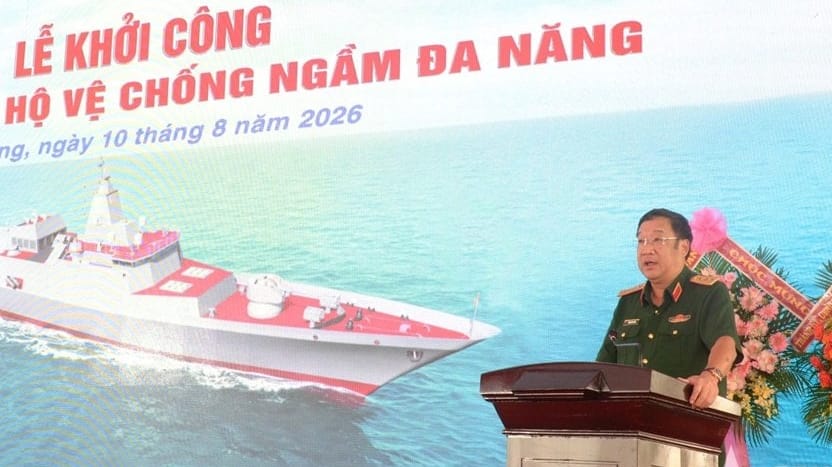
Deputy Minister of National Defense Senior Lieutenant General Pham Hoai Nam speaking during the ceremony (Vietnamese state media)
Vietnamese officials turned out on Monday, August 10, to celebrate the start of construction of what is being billed as the country’s largest and most modern warship. The frigate is being built domestically, with the state emphasizing it is part of its strategy to develop internal capabilities and demonstrate its expanding skills.
The reports highlighted that the frigate is being designed entirely by Vietnamese engineers. In addition, most of its weapons and military equipment will be developed or assembled in Vietnam. In the past, Vietnam has largely depended on its allies for military equipment.
For example, it introduced approximately 15 years ago a class of multi-role missile frigates designed and built in Russia by the Zelenodolsk Design Bureau and the A.M. Gorky shipyard. Known as the Gepard 3.9 missile frigates, the vessels displace around 2,000 tons with a length of 102 meters (335 feet). These warships are deployed by the Vietnam People's Navy for surface strikes, air defense, and anti-submarine warfare.
In the past, Vietnam’s military shipbuilding has mostly focused on building missile boats and patrol vessels. In addition to Gepard-class frigates, Vietnam also acquired Russian-built Kilo-class submarines.
Few details were provided about the size or capabilities of the new class, but analysts are saying they will be in the 2,000 to 3,000-ton displacement range. Reports said Vietnam projects the first ship will be completed in 36 months. The reports indicate that the vessel will likely incorporate an active electronically scanned array (AESA) radar, air-defense missiles, and anti-ship missiles.
The new frigate is being described alternately as a multipurpose vessel and an anti-submarine warship. The project was assigned to the Song Thu Corporation, which is reported to be one of the country’s leading military shipbuilders.
Party officials said during the steel cutting ceremony that the goal is developing a defense industry that is self-reliant, self-sufficient, capable of dual-use and fully modern. Vietnam has already developed a successful commercial shipbuilding capability, which it looks to further co-op into naval projects.
Vietnam has been actively pursuing efforts to expand and modernize its navy and military. It, along with several other neighboring countries, has found itself in an increasing number of disputes as China seeks to expand its influence and range in the region.
Video: Poland Rolls Out First of Three Next-Generation Frigates
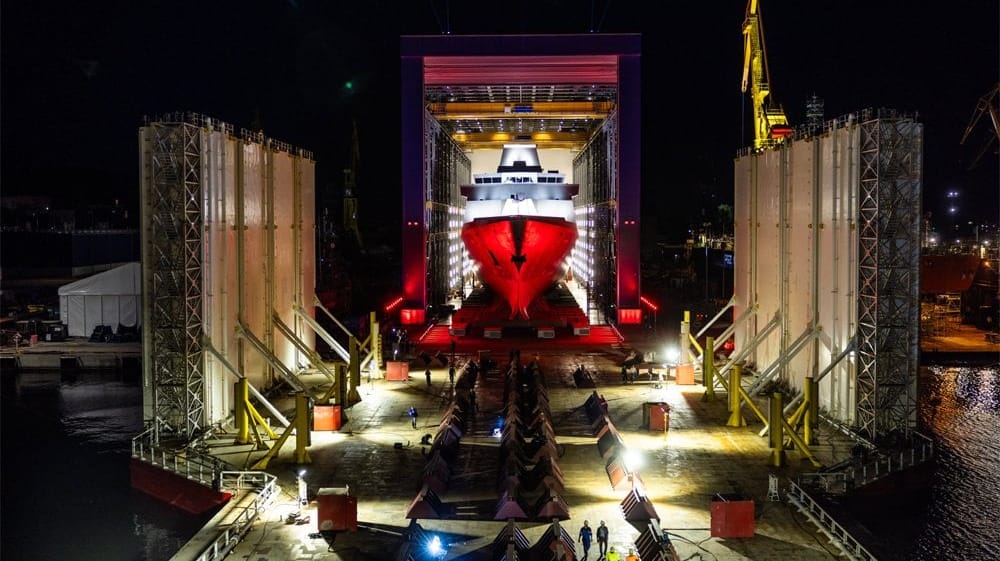
Wicher emerging from the building hall before christening and float out this week (Polska Grupa Zbrojeniowa)
In a dramatic nighttime event in Gdynia, Poland, the first of the country’s three new frigates was rolled out of the building hall on August 9. The program, which is reported to be costing more than $4 billion, started more than a decade ago and will be the largest in Polish naval history.
Poland originally envisioned building smaller vessels, but as world events evolved, the country ordered three 7,000-ton displacement frigates in 2021. The vessels are designed to replace two aging vessels, Gen. Kazimierz Pulaski and Gen. Tadeusz Kosciuszko, Oliver Hazard Perry-class guided-missile frigates commissioned by the United States in 1980 and transferred to Poland in 2000. The aging vessels are smaller at 4,100 tons displacement.
The new ships are designed as multi-role frigates to support Poland’s activities in the Baltic and coastal monitoring as well as NATO. The new ships measure approximately 140 meters (459 feet) with a crew of 120 and a speed of 28 knots. The design of the vessels is adapted from the Babcock International Arrowhead-140 vessels.
The ships will be equipped with anti-aircraft and anti-missile systems, surface-to-surface and surface-to-surface fire systems, and anti-submarine torpedoes. Ultimately, the ships will be outfitted with VLS Mk-41 vertical launchers and CAMM missiles for anti-aircraft systems. RBS-15 missile launchers will be used to engage surface and land targets. Artillery armament will include a 76 mm OTO Melara Super Rapid Strales medium-caliber gun, two 35 mm OSU-35K guns, and remotely controlled weapon modules equipped with large-caliber machine guns.
Work on the project known as Miecznik is underway at the PGZ Stocznia Wojenna shipyard. Assembly of the first of the vessels, named Wicher (Polish for Gale), began in February 2024 with the keel laying in December. The second vessel, Burza (Storm), began construction in May 2025, and the keel for the third vessel, Huragan (Hurricane), will be laid in November.
The hull of the new vessel was placed on a barge cradle and pulled from the building hall. Wicher is scheduled to be christened on Wednesday, August 12, and then the barge will be towed into the Gulf of Gdansk and lowered. After the vessel is afloat, tugs will tow it to the berth for outfitting.
Wicher is scheduled to be delivered to the Polish Navy in 2029. Her sisters will follow in 2030 and 2031. Part of a program to rebuild the Polish Navy, the frigates will be among the most capable in NATO when they are commissioned.
The U.S. division of South Korean shipbuilding giant Hanwha has made a non-binding offer to buy Austal USA, the American operations of Australian shipbuilder Austal Ltd. If accepted, the bid would achieve most of Hanwha's previous, unsuccessful effort to acquire the entire Australian parent company. The new bid for Austal USA is in the range of US$1.0-1.2 billion, according to an Australian stock market filing posted by Austal Ltd. - a marked improvement over its last reported offer for all of Austal's global holdings.
"Hanwha has made it a priority to significantly contribute to revitalizing American shipbuilding and is exploring a range of options to expand our footprint in the United States," said Hanwha Defense USA spokesman James Hewitt. "Any deal will be contingent on due diligence that permits a thorough evaluation of Austal USA’s operations and financials."
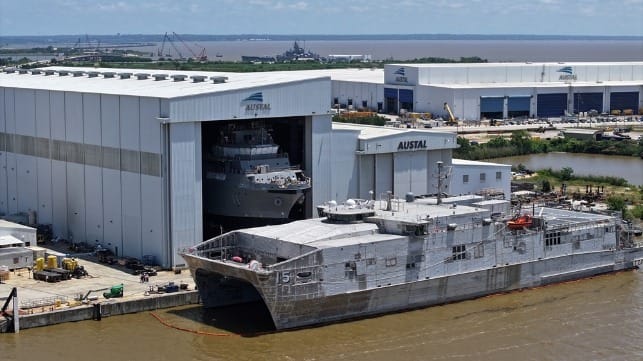
Austal USA is a large and growing defense shipbuilding enterprise based in Mobile, Alabama. It has expanded rapidly through the addition of multiple U.S. Navy contracts and subcontracts, including a new line of business in building modules for nuclear submarines. In 2024, it joined hands with the U.S. Navy, private equity firm CapZone and General Dynamics Electric Boat to effectively acquire and use the land of neighboring Alabama Shipyard for submarine module construction.
During the same period in 2024, Hanwha Ocean was in active conversations with Austal Ltd.'s management about the possibility of buying the firm and taking it private. As early as April 2024, rumors swirled of a proposed offer of about US$700 million for the entire business. Hanwha announced in September 2024 that it was giving up these conversations. The Australian Financial Review reported that Hanwha objected to a US$5 million discretionary termination fee that Austal Ltd. demanded in advance of due diligence reviews, and that the talks fell apart on the question of whether this fee was reasonable.
Hanwha has a demonstrated interest in the U.S. defense market. It has acquired Aker Philly Shipyard (now Hanwha Philly), won a newbuild order from the Missile Defense Administration, and secured repair work from U.S. Military Sealift Command. The addition of Austal USA would radically expand its American operations with more than 3,000 new employees, a modern 180-acre shipyard campus in Mobile, and a ship repair facility in San Diego - if its bid is accepted.
Austal USA is well placed for expansion, but has had difficulty in turning a profit on its recent contracts with the U.S. Navy. Its first deliveries from its new steel-hull construction line have generally been in the red, and it has not found success in convincing the Pentagon to provide contractual relief for unexpected expenses on those programs. In its latest filing, the company said that its U.S. division posted an EBIT loss of about US$125 million in FY2026.
South Korea’s SK Shipping to become Asia’s largest LNG carrier operator in H-Line asset swap
South Korean shipping companies SK Shipping and H-Line Shipping will swap vessels and long-term contracts in a deal that will make SK Shipping Asia’s largest liquefied natural gas (LNG) carrier operator, their owner Hahn & Co. said on Thursday.
SK Shipping will receive 16 LNG vessels and related long-term contracts from H-Line Shipping in exchange for 12 tankers, long-term contracts and about $300 million in cash, Hahn & Co. said in a press release.
After the transaction, SK Shipping will operate 32 LNG carriers and 14 liquefied petroleum gas (LPG) vessels, becoming the third-largest LNG carrier operator globally.
Hahn & Co. plans to rebrand the company as K-LNG. H-Line Shipping will become a tanker and bulk shipping-focused operator following the asset swap.
The reshuffle would improve scale and operating efficiencies at both companies and position K-LNG to benefit from growing LNG demand, Hahn & Co. said.
Both SK Shipping and H-Line Shipping are controlled by South Korean private equity firm Hahn & Co., which acquired a controlling stake in SK Shipping in 2018 and created H-Line Shipping in 2014 through the acquisition of Hanjin Shipping’s long-term dry bulk business.
(Reporting by Kyu-seok Shim; Editing by Ed Davies)
MSC and Chief Engineer Guilty and Fined for 2024 Runaway Boxship Incident
MSC Michigan VII took a wild ride at 16 to 17 knots exiting Charleston with the crew unable to control its speed (YouTube)
MSC Shipmanagement, as the operating company for the containership that took a full-speed runaway trip through Charleston harbor in 2024, and the chief engineer of the MSC Michigan VII appeared in court on Monday, August 10, admitting their guilt and being ordered to pay fines. The National Transportation Safety Board and the U.S. Coast Guard detailed a series of mechanical failures aboard the vessel, citing maintenance issues and charging a failure to report a hazardous condition.
The company pleaded guilty in court and was sentenced to a criminal fine of $6 million. The company was also ordered to conduct a root-cause analysis of the circumstances relating to the hazardous conditions on the MSC Michigan VII. It will also serve a four-year probation for failing to report the hazardous conditions and obstructing an NTSB and USCG investigation.
The chief engineer of the MSC Michigan VII, Fernando San Diego San Juan, had previously pleaded guilty to failing to report the hazardous conditions and also for obstructing the investigation. He was sentenced to pay a $2,000 fine and will be returned to his home in the Philippines.
“The hazardous condition onboard this vessel, and MSC’s failure to report it, could have ended in a fatal bridge strike,” said Principal Deputy Assistant Attorney General Adam Gustafson of the Justice Department’s Energy and Natural Resources Division (ENRD). “Had the MSC Michigan VII been heading into port instead of out to sea, the result would likely have been catastrophic.”
MSC Michigan VII was built in 2000 and was registered in Liberia. Databases show it started operating for MSC in 2022. The vessel is 998 feet (304 meters) in length with a capacity of 6,648 TEU.
The chief engineer admitted in his pleas that he found the vessel to be in poor condition when he boarded at the start of his contract months earlier. He had discussed the issue with the technical supervisor before the ship reached Charleston in June 2024. On the day of the incident, it was departing the terminal and completed the turn in the basin to begin the transit out of the port on the Cooper River.
The pilot reported to the USCG that they had lost control of the ship, and it was runaway making between 16 and 17 knots during its wild ride through the harbor. The two-and-a-half-mile, eight-lane Arthur Ravenel Jr. Bridge spanning the harbor was ordered closed and evacuated. Two people were injured on the shore by the wash from the vessel, which was going approximately four times the speed limit in the harbor. Ships and boats tied up along the river were damaged, as well as piers. The Coast Guard ordered local beaches cleared. Somehow, the crew was able to steer the vessel, avoiding the bridge and finally regaining control outside the harbor.
During the investigation, it was determined that the linkage rod running to the vessel’s governor had disconnected. The main engine was running at full speed, and the crew was unable to control the speed of the containership.
It came out that the ship was having a problem achieving the ordered speeds from the bridge, and the solution was to manually adjust the linkage rod between the governor and the fuel rack to achieve the ordered RPMs. It was discovered that the nuts on both ends of the linkage rod were loosened by the MSC Michigan VII’s engine department crew so that the rod could be more easily turned to adjust its length and, therefore, the main engine RPMs. The upper and lower locking washers, designed to prevent the rod from being backed out, had been removed. USCG found one of the locking washers on the deck beneath the governor.
In the court filing, it was asserted that only trained technicians should manually adjust a vessel’s governor and linkage rod. It states that none of the engineering crew onboard the MSC Michigan VII were qualified to make the adjustments. San Diego San Juan admitted that he knew that this practice was hazardous because manually adjusting the length of the linkage rod could cause it to fail. Nevertheless, he allowed the practice to continue.
During their investigation, the USCG and the NTSB interviewed San Diego San Juan, and asked him if the linkage rod was ever adjusted. He said that the crew never adjusted the linkage rod, and only a qualified technician would adjust the linkage rod.
The NTSB and USCG later interviewed San Diego San Juan again and asked him whether there had been a delay between the bridge telegraph and the main engine response in the past. He said there had not been. San Diego San Juan was asked again if anyone had ever adjusted the linkage rod, and he falsely answered “no.” However, he later admitted he knew that the governor linkage rod had at previous times been manually adjusted to reach the desired RPM.
In pleading guilty, MSC and San Diego San Juan admitted that, on occasion, the exact revolutions per minute (rpm) ordered by the MSC Michigan VII’s bridge telegraph could only be achieved if the length of the linkage rod between the governor and fuel rack was manually adjusted.
Further, during the USCG inspection of the MSC Michigan VII after the incident, it is alleged that San Diego San Juan told another crew member that he had said to the USCG that he did not see anyone adjust the linkage rod. He told that crewmember and two others to say what he had said to the USCG so they would be on “the same page.”
The court papers detailed other issues that San Diego San Juan discovered after joining the ship in April 2024. One of the main air compressors leaked and was malfunctioning. As a result, there was a risk that the main engine would not receive sufficient air during maneuvering. The ship’s generators could also not sustain enough power at times to run the bow thruster. The ship was also said to be at risk of a blackout.
The ship was detained for weeks in Charleston, but made repairs and returned to service. The chief engineer had been facing a maximum sentence of six years imprisonment and/or a fine of $250,000, as well as a term of up to three years supervised release for failing to report the hazardous condition. The charge of obstructing the proceeding also had a maximum sentence of five years imprisonment and/or a fine of $250,000, as well as up to three years supervised release.
MSC’s Terminal Company Withdraws Antitrust Review for Barcelona Acquisition
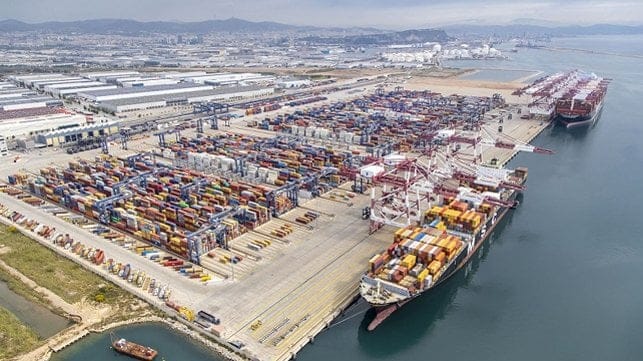
MSC's TiL withdrew its application for a antitrust clearance to acquire a container terminal in Barcelona (BEST Hutchison)
MSCs’ terminal operating company, TiL (Terminal Investment Limited), withdrew its application last week for an EU antitrust review for its proposed acquisition in Barcelona. Last year, the company agreed to the acquisition of the Barcelona Europe South Terminal (BEST) operated Terminal Catalunya in Barcelona, which is a division of CK Hutchison.
There was no explanation why the application was withdrawn, just a brief status note as of August 3 on the case, which was under review by the European Commission. The competition authority had been notified of the proposed acquisition at the beginning of November 2025 and reported that it found in a preliminary examination that it could fall within the scope of the European Commission’s Merger Regulation.
It was highlighted that the terminal is one of the main deep-sea gateways for cargo to Barcelona and Spain. Opened in 2012, the terminal is part of the port’s larger operations, which also include bulk cargo and vehicles. Hutchison BEST recently highlighted that the terminal has tripled its volume since 2013, reaching close to 2.8 million TEUs in 2025 and consolidating its position as a key Mediterranean gateway for international trade. This growth translates into high operational activity, with more than 1,200 vessels handled in a single year and a strong commitment to rail transport, reinforcing its role as a benchmark logistics node. It further reported that the terminal had exceeded its initial forecasts, reaching €876 million in investment — 32 percent above the expected figure — driving automation, digitalization, and sustainability projects that strengthen its long-term competitiveness.
The European Commission in December 2025 reported that it was proceeding with an in-depth investigation into the proposed acquisition of TERCAT, noting that MSC already had significant operations in the port of Barcelona.
The Commission said it had preliminary concerns that the transaction could lead to higher prices or reduced quality of container terminal services at the port of Barcelona. It said the investigation would consider the potential for significantly reduced competition for container services in Barcelona and the potential impact on shipping companies competing with MSC.
The Commission speculated that the merged entity could provide preferential treatment to MSC for the use of BEST’s container terminal services. They said this could take the form of higher prices, late access to the berth, or the limited availability of cranes and storage space for MSC’s competitors. They said competitors would also have a limited possibility to switch to the other deep-sea container terminal in the port of Barcelona, Terminal de Contenedores de Barcelona.
Under the European regulations, the Commission had until the end of April to reach a decision. However, that could be postponed as it sought information or other input.
The acquisition was separate from the larger deal that TiL and BlackRock were negotiating with CK Hutchison for the acquisition of its international terminal portfolio. The larger deal ran into roadblocks due to Chinese opposition, and while there is still interest, so far, a revised deal that might carve up the Hutchison portfolio, with a portion going to COSCO, has reportedly been discussed, but no agreement was announced. It was also further complicated by Panama’s moves in February that voided Hutchison’s concession for the two ports in Panama, which were a separate element of the larger transaction.
SAR Operation Underway as Indonesian Ferry Burns at Sea
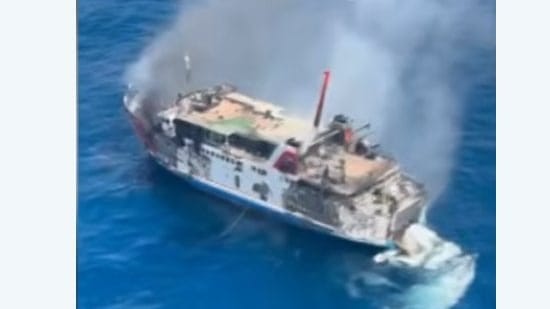
At last count, 212 people have been recovered with one death but without a complete manifest the authorities said the search would continue (Indonesian TV)
Indonesian authorities reported that, at the last tally, 212 people have been rescued from a ferry burning in the Lombok Strait located between the islands of Bali and Lombok. One person has succumbed to injuries while the authorities report the SAR operation will resume on Thursday at daylight.
The ferry KM Putri Yasmin (1,790 gross tons) was traveling from Bali to Lombok on August 12 when the fire began. The strait is reported to be only 25 miles wide, although it is unclear how long the trip lasts. The authorities reported the fire started at around 4:15 a.m. local time and that distress calls went out by 4:39 a.m.
Passengers aboard the vessel reported that they were instructed to put on their life jackets but were initially told to remain aboard the ship. Later reports said they had been told to jump, and the vessel's life rafts were deployed.
A coordinated search and rescue operation involving several departments from Indonesia was underway. The passengers were being ferried to the two islands. At least six rescue vessels were reported to have reached the ferry.
The authorities reported the operation was being hampered by the lack of an accurate manifest. Early reports said there were 114 passengers and 17 crew on the vessel’s manifest. The authorities later reported that 173 people had been evacuated and that one passenger had died. A later tally included an additional 39 people who were on another rescue boat.
Built in 1992 in Japan, the ferry was operated by Jemla Ferry, a well-established company that has been operating since 1976. On its website, it shows a fleet of 16 vessels. The Putri Yasmin was acquired in 2011 and is operating under the Indonesian flag.
The vessel is a RoRo ferry. Media reports say there were 44 people listed as drivers or passengers and that there were a number of “two-wheelers” aboard. Unconfirmed rumors are suggesting the fire was started by an electric bicycle.
Today’s incident comes less than a month after another Indonesian ferry, KM Matiara Sentosa 2, also caught fire. In that incident, like today, the operations were hampered by an incorrect manifest. The authorities reported that five people were killed in that fire, which remains under investigation.
Asked about the nature of today’s fire, the authorities said it would be investigated. They said for now their focus is on the SAR operation and ensuring that everyone is off the vessel and recovered. Due to the lack of a complete manifest, they said it was also impossible to confirm the number of casualties at this time. Reports are saying that one person was also taken to a hospital.
Indonesia’s Transport Minister spoke to the media later on Wednesday, saying they were monitoring the rescue operations and thanking those who responded. He said the vessel had been issued a permit to sail based on the manifest, but it was likely additional people had joined the ship and that they were not reported. He said the National Transport Safety Committee would be investigating the cause of the fire and cautioned not to make hasty conclusions.