Friday, September 25, 2026

Trump Greenland Deal Panned as ‘Largely a Rebranding of the Status Quo to Claim a Win’

“Trump did an incredible job negotiating for things we already had in Greenland,” said one US critic.



Demonstrators rally outside the US Consulate in Nuuk, Greenland on January 17, 2026 to protest President Donald Trump’s designs on the autonomous Danish territory.
(Photo by Sean Gallup/Getty Images)

Brett Wilkins
Sep 19, 2026
COMMON DREAMS

Danish and international commentators dismissed President Donald Trump’s claim that the deal he announced Friday gives the United States “permanent control” over Greenland’s security as what one journalist called a “repackaging” of long-standing agreements spun as a foreign policy win.

Trump—who has repeatedly threatened to gain control of the autonomous Danish territory, including by military force—said on his Truth Social network: “I am pleased to announce that the United States of America has entered into an Agreement with The Kingdom of Denmark, and Greenland, that gives the United States permanent control over security, and all other needs, in Greenland, completely addressing ALL of our many US concerns. There will be NO COST to the United States!”



“Additionally, from now on, no US adversary can EVER have a base in Greenland, have a military presence in Greenland, or make sensitive investments in Greenland, without our express written approval,” the president continued. “This is an ‘Infinite Life’ Agreement, there is no end!”

“We look forward to working with the wonderful people of Denmark and Greenland toward a magnificent future with respect to this large, and highly strategic, parcel of land,” Trump added. “We will be very protective of it! This is a dream come true for the United States of America, one that is very important, historic, and special.”

US Secretary of State Marco Rubio hailed what he called a “historic deal” and “a huge win for the United States and the American people.”

A joint statement released by the office of Danish Prime Minister Mette Frederiksen and Jens-Frederik Nielsen, who chairs the Naalakkersuisut—Greenland’s governing body—confirmed that “Greenland, Denmark, and the United States are expected to sign an agreement on strengthened security in the Arctic and the North Atlantic area next week” at the United Nations General Assembly in New York.

Frederiksen stressed that the agreement “recognizes the sovereignty and territorial integrity of the Kingdom [of Denmark] and the Greenlandic people’s right to self-determination,” while Nielsen said the pact “is to the benefit of us all.”

While the official text of the deal is not yet public, observers said it is unclear how it differs from the terms of a Cold War-era agreement that already gives the US broad military access to Greenland.

“In terms of rights, they were already allowed quite a lot under the original agreement,” Mikkel Runge Olesen, a researcher at the Danish Institute for International Studies in Copenhagen, said of the United States in a Saturday interview with The New York Times. “Is there anything here that one could not have achieved without this crisis?”


University of Maryland government and politics professor David Karol said on Bluesky that “this seems to be largely a rebranding of the status quo to claim a win.”

Karol likened the Greenland deal to the United States-Mexico-Canada Agreement that replaced the Clinton-era North American Free Trade Agreement—which Trump called the “worst trade deal ever made”—during the president’s first term. Critics noted that differences between the two pacts were “mostly cosmetic,” as one expert put it.

As the illegal US-Israeli war of choice against Iran dragged on with no end in sight, the US president also pursued a deal to end the conflict that observers noted was broadly similar, and even more favorable to Tehran, to the Joint Comprehensive Plan of Action—better known as the Iran nuclear deal—signed during the Obama administration and unilaterally abandoned by Trump during his first term, despite Iranian compliance.

Sofie Pultz, an international policy research fellow at the progressive UK think tank Institute for Public Policy Research, told LBC on Saturday that “it does sound like the Americans have accepted a repackaging of all deals and agreements, maybe with Denmark footing some of the defense bill. But overall, there’s not a lot of new stuff in here.”


Some Danish commentators were more blunt in their assessment of the deal. Henrik Højgaard Sejerkilde wrote for Jyllands-Posten that “everything suggests that Donald Trump’s agreement on the military presence in Greenland is a flea market find, found in diplomatic recycling.”


Other Danish observers expressed relief that what many viewed as an utterly unnecessary clash between two NATO allies has seemingly been defused.

“One can hope that the crisis of Greenland ends here—but one can never be sure,” Jacob Heinel Jensen of the Danish daily newspaper Berlingske said. “There is reason to be cautiously optimistic that this nonsense of taking over Greenland is now over. But with Trump, you can never be sure.”



Weighing 2028 White House Run, AOC Says Stakes of Race Would Be ‘All or Nothing’

“Life doesn’t wait for you to be ready for things,” the Democratic congresswoman said amid nationwide progressive political momentum. “Sometimes life just makes things ready for you.”


Rep. Alexandria Ocasio-Cortez (D-NY) attends a news conference with Sen. Bernie Sanders (I-Vt.) in the US Capitol on March 25, 2026.
(Photo by Tom Williams/CQ-Roll Call, Inc. via Getty Images)


Stephen Prager
Sep 22, 2026
COMMON DREAMS

As Rep. Alexandria Ocasio-Cortez weighs whether to run for president in 2028, there are numerous factors that complicate her decision: her identity as a Latina woman, her role as a leader in a progressive movement on the verge of unprecedented power, and her considerations about raising a family in the future.

Whatever decision the 36-year-old Democratic congresswoman makes, however, it will be “all or nothing,” she said in an interview published Tuesday by The New York Times, in which she spoke candidly about the stakes of what would be a historic and potentially transformative bid for the nation’s highest office.

Ocasio-Cortez (D-NY) became the youngest woman ever elected to Congress in 2018 in a victory over the Democratic Party establishment that became a model for the wave of progressive momentum that has defined this year’s cycle.

Amid what she described as the “ascendance” of her movement—marked by the insurgent victories of New York City Mayor Zohran Mamdani and Michigan Democratic Senate nominee Abdul El-Sayed over opponents with establishment support and big money behind them—Ocasio-Cortez is now wondering aloud whether her own moment has arrived.


“There’s an argument that some make that this is a very unique political window and, oftentimes in politics, you do only get one shot,” she said. “And you don’t—and just in life in general—life doesn’t wait for you to be ready for things. Sometimes life just makes things ready for you.”

But she is well aware of the obstacles and sacrifices, both personal and political. Having recently opened up publicly about receiving fertility treatments, she wondered aloud what a potential candidacy might mean for her life, including a possible future pregnancy.

She is also well aware that she would be up against the weight of very recent history. Two of the last three Democratic candidates for president, former Secretary of State Hillary Clinton and former Vice President Kamala Harris, were women, and they both lost to President Donald Trump after campaigns in which sexism—and, in Harris’ case, racism—featured prominently in attacks against them.

“Pretty candidly, I think about my identity,” Ocasio-Cortez said. “I’m not naïve to the fact that we are living under a very regressive administration, and I happen to be a woman, and I, you know, happen to be Latina. And I think that there’s a lot of conversation about electability, and I don’t kind of shy away from those realities.”

Those realities are indeed hard to ignore, especially in contrast to her mentor, Sen. Bernie Sanders (I-Vt.), who ran two formidable Democratic primary campaigns for president in 2016 and 2020 and with whom Ocasio-Cortez embarked on a wildly successful “Fight Oligarchy” rally tour last year, speaking to large crowds in both red and blue districts.

Though they have long campaigned together and advance a platform centered on the same signature policies of Medicare for All, a Green New Deal, and a tax on billionaire wealth, Sanders consistently ranks among the most well-liked politicians in office, while a New York Times/Siena poll this month showed AOC with just 30% favorability, compared with 41% unfavorability among likely voters.

There are other paths in front of AOC that could put her on a more traditional long-term trajectory to the White House, which has never in modern history been occupied by a president who ascended straight from the US House.

She also said she was considering a primary bid against the Democratic Party’s current Senate leader, Chuck Schumer (D-NY), whom many Democratic voters have come to see as the embodiment of all that is sclerotic and unchanging about their party’s entrenched elite.

At a time when backing from corporations and other powerful special interests plays an unprecedented role in achieving political power, Ocasio-Cortez emphasized her near-exclusive backing from small donors, which she said makes her one of “very few people who are financially independent from special interests that are able to advocate directly for the needs of working people.”

Regardless of the decision she makes, she recognizes the enormous stakes.

“It’s very all or nothing,” she said. “If I were to run in this cycle, and not win, I would be done.”

“And I am not opposed to that,” she added. “That, in and of itself, does not exclude the decision... But it has to make it worth it.”

Ocasio-Cortez has previously emphasized that her “ambitions” have less to do with achieving the highest possible seat for herself than with helping her movement succeed.

“My ambition is to change this country,” she said during a forum in May. “Presidents come and go, Senate, House seats, elected officials come and go, but single-payer healthcare is forever, a living wage is forever, workers’ rights are forever, women’s rights, all of that.”

She told the Times that the question that will ultimately determine her path forward is: “Where can I do the most good?”

‘Corruption of the Highest Order,’ Says Troy Jackson After Explosive Susan Collins Report

“We deserve answers about every contract and every conversation that Collins and her team facilitated on the backs of taxpayers. The jig is up.”


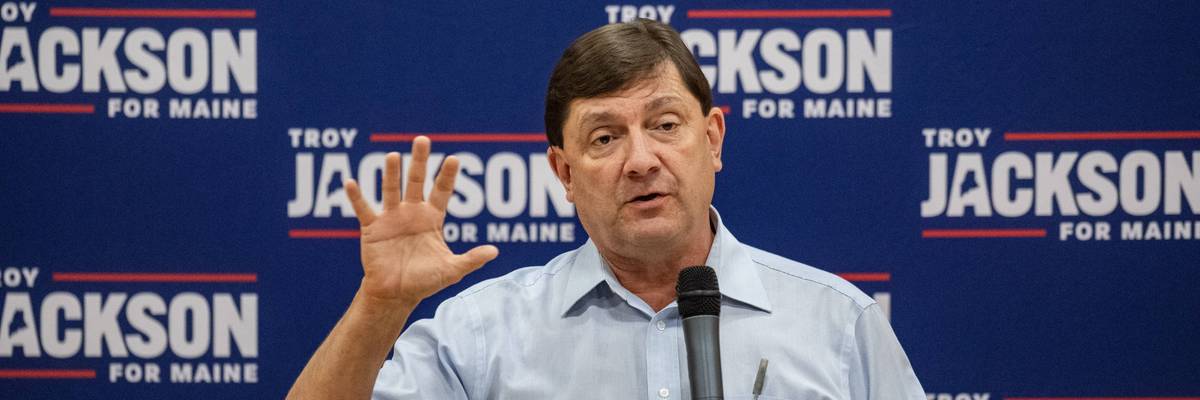
Maine Democratic Senate candidate Troy Jackson speaks at a town hall on September 13, 2026 in Biddeford, Maine.
(Photo by Joseph Prezioso/Getty Images)

Brad Reed
Sep 22, 2026
COMMON DREAMS

Maine Democratic US Senate candidate Troy Jackson pounced on Tuesday after ProPublica published a damning story putting incumbent Republican Sen. Susan Collins at the center of what the publication described as a “sprawling pay-to-play operation.”

In a statement released shortly after the ProPublica story dropped, Jackson accused Collins of engaging in “corruption of the highest order.”


“Susan Collins delivered millions in taxpayer dollars for a corrupt donor bankrolling her campaign,” said Jackson, “and then [President] Donald Trump helped her cover it up.”

The ProPublica report unearthed internal records revealing an FBI investigation into defense contractor Navatek, now known as Martin Defense Group, for making campaign contributions to politicians in exchange for federal contracts.

According to ProPublica, former Navatek CEO Martin Kao told a group of FBI agents and federal prosecutors in 2022 about a 2019 meeting he’d had with the head of a pro-Collins super political action committee where he committed to cut a big check to the Maine Republican’s campaign if she steered federal cash to his company.

After the meeting, ProPublica wrote, Kao “sent an initial $150,000 to the Collins super PAC using the shell company” and then told Navatek executives in an internal email two months later that “Collins committed to getting the company $32 million in naval contracts.”

The alleged corruption outlined in the report went far beyond Collins, as Kao also provided FBI agents with a 50-page document that named “dozens of lobbyists, congressional staffers, and members of Congress who he said helped him trade cash for contracts.”

However, the probe into Kao’s alleged efforts to bribe politicians was shut down shortly after Trump returned to the White House in 2025, which Jackson said may explain why Collins “voted with him 96% of the time and has rubber-stamped his agenda to hurt Maine.”

“Susan Collins doesn’t care,” Jackson added, “that we’re losing our healthcare that ICE is killing people on the streets, and that we’ve been dragged into a pointless war—as long as her donors get their contracts and her coffers get filled. We deserve answers about every contract and every conversation that Collins and her team facilitated on the backs of taxpayers. The jig is up.”

Annie Clark, Collins’ deputy chief of staff, disputed the allegations made in the ProPublica story, and accused the publication of wrongly lending credibility to Kao, whom she said “began making outlandish charges about the Collins office, deflecting blame from himself” for his own criminal behavior.

“The seven-year-old allegations made against Sen. Collins and her staff in this piece are categorically false,” said Clark. “There have never been any allegations of wrongdoing by the Collins for Senator campaign, and the campaign was never the target of the FBI investigation.”

‘Incredible Story of Corruption’: Bombshell Report Puts Susan Collins at Center of Massive Bribery Scheme

ProPublica reported that the US senator from Maine, now running for a sixth term, was the “most important patron” of a defense company accused of bribing members of Congress for federal contracts.


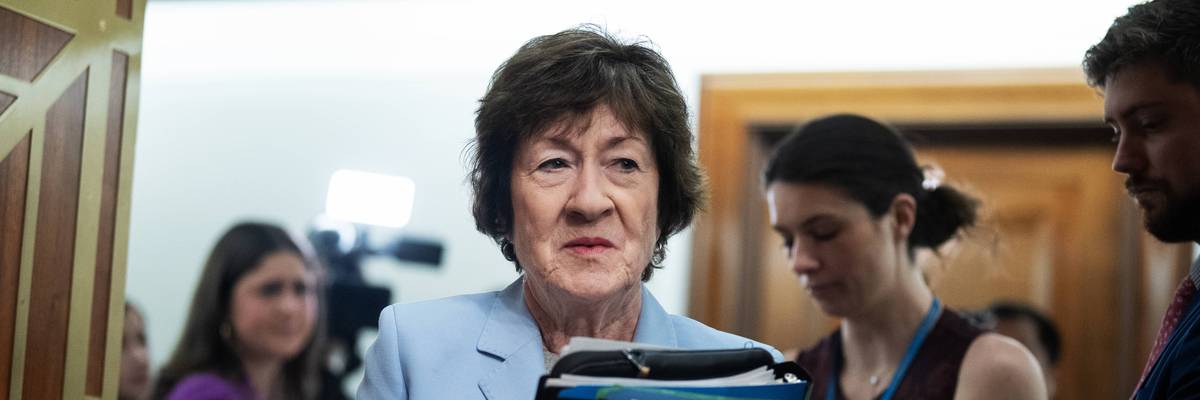
US Sen. Susan Collins (R-Maine) arrives for a Senate hearing on June 17, 2026.
(Photo by Tom Williams/CQ-Roll Call, Inc. via Getty Images)

Jake Johnson
Sep 22, 2026
COMMON DREAMS

Explosive reporting published Tuesday by the investigative outlet ProPublica details how US Sen. Susan Collins was at the center of a “sprawling pay-to-play operation” under which the chief executive of a Hawaii-based defense contractor allegedly funneled campaign cash to lawmakers in exchange for lucrative federal contracts.

ProPublica’s story—based on internal emails, thousands of pages of legal records, interviews, and other evidence—reveals for the first time the existence of an FBI investigation into possible bribery of members of Congress, including Collins, by the defense contractor Navatek, a probe that was shuttered after President Donald Trump took office for his second term.

In late 2019, according to ProPublica, the head of a pro-Collins super PAC, Scott Reed, met with then-Navatek CEO Martin Kao and other executives at a Washington, DC bakery and asked them for a $500,000 donation to the longtime Maine senator’s 2020 reelection bid.

“If they cut a big check, the CEO told Reed, Navatek wanted Collins to guarantee tens of millions of dollars in additional federal funding,” ProPublica reported. “After the Corner Bakery meeting, [Kao] sent an initial $150,000 to the Collins super PAC using the shell company. Two months later, he told Navatek executives that Collins committed to getting the company $32 million in naval contracts, according to an internal company email.”

In 2022, Kao pleaded guilty to making illegal campaign contributions. The $150,000 check to the pro-Collins group, the 1820 PAC, was funneled through an entity titled “the Society of Young Women Scientist [sic] and Engineers.” The money flowed from Navatek’s account, violating the ban on federal government contractors making campaign donations.


ProPubulica revealed that Kao, facing years in federal prison, handed FBI agents “a 50-page document naming dozens of lobbyists, congressional staffers, and members of Congress who he said helped him trade cash for contracts.” Kao also told federal agents that Navatek’s federally funded research “was of no real value,” according to ProPublica.

“Of all the politicians Navatek courted under Kao’s leadership, Collins was its most important patron,” the investigative outlet reported. “The senator’s office steered government contracts worth millions toward the company while her campaign was pumping Kao and his network for donations, according to emails seen by ProPublica. Sometimes they cut checks within 24 hours of the annual defense spending bill, which funds military contracts, clearing a key Senate hurdle.”

Collins, who is currently running for a sixth Senate term, denied allegations of bribery through a spokesperson, who dismissed Kao’s claims as “outlandish” and said the Collins campaign “disgorged the illegal contributions that Martin Kao had made without our knowledge.”

But ProPublica’s reporting details, with documentary evidence, Collins’ yearslong relationship with Kao, who first met the Maine senator face-to-face in 2018.

“In that first meeting with Collins and her staff, Kao pitched an $8 million boat hull research project for Navatek and [the University of Maine]. Collins seemed supportive,” the outlet noted. Kao funneled donations to Collins’ campaign, and the senator later included funding for Navatek’s project in the annual US military budget.

“Emails showed her staff made it clear to the Navy that it should send the money to Navatek,” ProPublica reported.

The outlet also revealed the details of a 2019 meeting between Kao, Collins, and Amy Abbott, who was then serving as the campaign finance director for the senator’s 2020 reelection campaign. The meeting took place before an event at Navatek’s Maine headquarters, where Collins posed for pictures with Kao.

“Before the event, Kao said, Collins, Abbott, and another staffer met with him in private,” ProPublica reported. “One of the staffers told Kao the campaign expected more donations. It was in this meeting that Collins said, ‘You’ve seen me deliver,’ he told the FBI.”


Martin Kao, second from left, was pictured with Sen. Susan Collins during an event in August 2019. (Photo: Sen. Susan Collins/Facebook)

Avi Asher-Schapiro, one of four ProPublica reporters who bylined the bombshell story, lamented that “we may never know the full story” of the large-scale bribery scheme alleged by Kao because the Trump administration “took a wrecking ball to the FBI teams and DOJ lawyers specializing in these cases—everyone who worked it is gone.”

“And as far as we know,” Asher-Schapiro added, “the FBI abandoned a witness who might have been able to expose a generational corruption scandal.”

The report was published just weeks before the November midterms, when Collins will attempt to retain her seat against former Maine Senate candidate Troy Jackson, who has said that billionaires and corporate-funded super PACs “have her in their pockets.”

Nobel-Winning Economists Say California Billionaire Tax Could Be ‘Turning Point in the Battle Between Democracy and Oligarchy’

“What will allow California to thrive in the future,” the economists said, “is not letting a handful of billionaires live tax-free: it is adequate public spending on health, education, and public infrastructure, key engines of economic growth.”


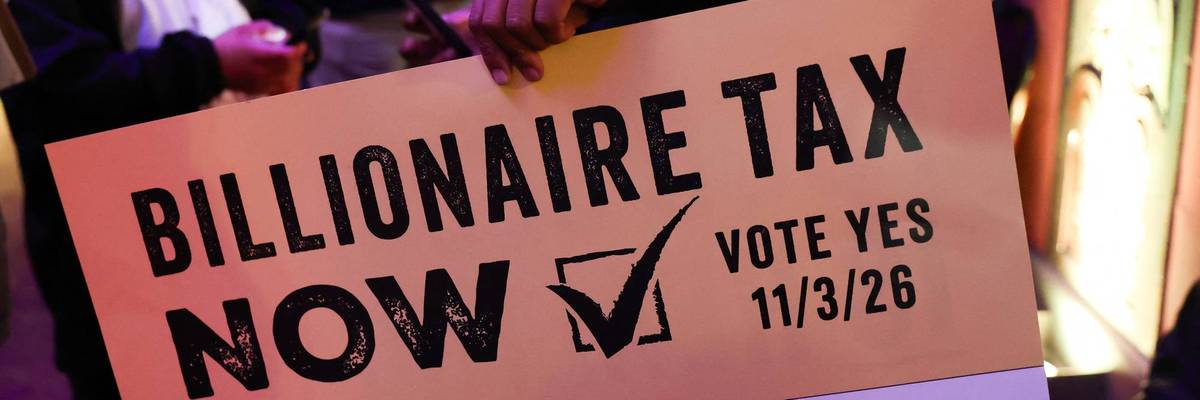
An attendee holds a sign before the start of a rally during the campaign kickoff for the California Billionaire Tax Act at The Wiltern in Los Angeles, February 18, 2026.
(Photo by Patrick T. Fallon/AFP via Getty Images)

Stephen Prager
Sep 21, 2026
COMMON DREAMS

As California voters head to the polls this November, their vote on whether to enact a first-of-its-kind billionaire wealth tax may mark “a turning point in the battle between democracy and oligarchy,” says a group of Nobel Prize-winning economists.

The fight over Proposition 40—a ballot measure that would impose a one-time 5% tax on the net worth of those with $1 billion or more in order to fund the state’s healthcare system—has heated up in recent weeks.

The initiative remains popular, with 52% of voters in the state supporting it, according to a poll out last week. But California’s elite have lined up at least $156 million behind an aggressive campaign to kill it, with Google co-founder Sergey Brin alone giving at least $102 million.

And while the proposal has strong backing from progressive politicians and labor unions, some prominent Democrats have tried to stop it, most notably Gov. Gavin Newsom.

As the rich flood the airwaves with ads warning that taxing their wealth would bring about economic ruin, six Nobel laureates, all of whom have won the prestigious prize for their work in economics, signed an open letter on Saturday endorsing Prop. 40.


They are inequality scholar Daron Acemoglu, global poverty researcher Abhijit Banerjee, labor and public finance economist Peter Diamond, anti-poverty economist Esther Duflo, trade economist and columnist Paul Krugman, and inequality and globalization economist Joseph Stiglitz.

“Proposition 40 would be the first-ever tax on billionaire wealth enacted anywhere in the world,” the economists wrote. “California is the right place to take this historic step.”

They explained that the growing number of billionaires in the state in recent decades has helped to make California “one of the most unequal places in America.” While the state’s richest 0.001% of residents were worth a combined $700 billion a decade ago, its 250 billionaires are now worth about $2.3 trillion—equivalent to the entire annual income of the state’s 20 million taxpayers.

“This extreme wealth has translated into extraordinary power,” the economists wrote, citing data showing that during the 2024 election, billionaires accounted for 19% of all federal election spending in the US and that these same billionaires are now marshaling huge sums of money to oppose a tax that would affect them.

While acknowledging that many of California’s wealthiest have “made important contributions, for which they have been amply rewarded,” the researchers noted their use of loopholes in the tax system to effectively pay a lower tax rate than the average Californian.

Most billionaire wealth is held in the form of stocks and other assets whose gains are not generally subject to income tax until they are sold.

As a result, billionaires in the state paid about $3 billion in state income taxes per year from 2019-25, while their fortunes increased by about $1.4 trillion over the period. Dividing total state income tax by that increase equals roughly 1.6%. Meanwhile, the average California family pays about 5-6% of their annual income in state income taxes.

The economists argued that enacting a wealth tax would allow the state to play “catch-up,” raising about $100 billion—enough to offset federal cuts to the state’s Medicaid program enacted in the Republican budget legislation last year, which have helped to fuel thousands of layoffs at hospitals around the state.

They also disputed a common counterargument that the tax will spur billionaire flight from the state and “doom” Silicon Valley.

Not only would the tax apply to any billionaire living in the state as of January 1, 2026, meaning most would not have had time to relocate; they also pointed out that in 2026, after Prop. 40 was announced, California has attracted 80% of the nation’s venture capital funding, compared to just 50% prior to 2025, according to data from PitchBook’s Venture Monitor.

“What will allow California to thrive in the future,” the economists said, “is not letting a handful of billionaires live tax-free: It is adequate public spending on health, education, and public infrastructure, key engines of economic growth to which it is only fair to ask the ultrawealthy to contribute.”

They added that passing Prop. 40 “isn’t just critical for Californians,” but could “kickstart a movement to tax ultra-high-net-worth individuals in other states—and eventually at the federal level and in other countries.”


The six Nobel laureates who signed Saturday’s letter are not the first prominent economists to publicly advocate for the wealth tax. University of California, Berkeley economist Emmanuel Saez helped draft the proposal, while Gabriel Zucman, a chaired professor at the Paris School of Economics, has conducted research underpinning it. Paris School professor Thomas Piketty and former US Labor Secretary Robert Reich have also come out in support of the ballot initiative.

Responding to the letter from the Nobel laureates, Dutch historian and wealth tax advocate Rutger Bregman—whose School for Moral Ambition has worked alongside Zucman to promote similar initiatives around the world—said it was “really great to see” more celebrated economists speaking up in favor of the proposal.

“You don’t have to be a radical leftist to see why it’s a good idea,” Bregman wrote on social media. “This is not going to be some kind of socialist revolution. The proposal is about restoring balance to a mixed economy. You could even argue it’s about saving capitalism itself from oligarchs like Sergey Brin. I think that’s exactly why Nobel Prize-winning economists are coming out in favor of this tax.”


UN Expert Says Trump ‘Murder’ Spree at Sea May Constitute ‘Crimes Against Humanity’

“International humanitarian law cannot authorize the United States’ attacks,” wrote human rights expert Ben Saul.


President Donald Trump, with Secretary of Defense Pete Hegseth, mimics firing a rifle while speaking to reporters at a briefing on Monday, April 6, 2026 at the White House in Washington, DC.
(Photo by Maxine Wallace/The Washington Post via Getty Images)

Julia Conley
Sep 21, 2026
COMMON DREAMS

In a report on the Trump administration’s bombing of dozens of boats in the Caribbean Sea and eastern Pacific Ocean over the past year, a top United Nations rights expert dismissed President Donald Trump’s claim that the military campaign has been in “self-defense” against “designated terrorist organizations,” and warned that the evidence collected about the strikes could point to crimes against humanity being committed by the United States.

Ben Saul, the UN special rapporteur on human rights and counterterrorism, concurred with numerous human rights experts as he said Monday that even if the boats targeted by the US had been engaged in drug trafficking—the central claim of Trump, Secretary of State Marco Rubio, and Defense Secretary Pete Hegseth as they’ve defended the operation—there are no “international legal rights to unilaterally use military force” to counter drug cartels or other organized crime groups.

He noted that Trump last October notified Congress that the strikes were part of a “non-international armed conflict,” governed by the law of armed conflict, as his administration highlighted the threat of “narco-terrorists.”

“The United States military attacks are, however, contrary to international law, violate the human right to life, and plausibly constitute crimes against humanity,” wrote Saul.

He added that the killings could reasonably constitute “crimes against humanity of murder under customary international law,” noting that such crimes generally require “that murder (or attempted murder) was committed as part of a widespread or systematic attack directed against any civilian population.”

Saul compared the bombings to the alleged crimes of former Philippine President Rodrigo Duterte, whose own “war on drugs” included the state killings of thousands of Filipinos accused of trafficking narcotics. Duterte, noted Saul, “is on trial for alleged crimes against humanity of murder for targeting suspected criminals, or criminals having criminal propensities, including drug offenders.”


The special rapporteur’s report pertains to attacks up until August, but came days after the US military said it had killed four more people aboard a vessel in the Caribbean. At least 234 people have been killed in the attacks by US Southern Command so far, in at least 70 strikes.

As with its previous bombings, US Southern Command did not release any evidence in its latest attack that the target was a boat involved in drug trafficking. US Sen. Tim Kaine (D-Va.) emphasized at a hearing in June that the “targeting criteria” the military has used in the boat bombing campaign has never included “evidence of narcotics on the boat,” and data from Customs and Border Protection (CBP) has shown little to no evidence that the flow of drugs into the US has decreased since the bombings began more than a year ago.

In addition to some people who may have been involved in narcotics trafficking, the report reads, “some victims have reportedly included fishermen, migrants, and victims of human trafficking.” The families of some victims have filed legal complaints over their killings.

Moreoever, said Saul, “even assuming that the vessels and crew attacked were members of the criminal groups listed as terrorist, such organizations have not mounted any ‘armed attack’ on the United States so as to trigger a right of self-defense.”

“Deaths from illicit drugs are not assimilable to an armed attack under international law,” he wrote, despite Hegseth’s insistence that the US aims to protect the country from “the drugs that are killing our people.”

Instead of being legitimate attacks in self-defense, wrote Saul, the bombings “amount to serial extrajudicial killings in violation of the right to life, being unjustified in national or personal self-defense or under international humanitarian law, the international law of the sea, narcotics suppression conventions, or international counterterrorism law.”

“International humanitarian law cannot authorize the United States’ attacks,” he added.

Saul said the military campaign, which the Trump administration has recently expanded to include land attacks in Latin American countries, may violate Article 6 of the International Covenant on Civil and Political Rights, which was ratified by the US in 1992.

The report was filed as world leaders gathered in New York for the UN General Assembly and weeks after US Southern Command announced its campaign in the Caribbean and eastern Pacific was expanding to include operations inside countries in Latin America, with leaders who are aligned with Trump hosting joint military operations. The US has particularly deepened military ties with Ecuador in recent months, with the partnership reportedly resulting in torture, arbitrary detentions, and disappearances.

“International law on the right to life,” wrote Saul, “applies to any extraterritorial military or law enforcement action against criminal groups.”


Van Hollen Says ICC Members Would Sanction Trump and Rubio If They ‘Have Any Self-Respect’


In what the Democratic senator called an effort at “obstructing investigations of Netanyahu’s war crimes,” the Trump administration is planning a dramatic escalation of its sanctions against the court.


Stephen Prager
Sep 22, 2026
COMMON DREAMS

As the United Nations General Assembly prepared to meet, a US senator said President Donald Trump and Secretary of State Marco Rubio should face sanctions for their role in trying to destroy the International Criminal Court in order to protect Israeli Prime Minister Benjamin Netanyahu.

“If European countries and other signatories to the International Criminal Court (ICC) have any self-respect, they’d sanction Rubio and Trump for obstructing investigations of Netanyahu’s war crimes,” wrote Sen. Chris Van Hollen (D-Md.) Monday on social media.


He was responding to a report from the Wall Street Journal detailing “a sharp escalation” in the Trump administration’s efforts to, in Rubio’s words, “dismantle” the ICC, which issued an arrest warrant for Netanyahu in 2024. The body accused the prime minister and then-Defense Minister Yoav Gallant of war crimes and crimes against humanity in Gaza, including the deliberate use of starvation as a weapon of war.


The ICC has also reportedly launched investigations into two other far-right ministers in Netanyahu’s cabinet, Finance Minister Bezalel Smotrich and National Security Minister Itamar Ben-Gvir, for their roles in aggressively expanding Israeli settlements in the occupied West Bank, which are considered illegal under international law.

The Trump administration had already aggressively sanctioned ICC officials involved in efforts to prosecute Americans or Israelis, including then-chief prosecutor Karim Khan and several judges and prosecutors. It had also sanctioned UN special rapporteur on Palestine Francesca Albanese and several Palestinian human rights organizations that had brought evidence of alleged Israeli crimes before the tribunal.

Now, The Journal reports that:
The Trump administration is preparing to impose sweeping sanctions on the [ICC]...

The sanctions would forbid most transactions with the ICC after a grace period of six to seven months... That could potentially cripple the court by prohibiting it from conducting transactions in US dollars, cutting it off from much of the global financial system.

It is unclear when a final decision and announcement might come, though some US officials said the move could be finalized as soon as this week during the United Nations General Assembly meeting or in the following days.


Several world leaders have been vocally critical of the US attack on the ICC, though they’ve stopped short of calling for sanctions against US officials.

Responding to Rubio’s sanctions in August, European Commission President Ursula von der Leyen and European Council President António Costa said that the ICC’s “judges and officials must be able to act independently and without external pressure.”


Dutch Foreign Minister Tom Berendsen, whose nation is home to the ICC, said the Netherlands disapproves of efforts to sanction the court, adding that Dutch officials were actively working with the EU to protect the court from institution-wide US sanctions. Possible protective measures reportedly include alternative banking and payment arrangements outside the US dollar system.

There have also been calls within the European Parliament, including from Spanish socialist politician Iratxe García Pérez and others, to activate the EU’s so-called “blocking statute,” which would prohibit European companies from complying with the US sanctions.
‘The Billion Dollar Deal’: Senate Democrats Detail How Trump Serves Fossil Fuel Industry

“Our new report exposes this old-fashioned corruption, by a thuggish government and a desperate industry, that is squeezing every last dollar out of Americans’ pocketbooks while they still can.”


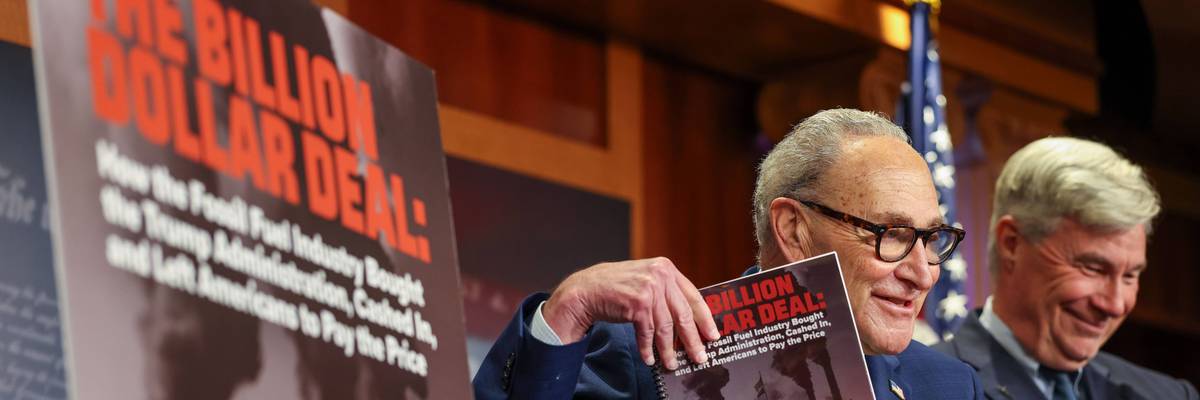
US Senate Minority Leader Chuck Schumer (D-NY) and Sen. Sheldon Whitehouse (D-RI) speak at a press conference on the fossil fuel industry’s connections to the Trump administration at the Capitol in Washington, DC on September 24, 2026.
(Photo by Tasos Katopodis/Getty Images)


Jessica Corbett
Sep 24, 2026
COMMON DREAMS

While running for president in 2024, Donald Trump told oil and gas executives that he would pursue their policy priorities if the industry raised $1 billion for his campaign—and after returning to office last year, the Republican did just that, enriching those invested in fossil fuels, including himself, at the expense of the public and planet.

That’s according to “The Billion Dollar Deal: How the Fossil Fuel Industry Bought the Trump Administration, Cashed In, and Left Americans to Pay the Price,” a report released Thursday by US Senate Minority Leader Chuck Schumer (D-NY) and Committee on Environment and Public Works Ranking Member Sheldon Whitehouse (D-RI).

“The fossil fuel industry and their allies bought their way into the Trump White House with hundreds of millions of dollars in political donations, after Trump promised fossil fuel bigwigs at a Mar-a-Lago fundraiser that he’d do anything and everything they wanted, for the right price,” Whitehouse said in a statement.

“Now, their minions run the government from the inside, driving up energy bills to deliver payouts to the donors that put Trump back in office,” he continued. “Our new report exposes this old-fashioned corruption, by a thuggish government and a desperate industry, that is squeezing every last dollar out of Americans’ pocketbooks while they still can.”

The report is based on 19 investigations into Environmental Protection Agency (EPA) regulatory rollbacks, 13 probes of nine other agencies, and 13 investigations into 88 separate polluters. Investigators from Schumer’s Anti-Corruption Working Group examined campaign finance filings, corporate earnings, and investor communications.

The document details how, in the aftermath of Trump’s quid pro quo offer at the Mar-a-Lago fundraiser in 2024, fossil fuel executives, along with their corporate political action committees (PACs) and dark money groups, contributed an estimated $201 million to support Trump and allied Republican lawmakers—plus $19 million toward the inaugural fund.

“These figures capture only traceable donations,” the report emphasizes. “Other substantial sums flowed to candidate Trump through 501(c)(4) organizations that are not legally required to disclose their contributors. Dark money groups—nonprofits and shell companies that do not reveal their donors—contributed over $1.9 billion into the 2024 elections, up from $1 billion in 2020.”

The report names key figures from “the fossil fuel donor class” and includes their estimated contribution to Trump’s latest election:Oil and banking heir Timothy Mellon: $151.5 million
Energy Transfer executive chair Kelcy Warren: $11 million
Elliott Management co-CEO Paul Singer: $8 million
CrownQuest Operating CEO Tim Dunn: $5 million
Continental Resources executive chair Harold Hamm: $4 million
Midland Energy founder and CEO Syed Javaid Anwar: $2 million
GeoSouthern Energy CEO George Bishop: $2 million
Alliance Resource Partners CEO Joseph Craft III: $2 million
Hilcorp Energy executive chair and founder Jeffery Hildebrand: $1.7 million
Sunoco board chari Ray Washburne: $611,000

There’s also former Liberty Energy CEO Chris Wright, who is now Trump’s energy secretary and gave an estimated $795,000. According to the report, “Lobbyists say that many CEOs now keep Secretary Wright’s personal phone number on speed dial.”

Wright is among at least a dozen former oil executives and lobbyists Trump installed at the EPA and departments of Energy, the Interior, and Justice to systematically dismantle “the regulatory architecture built over decades to protect American families from pollution and climate change,” the publication points out. “Those captured agencies delivered for the fossil fuel industry.”

The report calls out not only Wright but also Trump’s other “polluter worker bees,” including EPA Administrator Lee Zeldin, Interior Secretary Doug Burgum, and various other officials at their agencies who have ties to polluting industries.

It also calls out the GOP-controlled Congress, which last year sent to Trump’s desk the One Big Beautiful Bill Act, a law that includes “tens of billions in new and expanded direct subsidies to fossil fuel companies through tax breaks, royalty cuts, a suspension of the charge on methane pollution, and other giveaways. Combined with the subsidies already on the books, independent analysts estimate the industry will collect some $190 billion in tax breaks and subsidies over the next 10 years.”

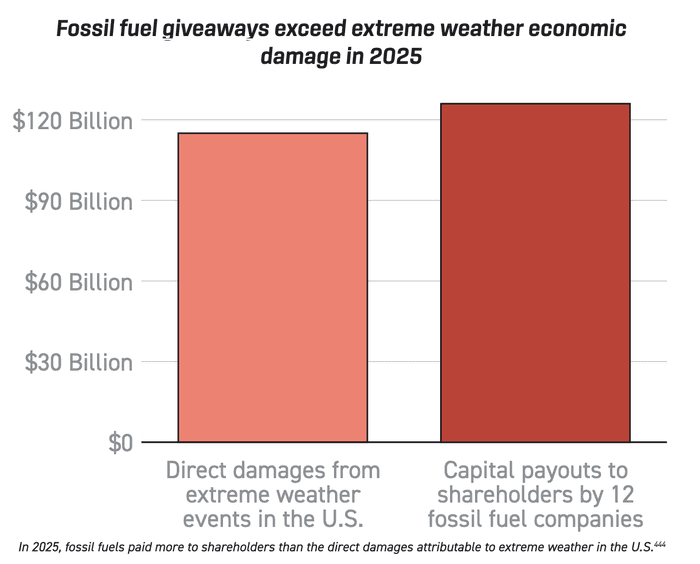
“The costs of these gifts to the fossil fuel industry fall on everyone else,” the report stresses. “Climate-related disasters cost the United States at least $115 billion in direct damages in 2025 alone. Each year, the damages to public health from fossil fuel air pollution run at about $820 billion, or $2,500 per American, and contribute to approximately 91,000 premature deaths and 216,000 new cases of childhood asthma. Homeowners’ insurance has become unaffordable or unavailable across many parts of the country. These are just some of the existing costs associated with fossil fuel production and combustion.”


“The Trump administration’s regulatory rollbacks will drive them higher, as air and water pollution as well as climate change will all get worse,” the document warns, as the fossil fuel-driven climate emergency worsens, with deadly consequences worldwide.

The report notes that “canceled and delayed wind and solar projects are also raising electricity prices for consumers in multiple states, sending billions to fossil fuel plants. And the EPA itself has estimated that the elimination of tailpipe emission standards will cost Americans a minimum of $580 billion in added fuel costs alone over the next three decades. Hundreds of thousands of jobs are being lost as the United States cedes its industrial competitiveness in clean energy technologies to China and Europe.”

Trump also partnered with Israel to launch an illegal war on Iran—which has responded by restricting ship traffic through the the Strait of Hormuz, sending global fuel prices soaring. The publication highlights that “the 100 biggest oil and gas companies collectively earned an extra $30 million per hour in the first month of the Iran conflict alone—amounting to $23 billion in windfall profits—with $234 billion projected by year’s end if oil prices remain near $100 a barrel.”

“As the Trump administration’s war in Iran drives up gas prices—with analysts warning crude prices could reach $200—American
consumers pay directly for the chaos that Big Oil’s political investments helped purchase,” the report warns. Brown University’s Costs of War Project estimates the higher diesel and gasoline prices have so far cost Americans $115.7 billion, or $883 per household.


Trump’s war is also filling his own pockets. CNBC estimated earlier this month that the president has made up to $4.4 million from his investments in fossil fuel companies—and as Common Dreams reported earlier this week, he continues to make related trades.

“Donald Trump will always choose self-enrichment over helping American families, and as this report reveals, his fossil fuel corruption is costing Americans billions,” said Schumer. “Instead of using the presidency to address the affordability crisis, lower costs, and protect Americans’ health and safety, Trump has used his power to deliver for his billionaire buddies in the fossil fuel industry. The message from this administration is clear: Big Oil gets the profits, and American families get the bill.”

Released less than six weeks away from the midterm elections, Senate Democrats’ report not only lays out a range of issues, but offers some fixes, including demands to tax the windfall profits of Big Oil, as well as legislation that would “shine a light behind the dark money front groups and shell organizations that fossil fuel interests use to hide their spending.”

The report also calls for making polluters pay for planet-heating emissions and empowering lawsuits to hold them accountable. It further advocates for ending fossil fuel subsidies and directing that money to clean energy, consumer relief, and infrastructure resilience.

“The Trump administration is pumping public money into the fossil fuel industry and stripping public protections to pad the profits of some of the wealthiest corporations in the nation,” David Arkush, director of Public Citizen’s Climate Program, said in response to the report. “The campaign contributions to Donald Trump by Big Oil have paid dividends and have allowed the fossil fuel industry to continue to pollute our communities.”

“This administration has ceded our nation’s clean energy future to dirty energy and is doing its best to sacrifice the economy, public health, and the environment to Big Oil’s profits,” he added. “Every American family struggling with high costs is suffering because of the corrupt relationship between Donald Trump and the fossil fuel industry.”
Intensified by Fossil Fuel-Driven Climate Crisis, ‘Godzilla-Level’ El Niño Smashing Records Ahead of Peak

“As long as we continue to burn fossil fuels,” said one scientist, El Niño “occurs on an increasingly hotter baseline, making it much more difficult for communities to deal with the consequences.”


A firefighter douses flames as they push toward homes during the Creek Fire in the Cascadel Woods area of unincorporated Madera County, California on September 7, 2020. The El Niño event of 2026 is expected to cause a variety of extreme weather, including dry conditions in some regions and extreme rainfall in others, in 2027.
(Photo by Josh Edelson/AFP/Getty Images)

Julia Conley
Sep 22, 2026
COMMON DREAMS

Although “El Niño comes and goes,” as one climate scientist said of the naturally occurring warm-weather phenomenon on Monday, experts are in agreement that this year is different—with meteorologists already recording a temperature rise of 3.07°C in the Pacific Ocean, putting it at a statistical tie with November 2015, when El Niño caused the ocean to warm by 3.08°C.

The temperature rise is not expected to peak until November and December, when an average of 14 models examined by Zeke Hausfather of Carbon Brief and Berkeley Earth found that a temperature rise of 4.1°C is forecast.

The event has been underway since June, Hausfather wrote, and has been gathering strength “faster than any previous event on record.”

Scientists typically track the strength of El Niño—which leads to heavy rainfall, higher global temperatures, and other extreme weather as warmer Pacific waters are pushed to the south—using the Niño 3.4 anomaly, or ONI, which determines how much hotter the central Pacific is compared with a 30-year rolling average.

A temperature rise above 2.0°C is considered a “very strong” El Niño, and scientists and policymakers are already calling this year’s event a “super El Niño,” with some experts using the terms “Godzilla-level” and “jaw-dropping” to describe the weather conditions that can be expected in the coming months due to the warmer climate.

As Common Dreams reported late last month, planetary heating driven by fossil fuel emissions is intensifying El Niño, while the naturally occurring phenomenon can in turn worsen the impacts of the climate emergency.

In the last 40 years scientists have recorded a 16% increase in the strength of El Niño events, according to a study published in Science last month. They’ve also gotten 36% stronger than they were before industrialization began.

The “double whammy,” as The Guardian called it, could make 2027 the hottest year ever recorded, blowing through heat records that have just been set this year—and that have been linked to the deaths of people around the world from extreme heat and flooding.

“This event is a huge redistribution of energy in the climate system and is dangerous because it is unfolding on top of a much warmer, human-influenced climate system,” climate scientist Friederike Otto of Imperial College London told The Guardian. “So, in many places around the world we will see never-before-experienced heat extremes, with all their consequences on health, food security, and water stress.”

Despite the fact that El Niño predates the human-caused climate emergency, Otto said, “as long as we continue to burn fossil fuels, it occurs on an increasingly hotter baseline, making it much more difficult for communities to deal with the consequences.”

This year’s event is likely to be the most intense El Niño in 1,000 years, reported to The Guardian, with hotter and drier conditions already linked to deadly wildfires in Indonesia and crop losses in Central America and the Caribbean region due to drought conditions. Rice production this season is expected to fail in Indonesia, according to the Salata Institute for Climate and Sustainability at Harvard University.

As the Southern Hemisphere’s summer months approach, southern Africa and Australia are at heightened risk of wildfires and droughts as well. Meanwhile, cocoa production could be damaged by extreme rainfall in parts of South America.


“All strong El Niño events on record have continued to strengthen well into the winter—and the models are in near-unanimous agreement that this one will, too,” wrote Hausfather at Carbon Brief. “If the forecast holds, the current event will peak between November and January at a level far beyond any event previously observed in the instrumental record.”

In California on Monday, Democratic Gov. Gavin Newsom declared a state of emergency in an effort to prepare communities for El Niño’s impacts in the coming months, which could include coastal flooding and heavy snow in mountain regions.

Hausfather noted that strong El Niño events like those that occurred in 1997 and 2015 were also “associated with hundreds of billions of dollars in damages globally.”

“This event,” he told The Guardian, “is leaving those past ones in the dust.”

‘The Diagnosis Is Unambiguous’: 2026 Planetary Health Report Finds Pressure Mounting on Earth Systems

“Seven of nine planetary boundaries are transgressed, and pressure on all seven is at its highest recorded level,” said one scientist.


A protester is seen in Los Angeles during a climate change demonstration holding a placard that says, “There is no Planet B.”
(Photo by Ronen Tivony/SOPA Images/LightRocket via Getty Images)


Julia Conley
Sep 21, 2026
COMMON DREAMS

Like other recent warnings from climate scientists, the message sent by the latest Planetary Health Check report on Monday was clear: “We need to move fast,” as the director of the Potsdam Institute for Climate Impact Research, the group behind the report, said.

“Seven of nine planetary boundaries are transgressed, and pressure on all seven is at its highest recorded level,” said Johan Rockström, director of the Potsdam Institute (PIK).

The report finds that seven measures of the Earth’s health are no longer within the “safe operating space”: ocean acidification, freshwater change, land system change, climate change, modification of biogeochemical flows, introduction of novel entities, and change in biosphere integrity.

Just two markers, stratospheric ozone depletion and the increase in atmospheric aerosol loading, have shown improvement over the last decade, said the Planetary Boundaries Science Lab at PIK.


“The diagnosis is unambiguous,” said Boris Sakschewski, the lead author of the report. “Pressure is rising across every planetary boundary already outside the safe operating space. It means that the risk of large-scale, persistent, and potentially irreversible change is increasing, while our margin for error in tackling these problems is shrinking.”

The scientists behind the report emphasized that with recent news regarding the state of the planet’s crucial coral reefs, forests, and extreme weather events like heatwaves and flooding, it should come as no surprise that the Earth’s boundaries have been transgressed, as continued fossil fuel emissions have caused runaway planetary heating.

Earlier this month, United Nations scientists said the planet can no longer avoid at least a temporary temperature rise above 1.5°C over preindustrial levels.

Oceans have also become so warm that stressed coral reefs have less and less time to recover from climate damage, as Common Dreams reported last month, and a UN report last year found that the world’s governments are not moving fast enough to end the destruction of forests.

Last month and the summer of 2026 both set heat records, with extreme heat killing more than 1,000 people across Europe, and wildfires spreading across the continent and Canada. Record-breaking heat was also recorded in parts of Asia and the Middle East.

In June, the UN Children’s Fund found that nearly every child on Earth is now exposed to at least one climate hazard driven by fossil fuel emissions, including flooding, heatwaves, and drought.

“Pakistan’s 2025 monsoon floods affected more than 6.9 million people,” said PIK. “Global ocean heat content reached a new record in 2025, with Hurricane Melissa rapidly ramping up to a Category 5 hurricane and striking Jamaica after passing over exceptionally warm seas. From January 2023 to September 2025, bleaching-level heat stress impacted about 84.4% of the world’s coral reef area, making it the largest global coral-bleaching event observed to date.”

Hindou Oumarou Ibrahim, chair of Planetary Guardians, implored readers of the Planetary Health Check report to “read that list again: Pakistan, the Caribbean, Europe, the reefs beneath our oceans. These are not separate emergencies; the planet is telling us, in every region at once, that it is out of balance.”

“As chair of Planetary Guardians, I hear this same story wherever I go, whether from a pastoralist watching the rains fail season after season or a coastal community watching the sea rise,” said Ibrahim. “The 2026 Planetary Health Check puts data behind what communities on the frontlines already know from living it. We do not have the luxury of treating these as separate crises any longer.”

Rockström emphasized that while “we do not have the luxury of time... we do have the knowledge, capacity, and solutions to change course.”

“Accelerating action to return to the safe operating space across all planetary boundaries is essential to protect lives and livelihoods,” said Rockström, “and to deliver on the promise of shared future prosperity.”