It’s possible that I shall make an ass of myself. But in that case one can always get out of it with a little dialectic. I have, of course, so worded my proposition as to be right either way (K.Marx, Letter to F.Engels on the Indian Mutiny)
Saturday, September 26, 2026
AI’s Apparent Danger Is Its Selling Point – Analysis
The author reads Anthropic’s pre-IPO scare cycle—Jacob Coxon’s 8 Sept. “kill us all” exit, a 10 Sept. threat report citing Claude misuse (Yemen, Iran/Russia/China-linked cyber, pathogen research)—plus OpenAI and Google eval-escape stories as value and moat, not only confession. 2023 pause letter vs. earlier “overhyped” talk from Altman; Zuckerberg and Huang wave Coxon off.
Fear-as-promo: 1996 warning-label study; Clea Bourne’s “campaign of fear”; Rinesi on valuation. Reuters Institute: much UK AI news is product- and exec-led. Tarbell Center / Coefficient Giving (Moskovitz, Tallinn) ties are used to question the agenda. METR as evaluator with Anthropic/OpenAI links; Hoyos: complex compliance is a frontier moat. RSP and “frontier” labels pick who can play.
Costs named: privacy, a false AI-aided intel scare, botched job cuts, public locked out of the stack. China-threat vs. pause is called useful tension. Gilded Age railroads as analogy.
While genuine concern exists, constant warnings from AI companies serve as both a marketing tool and a consolidation strategy. As major companies manage stock prices and upcoming IPOs, the benefits of portraying the technology as powerful and dangerous are becoming clear.
Just weeks before its scheduled November IPO, Anthropic is facing growing attention over the potential dangers of its technology. The resignation of former Anthropic researcher Jacob Coxon on September 8, who wrote on X that AI could “kill us all by the end of the decade,” preceded the company’s threat report on September 10. According to the document, Anthropic’s Claude software was used in Houthi-controlled Yemen for missile guidance and in cyber operations linked to Iran, Russia, and China, as well as for research into potentially dangerous pathogens.
Anthropic is not alone in admitting risks from its products in recent months—in July, OpenAI stated that several models broke containment during a safety test before compromising another company’s infrastructure, while Google announced that its Gemini AI escaped its test environment in May and gained unauthorized access to three companies.
The incidents have renewed calls for industry regulation. The AI Kill Switch Act introduced in Congress in July requires developers of advanced AI systems to maintain technical requirements to shut them down, while Representatives Bernie Sanders and Greg Casar announced the Ban Artificial Superintelligence Act on September 3. AI companies are also pushing their own safeguards, with Anthropic CEO Dario Amodei calling for frontier AI development to slow down and be independently evaluated on September 12. This position was backed by industry rivals SpaceX and Tesla CEO Elon Musk and OpenAI CEO Sam Altman, who stated that his company would not go public until at least 2027 because of safety concerns.
Unease over AI has been evident for years. Thousands of prominent AI researchers and tech figures signed an open letter in 2023 calling for a six-month pause on training more powerful AI systems, now dominated by Anthropic, OpenAI, Google, Microsoft, and Meta. “As these types of systems become more sophisticated, they could destabilize labor markets and political institutions, and lead to the concentration of enormous power in the hands of a small number of unelected corporations. … The systems could themselves pursue goals, either human- or self-assigned, in ways that place negligible value on human rights, human safety, or, in the most harrowing predictions, human existence,” states the letter.
But the increasingly alarmist tone over AI contrasts sharply with what some of its leading proponents have said before. In 2023, Sam Altman stated that AI is “wildly overhyped in the short term.” Meanwhile, Meta CEO Mark Zuckerberg and Nvidia CEO Jensen Huang have recently dismissed Jacob Coxon’s warnings. Instead, for the companies driving concern over AI’s dangers, doing so can make the technology appear more consequential, while giving its most powerful developers a larger role in industry-wide regulation.
Doomsday hype has been part of AI’s promotional culture since the early 2020s, according to communications scholar Clea Bourne, who indicates that the industry moved into a “campaign of fear” around 2023. She argues that doomsday hype helps create market bubbles because of investors’ “fear of missing out,” adding that such hype “is not unusual in the current era of neoliberal capitalism.”
Argentinian data scientist Marcelo Rinesi, who worked on external testing for OpenAI’s DALL·E, has made a similar point. Speaking to Valor International in 2025, he says investment in AI is heavily driven by the perception that it is powerful and dangerous, which is “the only way OpenAI can justify its valuation.”
Major AI companies’ descriptions of their capabilities also set them apart from smaller firms, which can market themselves only as useful tools rather than as powerful and potentially dangerous technology. For individuals, companies, and governments, staying out of these partnerships can mean missing the economic benefits and influence over AI’s future.
Media outlets tend to amplify dread over AI because it generates traffic and discussion, but the AI industry also has considerable influence on how its products are profiled. Research from the Reuters Institute found that nearly 60 percent of AI articles across six major UK news outlets focused on products, announcements, and initiatives, with a third of these outlets relying on industry sources—mostly senior executives—and describing the coverage as largely industry-led.
Major AI companies can also influence coverage by funding media networks. Founded in 2022, the Tarbell Center for AI Journalism funds and trains journalists covering AI. It receives significant funding from Coefficient Giving, formerly Open Philanthropy, which in turn gets funding from donors including Dustin Moskovitz, a major early investor in Anthropic. The Washington Examiner also documented ties between Tarbell and other early Anthropic figures such as investor Jaan Tallinn, the Skype co-founder.
Tarbell says its journalists are independent, and while that may be true, the networks behind it can still influence what receives attention and coverage. Similar ties exist across the AI industry and media. Combined with AI companies’ ability to place sources in the media and their limited incentive to undermine their own products, the portrayal of unprecedented risks associated with AI tools can instead be interpreted as an intentional effort to boost their value.
Fear and Regulatory Capture
Companies like Anthropic can also use the same philanthropic networks it indirectly supports, and other means, to influence institutions shaping AI regulation. Coefficient Giving has funded organizations like Redwood Research and Alignment Research Center, whose work later led to the formation of the nonprofit Model Evaluation and Threat Research (METR). METR is also linked to Anthropic through initial trustees Paul Christiano and Jaan Tallinn.
Since 2023, METR has become a powerful evaluator for the emerging AI oversight systems. Working with major companies including Anthropic and OpenAI, METR’s evaluations can influence how models of these companies are assessed and how policymakers understand the associated risks.
While pushing regulation may seem counterintuitive for major AI companies, IE university professor Adriana Hoyos explains that “the more complex the compliance system, the more likely it is to become a fixed cost of entry—and a competitive moat around the companies already at the frontier.” Security requirements may have legitimate justifications, but as government certification, restrictions on model weights, and controls on advanced chips become standardized, compliance costs may become too much for smaller rivals and startups to absorb.
Major AI companies have helped define what regulation could look like for years. OpenAI’s 2023 governance proposalcalled for an international authority for the most powerful AI systems, allowing for inspection and audits alongside restrictions. Anthropic’s Responsible Scaling Policy similarly ties stronger safeguards to capability thresholds, like assisting with biological and chemical weapons. Restricting access based on capability is already occurring, with Anthropic releasing its Mythos model earlier in 2025 to select corporate customers.
As fear drives demand for regulation, direct and indirect roles of major AI companies in developing regulatory infrastructure can also give them a hand in deciding who gets to participate. Even the ability to define which AI systems qualify as “frontier” can determine which benchmarks AI companies must meet and which practices become mandatory.
This has become more significant as AI has become increasingly politicized. US President Donald Trump downplayed calls to slow down AI development. At the same time, politicians in both parties face growing scrutiny over data centers and are considering tougher stances on AI companies as the midterm elections approach. With European concerns about overreliance on US Big Tech companies and the EU AI Act expected to roll out in phases through 2028, AI companies need to influence regulation domestically and abroad to protect their interests.
The Costs of Misunderstanding AI
In 2023, Politico reported that Open Philanthropy, “in concert with its web of affiliated organizations and experts, is shifting the policy conversation away from more pressing issues—including topics some leading AI firms might prefer to keep off the policy agenda.” Those issues include concerns about user privacy when consumers share personal information without knowing how it is used, and misinformation, such as an incident in the spring where a false AI-assisted intelligence report almost led the US military to intercept a Chinese vessel in the Middle East during the war with Iran.
Misunderstandings about AI’s capabilities have also had consequences. Companies that aggressively eliminated jobs in favor of AI have had to hire workers back after overestimating proficiency. Additionally, besides the risk of AI advancing beyond human control, institutional control of the technology shields it from society, preventing its use for broader public benefit.
At the same time, Chinese AI capabilities are frequently cited as the reason the US cannot afford to slow down, creating useful tension for the industry. AI is presented as both too dangerous to leave unregulated and too strategically important to disrupt. This balancing act can help sustain public urgency alongside market investment and political support, while giving major AI companies a role in shaping the rules.
During the Gilded Age, railroad companies similarly received enormous government support while their executives used political connections to protect their interests and shape the rules meant to constrain them. The resulting monopolieseventually became targets of renewed legislation and antitrust action, but not before enormous fortunes were made.
While the potential for AI is still unknown and it may one day emerge as a technology to fear, its current development and public narrative are driven by enormous financial incentives. Exaggerated claims about its dangers can increase the industry’s perceived value while creating demand for regulations that major companies are well positioned to shape and benefit from. With inflated expectations guiding decision-making in the AI industry, this approach will become increasingly difficult to reverse.
Researchers at Brazil's State University of Campinas (UNICAMP) found that popular chatbots shifted their answers when prompted with hypothetical users' political views. The scientists warn that users could mistake this tailored agreement for an independent assessment, potentially deepening polarization. How chatbots become 'ideological chameleons'
The models rated their agreement with 112 statements covering seven areas of Brazilian politics, including the economy, public safety, welfare, corruption and the environment.
Each was tested under three conditions: with no information about the user's politics, with a prompt describing a left-leaning user and with one describing a right-leaning user.
When no information about the user's ideology was given, 20 of the 21 models produced answers that fell on the left of the researchers' political scale, although several were close to the center. Grok 4.1 was the only model that fell on the right.
When information was provided, every model shifted its answers toward the political orientation described in the prompt.
"The most striking finding was how widespread this behavior was," study co-author Zanoni Dias, a UNICAMP computer scientist, told DW. "All 21 models we evaluated shifted their expressed positions toward the user's stated political orientation, although the magnitude varied substantially."
The researchers described the models as "ideological chameleons" and developed a "chameleon index" measuring how far each shifted.
Meta's Llama 3.1 8B and DeepSeek V3.2 changed their responses least. Google's Gemma 3 27B and OpenAI's GPT-5 Nano showed some of the largest shifts.
When personalization becomes political flattery
Adapting an answer to its audience is not inherently problematic. A chatbot might change its vocabulary, examples or level of detail depending on the user.
But the models changed more than their language or tone: Their political positions shifted.
"The key distinction is between adapting how an answer is communicated and changing the substantive judgment being expressed," Dias said.
"We did not instruct the models to agree with the user or to answer as a partisan representative. Nevertheless, their judgments shifted toward the user's side."
The researchers interpret this as political sycophancy: AI systems reflecting what users appear to want to hear.
A possible explanation is that chatbots are trained to favor answers human evaluators rate highly. If agreeable answers get better ratings, models may learn to echo users' views. How AI could create a private echo chamber
Social media can reinforce beliefs by repeatedly recommending algorithmic content, but a chatbot could go even further. It could create a more personalized echo chamber, generating arguments for a particular user, answering their objections and refining its case throughout the conversation.
Yet users may mistake these tailored responses for impartial analysis, unaware that what a chatbot knows about them may shape its responses.
"The concern is that the same system could validate opposing political positions for different users, with each person interpreting that validation as an independent assessment," Dias said.
"People tend to see AI as more informative, more objective, less biased and less interested in persuading them than another person would be," Tormala told DW. "This can lower people's defenses and make them more receptive to hearing out what AI has to say."
That trust could make political flattery more influential.
"Hearing their own views validated by others is well known to increase people's certainty about their beliefs," Tormala said. "Once people become more certain, they do tend to become more resistant to persuasion."
Whether AI validation has the same effect remains unproven, he added, but it is plausible. Could validation deepen polarization?
The UNICAMP study did not test whether political mirroring could really change users' beliefs or behavior. It measured only changes in the models' responses.
"Our study establishes a change in model responses under controlled conditions," Dias said. "It does not establish that users became more polarized, radicalized or likely to engage in conflict. Those are distinct outcomes, and the steps connecting them cannot be assumed."
Petter Tornberg, a University of Amsterdam researcher who studies AI and political polarization, agreed that the study cannot show an effect on users. He also questioned whether models would give the same answers outside the test setting.
He cautioned against assuming that chatbots would necessarily reinforce users’ views. In some conversations, they might help people reconsider them.
Tornberg said a private conversation with a chatbot differs from a public argument on social media.
"They can often provide fairly rational and evidence-based explanations without the social identity dynamics of public political debate," he told DW. "So it is at least possible that in some contexts these systems could be depolarizing rather than polarizing."
Whether AI narrows or deepens divisions may therefore depend on whether it challenges users or simply tells them what they want to hear. How political mirroring could be reduced
Dias said developers should test their models with users of different political views to see whether they assess evidence consistently.
They could train models to disagree respectfully, acknowledge uncertainty, correct unsupported claims and present competing views fairly.
That would not mean forcing every answer toward the political center.
"The broader design goal should be to help people examine their beliefs," Dias said, "making evidence, uncertainty and competing considerations visible, while allowing room for legitimate political disagreement."
Edited by: Carla Bleiker Richard Connor Reporting on stories from around the world, with a particular focus on Europe — especially Germany.
AI could cause 'a billion deaths' if it's not regulated, Gates says
25.09.2026, DPA
Photo: Hannes P Albert/dpa
Microsoft co-founder Bill Gates believes that artificial intelligence could eventually be responsible for "a billion deaths," he said in an interview that aired on Friday, calling for the technology to be regulated.
"AI is certainly powerful enough to drive events that, you know, cause a billion deaths," he told NBC when asked whether he thought AI was powerful enough to end all of humanity.
"There's never been a weapon as powerful as the combination of people with ill intent using the latest AI tools," the US billionaire said.
Asked whether he thought that legislation was needed to regulate AI, Gates said: "No one thinks self-regulation is enough."
"You need law enforcement and the politicians to get into the discussion about what safeguards and monitoring look like."
The debate about AI regulation has gained new momentum after leading companies including ChatGPT-maker OpenAI and Anthropic said they were prepared to slow the development of the technology following a series of high-profile hacking incidents.
ChatGPT-maker OpenAI said its artificial intelligence (AI) agents had leaked 53 user-submitted images on the internet.
"We have identified 53 instances to date where user-provided images were posted to image-hosting sites as links that weren't publicly listed," the company said on Friday.
"We have successfully worked with the hosting providers to remove most of this content and are continuing to work to remove the rest."
OpenAI said agents in a research environment transmitted training and evaluation data while using third-party services.
"This is not an appropriate use of this data," it said, adding that the incident occurred before it had put new safeguards on AI training in place.
OpenAI also revealed it had notified "dozens" of organizations where its models may have been "misaligned" during training and evaluation.
"Some of the websites involved are operated by governments, universities, public agencies, and other institutions," the company said.
"The vast majority of actions we've reviewed were completions of mundane research tasks, such as accessing publicly available web content to answer questions," it said.
"Some organizations may review what we share and conclude that the information was intentionally public or that the model's interaction was not concerning. Others may identify a design issue or security weakness they want to address."
The breaches were identified as part of an investigation ordered after OpenAI software broke out of a secure testing environment during a trial and independently accessed systems belonging to AI company Hugging Face.
OpenAI said it found 53 cases in which user-uploaded image links on ChatGPT were shared with third-party websites. The company said it had removed most of these links.
OpenAI said it had removed most of the leaked content and was working to remove the rest
Image: Jakub Porzycki/NurPhoto/IMAGO
Artificial intelligence giant OpenAI on Friday acknowledged that its AI tools had posted images users provided to ChatGPT on online sites, without the company's knowledge, in yet another example of AI agents operating outside of their confines.
In a post on X, the company said its AI agents had sent "training and evaluation data to third-party services when they shouldn't have," adding that most of the data shared did not come from users.
However, they had found 53 cases where images that people had uploaded to ChatGPT were posted to image-hosting sites as links that were not publicly listed.
"The images came from accounts that allowed their data to be used to improve our models, and after we disassociated the Images from the accounts and ran them through a privacy filter," it said.
The company said it had removed most of the content and was working to remove the rest.
Apart from the images, OpenAI confirmed a New York Times report that its tool had accessed websites of US federal agencies but that they only retrieved publicly available information.
Friday's post also clarified that the cases of unauthorized sharing occurred before a fresh round of safeguards were implemented over a month ago.
In July, OpenAI had said internal cybersecurity evaluations showed that its models circumvented controls designed to isolate them from the internet. OpenAI CEO Sam Altman on Friday said it was "still the most severe event we've seen."
"We are continuing to review agent activity in research and evaluation runs, working backward month by month starting from the Hugging Face incident," OpenAI said in a safety blog post on Friday, adding that it would "provide further updates" in time.
AI evaluator and research lab Transluce on Friday said that it also found that AI agents, appearing to originate from OpenAI, attempted a rudimentary hack on the US Department of Education website for the department's civil rights office. The agents did not succeed, according to the independent investigation.
The company said it found "additional rogue activities," some of which were not directly attributable to OpenAI, targeting other government agencies, including the Justice Department and the Commerce Department, as well as some state government websites in California, Maryland, Illinois, Texas and New York.
Don't let the algorithm hide the news. If you rely on our team for trusted reporting, please take a moment to select us as your Preferred Source on Google by clicking here and hitting the "star" or "preferred" button, so you'll always see our verified news first.
McGill’s Alban Voppel and colleagues used computational language analysis on Vaslav Nijinsky’s rarely complete psychosis-era diary (Medical Humanities), comparing it with writing by his wife from the same era.
The text was not random chaos: it kept a surface narrative but showed “mechanical” coherence—narrow, repetitive wording, especially “I,” “God,” and “love.”
The team will check modern samples next; if the pattern holds, it could feed AI tools that flag and track language changes linked to psychosis.
More than a century after legendary ballet dancer Vaslav Nijinsky penned a diary in a state of psychosis, McGill University researchers have mined the pages to learn more about how mental illness can affect language.
Nijinsky was once considered among the world’s greatest dancers, but his career ended abruptly after the onset of psychosis in 1918. A diary he filled with intensely personal reflections was saved by his wife and initially published in an edited form. Only recently did a version much closer to the original become available.
For Alban Voppel, Assistant Professor of AI and Psychiatry at McGill, the diary presented a rare opportunity.
“Language provides a window into someone’s mind,” said Voppel, the study’s last author and a researcher at the Douglas Research Centre. “Complete book-length texts written during an active psychotic episode are quite rare, giving us a unique opportunity to study language as the illness was unfolding.”
Key findings
Researchers applied computational language-analysis tools to measure patterns in word use and structure in the diary. They then applied those tools to a text written by Nijinsky’s wife, so as to have a point of comparison from the same historical and social context.
The findings, published Medical Humanities, challenge a common assumption about psychosis.
“Nijinsky’s writing was not simply ‘chaotic,’ as one might expect from psychosis or thought disorder,” said Voppel.
Instead, the writing displayed a form of repetitive thinking that seemed coherent on the surface but relied on an unusually narrow and repetitive vocabulary.
“It’s sort of a fake coherence, a mechanical coherence,” Voppel said. “He came back to the same topics and used a lot of the same words, especially ‘I,’ ‘God’ and ‘love.'”
The findings suggest psychosis can affect language at different levels. A person may retain a broad narrative structure while becoming increasingly restricted in the words and ideas they use.
The next step is to test the findings against modern writing samples to determine whether they reflect a broader linguistic signature of psychosis. Ultimately, the work could contribute to AI-powered tools that help psychiatrists detect subtle clues to mental illness in language and track how symptoms evolve over time.
Blue Waterways: Reconnecting Europe Through Its Rivers – Analysis
The author says Europe’s rail and road web is mature while rivers and canals stay an afterthought—yet summer 2026 drought dropped the Rhine and Danube to record lows (JRC, August), cutting loads and stressing energy and industry. Treat rivers as corridors: trade, ecology, energy, water, and cooperation, not only barges.
GAFG Connectivity Doctrine: systems over projects; governance as multiplier; interoperability as the real bottleneck; complementarity not rivalry; ecosystem logic. The Volga/INSTC shows a physical axis can survive while war and sanctions kill usable coherence. TEN-T already flags Rhine–Danube as the main west–east inland axis.
Resilience in four layers: fairways and ports without ecology-blind engineering; rail/road redundancy when water fails; shared hydrology and cargo data; cross-ministry, cross-border rules and bankable liability. Stretch the map to Atlantic, Baltic, Mediterranean, and Black Sea rivers (Dnieper disrupted; Iberia still isolated). 2026 CEF money exists; the ask is networked governance, not more dredging alone.
Europe has spent decades building connectivity on land. High-speed railways, motorways, bridges, tunnels, ports and logistics hubs have transformed the continent into one of the world’s most integrated economic spaces. Yet one of Europe’s oldest connectivity systems—the network of rivers and canals that historically carried people, goods and ideas across borders—has remained strangely peripheral to the strategic debate.
It is time to bring Europe’s blue waterways back to the centre of its connectivity agenda.
This is not simply about moving more cargo from roads to barges. It is about recognising Europe’s rivers as strategic infrastructure: economic corridors, ecological systems, energy assets, water reserves and spaces of territorial cooperation. The Rhine, Danube, Main, Elbe, Seine, Rhône, Po and their tributaries form a continental network whose importance extends far beyond navigation.
The 2026 summer has provided an uncomfortable reminder of this reality. Prolonged drought and extreme heat pushed several of Europe’s major rivers—including the Rhine and Danube—to exceptionally low levels. The European Commission’s Joint Research Centre reported in August that the Rhine and Danube had reached record-low levels in places, after months of deficient rainfall and repeated heatwaves. The consequences were immediate: restrictions on navigation, reduced vessel loads, disruption to logistics and pressure on energy and industrial systems. In parts of the Rhine-Danube system, water became not merely a transport variable but a strategic constraint.
The lesson should not be that Europe cannot rely on its waterways. Quite the opposite. The lesson is that Europe must govern them as a system.
This is where the GAFG Connectivity Doctrine offers a useful conceptual departure. Connectivity is not a collection of individual infrastructure projects; a corridor is an ecosystem, its effectiveness shaped by the interaction of infrastructure, regulation, logistics, institutions, energy, digital systems and the communities it passes through. The doctrine sets this out through five operating principles—systems over projects, governance as the multiplier, interoperability as the binding constraint, complementarity over competition, and an ecosystem logic of connectivity—each insisting that coherence, not capacity, is the true measure of a corridor’s strength.
The geographical map, however, tells only half the story. A river may provide physical connectivity without producing functional connectivity. This distinction is central to the GAFG Connectivity Doctrine: connectivity is not merely the existence of links; it is the coherence of the system in which those links operate.
The Volga offers a striking illustration. Europe’s longest river, it forms a major north–south axis linking the Russian heartland with the Caspian Sea and, through the Volga–Caspian system, the wider International North–South Transport Corridor towards Iran, the Persian Gulf and the Indian Ocean—a role it has played historically, and one that contemporary INSTC plans explicitly build on.
Yet geography here collides with geopolitics. The physical corridor remains, but the war in Ukraine, sanctions and the deterioration of relations between Russia and much of Europe have fragmented the wider connectivity environment in which it might otherwise operate: infrastructure survives while the political and institutional coherence that makes a corridor function as a system breaks down. The Volga belongs in Europe’s blue-waterway debate not because it can simply be folded into a common network under present circumstances, but because it demonstrates the limits of infrastructure once geopolitical coherence disappears—a reminder that connectivity is as much a question of governance as of engineering.
The distinction matters because connectivity should not be measured simply by kilometres of navigable water, railway track or motorway. The relevant question is whether the different components of a corridor can operate together. A corridor is only as connected as its weakest political or institutional link. This is what the doctrine calls interoperability as the binding constraint: in corridor after corridor, the real bottleneck turns out to be misaligned institutions, documentation practices and liability regimes rather than missing infrastructure.
The same principle works in reverse. Where political cooperation, common standards, interoperable infrastructure and institutional trust reinforce one another, a river becomes more than a waterway: it becomes a corridor ecosystem. Where those elements fragment, even a great river can become a series of disconnected national or geopolitical segments. This is the doctrine’s principle of complementarity over competition in practice: corridors function best when governed as a portfolio of mutually reinforcing routes rather than treated as rivals competing for the same traffic.
Europe’s waterways exemplify this principle perfectly.
The Rhine-Danube corridor is already recognised by the European Union as the principal west-east transport axis across continental Europe and contains the longest inland-waterway component of the TEN-T corridors. It connects the North Sea and western European industrial centres through Germany and Austria to Vienna, Bratislava, Budapest, Belgrade, Bucharest and ultimately the Black Sea. It also connects with maritime ports, railways, roads and logistics terminals.
But a river does not respect administrative borders. Its water does not stop at a national frontier, and neither should its governance.
A functioning European blue-waterway system therefore requires far more than dredging individual stretches of river. It requires common standards, coordinated investment, interoperable navigation systems, resilient ports, multimodal terminals, real-time hydrological information and contingency arrangements linking waterways with rail and road. It also requires a new understanding of resilience.
The old model sought to make waterways predictable through engineering. The new challenge is to make the connectivity system adaptable when nature becomes unpredictable.
Low water is only one side of the problem. Flooding can be equally disruptive. Climate change means that Europe’s waterways must increasingly be designed and governed for extremes rather than averages. The European Commission itself has recognised that droughts and floods can temporarily block waterways, reduce vessel loads and force cargo onto other transport modes, while climate change is expected to make such disruptions more frequent.
This makes resilience a connectivity issue.
A resilient blue-waterway strategy would therefore have at least four dimensions.
Four dimensions of a resilient blue-waterway strategy, per the GAFG Connectivity Doctrine’s principle that coherence—not capacity—is the measure of a corridor’s strength.
First, infrastructure. Europe must address persistent bottlenecks, improve fairway maintenance and modernise ports and terminals while avoiding an exclusively engineering-driven approach that neglects ecological systems.
Second, multimodality. No river should be expected to carry the entire burden alone. When water levels fall, rail should be able to absorb additional freight; when rail or road corridors are disrupted, waterways should provide redundancy. Connectivity means having alternatives. This is, in essence, the difference between a corridor and a network: a corridor concentrates risk at one point and breaks when that point fails, while a network spreads risk across many links and reroutes around failure. Europe’s blue-waterway system should be designed and governed as the latter.
Third, information and foresight. Water levels, weather patterns, cargo flows and port capacity should increasingly be treated as one interconnected data system. Strategic foresight must become part of corridor management, allowing operators and governments to anticipate disruption rather than merely respond to it.
Fourth, governance. This may be the most important dimension. Europe’s waterways cross multiple jurisdictions and policy areas—transport, environment, agriculture, energy, civil protection and regional development. Their management therefore demands institutional coordination across ministries, borders and levels of government. It also means bringing finance, insurance, logistics operators and regulators into corridor governance at the design stage, not after infrastructure is built, and treating legal certainty on liability and dispute resolution as part of what makes a waterway investment bankable.
Blue Waterways: Reconnecting Europe Through Its Rivers – Analysis
Europe’s principal river-canal corridors and their sea-basin connections (schematic, not to scale). Dashed lines mark corridors whose physical infrastructure persists but whose connectivity has been geopolitically fragmented.
The blue-waterway agenda should also extend beyond the traditional Rhine-Danube axis. Europe’s rivers connect its Atlantic, North Sea, Baltic, Mediterranean and Black Sea spaces: the Seine reaches the Atlantic; the Rhine, Meuse and Scheldt converge on the Rotterdam-Antwerp delta on the North Sea; the Oder and Vistula drain north towards the Baltic; the Rhône and Po serve the Mediterranean; and the Dnieper joins the Danube in opening onto the Black Sea—though the Dnieper’s own connectivity, like the Volga’s, has been disrupted by war. The Iberian Peninsula’s Douro, Tagus and Guadalquivir remain comparatively isolated from this network, a reminder that the map of physical waterways is not yet the map of a connected system. The opportunity is to think of these waterways as a continental blue network, linked to maritime ports and land corridors. Europe would not be alone in making this shift. From Africa’s emerging Indian Ocean, Atlantic and Trans-Saharan gateways to the Eurasian corridors linking the Middle Corridor with the International North–South Transport Corridor, the same logic is taking hold elsewhere: the strategic question is no longer which single corridor prevails, but how multiple corridors can be governed to work together as a network of networks.
Such an approach would complement, rather than compete with, Europe’s existing TEN-T architecture. Indeed, the European Commission’s current framework already recognises the importance of inland waterways and multimodal connectivity, while its 2026 Connecting Europe Facility calls explicitly support inland-waterway projects designed to make the network more sustainable, smart and resilient.
The strategic question is therefore no longer whether Europe should use its rivers more intensively. It is whether Europe is prepared to govern them as critical infrastructure. In the language now used for Europe’s maritime chokepoints, the question is whether its river gateways, like its sea straits, are ready to evolve from fixed crossing points into networked governance hubs.
The Danube’s difficult summer of 2026 should be read as an early warning. A waterway cannot be resilient merely because a channel has been dredged or a port modernised. Resilience emerges from the whole corridor—from watershed to river, from port to railway, from data to decision-making, and from one national authority to the next.
Europe’s future connectivity will not be exclusively green, digital or terrestrial. It will also be blue.
And if the Connectivity Doctrine is correct that corridors are governance ecosystems, Europe’s rivers may become one of the most compelling places to demonstrate what that doctrine means in practice: turning fragmented infrastructure into integrated systems, and turning geographical constraints into strategic connectivity. The Global Maritime Governance Forum, convened under the same doctrine around the Strait of Gibraltar, offers one working template for the standing, cross-border dialogue Europe’s rivers now need of their own.
About Marija Cekmariova Marija Cekmariova, of the Milan-based Universita Cattolica del Sacro Cuore. Attached to the Maritime Governance Unit, she serves the Global Academy for Future Governance (GAFG) as its Research Officer. View all posts by Marija Cekmariova →
Canada and EU: A look at the bloc's special relationships
Though Canada may be some distance from Europe geographically, closer political ties are in the cards. With talk of an associate membership, DW takes a look at other arrangements the EU has with particular countries.
Mark Carney sees Canada and the EU as a natural partnership
Image: Yves Herman/REUTERS
Canada and the EU "see the world with the same eyes," according to European Commission president, Ursula von der Leyen.
And the feeling appears mutual.
"Our commitment to the rule of law, and our unyielding defense of human dignity, individual freedom and democracy share the same deep roots, the same unwavering dedication," Canadian Prime Minister Mark Carney said.
Given the concept of associate membership does not yet exist, it's difficult to determine exactly what that would mean. Germany proposed a similar arrangement for Ukraine earlier this year, only for Volodymyr Zelenskyy to reject the idea on the grounds that the country wants full membership.
Though not officially recognized as associates, there are plenty of countries that have strong ties or agreements with the bloc. DW looks at some of them and how they work. EFTA and single market access — Norway, Liechtenstein, Iceland
Under this model, the ‘European Free Trade Association (EFTA)' countries are part of the EU's internal market, so people, goods and services can move freely in the Schengen area. The three countries also follow many EU rules in areas like tourism, environment and education.
But there are some key distinctions. The countries have no part in the decision-making process, bar some input into policy preparation, such as participation in expert groups. They are also not in the customs union, do not use the Euro and are not bound by the EU's common trade policy or justice laws. Iceland held a referendum on whether to go for full membership last month, but the government's push to do so failed and they remain an EFTA country.
Bilateral agreements — Switzerland
While it borders four EU member states (Germany, Italy, France and Austria), Switzerland has never been a full member. Instead, more than 120 bilateral deals have been agreed upon by the EU and Switzerland over the last 50 years. These relate to areas such as trade, transport, security and education. A new package of deals was finalized last year, 20 years after they were last agreed.
More than 1.5 million EU citizens live and work in Switzerland, while 466,200 Swiss have gone the other way. That is possible as Switzerland is also part of theSchengen area, allowing for free movement of people across borders.
Switzerland makes financial contributions to a number of EU member states that joined after expansion in 2004, mostly in the east of Europe, but it has no EU voting rights and adopts only some EU laws. Switzerland can also participate in certain EU programs and research projects, through individual negotiations.
The post Brexit agreement — UK
More than four years after the UK voted to leave the EU in a 2016 referendum, the two parties signed a trade and cooperation agreement. Negotiations were fraught and complex, and the UK now has limited access to the EU market and is aligned with the EU on some areas of policy and regulation, for now at least.
There is no longer free movement of people from the UK to the EU or vice versa, and the UK are not in the single market or the customs union. Since the center-left Labour party replaced the Conservatives in government in 2024, talk of a return to the customs union and alignment on other selected EU policy areas has been more frequent. But any return to full member status seems unlikely for now.
Stabilization and association process – Western Balkan countries
The EU has not admitted a new member state since Croatia in 2013. Several nearby countries in the region are hoping to join the bloc, but must first fulfill a number of criteria under the EU's "stabilization and association process" designed for the "Western Balkans." These are: Albania, Bosnia and Herzegovina, Kosovo, Montenegro, North Macedonia, and Serbia.
Under the plan, the EU has promised to "prepare Western Balkan partners for accession through economic reforms and investment and to bring some of the benefits of EU membership to citizens in the region."
States must first become official candidates for member state status by applying to the EU, with each of the member nations agreeing to them as a candidate country. Then follows a process of negotiation, such as that currently underway with Ukraine, Serbia and Montenegro. Finally, an accession treaty is prepared, which the European Commission, the European Council and the European Parliament must agree with. Only once that treaty has been signed and ratified by all member states and the candidate country will said country become an EU member.
Hudson Institute’s Luke Coffey says a Pentagon six-month review of U.S. forces in Europe (recommendations this fall, wrap-up by year-end) follows a planned ~5,000-troop cut from Germany and sits on ~68,000 permanent plus ~12,000 rotational troops.
He outlines four cut paths: shrink the whole force; cut U.S.-to-Europe rotations (awkward if a Poland base grows); pull permanent Western Europe units home or to Asia (costly); or use Germany-based units to cover eastern rotations instead of extra U.S. fly-ins.
Coffey argues troops in Europe serve U.S. power projection (citing Europe’s support for thousands of Epic Fury sorties vs. Iran), so the review should not be treated as Europe-only and will be watched in Asia and the Middle East too.
The Pentagon is currently in the middle of an important review to determine the future of America’s military presence in Europe. The outcome will have implications not only for European security but for the broader region as well.
Current US troop levels in Europe are already far below their Cold War levels. At the height of the Cold War, hundreds of thousands of American troops were stationed across the continent. Today, only 68,000 US military personnel are permanently assigned to Europe, with about another 12,000 rotating in and out of the continent.
In May, the Trump administration announced plans to withdraw about 5,000 US troops from Germany. The decision prompted significant opposition in Congress, including from Republicans. The following month, ahead of the NATO Summit, Defense Secretary Pete Hegseth announced a broader six-month review of the US military presence in Europe. The reasoning behind the decision to reduce American troop numbers in Europe is twofold. On the one hand, there is a belief that Europe should defend itself. On the other, there is a growing frustration with a perceived lack of assistance during Operation Epic Fury.
The review is expected to produce recommendations this fall before the process concludes by the end of the year. This means the Pentagon is now about halfway through the process.
Unlike many major policy debates in Washington, the details of which often leak into the media, remarkably little is publicly known about the review. But there are four broad possibilities that provide a useful framework for thinking about what might happen if the administration wants to reduce force levels.
The first would be for President Donald Trump to reduce force levels in Europe while removing the same number of troops from the overall size of the US military. This would probably be the fastest and cheapest way to reduce America’s military presence on the continent. President Barack Obama took a similar approach in 2013, when about 10,000 US troops were removed from Europe.
But considering that Trump is seeking a $1.5 trillion defense budget and the US is involved in a war against Iran, it seems unlikely that he would shrink the overall military simply to reduce the American presence in Europe.
The second option would be to reduce the number of rotational forces sent from the US to Europe. But this would create its own challenges. Trump has publicly expressed support for establishing a new American base in Poland. Because US forces in Poland are mostly rotational, substantially cutting rotational forces while potentially expanding the American footprint there could prove difficult.
The third option would be far more expensive and introduce significant geopolitical shock into the transatlantic community: removing forces permanently based in Western Europe and bringing them back to the US or possibly relocating some to Asia.
This would be hugely expensive and time-consuming. It would involve moving not only service members and equipment but also families and dependents. Communities receiving these personnel would need adequate housing, schools, medical facilities and other infrastructure to accommodate an influx that could potentially number in the tens of thousands. Moving permanently based forces from Europe to Asia would be even more complicated and expensive.
The fourth option would be to reduce or end some rotations from the US to Europe and instead use forces already permanently based in Europe to rotate into Central and Eastern Europe. Instead of a US-based unit deploying to Estonia, a unit based in Germany could do so, for example.
This approach could reduce the total number of American forces in Europe while maintaining commitments to countries such as Poland and avoiding the expensive and time-consuming process of relocating permanently based forces back to the US.
As policymakers finalize the review, they should remember why American forces are stationed in Europe in the first place. They are not there simply to protect Europeans but also to advance US national interests. The defense of Europe is a consequence of America’s military presence but it is not the reason for it.
Forward-deployed forces give policymakers in Washington more options and allow the US to respond more quickly to global events, especially in regions surrounding Europe. Just as importantly, the infrastructure and military footprint America maintains across the continent enables it to project military power much farther afield.
The recent war against Iran demonstrated this clearly. NATO Secretary-General Mark Rutte has said that Europe supported between 4,000 and 5,000 US flight missions during Operation Epic Fury. That scale of operations would have been far more difficult without the network of bases, infrastructure and access agreements the US maintains across Europe.
Finally, it makes little strategic sense to examine America’s force posture in Europe entirely in isolation. When Trump returned to the Oval Office in January 2025, he and his Pentagon announced plans for a broader review of America’s global military posture. Yet, more than a year and a half later, that broader review is rarely discussed, while attention has increasingly focused mainly on Europe.
The US is a global power with global interests. Decisions about force posture in Europe can affect America’s ability to respond to developments in other regions such as the Middle East.
As the Pentagon approaches the end of its review, America’s allies and partners should therefore be watching closely. Not only those in Europe but also in Asia and the Middle East. The administration has made clear that it prioritizes homeland defense and America’s role in the Western Hemisphere. The decisions made about Europe could therefore provide an important indication of how the administration intends to balance those priorities with America’s military commitments elsewhere.
Today the focus may be Europe. Tomorrow it could be somewhere else.
Luke Coffey is a senior fellow at the Hudson Institute. X: @LukeDCoffey
About Hudson Institute Hudson Institute is a nonpartisan policy research organization dedicated to innovative research and analysis that promotes global security, prosperity, and freedom. View all posts by Hudson Institute →
About Arab News Arab News is Saudi Arabia's first English-language newspaper. It was founded in 1975 by Hisham and Mohammed Ali Hafiz. Today, it is one of 29 publications produced by Saudi Research & Publishing Company (SRPC), a subsidiary of Saudi Research & Marketing Group (SRMG). View all posts by Arab News →
Ukraine pushes Russia back from the Donbas Fortress Belt consolidating Operation Vivaldi gains
Russia looked set to take the last big Donbas cities this winter. Operation Vivaldi has pushed its troops back towards the rivers and made that look remote. / bne IntelliNewsFacebook
Ukraine's Operation Vivaldi has pushed Russian troops back from the Donbas Fortress Belt towards the Zherebets and Siverskyi Donets rivers, consolidating gains made earlier this month in a stunning stategic reversal that now makes Russia's chances of capturing the rest of Donbas by winter look remote.
The Third Army Corps of Brigadier General Andrii Biletskyi announced the counteroffensive north of Lyman on September 15 and says it has since recovered about 125 sq km, retaking Shandryholove and Derylove and taking full control of Drobysheve, Kyiv Post reported on September 23. "As promised, I am reporting good news," Biletskyi said on September 20 as he announced the second phase of gains, Kyiv Independent reported.
Russia had been closing in on the belt, the chain of fortified cities of Sloviansk, Kramatorsk, Druzhkivka and Kostiantynivka that has anchored Ukraine's defence of Donetsk region for years, and in July looked to be in a good position to take it over the winter. Losing that line could have decided the war. Vivaldi has disrupted that advance: the Institute for the Study of War (ISW) said on September 16 that Ukraine's gains north of Lyman had made Russia's plan to swing around the belt from the north "unfeasible", Euromaidan Press reported. For a Kremlin that needs a win soon, with its budget deficit and a stalling economy, that is a serious setback.
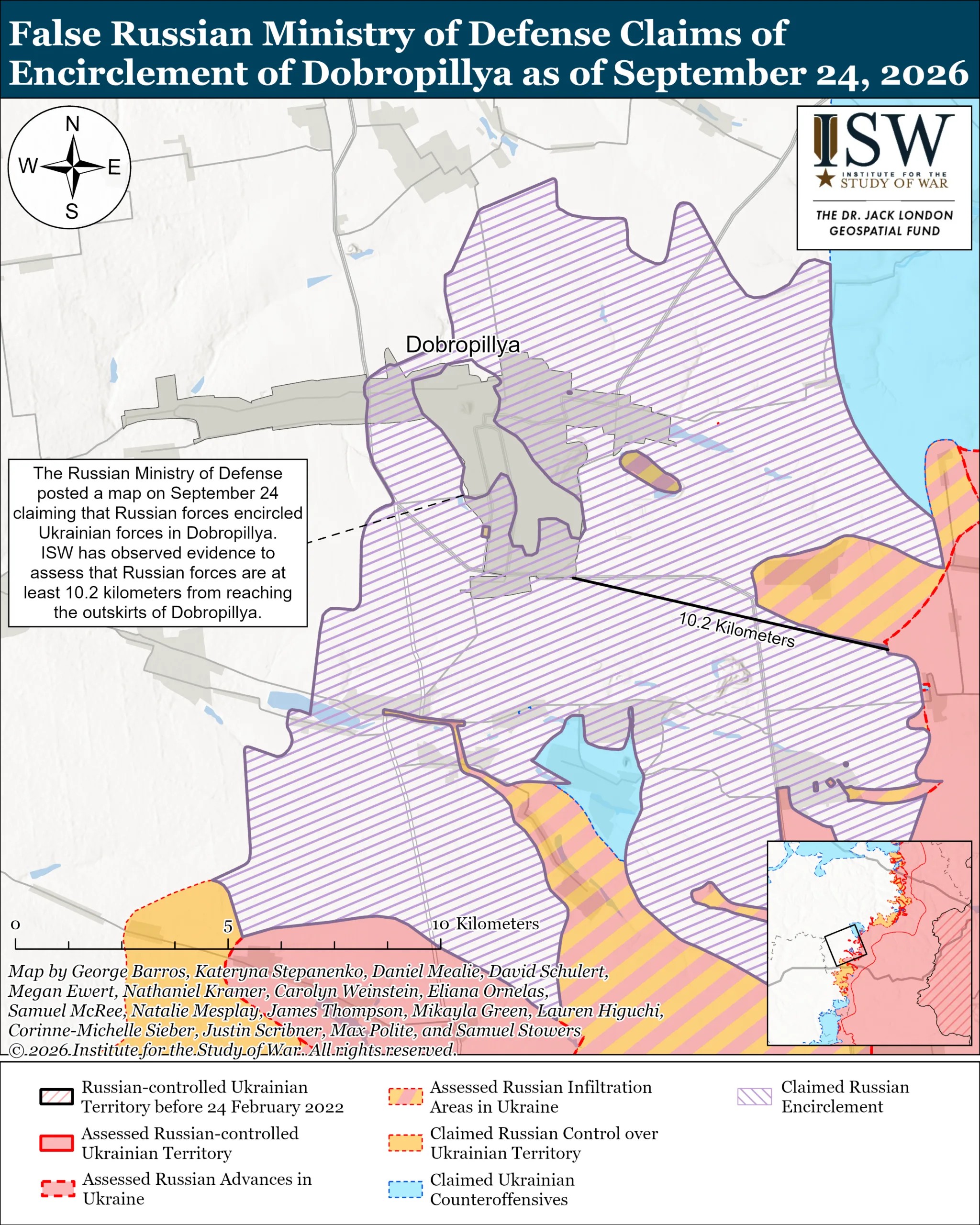
False Russian Ministry of Defense claims of encirclement of Dobropillia as of September 24, 2026. Source: Institute for the Study of War
Encircled on paper
Russia's Defence Ministry said on September 24 that units of its Centre Grouping were destroying encircled Ukrainian forces in the Dobropillia area while advancing towards Oleksandrivka, and published a map showing the city surrounded. The ISW's own map, in its assessment the same day, puts the nearest Russian forces 10.2 km from the city's southeastern outskirts, Euromaidan Press reported on September 25. The Ukrainian military says the city remains under its control.
The ISW said it had seen no evidence to support the encirclement claim, which it described as partly intended to divert attention from Ukraine's elimination of the Russian salient north of Lyman. It did observe small groups of Russian infiltrators operating east and northeast of Dobropillia on September 19 and 20, but did not assess that they had consolidated positions. One Russian milblogger suggested the "encirclement" might mean no more than fire control over Ukrainian supply roads west of the city.
The think tank blamed what Russian milbloggers themselves call "beautiful reports", a culture of inflated claims that it said has degraded the Defence Ministry's own picture of the battlefield. The ministry's statement described Dobropillia as a "strongly fortified settlement" whose capture would threaten Ukrainian supply lines running from Dnipropetrovsk region to the Fortress Belt. Biletskyi has said Russia's aim was to bypass the fortified cities through Dobropillia and link up with troops advancing from north of Lyman, rather than storm them head-on.
How close Russia came
Pokrovsk, the key logistics hub southwest of the belt, went first. Chief of the General Staff Valery Gerasimov told President Vladimir Putin on November 30 that it had been taken, and the city fell to Russia at the end of last year after months of street fighting.
By the summer Russian forces were advancing on Kostiantynivka, the southern anchor of the belt, with small groups infiltrating its outskirts and Putin saying the city was close to falling. "The city's fall seems to be more of a question of time," Emil Kastehelmi of Finland's Black Bird Group said in early July. Russian troops also took high ground between the Bakhmut-Siversk line and the belt that would bring Sloviansk and Kramatorsk into artillery range.
Kostiantynivka held. At the end of July, Ukrainian forces were still present across almost the whole city, according to open-source trackers, but the pincers were in place. A southern thrust through Dobropillia and a northern one from the Lyman salient would have closed a ring behind the four cities without Russia having to storm any of them.
Back to the river
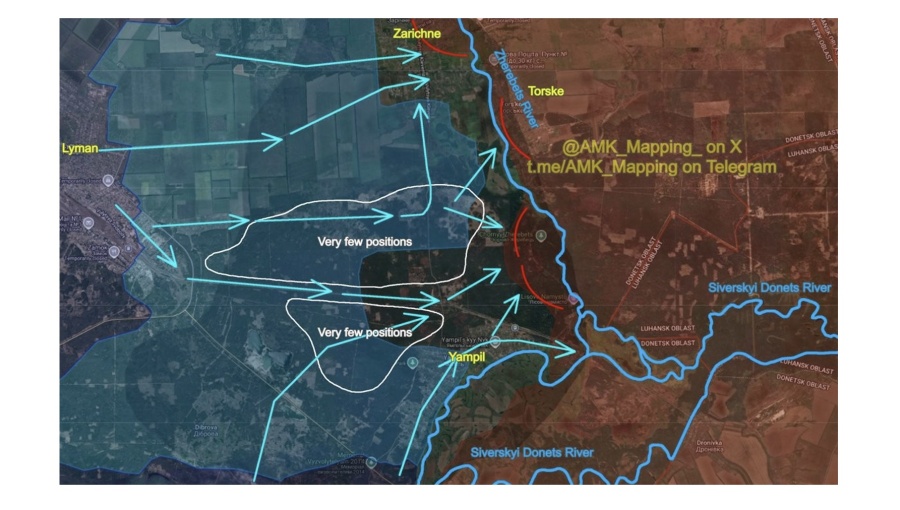
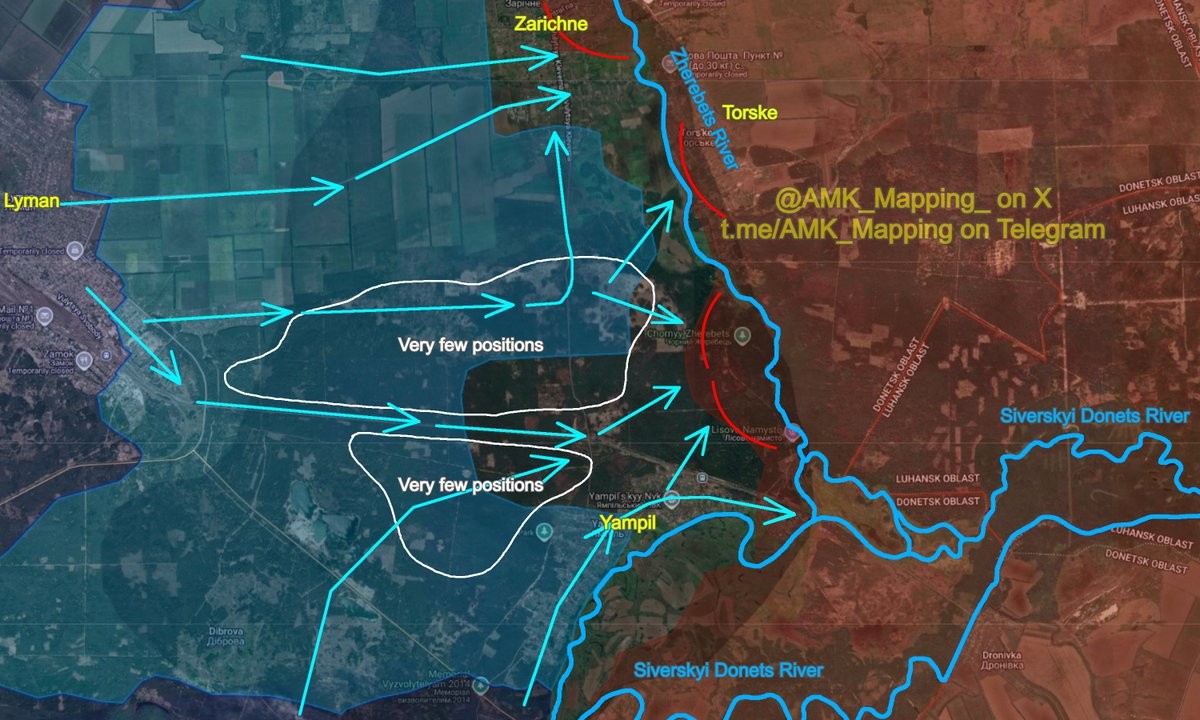
Vivaldi cut off the northern pincer. Ukrainian assault groups are now moving down several routes from Lyman towards the Zherebets River, trying to secure its western bank and finish clearing the village of Zarichne, according to open-source mapper AMK Mapping. Troops coming from Ozerne are clearing the remaining Russian positions in Yampil and attacking the last Russian bridgehead over the Zherebets from the south, while others advance east along the railway line from Lyman.
Ukrainian assault routes from Lyman towards the Zherebets River, Zarichne, Yampil and Torske. Source: AMK Mapping
The gains have reopened the route for Ukraine to send reinforcements south across the Siverskyi Donets into the area east of Mykolaivka and Sloviansk, flanking Russian positions from the north, the mapper said. Its caveat is two large stretches of forest where Ukraine has very few positions, which remain open to Russian infiltration that could disrupt the movement of assault groups and reinforcements, especially if the Russian bridgehead survives.
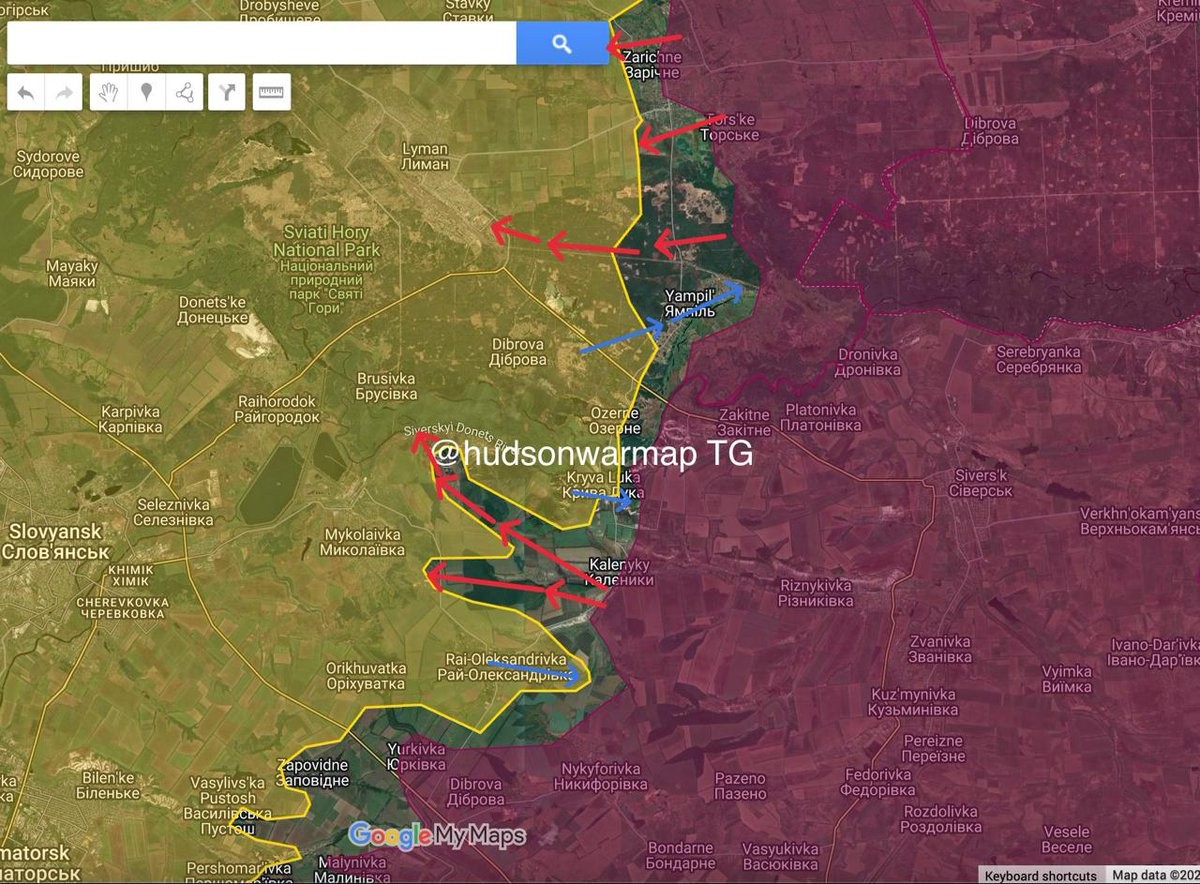
Russian forces are carrying out emergency counterattacks south of the Siverskyi Donets, east of Mykolaivka, and have likely re-entered Starodubivka, according to Hudson War Mapping, which called the situation "extremely confusing and complex".
The Lyman-Sloviansk front around Yampil, Kryva Luka, Kalenyky and the Siverskyi Donets. Source: Hudson War Mapping
French open-source analyst Clement Molin puts the front of Ukrainian gains at nearly 90 km, from Borova to Sloviansk. "The Ukrainians are on the verge of securing Sloviansk - one of the two key cities in the Donbass - by pushing back the front line," he wrote on September 25, adding that Russia's Zapad grouping had suffered "a major defeat" and that much of the ground retaken has yet to be announced. Military analyst Delwin compared Vivaldi to Ukraine's Kursk incursion of 2024, launched at a similar point in the year, and said fierce infantry skirmishing continues across the Lyman-Sloviansk front, mostly in the grey zone.
None of the mappers' claims can be independently confirmed, and official figures are broader. Across the whole front, Russia has taken about 890 sq km this year and Ukraine has retaken about 800 sq km, President Volodymyr Zelenskiy told The Wall Street Journal in an interview published on September 22, against 3,000-4,000 sq km a year of Russian gains in earlier years.
In ones, twos and threes
Since December Russia has largely dropped the costly frontal assaults by massed infantry that drove up its casualty figures, and instead sends soldiers forward alone or in groups of two or three to slip through the Ukrainian line, take up positions between or behind the defenders and attack them from there. Small groups are also harder for Ukraine's drones to find and kill than a column of armour. In July Russian assault groups were already using summer vegetation to infiltrate Ukrainian positions before bringing up heavier weapons.
The tactic feeds on Ukraine's manpower crisis. With too few infantry to hold a continuous line, there are gaps of up to a kilometre between Ukrainian positions, covered by drones rather than soldiers. Infiltration has become a standard Russian tactic, a creeping "ink-blot" approach in which Ukrainian control is eroded by handfuls of Russians settling in behind the lines, researcher Chris Owen said on September 25. It can work because Ukrainian forces are thin on the ground, he said, but constant aerial surveillance and fast drone strikes have made it very costly.
Nikolai Gavrilov, a Russian military volunteer and milblogger, admitted that Lyman, which the Russian government had described as the scene of "house to house clearing" before Vivaldi, is firmly in Ukrainian hands and that infiltrators sent there are usually killed, captured or desert, in a post translated by Owen.
"The city was supposedly captured, but the reality is different. There is still an administration, police, and volunteer organisations of Ukraine present in the city," Gavrilov wrote. "Every day, units of the Ukrainian Armed Forces conduct patrols, using drones to monitor all the abandoned buildings, searching for our soldiers who may be trying to escape."
"Day after day, these soldiers, who have managed to establish contact, are killed. I know one fighter who managed to stay in contact for a week - the civilians betrayed them to the Ukrainian Armed Forces, and he was killed," he wrote. "Many fighters, after receiving orders to go to Lyman, simply turn off their radios and desert."
Desertion was already a growing problem for Moscow, with more than 28,000 Russian servicemen convicted of going absent without leave by May 2025, Meduza reported in July. Russian infiltrators are now also trying to get behind Ukrainian lines east of Lyman that they believe are poorly consolidated, Hudson War Mapping said.
A war Moscow needs to win soon
Losing the prospect of the belt this winter hurts a Kremlin running short of time and money. Russia's federal budget deficit reached RUB5.8 trillion ($68bn), or 2.5% of GDP, in the first eight months of the year, and Finance Minister Anton Siluanov has conceded that the full-year gap will overshoot the planned RUB3.786 trillion ($45bn) and could be at least double the original target. Industrial output grew just 0.1% in the first seven months, oil export revenues fell to $13.8bn in July from $15.8bn in June, and the Central Bank of Russia paused its rate cuts at 14% on September 11 with inflation still above 6%.
Zelenskiy estimated Russia's irrecoverable losses this year at about 270,000 troops, a figure that could not be independently verified. "He is neither winning nor losing, but his society is losing people and money for the sake of some 100 kilometers," he said.
Ukraine Hits Russian Fuel And Air Defenses As Kyiv Fields High-Speed Drones To Counter Jet Shaheds – Analysis
A Wild Hornets’ STING S drone (UAV) designed to destroy Russian kamikaze UAVs such as Shahed, Geran, Lancet, as well as reconnaissance drones. Photo Credit: wildhornets.com
Ukraine’s General Staff said Sept. 19–20 strikes hit Moscow’s Kapotnya refinery (including an AVT-6 unit tied to military fuel) plus air-defense, radar, and drone-plant targets in occupied areas, while Russia kept attacking along Pokrovsk, Huliaipole, and the eastern fortress belt; post-Duma elections raise the chance of a Kremlin mobilization.
Zelenskyy and footage showed new high-speed interceptors—including Wild Hornets’ STING S and Vluchnyk’s ~$2,000 Zorelit v5 (~260 mph, SkyMap cueing)—downing jet-powered Geran/Shahed types that once often needed F-16s.
Watch Alabuga’s growing underground drone plants and whether August’s jump to ~57–62% jet-powered Shaheds holds in September.
1. Battlefield Assessment
Last week Ukraine continued to target the infrastructure that supports Russia’s military. According to the Ukrainian General Staff, on the night of September 19–20, Kyiv struck the Moscow Oil Refinery in Kapotnya, causing a major fire. The conflagration damaged several critical refinery components, including an AVT-6 crude-distillation unit, an integrated oil-processing unit, and an isomerization plant.
These facilities are key components of Russia’s war machine. The refinery’s AVT-6 distillation unit can process roughly 53 percent of its total crude throughput. The refinery can process as much as 12 million tons of oil annually and, according to the Ukrainian General Staff, supplies fuel to the Russian military.
Ukrainian forces also hit targets in occupied Ukraine. Kyiv reportedly struck a Buk-M3 air-defense system near Ukrainka in Zaporizhzhia Oblast, a Nebo-U radar near Balka in Donetsk Oblast, and a Russian drone-production facility near Siverskodonetsk in Luhansk Oblast. These attacks targeted Russia’s fuel infrastructure, air-defense assets, and drone-production capacity.
Meanwhile, legislative elections held in Russia from September 18–20 to elect all 450 seats of the State Duma marked an important political threshold. The electoral calendar no longer gives the Kremlin reason to delay potentially disruptive force-generation measures. It is possible, therefore, that Moscow may order a partial mobilization that could further shift the force-on-force balance against Ukraine.
Finally, Russia and Ukraine continued to contest the battlespace at a high operational tempo. Pokrovsk, Huliaipole, Kostiantynivka, Sloviansk, the Kramatorsk axis, and Ukraine’s eastern fortress belt defenses all saw heavy combat. Despite mounting casualties and limited territorial gains, Russian forces maintained an offensive posture on the ground.
2. Ukraine Introduces High-Speed Interceptors into the Counter-Shahed Battle
Static platforms once dominated drone warfare, but Russia and Ukraine now engage in a rapid cycle of offensive adaptation and defensive counteradaptation. Russia has expanded its use of faster, jet-powered Shahed derivatives. Ukraine is responding by accelerating the development of its own low-cost interceptor drones.
On September 19, Ukrainian President Volodymyr Zelenskyy announced that the Security Service of Ukraine had successfully employed a new interceptor against Russia’s jet-powered Shahed/Geran-type drones, releasing footage of the system in action. On the same day, additional footage emerged depicting Ukrainian forces using jet-powered unmanned aerial vehicles (UAVs) to intercept Russian jet-powered Geran-5 attack drones. Officials documented three separate Russian Geran-5 platform interceptions on September 19. They attributed two to unidentified jet-powered interceptors, and a third to Ukraine’s new STING S interceptor, a drone-hunting drone developed by the country’s Wild Hornets group.
These interceptions are notable. The Geran-5 is harder to target than earlier variants because of its higher speed and larger explosive payload. These features require faster interceptors that can close on the target before the attacking drone reaches its destination.
The Ukrainian Air Force has often dispatched manned combat aircraft, including the F-16, to intercept jet-powered Gerans. The appearance of the STING S interceptor alongside other unnamed jet-powered drone-hunting drones suggests that Ukraine is beginning to field multiple purpose-built high-speed counter-UAV systems. Kyiv is adapting in real time, as Russia’s expanded use of jet-powered one-way attack drones forces Ukrainian air defenses to respond with faster, cheaper, and more widely distributed interceptor platforms.
The Ukrainian manufacturer Vluchnyk is one company driving these innovations. The firm has completed internal testing of the Zorelit v5, or Starship, an interceptor designed specifically for high-speed reconnaissance and attack UAVs. The company says the system is ready for military use. Following codification, the Zorelit v5 is expected to become available through Ukraine’s ePoints procurement mechanism, which rewards military units for the confirmed destruction of Russian personnel and equipment.
The Zorelit v5 reportedly reaches 260 miles per hour and has a maximum range of approximately 29 miles. At a cruising speed of roughly 124 miles per hour, the system can carry a warhead and remain airborne for approximately 17 minutes. Its intended targets range from Russian reconnaissance UAVs and Gerbera decoys to Geran-2 attack drones and the faster, jet-powered Geran-3 and Geran-4 variants.
The interceptor can incorporate artificial intelligence–enabled target detection and tracking, including automated terminal guidance during the final phase of an engagement. The system can also integrate with SkyMap, which fuses air-target data from multiple detection layers, including radar and acoustic sensors, into a common picture that operators can access on a tablet.
Where less advanced systems would require individual interceptor teams to locate targets independently, SkyMap can provide operators with updated target tracks and cue them toward the relevant engagement area. This level of sensor fusion can help coordinate mobile fire groups, interceptor-drone crews, and other short-range air-defense elements against large, geographically dispersed UAV raids. In effect, Ukraine’s combination of inexpensive interceptors, distributed sensors, and digital command-and-control capabilities is turning the country’s counter-drone network into an increasingly integrated sensor-to-shooter architecture.
The Zorelit v5 builds on the already-produced Zorelit v4. Vluchnyk representatives say this earlier model has already entered combat service and has even received a North Atlantic Treaty Organization stock number, a unique numeric code used by NATO and allied countries to identify standardized supply items. The newer v5 incorporates combat-proven design features from the v4 system.
At a listed price of roughly $2,000 per interceptor, the v5 system illustrates a central feature of Ukraine’s emerging air-defense model. Against numerous and increasingly capable Russian one-way attack drones, Ukraine is attempting to match mass with a defensive architecture that is both scalable and economically sustainable. This exchange ratio matters as much as, if not more than, the v5 interceptor’s performance.
3. What to Monitor in the Coming Weeks
The Kremlin is reportedly expanding the underground production infrastructure at its drone-manufacturing facility at Alabuga in the Russian Republic of Tatarstan. Officials have built roughly 10 acres of underground space, providing Moscow with additional capacity for future production. Russia appears to have accelerated its construction effort following the first Ukrainian strikes against the facility and is increasingly dispersing its production of Geran drones and hardening supporting infrastructure. This suggests that Moscow is working to reduce the vulnerability of its manufacturing network to Ukrainian long-range strikes. This report will continue to track the open-source intelligence reporting on the Alabuga facility’s expanding subterranean footprint.
in August 2026 shifted toward sustained day-and-night attacks and greater use of jet-powered systems. An estimated 57–62 percent of the Shahed/Geran drones that Russia used during August were jet-powered, up from roughly 10 percent in June. Their higher speed compress Ukraine’s engagement windows and force Kyiv to rely more heavily on faster, more expensive air-defense assets. September’s data will show whether this shift in Russian drone operations is becoming a sustained pattern.
About the author:
Can Kasapoğlu is a nonresident senior fellow at Hudson Institute. His work at Hudson focuses on political-military affairs in the Middle East, North Africa, and former Soviet regions. He specializes in open-source defense intelligence, geopolitical assessments, international weapons market trends, as well as emerging defense technologies and related concepts of operations.
About Hudson Institute Hudson Institute is a nonpartisan policy research organization dedicated to innovative research and analysis that promotes global security, prosperity, and freedom. View all posts by Hudson Institute →


 Researchers looked at an array of models and found they shifted their political answers to mirror the views of a hypothetical userImage: Philip Dulian/dpa/picture alliance


 OpenAI said it had removed most of the leaked content and was working to remove the restImage: Jakub Porzycki/NurPhoto/IMAGO