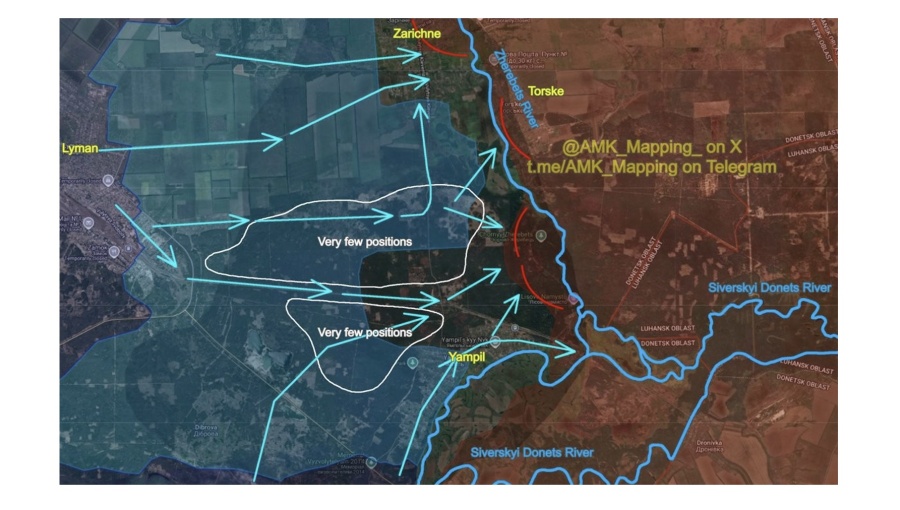
Ukraine's Operation Vivaldi has pushed Russian troops back from the Donbas Fortress Belt towards the Zherebets and Siverskyi Donets rivers, consolidating gains made earlier this month in a stunning stategic reversal that now makes Russia's chances of capturing the rest of Donbas by winter look remote.
The Third Army Corps of Brigadier General Andrii Biletskyi announced the counteroffensive north of Lyman on September 15 and says it has since recovered about 125 sq km, retaking Shandryholove and Derylove and taking full control of Drobysheve, Kyiv Post reported on September 23. "As promised, I am reporting good news," Biletskyi said on September 20 as he announced the second phase of gains, Kyiv Independent reported.
Russia had been closing in on the belt, the chain of fortified cities of Sloviansk, Kramatorsk, Druzhkivka and Kostiantynivka that has anchored Ukraine's defence of Donetsk region for years, and in July looked to be in a good position to take it over the winter. Losing that line could have decided the war. Vivaldi has disrupted that advance: the Institute for the Study of War (ISW) said on September 16 that Ukraine's gains north of Lyman had made Russia's plan to swing around the belt from the north "unfeasible", Euromaidan Press reported. For a Kremlin that needs a win soon, with its budget deficit and a stalling economy, that is a serious setback.
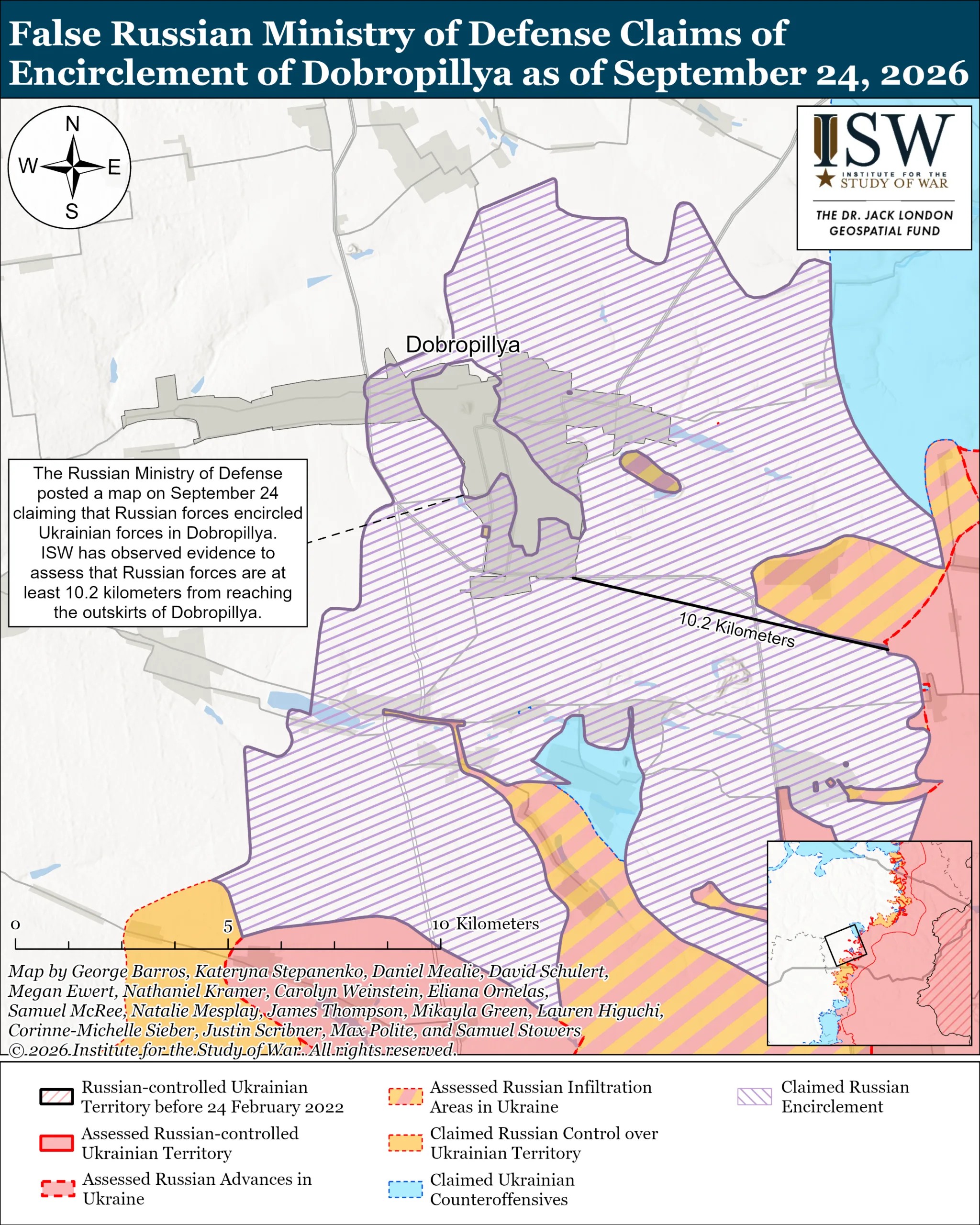
False Russian Ministry of Defense claims of encirclement of Dobropillia as of September 24, 2026. Source: Institute for the Study of War
Encircled on paper
Russia's Defence Ministry said on September 24 that units of its Centre Grouping were destroying encircled Ukrainian forces in the Dobropillia area while advancing towards Oleksandrivka, and published a map showing the city surrounded. The ISW's own map, in its assessment the same day, puts the nearest Russian forces 10.2 km from the city's southeastern outskirts, Euromaidan Press reported on September 25. The Ukrainian military says the city remains under its control.
The ISW said it had seen no evidence to support the encirclement claim, which it described as partly intended to divert attention from Ukraine's elimination of the Russian salient north of Lyman. It did observe small groups of Russian infiltrators operating east and northeast of Dobropillia on September 19 and 20, but did not assess that they had consolidated positions. One Russian milblogger suggested the "encirclement" might mean no more than fire control over Ukrainian supply roads west of the city.
The think tank blamed what Russian milbloggers themselves call "beautiful reports", a culture of inflated claims that it said has degraded the Defence Ministry's own picture of the battlefield. The ministry's statement described Dobropillia as a "strongly fortified settlement" whose capture would threaten Ukrainian supply lines running from Dnipropetrovsk region to the Fortress Belt. Biletskyi has said Russia's aim was to bypass the fortified cities through Dobropillia and link up with troops advancing from north of Lyman, rather than storm them head-on.
How close Russia came
Pokrovsk, the key logistics hub southwest of the belt, went first. Chief of the General Staff Valery Gerasimov told President Vladimir Putin on November 30 that it had been taken, and the city fell to Russia at the end of last year after months of street fighting.
By the summer Russian forces were advancing on Kostiantynivka, the southern anchor of the belt, with small groups infiltrating its outskirts and Putin saying the city was close to falling. "The city's fall seems to be more of a question of time," Emil Kastehelmi of Finland's Black Bird Group said in early July. Russian troops also took high ground between the Bakhmut-Siversk line and the belt that would bring Sloviansk and Kramatorsk into artillery range.
Kostiantynivka held. At the end of July, Ukrainian forces were still present across almost the whole city, according to open-source trackers, but the pincers were in place. A southern thrust through Dobropillia and a northern one from the Lyman salient would have closed a ring behind the four cities without Russia having to storm any of them.
Back to the river
Vivaldi cut off the northern pincer. Ukrainian assault groups are now moving down several routes from Lyman towards the Zherebets River, trying to secure its western bank and finish clearing the village of Zarichne, according to open-source mapper AMK Mapping. Troops coming from Ozerne are clearing the remaining Russian positions in Yampil and attacking the last Russian bridgehead over the Zherebets from the south, while others advance east along the railway line from Lyman.
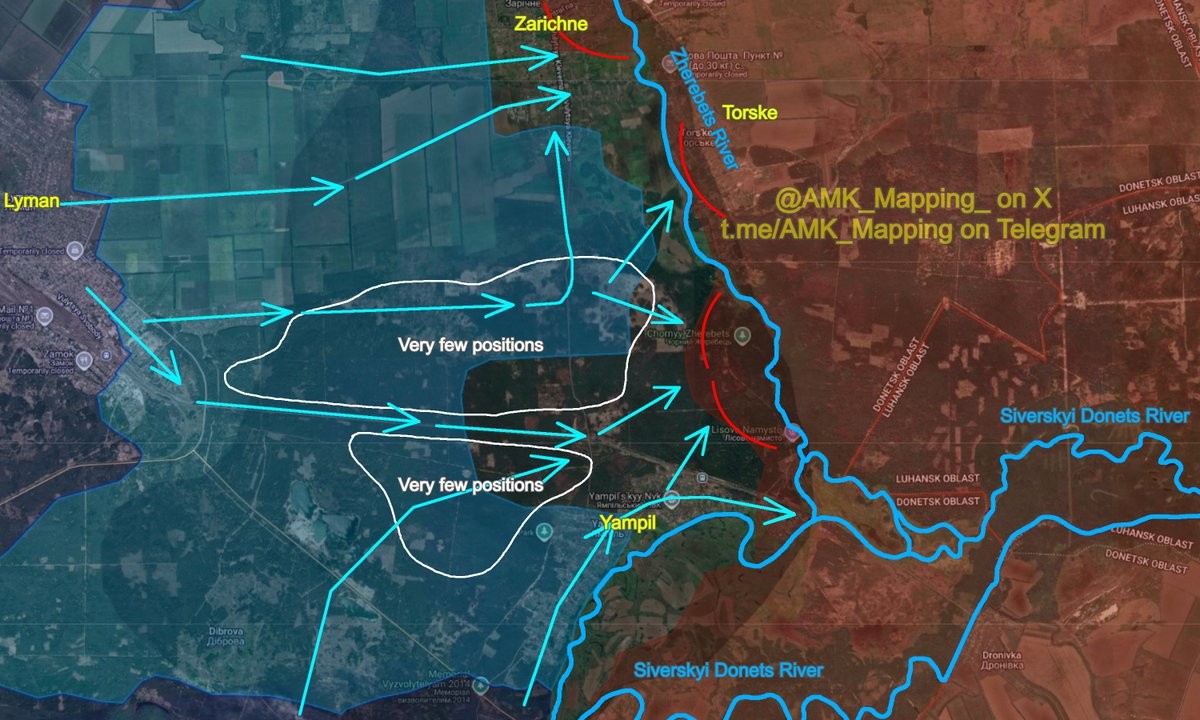
Ukrainian assault routes from Lyman towards the Zherebets River, Zarichne, Yampil and Torske. Source: AMK Mapping
The gains have reopened the route for Ukraine to send reinforcements south across the Siverskyi Donets into the area east of Mykolaivka and Sloviansk, flanking Russian positions from the north, the mapper said. Its caveat is two large stretches of forest where Ukraine has very few positions, which remain open to Russian infiltration that could disrupt the movement of assault groups and reinforcements, especially if the Russian bridgehead survives.
Russian forces are carrying out emergency counterattacks south of the Siverskyi Donets, east of Mykolaivka, and have likely re-entered Starodubivka, according to Hudson War Mapping, which called the situation "extremely confusing and complex".
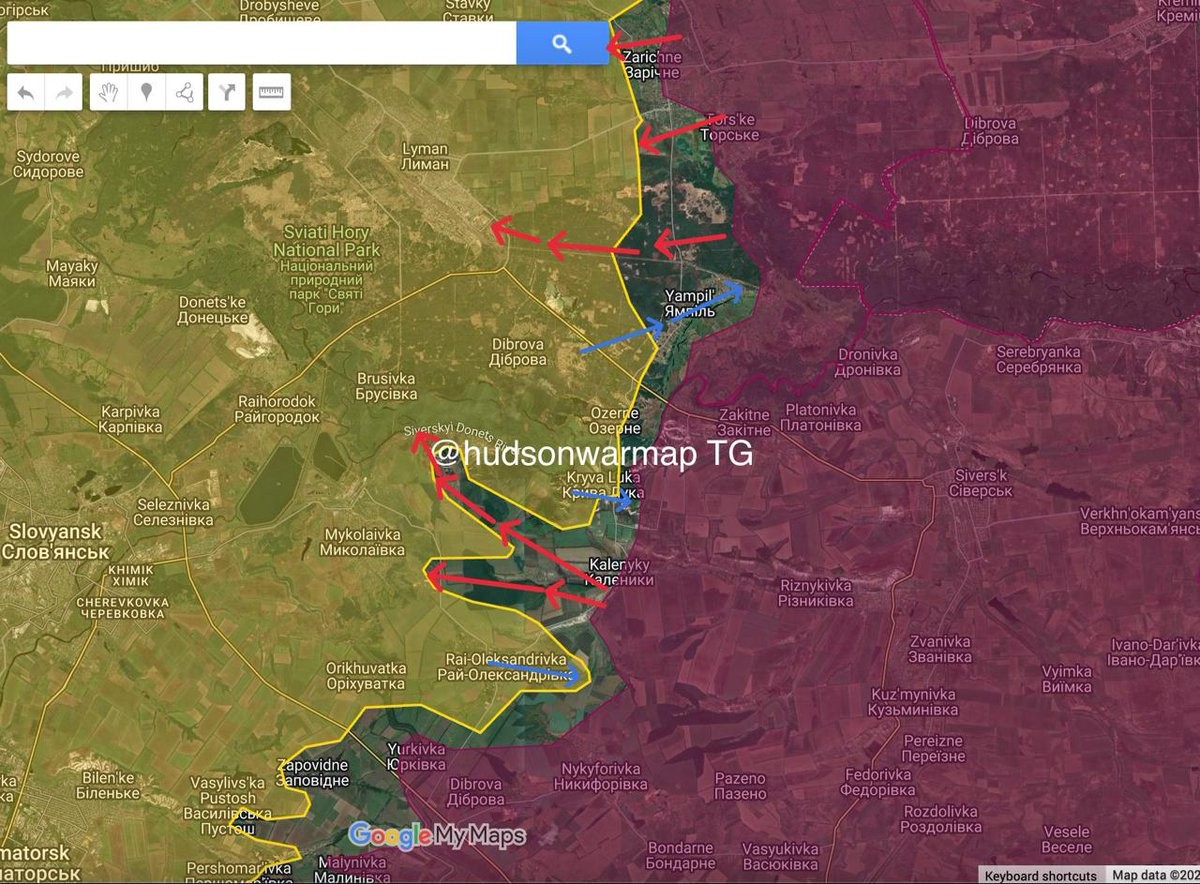
The Lyman-Sloviansk front around Yampil, Kryva Luka, Kalenyky and the Siverskyi Donets. Source: Hudson War Mapping
French open-source analyst Clement Molin puts the front of Ukrainian gains at nearly 90 km, from Borova to Sloviansk. "The Ukrainians are on the verge of securing Sloviansk - one of the two key cities in the Donbass - by pushing back the front line," he wrote on September 25, adding that Russia's Zapad grouping had suffered "a major defeat" and that much of the ground retaken has yet to be announced. Military analyst Delwin compared Vivaldi to Ukraine's Kursk incursion of 2024, launched at a similar point in the year, and said fierce infantry skirmishing continues across the Lyman-Sloviansk front, mostly in the grey zone.
None of the mappers' claims can be independently confirmed, and official figures are broader. Across the whole front, Russia has taken about 890 sq km this year and Ukraine has retaken about 800 sq km, President Volodymyr Zelenskiy told The Wall Street Journal in an interview published on September 22, against 3,000-4,000 sq km a year of Russian gains in earlier years.
In ones, twos and threes
Since December Russia has largely dropped the costly frontal assaults by massed infantry that drove up its casualty figures, and instead sends soldiers forward alone or in groups of two or three to slip through the Ukrainian line, take up positions between or behind the defenders and attack them from there. Small groups are also harder for Ukraine's drones to find and kill than a column of armour. In July Russian assault groups were already using summer vegetation to infiltrate Ukrainian positions before bringing up heavier weapons.
The tactic feeds on Ukraine's manpower crisis. With too few infantry to hold a continuous line, there are gaps of up to a kilometre between Ukrainian positions, covered by drones rather than soldiers. Infiltration has become a standard Russian tactic, a creeping "ink-blot" approach in which Ukrainian control is eroded by handfuls of Russians settling in behind the lines, researcher Chris Owen said on September 25. It can work because Ukrainian forces are thin on the ground, he said, but constant aerial surveillance and fast drone strikes have made it very costly.
Nikolai Gavrilov, a Russian military volunteer and milblogger, admitted that Lyman, which the Russian government had described as the scene of "house to house clearing" before Vivaldi, is firmly in Ukrainian hands and that infiltrators sent there are usually killed, captured or desert, in a post translated by Owen.
"The city was supposedly captured, but the reality is different. There is still an administration, police, and volunteer organisations of Ukraine present in the city," Gavrilov wrote. "Every day, units of the Ukrainian Armed Forces conduct patrols, using drones to monitor all the abandoned buildings, searching for our soldiers who may be trying to escape."
"Day after day, these soldiers, who have managed to establish contact, are killed. I know one fighter who managed to stay in contact for a week - the civilians betrayed them to the Ukrainian Armed Forces, and he was killed," he wrote. "Many fighters, after receiving orders to go to Lyman, simply turn off their radios and desert."
Desertion was already a growing problem for Moscow, with more than 28,000 Russian servicemen convicted of going absent without leave by May 2025, Meduza reported in July. Russian infiltrators are now also trying to get behind Ukrainian lines east of Lyman that they believe are poorly consolidated, Hudson War Mapping said.
A war Moscow needs to win soon
Losing the prospect of the belt this winter hurts a Kremlin running short of time and money. Russia's federal budget deficit reached RUB5.8 trillion ($68bn), or 2.5% of GDP, in the first eight months of the year, and Finance Minister Anton Siluanov has conceded that the full-year gap will overshoot the planned RUB3.786 trillion ($45bn) and could be at least double the original target. Industrial output grew just 0.1% in the first seven months, oil export revenues fell to $13.8bn in July from $15.8bn in June, and the Central Bank of Russia paused its rate cuts at 14% on September 11 with inflation still above 6%.
Zelenskiy estimated Russia's irrecoverable losses this year at about 270,000 troops, a figure that could not be independently verified. "He is neither winning nor losing, but his society is losing people and money for the sake of some 100 kilometers," he said.
Ukraine Hits Russian Fuel And Air Defenses As Kyiv Fields High-Speed Drones To Counter Jet Shaheds – Analysis
A Wild Hornets’ STING S drone (UAV) designed to destroy Russian kamikaze UAVs such as Shahed, Geran, Lancet, as well as reconnaissance drones. Photo Credit: wildhornets.com
September 26, 2026
Hudson Institute
By Can Kasapoğlu
Key Takeaways:
Zelenskyy and footage showed new high-speed interceptors—including Wild Hornets’ STING S and Vluchnyk’s ~$2,000 Zorelit v5 (~260 mph, SkyMap cueing)—downing jet-powered Geran/Shahed types that once often needed F-16s.
Watch Alabuga’s growing underground drone plants and whether August’s jump to ~57–62% jet-powered Shaheds holds in September.
1. Battlefield Assessment
Last week Ukraine continued to target the infrastructure that supports Russia’s military. According to the Ukrainian General Staff, on the night of September 19–20, Kyiv struck the Moscow Oil Refinery in Kapotnya, causing a major fire. The conflagration damaged several critical refinery components, including an AVT-6 crude-distillation unit, an integrated oil-processing unit, and an isomerization plant.
These facilities are key components of Russia’s war machine. The refinery’s AVT-6 distillation unit can process roughly 53 percent of its total crude throughput. The refinery can process as much as 12 million tons of oil annually and, according to the Ukrainian General Staff, supplies fuel to the Russian military.
Ukrainian forces also hit targets in occupied Ukraine. Kyiv reportedly struck a Buk-M3 air-defense system near Ukrainka in Zaporizhzhia Oblast, a Nebo-U radar near Balka in Donetsk Oblast, and a Russian drone-production facility near Siverskodonetsk in Luhansk Oblast. These attacks targeted Russia’s fuel infrastructure, air-defense assets, and drone-production capacity.
Meanwhile, legislative elections held in Russia from September 18–20 to elect all 450 seats of the State Duma marked an important political threshold. The electoral calendar no longer gives the Kremlin reason to delay potentially disruptive force-generation measures. It is possible, therefore, that Moscow may order a partial mobilization that could further shift the force-on-force balance against Ukraine.
Finally, Russia and Ukraine continued to contest the battlespace at a high operational tempo. Pokrovsk, Huliaipole, Kostiantynivka, Sloviansk, the Kramatorsk axis, and Ukraine’s eastern fortress belt defenses all saw heavy combat. Despite mounting casualties and limited territorial gains, Russian forces maintained an offensive posture on the ground.
2. Ukraine Introduces High-Speed Interceptors into the Counter-Shahed Battle
Static platforms once dominated drone warfare, but Russia and Ukraine now engage in a rapid cycle of offensive adaptation and defensive counteradaptation. Russia has expanded its use of faster, jet-powered Shahed derivatives. Ukraine is responding by accelerating the development of its own low-cost interceptor drones.
On September 19, Ukrainian President Volodymyr Zelenskyy announced that the Security Service of Ukraine had successfully employed a new interceptor against Russia’s jet-powered Shahed/Geran-type drones, releasing footage of the system in action. On the same day, additional footage emerged depicting Ukrainian forces using jet-powered unmanned aerial vehicles (UAVs) to intercept Russian jet-powered Geran-5 attack drones. Officials documented three separate Russian Geran-5 platform interceptions on September 19. They attributed two to unidentified jet-powered interceptors, and a third to Ukraine’s new STING S interceptor, a drone-hunting drone developed by the country’s Wild Hornets group.
These interceptions are notable. The Geran-5 is harder to target than earlier variants because of its higher speed and larger explosive payload. These features require faster interceptors that can close on the target before the attacking drone reaches its destination.
The Ukrainian Air Force has often dispatched manned combat aircraft, including the F-16, to intercept jet-powered Gerans. The appearance of the STING S interceptor alongside other unnamed jet-powered drone-hunting drones suggests that Ukraine is beginning to field multiple purpose-built high-speed counter-UAV systems. Kyiv is adapting in real time, as Russia’s expanded use of jet-powered one-way attack drones forces Ukrainian air defenses to respond with faster, cheaper, and more widely distributed interceptor platforms.
The Ukrainian manufacturer Vluchnyk is one company driving these innovations. The firm has completed internal testing of the Zorelit v5, or Starship, an interceptor designed specifically for high-speed reconnaissance and attack UAVs. The company says the system is ready for military use. Following codification, the Zorelit v5 is expected to become available through Ukraine’s ePoints procurement mechanism, which rewards military units for the confirmed destruction of Russian personnel and equipment.
The Zorelit v5 reportedly reaches 260 miles per hour and has a maximum range of approximately 29 miles. At a cruising speed of roughly 124 miles per hour, the system can carry a warhead and remain airborne for approximately 17 minutes. Its intended targets range from Russian reconnaissance UAVs and Gerbera decoys to Geran-2 attack drones and the faster, jet-powered Geran-3 and Geran-4 variants.
The interceptor can incorporate artificial intelligence–enabled target detection and tracking, including automated terminal guidance during the final phase of an engagement. The system can also integrate with SkyMap, which fuses air-target data from multiple detection layers, including radar and acoustic sensors, into a common picture that operators can access on a tablet.
Where less advanced systems would require individual interceptor teams to locate targets independently, SkyMap can provide operators with updated target tracks and cue them toward the relevant engagement area. This level of sensor fusion can help coordinate mobile fire groups, interceptor-drone crews, and other short-range air-defense elements against large, geographically dispersed UAV raids. In effect, Ukraine’s combination of inexpensive interceptors, distributed sensors, and digital command-and-control capabilities is turning the country’s counter-drone network into an increasingly integrated sensor-to-shooter architecture.
The Zorelit v5 builds on the already-produced Zorelit v4. Vluchnyk representatives say this earlier model has already entered combat service and has even received a North Atlantic Treaty Organization stock number, a unique numeric code used by NATO and allied countries to identify standardized supply items. The newer v5 incorporates combat-proven design features from the v4 system.
At a listed price of roughly $2,000 per interceptor, the v5 system illustrates a central feature of Ukraine’s emerging air-defense model. Against numerous and increasingly capable Russian one-way attack drones, Ukraine is attempting to match mass with a defensive architecture that is both scalable and economically sustainable. This exchange ratio matters as much as, if not more than, the v5 interceptor’s performance.
3. What to Monitor in the Coming Weeks
The Kremlin is reportedly expanding the underground production infrastructure at its drone-manufacturing facility at Alabuga in the Russian Republic of Tatarstan. Officials have built roughly 10 acres of underground space, providing Moscow with additional capacity for future production. Russia appears to have accelerated its construction effort following the first Ukrainian strikes against the facility and is increasingly dispersing its production of Geran drones and hardening supporting infrastructure. This suggests that Moscow is working to reduce the vulnerability of its manufacturing network to Ukrainian long-range strikes. This report will continue to track the open-source intelligence reporting on the Alabuga facility’s expanding subterranean footprint.
in August 2026 shifted toward sustained day-and-night attacks and greater use of jet-powered systems. An estimated 57–62 percent of the Shahed/Geran drones that Russia used during August were jet-powered, up from roughly 10 percent in June. Their higher speed compress Ukraine’s engagement windows and force Kyiv to rely more heavily on faster, more expensive air-defense assets. September’s data will show whether this shift in Russian drone operations is becoming a sustained pattern.
Source: This article was published by the Hudson Institute
About Hudson Institute
Hudson Institute is a nonpartisan policy research organization dedicated to innovative research and analysis that promotes global security, prosperity, and freedom.
View all posts by Hudson Institute →

No comments:
Post a Comment