Saturday, September 26, 2026

US Air Force Reaper Fleet Declines As Congress Moves To Halt Retirements – Analysis


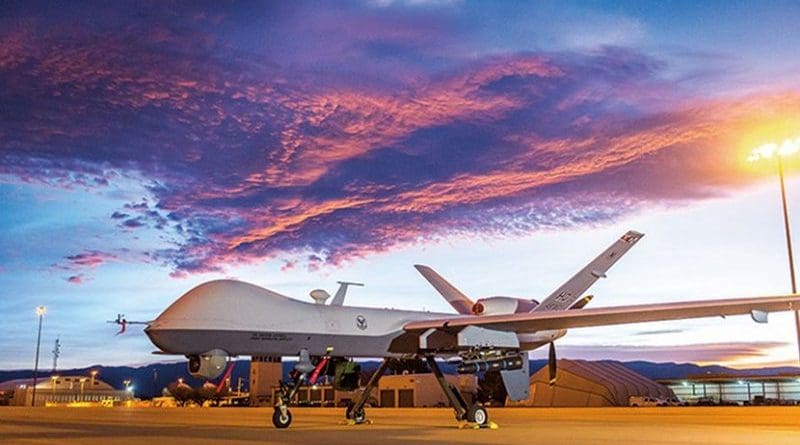
File photo of a MQ-9 Reaper (drone) remotely piloted aircraft at Holloman Air Force Base, New Mexico (U.S. Air Force/J.M. Eddins, Jr.)


September 25, 2026
the Congressional Research Service (CRS).
By Daniel M. Gettinger


Key Takeaways:

Air Force MQ-9A Reaper inventory has fallen from 351 in FY2022 to 135 in service as of May 2026 testimony, after divesting older Block 1s plus losses in accidents and combat. An August 2026 report, citing U.S. sources, put 45 Reapers lost in operations against Iran; officials called them a standout in Operation Epic Fury but “concerned about how they’ve attrited.” The production line is closed (2–3 years to restart). Some Members want a near-ban on further divestment (e.g., H.R. 9119; S. 4677).

Group 5 UAS used for ISR, strike, relay, and related missions; 56 combat lines as of May 2026, including Air National Guard remote ops from 12 units in 11 states. Unit cost cited from ~$23.5 million (FY2020 estimate) up to ~$50 million with sensors. Air Force approved a cheaper Massed Modular Aircraft (MMA) concept in May 2026: DIU CSO closed July; up to four prototype firms by end-2026; ~$10 million/unit and 500 aircraft by 2032 reported as goals. FY2027 request funds existing MQ-9A work and five Marine Corps airframes, not new Air Force Reapers or MMA procurement.

FY2027 NDAA drafts would roughly match requested Reaper dollars and restrict retirement until 2031 or until a replacement is certified IOC. Issues flagged for Congress: whether 135 jets cover requirements, training after attrition, whether MMA cost/capability claims hold (General Atomics has called the price target unrealistic), and industrial-base risk.


The MQ-9A Reaper is a multi-role uncrewed aircraft system (UAS, or drone) produced by General Atomics Aeronautical Systems, Inc. Within the U.S. Department of Defense (DOD), the Air Force operates the greatest number of Reapers; the Air National Guard and Marine Corps also operate the MQ-9A. (DOD is “using a secondary Department of War designation,” under Executive Order 14347 dated September 5, 2025.)

The Air Force’s inventory of MQ-9A Reaper aircraft has declined as the Air Force has divested older-variant MQ-9As and lost aircraft in accidents and combat operations. The Air Force has proposed developing a successor for the MQ-9A known as the Massed Modular Aircraft (MMA). As currently conceived, an MMA would cost less per unit than the Reaper, which has a unit cost of between $30 million and $50 million, and potentially perform many of the same missions. Some Members of Congress have expressed concern about the reported decrease in the Air Force inventory of MQ-9As and have introduced legislation that would, if enacted, prohibit the service from divesting the aircraft in most circumstances (e.g., H.R. 9119; S. 4677, 119th Congress).

Background

The Reaper is part of the Predator aircraft series, the origins of which date to the early 1980s, which has included the Air Force MQ-1A/B Predator (now retired), the Army MQ-1C Gray Eagle, and other variants. In 1999, General Atomics began developing a Predator B model as an internal project. In 2001, the Air Force awarded General Atomics a contract for work on developing the Predator B aircraft—later renamed the Reaper. The Air Force and Air National Guard began fielding the aircraft in 2007 and 2008, respectively, while the Marine Corps first leased Reapers for operations in 2018.

In FY2021 and FY2022 budget requests to Congress, the Air Force proposed ending production of the MQ-9A and iteratively divesting older Block 1 variants of the MQ-9A in favor of the newer Block 5s. Air Force officials expressed concern that the Reaper “was not designed for operation in a future highly contested environment.” In 2020-2021, the Air Force reportedly considered concepts for a successor aircraft, one potentially capable of surviving in contested environments. The extent to which the service pursued such concepts is unclear. The MQ-9A production line is closed and is estimated to take 2-3 years to restart, a company official said in an email to CRS.

Design and Cost

The Reaper is what DOD categorizes as a Group 5 UAS, meaning the largest and highest-flying drones. (The department categorizes UAS on the basis of their weight, speed, and operating altitude.) The Reaper is capable of flying up to 27 hours and is designed to conduct intelligence, surveillance, and reconnaissance (ISR) and strike missions, as well as electronic reconnaissance and communications relay missions. DOD has explored using the Reaper for ballistic missile defense.

Beginning in the early 2020s, the Air Force began retrofitting MQ-9A Block 5s to the Multi-Domain Operations (M2DO) configuration, which included changes to the aircraft’s communications, sensors, and software. The Air Force stated that these changes were “aimed at increasing MQ-9s effectiveness against near-peer adversary threats” and designed to “allow the Air Force to rapidly integrate new capabilities.”

In FY2020, the Air Force estimated that an MQ-9A would have an average procurement unit cost of $23.5 million ($28.7 million in 2026 dollars). Estimates of the aircraft’s unit cost have varied based on payloads, such as sensors and other equipment. For example, an Air Force official stated in congressional testimony in May 2026 that the MQ-9A “can cost up to $50 million a copy” depending on its sensor package.

Operations and Inventory

The Air Force has used the Reaper and Predator extensively in combat operations. In 2019, the Air Force reported that its Reaper and Predator fleet had surpassed a total of four million lifetime flight hours—several times that of the Air Force’s crewed reconnaissance aircraft. The Reaper and Predator’s role in U.S. strikes on counterterrorism targets since the attacks of September 11, 2001, has been a subject of congressional oversight hearings. Some Members of Congress, as well as human rights and media organizations, have raised concerns about civilian deaths resulting from airstrikes involving Reapers and the Pentagon’s decisionmaking process for such strikes.

As of May 2026, the Air Force maintained 56 Reaper combat lines (i.e., continuous coverage of a geographic area, previously known as combat air patrols, or CAPs), each of which could require multiple aircraft. A portion of the Air Force’s combat lines are flown by the Air National Guard. In an email to CRS, Air Force officials said that as of mid-2026, 12 Air National Guard units in 11 U.S. states operated the Reaper, in most cases remotely from locations in the United States.

The Reaper has had a prominent role in Operation Epic Fury (OEF), the name of the U.S. military operation against Iran in 2026. In congressional testimony in May 2026, Air Force Chief of Staff General Kenneth Wilsbach described the MQ-9A as “maybe the most valuable player” of OEF. The Air Force has not officially disclosed how many MQ-9s the service has lost in OEF. In congressional testimony in May 2026, another Air Force official said of the MQ-9A that the service was “concerned about how they’ve attrited.” An August 2026 news article, citing U.S. government sources, reported that the United States had lost 45 MQ-9A Reapers in operations against Iran.

According to figures in its annual budget submissions to Congress, the Air Force’s inventory of Reapers has decreased since FY2022, when the Air Force reported an inventory of 351 MQ-9A aircraft (see Figure 1). In congressional testimony in May 2026, an Air Force official stated that 135 MQ-9As remained in service and that the Air Force could meet its requirement for 56 combat lines at that level.


Figure 1. Air Force MQ-9A Reaper Inventory FY2015-FY2026 Source: CRS graphic based on the enacted column in the “Aircraft Inventory” tables in Air Force Budget Overview documents; and congressional testimony. Note: The FY2026 figure is based on congressional testimony in May 2026.


Massed Modular Aircraft Proposal


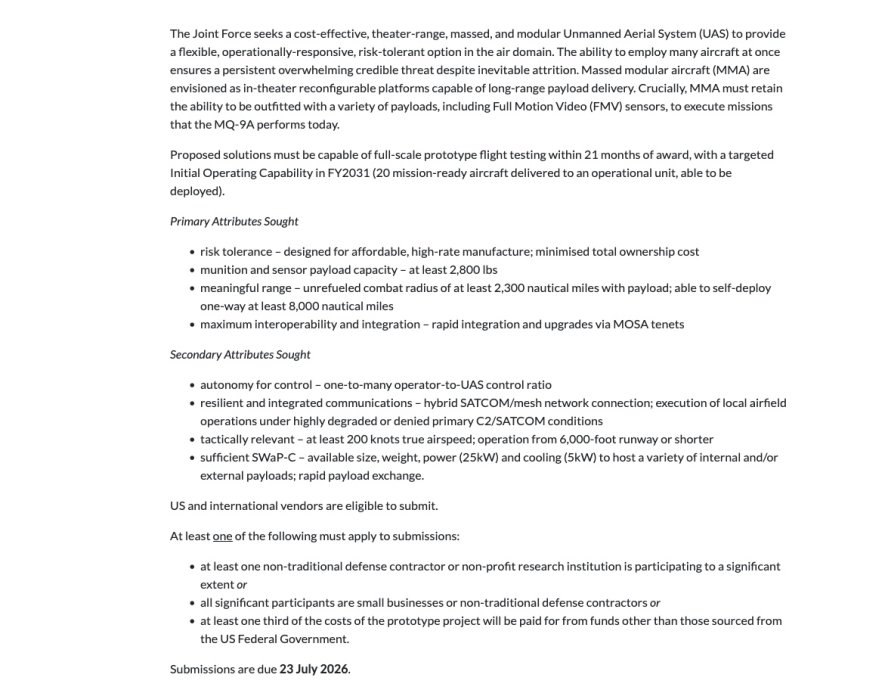
The Air Force has proposed developing and fielding a near-to-midterm successor to the MQ-9A Reaper known as MMA. Under the MMA proposal, which the Air Force approved in May 2026 and released in July, the service has proposed acquiring a Group 5 aircraft that costs less than the MQ-9A Reaper and that retains “the ability … to execute missions that the MQ-9A performs today.”

In July 2026, the Air Force and the Defense Innovation Unit (DIU) released a commercial solutions opening (CSO) solicitation to industry, which closed later that month. DIU and the Air Force reportedly described an MMA as “in-theater reconfigurable,” or tailored to specific missions, and as having sufficient automation to allow one operator to control multiple aircraft. The Air Force has not said whether it would change the service’s force structure should it transition to an MMA.

To fund initial efforts, the Air Force plans to use a $40 million FY2026 appropriation to DIU for “theater-range UAS mass manufacturing.” The Air Force plans to select up to four companies by the end of 2026 to develop prototypes. The Air Force has reportedly estimated an MMA would cost approximately $10 million per unit and reportedly plans to request FY2028 procurement funds to begin purchasing MMAs, with a goal of having 500 MMAs in service by 2032.

FY2027 Budget Request


For FY2027, DOD requested $766.2 million in procurement and research, development, test, and evaluation (RDT&E) funding for the MQ-9A Reaper, including a Navy request for five MQ-9As for the Marine Corps. The Air Force did not request funding for new MQ-9As or for the proposed MMA program.

As part of its June 2026 supplemental funding request to Congress, the Trump Administration sought funding for military “drones.” In a July 2026 statement to the Senate Appropriations Committee, Secretary of Defense Pete Hegseth, who is using “Secretary of War” as a “secondary title” under Executive Order 14347 dated September 5, 2025, indicated that an unspecified portion of the funds would be spent on “MQ-9 platforms.” Some Members of Congress have asked that DOD provide a “detailed accounting” of the requested supplemental funding.

Legislative Activity

Proposed defense authorization and appropriation legislation (H.R. 8800; S. 4784; H.R. 9495) would authorize and provide approximately the level of FY2027 discretionary funding requested for the MQ-9A Reaper. Section 134 of the Senate Armed Services Committee (SASC)-reported version of a National Defense Authorization Act for Fiscal Year 2027 (FY2027 NDAA; S. 4784) would prohibit the Air Force Secretary from divesting or reducing the inventory of MQ-9 aircraft until September 30, 2031, among other actions. Section 147 of the House-passed version of an FY2027 NDAA (H.R. 8800) would prohibit the Air Force from retiring the MQ-9 until the Air Force Secretary certifies that a replacement has achieved initial operational capability, among other conditions.
Potential Issues for Congress

Potential issues for Congress include but are not necessarily limited to the following:

Operational Capability. An issue for Congress is whether or not the Air Force has sufficient MQ-9A aircraft to meet operational requirements today and until a replacement is available. Congress may consider what options the Air Force has explored to increase its inventory of MQ-9As, the potential time needed for doing so, whether doing so is cost and operationally effective, and options for performing MQ-9A missions with other military assets.

Force Structure and Training. An issue for Congress is whether or not the reported attrition of MQ-9As has affected the training and staffing of Air Force and Air National Guard MQ-9A units. Another issue is the potential effects that a transition to an MMA could have on those MQ-9A units and on Air Force manpower requirements.

Effectiveness of the Proposed Massed Modular Aircraft. The Air Force has stated that the MMA concept would provide field commanders with a similar capability as the Reaper at a lower per-unit cost. Representatives for General Atomics have criticized the Air Force’s cost target for MMAs as not realistic. Congress could consider what sort of analysis of alternatives informed the MMA proposal. Congress might also consider how the Air Force is applying lessons from the Iran conflict to the development of the MMA.


Technical, Schedule, and Cost Risks. Congress may consider the risks of cost growth, schedule delay, or technical challenges of the MMA proposal; whether the proposed technical attributes and cost of an MMA support the Air Force’s employment concept; and the capacity of the U.S. industrial base to produce MMAs at the anticipated rate.


About the author: Daniel M. Gettinger, Analyst in U.S. Defense Policy


Source: This article was published by the Congressional Research Service (CRS).

About CRS
The Congressional Research Service (CRS) works exclusively for the United States Congress, providing policy and legal analysis to committees and Members of both the House and Senate, regardless of party affiliation. As a legislative branch agency within the Library of Congress, CRS has been a valued and respected resource on Capitol Hill for nearly a century.
View all posts by CRS →
Drawing The Line: India And Myanmar’s Unfinished Border – Analysis


Myanmar (Burma) on the left and India on the right bank of Tio River. Rihkhawdar is the busy trading broader town on the Chin State of Burma side and Zokhawdar on Mizoram State of India side. Photo Credit: Ericwinny, Wikipedia Commons


September 25, 2026
Observer Research Foundation
By Sreeparna Banerjee


Key Takeaways:

The piece frames a 2 Sept. 2026 Manipur home-minister update—about 55 km of the state’s 398-km Myanmar border fenced, rest aimed at 2028—plus a 26 May 2026 document (The Diplomat, July) on a possible ~1.4 sq mi / 3.5 sq km exchange between pillars 65–68 (Chandel / Kabaw Valley). MEA on 4 Aug. said some sectors remain unsettled and talks continue; it did not confirm a swap.

History: colonial Pemberton Line after Yandabo (1826) and 1834 Kabaw restoration; 1967 India–Myanmar agreement; ~1,472 of 1,643 km pillar-marked, ~171 km still open. After Myanmar’s 2021 coup, New Delhi treats an undemarcated line as a barrier to fencing, patrols, and crime control. FMR (1968/2018, 16 km) was suspended then ended (MHA, 8 Feb. 2024); Dec. 2024 protocol: 10 km with biometric border passes.

A swap, if ever agreed, is compared to the 2015 India–Bangladesh LBA and Berubari (1960): surveys, a treaty, Article 368 amendment, then pillars, records, and residents’ rights. Civil-society worries over villages and farmland.


The India-Myanmar border is back in the spotlight, not because the boundary itself is new, but because questions over how it should be demarcated are once again attracting attention. On 2 September 2026, Manipur’s home minister stated that, of the state’s 398-km border with Myanmar, around 55 km has been fenced, with the entire stretch targeted for completion by 2028.

Meanwhile, a reported government document dated 26 May 2026, cited by The Diplomat in July, has fuelled speculation over a possible territorial exchange. The document refers to the unresolved stretch between Boundary Pillars 65 and 68 in Manipur’s Chandel district and reportedly proposes exchanging around 1.4 square miles (3.5 sq km) of territory with adjoining Myanmar’s Kabaw Valley in the Sagaing Region. The reported proposal has not been confirmed as a decision. On 4 August, a Ministry of External Affairs spokesperson acknowledged that “there are certain areas on the border which are yet to be settled” and that “discussions on those sectors are ongoing,” but stopped short of confirming any territorial adjustment.


The issue cannot be understood without examining how the boundary came into existence. The 1,643-km frontier is largely an inheritance of the colonial era, shaped by the Treaty of Yandabo (1826) and subsequent boundary arrangements. In 1834, the British restored the Kabaw Valley to the Kingdom of Burma and tasked Major F.J. Grant and Captain Robert Boileau Pemberton with defining the Manipur-Burma boundary, giving rise to what became known as the Pemberton Line. These successive boundary-making exercises did not always correspond with pre-existing patterns of social, cultural, and economic interaction, and communities such as the Nagas, Kukis, and Mizos subsequently found themselves living on either side of an international frontier.

After independence, India and Burma sought to regularise the inherited boundary through the 1967 India-Myanmar Boundary Agreement, which established the modern alignment and created a Joint Boundary Commission for its physical demarcation. Around 1,472 km has since been demarcated through boundary pillars, leaving approximately 171 km unresolved. The present debate, therefore, is not about reopening the entire frontier, but about addressing the specific pockets where the boundary has yet to be conclusively demarcated on the ground.

A New Urgency for Demarcation

The renewed push for demarcation needs to be understood against a much wider transformation in India’s approach to its eastern border with Myanmar. For decades, the frontier was managed as a relatively porous border in which security considerations coexisted with considerable cross-border social and economic interaction. The situation has changed considerably since the military coup in Myanmar in February 2021. The intensification of conflict in Myanmar, the movement of armed groups and displaced nationals, and the expansion of transnational criminal networks have heightened India’s concerns about maintaining effective control over the frontier.

Border infrastructure has consequently become a central component of India’s security policy. India has been pursuing fencing in identified stretches of the 1,643-km boundary, alongside efforts to strengthen patrolling and surveillance. An unresolved boundary line creates an obvious practical difficulty: where stretches remain undemarcated, the construction and alignment of permanent border infrastructure becomes more complex. Demarcation is therefore not simply a cartographic exercise; it is increasingly central to the effective planning and implementation of a comprehensive border-management system.

The changing security environment also includes insurgency, narcotics trafficking, arms smuggling, and other forms of transnational crime. The India-Myanmar frontier connects India’s Northeast with Myanmar’s conflict-affected areas and, further east, the wider Golden Triangle. Undemarcated stretches can complicate surveillance and coordination between the two sides. For New Delhi, clearly established boundary coordinates can strengthen the legal and administrative basis for fencing, patrolling, and monitoring movement.

The FMR Question

The debate over demarcation is closely connected to India’s decision to end the Free Movement Regime (FMR). The FMR, which has existed since 1968 and was formalised in 2018, was designed to recognise the distinctive social and ethnic character of the India-Myanmar border, where communities on either side of the international boundary have longstanding familial, cultural, and economic ties. Under the earlier arrangement, eligible residents living close to the border could cross up to 16 km into each other’s territory without following normal visa or passport procedures, subject to specified conditions.

This arrangement reflected a reality the colonial boundary had never erased. Communities such as the Nagas, Kukis, and Mizos have long maintained social, familial, and economic ties across what later became an international border. The border, then, has never been merely a line separating two sovereign states; for many communities, it has also been a shared space of livelihood, education, healthcare, kinship, and marriage.

Security concerns over unrestricted movement have gained greater prominence in New Delhi’s approach to border management in recent years. The Manipur border with Myanmar has faced tighter movement restrictions since 2022, when the FMR was suspended amid Myanmar’s deteriorating security situation and concerns over a growing influx of Myanmar nationals. The porous border has also remained a major route for narcotics trafficking, compounding New Delhi’s border-security concerns.

On 8 February 2024, the Ministry of Home Affairs announced its decision to scrap the FMR, citing internal security and the need to preserve the demographic structure of India’s northeastern states bordering Myanmar. The MHA also recommended its immediate suspension while the Ministry of External Affairs undertook the formal process of ending the arrangement. However, in view of the familial ties on either side of the border, the Centre introduced a stricter replacement protocol in December 2024, allowing movement within 10 km with biometric screening through border passes issued to residents at designated crossing points.

Fencing the border has consequently become a key component of New Delhi’s border-management approach. The shift towards a more regulated movement regime marks a significant departure in India’s handling of a historically porous frontier, and makes physical demarcation considerably more consequential: greater regulation of movement and stronger physical border controls increase the need for clarity and precision in the boundary’s alignment.

At the same time, eliminating the FMR cannot by itself resolve the socio-economic consequences of a hardened border. Communities that have traditionally crossed the frontier for agriculture, trade, religious activities, medical treatment, or family reasons could face higher costs and administrative barriers. A successful border-management policy will therefore have to reconcile security requirements with the legitimate interests of border communities.

Is a Land Swap on the Table?

The possibility of a territorial exchange has attracted particular attention because of the proposed arrangement in the Molcham sector. Reports suggest that a territorial adjustment involving approximately 1.4 square miles has been discussed in connection with the disputed stretch between Boundary Pillars 65 and 68.

It is important, however, to distinguish between a proposal under examination and an agreed territorial settlement. The available reporting indicates that the proposal is being considered as a means of resolving a difficult section of the boundary; it does not establish that India has agreed to any transfer of territory, nor does it suggest that a final land swap has received the necessary governmental approvals.

The rationale for considering an exchange is essentially practical. If the existing boundary alignment produces an awkward or contested configuration on the ground, a mutually negotiated adjustment could, in theory, establish a clearer and more manageable boundary. Any such adjustment would, however, carry wider legal and administrative implications, and would bear directly on local communities and their customary land-use practices. Civil society organisations have already raised concerns on this front, particularly over the potential impact on villages, agricultural land, and established land-use patterns.

What Would a Territorial Swap Require?


India already has a precedent for negotiated territorial adjustment in the 2015 India-Bangladesh Land Boundary Agreement (LBA), under which the two countries exchanged enclaves and settled outstanding boundary issues. Its implementation required the Constitution (100th Amendment) Act, 2015, demonstrating that any transfer of sovereign territory involves more than a bilateral administrative decision.

A similar India-Myanmar arrangement would likely require joint surveys and precise demarcation to establish the territory involved, followed by a formal bilateral agreement defining the revised boundary, boundary pillars, and implementation arrangements. Given the principles set out in the Berubari judgment (1960), any proposal to transfer Indian territory would need to proceed through Article 368, the constitutional amendment procedure, rather than through ordinary legislative or executive action.

The final stage would involve ground-level implementation: relocating or installing boundary pillars, updating maps and land records, and determining the status of affected residents, including their residence, land and property rights, documentation, and, where applicable, compensation or rehabilitation.

The process would ultimately have to balance strategic border management with the rights and livelihoods of communities living along the frontier. The broader challenge, therefore, is to clarify and secure the boundary while accounting for the social and economic interests of communities that have long lived across it.


About the author: Sreeparna Banerjee is an Associate Fellow with the Strategic Studies Programme.

Source: This article was published by Observer Research Foundation

About Observer Research Foundation
ORF was established on 5 September 1990 as a private, not for profit, ’think tank’ to influence public policy formulation. The Foundation brought together, for the first time, leading Indian economists and policymakers to present An Agenda for Economic Reforms in India. The idea was to help develop a consensus in favour of economic reforms.
View all posts by Observer Research Foundation →

TikTok agrees to time limits for teens to avoid Alabama trial

26.09.2026, DPA

Photo: Jan Woitas/dpa

TikTok has agreed to restrict how teenagers use its platform in the US state of Alabama and pay up to $300 million to avoid a trial over allegations that it deliberately designed its app to be addictive to children.

The settlement, announced on Friday by Alabama Attorney General Steve Marshall, includes a two-hour daily time limit for young users and restrictions on access between midnight and 6 am.

Teenagers will also be barred from using cosmetic filters in videos.

The changes will only apply in the southern US state.

The Alabama trial had been due to begin next week and was expected to focus in part on allegations that the short-video platform was intentionally designed to encourage addictive behaviour among children.

Instagram parent company Meta agreed to similar restrictions last month as part of a settlement with several US states that included payments of up to $18 billion.

OOP'S

US Company That Sold Phone Hacking Software To Pentagon, Secret Service Lied About Russian Ownership, Officials Say


An aerial view of the Pentagon building, Washington, D.C. Photo Credit: Navy Petty Officer 2nd Class Alexander Kubitza, DOD

September 25, 2026
 RFE RL
By Mike Eckel


Key Takeaways:

U.S. prosecutors say Virginia-registered Oxygen Forensics, which sold digital-forensics tools to the Pentagon and other agencies, was owned by Russians who also ran a Moscow firm serving the FSB. CEO Lee Reiber, 55, of Idaho, was arrested on wire-fraud charges Sept. 22 and released on bail. Oleg Davydov, 52, of Moscow, was arrested at Heathrow Sept. 20; extradition is sought.

Complaint (released Sept. 23): the firm allegedly claimed no foreign ownership and U.S. development. After 2022, ownership was allegedly hidden; inside Russia the firm became MKO Systems. Secret Service’s National Computer Forensics Institute signed a five-year contract in 2024. Authorities say the complaint does not allege malware or unauthorized access to customer systems.

Same day, FBI said it was looking into a claim that a group stole files tied to agents/applicants and hit a jobs site—separate from this case.


A US company that provided digital forensics and data-extraction software to the Pentagon and other government agencies was in fact owned by a Russian company that also sold software to Russian spy agencies, US authorities charged.

Oxygen Forensics’ chief executive — Lee Reiber, 55, of Idaho — was arrested on wire fraud charges and released on bail on September 22, US prosecutors said. A Russian man — Oleg Davydov, 52, of Moscow – was arrested at London’s Heathrow Airport two days earlier, and US officials said they will seek his extradition.

In the criminal complaint released on September 23, US prosecutors said Oxygen Forensics and Reiber in particular allegedly told the US government that the Virginia-registered company had no foreign ownership or control and that its software was developed in the United States.

In fact, prosecutors alleged, Oxygen Forensics was owned by Davydov and four other unnamed Russian citizens who also ran a Moscow-based company that provides software services to the Federal Security Services, Russia’s main intelligence agency.

The company set up a US affiliate in the suburbs of Washington, D.C., in 2013.

After 2022, when the United States and other Western countries tightened regulations in the wake of Moscow’s all-out invasion of Ukraine, Davydov and his partners allegedly moved to conceal Oxygen Forensics’ ownership.

Inside Russia, Oxygen was renamed MKO Systems. The company’s main application, called Mobile Forensic Detective, is in wide use among Russian law enforcement agencies.

The software that Oxygen provided to US government agencies was data-extraction software, used to circumvent security features and gather data from mobile phones, computers, and other electronic devices.


The National Computer Forensics Institute for the Secret Service, which is the agency that provides protective details to the White House and government officials, signed a five-year contract with the company in 2024.

“The complaint does not allege that the software contained malicious code or that it was used to gain unauthorized access to any customer’s computer systems or data,” authorities said.

Both Reiber and Davydov were charged with wire fraud. Reiber did not immediately respond to an e-mail seeking comment. Davydov could not be located for comment.

The announcement comes as instances of hacking, cyberespionage, malware, and other malicious computer activity have exploded around the world.

Government agencies in the United States, Russia, China, Israel, and Iran have invested massive sums into building out new cybercapabilities, and private companies increasingly have access to powerful new nongovernment tools.

The FBI on September 23 announced it was investigating a claim that a hacker group had stolen sensitive files belonging to thousands of agents and applicants and that it had compromised the bureau’s jobs website.Mike Eckel is a senior international correspondent reporting on political and economic developments in Russia, Ukraine, and around the former Soviet Union, as well as news involving cybercrime and espionage. He’s reported on the ground on Russia’s invasion of Ukraine, the wars in Chechnya and Georgia, and the 2004 Beslan hostage crisis, as well as the annexation of Crimea in 2014.
‘F*ck the Consultants’: Free Advice Offered for Democrats in Need of a Position on AI

“Wild that candidates are avoiding an enormously consequential issue with broad bipartisan support among voters, for fear of unleashing attack ads from super PACs funded by a tiny handful of AI billionaires and corporations.”


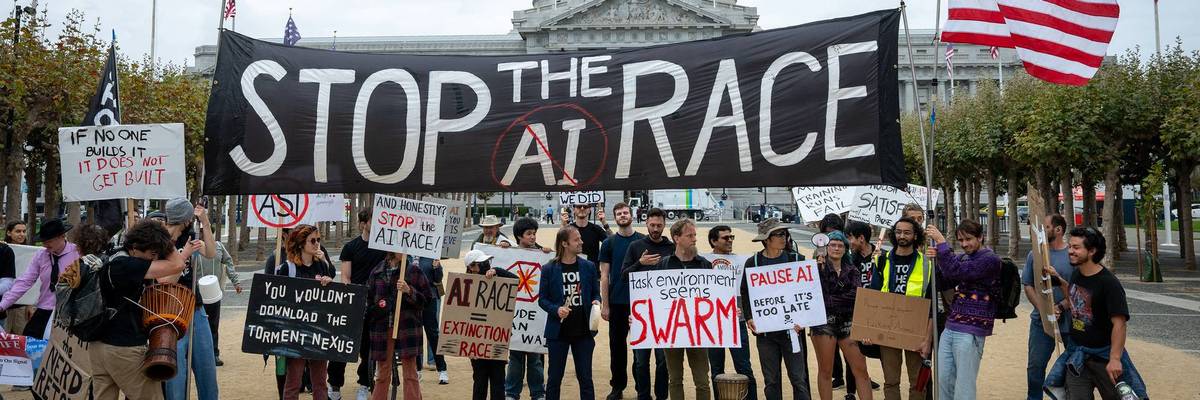
Protesters during a “Stop the AI Race” demonstration calling for a slowdown in the development of advanced artificial intelligence systems outside City Hall in San Francisco, California, on September 17, 2026.
(Photo by Karl Mondon / AFP via Getty Images)

Jon Queally
Sep 18, 2026
COMMON DREAMS

A veteran aide for Sen. Bernie Sanders (I-Vt.) has some choice advice for Democrats running for office in this year’s election, which is to ignore the guidance some of them are reportedly receiving from their political consultants on the question of regulating the artificial intelligence industry in the face of growing public concerns about runaway machine learning and the data center buildout that big tech companies are pursuing nationwide.

Warren Gunnels, who currently serves as the minority staff director for Sanders on the Health, Education, Labor and Pensions (HELP) Committee in the US Senate, issued his advice in response to a Politico article published Thursday, which had the headline “Democratic advisers are warning their candidates not to go too hard at AI.”

While the reporting noted that members of the Democratic Party’s consultancy class are “privately encouraging their battleground candidates to avoid talking about AI regulations out of fear that powerful tech groups will unleash a tidal wave of spending against them” ahead of this year’s midterm election, Gunnels offered a 9-word antidote to what he considered bad political advice and a failure to recognize where most voters are on the issue.

“Nine words,” said Gunnels in his post: “Fuck the consultants, End Citizens United, Ban super PACs.” Gunnels backed up his statement with recent polling data suggesting that a strong stance on AI and data centers would likely help, not hurt, those seeking elected office.


Gunnels wasn’t the only one to react negatively.

Brendan Fischer, director of strategic investigations at the Campaign Legal Center, said it’s “wild that candidates are avoiding an enormously consequential issue with broad bipartisan support among voters, for fear of unleashing attack ads from super PACs funded by a tiny handful of AI billionaires and corporations.”

The US Supreme Court’s 2010 ruling in the Citizens United case, which unleashed a tidal wave of dark money campaign spending, said Fischer, “promised unlimited political spending would mean more speech and a more robust marketplace of ideas. But instead, candidates are chilled from discussing issues voters care about for fear of angering wealthy interests capable of spending millions to defeat them.”


In July, Business Insider reported that the AI industry had already spent at least $65 million in midterm races, though other estimates have put that figure much higher. Meanwhile, Elon Musk, CEO of Space X and a major player in the AI space with his GROK model, has vowed to spend a $100 million help his preferred candidates and the Republican Party win.

At a summit on the need for robust regulation of the AI industry held earlier this week, Sanders said he had a message for leaders and executives running theses tech companies.

“My message to the AI CEO’s: If you truly care about the future of humanity,” said Sanders, “stop pouring hundreds of millions of dollars into super PACs to defeat Members of Congress and candidates who are fighting for serious guardrails on AI.”


As the debate over AI regulation has emerged as a major topic in Washington, DC, and on the campaign trail in recent weeks, a series of polls have confirmed public anxieties about the technology.

A poll from The Associated Press-NORC Center for Public Affairs Research and the Energy Policy Institute at the University of Chicago released Wednesday showed that more than half of US voters (53%) are “extremely” or “very” concerned about artificial intelligence’s environmental impacts, and the poll also found broader concerns about the negative impacts of data centers, especially on local water resources and utility rates.

“Change is scary, and I think some of that is being reflected here,” said Michael Greenstone, who directs the University of Chicago institute that collaborated on the survey, of the results.

The Politico reporting, which drew Gunnel’s fiery response, also acknowledged the public sentiment, but described how consultants working on various Democratic campaigns are trying to avoid provoking the ire of deep-pocketed tech giants:
Some top Democratic candidates and their campaigns are quietly trying to avoid crossing any red lines for tech super PACs — even as it’s unclear exactly what those lines would be, after Musk and two of the biggest AI CEOs called for more regulation on the technology last week.Democrats are especially wary of Leading the Future, a pro-AI industry super PAC that spent over $25 million in primary races this year and is backed by investors and executives of OpenAI. The rival super PAC network, Public First Action, pushes for AI regulation and is funded by OpenAI’s chief competitor, Anthropic.

While the fears of being targeted by the industry cash may not be unfounded, progressives like Gunnels suggest that a willingness to take a stand against powerful AI companies is exactly the kind of fight voters want to see from party candidates.

For the Politico article, Rep. Pramila Jayapal (D-Wash.), former chair of the Congressional Progressive Caucus in the House, explained how AI super PACs “come out and they say that they’re concerned, that they want regulation. But then they spend huge amounts of money on defeating anybody who wants legislative regulation.”

In a social media post Thursday night, however, Jayapal backed the congressional campaign of Will Lawrence, running as a Democrat to win an open seat in Michigan’s 7th Congressional District, by saying voters “need leaders who answer to their constituents, not the corporations that paid for their election.”

Following Gunnels advice that bucking the influence of corporate donors is actually a key component of a winning electoral strategy in the 2026 midterms, Jayapal said “electing fighters who don’t take corporate PAC money”—whether on the issue of AI, healthcare, housing policy, or broader concerns about economic inequality and affordability—is key for Democrats.

Amid Urgent Demand for Oversight, Analysis Details 105 US Lawmakers Personally Invested in the AI Industry


Despite catastrophic warnings from AI industry insiders, Congress has adjourned until after the midterms without passing any laws to regulate the technology.


US Rep. Josh Gottheimer (D-NJ) participates in the Competing and Setting the Standards in the AI Era panel during The Hill & Valley Forum 2026 at Andrew W. Mellon Auditorium on March 24, 2026, in Washington, DC.
(Photo by Leigh Vogel/Getty Images The Hill & Valley Forum)


Stephen Prager
Sep 18, 2026
COMMON DREAMS

Despite increasingly urgent calls to regulate artificial intelligence, including from industry insiders who warn of potentially catastrophic consequences, the US Congress has continued to drag its feet on meaningful legislation.

A report released Friday by Sludge may shed some light on one potential roadblock. It found that 1 in 5 members of Congress has household investments in AI companies or those producing the infrastructure behind the technology.


Sludge revealed that:
At least 105 members of Congress have disclosed that they, their spouse, or their dependent children hold stocks or other investments in AI developers, chipmakers, cloud infrastructure providers, data center companies, and specialized AI firms, with a total value of between $75 million and $287 million.

Most of the money is invested in large tech companies like Nvidia, Meta, and Alphabet. But lawmakers also report their households holding and trading shares in smaller publicly traded AI companies like BigBear.ai, Tempus AI, and C3 AI, as well as little-known private startups whose shares are unavailable to ordinary investors.

Of the lawmakers reporting investments, at least 44 sit on committees with jurisdiction over legislation dealing with AI safety, consumer protections, semiconductor policy, and trade with China.

The report identifies several lawmakers in positions of influence over Congress’ AI policy whose households simultaneously have deep investments in the industry.


One of them is Rep. Josh Gottheimer (D-NJ), the co-chair of the House Democratic Commission on AI and the Innovation Economy—created to help direct the party’s legislative agenda around the emerging technology.

According to Sludge, Gottheimer’s household has investments in several key chipmaking and semiconductor companies, and he has regularly traded in AI stocks while in Congress.

The report draws attention to the “scores of sales” he made on April 9, 2025, when President Donald Trump announced a surprise 90-day pause on his “Liberation Day” tariffs, an announcement that led stocks for many AI companies to surge in value. Gottheimer has previously told Sludge that his investments are managed by a third party and that he does not make the decisions himself.

Gottheimer is one of the Democrats helping shape the party’s approach to regulating AI. Earlier this month, amid concerns about the growing capability of “superintelligent” AI agents that can exceed human capability, he joined with Rep. Mike Lawler (R-NY) to introduce the Stop Rogue AI Act.

This bill would direct the National Institute of Standards and Technology (NIST) to adopt a series of standards and best practices that AI companies could implement to track the behavior of agents. However, critics have argued that the bill’s voluntary guidelines fall short of what is necessary to rein in the industry.

Gottheimer’s proposal is one of several measures Democrats have proposed in recent weeks following warnings from Anthropic researchers Jacob Coxon and Evan Hubinger that AI systems could wipe out humanity if allowed to escape human control.

Others include a more muscular bill proposed earlier this month by Sen. Bernie Sanders (I-Vt.) and Rep. Greg Casar (D-Texas) that would permanently ban the development of superintelligent AI and pause the development of advanced AI until a federal regulatory body can be established.

Some members of Congress whose households are heavily invested in AI stocks have nonetheless supported stronger regulation. According to Sludge, Rep. Ro Khanna (D-Calif.) disclosed between $3.4 million and $8.4 million worth of stock owned by his wife in AI companies, including Nvidia and chipmaker Broadcom.

Khanna has said he does not personally trade stocks and has pushed for a congressional ban on stock trading. Despite his household’s millions of dollars worth of AI investments, he has also voiced support for blocking the development of superintelligent AI until stronger safeguards are in place, broadly aligning him with the Sanders-Casar proposal.

Sludge found that investments in AI stocks are not concentrated in either party. Among the lawmakers who reported AI-related investments, 62 were Republicans, and 43 were Democrats.

One of the largest portfolios is held by the husband of former House Speaker Nancy Pelosi (D-Calif.), who plans to retire at the end of the term.

Paul Pelosi, a venture capitalist, reported holdings in Alphabet, Amazon, Microsoft, Nvidia, Broadcom, and Tempus AI worth between $28.4 million and $134.9 million, while also buying an estimated $1.3 million to $2.6 million in Alphabet, Amazon, Nvidia, and Tempus shares in 2026 and up to $12 million in Bloom Energy, which stands to benefit from the AI data-center buildout.

On the Republican side, the report singles out Rep. Lisa McClain (Mich.), the chair of the House Republican Conference and the fourth highest-ranking member of House GOP leadership. Since December, her household has invested as much as $515,000 in AI companies, including private stakes in Elon Musk’s company xAI, as well as Apptronik and Saronic.

Rep. Diana Harshbarger (R-Tenn.), meanwhile, disclosed holdings in Alphabet, Amazon, Meta, Microsoft, Nvidia, and Oracle. She serves on the House Energy and Commerce Committee’s Energy Subcommittee, which has authority to legislate on energy issues related to the controversial buildout of data centers around the country.

The report comes as members of Congress head home for a seven-week recess that will last until after November’s midterm elections.

On Wednesday, more than 100 Democrats—including Gottheimer, Khanna, and Pelosi—sent a letter to House Speaker Mike Johnson (R-La.) urging him to postpone the recess until Congress passes AI safety legislation.

“AI experts and leading companies agree that the United States can lead the world in artificial intelligence while establishing reasonable safeguards that protect Americans and our national security. We can—and must—do both,” the lawmakers wrote. “While AI safety experts and Americans increasingly urge action to confront this conflagration of risk, Congress fiddles.”

“The House should remain in session until Congress advances meaningful, bipartisan AI safeguards,” the letter concluded. “To our children who will have read a post-apocalyptic history, ‘Why Congress Slept’—likely written by agentic AI—our inaction will be inexplicable and unforgivable.”

Johnson, who has rejected calls for AI regulation and said companies should be in charge of regulating themselves, ignored the request and adjourned the House on Wednesday.
The Invisible Boom: Why Traditional Economics Can’t See The AI Supercycle Reshaping Asia – OpEd


Image: Grok


September 26, 2026

By Professor Paolo Casadio and Dr. Geoffrey Williams

Key Takeaways:

The author says industrial-age GDP (cement, containers, oil) misses an “AI supercycle”: high-value chips and services with little physical bulk. Official 2026 forecasts for India and ASEAN-3 (Vietnam, Malaysia, Singapore) are called 1–2 points too low; Philippines and Thailand are named as relative losers.

Country claims: India Q2 2026 at 7.8% vs ~6.5% models (Dixon as value-add electronics). Vietnam FDI-to-export lag cut from nine months to four; air/digital flows beat ports (FPT). Malaysia/Penang as AI-packaging chokepoint (Inari); author 5.7% for 2026 vs ~4.0–5.0% official, Q4 5.9%. Singapore: family-office wealth plus compact data-centre output (UMS).
Method: “Nowcasting” via grid load, digital payments, freight, water, and industrial land—not quarterly surveys. Ambition is said to be unpriced.


There is new kind of growth sweeping the world and especially Asia that old-style economic tools do not see or measure and its forging economic growth like we have never seen before.

The latest macroeconomic data across Asia revels that something profound is happening, especially in the economies of India and the ASEAN-3 corridor in Vietnam, Malaysia. and Singapore.

Most economists are missing it, not because they lack intelligence but because they lack the right lenses.

For decades, macroeconomists have measured growth in the same way by counting tons of cement poured, ships loading containers, barrels of oil consumed and broad export volumes. These “real” measures were excellent tools for the industrial age.

But the new growth engine, sometimes called the AI Supercycle, operates on completely different basis. It creates enormous value with almost no physical footprint. A single advanced AI chip package is worth hundreds of times more than a legacy processor, yet it weighs the same, ships in a small box and burns less coal than a traditional factory line.

This is the measurement gap. Traditional models extrapolate from history, assuming economies gently revert to their “potential” growth rate. This is why, they cannot recognize a “structural break” when shifts, sharply into a new regime.

The result is that official forecasts for India, Vietnam, Malaysia and Singapore are just not slightly wrong, they are systematically and hugely understated.

When comparing the recent actual economic growth figures of one month ago with the official estimates for 2026, a gap of about 1-2% point emerges. The new engines of growth in the AI revolution are quickly changing the scenario with clear winners in India, Vietnam, Malaysia and Singapore and some clear losers in Philippines and Thailand.

India: The Synchronized Supercycle

India’s economy is no longer running on one cylinder. Private companies are building factories at the fastest pace in a decade. The government is laying highways and freight corridors at record speed and a new class of electronics manufacturers is exporting to the world. The old models looked at cement and tractors and forecast around 6.5% growth. The reality came in at 7.8% in Q2 20206.

What the models missed was the velocity. Consider Dixon Technologies, a champion of India’s electronics manufacturing push. As global brands relocated production from China, Dixon’s profits surged and its stock price multiplied many times over, not because it moved more volume but because it captured more value-add exponentially. Traditional GDP surveys, with their quarterly lags, simply cannot keep up with this speed. Our new Nowcasting system that we have recently created reads things in real time, tracking industrial grid loads and the velocity of digital payments with capture the true pulse of a modernizing economy.

Vietnam: The FDI Export Machine

Vietnam has compressed the time between foreign direct investment (FDI) arriving and finished goods leaving the country from nine months to four. The old models, still counting shipping containers, missed that the highest-value electronics now move by air and through cross-border digital channels that never touch a traditional port.

Companies like FPT Corporation, Vietnam’s technology and IT services giant, are riding this wave, with profits and stock prices reflecting a structural shift in how Vietnam produces and sells value to the world. Our system detects this through northern industrial grid consumption and digital freight flows, not outdated port statistics.

Malaysia: The AI Chokepoint


Malaysia, is perhaps the clearest example, particularly the island of Penang, which has quietly become the world’s chokepoint for the final, most valuable stage of AI chip production of advanced packaging and testing. Legacy models still measure Malaysia by the sheer number of electronic components exported but a legacy smartphone chip and an AI accelerator are worlds apart in value, even if they look similar in export statistics.

Companies like Inari Amertron, a leader in advanced semiconductor testing, have seen explosive profit growth as their work shifted from low-margin components to the high-margin heart of the AI revolution. Our Nowcasting system sees this value-add premium directly, reading the intense power and water demands of Penang’s testing facilities and the industrial land being absorbed in the Johor corridor.

That is why a 5.7% Malaysian growth rate for 2026, far above the consensus of around 4.5% in the centre of the official forecast of 4.0-5.0%, is not optimistic fantasy. It is already visible in the data for the first half of 2026 and will continue into the rest of the year, with Q4 growth expected to be 5.9%.

Singapore: Wealth and Computers

Singapore’s story is equally invisible to old tools. Traditional finance metrics count assets under management but miss the ripple effects of the lawyers, the premium real estate, the luxury services generated by the wave of family offices and sovereign wealth settling in the city. Meanwhile, the real value of AI is being built in data centres, whose enormous economic output occupies remarkably little physical space.

Precision engineering champions like UMS Holdings, supplying the equipment that builds semiconductors, have outperformed precisely because they sit at this intersection of wealth, compute and advanced manufacturing.

Why the Ambitious Forecasts Are Real but Not Yet Priced In


What unites all four economies is this, the new growth is driven by value-add, not volume. It grows through speed, not scale, by electrons not tons. This is why forecasts that look “too optimistic” to the consensus are, in fact, the most realistic. The market consensus is still running on an industrial-age spreadsheet while these economies have switched to a digital dashboard. There is still an enormous gap between what is happening and what is priced in and that gap is the opportunity.

The ASEAN-3 Corridor: The Numbers

If Malaysia grows at an average rate of 5.7% in 2026, a figure our system sees firmly on the cards, then the same recalibration logic, applied consistently to its corridor partners, points to these full-year 2026 outcomes, contrasted with the market consensus of around 4.5%

Singapore’s gap is the largest precisely because its new engines, wealth multipliers and data-centre value, are the least understood by traditional measurement.

The Challenge Ahead


The real challenge of the decade to come is not predicting these shifts, it is having the tools and the new models to see them while they are still forming.

Economies are no longer machines whose speed can be read off a single dial. They are living systems whose vitality shows up in power grids, digital transactions and the price of specialized land, long before they appear in official statistics.

Those who keep reading the old dials will be systematically surprised by the destination, those who learn to read the new ones will be in the best position to understand the revolution unfolding before our eyes and measured in our Nowcasting.


About Professor Paolo Casadio
Professor Paolo Casadio is an economist and academic currently working in private practice. After many decades working in finance in Europe he has been working in Asia for more than 20 years as an academic and advisor to government and business
View all posts by Professor Paolo Casadio →


About Dr. Geoffrey Williams
Dr. Geoffrey Williams is an economist, columnist and academic currently working in private practice. He has been working in Asia for more than 23 years as a Provost and Deputy Vice Chancellor and advisor to government, business and civil society organisations.
View all posts by Dr. Geoffrey Williams →


‘Elite Crime Spree’: AI Execs Admit Scraping of News Outlets Was ‘Largest Theft of Labor’ in History

“If a foreign government or terrorist group did the kind of hacking and IP theft being done by AI giants, America would declare a national security emergency and start a war,” said one journalist.


OpenAI CEO Sam Altman speaks at the Federal Reserve in Washington, DC, on July 22, 2025.
(Photo by Mandel Ngan/AFP via Getty Images)


Julia Conley
Sep 18, 2026
COMMON DREAMS

Publicly, billionaire artificial intelligence executives have denied that their product will ultimately replace people in jobs they’ve spent decades working at, with OpenAI CEO Sam Altman declaring that “AI won’t replace humans, but humans who use AI will replace those who don’t,” in one effort to convince the public to embrace the deeply unpopular expansion of the technology.

But internal documents from OpenAI and Microsoft, unsealed as part of a lawsuit The New York Times and other news outlets filed against the two companies over their scraping of news content in order to train their AI models, tell a different story—one in which executives and workers at the tech giants were fully aware that the practice was meant to result in a “substitutive” product to replace journalists, after stealing millions of articles they’d written.

As the Times reported, employees at Microsoft wrote that by scraping the news content, they were committing the “largest theft of labor in human history.”

Nick Turley, the head of OpenAI’s AI chatbot, ChatGPT, wrote that the technology posed an “existential threat” to news publishers and that the goal was for AI products to get “more and more substitutive”—although other employees said the stealing of news content could ultimately negatively impact the quality of the large language models (LLM) they were creating.

“It is highly unusual that an end-product threatens the economic foundations of its essential suppliers, but that is the situation we have created for our LLM business with respect to its ‘content supply chain,’” one document says.

Executives painted a picture of the companies gathering up news content from across the internet, ultimately leaving nothing behind.

Brent Hecht, Microsoft’s director of applied science, wrote in an internal memo that eventually, an LLM is “a product that destroys its supply chain.”

“Millions of people around the world will soon consider large models ‘hoovering up’ all their work to be an astonishing theft of unprecedented proportions,” Hecht wrote.

Although officials at the two companies expressed these views privately from 2020-24, in response to the lawsuit filed in late 2023 by the Times they have claimed that their use of news content is covered by “fair use” rules pertaining to copyrighted material, and that the articles were turned into new work and are therefore not substitutes for the original articles.

But the unsealed documents, said reporter Shawn Setaro of Complex, show that OpenAI and Microsoft “KNEW they were stealing, and KNEW they were destroying news outlets.”


Hecht wrote in one memo that the companies’ practice was making “a complete mockery of the idea of ‘fair use.’”

The internal memos were unsealed by Judge Sidney H. Stein of the District Court for the Southern District of New York, who is considering motions for a summary judgment in the lawsuit.

The Times and 11 other outlets that have joined the suit argue that OpenAI and Microsoft violated copyright laws.

One document showed that the companies even developed “a hack” to circumvent paywalls in order to collect paid content.

OpenAI President Greg Brockman replied, “Ah nice” to a note from a staffer telling him about the tool, but Microsoft DEO Satya Nadella said in a deposition that had he been aware that AI teams were scraping paywalled articles, he would have required that OpenAI retrain the models.

“If a foreign government or terrorist group did the kind of hacking and IP theft being done by AI giants, America would declare a national security emergency and start a war,” said David Sirota of The Lever. “But because the crime is being done by Silicon Valley billionaires, we’re told by politicians and corporate media that it’s fine, that it should be accelerated, and that we should consider granting them new legal protections/exemptions, as well as new tax subsidies.”

In 2020, then-OpenAI policy director Jack Clark wrote to Brockman and Altman that he was concerned the company’s AI development practices would “increasingly lead to us creating systems that substitute for the labor of the people that define the ‘culture’ of society.”

While tech executives have spent recent years extolling the virtues of AI—and, recently, threatening that their technology has the capacity to wipe out humanity—Matt Stoller of the American Economic Liberties Project said the documents exposed AI as “an elite crime spree.”

“From copyright violations to hacking to monopolization to sex trafficking, the companies behind AI violate the law,” he said. “The problem isn’t a lack of regulations, it’s that the law doesn’t apply to the powerful.”