Saturday, September 26, 2026

EDF faces legal action over France’s continuing nuclear ties with Russia

France’s continuing reliance on Russia for part of its nuclear fuel cycle is facing a new legal challenge, with Greenpeace seeking to force French state electricity company EDF to address the environmental, health and human rights implications of its dealings with Russian state nuclear group Rosatom.


Issued on: 25/09/2026 - RFI

Reprocessed uranium being shipped from the port of Dunkirk to Russia in 2026. EDF sends the material to Rosatom’s Seversk site in Siberia for conversion so it can be reused as nuclear fuel in France. © Greenpeace France

In 2022, shortly after Russia launched its full-scale invasion of Ukraine, Greenpeace France revealed that reprocessed uranium – known as RepU – was being shipped to Rosatom's Seversk site in Siberia for conversion so it can eventually be reused as fuel in French nuclear power plants.

EDF subsequently halted the exports after being ordered to do so by the French government.

However, in November 2025 Greenpeace France revealed that shipments had resumed through the port of Dunkirk, despite the continuing war in Ukraine.

Seversk remains the only facility in the world capable of carrying out the conversion of this reprocessed uranium.

Omission of risks

In May 2026, Greenpeace raised concerns about the lack of European sanctions targeting Russia's nuclear sector, when import bans had already been imposed on Russian oil and gas.

The NGO is now challenging EDF's handling of those activities under France's corporate duty of vigilance law.

Under this 2017 law, large French companies must identify and take steps to prevent serious risks to human rights, health and safety and the environment resulting from their activities.

In a formal notice sent this month, Greenpeace accused EDF of failing to include key risks linked to its Russian operations in its 2024 and 2025 vigilance plans – including environmental damage, risks to workers' health and safety and the possibility of serious human rights violations.

It has given EDF three months to respond to its formal notice and says it could then take the matter to the Paris Judicial Court.

Greenpeace says the processing of reprocessed uranium at Seversk carries risks of pollution and damage to biodiversity. It also says approximately 90 percent of the material sent there remains at the site in the form of radioactive materials and waste.

"EDF cannot simultaneously publicly promote its uranium cycle as part of the circular economy while glossing over the environmental, health and human impacts of that cycle – including those occurring abroad," Roger Spautz, Energy Transition and Nuclear Campaigner for Greenpeace France, said.

Forced labour


Greenpeace also pointed to the condition of facilities at Seversk during a 2012 visit by France's High Committee for Transparency and Information on Nuclear Safety (HCTISN).

The NGO says the site has a history of accidents involving the release of radioactive material into the environment, including an explosion on 6 April, 1993.

It added that workers involved in converting and re-enriching uranium face serious health and safety risks.

Its third concern relates to human rights and Rosatom's activities in Russian-occupied Ukraine.

The International Labour Organisation has reported that workers at Ukraine's Zaporizhzhia nuclear power plant have faced forced labour, coercion, interference with freedom of association and serious workplace safety risks under Russian occupation.

"By leaving these activities in its blind spot, EDF is failing to meet its obligations under the duty of vigilance," Charlotte Rohmer, a legal expert at Greenpeace France, said.

"The company must update its vigilance plan and thereby shed light on the consequences of its activities in Russia."

Greenpeace is asking EDF to complete its risk assessment, regularly assess Rosatom and companies it owns or controls, introduce measures to prevent or reduce serious risks and publish a system for monitoring whether those measures work.

As well as sending reprocessed uranium to Siberia, France also imports natural uranium from Kazakhstan and Uzbekistan, with some supplies passing through logistics networks linked to Russia.

President Emmanuel Macron addressed France's dependence on Russia at the World Nuclear Summit in Paris in March, while arguing that nuclear power could help provide affordable energy, reduce carbon emissions and strengthen strategic autonomy.

He also called for greater international cooperation to diversify nuclear supplies and reduce dependence on Russian nuclear fuel-cycle services.

(with newswires)
Homes for Europe: can the EU’s Affordable Housing Act deliver?

The European Union is making a new move to tackle the continent's housing crisis, with the European Commission’s Affordable Housing Act designed to authorise cities to curb soaring housing costs.


Issued on: 26/09/2026 - RFI

Paris, the most visited city in the world, is also the most popular city for home-sharing services such as those provided by Airbnb. AP - Jacques Brinon

By:  Jan van der Made

In many major European cities, housing affordability has deteriorated sharply since 2020. House prices across the European Union have risen by more than 60 percent since 2013, while rents have climbed by around 20 percent.

On average in 2024, EU households spent 19 percent of their disposable income on housing according Eurostat.

Greece recorded the highest housing costs, with more than a quarter of residents spending at least 40 percent of their disposable income on housing, with an average of 29 percent in cities, followed by Denmark where the average was 22 percent in cities.

Cyprus reported the lowest costs, with people spending just 2.6 percent of their income on lodging.


The EU’s Affordable Housing Act (AHA is aimed at mapping out areas experiencing “housing stress” and determining when local authorities can intervene.

Measures they can take will include increasing affordable social housing, renovating existing buildings and making better use of empty properties.

Short-term lets

“The Affordable Housing Act is no half-measure,” says Sarah Coupechoux, head of the Europe Mission at the Foundation for Housing for Disadvantaged People.

However, she worries that some of its key provisions could stop cities from acting quickly when their housing markets come under pressure.

Under the proposal, cities could restrict short-term rentals in areas officially recognised as "under housing stress". But first they would have to prove that short-term rentals had seriously reduced the supply of homes over at least three years, and that lesser measures would not work just as well.

One of the most politically sensitive elements of the crisis concerns short-term rentals such as those listed on Airbnb. The platform, which caters to leisure travellers worldwide, would be heavily affected by the EU Act.

Airbnb said in a statement the Act "will not add a single home to the long term rental market, while adding regulatory uncertainty for hosts across European cities".

It wants clearer rules that distinguish people who occasionally rent out their home from large commercial operators.

Coupechoux also questioned the proposal's affordability test. An area would normally qualify only if average home prices are at least eight times local incomes, and that ratio has been rising for a decade.

In practice, that means a city where residents earn €30,000 a year on average would only qualify if homes there sell for an average of €240,000 or more. That bar, she said, could leave out cities that are already under serious pressure.

Local authorities across Europe share these concerns.

The Council of European Municipalities and Regions (CEMR) said it welcomes clearer legal rules, but argued that housing affordability cannot be measured by comparing prices and incomes alone. It wants local authorities to be free to decide what works best for them locally.
Protestors hold a banner reading "Right to housing" at a protest in Paris in June 2021. AFP - SAMEER AL-DOUMY


Focus on young renters

Meanwhile, youth and student groups want the law to go further. CESI Youth, the youth wing of the European Confederation of Independent Trade Unions, welcomes the focus on building social and affordable housing, on investment and on tackling short-term rentals.

But it says young tenants “need stronger protection against rent increases and evictions".

The European Students' Union wants students to be treated as a “priority group” in areas under housing stress. It is calling for more publicly funded student housing, protection from the effects of short-term rentals, and an EU-wide guarantor scheme to reduce the upfront costs of renting.

In France, an initiative launched this month by real estate organisations I Loge You, FNAIM and Cohabilis is encouraging owners with spare rooms to offer "intergenerational accommodation" to students.

The groups say the average French student now pays €637 a month in rent, while the cost of moving into a new home exceeds €1,600.

For Coupechoux, however, the long-term answer lies in expanding public and social housing. “Housing must be supported with public funds and preserved as a long-term asset,” she said.

As for Airbnb and similar platforms, she added that while they should not be banned, “a fair balance” has to be found between tourism and the needs of people looking for a home.
Pope Leo's visit to Paris migrant centre sends message ahead of French election

Pope Leo XIV will on Saturday visit Maison Bakhita, a church-run centre for migrants and other marginalised groups in the north of Paris, bearing a message of charity and acceptance. Part of his four-day state tour of France, the visit comes just months before a presidential election set to be dominated by anti-immigration rhetoric.


Issued on: 25/09/2026 - RFI

Pope Leo XIV is visiting Paris, Lourdes and Metz in France from 26 to 28 September. Among his engagements in Paris is a visit to a migrant community centre. © AP Photo/Pascal Bastien


Maison Bakhita was founded by the Paris diocese following Pope Francis's 2017 call to "welcome, protect, promote and integrate" migrants.

Dedicated to welcoming refugees and other exiles – with or without official paperwork – the centre was named after Josephine Bakhita, an enslaved Sudanese woman who became a nun and was later canonised.

Located in Paris's 18th district, it provides a space for people to find company, learn French or train in carpentry, sewing or cooking. The walls of its corridors bear a verse from the Gospel of Matthew: "I was a stranger and you welcomed me."

The centre's president, Valérie Moniod, says Pope Leo XIV's visit, at a time of economic strain and social tension in France, is significant.

With the presidential election just seven months away, several candidates have already begun making controlling immigration a central promise of their campaigns.

"The Pope is telling the French people that, whatever our political convictions, we all share a common humanity and a right to dignity," Moniod told French news agency AFP.

"When we speak of migrants, we are dealing with people first and foremost, not problems," Moniod said. Welcoming people from elsewhere is "part of the Church's social doctrine".

Live: Pope Leo XIV arrives in France for first papal state visit in 18 years

A banner reading "So the World may have life" outside the Saint-Augustin church in Paris, two days ahead of Pope Leo XIV's visit, on 23 September 2026. © LOU BENOIST/AFP


In the Pope's footsteps

Saturday morning's visit is expected to last around 30 minutes, with the centre closed to the public.

Six people of different faiths and nationalities – Algerian, Afghan, Belarusian, Iraqi and Ivorian – will meet the Pope personally and relate their stories.

Archbishop of Paris Laurent Ulrich is also expected to attend.

Among the 40 or so people present will be representatives of several charities, including Aux Captifs, la Libération, a group that helps homeless people and victims of prostitution or human trafficking.

The organisation's director-general, Thierry Desjuzeur, told RFI about its approach: "Our values ​​are free access, loyalty, and unconditional support."

For the centre's guests, he said he hoped meeting the Pope would prove "a turning point and a catalyst in their life journey".


The charity "Aux Captifs, la Libération" runs a sewing workshop at Maison Bakhita. Here, five young women are busy making glasses cases out of fabric. © Marie Casadebaig/RFI

The Pope brings a message of "love, simplicity and kindness", said Bernisse Ngoma, a Congolese woman who received help at Maison Bakhita upon her arrival in France and has volunteered there ever since.

Charlotte, originally from Côte d'Ivoire, comes to the centre every week for painting classes.

"Usually we're the ones seeking out the Pope, but now he is coming to us," she told RFI.

"I'll be watching it on television, but it means a lot to me that he'll be here nonetheless. We're going to walk in his footsteps. His blessing will rub off on us."


Defender of migrants


The grandson of immigrants from France and Italy, Leo – the first American pope – has repeatedly championed the cause of migrants since taking office in May 2025.

Following on from his predecessor Pope Francis, who rebuked populist leaders for their anti-migrant rhetoric, Leo has criticised the crackdown on immigration under United States President Donald Trump.

On US Independence Day in July, he visited the Italian island of Lampedusa, a gateway for people attempting to cross from Africa to Europe via the Mediterranean.
Pope Leo visits a memorial on the Italian island of Lampedusa, a key entry point for migrants crossing the Mediterranean Sea, on 4 July 2026. © REUTERS - Remo Casilli


He urged both US and European leaders to do more to protect and assist vulnerable migrants.

A month earlier, during a trip to Spain's Canary Islands, the Pope visited a migrant reception centre with the message: "Human dignity has no passport."

While reminding host societies of their "duties" towards new arrivals, he also referred to integration as a "reciprocal journey" – urging migrants to learn the language of their host country, respect its laws, get to know its customs and take part in the community.

(with AFP)


FRENCH HISTORY

France's first divorce law, a social revolution ahead of its time

For a brief period at the end of the 18th century, France had the most liberal divorce laws in Europe. Before a conservative backlash brought it down, the legislation allowed thousands of couples to leave marriages for no other reason than wanting to – and became a touchstone for opponents and supporters of divorce alike.


Issued on: 26/09/2026 - RFI

An engraving by Jean-Baptiste Lesueur from around 1795 shows a couple before a judge, rethinking their divorce for adultery after the wife brought their young child into the courtroom. France first introduced divorce in 1792. © Jean-Baptiste Lesueur / Musée Carnavalet


By: Jessica Phelan

When France first legalised divorce on 20 September, 1792, it was revolution at its most intimate.

The French Revolution had begun three years earlier and was overhauling customs that had been accepted for centuries. In 1791, France’s first constitution wrested marriage out of the hands of the Catholic Church and put it into the state’s remit, defining it as a civil contract.


The right to break that contract came the following year, when legislators passed the country’s first divorce bill.

“The right to divorce stems from individual freedom,” the text read, “which would be lost if one were bound unbreakably.”

Until then, couples in France could only separate, enabling them to live apart but not remarry. And while a handful of Protestant countries allowed divorce, obtaining one relied on proving a spouse had committed a serious offence – typically adultery or desertion.

France’s new law differed by introducing several more grounds for divorce – ranging from absence to abuse, insanity to fleeing revolutionary France – and crucially, offering couples the chance to split in the absence of any specific fault.

Spouses could divorce by mutual consent, or one partner could request it unilaterally on the simple basis of “incompatibility”. The rules applied equally to husbands and wives.

“The 1792 divorce law was very, very liberal – actually liberal in today’s terms, but certainly in terms of the late 18th century, there was nothing like it in Europe,” says Roderick Phillips, a historian who has studied divorce in France and beyond.
A family matter

The procedure for filing for divorce was similarly radical.

Part of the revolutionaries’ project was to make household disputes a matter for families, not lawyers, to resolve. Divorce was decided by relatives or friends appointed by the couple – three for each spouse – who formed a kind of family court.

Their role was either to try and reconcile the partners, if they were divorcing by mutual consent or for incompatibility, or otherwise to hear the evidence that one was at fault.

These family members would decide together whether divorce should be granted, as well as custody arrangements, the division of property and whether child support or alimony was due. Then a judge made it official.

The process could take anywhere from a month to a year or more.

At the same time in England, the only way to obtain a divorce was to persuade parliament to pass a private act. In contrast, the French procedure made divorce relatively discreet, as well as accessible.
The law catches up

At first, it looked like legalising divorce had opened the floodgates.

Around 38,000 to 50,000 divorces took place in France in the 11 years after the law passed, according to historian Suzanne Desan, but rates peaked soon after it took effect in 1793-95.

Phillips, who examined records in the city of Rouen, points out that in many early cases, the law was just catching up to the facts.

“For example, the very first divorce in Rouen, just a couple of weeks after the divorce law was passed, was a woman who divorced her husband because he’d been absent. This is 1792. He’d been absent since 1763,” he says.

The man had left for war and never returned or sent news again, leaving his wife in legal limbo. Two days after her divorce was granted, she married a man who was living at her address. “So she's obviously been in a relationship with somebody for, who knows, years, decades possibly.”

Once de facto break-ups had been converted, the rate levelled off. Couples most often opted for no-fault divorces, which were usually the simplest to claim.

In Rouen, the records show people divorcing were more likely to be live in urban areas and perform skilled work, conditions that would make it easier to live independently. They tended to have married slightly younger and were more likely not to have children.

“Otherwise,” Phillips says, “they seem to be fairly a fairly ordinary, straightforward cross-section of the population.”

Revolution at home


One striking trend did emerge: across France, most divorces were initiated by women.

“In Rouen, for example, over 76 petitions of the petitions for divorce were filed by women. And that’s true in every big city except for Toulouse, where it’s only 66 percent,” says Phillips.

As parliament debated the law, lawmakers repeatedly made the case that divorce would redress injustice faced by women in particular.

The divorce law was a piece of legislation of the era that reformed property rights and increased punishments for violence against women, Phillips says, and which formed part of a broader project to “remake the family in the image of the revolution”.

“There’s a sense that in the family with the father at the head and a great deal of power invested in the father and the husband, the father was a kind of king in his little kingdom. And it was time to get rid of that king as well. And to create a republic – a republic in the family with equality, fraternity and so on.”

In late 1793, a year into France’s new rules, a woman stood before legislators brandishing her wedding ring. She wanted to present it to the nation, she told them, in honour of the “holy law of divorce” that had allowed her to break free of an unhappy marriage.

“The day is purer,” she said. “I taste freedom without constraints.”

Conservative backlash

Such freedom horrified conservatives, who wrung their hands over the high numbers of early divorces and warned that reform would unravel the fabric of society itself.

“Divorce in the French Revolution became a fixation for conservatives,” says Phillips. “They were convinced that divorce just showed how bad the French Revolution was. ‘Yes, executions and the Terror and all of that. But divorce? Oh my God. See what they did to the fabric of France and to the family and to social order’, that kind of thing.”

The conditions for divorce were duly restricted in the new Civil Code introduced under Napoleon in 1804, which notably required wives to prove that adulterous husbands had betrayed them in the marital home itself. Women found to have committed adultery, meanwhile, faced a prison sentence of up to two years.

In 1816, with the monarchy restored and the Church reclaiming its influence, divorce was abolished altogether.

Nearly 70 years would pass before France reinstated it. When it did, in 1884, divorce was only allowed in the case of serious fault.

It wasn’t until 1975, when French society was in the midst of another revolution, that couples would once again be able to divorce simply because they weren’t happy – the same right people nearly 200 years before them had enjoyed.

Although short-lived, according to Phillips France’s first divorce law became a model for progressives, and a cautionary tale for reactionaries.

“Right through the 19th century and even the 20th century, not only in France, but in other places, people argued against liberalising divorce by pointing to what happened during the French Revolution,” he says.

“They say, ‘oh, people just got divorced whenever they wanted to. Husbands got married, divorced, married, divorced, married, divorced...’ Mischaracterisations of what happened became this point of reference for conservatives and for the Church when it came to divorce.”

In contrast, when Portugal introduced divorce in 1910 and Spain in 1932, both adopted France’s revolutionary example.

“So it was a model for people on the left wing. And then something that people on the right wing tended to point to as something that should be avoided at all costs,” Phillips says. “For well over a hundred years afterwards, it was something that was quite iconic.”

Listen to this story on the Spotlight on France podcast, episode 150.
Paris congress that helped shape pan-African thought marks 70th anniversary

Tuesday marks the 70th anniversary of the landmark 1956 Congress of Black Writers and Artists, held at the Sorbonne university in Paris and aimed at strengthening the Pan-African movement and giving voices to black writers and intellectuals from across Africa, Europe and the United States.


Issued on: 22/09/2026 - RFI

The poster for the inaugural Congress of Black Writers and Artists, drawn by Picasso.
 © Paris Africa Gallery

The congress took place from 19 to 22 September 1956 – a pivotal time following the Second World War, when the Cold War, colonial rule and segregation were shaping world affairs.

It brought together leading intellectual figures of the time, including Sengalese intellectual and author Cheikh Anta Diop, Senegal's future president Léopold Sédar Senghor, future president of Martinique Aimé Césaire and African-American author Richard Wright – as well as the event's organiser Alioune Diop, Senegalese writer, politician and founder of the literary journal Présence Africaine and the publishing house of the same name.

Diop wanted to hold an event that would draw attention to the long-overlooked contribution to human heritage of Africa and its diaspora communities.

The Paris congress was prepared over 18 months by Diop and the editorial team of Présence Africaine, with its organising committee including major literary figures. Jean-Paul Sartre, author André Gide and ethnologist Marcel Griaule also supported the project, while Picasso, a friend of Diop's, drew the poster for the event.

Over the four days of the congress, the Sorbonne's Descartes lecture hall drew large crowds. Diop had assembled representatives from 25 African and American countries, alongside numerous young African students from mainland France.

The programme listed 42 papers, but only 27 were delivered because the schedule was so full. These covered three broad themes – from an inventory of the riches of African culture to its prospects, and the crisis facing black cultures under racism and colonialism.

Heated debates

In an event that saw intense exchanges between speakers, the audience and critics from all sides, the first major split emerged after Senghor spoke on “the spirit of civilisation or the laws of Black African culture”.

Some listeners backed Senghor’s belief in a unique Negro-African civilisation, while others argued for a more historical understanding of culture, proposing that it be approached as a sum of evolving identities, linked to the diverse circumstances of black communities around the world.

Senghor's essentialist stance – according to which the black identity is fixed and characterised by sensuality and intuition rather than an intellectual or analytical dimension – raised questions over abstract analysis of cultural issues at the expense of the historical dimension of those issues.

Aimé Césaire, Jacques Alexis and Richard Wright pictured outside the conference at the Sorbonne in Paris, 1956. © Wikimedia Commons

A second significant divide in opinion emerged during Césaire’s talk on “culture and colonisation”. Césaire blamed the hardships of African Americans on their political situation, as dominated and colonised people on the same level as Africans or Antilleans.

The American writers in the room strongly rejected that comparison, insisting that black Americans were not colonised. The debate became heated, with the Americans preparing to walk out, as Senghor asked whether segregation in the United States was not a legacy of colonisation and the slave trade.

"It was interesting to see Senghor and Césaire assert loud and clear the unity of the black world, a concept on which there is absolutely no consensus," said Elara Bertho, a literary historian at the French National Centre for Scientific Research.

It took all of Diop’s diplomatic skill to secure a compromise by the end of the meeting, allowing the final resolution to affirm the "solidarity" of the oppressed and the need for dialogue between cultures.

Despite these divisions, for Senegalese novelist and historian Elgas the congress indisputably left its mark. “Between 19 and 22 September 1956, what was being played out above all was the assertion that we are here, that the world can no longer be made without us."

This article has been adapted from the original version in French by Tirthankar Chanda.
INVESTIGATION

The global machinery built to carry out Trump’s mass deportation drive

More than 25,000 people have been deported by the United States to countries other than their own since Donald Trump returned to power. As part of The Deportation Project, coordinated by Forbidden Stories – a Paris-based journalism network that pursues the work of reporters who have been threatened, jailed or killed – RFI is publishing investigations into how this policy operates, with their findings exposing a global system backed by hundreds of millions of dollars.


Issued on: 23/09/2026 - 

The Deportation Project has traced a global system used by the Trump administration to deport thousands of people from the United States to third countries. © Forbidden Stories

Arsaalan Saleh Fard, a 25-year-old Iranian, fled his country hoping to find refuge in the United States.

He had shared slogans and resistance texts online after the protests triggered by the 2022 death in custody of Mahsa Amini, a 22-year-old Iranian Kurdish woman arrested for allegedly violating Iran's headscarf rules. He had also converted to Christianity, and learnt that he was the target of an arrest warrant.

In February 2025, after a long journey from Venezuela, Saleh Fard crossed the Mexico-US border near San Diego and turned himself in to the authorities to seek asylum. He was immediately detained.

Around 10 days later, Saleh Fard was put on a flight to Panama – a country with which he had no connection.

He was among 299 migrants deported there on three flights organised in the weeks after Trump took office. None was Panamanian.

His account was gathered by The Washington Post as part of The Deportation Project.

Around two-thirds of those sent to Panama agreed to return to their countries of origin, but 112 people who said they feared persecution there were left stranded. Saleh Fard was among them.

He spent the next 18 months in Panama without assistance or the right to work, in a country where he did not speak the language. “I feel completely lost,” he said.

His case was one piece of a much bigger picture uncovered by journalists working on The Deportation Project. They traced how the Trump administration has built a system for sending migrants not only back to their countries of origin, but also to third countries.

RFI has previously documented how the policy operates in Africa and examined the secret US agreement with El Salvador. But the system extends far beyond those cases.

Between 20 January, 2025 and 31 August, 2026, at least 25,447 people were sent from the US to 28 countries that were not their country of origin, data verified by Forbidden Stories shows.

At least 105 flights were identified during that period, although the total is incomplete.

Countries such as Ecuador regularly receive deportation flights carrying their own citizens, making it difficult to identify small numbers of people of other nationalities on the same planes. Most transfers to Mexico were made by bus and are therefore harder to document.

Financial incentives and political pressure

Carrying out “the largest deportation operation in American history” was Trump's promise during his second presidential campaign. His administration set a target of up to 1 million removals in a year, with deportations to third countries forming part of that drive.

In February 2025, US Immigration and Customs Enforcement (ICE) instructed agents to consider sending people more systematically to third countries when they could not be returned to their country of origin, because of the risks they faced there.

The State Department was also reorganised, creating an Office of Remigration to help negotiate agreements with foreign governments. Some of these were secret and involved financial incentives and political pressure.

In less than two years, the administration built a network across Latin America, Africa and the Caribbean of countries willing to accept deportees who were not their own citizens.

The terms of one such agreement have emerged in Eswatini, a small southern African kingdom and Africa’s last absolute monarchy.

RFI's sister broadcaster France 24, also a partner in The Deportation Project, obtained a deal signed in May by Prime Minister Russell Dlamini under which the country agreed to take 160 people deported from the US.

The document sets out a payment of $5.1 million to strengthen Eswatini's border and migration capacity. Ministers have given contradictory accounts of the money involved, with Dlamini saying publicly there was no financial compensation.

Among those sent there was Dung Nguyen, a Vietnamese man who had previously been convicted of a crime in the US and had been living there after his release from prison.

“I had never heard of Eswatini,” Nguyen told France 24. He said US officials told the deportees that whether or not they signed the papers they were given, “we're still going to get left here”.

The sums involved in agreements with foreign governments extend far beyond the $5.1 million set out in the Eswatini document. Internal documents seen by The Washington Post show at least $410 million was mobilised to help secure such agreements.

From Mexico to Saint Lucia

The destinations for deportees varied widely, as did the numbers involved. Mexico accounted for the vast majority, with around 20,000 people sent there, while Guatemala took in 2,981 people.

In Africa, 34 people – including Vietnamese and Laotian nationals – were imprisoned in Eswatini. Another 63 people, including Cubans and Brazilians, were sent to Equatorial Guinea.

The numbers were far smaller in Caribbean countries. Saint Lucia took in an initial group of six people from five countries – Cuba, Kyrgyzstan, Papua New Guinea, Jordan and Indonesia.

By 31 August, 28 countries had received people deported from the US who were not their citizens, while at least 35 had reached agreements with Washington.

The network has continued to expand. Guyana joined the list on 4 September, receiving six Cuban and Afghan nationals. Mexico is an exception: no formal agreement has been made public, but an arrangement operates in practice.

However, the system suffered a legal setback in the US last week.

A federal appeals court upheld a decision striking down the rules governing these transfers, finding that people had not been given enough advance notice or an adequate opportunity to challenge being sent to a country where they feared persecution.

The Trump administration could still take the case to the Supreme Court.


For Saleh Fard, meanwhile, the uncertainty continued long after he was sent to Panama. After 18 months there, he eventually left for Mexico.

This article was adapted from the original version in French by Aurore Lartigue and incorporates additional reporting by RFI's sister channel, France 24.


How a secret US deal funnelled deportees into El Salvador’s prison system

Families of 11 Salvadoran men deported from the United States are demanding to know what happened to their relatives after they were sent back to El Salvador under a secret agreement between US President Donald Trump and his Salvadoran counterpart Nayib Bukele. Part of The Deportation Project coordinated by Forbidden Stories, this investigation traces how Trump's deportation drive fed into El Salvador's prison system, in a case rights groups say amounts to enforced disappearance.


Issued on: 22/09/2026 - RFI

RFI and France 24 are among 24 media outlets taking part in The Deportation Project, an investigation coordinated by Forbidden Stories into the US government's deportation system. © Studio graphique FMM

Glenda and Karen have spent more than a year trying to find their brothers, Elmer Concepcion Romero Janes and Kevin Rolando Barrera Torres. RFI met the two women in El Salvador, where their search has taken them from government offices to prisons, with few answers.

“My brother has disappeared. He has been held for more than a year without any legal process. We would like proof that he is all right, because we can't go on living with this uncertainty,” Glenda told RFI.

Elmer and Kevin were among a group of Salvadorans flown from the US to El Salvador on military flights between March and April 2025. On the same flights were 252 Venezuelans, who were sent not to their own country but to El Salvador. Both governments described those deported as dangerous criminals.

The detainees were taken to Cecot, a high-security prison built as part of Bukele's crackdown on the country's maras – powerful street gangs that have long controlled territory and been blamed for widespread violence in El Salvador. They were held without contact with the outside world, access to lawyers or a legal process.

Four months later, the Venezuelans were sent home. The Salvadorans remained in detention.

Rights groups later established that 36 Salvadorans had been on the flights, although neither government had initially said how many there were. Families have since identified 11 of the men.

Finding out where they were being held was much harder. Glenda recognised Elmer in footage released by the Salvadoran government showing the deportees arriving. Karen said prosecutors confirmed that Kevin had arrived on the first flight in March, but refused to show her the document proving it because it was confidential.

“He was deported more than a year ago and, to this day, nobody has been willing to tell us where he is. For us, this is an enforced disappearance,” Karen told RFI.

The UN uses the term enforced disappearance when someone is detained with the involvement of the state, but the authorities then refuse to acknowledge it or say what has happened to the person or where they are being held.

Karen and her mother have spent more than a year searching for Kevin Rolando Barrera Torres. Karen established that her brother was among 36 Salvadorans deported from the US between March and April 2025. © RFI Angelica Pérez


A secret pact

Bukele has ruled El Salvador under a state of exception since 2022, an emergency measure that suspends some normal legal protections. Introduced as part of his campaign against the country's gangs, it gives the authorities sweeping powers to arrest and detain people, including holding them without access to a lawyer or judge.

In the US, Trump returned to the White House in January 2025 promising “the largest deportation campaign in US history”. The scale of that campaign is documented by The Deportation Project, which found that more than 25,000 people have since been deported from the US to countries other than their own.

Within weeks of Trump's return, Washington and San Salvador announced a migration agreement, but did not make its terms public.

Under the arrangement, Bukele offered to imprison people deported by the US who were accused of belonging to gangs including Tren de Aragua and MS-13. The offer also extended to US citizens and legal residents convicted in the US.

During a visit to El Salvador in February 2025, US Secretary of State Marco Rubio called the offer “an unprecedented act of generosity”, adding: “It is further proof of President Bukele's incredible friendship.”

Bukele said El Salvador would receive a fee that would be relatively small for the US but bring significant benefits to his country.

The terms of the agreement only emerged in September 2025, when a Trump administration document was revealed as part of a class-action lawsuit brought by advocacy groups the American Civil Liberties Union and Democracy Forward on behalf of Venezuelans facing deportation.

“It's a contract they didn't want to make public,” Cotrino said.

The documents showed that Washington had agreed to pay El Salvador $4.76 million to hold Venezuelan and Salvadoran deportees at Cecot. A State Department letter from March 2025 also said El Salvador must not provide resources or legal assistance to asylum seekers as a condition of the funding.

An old wartime law

In February 2025, the Trump administration designated several criminal groups as terrorist organisations, including the Venezuelan gang Tren de Aragua – which it accused of having links to the government of Venezuelan President Nicolas Maduro.

A month later, Trump invoked the Alien Enemies Act, a law dating from 1798 that allows the US government to detain or deport people considered enemies during a war or invasion. Trump argued that Tren de Aragua was carrying out or threatening an “invasion” of the United States.

The move allowed his administration to target alleged members of the gang aged over 14 who were not naturalised US citizens, including permanent residents. Just hours later, the first military flight left for El Salvador.

Lawyers and legal groups challenged the use of the law, arguing that it was intended for conflicts involving a foreign country and could not be used to treat irregular migration or organised crime as an invasion.

“The worst part is that Judge Boasberg, of the federal court in Washington DC, ordered the flights to be suspended. Despite that, they went ahead,” said Carlota Roby, senior lawyer for Latin America at the Robert and Ethel Kennedy Human Rights Centre.

The administration's case also rested on its claim of links between Tren de Aragua and Maduro's government. But a declassified memo from the US Office of the Director of National Intelligence found no evidence that the Venezuelan government had directed, controlled or coordinated the gang.

Roby said the deportees were given no opportunity to challenge the accusations against them in court.

“None of them belonged to Tren de Aragua. But they never appeared before a judge, never had a fair trial and never enjoyed the presumption of innocence,” she said.


Inside Cecot

Shackled at the wrists and ankles, the deportees were taken from the airport to Cecot, El Salvador's maximum-security mega-prison.

As they arrived, the prison director told them: “Welcome to hell”, adding that the only way they would leave was “dead”.

But the picture that emerged from investigations into the detainees was very different from the one presented by the authorities.

“Beyond the official narrative, the data we were able to gather told a completely different story,” said René Valiente, director of Cristosal, a leading Salvadoran human rights organisation that was recently forced into exile.

“These were poor migrants looking for a better future in the United States. Only a small percentage had criminal records and, in those cases, the offences did not suggest any involvement in organised crime.”

Cristosal and Human Rights Watch documented severe and systematic physical, psychological and sexual abuse of the deportees at Cecot. Valiente said they spent four months without appearing before a judge, while their families were given no information about where they were being held.

In July 2025, the Venezuelans were freed and returned home in exchange for political prisoners after negotiations involving the US, El Salvador and Venezuela. The Salvadorans remained behind, accused of belonging to the gangs targeted by Bukele's crackdown.

Human Rights Watch found that only 10 percent of the Salvadorans had records in the US involving violent or potentially violent crimes.

“As for the others, we don't know where they are. That is why we say the United States, in collusion with El Salvador, has subjected them to enforced disappearance,” Cotrino said.

It took almost a year for some families to seek help from rights groups, in part because they were afraid of the consequences.

“Because of the general climate of fear … these families only came to us almost a year after the deportations … Lawyers themselves told them they refused to take on these cases because they didn't want problems with the regime,” Cotrino said.

The families eventually took their cases to a regional human rights body, the Inter-American Commission on Human Rights. El Salvador then disclosed the whereabouts of six of the 11 identified men – one was being held at Cecot and five at Santa Ana prison.

No trace, no answers

Before his deportation, Elmer called Glenda from a low-security federal prison in Lompoc, California. He told her he was being handed over to US immigration authorities and expected to be sent home.

“At no point was he told he would be locked up here in El Salvador,” Glenda said.

“I'll be in El Salvador at the beginning of April,” he had told her. Instead, the family next saw Elmer in government footage showing his arrival in El Salvador, where he was presented as a dangerous member of the MS-13 gang and taken to Cecot.

After that, they lost track of him.

Elmer Concepcion Romero Janes is seen getting off a plane in El Salvador in footage released by the Salvadoran government. His family recognised him in the video, including by the clothes an aunt had sent him before his deportation. © Secretaría de Prensa de la Presidencia de la República.

Kevin was on the first flight to El Salvador, in March 2025. Two days earlier, he had called his friend and employer Gerber from a Texas detention centre run by the private prison company GEO Group.

“Here's the officer in charge of the deportation. I'll call you back,” Kevin told him. He never did, Gerber recalled.

Kevin's name then disappeared from the detention centre's records and his family was told he had been deported, Karen said. But they received no information about where he had been taken.

Glenda and Karen, who did not yet know each other, began searching for their brothers. They contacted immigration officials, the Foreign Ministry, the US embassy, prosecutors and prisons, including Cecot. Again and again, they were told there was no record of the men having entered El Salvador. Both filed missing persons reports, without success.

RFI sought access to the migrant reception centre, Cecot and Santa Ana prison, and requested interviews with El Salvador's vice-president and security minister. The government did not respond. The Foreign Ministry also did not answer questions from the consortium.

The families faced another obstacle in the United States. Once someone is deported, they are removed from the US Immigration and Customs Enforcement (ICE) detainee database, leaving families with no way to use it to trace where they were sent.

“If the United States respected its obligation under the Convention against Enforced Disappearances to disclose where a person is, it would have to say they had been transferred to El Salvador,” Goebertus said.

“Instead, ICE's online detainee locator says: ‘This person is not in US custody’, and nobody can then know where they are.”

Two brothers, two pasts

Kevin had already had several encounters with Salvadoran police before his deportation from the US. In 2015, he was accused of belonging to a gang but released after his innocence was established. Two years later, police detained him again.

“They took him to the local cemetery and tortured him to make him confess. He was only held for eight days, because it was proved he had nothing to do with it,” Karen said.

Kevin later went to work in the US, but his asylum claim failed and he was sent back to El Salvador. When Bukele introduced the state of exception in March 2022, police came looking for him again, Karen said.

More than 92,000 people have been arrested under the emergency measures over the past four years. Human rights groups say many people with no gang links have been swept up in the crackdown.

Kevin returned to the US and found work in construction in New Jersey.

“He was loading his work tools into his vehicle when they arrived. The strange thing is that they weren't wearing ICE uniforms but plain clothes. It was 3 March 2025 in Irvington, New Jersey,” Karen said.

ICE later deported him to El Salvador.

“They should not have sent him to El Salvador, given his history,” said Kelvi Zambrano, a US-based lawyer representing Kevin's family.

Zambrano argues that Kevin's deportation breached the principle of non-refoulement, which bars countries from sending someone somewhere they could face serious harm.

Kevin's family believes he was detained on arrival because both governments wanted to present the deportees as dangerous gang members.

“People with criminal records in El Salvador were arrested again, even though in his case his innocence had been proved. He doesn't even have a gang tattoo,” Karen said.

Human Rights Watch's Goebertus said ICE data showed that the vast majority of the deportees had no criminal record or gang links. HRW has also documented hundreds of arrests in El Salvador of people with no gang connections, as well as testimony from police officers who said they had been ordered to meet arrest quotas.

Elmer had a different history. He first went legally to the US in 2003 and obtained Temporary Protected Status (TPS), which allows people from countries facing war, disaster or other dangerous conditions to live and work temporarily in the US.

A year later, when he was 17, Elmer was sentenced to eight years in prison for group assault and involuntary manslaughter.

“He finished serving his sentence in 2011, was released and deported. He came back here and had no problems,” Glenda said.

Elmer's trail

Elmer returned to the US in 2023 and was arrested for being there without legal status. He spent 26 months in detention before being deported to El Salvador in March 2025.

Glenda said he had returned to the US to support his son.

“He didn't flee the country – he left to help his son, because times are hard here. The prosecutor's documents show he has committed no crime.”

For more than a year, she did not know where he was. Then a tip from another detainee's family led her to Santa Ana prison.

“At first they insisted he wasn't there, but I kept pushing. Then they told me: ‘Yes, he's here, you can leave him a parcel.’ But we haven't had a single call or photo to know whether he's all right.”

In June 2026, El Salvador confirmed to the Inter-American Commission on Human Rights that Elmer was being held incommunicado at Santa Ana, but did not say what he was accused of. Prosecutors have given his family a certificate stating that he has no criminal record in El Salvador.

Finding Elmer did not resolve the wider case. A year and a half after the deportations, lawyers for the families have still not seen case files or been told what charges, if any, the men face. Some families still do not know where their relatives are being held.

“The Salvadoran state has said where he is being held, but provides no legal basis for depriving him of his liberty. So we are dealing with arbitrary detention,” said Zambrano, who represents nine of the 11 identified families.

“We have filed a complaint against the Salvadoran state on behalf of these people, so that it is found responsible for enforced disappearance.”

Zambrano said responsibility did not stop at El Salvador.

“The crime starts in the United States and continues in El Salvador.”

► Forbidden Stories is a Paris-based journalism network that coordinates cross-border investigations.

This article has been adapted from the original version in French by Angélica Pérez.
Trump's 'biggest oil deal' doomed to collapse as investigation exposes legal flaws


Bennito L. Kelty
September 26, 2026
RAW STORY


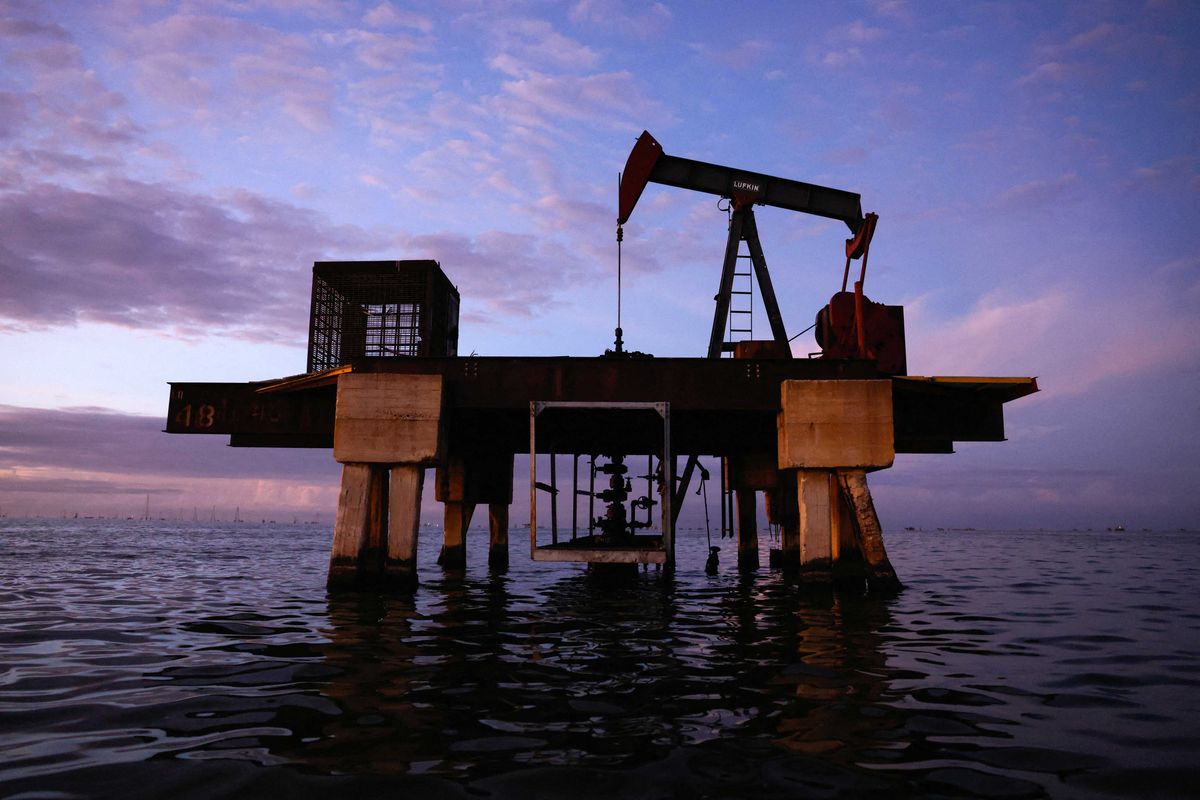
FILE PHOTO: FILE PHOTO: An oil pumpjack at Lake Maracaibo in Cabimas, Venezuela, January 27, 2026. REUTERS/Leonardo Fernandez Viloria/File Photo/File Photo


President Donald Trump's touted "biggest oil deal in world history" with Venezuela faces legal and logistical problems likely to sink it.


The Guardian reported Saturday that nearly every major claim the Trump administration has made about the arrangement falls apart under scrutiny, from how long it lasts to the Pentagon's role in it. Venezuelan law caps oil development agreements at 25 years, not the 100 Trump has boasted about, and Venezuela's own government has put the term at 25.

"This is all just propaganda," Venezuelan legal expert Jose Ignacio Hernandez told The Guardian. "It cannot be implemented as announced by the administration."

Trump announced in August that the Pentagon would take roughly a third of North American Blue Energy Partners, the second-largest private oil company in Venezuela. The move followed the January raid in which U.S. forces captured Nicolas Maduro and replaced him with Delcy Rodriguez.

Experts say Congress never gave the Office of Strategic Capital, the Pentagon arm initially tied to the investment, the power to buy stakes in companies. A Pentagon spokesperson told Reuters in August that the office "does not take equity stakes in private companies." In a written briefing to the armed services committees, the Pentagon said it actually holds warrants, which are rights to buy shares later, rather than the shares themselves.

The stake will reportedly be held by a separate Pentagon office whose mission is shoring up the defense industrial base and has nothing to do with oil.

Phil Gunson of the International Crisis Group said major oil firms and investors are privately keeping their distance.

"It's the opacity of the agreement that has serious investors concerned," he said.

The Guardian's investigation also found that Venezuelan crude won't help refill the U.S. Strategic Petroleum Reserve any time soon, despite Trump's promises.

At the center of the deal sits the company's owner, Alejandro Betancourt Lopez, who has been pulled into several international corruption inquiries but has never been charged with a crime. His lawyer denied that Betancourt ever sought or encouraged bribes. Secretary of State Marco Rubio has said the U.S. had no investigation into him.

Former U.S. diplomat John Feeley offered a blunt comparison.

"The deal is like the big beautiful wall that Mexico will pay for," he said.


The Guardian noted Trump's comments at the United Nations earlier this week remained defiant.

"It was a war, but it's perhaps the biggest deal ever made," he said. "To the victor belong the spoils."
Trump slammed for 'waste of time' by EU ally fed up with reputation-wrecking plan

Bennito L. Kelty
September 26, 2026 
RAW STORY


U.S. President Donald Trump arrives to board Air Force One for travel to Tennessee from Joint Base Andrews, Maryland, U.S., September 26, 2026. 
REUTERS/Jonathan Ernst TPX IMAGES OF THE DAY

A European energy official ripped dealing with the Trump administration as a waste of time while the White House weighs capping diesel exports.

Politico reported Saturday that the White House is considering curbs on diesel shipments overseas, with options ranging from a full 90-day ban to gradual limits, as prices in the U.S. have climbed from $3.74 to $6.52 a gallon over the past year. The oil and gas industry has fiercely resisted the idea, warning it could hurt American producers in foreign markets.

The official, who represents an Eastern European government and spoke on the condition of anonymity to describe internal discussions, pointed to that industry pushback as proof of how little sway foreign governments hold with the administration.

"If they're not listening to their own people, why would they listen to us?" the official said.

The official added that a wider diplomatic breakdown had made formal outreach pointless.

"With this administration, official channels tend to be a slow waste of time," the official said. "And yet that's exactly why official channels are supposed to work. If everyone tries to get in through the back door, the back door becomes the front door."

Some in Trump's own orbit share the concern. An outside adviser to the Trump administration, also granted anonymity, warned the move would undercut the president's pledge to keep allies supplied with American energy.

"This is going to damage our reputation," the adviser said. "The whole premise of energy dominance was that the United States would be able to supply our allies around the world. Curtailing that is going to raise question marks."

Europe has leaned heavily on U.S. diesel since the war with Iran disrupted oil supplies in February. David Jorbenaze, a senior oil analyst at ICIS, said European Union imports rose by 1.5 million barrels a day in August. S&P Global Energy estimates American diesel now meets a tenth of the continent's demand.

"Removing that source would pull away the leg Europe has been leaning on hardest," Jorbenaze said.
DEJA VU

White House bars CNN from covering upcoming Trump trip
DW with AP
September 25, 2026

CNN said its journalists have been barred from accompanying President Donald Trump on his upcoming trip to Tennessee. The episode marks the Trump administration's latest salvo against the major cable news network.


Trump banned reporters from CNN from White House grounds earlier this week, with main networks having suspended coverage in solidarity as well
Image: Bonnie Cash/UPI Photo/Newscom/picture alliance


American news broadcaster CNN said its journalists were not allowed to board Air Force One for a planned trip with President Donald Trump on Saturday.

CNN was scheduled to travel on Air Force One to Knoxville, Tennessee, where Trump was expected to watch a college football game.

The news organization was to be the representative of the TV press pool for the weekend, meaning that it would cover the president and share video and information with the four other big networks that are part of the press pool.

CNN was replaced by Real America's Voice News, a conservative network, the Associated Press reported.

The episode represents the latest showdown between the Trump administration and media networks that the president believes to be unfavorable in their coverage.

Trump bans CNN, MS NOW, and Politico from White House

Trump earlier this week barred CNN, MS NOW and Politico from the White House after he said the networks report "fiction and lies."

Major TV networks, including DW, then cut off their pooled coverage of the president in solidarity.

A federal judge temporarily struck down the ban in a ruling on Thursday after the outlets filed a lawsuit.

But the order from the judge addressed "hard passes" to the White House grounds and didn't directly address pool duties.

Edited by: Rana Taha


Roshni Majumdar Roshni is a global breaking news writer and digital editor for DW, based in Germany.@RoshniMaj


Trump’s Diversionary Assault on the First Amendment

As the many disasters of his presidency pile up, President Donald Trump turned to a familiar foil and a proven strategy: Attack the press to distract public attention from his failures.


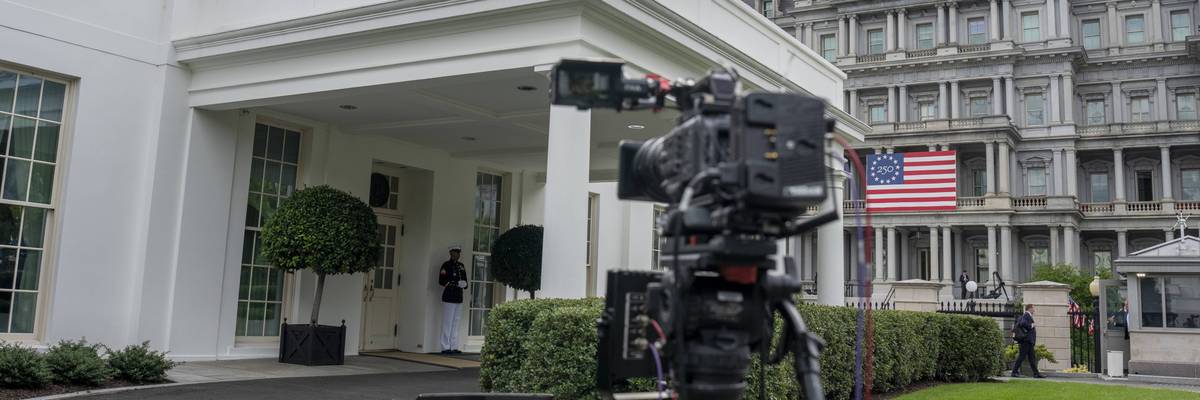
A television camera is pointed at the entrance to the West Wing of the White House on September 18, 2026 in Washington, DC.
(Photo by Daniel Heuer/Getty Images)


Steven Harper
Sep 26, 2026
Common Dreams

President Donald Trump is in trouble and he knows it.He promised “no more foreign wars,” but started a war with Iran that he has lost.
He promised to tame inflation, but tariffs and his war of choice have made it worse.
He promised to deport only the “worst of the worst” illegal immigrants. But Immigration and Customs Enforcement has terrorized American cities as agents sometimes arrested, detained, wounded, or killed US citizens.
He promised to make the United States the most respected country in the world, but he has destroyed America’s reputation and alienated its allies.
He calls himself the best president in history, but his approval rating has dropped to the mid-30s—his lowest ever and approaching President Richard Nixon’s final approval rating of 24% shortly before his resignation in 1974.
He tells his audiences to pretend he’s on the ballot in November, but many Republican congressional candidates are distancing themselves from him.
Sen. John Curtis (R) from ruby-red Utah is not up for reelection, but he has urged an investigation into the Trump family’s financial dealings and the potential for corruption.
Trump promised lower interest rates on home mortgages, but 30-year fixed-rate mortgages now exceed 7%—the highest since May 2024.
He promised gasoline below $2.00 per gallon, but the price has soared to an average of $4.50 per gallon. The price of diesel has increased even more dramatically—to a record-shattering $6.50 per gallon.

The list goes on and on. So Trump turned to a familiar foil and a proven strategy: Attack the press to divert public attention from his failures.
Same Old Playbook

CNN, MSNOW, and Politico won the first round in Trump’s latest attempt to subvert the First Amendment. But Trump’s shiny object consumed the media. His goal now is to extend the controversy.

Act I

While many of his most senior advisers were away at 3:00 pm on Friday, September 18, Trump announced on social media that he was banning CNN, MSNOW, and Politico from the White House. At first nothing happened, but by Saturday morning the press passes for reporters at those organizations no longer allowed them past White House security.

On Monday morning, September 21, the news organizations sued the Trump administration for violating their First Amendment right to a free press and their Fifth Amendment right to due process of law.

On Tuesday, September 22, the White House sent the organizations what it purported were notices of the revocations, giving them until Friday to respond.

Act II

At a court hearing on Wednesday, September 23, Trump’s Department of Justice (DOJ) asserted the laughable argument that the White House letter sent to the news organizations on Tuesday, September 22—days after Trump revoked the press passes—somehow satisfied the Fifth Amendment requirement of due process prior to any revocation.

The DOJ also told the judge that amorphous “national security” concerns justified revoking the passes. But Trump’s own statements of his reasons for the revocation undercut that argument.

Without reaching the First Amendment issues, the court based its constitutional ruling on Trump’s failure to provide due process. Judge Timothy J. Kelly—a Trump appointee—granted a temporary restraining order requiring Trump to restore the revoked press credentials immediately.

Act III

Judge Kelly issued his opinion around 1:00 am on Thursday, September 24. But as the business day began, the affected reporters’ press passes were still disabled, prompting the news organizations to file an emergency motion before Judge Kelly. The Justice Department responded with a declaration stating that press access had been restored at 9:55 am, so the judge cancelled the hearing.

But that evening, reporters for CNN and MSNOW were turned away from the state dinner arrivals at the White House, where Trump was hosting Chinese President Xi Jinping.

Act IV

To satisfy Trump, government attorneys are probably working on a new strategy. Here’s one possible scenario:The White House imposes less drastic restrictions on its disfavored press outlets. Slow walking the reinstatement of press passes and preventing CNN and MSNOW reporters from covering arrivals at the state dinner for President Xi Thursday night could be previews of coming attractions.
The White House gives the news organizations new notices and an opportunity to be heard before suspending their press passes again. The notices would concoct arguments, probably with a focus on Trump’s favorite phrase for justifying his consolidation of power—“national security.”
The White House would then revoke the press passes.
The news organizations would file another lawsuit challenging the revocation.
Trump would lose again, but he would press ahead in the hope that eventually the US Supreme Court would bail him out. If Trump loses in the DC Court of Appeals, the Supreme Court probably would refuse to take the case—leaving his loss in place.
If the Supreme Court accepted the case, I predict it would issue a 7-2 opinion—with Justices Samuel Alito and Clarence Thomas dissenting—confirming that the First Amendment still means what it says.
All of this will take time. And most importantly, it will remain a big news item that diverts at least some attention away from the broader failures of Trump’s presidency.
“The People’s House”

Trump has been eager to tear down the East Wing, reshape the White House grounds, turn the interior into a gilded spectacle, and otherwise impose his dramatic construction ideas at 1600 Pennsylvania Avenue.

Yet shortly after revoking the press credentials of CNN, MSNOW, and Politico, he told reporters: “It’s sick. I mean, there’s something wrong with a country that can allow people to write purposely negative stuff.”

In the next sentence, he revealed himself: “Now, if they want to write them, that’s fine. But I don’t have to let them into my, into the people’s house.”

Trump thinks the White House belongs exclusively to him. But his lease ends in two years, and no security deposit is sufficient to cover the profound damage he is inflicting on the nation.

Meanwhile, it is vital to beat back Trump’s repeated assaults in the Constitution. But it’s also important to remember that among the most important underlying goals of his most outrageous actions is diverting Americans from the mess that he has made of the country.


Our work is licensed under Creative Commons (CC BY-NC-ND 3.0). Feel free to republish and share widely.


Steven Harper
Steven J. Harper is an attorney, adjunct professor at Northwestern University Law School, and author of several books, including Crossing Hoffa -- A Teamster's Story and The Lawyer Bubble -- A Profession in Crisis. He has been a regular columnist for Moyers on Democracy, Dan Rather's News and Guts, and The American Lawyer. Follow him at https://thelawyerbubble.com.
Full Bio >


Hollow core of Trump's 'preposterous' press ban exposed by shock leak disclosure: expert

Bennito L. Kelty
September 23, 2026
RAW STORY


Former federal prosecutor Jeffrey Toobin flagged a reason that the White House's argument for a media ban is 'preposterous.' (CNN/Screenshot)

A CNN analysis keyed in on the latest bombshell revelation about a White House leaker to tear into President Donald Trump's media ban.

On Wednesday, former federal prosecutor and columnist Jeffrey Toobin spoke with CNN anchor Anderson Cooper about the hearing regarding Trump's media ban. U.S. District Judge Timothy Kelly was still expected to rule on a temporary restraining order sought by lawyers for CNN, MS NOW and Politico, who were kicked out of the White House by the ban.

Cooper brought up that the Department of Justice argued to keep the ban in place by citing national security concerns. Toobin said, "It's understandable why the White House is trying this, because the courts are at their most deferential to the executive branch when it comes to national security."

However, Toobin tore into the DOJ's and White House's national security argument and noted how they've undercut it themselves. He mentioned reporting that came out shortly after Wednesday's hearing and while Kelly still hadn't ruled on the case.

In a letter made public through a court filing on Tuesday, the White House justified banning Politico by citing an article with high-level information about the Iran war and characterized it as a leak that endangered national security. However, Status reported on Wednesday that Vice President JD Vance was responsible for leaking the information in question to Politico.

Toobin brought it up as he ripped the DOJ's national security argument, saying, "One of the articles that the White House is complaining about, the source for that was JD Vance, the vice president of the United States."

He continued, "So, they're trying to kick Politico out of the White House for a story where the source was JD Vance. I mean, it just shows how preposterous this argument is."

The Washington Post noted that the White House also called the information that Politico reported "misinformation," even though it came from Vance.


Free Press Defenders Demand End of ‘Horrifying’ ICE Detention of Journalist Luis Galeano

“If our government can close off channels of exchange and the free flow of ideas, it is no more than a dictatorship.”


Immigration and Customs Enforcement (ICE) agents walk a detainee out of the Ventura County Government Center in Ventura, California, on July 27, 2026.
(Photo by Blake Fagan/AFP via Getty Images)

Brad Reed
Sep 18, 2026
COMMON DREAMS

A coalition of 15 press freedom advocacy organizations on Friday demanded the release of Nicaraguan journalist Luis Galeano, who was arrested by federal immigration enforcement officials earlier this week.

The groups—which include Free Press, the Committee to Protect Journalists, the Freedom of the Press Foundation, the National Association of Hispanic Journalists, and Reporters Without Borders (RSF)—released a letter decrying Galeano’s detention at the hands of US Immigration and Customs Enforcement (ICE) agents on Monday.

The organizations expressed concern about Galeano being potentially deported back to Nicaragua, where he could face imprisonment for his past work exposing that government’s human rights abuses. According to a Wednesday report in The Guardian, Galeano fled his home country eight years ago shortly after police raided the news outlet where he worked.

The groups also said Galeano’s detention marked “a troubling escalation of attacks on journalists and media workers, particularly immigrant journalists, who consistently provide much-needed journalism and civic information for their communities.”

Galeano was taken into custody despite entering the US legally in 2018 and having a pending asylum case. The Nicaraguan journalist also has a work permit and a Social Security number.

Nora Benavidez, senior counsel at Free Press, called Galeano’s arrest “horrifying,” while noting that the Nicaraguan is “the latest in a long line of journalists who came to the United States to report on issues of the day and instead face deportation.”

“These cases aren’t just about cracking down on immigration,” said Benavidez. “They are about cutting off community access to vital coverage and scaring reporters from holding those in power accountable. If our government can close off channels of exchange and the free flow of ideas, it is no more than a dictatorship.”

Edith Rodríguez Cachera, vice president of RSF Spain, pointed out that Galeano was also a citizen of Spain, and urged the Spanish government to secure his freedom.

“Spain cannot stand by while one of its citizens, a journalist persecuted for doing his job, is detained in the United States and faces the risk of being sent back to a country he fled because of severe repression,” said Rodríguez Cachera, “where his safety could be seriously endangered if he is deported. Spain must use every diplomatic and consular instrument at its disposal to safeguard his security and prevent his return to a country where he will likely be targeted due to his journalistic work.”

Galeano’s wife, Deykell Santamaría, said in an interview with El País published Thursday that she has been able to contact her husband during his detention, but she still fears “for his safety, his freedom, and his integrity if he were to be sent to Nicaragua.”

Javier Melendez, a longtime friend of the detained journalist, was even blunter about what would happen to Galeano were he to be deported, describing it as nothing less than a “death sentence” in an interview with The Guardian.

The El País report noted that US Reps. María Elvira Salazar (R-Fla.) and Mario Díaz-Balart (R-Fla.) have expressed concerns about Galeano’s detention, with Salazar saying that the US government should “always know how to distinguish between a criminal and a political exile.”