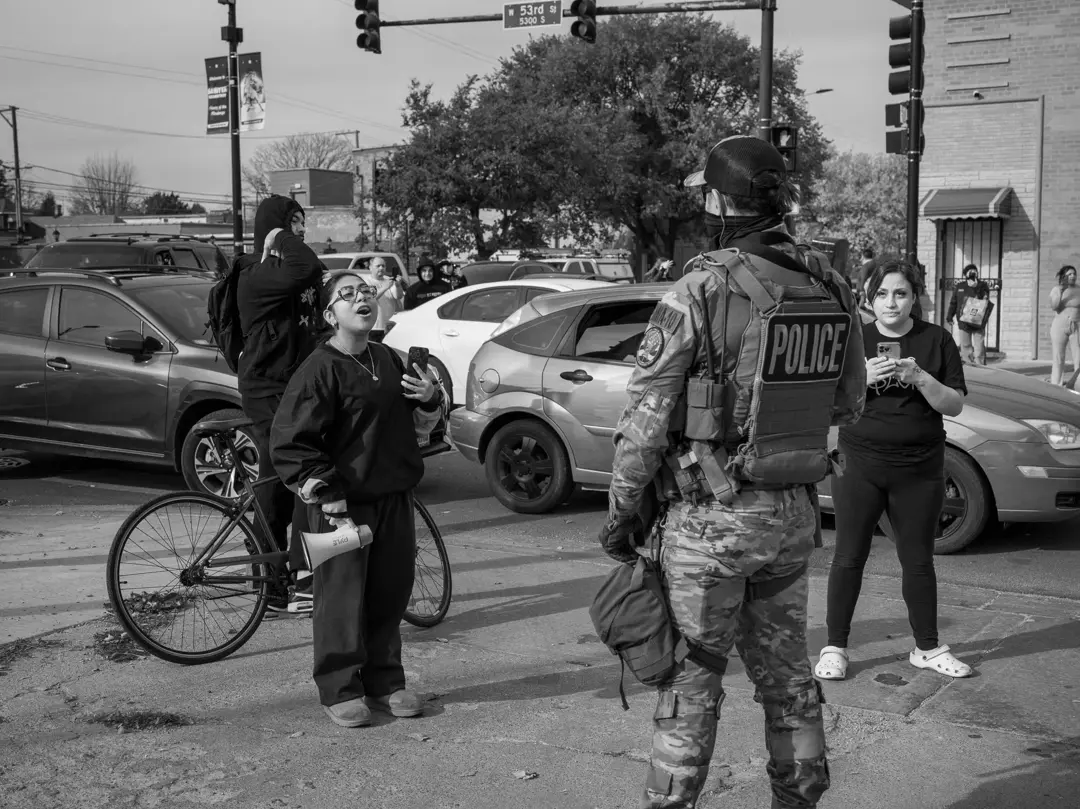
The mass popular opposition to ICE “surges” led to a sea change in public opinion. Now organizers are asking: What’s next?
Jan. 5 is a day that Marie will never forget. Minneapolis public schools had just reopened after winter break, and the Trump administration’s invasion of federal immigration agents was in full swing. Marie (not her real name), a community organizer and the daughter of immigrants, had connected with her neighborhood’s rapid-response network in the south Minneapolis community of Powderhorn. Alerted by a report of “a weird vehicle lurking,” she arrived at a street corner to find an ICE agent sitting in a white Durango. Marie said she realized the agent was “watching a mom about to put her kid on the bus” and waiting to abduct the mother. “I’m a single mom,” she told me. “I put my kids on the bus. I say bye to my kids every day, you know. The thought of that infuriated me.”
Marie laid on her horn until the agent left. But before she got to the end of the block, she witnessed another abduction, and this time she couldn’t stop it. Minutes later came a report about another woman pulled over by ICE. When Marie got to that corner, she saw ICE agents taking the woman from her car. “It broke my heart,” she said. “I saw my mom. I saw so many of my aunts and uncles, who accepted less than they deserved just to make ends meet for themselves and their families.” That night, she said, “I pulled into my driveway, and I cried, I cried, I cried, before I walked into my house to hug my kids.”
Two days later, Marie was out on patrol again when she heard about a shooting. She arrived on the scene to find Renee Good’s wife crying in the passenger seat of the couple’s car, with blood covering her face. Marie said she looked down the block and saw an ambulance “leaving with no lights on, and that’s how I knew she died.” She heard an agent say, “Come on, we’re going to go get some more.”
For more than a year, hundreds of thousands of people of color have been terrorized by the Trump administration’s campaign of detentions, deportations, and violence. This reign of terror — centered on “surges” of heavily armed, masked agents carrying out aggressive arrests in urban centers, rather than the previous focus on detentions at the border and transfers from jails — led to a quadrupling of immigration arrests and a fivefold increase in deportations during the first year of Trump’s second term. The war on immigrants is taking place everywhere, but the administration had especially cruel treatment prepared for liberal sanctuary cities: first Los Angeles last summer; then the federal takeover in Washington, D.C.; then ICE surges in Chicago and Portland, Ore.; and finally Minnesota’s Twin Cities.
But these surges were met by a determined resistance that spread across the country and only grew more committed and better organized as ICE and Border Patrol violence escalated. Like the “whirlwind” moments described by the famed community organizer Saul Alinsky and his protégé Nicholas von Hoffman, the nationwide movement against ICE reached deeply into neighborhoods and diverse communities, moving tens of thousands of people into action — from heroic confrontations with federal agents and complex mutual-aid networks to massive demonstrations such as the Jan. 23 day of “no work, no school, no shopping” in Minnesota. A whirlwind moment “involves a dramatic public event or series of events that set off a flurry of activity,” write Mark and Paul Engler in This Is an Uprising: How Nonviolent Revolt Is Shaping the Twenty-First Century. “This activity quickly spreads beyond the institutional control of any one organization. It inspires a rash of decentralized action, drawing in people previously unconnected to established movement groups.”
In interviews with more than two dozen organizers in Minneapolis, St. Paul, Chicago, Washington, and Los Angeles, I learned about the structures that were built on the fly, as well as the existing relationships among diverse organizations that helped ground the resistance. Across the country, large numbers of people — some of them veterans of social movements, others newly activated — tackled longstanding questions about spontaneity and organization, silos and lanes, openness and security, and burnout and long-term organizing. Debates and disagreements that weren’t aired in the heat of the moment are now being taken up. And then there’s the million-dollar question: What’s next?
“I can’t stop checking plates,” a Minneapolis rapid responder I’ll call Nora told me in late April. Nora had shown me the Whipple Federal Building compound that served as ICE’s base of operations and was pulling into a Speedway gas station when she glanced in her rearview mirror and saw a car that she thought looked suspicious. She entered the car’s license plate number into a Signal chat and verified that it wasn’t an ICE vehicle. The hypervigilance that so many Minnesotans adopted out of necessity during the winter surge clung on, and for good reason: Federal agents — more than 600 as of March — remain in the state, doing their dirty work in more subtle and covert ways.
As a St. Paul teacher, Mara Solis, told me, “The surge has ended, but the impact hasn’t. Our students have lost some of their parents, or their parents are having a hard time paying bills, or the students themselves have self-deported back home.” She added, “And just like with Covid, just like with George Floyd, we will not know the full impact for who knows how long.”
That impact is physical, economic, emotional, and political. The arrest of 15 activists in Minneapolis in June — with more indictments threatened — brought the point home. “If you are actively conspiring to impede law enforcement,” said Daniel Rosen, the U.S. attorney for Minnesota, “you ought to go on the assumption that we’re watching you, and that we’ll get you.”
The surge may be over, but organizers cannot simply move on.“When a creepy car drives by,” Solis said, “we’re all still looking over our shoulder, making sure it’s not stopping for us or stopping for our kids.” But at the same time, she said, “we’re asking: How do we build on the movement that’s been started?”
In early October, at the height of Operation Midway Blitz in Chicago, children playing at recess at Funston Elementary School had to be brought indoors as tear gas wafted into the schoolyard from a nearby confrontation with ICE. Teachers at the school, which is located in a predominantly immigrant neighborhood on the northwest side of the city, had been building up an infrastructure of “sidewalk solidarity” for weeks, going out regularly before and after school to provide eyes and ears for students and parents.
Maria Heavener, a first-grade teacher at Funston, told local newscasters that she heard car horns honking outside the school and then got a notification that a fifth-grade teacher on a lunch break had seen ICE agents and blew her whistle to alert neighbors. A person riding a moped saw a car full of agents behind him and stopped in the street to block them. As a crowd gathered, the agents responded by launching multiple tear gas canisters. Heavener alerted the rapid-response groups that she’s part of. By the end of the school day, about 100 community members had shown up outside the school and formed lines up and down the sidewalks to create a safe passage for children and families going home.
The resistance to ICE is made up of thousands of moments like this one. The very public nature of the ramped-up street arrests produced a true “whirlwind moment” of direct actions. Agents faced countless confrontations and challenges, whether they were rounding up immigrants on the street or simply eating at a local restaurant or staying at a hotel. This not only made it difficult for the agents to operate effectively but also precipitated overreactions — like using tear gas near an elementary school in a densely populated neighborhood. These violent overreactions, in turn, deepened the anger at the agents’ presence and spurred more resistance.
Developing parallel to the rapid-response patrols were other forms of resistance, including mutual-aid efforts to support vulnerable populations. Harking back to a refrain that emerged during the 2020 George Floyd uprising — “Who keeps us safe? We keep us safe!” — and often relying on infrastructure developed at that time, mutual-aid networks organized food drives and fund-raisers, deliveries of necessities from groceries and medicine to diapers, coordinated rides to and from school and work, and underground networks for child care and doulas delivering babies at home. “The words ‘mutual aid’ don’t cover it,” Doran Schrantz, an organizer in Minneapolis, told Hammer & Hope earlier this year. “It reminded me of reading about the Polish Home Army resistance during World War II,” which, together with civilian support efforts, maintained an extensive network of clandestine medical, welfare, and social services.
Mutual-aid and rapid-response networks were often kept separate for safety purposes, but both provided entry points into the movement. In some cases, the networks were launched by existing formations: political organizations, tenants unions, even informal parent groups. Other times, it was just neighbors talking to neighbors. As Paige, a rapid responder from Washington, said, “You would come upon a scene because you could hear the shouting from down the block. Neighbors would just come out, and that’s how folks would meet each other and start these Signal groups.” Organizers in Minneapolis and Chicago said they pre-emptively reached out to neighbors with a QR code to join a Signal or WhatsApp chat and posted fliers with the codes.
Minnesota had the benefit of learning from other cities that endured a surge. Marie — who helped launch a mutual-aid network around the time of the protests against Floyd’s murder — said she started out in December distributing a zine about responding to ICE that she had received from friends in Chicago and adapted for Minneapolis. Soon she began patrolling. After federal agents killed Renee Good in January, the thousand or so rapid responders like Marie who had gotten involved in December multiplied tenfold. Neighborhood Signal chats quickly reached their 1,000-person capacities and had to split into smaller and smaller geographies — first local chats, then hyperlocal chats, and then hyper-hyperlocal chats often covering just a block or two.
The sudden, explosive growth of rapid response forced participants to develop infrastructure on the fly, tweaked and reworked as needed, often with no central direction. People came out of the woodwork to manage the proliferating networks of Signal chats, build databases, analyze data, dispatch patrols, and coordinate legal and aftercare support for those abducted or left behind. Lines of communication were developed to connect different neighborhoods with one another and the mostly English-speaking Signal chats with the mostly Spanish-speaking WhatsApp chats.
In Minneapolis, one woman — who said she got involved to make a safer world for her biracial child — developed a system to quickly dispatch rapid responders to places where ICE was present; more than 1,300 people across the state were trained to use it. Other participants built an easily searchable database containing about 2,600 license plate numbers of known ICE vehicles. At the height of Operation Metro Surge, rapid responders on patrol held continuous live group calls on Signal. Trained dispatchers moderated them, keeping track of where patrollers were to make sure neighborhoods had full coverage. The dispatchers took time-stamped notes and later refined strategies for directing the patrols based on an assessment of the data. In Washington, patrols tended to be simpler; the rapid responders that I spoke with worked in large groups in specific locations and at times when ICE activity tended to be high.
Patrollers known as commuters took on the dangerous work of following known ICE vehicles. Federal agents would pull hazardous stunts like stopping suddenly on a highway, risking an accident. At times, caravans of ICE vehicles would box in commuters against a curb or the side of a building. “They can pin you with a car in front, a car behind, and a car on the side and make it impossible for you to leave,” said Nora, who spent hours on commuter patrol every day. “Then they can do whatever the hell they want to you. Sometimes they yell at you, sometimes they bust your window, and they rip you out of the car and abduct you.’’ Joe (not his real name), also from Minneapolis, told me that he got caught in a caravan of ICE vehicles doing a loop in his neighborhood when he was out on his own on foot. When he walked onto a crosswalk in front of the vehicles, they accelerated toward him, and agents jumped out of their vehicles with guns drawn, yelling, “This is your first warning!” He walked away.
The need to develop organizing structures quickly led to tactical debates that could reach different conclusions across cities or neighborhoods. One question that emerged early on centered on internal security and the process of vetting new participants. Careful vetting stood in tension with the need to expand activism as fast as possible.
In Los Angeles and Washington, existing organizations at the heart of rapid-response networks tended to have a tighter security culture and a rigorous onboarding process. As a result, one Washington activist told me, large bottlenecks developed in the D.C. area, and people who couldn’t get into existing networks often ended up setting up their own separate patrols. In L.A., Guadalupe Carrasco Cardona of Unión Del Barrio, a political organization that does immigrant defense work, told me that vetting new participants is one of the most time-consuming tasks for organizers. The Community Self-Defense Coalition in L.A. has just seven individuals, representing organizations on the coalition’s steering committee, doing all the group’s administrative work — from vetting to making copies of fliers and reserving meeting spaces for trainings. The coalition has been active for more than a year; its biweekly trainings draw anywhere from 60 to 200 people. Maintaining that level of organization without expanding the core at its center has led to some burnout and slowed down the development of block-by-block organizing, Carrasco Cardona said.
In Chicago and Minneapolis, the vetting of participants was less rigorous, leading to quicker growth. Some organizers I spoke to emphasized that not even thorough vetting can ensure that the government doesn’t infiltrate WhatsApp groups or Signal chats, so trainings need to teach rapid responders to operate knowing that what they are doing is legal but making sure not to say anything they wouldn’t want repeated in court or the media. According to Diego Morales from Pilsen Unidos por Nuestro Orgullo (PUñO), an organization rooted in the Mexican American neighborhoods of Chicago’s Southwest Side, a looser vetting process led, surprisingly, to greater centralization. He thinks cities with tightly knit central organizing ended up with competing rapid-response groups disconnected from more established networks. “It made it messy and inefficient,” Morales said. In Chicago, by contrast, the Illinois Coalition for Immigrant and Refugee Rights provided resources and support to local grassroots networks. Groups like Morales’s could harness mass energy in their neighborhoods while also participating in a citywide effort to centralize and analyze data and tap into legal aid networks that connected families to pro bono lawyers.
PUñO grew to about 400 trained and active members. “We were one of the first teams to grow to that kind of size because of the way in which we embraced the public,” Morales explained. The more people who are involved in rapid response, the more eyes and ears are available to stop or slow abductions, he said. “You have members who are just walking up and down the street, going to work, going grocery shopping,” he said. “Maybe it’s the bus driver or a guy that does Uber deliveries around the neighborhood, and he’s always got his eyes open.”
Longstanding organizing debates came up, including whether to engage with the media and how confrontational rapid responders should be in encounters with ICE. But ordinary people, whether plugged into a network or not, often made those decisions for themselves. In scenes that became commonplace and broadcast nightly, crowds of people challenged raids and abductions across the country, phones in hand to record the agents. When ICE descended on immigrant vendors on Canal Street in New York City last October, hundreds of people swarmed the agents, recording with their phones, blocking vehicles with their bodies, and yelling “Shame” and “Fuck you” in equal measure.
Morales believes that those scenes fueled more opposition. “We should be talking to journalists,” he said. “And we shouldn’t be talking to journalists in a way that’s like, Oh, woe is me, we’re such victims, we’re helpless. Actually, we’re organizing, we’re preventing people from being abducted, we’re getting people out of detention.” That attitude helps to counter the culture of fear that he says only empowers the government. “We have much more power than they want you to think,” he said, “and they have much less power than they want you to believe.”
For all the movement’s organic spontaneity, the anti-ICE resistance developed inside an ecosystem of existing organizations, political relationships, and local experiences. Some of the first people to initiate rapid-response networks had already been through know-your-rights trainings after Donald Trump’s first election in 2016. In Minneapolis, earlier iterations of mutual-aid networks and neighborhood patrols arose during the uprising after George Floyd’s murder. Longer-term relationships among labor and movement organizations played a vital role when the anti-ICE resistance reached a new level after the killing of Renee Good.
Twin City organizers had 10 days to mobilize people across the state for the Jan. 23 Day of Truth & Freedom. According to a survey commissioned by movement organizations, roughly one in four people in Minnesota participated in the day of “no work, no school, no shopping” or had a loved one who did. Tens of thousands of people braved dangerous temperatures, with the wind chill reaching as low as minus 35, to march in downtown Minneapolis. The turnout showed the deep well of outrage over the ICE surge — but also the commitment of longstanding labor, community, and social movement organizations.
Greg Nammacher, the president of SEIU Local 26 — which represents janitors, security officers, airport staff, Uber and Lyft drivers, and window cleaners in the Twin Cities — told me how his local helped bring together the forces that made Jan. 23 a reality. “We have been in close relationship with some of the Twin Cities’ most progressive, militant unions and community organizations for over a decade,” he said. After Trump was elected to a second term, Nammacher said, 300 leaders of different organizations met to discuss possible scenarios and contingencies. Nammacher emphasized the importance of aligning groups with existing bases in labor and communities of color, rather than just relying on broad, big-tent organizing. “I wouldn’t say it was easy to come together,” he said, acknowledging the divides along class, race, and gender lines that exist among and within left and progressive forces in every big city. “But there was a muscle,” he said, developed over the course of more than 15 years working together.
In Chicago, the Illinois Coalition for Immigrant and Refugee Rights has played a central role in immigrant rights organizing for decades. When Operation Midway Blitz began in September, the organization devoted funding, staff, and infrastructure to organizing trainings and supporting newly formed networks — including running a widely used hotline to report ICE sightings. The Chicago Teachers Union, with its record of fighting for “common good” demands beyond bread-and-butter labor issues, also played an important role. The union’s former president Jesse Sharkey said, “For at least a decade, the CTU has developed a cadre of Latino immigrants or sons and daughters of immigrants who made the union their social justice home.”
Critical to that work was Rebecca Martinez, an organizer in the Southwest Side neighborhood of Little Village. She had joined the CTU’s staff on the heels of the union’s historic 2012 strike. “As a Mexican woman,” she told me, “I thought that a lot of people who are educators like me feel a connection to their community but don’t quite feel it in their union.” After giving the union leadership grief about the disconnection, she said she decided that a base of rank-and-file teachers was necessary to raise issues that mattered to them and left her union job to work in a classroom. During Trump’s first term, Martinez, with the help of the union’s executive board, planned trainings for teacher-led sanctuary teams at schools throughout the city. She also helped launch a Latino caucus to lead on promoting bilingual education and lobbying the city to dismantle its anti-gang database.
When ICE invaded Chicago during Trump’s second term, Martinez said, “We were able to just kind of hit go. We had materials ready and were in a position to explain, ‘This is what a sanctuary team is, and this is what you do.’” The union went beyond supporting school-based efforts and connected teachers to community organizations and networks where needed. “It didn’t just happen,” Martinez said. “It’s been over a decade of the union working with community folks, nonprofits, organizations, and groups to make that possible.”
There are, of course, limitations to relying on established organizations, many of which operate in top-down ways or exert control in movements that they believe are on their turf. While tensions between and among traditional organizations and grassroots formations mostly took a back seat during the height of ICE surges, questions have emerged in the weeks and months since. “I almost think [Chicago] sometimes is a little too organized,” Morales said. “There are certain old ways that get set in, and it can be hard to be dynamic.” In Minneapolis, Joe thought that top-down organizing might achieve a big turnout on a single day, but what happens on the second or third day? “It just dissipates when it’s not led by the community,” he said. How to collaborate among different types of organizations is one of the questions that activists will need to continue to hash out.
Institutional resources and infrastructure are clearly necessary for coordinating mass action and long-term organizing that can go beyond heat-of-the-moment crescendos in the struggle. Organized labor has a vital role to play. Unions representing millions of workers around the country have the power to disrupt the economy and shift society-wide narratives.
When the ICE assaults began last year, there were early indications that the labor movement could be a leading part of the resistance. When federal agents descended on L.A. over the summer, they violently arrested David Huerta, the president of the SEIU-Social Service Workers West and the SEIU’s California State Council, at an anti-ICE protest and charged him with a felony. Following his arrest, the country’s main union federation, the AFL-CIO, and the national unions the United Auto Workers, American Federation of Teachers, and AFSCME joined the SEIU in condemning and protesting Huerta’s arrest, as well as Trump’s mass deportation agenda. The charge against Huerta was downgraded to a misdemeanor in the face of this pressure. These actions were a stark contrast to the labor movement’s not-so-distant history of opposing immigration. The AFL-CIO reversed its longstanding support for immigration restrictions and enforcement only in 2000. Now it looked as though unions could become a bulwark against ICE’s crimes.
On the ground in Minnesota, labor was an integral part of the resistance. Greg Nammacher said many local unions that had not previously come out against ICE’s occupation “ended up endorsing the day of no work, no school, no shopping after Renee’s murder” in early January. Other unions whose members were hit hard by ICE raids had already gotten involved. Geof Paquette, the lead internal organizer at the hospitality union UNITE HERE Local 17, said he began getting phone calls around Christmas from airport workers saying that immigrants were being abducted at work despite passing significant background checks to get their jobs. Many UNITE HERE members stopped coming to work, Paquette said.
Other union members, like Feben Ghilagaber, an Eritrean immigrant and Local 17 shop steward, jumped into action to help her co-workers. She began daily deliveries to reach co-workers who couldn’t leave their homes. Many kept their lights off and sat in the dark, she remembered, in the hopes that ICE wouldn’t come knocking. “The more I saw, the more I’m like: I have to keep going. I can’t think about myself,” Ghilagaber said. She and Paquette devised a vast food distribution system for vulnerable members. At its height, Paquette said, 200 families were receiving food support, being driven to work, and having other needs met, from diapers to pads and tampons to children’s birthday gifts. The local also raised money so that it could offer rental assistance — support that it still provides today, since workers who had to miss work have fallen behind financially.
Labor’s participation reached a new pitch when Customs and Border Protection agents killed Alex Pretti, a nurse at the Minneapolis Veterans Affairs Medical Center and a member of American Federation of Government Employees Local 3669. That prompted the AFL-CIO to join the call for ICE to immediately leave Minnesota. The American Postal Workers Union had already demanded that ICE stop using postal facilities as staging areas earlier in the month. National Nurses United held a week of actions calling for ICE to be abolished entirely. Pretti’s national union, AFGE, includes not only nurses but also ICE and Border Patrol agents, but even it demanded the resignation of Homeland Security Secretary Kristi Noem and organized a nationwide day of remembrance for Pretti. AFGE locals held vigils outside VA hospitals in 23 cities; national President Everett Kelley spoke at the vigil at the Minneapolis facility where Pretti worked. Jake Romans, the Minneapolis local’s president, remembered speaking with Pretti, a union supporter respected by his co-workers, a few days before his murder about the state of the union. Now there is a movement among some AFGE locals to get ICE agents out of the union, according to Romans.
As known and trusted community members, union teachers often played particularly critical roles, Mara Solis, the St. Paul teacher, told me. Solis and her fellow teacher Alli Kildahl were leaders in their school district’s Immigrant Defense Committee. The night after Renee Good was killed, she said, “We had like 500-plus people trying to get on the Zoom call with us, signing up to be a regional captain or a site lead or whatever other roles we asked for.” From there, Signal chats were set up, parents came to trainings at the St. Paul Federation of Educators union hall, families in need were connected to mutual-aid networks, and a school patrol network was established, with parents in safety vests showing up every day outside schools. Union members ran weekly meetings and webinars and raised hundreds of thousands of dollars for rental assistance. Each school site led its own work, but centralization across the district led to important information and resources being shared and schools in more affluent neighborhoods being paired with those with scant resources.
Labor solidarity with the ICE resistance has gone furthest at the local level. National unions have issued statements and organized some protests, but — whether out of fear that they will alienate conservative locals or simply because they are out of practice — they have yet to wield the much deeper institutional resources and infrastructure at their disposal. Nammacher believes the labor movement needs to step up as a matter of self-defense. “There’s no way through these next few years without politicians and the current administration and their billionaire agenda running directly at unions,” he said. If mobilized, organized labor could activate hundreds of thousands of members nationwide. “I don’t think the U.S. labor movement is up to that task,” Nammacher said. “But that said, I do feel very hopeful.” He went on, “I haven’t talked to a labor leader anywhere in the country who isn’t open to and hungry to think about new ways that we can use our institutional power in this moment,” adding, “Those conversations happening at the local level will be the most decisive examples as we continue to move the full national apparatus into a more aggressive stance.”
The ICE surges in blue-state cities last year and this winter have waned. But federal agents continue to detain immigrants in record numbers. In L.A., says Carrasco Cardona of Union Del Barrio, “It’s ongoing. It’s every single day.” Street vendors are still being harassed and kidnapped outside Home Depots and in the callejones (alleys) in the downtown market area, she said. “It’s the same thing. It’s snatch and grab — grabbing children and using them as bait.” In Minneapolis, rapid responders fear that thousands of agents may still return. One dispatcher told me that responders have seen several hundred black, Ford Expedition–style SUVs parked in a lot, apparently “staged and ready for their next big push.”
At the height of the surges, the anti-ICE resistance benefited from both momentum and movement unity. The situation was so dire that there simply was no time to worry about organizational turf or get wound up about tactical differences, organizers told me. But in this next phase of the movement, debates are surfacing. Organizers hope that there will be space to flush out the discussions positively. After the surges, “expectations became a little bit less clear,” said Joe. “Some people just left, went back to their day job, went to other organizing. This is all normal and healthy, I think. The important part is recognizing that we had such unity for this moment. It might not be required all the time. But how do we make sure that we are able to build that back?”
The movement against ICE reinforced some of the historical divisions within left and progressive movements. Because the people most vulnerable to ICE abductions necessarily had to stay outside of visible organizing spaces, many of the rapid-response and mutual-aid networks were dominated by white participants. That was a vital show of solidarity that helped turn the tide against Trump’s anti-immigrant agenda. But the process exposed limitations and fissures. May Day demonstrations in Minneapolis, for instance, included several different events across a couple of days, each organized by different parts of the movement, with only some crossover. A march against ICE down Lake Street in the Powderhorn neighborhood — the site of countless abductions — included many leftists, few unionists, and even fewer immigrant participants.
Marie told me that she’s one of the only Black people in her mutual-aid and rapid-response networks, despite living in a neighborhood that is almost half Black and Latino. “I went to a rapid-response meeting, and one of the things that I said is, ‘I think we have to be talking about how we make amends with Black Americans right now,’” she said. “Because we mobilized at a scale that we haven’t done for them, right? People saw the level of resources that came into the city that never came to them, and they were suffering long before this.”
Martinez of the CTU said that organizers and members of vulnerable communities have a tendency “to look at these things separately, as if they have no relationship.” She added, “I think it’s really easy for folks on all sides to say: Well, you didn’t come out for me. Why should I come out for you?”
At the same time, though, the movement provided inroads to connect struggles and communities. As Joe pointed out, when the state can inflict violence on the most vulnerable communities among us, no one is truly safe, as the killings of Good and Pretti showed. Nora has been reflecting on this. “One of my deep regrets is that I wasn’t activated before Renee Good was murdered,” she said. “It’s a shame of mine that it took the murder of someone who looks like me. I’m a mom of two small children. I drop my kid off to a school just blocks away from where she was murdered. You could have spun the wheel, and it could have been my car with stuffies in it. It could have been me who was murdered.”
Yet the activation of so many people in the aftermath of Good’s killing has strengthened the movement against racism and state repression. In cities and towns across the country, participants are finding spaces to have important conversations, while practical work continues. For some, this means adopting new ways to challenge ICE’s more covert operations. Others are working to connect the government’s attack on immigrants with police repression of Black and Latino people. Still others are focused on political education and infrastructure. At PUñO, Morales says, the organization has built up about a dozen committees for everything from book clubs and creating literature to ongoing mutual aid. By necessity, some of the work will require defending organizers targeted by an administration trying to reclaim the offensive. The June indictment of the 15 Minneapolis activists specifically cites rapid-response networks and the use of Signal chats to monitor ICE.
The movement against ICE showed what’s possible in building bases, creating infrastructure, and forging relationships among different movement forces and communities. In cities around the country, people risked their own safety and well-being over and over again to defend their neighbors. That resistance helped to drive a sea change in public opinion. And now demands that previously seemed out of reach — to defund and eventually abolish ICE — seem possible.

.jpeg)

No comments:
Post a Comment