Bedouins With A-Bombs
Washington has opened talks with Saudi Arabia to consider nuclear capability for the desert kingdom.
The Americans and Saudis insist they are only discussing peaceful nuclear weapons. Don’t believe it. The Saudis argue they must have nuclear capability to generate energy when their oil begins to wear out. Every oil-producing nation can rightly make the same argument. When the oil runs out, no more gold beds, French furniture, show girls and disposable Rolls-Royces.
The only really admirable Saudi king in recent memory, Faisal bin Saud, reportedly said, ‘we are riding in expensive cars, but I fear one day soon we will end up riding camels again when our oil runs out’. This noble far-seeing ruler was assassinated in 1976 by a nephew who was said to be demented. Some Saudis suspected Faisal was killed by a western power.
Saudi has only 38 million tribal people scattered over a vast, arid nation. Libya’s late chief, Muammar Gaddafi told me ‘The Saudis are very rich people who live behind high walls. They are terrified of their neighbors.’ Gaddafi was himself murdered by the French and Americans.
Traditionally, the Saudis have turned to militarily powerful Pakistan for protection. The late Pakistani President, Zia ul Haq, commanded an important contingent of Pakistani troops protecting the Saudi royal family. Zia told me he had a low opinion of Saudi military capabilities. In fact, the Saudis have never developed a significant military force to protect their vast oil wealth for fear of coup d’etat from the army, a common event across the Arab world and Africa.
The US stations large numbers of mercenaries and American troops across the Mideast, estimated at 50,000, as well as large contingents of CIA agents and other security forces to protect the Egyptian regime.
Saudi and the US also use the United Arab Emirates (UAE) for ‘kinetic’ i.e. shooting operations and are deeply involved in wars in Sudan, Somalia and Central African Republic. But wealthy Saudi Arabia is the real prize.
Now, the Trump administration is trying to arm-twist the Saudis into abandoning their half-hearted support of the Palestinians and get into bed with Israel, using the lure of a supposedly civilian nuclear program. How well this would work out for the Saudis is uncertain. The Saudis are so behind the times they must import bakers from Egypt or India and Pakistan. There is no cadre of nuclear technicians in Arabia. Some could be hired, as Egypt tried to do in the 1960’s. Israel killed many of them. Now, Israel might allow it again but with the greatest caution. Israel’s policy is to assassinate nuclear specialists who come to assist the Arab nations. Saudis would think three times before using a nuclear device against Israel because it has at least 100 nuclear weapons poised to strike – over the entire Arab world – not to mention submarine-launched nuclear missiles that are invulnerable to a surprise first strike.
The Saudi royal family relies on the United States for protection. It has consistently betrayed the Palestinians. But Riyadh must at least show some support for Palestine to keep up the pretense of helping the Arab cause. In reality, the Saudis fear Palestinians as dangerous revolutionaries drawn to socialist causes or states. Interestingly, the biggest expulsion of Palestinians since Israel’s creation in 1948 was by Kuwait. Saddam Hussein promised to create a Palestinian state out of the British-created state of Kuwait. Palestinian leader Yasser Arafat welcomed the offer. Kuwaitis were outraged and expelled their many Palestinians residents.
Now, the Saudis want to be the big shots of the Mideast. America can’t resist fawning Arab states. Will the volatile Saudi Bedouins be trusted with nuclear weapons?
Copyright Eric S. Margolis 2026
Eric S. Margolis is an award-winning, internationally syndicated columnist. His articles have appeared in the New York Times, the International Herald Tribune the Los Angeles Times, Times of London, the Gulf Times, the Khaleej Times, Nation (Pakistan), Hurriyet (Turkey), Sun Times (Malaysia), and other news sites in Asia. He writes at EricMargolis.com
Vampire Planet: The Time the US Nuked Spain

The remediation of nuclear waste has long been a classified endeavor. Accidents, exposure to radiation, and worker injuries on the job rarely, if ever, make the newspapers where they would receive public scrutiny. This is, of course, intentional. The less oversight, the easier it is to mislead and cover up mistakes. Take the case of the military’s Palomares disaster.
On January 17, 1966, a collision occurred during a routine refueling operation of a B-52 bomber over Spain’s Mediterranean coast. The Associated Press reported first on the incident, writing that a KC-135 tanker with jet fuel had collided in mid-air with a B-52.
“At least five of the eleven crewmen aboard the two planes died in the crashes,” wrote the AP. “They collided miles above the earth. School children walking to their classes heard the rending of metal, then watched as smoke clouds erupted from the big planes as they spiraled down, scattered burning wreckage over a wide area.”
The startling reporting left out one important fact: when the KC-135 struck the B-52, four hydrogen bombs became dislodged and fell toward the unsuspecting countryside of Palomares. Had the weapons been armed, the result would have been unspeakably deadly. Nonetheless, each bomb was laced with plutonium. While the bombs themselves were not activated, other explosives on the aircraft detonated in the crash, causing the plutonium housed in the B-52’s warheads to scatter across Spanish homes and farmland below.
Had the AP news report of the accident included the tidbit about radioactive particles raining down on innocent Spaniards, there would have been an international uproar and a collective call for an abandonment of nuclear arms. But the initial communiqué from the Air Force was intentionally vague, if not overtly misleading:
A B-52 bomber from the 68th Bomb Wing at Seymour Johnson Air Force Base, North Carolina, and a KC- 135 tanker from the 910th air refueling squadron at Bergstrom Air Force Base, Texas, crashed today southwest of Cartagena, Spain, during scheduled air operations. There are reports of some survivors from the crews of the aircraft. An Air Force accident investigation team has been dispatched to the scene. Additional details will be available as the investigation progresses.
Later, the military reluctantly admitted the bombs had cracked and estimated that only a “small amount of basically harmless radiation” had been released. The United States was not about to reveal the gravity of its mistake. It was not uncommon throughout the Cold War for US aircraft to fly during all hours of the day, in all types of weather, with live, activated nuclear bombs attached to their bellies. In a way, it was a lucky break that the Palomares disaster was not a nuclear detonation. Yet plutonium is a tricky little element. A big dose will kill you on the spot, but in most cases, plutonium bioaccumulates, causing a host of problems down the road, like various forms of cancer. The more you are exposed, the more likely it is that plutonium will kill you later in life.
Such was the case for many of the Air Force personnel assigned to secretly clean up the Palomares collision. Many of the men who gathered soil and worked to remediate as best they could this wide swath of Spanish land had no special training or expertise to deal with such an event. As the New York Times reported:
“[The] response crew [was] made up of low-ranking airmen with no special training—cooks, grocery clerks, even musicians from an Air Force band—[who were rushed] to the scene. Wearing nothing more protective than cotton coveralls and sometimes a paper dust mask, they cut down contaminated crops, scooped up contaminated soil, and packed the material in 5,300 steel barrels that were shipped back to the United States to be buried in a secure nuclear waste storage site in South Carolina.”
Victor Skaar, a chief master sergeant, was one of the men who would suffer from the covert work he performed as a young airman in Spain in 1966. Nearly two decades later, while receiving a routine military physical in 1982, Skaar learned something alarming: his white blood cell count was totally out of whack. His body was fighting an invader. Skaar, at that very moment, speculated about what the culprit could be. Plutonium was invading his cells—plutonium he had breathed in while cleaning up Spanish soil in the 1960s.
“First they told me there were no records, which I knew was a lie because I helped make them,” he told The New York Times in 2019. “Then they told me I had been exposed, but the levels were so low that it didn’t matter.”
Now, in his late eighties, Skaar was fighting the very government he had once dutifully served. He was hoping for some recognition that the tasks the military assigned him when he was a young man were slowly killing him and some of his fellow servicemen.
Skaar’s fight was not unlike Vietnam vets requesting compensation from the federal government for their exposure to Agent Orange. His story was just another part of a much longer story about US troops being treated as disposable, whether they were dying on the battlefield or suffering quietly at home. In February of 2020, the Air Force doubled down, stating that the troops who had shoveled and removed plutonium debris in Palomares had not been exposed to any detectable amount of radiation. The government’s proof was scanty. Skaar’s lawyers had recently filed a lawsuit, which became a first of its kind, against the Department of Veterans Affairs for failing to acknowledge he and his fellow soldiers suffered radioactive exposure while on the job for the US government.
Skaar mailed letters to each of the men who served with him during the Palomares event to inform them that his suit had been accepted as a class action. The letters were often returned, a note attached when applicable: they were gone. Most were dead, and Skaar suspected that many had died from cancer, a result of the work they did while in the Air Force. With help from Yale Law School students, a federal appeals court heard Skaar’s case in September 2020. Their main complaint was that the Air Force’s method of collecting samples of potential radioactive exposure during the Palomares cleanup had not been scientifically sound. The Air Force contended that the urine samples they took in 1966 were enough to see whether or not the men were poisoned. Skaar, who was involved in the collection of these samples, knew they were not accurate.
“There was no time,” said Skaar. “We had to find all the bombs and do the cleanup—that took priority.”
An internal report by the Air Force—a report they have ignored—backs up Skaar’s claim that the testing was done haphazardly. This lapse in protocol became the backbone of the class action lawsuit.
“The VA has denied those veterans who are now elderly and facing a variety of health concerns benefits and has refused to recognize the conditions of their service for over fifty years,” Yale student Lily Halpern told the US Court of Appeals for Veterans Claims during the hearing, which was held remotely. “So while this case is about unsound science, it is also about remedying a grave injustice.”
The Department of Veterans Affairs countered that “adverse acute health effects were neither expected nor observed, and long-term risks for increased incidence of cancer to the bone, liver and lungs (the target organs for plutonium) were low.” They continued that “the Air Force Medical Service reconstructed the possible radiation doses for Veterans who participated in cleanup of the Palomares accident in 2013, using the highest measured doses obtained from biological monitoring at the time of the accident.”
It was nonsense, and on December 17, 2020, Skaar and his fellow servicemen were victorious. The court accepted their argument that the government’s methodology for measuring radiation exposure “ignored 98 percent of the radiation measurements taken from veterans after the incident.” The class action suit is now moving forward, but facing battles in court.
“Thanks to the Court’s decision and the continuing advocacy of Mr. Skaar and other class members, the VA must now justify its practice of arbitrarily dismissing the exceedingly high levels of radiation these veterans encountered and continue to suffer from … [and] fulfill its duty under law to assist these veterans and ensure their claims are evaluated using methods that are both scientifically and legally sound,” said John Rowan, Air Force veteran and national president of Vietnam Veterans of America.
Washington’s Nuclear Double Standard in West Asia
July 31, 2026
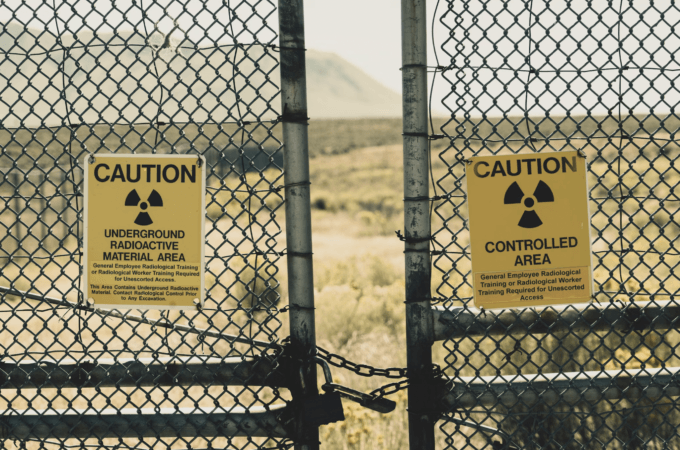
Photo by Dan Meyers
On 22 July, the United States and Saudi Arabia signed what Washington calls a ‘peaceful nuclear cooperation agreement.’ The agreement has been presented as a commercial arrangement that will help Saudi Arabia diversify its energy system while creating a vast new market for US-based nuclear companies. But its significance goes far beyond the construction of power stations. By permitting the possibility that Saudi Arabia might eventually enrich uranium on its own soil, while apparently exempting the kingdom from the most intrusive international inspections, Washington has further weakened the already fragile international regime against nuclear proliferation.
The timing could hardly be more revealing. The United States has waged an illegal war of aggression against Iran on the grounds that Iran must not be permitted to retain an independent uranium-enrichment capacity, even though Iran is a party to the Non-Proliferation Treaty(NPT) and has repeatedly stated that its programme is intended for peaceful purposes. Yet Washington is now prepared to open precisely this technological door for Saudi Arabia, whose crown prince, Mohammed bin Salman, has publicly said that the kingdom would seek a nuclear weapon if Iran obtained one.
The issue, therefore, is not simply whether Saudi Arabia intends to build a bomb. The deeper issue is the replacement of universal rules by a system of political permissions. Under this system, enrichment is intolerable when conducted by an adversary but negotiable when desired by an ally. Nuclear technology, like so much else in the imperial order, is governed not by law but by hierarchy.
What Has Been Agreed?
The agreement signed by US Energy Secretary Chris Wright and Saudi Energy Minister Prince Abdulaziz bin Salman is known as a 123 agreement, after Section 123 of the US Atomic Energy Act. Such an agreement provides the legal framework required before US companies can transfer major nuclear equipment, materials and technical knowledge to another country. The agreement was accompanied by a separate bilateral safeguards arrangement and must now pass through a period of review in the US Congress.
The US Department of Energy describes the arrangement as the foundation of a ‘decades-long, multi-billion-dollar partnership.’ US companies, including reactor manufacturers such as Westinghouse, are expected to compete for contracts to construct Saudi Arabia’s civilian nuclear infrastructure. Riyadh argues that nuclear electricity will allow it to reduce the domestic consumption of oil and natural gas, leaving a larger share of its hydrocarbons available for export. The programme is also part of the kingdom’s Vision 2030 plan to expand its technological and industrial capacity.
But civilian nuclear cooperation is not, by itself, the source of controversy. Under Article IV of the Non-Proliferation Treaty, every state party has the right to develop nuclear science and energy for peaceful purposes. Saudi Arabia has as much right as any other country to construct reactors, produce electricity, and train nuclear scientists. The danger lies in the terms under which Washington appears willing to facilitate this programme.
The full text has not yet been made public. Nonetheless, reports indicate that the agreement does not permanently prohibit Saudi Arabia from enriching uranium or reprocessing spent nuclear fuel. Instead, it provides for a two-year US-Saudi study into whether the kingdom should establish an indigenous enrichment facility. A future US administration could therefore authorise enrichment on Saudi soil. Although Donald Trump subsequently claimed that there would be ‘no enrichment’ and suggested that final approval was conditional upon Saudi Arabia recognising Israel, his intervention only deepened the confusion surrounding the agreement.
The contrast with the 2009 US agreement with the United Arab Emirates is stark. Under that arrangement, often called the ‘gold standard,’ the UAE permanently renounced domestic enrichment and the reprocessing of spent fuel. It also accepted the International Atomic Energy Agency’s Additional Protocol, which gives inspectors broader rights of access to facilities, information and locations that might be connected to undeclared nuclear activity.
Saudi Arabia has not accepted the Additional Protocol, and the new agreement reportedly relies instead on a bilateral US-Saudi monitoring mechanism. Washington is thus asking the world to trust an inspection arrangement negotiated by the same government whose companies stand to earn tens of billions of dollars from the programme. The details of this bilateral mechanism remain unavailable to the public and, crucially, it cannot substitute for universal and independently administered IAEA verification.
The commercial and geopolitical motives are plain. Washington fears that Saudi Arabia might purchase reactors from China, Russia, or South Korea if US companies refuse to meet its conditions. The deal is therefore intended to capture a lucrative market while fastening Riyadh more securely to the United States. It is nuclear commerce presented as non-proliferation.
A Blow Against the Nuclear Order
The US-Saudi agreement does not, on the available evidence, directly violate the Non-Proliferation Treaty. Saudi Arabia joined the NPT as a non-nuclear-weapon state, and the treaty does not prohibit such states from enriching uranium for peaceful purposes. What it prohibits is the manufacture or acquisition of nuclear weapons, while requiring nuclear materials to be placed under IAEA safeguards.
This legal distinction is important. Enrichment is not identical to weaponisation. Low-enriched uranium can fuel civilian reactors, whereas far higher enrichment levels are generally required for weapons. But the same basic technology can be used for both purposes. Once a country possesses enrichment plants, trained personnel and stocks of nuclear material, the time required to cross from a civilian programme to a military one can be greatly shortened. This is why enrichment and reprocessing are described as sensitive parts of the nuclear fuel cycle.
The IAEA’s standard Comprehensive Safeguards Agreement verifies declared nuclear materials and facilities. The Additional Protocol, developed after the discovery of Iraq’s nuclear programme in the early 1990s, gives the agency wider access and stronger tools with which to investigate undeclared activities. To allow Saudi Arabia access to sensitive technology without requiring the Additional Protocol is therefore not a technical omission. It is a conscious weakening of the verification regime.
There is also a larger political contradiction. The NPT is built upon three connected promises: non-nuclear states will not acquire nuclear weapons, they will retain access to peaceful nuclear technology, and the existing nuclear-weapon states will pursue disarmament. The third promise has been systematically violated. Rather than move towards disarmament, the recognised nuclear powers have modernised their arsenals, developed new delivery systems and incorporated nuclear weapons more deeply into their military doctrines.
Beyond the NPT stands the Treaty on the Prohibition of Nuclear Weapons, adopted at the United Nations in 2017 and in force since 2021. That treaty prohibits its parties from developing, possessing, threatening to use or assisting with nuclear weapons. Neither the United States nor Saudi Arabia is a party to it. The Comprehensive Nuclear-Test-Ban Treaty, meanwhile, has still not entered into force, largely because key states, especially the United States, have refused to ratify it. Decades of UN resolutions calling for a West Asian zone free of nuclear weapons and other weapons of mass destruction have also remained unrealised, above all because Israel refuses to join the NPT or submit its nuclear facilities to comprehensive IAEA safeguards.
This is the central hypocrisy in West Asia. Israel possesses nuclear weapons outside the NPT and faces neither sanctions nor inspections. Iran’s safeguarded nuclear programme has been subjected to sabotage, assassinations, sanctions and war. Saudi Arabia, a close US partner, is now offered a potential route towards enrichment without the strongest available international inspections. Washington is not defending a non-proliferation order. It is administering a nuclear hierarchy.
The precedent will not remain confined to Saudi Arabia. Turkey, Egypt and other regional states will ask why they should renounce fuel-cycle capabilities that Washington is prepared to discuss with Riyadh. Iran will reasonably conclude that negotiated restrictions provide no security: it complied with the 2015 nuclear agreement, only for Trump to abandon it in 2018 and restore sanctions. Military attacks and nuclear double standards strengthen precisely those forces in Iran that argue that only a nuclear deterrent can prevent future aggression.
The Iran–Saudi–China Process
At first sight, the agreement appears to draw Saudi Arabia back into the strategic orbit of the United States and therefore to threaten the Iran-Saudi reconciliation facilitated by China in March 2023. But the evidence so far suggests a more complicated reality.
The Beijing agreement was never an alliance between Iran and Saudi Arabia. It restored diplomatic relations, reopened embassies and revived an earlier security cooperation agreement after seven years of estrangement. Its immediate purpose was limited but important: to prevent rivalry from becoming direct war and to establish channels through which crises could be managed.
This process has survived extraordinary pressure. It endured the Israeli assault on Gaza, the regional expansion of that war, attacks in the Red Sea and successive confrontations involving Iran, Israel, and the United States. Riyadh and Tehran continue to distrust one another, but both have powerful reasons to preserve the dialogue. Iran seeks to prevent its encirclement and reduce the effectiveness of US sanctions, while Saudi Arabia needs regional stability to carry out its economic plans and its leadership understands that neither US weapons nor US military bases can guarantee the security of its oil installations, cities, and shipping routes.
The nuclear agreement does not remove these structural interests. Indeed, it may be better understood as part of Saudi Arabia’s policy of strategic diversification. Riyadh maintains its old military relationship with Washington while deepening economic ties with China, coordinating with Russia in the oil market, building links with Pakistan, and keeping diplomatic channels open to Iran. Saudi Arabia is no longer willing to entrust all its options to a single external power. China’s role in the 2023 agreement was successful precisely because Beijing did not demand exclusive alignment. It offered neither a military bloc nor an ideological test. China is Iran’s largest oil customer and an increasingly important economic partner of Saudi Arabia and the Gulf states. Its principal interest is the security of energy supplies, shipping lanes, and infrastructure. Unlike Washington, which has repeatedly attempted to organise the region through sanctions, military bases, and war, China benefits from a regional order in which Iran and Saudi Arabia negotiate their differences.
The US-Saudi nuclear agreement will undoubtedly introduce new suspicion into Tehran’s calculations. If Saudi enrichment becomes a reality, Iran will regard it as evidence that Washington is constructing a permissive nuclear threshold for its partners while trying to destroy Iran’s own technological capacities. This could make broader nuclear diplomacy far more difficult. But it does not follow that Iran or Saudi Arabia will abandon the Beijing process. Both sides know that breaking diplomatic contact would expose them to even greater danger.
The real contradiction is therefore not between Saudi Arabia’s relations with the United States and China. It is between two conceptions of regional order. Washington offers Saudi Arabia advanced weapons, nuclear technology, and a place beneath a US security umbrella that has repeatedly failed to prevent war. The Beijing process offers no such umbrella; it offers diplomacy, commercial interdependence, and the possibility that the region’s states might manage their own disputes without permanent external supervision.
The Saudi leadership will attempt to draw benefits from both arrangements. But the US nuclear deal contains the seeds of a new regional danger. By converting non-proliferation rules into privileges distributed among friends, Washington encourages every state to acquire the technological basis for a future bomb. The only principled alternative is a universal one: no nuclear weapons for Israel, Iran, Saudi Arabia, or any other state, full and equal IAEA safeguards, implementation of the long-delayed nuclear-weapon-free zone in West Asia, and the complete abolition of nuclear arsenals, beginning with those held by the established nuclear powers.
Peace cannot be built by deciding which governments may stand closest to the nuclear threshold. It can only be built by dismantling the threshold itself.
This article was produced by Globetrotter.
An Eighty-Year Nuclear Nightmare: The U.S., Japan, and Korea
July 31, 2026

Second International Hiroshima Forum.
On the right corner of my desk, next to my laptop and always in eyeshot, sits a metal model of an atom bomb I assembled from a kit, a model of “Little Boy,” the bomb the U.S. dropped on Hiroshima. The model is made from aluminum alloy parts and is a 1/12th scale of the original atom bomb, about nine inches long. The ad for the bomb contained a video with dramatic music showing the model spinning through the air as it falls toward its imagined target.
“Perfect for collectors,” the ad boasted. “A must-have for history enthusiasts. Very enjoyable assembly process.”
Toward the bottom of the ad, perhaps as an afterthought, perhaps recognizing the implications of marketing such a murderous model, was the following: “By assembling this model, you can understand the history and moral issues of nuclear weapons and trigger thoughts about the future of the world.”
The kit came with a tiny screwdriver, two dozen tiny screws, a sanding rod, glue, and decals. The aluminum alloy parts were in molded plates. The model even had a metal cart to assemble that the bomb sits on so it can be pulled around your desk, pretending you’re getting ready to load it onto the Enola Gay, extinguish a city in a flash.
On the morning of August 6, 1945, the real “Little Boy” exploded with a flash 2,000 feet above the city of Hiroshima, which sits on the Ota River delta on Hiroshima Bay. The Ota River has six channels splitting Hiroshima into islets. Bomb victims staggered toward these channels to throw themselves into the water hoping to extinguish their burning bodies. The channels became so clogged with bodies that others couldn’t squeeze in. Some people, closer to the hypocenter, were vaporized, reduced to shadows seared into stone. Temperatures on the ground reached 4,000 degrees.
As we once again approach that fateful day of August 6th, it is important to recognize that not just the U.S. and Japan are intertwined in a nuclear nightmare that has lasted over eighty years, but also 70,000 Koreans who were exposed to the two atomic bombs incinerating Hiroshima and Nagasaki, people forcibly removed from their homeland by the Japanese and sent to work in these cities. Japan colonized Korea in 1910 and for decades used Koreans as they saw fit, from Comfort Women to slave labor. The Koreans then became atomic bomb victims, despite their country not being at war with the United States. They are among the unintended victims, the forgotten victims.
This November in Seoul, South Korea, the surviving Korean bomb victims will testify at a People’s Tribunal holding the U.S. accountable for war crimes. Lawyers from around the world have been preparing legal briefs and will argue the case. The U.S. government is invited to appear as the defendant at the Tribunal. The Republic of South Korea has also been asked to appear as a witness.
Once let loose, an atomic bomb keeps on killing, generation after generation, the cancers passed down to those not even born when the bombs first exploded. The Korean atomic bomb victims, as well as the Japanese, have horrific stories testifying to this. Children of the bomb. Atomic maladies. The bomb wages war against the future.
The second atomic bomb that was dropped on August 9th incinerating another Japanese city had a different nickname. That bomb had an even bigger belly and used plutonium rather than uranium. They called it “Fat Man.” The same ad for the model of the “Little Boy” atom bomb had a second ad inducing you to buy “Fat Man.” It is another 1/12th scale model of the original, this one weighing 6.2 pounds when completed. I declined the offer to buy and build it. One was repellent enough.
The U.S. currently has 5,277 nuclear warheads. Russia has 5,4490. China, approximately 600. France and the U.K have about 250 each and Israel has about 90. India, Pakistan, and North Korea bring up the rear with a few nukes each. In total there are over 12,300 nuclear warheads spanning the globe. The Korean atomic bomb victims stand as ready reminders of what happens when these things are unleashed.
Unavailable, Unethical, Unhinged: U.S. H-bomb Unit in Germany Should be First to Go
July 31, 2026

Anti-nuclear activists placed sunflowers, a symbol of nuclear disarmament, in the fence at Germany’s Büchel air base Thur., July 24, marking the 30th anniversary of protests at the base. Photo by Luthar Lange.
For the last four years, the U.S. hydrogen bombs stationed in Germany have been stranded at Büchel Air Force Base, southeast of Cologne, unavailable to the fighter jets and pilots that are rehearsed and ready to detonate them against Russia. These WMD have been unusable for nuclear attacks or threats — i.e. ‘deterrence’ — since 2022 because the base is getting a makeover.
The deterrence that the U.S. and Germany say the nuclear weapons provide disappeared in 2022 when massive remodeling of the base began. A total rebuild of its runway and more forced the base’s 46 Tornado fighter jets to be moved to Nörvenich Air Base, 28 miles away, to practice their take-offs, attacks, and landings.
Because the base’s reconstruction has left the ‘nuclear deterrent’ unavailable for years, the unoccupied and redundant U.S. Air Force’s 702d Munitions Support Squadron (or MUNSS) should be the first unit withdrawn from Germany under Trump’s recent orders.
The Department of War says the 702d MUNSS is needed because it ‘receives, stores, maintains, controls, and employs war reserve munitions in support of [Büchel’s] 33rd Tactical Air Wing’s role in NATO’s strike mission.’ This, of course, has been mission impossible for at least four years, a pause that means relief from the self-destructive threat of nuclear strike missions aimed at Russia.
The ‘Commander’s Welcome Letter’ for new arrivals, on Büchel’s website, explains: ‘The 702d consists of approximately 170 personnel across 26 different Air Force Specialties, responsible for maintaining, operating, and securing $6B [billion] in Protection Level-1 assets….’ And according to a Shaw Air Force Base manual, ‘Protection Level 1’ resources ‘include nuclear weapons and … systems critical to the success of active nuclear missions….’
Büchel’s nuclear mission involves twenty U.S. B61 H-bombs — the only remaining nuclear weapons in Germany — which are polished on base by the 702d MUNSS. This arsenal is the crux of a so-called ‘nuclear sharing’ arrangement between the United States and Germany (and four other NATO countries). But neither ‘active nuclear missions’ nor any other kind have flown out of Büchel since 2022, leaving the 702d on holiday.
Declaring he would reduce Germany’s U.S. military presence, Trump said May 2, “We are going to cut way down, and we’re cutting a lot further than 5,000.” Liana Fix reported for the Council on Foreign Relations that 5,000 troops were about one-seventh of the roughly 38,000 GIs currently stationed in Deutschland. Secretary Hegseth promptly had the Pentagon claim that the decision on withdrawals had followed a ‘thorough review of the force posture in Europe.’
The actual fatuous reason for the potential drawdown was a Trump tantrum over German Chancellor Friedrich Merz’s derisive public assessment that the U.S. was being ‘humiliated’ by Iran. Merz said to students last April, ‘[T]he Iranians are … letting the Americans travel to Islamabad and then leave again without any result. An entire nation is being humiliated by the Iranian leadership’, The Guardian reported. Trump’s reactionary fit opens a door to the long-sought-after removal of U.S. nuclear weapons from Germany, something that the Parliament/Bundestag — moved by mass public pressure — formally instructed the government to pursue in March 2010.
For decades, Tactical Air Force Wing 33 has reportedly been operating 46 Tornado jet fighters. The Tornados are flown by German pilots who train to carry the U.S. H-bombs and to detonate them against Russia if a U.S. president so orders. While the Tornados returned to Büchel this year, the first F-35s are set to replace them starting in 2027.
Indeed, the two billion Euros being spent on the Büchel rebuild (widening taxiways and airfield intersections; new runway; new cargo apron; and a new so-called fighter jet ‘campus’), is in preparation for the delivery of new U.S. ‘B61-model 12’ thermonuclear bombs, and the arrival of new F-35A fighter-jets to carry them.
The F-35s from Lockheed Martin cost Germany over ten billion euros, or $11.4 billion, according to Aero.de, Dec. 12, 2022. And Aero reported June 24, 2025, that the F-35s are ‘intended to support Germany’s so-called “nuclear sharing” program — a NATO deterrence strategy under which allies have access to U.S. nuclear weapons in the event of war.’
If there is any seriousness to Trump’s erratic outburst about troop withdrawals from Germany, nothing could be more reassuring, more stabilizing, and more de-escalatory than throwing out the 702d MUNSS along with its nuclear suicide mission.

No comments:
Post a Comment