Church leaders not bound to report sexual abuse confessions, Arizona Supreme Court rules

The Arizona Supreme Court building in Phoenix. (Photo by David Pinter/Wikimedia/Creative Commons)
(RNS) — The Arizona State Supreme Court ruled that church leaders do not need to report cases of sexual abuse, disclosed during confessions, to authorities, in a lawsuit brought against a man who confessed to Church of Jesus Christ of Latter-day Saints bishops to sexually abusing his daughter.
Arizona justices unanimously ruled on Thursday (July 30) that trial courts couldn’t interfere in church leaders’ decision to report sexual abuse cases disclosed in confession, according to their own interpretation of religious doctrine.
“We hold that the First Amendment generally prohibits fact finders from inquiring into a clergy member’s application of his particular religious doctrine — absent fraud or collusion for secular purposes — in determining whether reporting should be withheld if ‘reasonable and necessary,’” wrote Vice Chief Justice John Lopez in the court’s opinion.
The Mormon Church praised the ruling, saying it affirmed the confidential nature of religious confession.
“Arizona law also recognizes the confidential nature of religious confession. The decision affirms that these religious protections are to be respected alongside society’s shared commitment to protect the vulnerable,” it wrote in a statement. “The abuse at the center of this case was reprehensible, and the Church has always condemned it.”
Angela Walker, the executive director of the Survivors Network of those Abused by Priests advocacy group, expressed concern that predators would be able to use a “confessional loophole to escape justice.”
“While we respect the court’s decision, we believe that the safety of these children must be protected,” Walker wrote in a statement. “Especially since this predator videoed these images and put them online.”
The ruling sends the case back to lower courts and reverses a July 2025 decision of the state’s Court of Appeals. Arizona’s reporting statute compels anyone who reasonably believes a minor has been the victim of abuse to immediately report it. But the statute exempts clergy who deem it necessary to not report it for religious reasons. The Court of Appeals found the admissions of guilt in the case didn’t invoke clergy-penitent privilege and that church leaders could have reported the abuse.
In 2020, three of Paul Adams’ children sued the LDS church for violating the state’s reporting statute by not reporting Adams’ sexual abuse after he admitted it in multiple meetings with church leaders.
In late 2011, Adams told Bishop John Herrod of Bisbee Ward Mormon Church in southern Arizona during a confession that he had sexually abused his 5-year-old daughter, who is one of the plaintiffs, according to the lawsuit. Herrod convened counseling meetings with Adams and his wife, Leizza, in 2012, during which Adams confirmed the abuse.
In 2013, Paul Adams was brought before a church council and admitted to the abuse and was excommunicated.
Herrod and his successor, Bishop Robert Mauzy, both considered his admission to be made in the context of “confidential communications” or confessions.
In 2017, the couple was indicted following an Interpol investigation that traced a child pornography video downloaded by a New Zealand man back to Paul Adams. The U.S. State Department found thousands of videos of child abuse on Paul Adams’ devices, including of his daughters. He also admitted to abusing multiple of his children around that time.
Leizza Adams pleaded no contest to two felony counts of child abuse and was sentenced to 2 1/2 years in prison. Paul Adams admitted to abusing two of his daughters and posting about it online to law enforcement but died by suicide in jail before trial.
In November 2023, the Cochise County Superior Court ruled church leaders learned about the abuse in confidential communications and had no duty to report it because clergy-penitent privilege applied. The Superior Court granted defendants a motion for summary judgment.
The trial court ruled that defendants learned about the abuse as church leaders and could determine whether it was “reasonable” and “necessary” within their religious doctrine not to report it. However, the appellate court held that a reasonable fact finder could conclude Herrod had, in some situations, “observed” Paul Adams speak about the abuse to another bishop, rather than during their one-on-one confession, which could lead a trial court to conclude clergy-penitent privilege didn’t apply.
In 2022, an Associated Press investigation reported LDS church lawyers told bishops not to report the abuse to police or child welfare officials, complying with the church’s help line advice on such situations arising from confessions.
The church argued the AP investigation misrepresented the church’s efforts and denied covering up the abuse. It said clergy members advised Paul Adams to repent and seek professional help, asked him to report the abuse and encouraged his wife to report it. The church also said it only learned about the extent of the abuse in 2017. The Church’s Handbook requires leaders to report abuse disclosed in confessions when they could cause serious injury.
Flunking Sainthood
Why are so many young women leaving Mormonism?
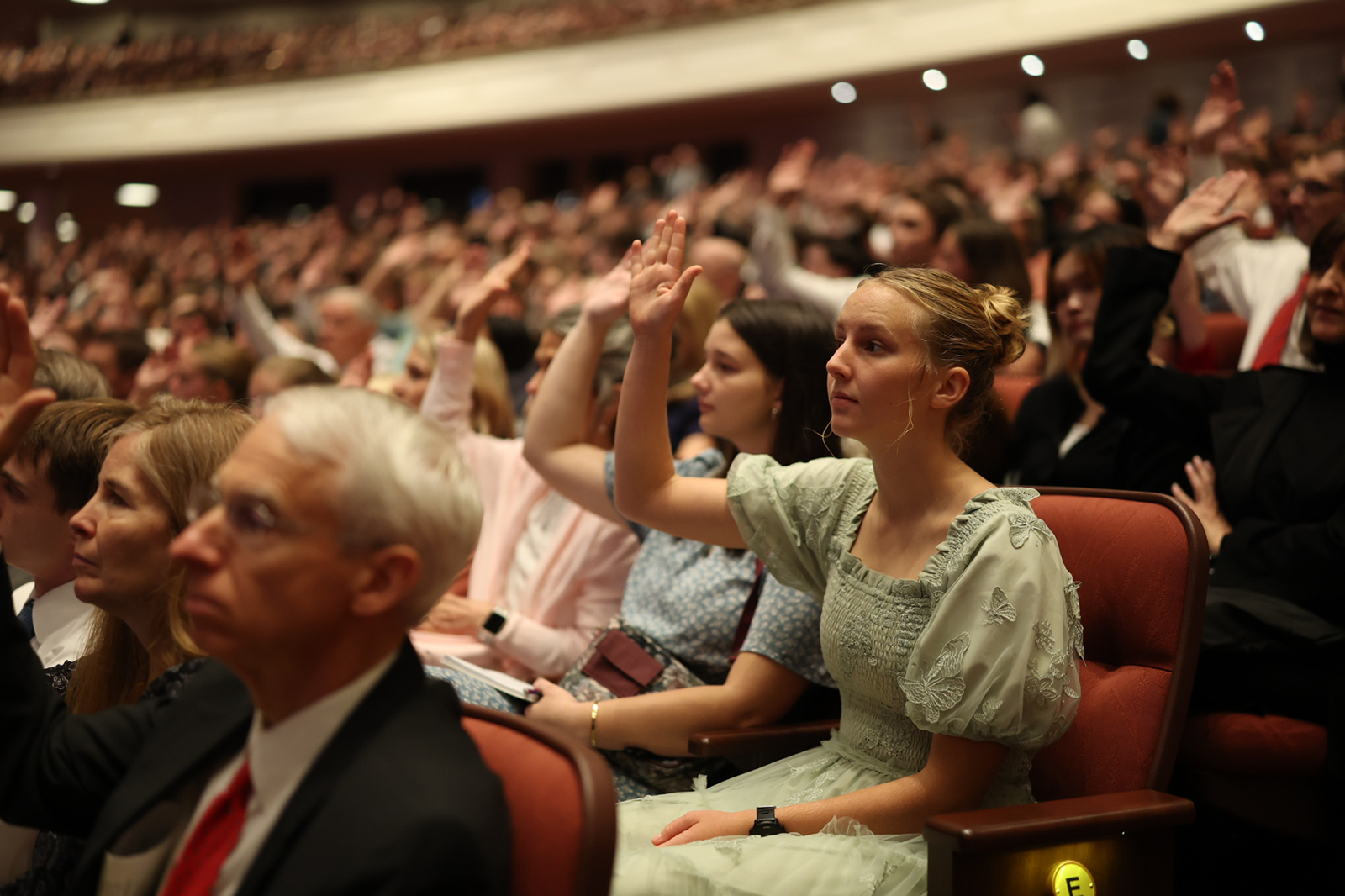
Members attending general conference raise their hands to sustain the general authorities and officers of the Church during the Saturday morning session of General Conference at the Conference Center in Salt Lake City, Utah, on October 4, 2025. (© 2025 by Intellectual Reserve, Inc. All rights reserved.)
(RNS) — A recent article in BYU Studies called attention to two clear trends in the Church of Jesus Christ of Latter-day Saints in the United States. The first is that Mormons are succeeding in many ways — we pray more, attend church more and report being happier than most other Americans.
The other trend is that markedly fewer people are staying in the church. We’re keeping about half, which is a big drop from what it used to be. We kept about 8 in 10 childhood members back in the 1980s.
And the biggest bombshell? Women are now more likely to leave than men, especially if they’re younger.
Consider Ryan Burge’s 2025 Spiritual Seismology Survey, with an overall sample size of 100,741 U.S. adults, including 1,177 who were raised LDS. It found that only about 4 in 10 Gen Z women who grew up LDS are still in the church. For the very youngest 18-year-old Mormon women, the retention rate was just 37.5%.
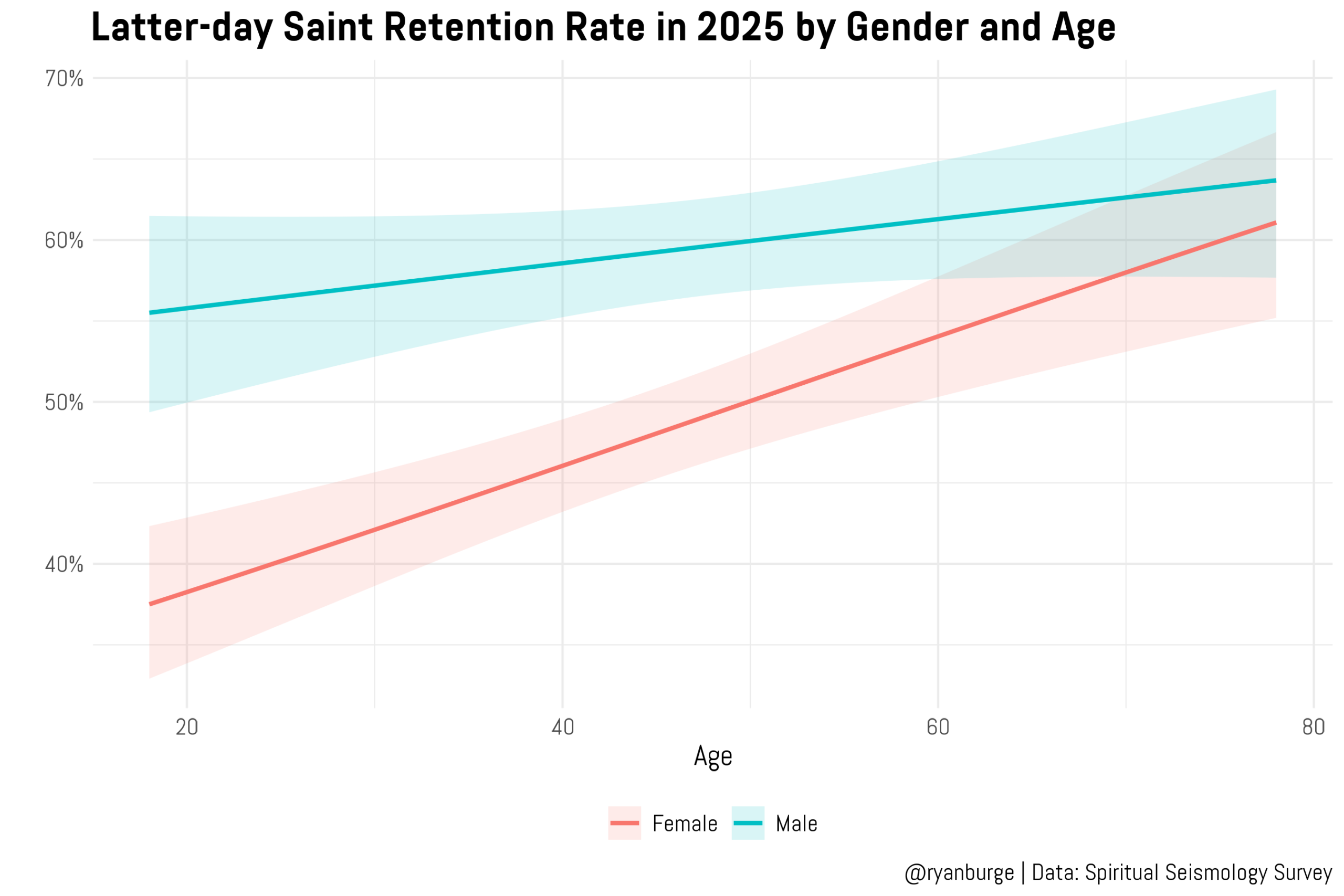
The 2025 Spiritual Seismology Study found that only about 4 in 10 Gen Z women who grew up LDS are still in the church. Graph: Ryan Burge.
Pew’s 2023-24 Religious Landscape Study shows a similar general trend, though it’s less dire. Two-thirds of women over age 50 have stayed members, compared to just under half of younger ones. That’s a retention difference of 17 points.
Among people who were raised as Latter-day Saints, % who identify as Latter-day Saint (Mormon) in adulthood
| % | Confidence interval range | |
| Men, ages 18–49 | 54 | 43.8 – 63.4 |
| Women, 18–49 | 49 | 40.7 – 56.9 |
| Men, 50+ | 57 | 46.9 – 67.3 |
| Women, 50+ | 66 | 55.9 – 74.0 |
Source: Pew 2023–24 Religious Landscape Study
Why is this happening? Based on Benjamin Knoll’s and my research for the forthcoming book “Leaving Mormonism: Who Is Exiting the Church of Jesus Christ of Latter-day Saints—and Why,” I have some ideas. Let’s boil them down to “three Ps”: young women are reacting against politics, purity culture and powerlessness.
Young women are more liberal, and liberals are more likely to leave religion:
Recent U.S. surveys have shown that young women are growing more liberal than men their age. Gallup helpfully breaks this out over time: 20 years ago, there was only a three-point gap in young women who leaned left (28%) compared to young men (25%). That has now widened to 15 points (40% vs 25%). PRRI and Change Research have also found Gen Z women to be one of the most liberal demographic groups in America.
Why does this matter for LDS retention?
It matters because politics is now driving religious affiliation and disaffiliation in America. In the last 50 years, religious conservatives have aligned with the Republican Party, and religious “nones” have gravitated toward the Democratic Party.
Meanwhile, our political identities have become more important over time in how we define ourselves — for many people, more so than religion.
Taking these developments together, it can be lonely and painful to be liberal in a conservative church, including the LDS Church.
This discomfort is especially acute for young women, because some of the political issues the LDS Church has publicly combatted are the same ones young women are likely to support.
Gen Z women lead all demographic groups in wanting full equality for LGBTQ+ people under the law, whereas the church mounted a massive political effort to defeat same-sex marriage when these women were kids.
Gen Z women want equal rights for women, whereas the church publicly opposed the Equal Rights Amendment not only in the 1970s but as recently as 2019-2020.
They want legal access to abortion, which the church opposes except in rare instances.
Young women are reacting against the extreme “purity culture” of the early 2000s:
Related to their generally liberal views on gender and sexuality, today’s disaffiliation may be a backlash against the extreme sexual “purity culture” that was taught when many young LDS women were teens.
One study tracked the church’s guidance on modest dress through its official magazines. Up through the 1990s, the church taught teens and adults of both genders to dress modestly and take care of their bodies. In the early 21st century, though, the targeted warnings to teenage girls went through the roof. Girls 20 years ago were hearing about the dangers of immodest dress about six times as often as boys in church magazines. Paradigmatic of this era, then-apostle Dallin Oaks warned girls specifically in 2005 that if they dressed immodestly, they were “becoming pornography” to men.
This focus caused anxiety for young LDS women I’ve interviewed. For Nicole, a 23-year-old woman, the church’s constant policing of her body and her thoughts meant that she “learned how to avoid feeling sexual” as a teen. She just shut it down. At the time of our interview, she’d been out of the church for two years but was still deeply uncomfortable with her own sexuality. She identified purity culture as one of the most damaging aspects of growing up Mormon and part of why she left the church. She is not alone in this.
Young women now have equal power in almost every arena of their lives — except at church:
Finally, there’s a growing disconnect between the power young women experience now in most aspects of their lives compared to the powerlessness many report feeling at church. In the church, women cannot hold the priesthood, bless or pass the sacrament, baptize a convert or make policy decisions. (And no, please don’t try to tell me that because teen girls get to plan some of their weeknight activities, this makes them “equal.”)
In earlier generations, barring women from leadership was par for the course in larger society, so the LDS Church was hardly an outlier. Gender inequality was the norm in America. But for the rising generation — schooled in the girl power movement and promised they could do anything — it feels like a slap.
The church has made some strides in recent years. In 2025, it finally began allowing women to serve missions at the same age men can and debuted sleeveless temple garments for women. I suspect both changes are quiet attempts to stem the loss of so many female members. Time will tell whether such changes are helping.
Because in a church that does not permit women to help create the policy decisions that affect them, some feel there’s only one way to be heard: voting with their feet.
Related:
US Gen Zers and Millennials are leaving the LDS Church, data confirms
Gen Z Women are dropping out of religion, but ramping up in politics
“Secret Lives” shows Mormon women working out the damage of purity culture in real time

No comments:
Post a Comment