Connecticut legislation aims to expand Islam education in public schools

(Photo by Jan Walter Luigi/Pexels/Creative Commons)
HARTFORD, Conn. (RNS) — For nearly 25 years, education on Islam in public schools has been met largely with fears of indoctrination. Now, the state of Connecticut is leaning into the debate.
A new state provision, passed as part of a larger education bill last month, directs the Connecticut State Department of Education to develop instructional resources on Arab and Islamic studies, offering public schools optional materials designed to expand how students learn about the history, culture and contributions of Arab and Islamic civilizations.
“As with previous legislative directives on Holocaust education, Native American studies, and Asian American and Pacific Islander studies, the Connecticut State Department of Education is convening a Curriculum Design Leadership Team of educators, curriculum leaders, higher education faculty, and other content experts,” a CSDE spokesperson said. The team will identify, review and curate instructional resources before making them available to school districts.
Casey Cobb, Neag endowed professor of educational policy at the University of Connecticut in Storrs, said it is hard to predict how widely the Islamic and Arab curriculum will be used, though he expects its implementation to align with local demographics.
“School administrators know their communities very well, and those who have substantial Arab American or Muslim populations are probably the ones that would want to represent those students in the curriculum,” he said. This leaves out rural districts that he said would likely benefit the most from this curriculum.
Implementation faces an uphill battle in districts where conservatives have made targeted runs for school board membership. They may see learning about Islam as at odds with their own beliefs, which are rooted in Christianity, Cobb said.

The Connecticut State Capitol in Hartford. (Photo by Decaseconds/Flickr/CC BY-NC 4.0)
Some also object to the curriculum over First Amendment concerns that it endorses one religion over others. In a Hartford Courant story, Chris Healy, executive director of the Connecticut Catholic Conference, said the curriculum violates the First Amendment by endorsing Islam. “This is so clearly unconstitutional. … It’s similar to the outrage people would have if the Ten Commandments were put on the wall,” he told the newspaper.
Farhan Memon, chairman of the Council on American-Islamic Relations Connecticut, a Muslim advocacy group, said the legislation is meant to broaden how students learn about Arab and Islamic history and civilization, rather than endorse Islam as a religion. “The law is not about religion per se,” Memon said.
The measure, for which CAIR advocated, is designed to help educators present a fuller understanding of Islamic and Arab civilizations while remaining within the constitutional boundaries of public education, he added. “Teaching students about a civilization or a faith tradition is not the same as teaching them a religion to adopt it,” he said. “Ignorance itself creates fertile ground for fear and prejudice, and so education helps replace these stereotypes and furthers understanding between people.”
Susan Douglass, an educational outreach coordinator at Georgetown University in Washington, D.C., who has spent decades training educators on teaching religion in public schools, said that distinction has guided public education for decades.
“You’re teaching about religion. You’re not teaching religion in a normative manner,” Douglass said, referring to longstanding First Amendment guidelines developed for public schools.
Earlier this year, two Muslim girls were assaulted at their Waterbury middle school in what authorities classified as a hate crime, prompting renewed concerns about anti-Muslim bias in Connecticut schools.
The investment into the new curriculum in the state also comes at a time when anti-Muslim bigotry and racism appears to be becoming increasingly acceptable in the public square on a national level. According to research by the Social Science Research Council and the Bridge Initiative, it especially flourishes during election cycles.
“There’s a whole cottage industry around Islamophobia,” said Douglass, alluding to a $57 million network that funds anti-Islam content identified by the Center for American Progress.

Attendees react during a vigil, the day after a shooting, outside of the Islamic Center of San Diego, Tuesday, May 19, 2026, in San Diego. (AP Photo/Jae C. Hong)
Anti-Muslim bigotry has become deadly in recent months. In May, three people were killed in a shooting at the Islamic Center of San Diego, and a Muslim man was hospitalized after a targeted anti-Muslim stabbing attack in Utah in July.
Since the 9/11 attacks in particular, school districts across the country have faced resistance from parents who discovered their children were learning about Islam in school and feared religious indoctrination. That fear spilled into state legislatures. After parental uproar over a lesson on Islam in a Maury County middle school, Tennessee passed a state law in 2016 that restricted the use of educational materials from promoting or establishing any religion or religious belief.
“I did not fight radical Islam in Iraq just to come home and find our children being indoctrinated,” Tennessee Republican State Rep. James Van Huss said at the time.
Today, the debate over the place of religion in the classroom is being renegotiated. In Texas, students will be required to read portions of the Bible as part of a newly approved state reading list taking effect in 2030. This comes after the state became the first in the nation to require every classroom to hang the Ten Commandments — a law being challenged in court.
Cobb said conservative lawmakers have been emboldened in recent months by a suite of favorable Supreme Court rulings to push the boundaries of the First Amendment in Christianity’s favor.
“I don’t think there’s going to be a reversal of that momentum … my prediction is that it’ll continue,” he told RNS.
For Douglass, the significance of Connecticut’s law extends beyond a single curriculum.
“It’s vital to our continued coexistence as one of the most pluralistic countries in the world,” she said of supporting neutral, effective public education on all religions, including both Christianity and Islam. “If we’re going to continue to live together, we should be joining hands and not pointing fingers.”
Broken Arrow mosque leaders sue over alleged discrimination
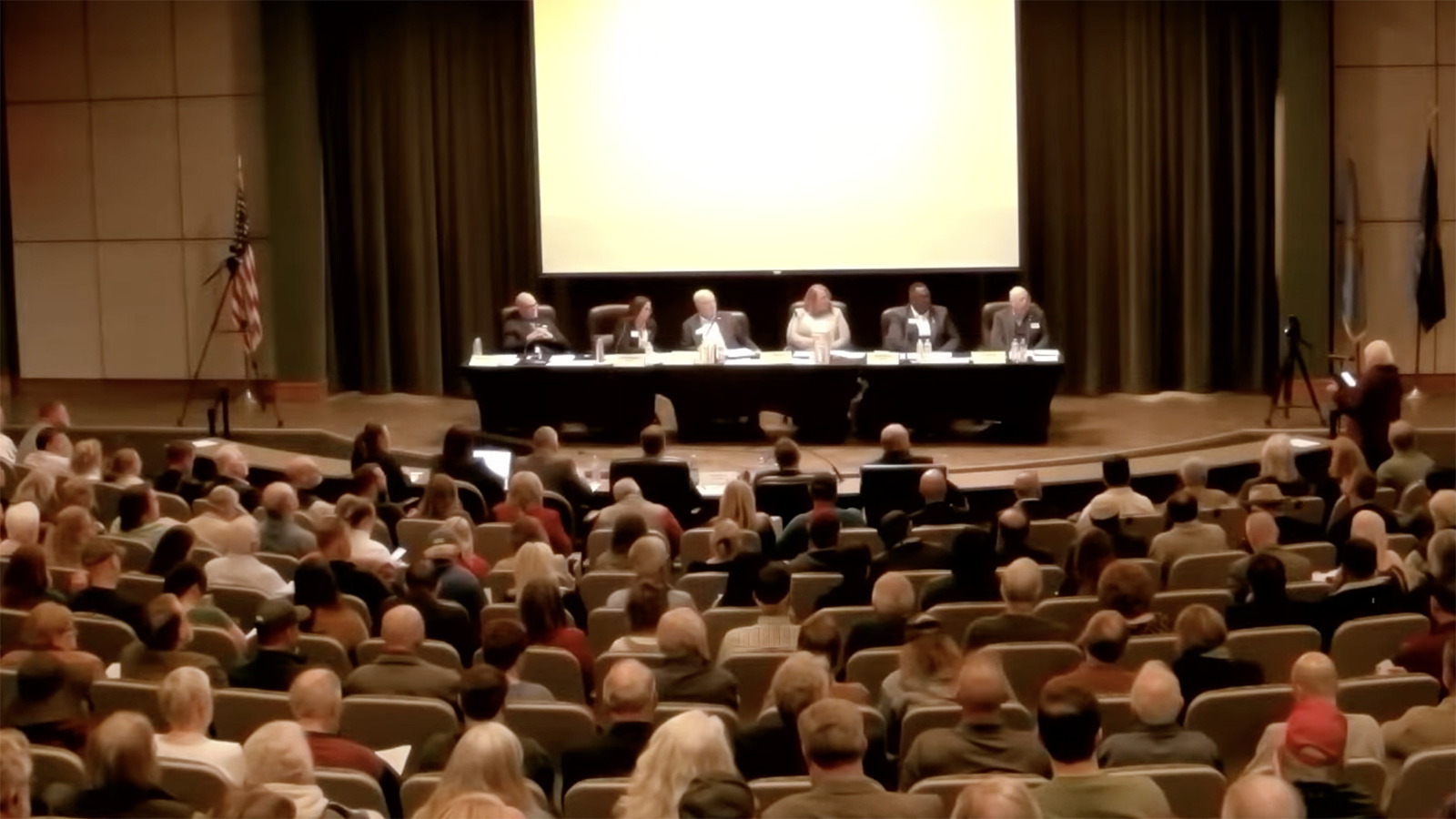
People attend a special Broken Arrow City Council meeting on Monday, Jan. 12, 2026, in Broken Arrow, Oklahoma. (Video screen grab)
(RNS) — Just before a crucial vote on a proposed mosque in Broken Arrow, Oklahoma, Mayor Debra Wimpee and other city officials were swamped by emails demanding that they reject the proposal, with many writing anti-Muslim comments.
“Every country in Europe, once Muslims reached over 2% of the population, they started acting violently,” claimed one email from a mosque opponent. “We are not discriminating against them as people, we just do not want them setting up shop in our neighborhood.”
“I have the very same concerns,” Wimpee replied.
Wimpee’s response and a similar email from a city council member, both first reported by the Tulsa Flyer, are cited in a lawsuit filed Monday (Aug. 3), alleging that Wimpee and other Broken Arrow leaders illegally rejected a rezoning request by the Islamic Society of Tulsa to build the first mosque in the city.
The complaint, filed on behalf of the Islamic Society of Tulsa in U.S. District Court for the Northern District of Oklahoma, names Wimpee, four members of the Broken Arrow City Council and the city itself in arguing a January vote against the proposed mosque violated federal land use and religious freedom laws.
“The City of Broken Arrow violated IST’s constitutional and statutory rights to use their land for worship and to not be treated differently simply because of their faith,” the complaint reads.
Leaders of the Islamic Society of Tulsa say the new mosque is needed to accommodate Muslim residents of Broken Arrow, who otherwise have to travel to a small mosque in Tulsa, about 15 miles away, for worship. The proposed project would be built on property owned by the Islamic society and currently zoned for agricultural use.
Aslam Syed, who led construction for the Broken Arrow mosque project, said the lawsuit is meant to ensure city decisions are not guided by public pressure.
“None of us wanted to be here announcing a lawsuit,” Syed said at a press conference Monday. “We wanted to build a place of worship for community members who already lived and contributed to the fabric of Broken Arrow.”
Both city staff and the Broken Arrow Zoning Commission had approved the rezoning request for the mosque before the council rejected it. The city council had previously approved zoning changes for a nearby apartment complex and new housing development, as well as two churches.
However, the complaint alleges, city leaders treated the mosque differently, citing traffic and infrastructure concerns in their denial, even though the other approved projects had similar concerns raised.
“The relevant departure was not merely that the council approved other applications but denied IST’s applications — it used unique and more stringent review standards,” according to the complaint.
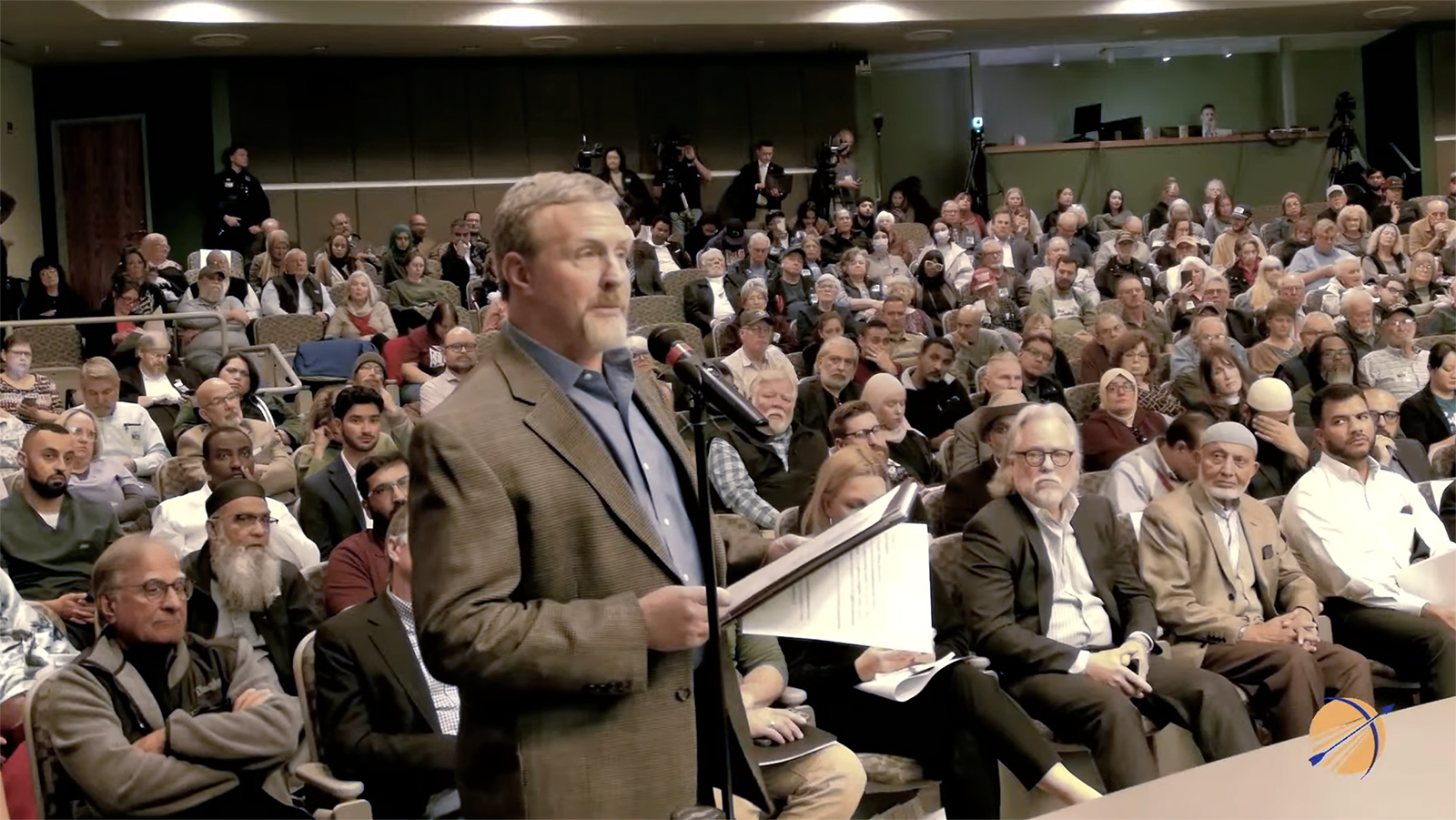
David Oldham speaks against a proposed mosque project during a special Broken Arrow City Council meeting on Monday, Jan. 12, 2026, in Broken Arrow, Okla. (Video screen grab)
The complaint argues that city officials violated the Religious Land Use and Institutionalized Persons Act, known as RLUPA, as well as the 1st and 14th Amendments and the Oklahoma Religious Freedom Act.
Meghan Murphy, a staff attorney with CAIR’s Legal Defense Fund, which represents the Islamic Society, said Broken Arrow City Council succumbed to a “wave of bigoted anti-Muslim hysteria.”
“They did not want Muslims here, so they made up a reason, and in doing so, they violated the law,” Murphy said at the press conference.
During the January city council meeting, dozens of residents testified against the mosque’s expansion while making anti-Muslim comments. Others raised concerns about water flow and congestion.
In the days leading up to the vote, a meeting organized by conservative nonprofit Constitutional Grounds used criticism of Islam as a reason to oppose the mosque.
RLUPA bars government officials from treating houses of worship differently in zoning matters than other groups.
Last week, the U.S. Department of Justice said it was investigating how the City of Broken Arrow’s zoning laws treat religious land uses and the city’s denial of the mosque rezoning request. Oklahoma Attorney General Gentner Drummond has asked President Donald Trump to stop the DOJ inquiry, according to the Tulsa Flyer.
City officials plan to meet Monday to discuss the DOJ investigation. That meeting will be held in executive session and is not open to the public, according to a statement from the city.
“The city council and administration are fully engaged with the DOJ in its investigation,” city leaders said in a public letter about the investigation.
A spokesman for Broken Arrow said the city does not comment on potential litigation.
Leaders with CAIR and IST said Monday they hope the suit leads to the construction of the mosque.

No comments:
Post a Comment