A Fragile Food Regime
Governments across the world have been scrambling to find ways to deal with food inflation, with populations justifiably enraged by the fact that grocery prices have been growing much faster than incomes. In May, the British government suggested the adoption of voluntary price caps on essential foods. Supermarket executives responded with characteristic goodwill. One described the policy as “completely mad” while another labelled it an “unnecessary, unwanted and unjustified intervention in the market.”
Similar initiatives have been proliferating across Europe as food inflation has gathered pace since the pandemic, as Carolina Alves describes in a recent article in Project Syndicate. Some countries like France and Greece have focused on voluntary collaboration from retailers. Others went further, imposing caps on specific prices (Hungary) or trading tax cuts for price reductions (Spain). Across the Atlantic, food inflation has also spurred states into action: in Mexico, the government has negotiated with supermarkets to establish a fixed-price basket of basic food items; in Brazil, Lula’s administration has taken the less effective step of manipulating tax rates on some specific products (it refrained from bolder action after neoliberal vigilantes spread panic that strategic price controls would lead to scarcity). And in New York City, Zohran Mamdani is beginning to make good on his campaign pledge to roll out public grocery stores.
The debate about alternative methods to guarantee access to food is welcome. While mainstream economists like to claim that inflation-targeting central banks have the situation under control, the realities of the affordability crisis are prompting more and more politicians to break with neoliberal orthodoxy. There are historical reasons for their concern. The Arab Spring of the 2010s was at least partially propelled by food inflation, and there have been countless other episodes in which a rise in food prices, perceived as an affront to the shared moral economy, has prompted populations to revolt.
Yet this lineage can also be misleading, in that it obscures the singularity of the current global food regime, which determines the range of products on supermarket shelves as well as their prices. While spikes of food inflation are not unprecedented, they have arguably become more common and more pronounced, as this particular food regime has proven inadequate to the task of feeding the world—especially in the context of climate-induced shocks. Over the coming months, the combination of disrupted oil and fertilizers supplies, due to the closure of the Strait of Hormuz, and a “super” El Niño is expected to push food prices even higher. The process of building state capacity to deal with such shocks—buffer stocks, public retailers, or tax policies—is underway, accompanied by intensified critical engagement with the dynamics of the food regime itself. The question is whether such emergency measures can create the conditions to transform global food provision or whether their only purpose is to catch up with the latest crisis. A sketch of the historical origins of the global food regime will help us to grasp the magnitude of the present challenge and the conditions for overcoming it.
An avalanche of grain
Research on how capitalism restructured global food production has been focused on the concept of the “food regime” since 1989. That year, Harriet Friedmann and Philip McMichael published a seminal article which drew both on the French regulation school and world-systems theory, aiming to link “international relations of food production and consumption to forms of accumulation broadly distinguishing periods of capitalist transformation since 1870.” The notion of a regime of food was thus inspired by the regulationist concept of a regime of accumulation. Friedmann and McMichael identified two food regimes, each related to a different global hegemonic power. The first, under British hegemony, lasted from 1870 to 1914, while the second, under US hegemony, was established after World War II. Later research has speculated on whether we are now living under a third regime—a question to which we will return later.
If the first regime was established in 1870, its political and intellectual origins date back to around half a century earlier, to one of the foundational debates in political economy. As David Ricardo and Thomas Malthus discussed the determination of land rent and profits in the 1810s, debate in Britain turned to food prices—with landlords fearing that the end of the Napoleonic Wars would lead to falling grain prices squeezing their rents. The anxiety was behind the dispute around the so-called Corn Laws, which turned out to be one of the defining political struggles of the time, pitting the landlords against the emerging industrial bourgeoisie.
In a series of essays from 1815, the two economists offered their contrasting views on the controversy while also refining their conceptual frameworks. Malthus stood with the landlords, arguing for restrictions on the import of foreign grain, while Ricardo made the case for free trade. “The interest of the landlord is always opposed to the interest of every other class in the community,” he asserted. (Ricardo’s essay not only laid the ground for his major work, which would be published a few years later, but also included his hypothesis about a long-term decline in the rate of profit, which would be critically appropriated by Marx and would eventually become one of the key debates within Marxism.) Initially, the landlords prevailed and managed to impose import restrictions, but the Corn Laws were repealed in the 1840s when the balance of political power turned against them.
The elimination of import restrictions triggered the formation of what Friedmann called “the first price-governed market in an essential means of life”: an international market, that is, with world prices for food. The consolidation of this market would require infrastructure to move grains across long distances, which was put in place over the following decades. Between 1840 and 1880, global crop cultivation increased 50 percent, half of that increase taking place in North America and Australia. Over the next three decades, international trade in primary products tripled. Wheat exports from the US to Europe alone “grew by a factor of forty,” in the second half of the nineteenth century. Basic subsistence in Europe started to rely, for the first time in history, on long-distance trade, namely on imports of grains from “settler states”—the US, Canada, Argentina, Australia and New Zealand. In Karl Polanyi’s words, “once the great investments involved in the building of steamships and railroads came to fruition . . . an avalanche of grain descended upon unhappy Europe.”
This first food regime was an unambiguous product of capital’s relentless drive for profit, seizing the opportunities created by an increasing number of urban wage-laborers in Europe that needed to be fed. In this way, profits appropriated by the exploitation of industrial workers, by investment in railroads around the world, and by buying and selling grains were all premised on this new pattern of food production and consumption. GDP per capita data is not a particularly reliable metric for these periods, but it is nevertheless revealing that, according to data from the Maddison Project, the UK and the five settler states that provided it with grain were among the eight countries in the world with the highest GDP per capita in 1910—the other two were Switzerland and Belgium.
With the second food regime, in the second half of the twentieth century, dependency on food imports was globalized. The deepening mechanization and chemicalization of industrial agriculture in the US, building on trends already observable in the first regime, created the need to find outlets for its overproduction of grain. The foreign policy of “food aid” adopted in this context disrupted domestic food production in the global periphery, extending the import dependency from Europe to most of the world—a situation that has been further aggravated in the last few decades. “The least developed countries as a group,” Jennifer Clapp wrote in 2020, “were net agricultural exporters in the 1960s, but are now net agricultural importers.”
In a partial countertrend, the Green Revolution, “which brought the entire package of seeds, agrochemicals, fertilizers, and machinery to the developing world on a massive scale over the course of the 1950s–80s,” increased production in some countries. Yet its ultimate consequence was to incorporate them into the global food system dominated by foreign corporations, displacing farmers through land concentration, and at the same time producing the mega-slums that symbolized the limits of peripheral “development.” Finally, another aspect of the second food regime was to tie industrial agriculture to industrial capital through the outputs of the former, which increasingly supplied not the final consumers, but rather processed food corporations. This was yet another trend that has been reinforced in recent decades.
A system vulnerable to shocks
In the 2000s, Friedmann and McMichael parted ways, disagreeing on the characterization of a possible third food regime, and prompting intense debate in the field. One of the crucial issues was the relative roles of corporations and states after the rise of neoliberalism. In McMichael’s view, in the third regime—which he named “corporate”—”states become subservient to (global) capital, and follow the ‘rules’ imposed by the ideology of the market.” Giant agri-food corporations, which gained prominence during the second regime, have indeed exerted enormous power over food systems in the recent period. Yet perhaps the novelty of the last few decades is not a decline in the power of the state but a deliberate reorientation of state action in favor of big agri-food capital. Compared to other industries, food production has always been relatively more embedded in regulations and state policies, for a variety of reasons. With the rise of neoliberalism, those regulations and policies were more often mobilized to meet the demands of Big Ag than to constrain it.
Besides, underlying the transitions from one global food regime to the next, one can identify longer trends of global integration of food production, commodification of access to food, and ongoing corporate concentration in all the links in the food supply chain, which go back to the early nineteenth century. As Clapp wrote, “successive food regimes are both in part a product of, and are overlaid on top of, the concentrating processes of this global industrial food system.” The current food regime marks an unprecedented culmination of these trends, with all their fragilities and rigidities, over more than two centuries.
Take the average diet. Rice and wheat products alone account for more than a third of all daily calories, on average. Adding corn, soy and animal products, the share increases to around 60 percent. With the mentioned globalization of dependency on food imports, many countries across the global south—and some European ones—import more than 10 percent of their total consumption of grain. The most vulnerable ones import more than half (sometimes even three-quarters) of their consumption. To source those grains, they can only rely on a few countries.
In the last three decades, around 57 percent of all wheat (and meslin) traded internationally have been exported by only five countries (Russia, Ukraine, the US, Canada, and Australia). In the case of rice, the situation is even more serious, with 72 percent of the total coming from the top five exporters (India, Thailand, Pakistan, Vietnam, and the US). Finally, when it comes to soybeans, the top five (Brazil, Argentina, Paraguay, the US, and Canada) accounted for 95 percent of all exports. And even these “granaries of the world” are not exempt from dependency on food imports. In Brazil, for instance, the massive expansion of soy croplands in the last two decades reduced the area devoted to cultivating staples of the local diet (like rice and beans). The scourge of domestic food inflation afflicted even the emerging agricultural superpower.
Production and distribution of this monotonous diet, sourced from a handful of countries, are controlled by a very few giant corporations. While in many cases agricultural production and cattle raising are delegated to a multitude of small and medium-sized farmers, their autonomy has been severely curtailed by the oligopolistic and oligopsonic character of the other links of the supply chain. Wherever they are, farmers buy their seeds, fertilizers, pesticides, tractors and farm equipment from just a few companies—the oligopoly—and sell their produce to just a few giant traders—the oligopsony. The traders themselves will then sell the commodities to a few giant food manufacturers, who will disguise the concentration stocking supermarkets with an apparently large variety of processed food products, not that distinct from each other and all coming from the same firms.
The statistics, compiled by Clapp and others, prove that this is no exaggeration. In 2015, it was estimated that four giant corporations accounted for around three quarters of the market for soybean seeds, 85 percent of corn seeds and more than 90 percent of cotton seeds. This was before a new wave of concentration in the seed and pesticide industry, with the mergers of Bayer and Monsanto, and Dow Chemical and DuPont, as well as the acquisition of Syngenta by ChemChina. Only two firms control 95 percent of the market share for poultry breeding stock, while six corporations account for 60 percent of the market for cocoa trade and grinding. The grain trade is famously dominated by the ABCD companies (ADM, Bunge, Cargill, and Louis Dreyfus). Together with COFCO, their Chinese challenger, they make up 90 percent of the market. These are a few salient cases from a larger list including agrochemicals, farm equipment, banana trade, and carbonated soft drink sales. As Clapp and her collaborators argue, these giant companies play a large role in determining what foods people can access and afford, the remuneration producers receive when selling their crops into food supply chains, what agricultural production methods are employed, the working conditions experienced by food system workers, and the opportunities for food system actors to participate in policy and governance.
There has been some discussion about whether the recent centrality of China and Brazil in the global food regime, and the corresponding rise of corporations from these countries—such as COFCO and JBS—would challenge the prevailing concentration. So far, though, this has not been the case. With the emergence of COFCO, for instance, an oligopsony of four firms was transformed into an oligopsony of five without significant changes in practices or in the power relations within the agri-food supply chains.
Overlapping concentrations—few crops grown in a few countries, within supply chains dominated by a few firms—result in a food system particularly vulnerable to shocks. And such shocks have become more common. Heightened geopolitical tensions have recently affected the food system, disrupting key sites of production (Ukraine) and transportation (Black Sea, Hormuz) in this interconnected system. Climate change meanwhile increases the risk of simultaneous droughts in producing regions, further threatening global food security. A study from 2020 estimated that the risk of a multi-breadbasket failure occurring once within a ten-year period will increase from 10 percent to 34 percent by 2050. This would aggravate a situation that is already dire.
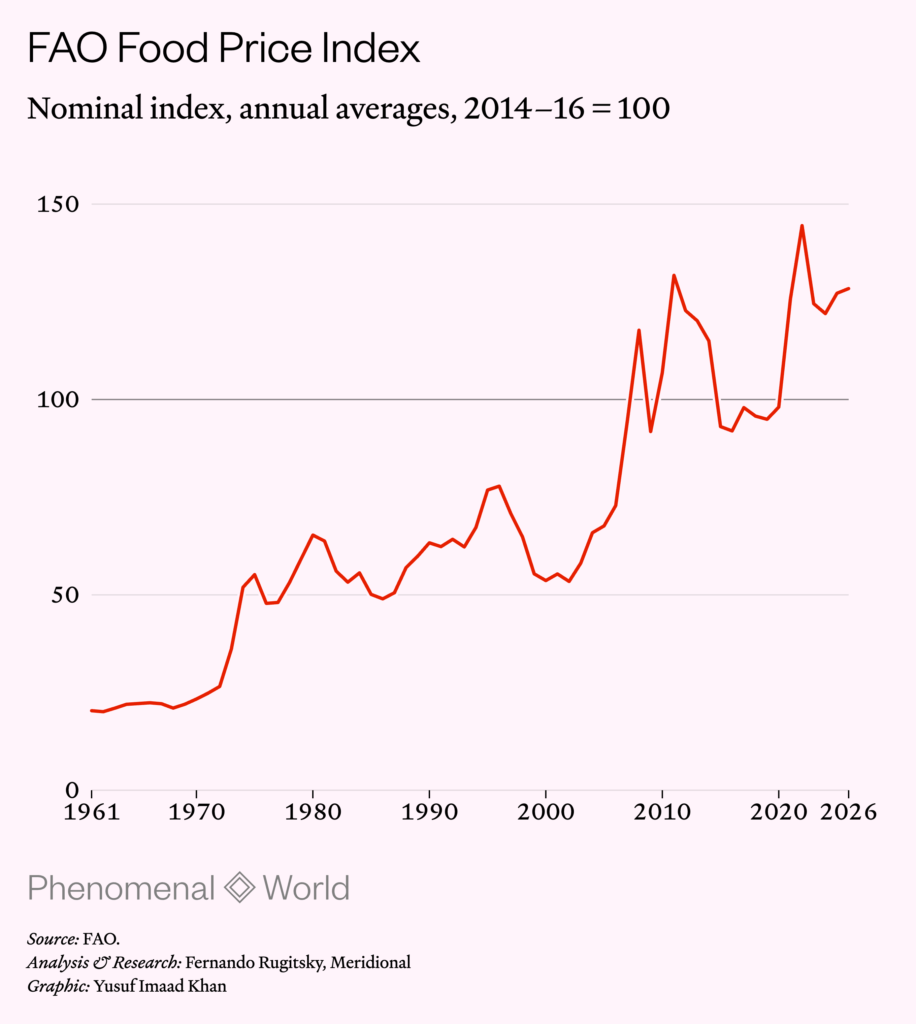
According to the Food Price Index published by FAO (Food and Agriculture Organization, of the United Nations), after a significant episode of food inflation in the early 1970s, food prices oscillated around a relatively stable level over the three subsequent decades. Since the mid-2000s, however, the world has experienced two major food price crises: the first coincided with the global financial crisis of 2008, while the second started during the Covid pandemic. The reversal after 2008 was modest, keeping prices significantly above their pre-crisis trend. And the combination of the fertilizer crisis with the forecasted super El Niño this year will likely extend the crisis that started with the pandemic. Unsurprisingly, research has shown again and again that the effects of these crises are more severe in the poorer countries of the global south. When scarcity emerges, richer economies use their deeper pockets to guarantee their supplies, leaving the rest to fight over crumbs.
The global food system not only fails to guarantee a stable flow of affordable food but also fuels many of the structural trends that prevent it from doing so. Through its ecological impact, it acts as its own gravedigger, at both a local level and a global one. Readers of this column are already aware of how the Amazon rainforest—a critical biome for the planet’s climate—is threatened by the soy-meat complex, a key node of the current food regime. The deforestation driven by cattle and soy ends up affecting the rainfall patterns on which these productive activities depend. The Indonesian rainforest, in turn, is particularly threatened by oil palm plantations that cater for processed food manufacturers.
More generally, as Martín Arboleda and his co-authors write, the globalized agri-food system constitutes “the main driver of biodiversity loss, depletion of water sources, and soil erosion at the planetary scale.” Estimates suggest that when one factors in land-use change, transport, packaging, retail, and waste, the food system accounts for a fifth to a third of all global greenhouse gas emissions. Through its contribution to global warming, the global food system—“fossil food”—helps to create the extreme weather events that disrupt its own operations.
The future of food
As it developed, the current global food system met continuous resistance, especially from peasant movements that rose against expropriation, displacement, the spread of monocropping, and the uprooting of cultural traditions. These movements won specific battles, shaping policies and institutions, but did not manage to prevent the big agri-food corporations from consolidating their dominant position. Yet in the last decade, as the pathologies of the current food regime—including food inflation—combined with the generalized social, economic and ecological crises, they provoked serial revolts against the status quo.
Still, the ruling agri-food interests were mostly able to remain beyond the reach of political controversy. In fact, the far-right movements that emerged during this period managed to mobilize farmers—in the Americas and in Europe—against environmental policies, rather than against the corporations that subordinate them. In some cases, these social sectors were key to strengthening reactionary political parties, such that they could foreclose inclusive and democratic alternatives to the current situation—at least for the time being.
The question, then, is whether the emergency measures aimed at dealing with food inflation can break out of this doom loop and revive the possibility of transforming food provision. There is certainly scope to mitigate the harmful effects of the current system, designing policies to improve standards, reduce concentration across the supply chain, and moderate price volatility—as with the buffer stocks that Isabella Weber and others have been advocating. The importance of these steps should not be underestimated in a world where just under a tenth of the population faces hunger, and more than a quarter is moderately or severely food insecure.
However, it is unlikely that any commodified food system, based on profit-seeking firms, can reverse the trend towards ever-increasing concentration and centralization of capital, to borrow Marx’s phrase. The last two centuries suggest that such concentration inevitably produces ecological degradation and food insecurity—even if its other negative impacts (for instance on inequality) could be softened. This is probably the main lesson from the literature on the history of the global food system. In the beginning, capitalism’s transformation of food production and distribution increased yields substantially, creating the possibility of sustaining the growing shares of the population that started to concentrate in cities. Yet such development, driven by profits rather than by the goal of providing society with sufficient healthy food, created a food system defined by accumulating vulnerabilities: one which degraded the environment and supplied addictive and unhealthy food, ultimately failing to deliver on its promise.
There are various forms that a decommodified alternative could take. One possibility would involve replacing the homogenizing drive of the last two centuries with a logic of diversity based on agroecological practices. This could build on peasant resistance, not to take agriculture back to the eighteenth century, but to extend the innovative ways in which agroecological practices have been managing to reconcile modern techniques with conservation, renewing a multitude of food, agricultural and cultural traditions. In the words of Kai Heron, such a path would mean “freeing the world’s producers to choose from a richer and more diverse array of technologies and socio-ecological relations than capitalist industrialization can offer.”
There is a broad convergence between researchers working on the topic in that direction. But some on the left remain skeptical. Matt Huber, for instance, has argued that “the eco-socialist penchant for a retreat to small-scale agriculture . . . implies hunger, if not starvation, for the world’s mega-slums.” Similarly, George Monbiot has stated that “it’s impossible to feed the world on low-yield agroecology.” They both share hopes for technological alternatives, like “lab meat”—the development of which, according to Huber, would thrive if it were unfettered from capitalist social relations. These eco-modernist challenges are useful to focus the discussion on key issues, like the measurement of yields in mixed cropping systems and the current role played by family farmers in food provision. There is evidence, for instance, that farms under two hectares, surviving in the shadows of the global food system, are responsible for around a third of food supply.
In any case, accepting that the current system is broken is a vital prerequisite for mapping these possible decommodified futures, their political and ecological implications, and the barriers to their realisation. Here, a detailed understanding of the current food system is essential to develop a politics that can transform it, from the eco-territorial struggles in the main producing regions to disputes about food provision and prices in importing countries. The stakes are high, given that the status quo offers nothing but deepening food insecurity and feeds political regression. Yet transcending such problems may also illuminate a path to resolving our broader planetary crises—since the former are inextricably bound up with the latter.
Fernando Rugitsky, born and raised in São Paulo, Brazil, is a Senior Lecturer in Economics at SOAS University of London. He has held positions at the University of São Paulo (2015–2021) and the University of the West of England (2021–2025) and obtained his PhD at The New School for Social Research.

No comments:
Post a Comment