“Do not tell me we cannot afford Medicare for All,” said Sen. Bernie Sanders. “What we cannot afford is a broken healthcare system based on greed.”
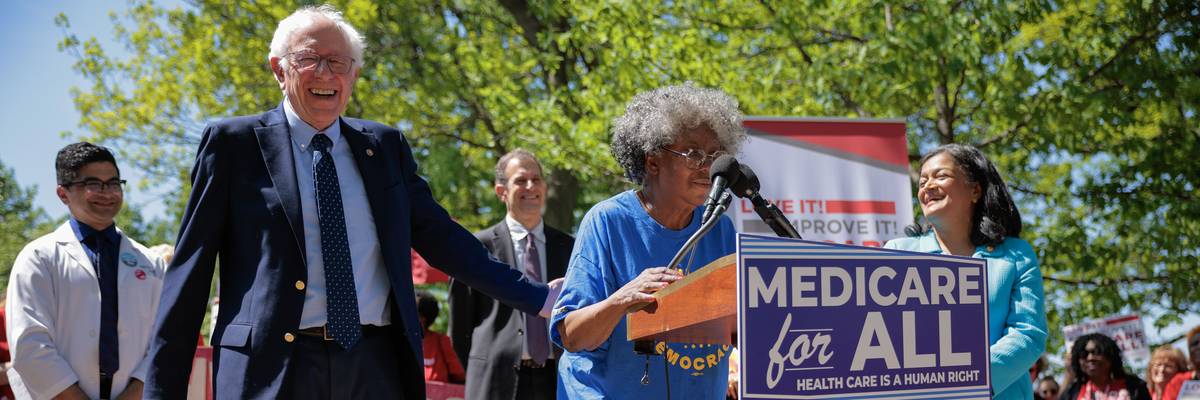
US Sen. Bernie Sanders (I-Vt.) shares a laugh with 80-year-old Frankie Clark of North Carolina as she addresses a rally to reintroduce the Medicare for All Act on April 29, 2025 in Washington, DC.
(Photo by Chip Somodevilla/Getty Images)
Jessica Corbett
Aug 11, 2026
COMMON DREAMS
Previous research has shown that shifting the United States to a Medicare for All system could save roughly 68,000 lives and $650 billion per year, but a new study by experts at Yale University suggests the savings would likely be even greater on both fronts.
In a Tuesday statement, Sen. Bernie Sanders (I-Vt.), lead sponsor of the Medicare for All Act in the Senate, highlighted the findings, published recently on medRxiv, a server for preprints, or research that hasn’t yet been peer reviewed.
“The US spends more on healthcare than any other nation, yet tens of millions of Americans are uninsured or underinsured, and coverage retractions enacted in 2025 are widening these gaps,” the five experts wrote.
Upward of 15 million Americans could lose health insurance coverage over the next decade because of Medicaid cuts in President Donald Trump’s so-called One Big Beautiful Bill Act and the Republican-led Congress’ failure to extend Affordable Care Act subsidies that expired at the end of last year.
“The misalignment between the for-profit insurance architecture and optimal patient care, together with the inefficiencies of a fragmented system, contributes to both unnecessary costs and preventable mortality,” according to the Yale researchers. “We update our previous analyses with the most recent data to project the economic benefits and the number of lives saved that would be achieved by single-payer universal coverage, as proposed in the Medicare for All Act.”
“We estimate that such a system would reduce national health expenditure by $1,041 billion annually,” they explained. “Sources of savings include reductions in administrative overhead, pharmaceutical prices, fraudulent billing, and avoidable emergency care. Combined with the reversal of recent retractions, universal coverage would save over 114,000 lives annually.”
Specifically, as Sanders’ office detailed in a statement, Americans would save:$377.5 billion by paying no more than other major countries for prescription drugs;
$286.3 billion by eliminating bureaucracy and waste;
$285.7 billion by curbing fraudulent billing;
$100 billion by preventing costly emergency room and hospital visits; and
$295.6 billion by reimbursing providers fairly for the care they provide.
Welcoming the findings, the senator declared that “this study confirms what we have known for years: Medicare for All saves lives and saves money. In fact, guaranteeing healthcare as a human right through a Medicare for All, single-payer system would cost $1 trillion less than our current dysfunctional system.”
“It would save working families thousands of dollars a year. And it would prevent over 100,000 Americans from dying unnecessarily each and every year because they cannot make it to a doctor in time,” he stressed. “At a time when 15 million Americans are being thrown off the healthcare they have and 20 million Americans have already seen their premiums double, on average, as a result of Trump’s so-called ‘Big Beautiful Bill,’ we need Medicare for All now more than ever.”
“The time is now to end the greed of the big insurance and drug companies and pass Medicare for All,” he added.
The research comes as Americans face high prices for not only healthcare but also food, gasoline, housing, and more under President Donald Trump and the GOP-led Congress. It also comes amid a renewed push by hundreds of advocacy groups that support Medicare for All and a wave of victories by progressive candidates who support the policy.
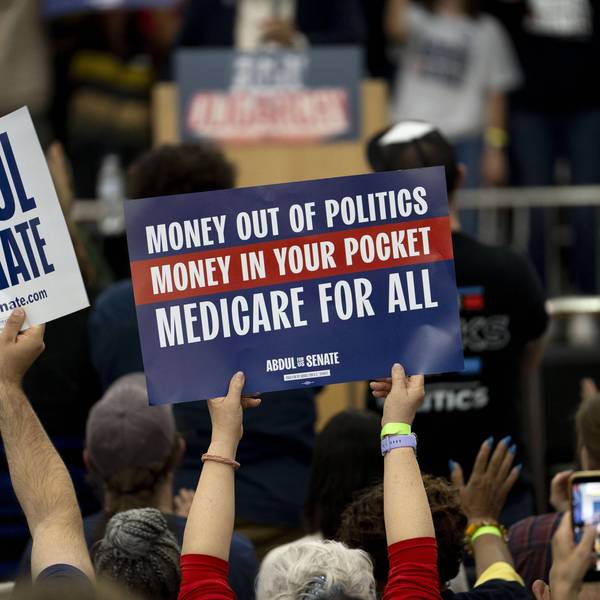
Among them is former Detroit health official Abdul El-Sayed, who won the Democratic primary for US Senate in Michigan last week having campaigned on a promise to prioritize “money out of politics, money in your pocket, and Medicare for All.” His victory followed those of various other candidates, from Colorado to New York and Pennsylvania.
However, it’s not just elected Republicans standing the way of a transition to universal healthcare in the United States. As a Monday analysis from the investigative outlet Sludge shows, the health insurance industry is pouring money into Third Way, a think tank reportedly preparing to spend $15 million combating the rise of candidates who support progressive policies including Medicare for All.
Analysis Shows Insurance Industry Funding Third Way as It Plots ‘War’ on Medicare for All Backers
Third Way has received donations from CVS Health, Johnson & Johnson, and an organization that counts the Blue Cross Blue Shield Association as one of its members, tax filings reveal.
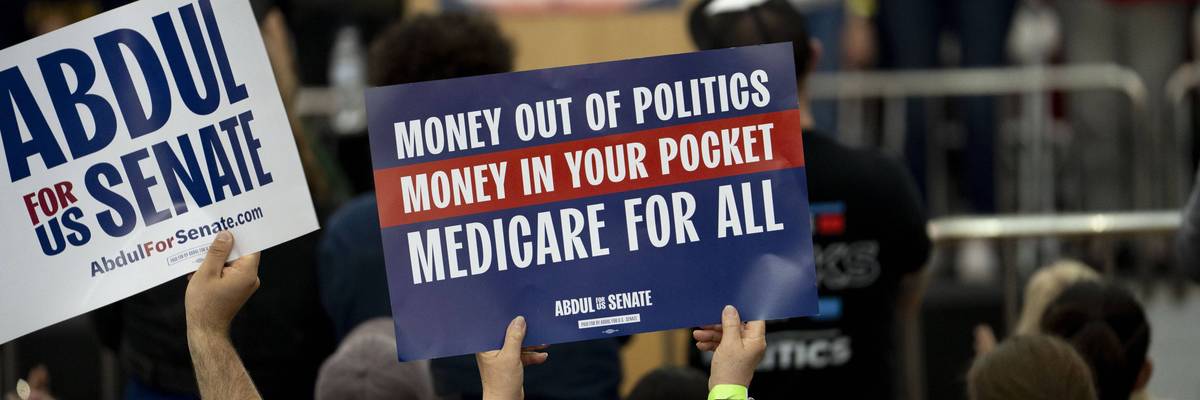
The audience cheers during a rally at Mumford High School on May 3, 2026 in Detroit, Michigan.
(Photo by Sarah Rice/Getty Images)
Jake Johnson
Aug 11, 2026
COMMON DREAMS
The investigative outlet Sludge published an analysis on Monday showing that the health insurance industry is among the corporate donors to Third Way, a think tank that is reportedly preparing to pour $15 million into an effort to combat the rise of candidates who support Medicare for All and other progressive policies.
Third Way, which has long been hostile to the progressive wing of the Democratic Party and Medicare for All in particular, does not publicly disclose its donors. But Sludge’s David Moore uncovered some of the group’s benefactors by examining corporate tax filings, which revealed that the private insurance industry group Better Solutions for Healthcare (BSFH) donated $50,000 to Third Way’s advocacy arm in 2024.
Among BSFH’s members are the Blue Cross Blue Shield Association and the health insurance industry trade group AHIP. Moore noted that BSFH is “run out of the offices of leading Republican digital and strategy firm Targeted Victory in Arlington” and was founded by GOP operative Alexander Schriver.
Sludge’s review of corporate tax filings showed other healthcare industry donors to Third Way, including CVS Health and Johnson & Johnson.
“Another corporate lobbying heavyweight, the Business Roundtable (BRT), gave $50,000 to Third Way in 2024, up from the $25,000 it gave in 2023 and down from the $75,000 it gave in 2022,” Moore reported. “Each year in 2019, 2020, and 2021, BRT gave $50,000 to Third Way. The CEO group’s health insurance members include the heads of UnitedHealth, Cigna, Elevance (formerly Anthem), CVS Health—all members of AHIP (formerly America’s Health Insurance Plans), save for UnitedHealth—as well as healthcare company Centene and many Big Pharma firms like Johnson & Johnson.”
Moore’s reporting came days Third Way president Jonathan Cowan told The New York Times that his organization is “preparing for the next war that is coming.”
Cowan said that “it is deeply troubling to see radical, far-left candidates winning in places that are potentially presidential swing states”—a comment published two days after progressive epidemiologist Abdul El-Sayed, a vocal supporter of Medicare for All, won the Democratic primary for a critical US Senate seat in Michigan.
The Times story characterized Third Way as “a leading centrist Democratic group,” without mentioning the organization’s corporate ties.
“Post El-Sayed’s win, Third Way has done media hits in NYT, CNN, WaPo, Vox, and not one of these outlets has mentioned who funds Third Way historically or bothered to ask who their current donors are,” journalist Adam Johnson wrote in a social media post on Tuesday, praising Sludge’s review of tax records.
“Journalists are, in principle, supposed to do what David did here: investigate ulterior motives, follow the money, dig deeper,” Johnson wrote. “Alas what mainstream outlets have done for Third Way this past week is credulously take them at their word they are merely ‘concerned about electability.’”
Earlier this year, Third Way published a memo attacking Medicare for All and its purportedly “astronomical cost.” (The memo does not mention research showing that a Medicare for All system would cost less than the status quo, while providing comprehensive universal health coverage and saving tens of thousands of lives per year.)
A recent study by Yale University researchers found that a Medicare for All system would reduce US national health expenditures by more than $1 trillion a year and “save over 114,000 lives annually.”
Dr. Ed Weisbart, the national board secretary of Physicians for a National Health Program, told Sludge that “anybody who chooses to attack [Medicare for All] is putting themselves out of step with what I think most people in our country see as the solution.”
“People want this, even when they understand that of course it’s going to mean a change in their taxes—but they also understand that for 95% of people or so, the change in taxes is smaller than the amount that they would save by not having premiums, not having co-pays, not having deductibles,” said Weisbart. “People are getting that. And if you try to market a political view that’s opposite, people see right through that.”
Third Way has received donations from CVS Health, Johnson & Johnson, and an organization that counts the Blue Cross Blue Shield Association as one of its members, tax filings reveal.
The audience cheers during a rally at Mumford High School on May 3, 2026 in Detroit, Michigan.
(Photo by Sarah Rice/Getty Images)
Jake Johnson
Aug 11, 2026
COMMON DREAMS
The investigative outlet Sludge published an analysis on Monday showing that the health insurance industry is among the corporate donors to Third Way, a think tank that is reportedly preparing to pour $15 million into an effort to combat the rise of candidates who support Medicare for All and other progressive policies.
Third Way, which has long been hostile to the progressive wing of the Democratic Party and Medicare for All in particular, does not publicly disclose its donors. But Sludge’s David Moore uncovered some of the group’s benefactors by examining corporate tax filings, which revealed that the private insurance industry group Better Solutions for Healthcare (BSFH) donated $50,000 to Third Way’s advocacy arm in 2024.
Among BSFH’s members are the Blue Cross Blue Shield Association and the health insurance industry trade group AHIP. Moore noted that BSFH is “run out of the offices of leading Republican digital and strategy firm Targeted Victory in Arlington” and was founded by GOP operative Alexander Schriver.
Sludge’s review of corporate tax filings showed other healthcare industry donors to Third Way, including CVS Health and Johnson & Johnson.
“Another corporate lobbying heavyweight, the Business Roundtable (BRT), gave $50,000 to Third Way in 2024, up from the $25,000 it gave in 2023 and down from the $75,000 it gave in 2022,” Moore reported. “Each year in 2019, 2020, and 2021, BRT gave $50,000 to Third Way. The CEO group’s health insurance members include the heads of UnitedHealth, Cigna, Elevance (formerly Anthem), CVS Health—all members of AHIP (formerly America’s Health Insurance Plans), save for UnitedHealth—as well as healthcare company Centene and many Big Pharma firms like Johnson & Johnson.”
Moore’s reporting came days Third Way president Jonathan Cowan told The New York Times that his organization is “preparing for the next war that is coming.”
Cowan said that “it is deeply troubling to see radical, far-left candidates winning in places that are potentially presidential swing states”—a comment published two days after progressive epidemiologist Abdul El-Sayed, a vocal supporter of Medicare for All, won the Democratic primary for a critical US Senate seat in Michigan.
The Times story characterized Third Way as “a leading centrist Democratic group,” without mentioning the organization’s corporate ties.
“Post El-Sayed’s win, Third Way has done media hits in NYT, CNN, WaPo, Vox, and not one of these outlets has mentioned who funds Third Way historically or bothered to ask who their current donors are,” journalist Adam Johnson wrote in a social media post on Tuesday, praising Sludge’s review of tax records.
“Journalists are, in principle, supposed to do what David did here: investigate ulterior motives, follow the money, dig deeper,” Johnson wrote. “Alas what mainstream outlets have done for Third Way this past week is credulously take them at their word they are merely ‘concerned about electability.’”
Earlier this year, Third Way published a memo attacking Medicare for All and its purportedly “astronomical cost.” (The memo does not mention research showing that a Medicare for All system would cost less than the status quo, while providing comprehensive universal health coverage and saving tens of thousands of lives per year.)
A recent study by Yale University researchers found that a Medicare for All system would reduce US national health expenditures by more than $1 trillion a year and “save over 114,000 lives annually.”
Dr. Ed Weisbart, the national board secretary of Physicians for a National Health Program, told Sludge that “anybody who chooses to attack [Medicare for All] is putting themselves out of step with what I think most people in our country see as the solution.”
“People want this, even when they understand that of course it’s going to mean a change in their taxes—but they also understand that for 95% of people or so, the change in taxes is smaller than the amount that they would save by not having premiums, not having co-pays, not having deductibles,” said Weisbart. “People are getting that. And if you try to market a political view that’s opposite, people see right through that.”

No comments:
Post a Comment