The Silver Lining: The Donald’s Impending Defeat in Iran May Finally Bring the Empire Home
It is damn obvious that Washington has lost Donald Trump’s idiotic war on Iran. After all, it is now five months since the opening salvos of Operation Epic Fury on February 28, which was advertised to last only 3-4 weeks. Instead, the conflict has settled into a grinding, inconclusive stalemate at best, and, more importantly, a strategic fiasco that reveals the bankruptcy of America’s entire Empire-based foreign policy.
The fact is, the War on Iran was misbegotten from the get-go because Iran posed no credible threat whatsoever to the homeland security of the United States. Period. Full stop.
In that regard, no American president has ever launched a war on such thin, specious grounds: The one and only reason for unleashing the bombers and missiles on February 28th was to honor the request of a so-called “ally” in furtherance of his desperate need to maintain a 61-vote coalition in the Knesset.
That’s right. The Donald took America to war lest Netanyahu be thrown from office, tried and convicted for years of egregious corruption and put behind bars where he belongs.
After all, on the eve of the strikes Iran possessed no nuclear weapons; no active weaponization program that had crossed the threshold of a deployable bomb; no blue-water navy capable of projecting power across oceans; not a single of long-range strategic bombers capable of dropping bombs anywhere, let along on the far side of the Atlantic; and no ballistic missiles with ranges exceeding the 2,000 kilometers to the Strait of Gibraltar – far, far short of Washington, D.C., or any American city at 10,000 kilometers or more distant from Tehran.
Likewise, Iran’s military budget at hardly $25 billion was a pittance (2.2%) relative to the Pentagon’s bountiful $1 trillion of annual rations – while its GDP of approximately $350 billion represented a tiny 1.1% of America’s $30 trillion economy.
Yet Ding Dong Donald and his Def Sec Gymboy Kegseth – all of the latter’s performative fitness videos and martial posturing notwithstanding – have flat-out managed to lose the war.
That is to say, the Pentagon is nearly out of critical munitions, meaning that short of a land invasion by US boots on the ground there is nothing left to do. Indeed, given Iran’s vast expanse, mountainous fortress like terrain and large, well trained and brutal IRGC militias, it would be a meat-grinder like no other; and surely one that even Bone-Spur Donald doesn’t have the stomach for (and appropriately so).
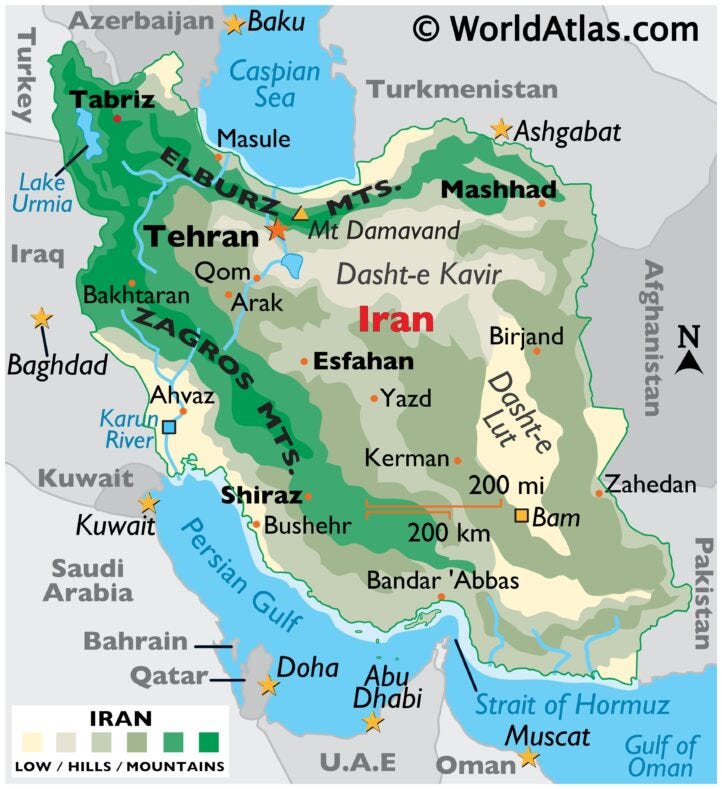
So what comes next will be a transparent “defeat” that the Donald will nevertheless claim is Fake News. That’s right. Any day now as the clock ticks down to the November mid-terms, Trumpety will announce a “deal” that for all intents and purposes leaves Iran and its Oman partner in charge of the Strait of Hormuz (SOH). In fact, Kegseth may have already raised the white flag:
Bessent: Today or Tomorrow the Strait will be Open While Iran Signals ‘Compensation’
…Iran has announced that under the ‘finalized’ Oman-Iran scheme and ‘deal’ for management of the Hormuz Strait that “enemy countries” (read: US and Israel) may only transit the waterway after lifting sanctions and paying compensation for the war.
Perhaps through some cosmetic variation of their pending agreement for Iran to supervise and tax vessels entering the SOH and Oman to supervise them and tax them again on the way out of the SOH.
Indeed, based on the currently leaked essentials of the impending bilateral agreement between Iran and Oman, there is no other way to describe the current state of play than as a humiliating defeat for Donnie & Bibi:
- The passage of vessels belonging to the United States, Israelis and other hostile countries through the Strait of Hormuz will be prohibited.
- Ships related to Israel, whether military or civilian, will not have the right to transitthrough this area.
- Vessels or cargoes that play a role in actions against the Resistance Front will also be subject to the ban.
- Countries and individuals that have caused damage to Iran will not receive permission to pass through the Strait of Hormuz and the Persian Gulf until compensation is paid.
- Heavy fines, including up to 20% of the value of the goods, will be imposed on violators.
- The two government will assume responsibilities for guiding navigation, monitoring vessel traffic, and protecting the security and environment of the Persian Gulf.
For want of doubt that Washington can’t do a damn thing to mitigate this impending arrangement, just consider the Pentagon’s depleted state of munitions. The facts with respect to the latter are now leaking into the public press through a sieve.
Thus, it is now an established fact that interceptor stocks for THAAD missile defense systems have been drawn down by 80%, meaning that 200 interceptor missiles of the pre-war stock of 250 interceptors have already been expended.
The same thing is true of the Patriot defense systems, where pre-war stocks of ab0ut 2200 interceptors have been drawn down to an estimated 800. At the same time, on the offensive missile stocks including ATACMS and Precision Strike Missiles are effectively exhausted in many categories, and Tomahawk cruise missile inventories have also been heavily depleted after the intensive opening campaigns and subsequent tit-for-tat exchanges.
Under these circumstance, a no exit stalemate wrapped in the humiliating straight-jacket of the impending Iran-Oman agreement is indeed a thundering defeat because their was no reason for the attack in the first place. And no reason to imperil the domestic and world economy to the punishing impact of stopping the flow of 30 million barrels per day energy equivalent of crude oil, refined products, LNG and LPGs, helium, sulfur, aluminum and other industrial materials.
Still, there is surely a silver lining in this greatest U.S. military defeat in modern history – even if under the nation’s most impulsive and strategically incompetent presidents ever. Namely, the possibility that the delusional scales of Empire may finally fall from the eyes of the American people.
The fact is, there is no need for a globe-spanning empire of military forces, bases, naval armadas, forward deployments, and Forever Wars stretching from one end of the planet to the other. An invincible nuclear deterrent combined with a robust Fortress America conventional defense of the nation’s coastlines, airspace, and near approaches would more than guarantee the security and liberty of the American people from sea-to-shining-sea.
Moreover, a true America First defense posture could be funded on roughly $350 billion per year, not the empire’s current near-trillion-dollar budget. So the Donald’s rash, impulsive launch of the war on Iran may, ironically, point the way toward a more peaceful world free of the utterly unnecessary, dangerous, and bankrupting empire bivouacked on the banks of the Potomac.
Iran as a Non-Threat to the American Homeland
Begin with first principles of strategic assessment. The military security of the American Homeland must sharply distinguish between regional nuisances and genuine existential threats. Iran under the Islamic Republic has been no model of world citizenship, but on the metrics that matter for direct American defense, Tehran ranked near the bottom of plausible adversaries.
Its ballistic missile inventory, while sizable and improved through domestic production and foreign assistance, remained firmly in the medium-range category, with a reach of a few hundred kilometers to 2,000 kilometers at most. It’s missiles such as the Shahab-3 and its derivatives, along with more recent solid-fuel designs, offered ranges sufficient to menace regional targets – Israel, Gulf oil facilities, U.S. bases in the Middle East – but not remotely the continental United States 10,000 or more kilometers distant.
Likewise, Iran’s air force relied on aging platforms, many of them pre-1979 American or Soviet designs kept flying through engineering ingenuity, sanctions-busting imports and bailing wire and bubble-gum.
Similarly, its navy was a coastal and asymmetric force centered on fast boats, mines, and anti-ship missiles. These forces were arguably formidable in the confined waters of the Persian Gulf and Strait of Hormuz, but utterly irrelevant for blue-water power projection against the U.S. Navy or the American seaboard.
Likewise, nuclear weapons remained aspirational rather than operational. Enrichment levels had risen, and breakout timelines shortened in various intelligence assessments, but Iran had no confirmed weaponization program that had produced a tested or deliverable device by early 2026. That is to say, according to the 17 US intelligence agencies, the weaponization research program which had been abandoned 23 years ago, in 2003, had remained abandoned.
Iran’s entire $25 billion of annual military expenditure, even allowing for off-budget Revolutionary Guard funding from oil and other sources, remained a rounding error relative to the United States. Against this backdrop, the decision to initiate major combat operations in late February 2026 – framed by Trump as necessary to prevent nuclear acquisition, destroy missile capabilities, annihilate the navy, and encourage regime change – represented the ultimate case of egregious threat inflation.
The war’s opening phase, involving nearly 900 strikes in the first twelve hours and the killing of Supreme Leader Ali Khamenei, demonstrated American and Israeli technological superiority on the narrow matter of precision strikes and intelligence. But Iran’s retaliatory barrages of missiles and drones inflicted far more consequential damage across the region, drastically disrupted shipping in the Strait of Hormuz, and strained U.S. and allied air defenses.
At the same time, the fanciful strategic objective of forcing Iranian capitulation or collapse did not remotely materialize. Successive cease-fires collapsed. Tit-for-tat strikes continued into the summer. By August, the conflict had settled into attrition without decision – even as the massive, undeniable outpouring of tens of millions of Iranians for the Ayatollahs funeral exemplified the very opposite of “capitulation” or even the Donald’s open days demand for “unconditional surrender”.
Resource Disparity and the Illusion of Easy Victory
Indeed, the numerical mismatch was staggering and should have counseled caution. The U.S. defense budget hovered near or above $1 trillion when all accounts, supplementals, and nuclear costs are included. Iran’s formal military budget was reported in various open sources in the single-digit to low double-digit billions, representing a couple of percent of a GDP and less than 2 percent the size of the Pentagon’s massive annual rations.
This disparity, however, fueled the hubris that air and missile power alone could achieve decisive results. Alas, modern history offers repeated warnings against such optimism: Vietnam, Iraq after 2003, Afghanistan, Libya.
That is to say, precision munitions can destroy fixed infrastructure and leadership compounds, but they cannot occupy territory, police populations, or compel political outcomes in a large, coherent nation-state with significant popular residual support for sovereignty, however authoritarian the regime.
Iran’s population, terrain, and experience with prolonged external pressure made it particularly unsuitable for a low-cost coercive campaign.Instead of a quick victory, Washington found its stockpiles of high-end munitions drawn down at the alarming rates cited above, including near-exhaustion of certain tactical ballistic missiles, the aforementioned severe depletion of air-defense interceptors, and heavy consumption of cruise missiles.
Moreover, production lines for replacement munitions and equipment stocks take years to ramp up to higher production. Industrial base constraints that accumulated over decades of the reduced post-Cold War procurement modus operandi and simultaneous commitments in Europe and the Indo-Pacific could not be wished away overnight.
The Donald and Secy Kegseth, of course, repeatedly and publicly denied critical shortages. Yet the evidence for this has been plain to see: To wit, threatened major escalations didn’t happen and repeated “pauses” in between were as much driven by munitions availability as by diplomatic tactics.
The absence of appetite for a ground invasion was equally telling. A full-scale invasion would have required hundreds of thousands of troops, months of buildup, and acceptance of potentially high casualties against an enemy prepared for asymmetric defense. Public opinion, congressional caution, economic costs (already in the tens of billions and rising), and the proximity of midterm elections made such a course just plain politically toxic. Even to the Donald and his retainers.
Yet without a land-based military clearance of the territory occupied by the IRGC and Iran’s now make-shift and shape-shifting wartime government, the Iran War has remained, and will continue to be, a limited, inconclusive tit-for-tat air and naval contest. And be all appearances, one that Iran could endure through its proxies, geography, and willingness to absorb punishment for an indefinite duration.
Washington’s Leadership Failure and Strategic Incoherence
Needless to say, the herky-jerky Trumpian conduct of the war reflects deeper pathologies of leadership. The Donald’s decision-making style – impulsive announcements, maximalist rhetoric, rapid shifts between threats of annihilation and claims of impending deals – have produced a muddled, meandering campaign, to put it charitably.
The regime-change rhetoric early on may have encouraged US and Israeli hardliners, but the proof is now in the pudding: it’s been a big nothing-burger on the ground in Iran: The Donald’s hollow calls for the Iranian people to rise up completely ignored the realities of authoritarian control and nationalist backlash against external attack.
Secy Kegseth’s comical tenure has surely compounded the problem. As a former media personality elevated to the top civilian defense post for which he was utterly unqualified, he did bring a simulacrum of noising energy to “America First” rhetoric. Yet that was a distraction at best, only faintly disguising his lack of practical management experience and dearth of policy and military knowledge, as well as the obvious limits of performative toughness.
It cannot be gainsaid, of course, that munitions accounting, industrial mobilization, and alliance coordination required bureaucratic competence—far more than gym videos or martial slogans. But now the true state of operational reality in the Persian Gulf theater is rapidly bubbling to the surface: To wit, Washington is tantamount to out of ammo, and the Zulu hordes are still coming.
The Broader Pathology of Empire Revealed
The Iran war is merely the latest chapter in a longer story of Washington’s over-extension globally. Since the end of the Cold War, successive administrations of both parties expanded the perimeter of U.S. security commitments: NATO enlargement, the global war on terror, nation-building experiments, and a web of bases and alliances that now spans the planet.
The original rationale – containing Soviet power – disappeared nearly 35 years ago. And yet and yet. The military budget and infrastructure of Empire remained and grew. The result has been perpetual low-level conflict, fiscal strain, and a military posture optimized for presence nearly everywhere rather than concentrated defense of core interests.
Moreover, once far-flung bases and alliances exist, bureaucratic and political incentives preserve them. Forever Wars produce neither decisive victories nor stable political outcomes; they just generate resentment, radicalization, and opportunities for adversaries to impose costs asymmetrically.
The gaping munitions shortages now being revealed are actually a symptom of a system that tries to do everything everywhere with finite industrial capacity. Yet a rational alternative exists and has deep roots in American tradition.
George Washington’s farewell address warned against permanent alliances and entanglement in European quarrels. The Monroe Doctrine focused on the Western Hemisphere only. For most of its history before 1945, the United States thrived under a strategy of continental defense, commercial engagement, and naval power sufficient to protect its approaches – not global constabulary duty.
The advent of the nuclear weapons age after WWII actual reinforced this historic equation by providing an ultimate deterrent that makes large-scale conventional aggression against the American homeland suicidal for any peer or near-peer. Combined with modern sensors, air and missile defenses, a capable navy focused on sea control in the approaches, and a professional army sized for hemispheric contingencies, such a posture would be formidably secure.
Fortress America and the $350 Billion Alternative
What would a restrained Fortress America posture look like in practice?
First, an invincible nuclear triad – modernized but not endlessly expanded – would remain the bedrock. Second, conventional forces would prioritize defense of the continental United States, its airspace, its exclusive economic zone, and key near-abroad interests in the Western Hemisphere.
Carrier strike groups and expeditionary forces useful only for foreign invasions and occupation would be eliminated. Symbolically, the US Marine Corps would be the first to go and would be abolished completely: It never should have traversed ” from the shores of Montezuma to the halls of Tripoli” in the first place.
Likewise, the 800 US overseas bases would be closed . Forward deployments in Europe and the Middle East would be eliminated completely, forcing regional actors to assume primary responsibility for their own security.
Needless to say, the fiscal dividend would be substantial. Credible analyses of a Fortress America defense posture have long suggested that a force structure focused on nuclear deterrence and homeland defense could be sustained at roughly one-third of current spending levels – around $350 billion in today’s dollars.
And, no, the bogeyman of power “vacuums” filled by China, Russia, or regional predators does not gainsay the case for Fortress America. This argument confuses American presence with American security. Regional balances of power can and do form without permanent U.S. garrisons. Allies with larger populations and economies than Iran – Japan, South Korea, European NATO members, Gulf states – are capable of greater self-reliance if the expectation of automatic American rescue is removed.
The Path to a More Peaceful World
The defeat in Iran, if recognized as such, offers a rare so-called “teaching moment”. Americans have repeatedly learned the limits of military power the hard way – Vietnam, Iraq, Afghanistan – only to forget the lesson within a generation.
The current war’s combination of high cost, limited results, munitions exhaustion, and political reluctance for escalation will hopefully prove harder to ignore this time around. Public fatigue with distant conflicts is already palpable; fiscal reality will reinforce it.
A, not, a shift toward Fortress America would not mean isolation or pacifism, either. Trade, diplomacy, intelligence cooperation, and selective engagement would continue. Nuclear deterrence would remain robust. The United States would still possess unmatched conventional capabilities for the defense of its core interests.
What would end is the illusion that American blood and treasure must be spent indefinitely to manage every regional rivalry or to guarantee the internal political arrangements of distant societies.In that sense, Trump’s impulsive war may achieve an unintended constructive result. By demonstrating the costs and limits of coercive regime change and open-ended military pressure against a mid-sized power that posed no direct homeland threat, it could accelerate a long-overdue abandonment of the foolishness of Empire.
Today’s Empire on the Potomac is not inevitable. It is a long-standing and erroneous policy choice sustained by inertia, interest groups, and threat inflation. When that choice is finally and decisively shown to produce defeat rather than security, the possibility of a more restrained, solvent, and peaceful American strategy becomes visible.
The American people deserve a defense policy calibrated to actual threats rather than maximalist ambitions. Iran in February 2026 was not such a threat. The only real threat which existed on February 28th was the threat to Bibi’s tenure in office in the absence of war that he has campaigned for with one Oval Office occupant after the next, until he finally found one foolish enough to take the bait.
In any event, recognition of that failure is the first step toward a posture that prioritizes the security of the American homeland, the solvency of the American republic, and the avoidance of unnecessary wars. An invincible nuclear deterrent and impregnable Fortress America defense funded at a sustainable level would provide both safety and the freedom to rebuild at home.
That is the genuine America First strategy that the current debacle may finally make possible.
David Stockman was a two-term Congressman from Michigan. He was also the Director of the Office of Management and Budget under President Ronald Reagan. After leaving the White House, Stockman had a 20-year career on Wall Street. He’s the author of three books, The Triumph of Politics: Why the Reagan Revolution Failed, The Great Deformation: The Corruption of Capitalism in America, TRUMPED! A Nation on the Brink of Ruin… And How to Bring It Back, and the recently released Great Money Bubble: Protect Yourself From The Coming Inflation Storm. He also is founder of David Stockman’s Contra Corner and David Stockman’s Bubble Finance Trader.
Trump’s Iran War Raises a Midterm Question: Who Decides When America Goes to War?
On July 23, President Donald Trump threatened to carry out his “biggest attack yet” on Iran after nearly two weeks of renewed U.S. airstrikes. That same day, the House voted 214–208 to direct the president to remove U.S. forces from hostilities with Iran, while a parallel Senate effort failed 47–49. The contrast sharpened a question that has followed the conflict from the start: why can any president bring the United States deeper into another Middle Eastern war with so little meaningful involvement from Congress? The answer reaches beyond one administration, party, or operation to the functioning of American democracy itself.
Washington has long debated individual interventions while paying less attention to the expanding presidential authority that made them possible. Trump did not create this system; he inherited it. His presidency, however, exposed how much war-making power has accumulated in the executive branch and how far the country has moved from the constitutional balance the founders envisioned.
The Constitution’s principle is clear: decisions about war should not rest with one person. The president is commander in chief, but Congress received the authority to declare war because the framers feared concentrated power. Having lived under monarchy, they believed sending citizens to war required public debate, legislative consent, and political accountability.
That balance eroded from Korea through Vietnam, Iraq, Libya, Syria, and numerous counterterrorism missions. Presidents claimed wider discretion to use force without explicit authorization; Congress sometimes delegated authority and sometimes declined to challenge its use. The presidency consequently grew stronger in war-making while Congress retreated toward the sidelines.
This was not one party’s project. Republicans expanded executive authority, and Democrats preserved it. Administrations criticized presidential overreach while out of power, then retained its advantages in office. Executive war power thus became one of Washington’s genuinely bipartisan projects.
Reducing the problem to Trump therefore misses the larger danger. Critics see his reliance on instinct, personal judgment, and a small advisory circle as uniquely risky; supporters call the same qualities decisive leadership. Neither view changes the constitutional principle: a democratic system should not depend on the personality of whoever occupies the Oval Office. Even capable presidents can make catastrophic mistakes when meaningful oversight disappears.
History demonstrates the risk. Few expected Vietnam to consume a decade of national life. Iraq began as a limited mission with defined objectives but cost thousands of American lives and trillions of dollars, reshaped the Middle East, and left lasting regional consequences. Wars rarely begin by announcing how long or expansive they will become.
The United States now possesses unmatched military capabilities, global intelligence networks, and the ability to project force almost anywhere within hours. That makes executive flexibility valuable, but democratic oversight even more necessary. The faster a president can act, the stronger the institutions checking that power must be.
Why the Midterms Matter More Than Ever
The Constitution assigns that checking role to Congress, yet Congress has too often behaved less like a coequal branch than a spectator – especially when the president’s party controls both chambers. Oversight fades, difficult questions are postponed, and lawmakers hesitate to challenge an allied White House. Executive power grows not because the Constitution changes, but because those responsible for enforcing it stop doing so.
The 2026 midterms therefore matter beyond taxes, immigration, or inflation. They will help determine whether presidential authority keeps expanding or Congress begins reclaiming responsibilities it surrendered. Voters need not become constitutional scholars to recognize that divided government has often protected democracy. Gridlock can be frustrating, but it also forces presidents to justify decisions before skeptical lawmakers rather than rely on partisan loyalty. In matters of war, such friction is a safeguard, not a flaw.
There is therefore a constitutional, not merely partisan, case for electing a Congress willing to challenge the White House. Democratic control of one or both chambers might not immediately transform foreign policy, but it could restore institutional oversight. Committees would have greater incentives to investigate military decisions, demand legal justifications, revisit outdated Authorizations for the Use of Military Force, and require more transparency before operations begin. Ultimately, however, party matters less than whether legislators take their constitutional duty seriously. America needs neither automatic opposition nor subordination, but an independent Congress.
Critics argue that stronger congressional involvement could slow America during international crises. National security sometimes requires speed, but speed cannot permanently displace democratic accountability. The Constitution deliberately made major decisions difficult because war’s costs are measured not only in dollars, but also in lives, alliances, and public trust.
Unchecked presidential power also changes public expectations. Americans may begin treating military action as an ordinary executive function, like issuing a regulation. Yet war is the most consequential decision a government makes. Leaving it almost exclusively to the White House weakens representative government, regardless of whether the next president is Republican or Democratic. Constitutional principles cannot depend on who holds office.
The United States has corrected institutional imbalances before. After Watergate, Congress reasserted oversight of intelligence agencies and presidential power. After Vietnam, the War Powers Resolution attempted, however imperfectly, to limit unilateral military action. Both reflected the same instinct: when executive authority expands too far, democratic institutions must restore the balance.
Reclaiming congressional authority would not prevent presidents from responding to genuine emergencies. It would restore the distinction between meeting an imminent attack and initiating a sustained campaign. Congress can begin by repealing outdated war authorizations, requiring approval for extensive operations, demanding greater transparency, and making presidents explain – not merely announce – why force is necessary. Democratic legitimacy cannot be separated from decisions about war.
In the end, this is less about trusting Trump than about whether Americans still believe constitutional limits matter. The framers did not ask citizens to trust presidents unconditionally; they designed institutions around skepticism of concentrated power. The coming midterms offer a chance to revive that balance. If Congress reclaims its role, future presidents of either party will have to make the case for war before the people’s representatives, not after the fact. That is not an obstacle to effective leadership; it is what constitutional government was designed to be.
Peter Rodgers is an international relations graduate of Penn State University. His area of interest is the United States’ relations with Eurasia. His writings have appeared on news analysis websites like responsiblestatecraft.org and middleeastmonitor.com.
JD Vance’s Iran War Dilemma
Vice President JD Vance has struggled to justify his shifting rhetoric on Iran. Once thought of as the standard-bearer of a right-wing, non-interventionist school of foreign policy thought, Vance has been forced to repeatedly contradict himself in an effort to sell this war to the American public.
Once the bombs started dropping, JD Vance folded on his supposed principles. While we were told that he was urging restraint behind the scenes, he was hardly seen in public for weeks following the war’s launch. Whatever his private reservations may have been, he wasn’t willing to make them known to the American people. This was the behavior not of a strong, independent voice, but of a political actor who was more concerned with staying in the good graces of Trump than he was in stopping a war that was being justified based on provable, obvious lies.
With this being said, Vance did have a surprising stretch in June where he suddenly reverted to his old foreign policy credo: “America First.” In trying to secure a Memorandum of Understanding (MoU) with Iran and start the process of deescalation and diplomacy, Vance began to more explicitly call out the Israelis for their efforts in prolonging and expanding the conflict.
“Number one, Donald J. Trump is the only head of state in the entire world who is sympathetic to the nation of Israel at this moment in time,” Vance said, “and he happens to be the head of state of the world’s superpower.” Vance, in a move rarely seen from American officials, was finally (at least rhetorically) acknowledging the immense leverage America has over Israel.
Vance continued, “over the last three months, two thirds of the defensive weapons that have protected your homeland, have been built by American hands and paid for by American tax dollars.”
It seemed as though we may have finally reached a breaking point, and that the illusion of America and Israel having shared military goals was fading. However, the MoU only lasted 18 days. Amid the renewed strikes on Iran, Vance had to engage in the humiliation ritual of explaining why his diplomatic efforts failed.
“The basic deal that we cut was we’ll lift our blockade if you stop shooting at ships. But if you shoot at ships, we’re going to punch back and we’re going to punch back harder than ever before,” Vance claimed.
Of course this is a mischaracterization of the deal, which in actuality contained many more concessions from the U.S. than it did from Iran. Conveniently, Vance chose not to mention clause one of the MoU, which explicitly stated that Israel would cease their attacks in Lebanon and leave the territory they had been occupying. This clause, which was essentially a promise from the Americans to reign in the Israelis, was not followed through on, as Israel continued their assault.
After the MoU’s collapse, a few more weeks of ineffective strikes on the Iranian coast began. Once it became apparent that the U.S. wasn’t getting any closer to a victory with these attacks, Donald Trump again returned to a more diplomatic posture. Showcasing his delusion, Trump said that Iran had started to “beg” for a deal, a statement only made to further his efforts to convince the American people that we had won and that the end of the war was near.
Negotiating from a position of increasing desperation, Trump is seeking a quick agreement to achieve the bare minimum: open the Strait of Hormuz. Iran has made it clear in recent days that any deal to open Hormuz will require massive concessions from Trump, including billions of dollars in payments, a withdrawal of the U.S. military from the Middle East, and the lifting of the U.S. blockade on Iranian ports.
If these conditions end up as terms on an official agreement, that would make it even more undeniable that the U.S. was strategically defeated by Iran. This, of course, is a political nightmare for all involved, but most of all to JD Vance. As the Vice President, he owns this disaster. Unless he is willing to openly diverge from Trump, he will be forced into trying to justify one of the most consequential foreign policy blunders in modern history.
Giving mixed signals, Vance went on Fox News on Saturday to explain to the American people where things stand.
“We’ve destroyed their nuclear program, we’ve destroyed their conventional military, we’ve radically reduced what you might call their asymmetric military abilities,” Vance explained. He went on to say that if Iran wasn’t willing to make the changes necessary for them to have a better relationship with the U.S., “that’s fine too.”
“We’re really in the middle of the game here,” Vance urged, hinting at a prolonged conflict.
Obviously, this description of the state of the war is incoherent. Vance claims on the one hand that we have achieved our objectives and “destroyed” their nuclear and military capabilities, yet he simultaneously says that we are “in the middle” of the conflict.
What he is actually saying – in a slick way – is that due to our miscalculations about Iran’s ability to close the Strait of Hormuz, we are being forced into making concessions that Donald Trump isn’t yet ready to publicly accept, for the sake of not admitting defeat.
Vance would rather play defense for this administration and their wars than speak honestly with the American public. If he is forced to choose between furthering his political career and stopping a reckless war, he will choose his career.
Once you have assumed the role of Vice President of the United States, and claim all of the societal privileges that come with that, these priorities become unacceptable.
Nolan Denaro is an independent political analyst, writer, and host of “The Quest For Clarity” podcast, which can be found on YouTube and Spotify. His work has been featured on Antiwar.com, Responsible Statecraft, and Mises.org. He writes on U.S. foreign policy, economics, and current events, with a particular focus on war and imperialism. He writes opinion pieces on his Substack, and you can follow him on X @nolandenaro. Nolan can be reached for correspondence at nolansdenaro@icloud.com.

No comments:
Post a Comment