Saturday, September 26, 2026


Ukraine pushes Russia back from the Donbas Fortress Belt consolidating Operation Vivaldi gains

Ukraine pushes Russia back from the Donbas Fortress Belt consolidating Operation Vivaldi gains
Russia looked set to take the last big Donbas cities this winter. Operation Vivaldi has pushed its troops back towards the rivers and made that look remote. / bne IntelliNewsFacebook
By Ben Aris in Berlin September 26, 2026

Ukraine's Operation Vivaldi has pushed Russian troops back from the Donbas Fortress Belt towards the Zherebets and Siverskyi Donets rivers, consolidating gains made earlier this month in a stunning stategic reversal that now makes Russia's chances of capturing the rest of Donbas by winter look remote.

The Third Army Corps of Brigadier General Andrii Biletskyi announced the counteroffensive north of Lyman on September 15 and says it has since recovered about 125 sq km, retaking Shandryholove and Derylove and taking full control of Drobysheve, Kyiv Post reported on September 23. "As promised, I am reporting good news," Biletskyi said on September 20 as he announced the second phase of gains, Kyiv Independent reported.

Russia had been closing in on the belt, the chain of fortified cities of Sloviansk, Kramatorsk, Druzhkivka and Kostiantynivka that has anchored Ukraine's defence of Donetsk region for years, and in July looked to be in a good position to take it over the winter. Losing that line could have decided the war. Vivaldi has disrupted that advance: the Institute for the Study of War (ISW) said on September 16 that Ukraine's gains north of Lyman had made Russia's plan to swing around the belt from the north "unfeasible", Euromaidan Press reported. For a Kremlin that needs a win soon, with its budget deficit and a stalling economy, that is a serious setback.
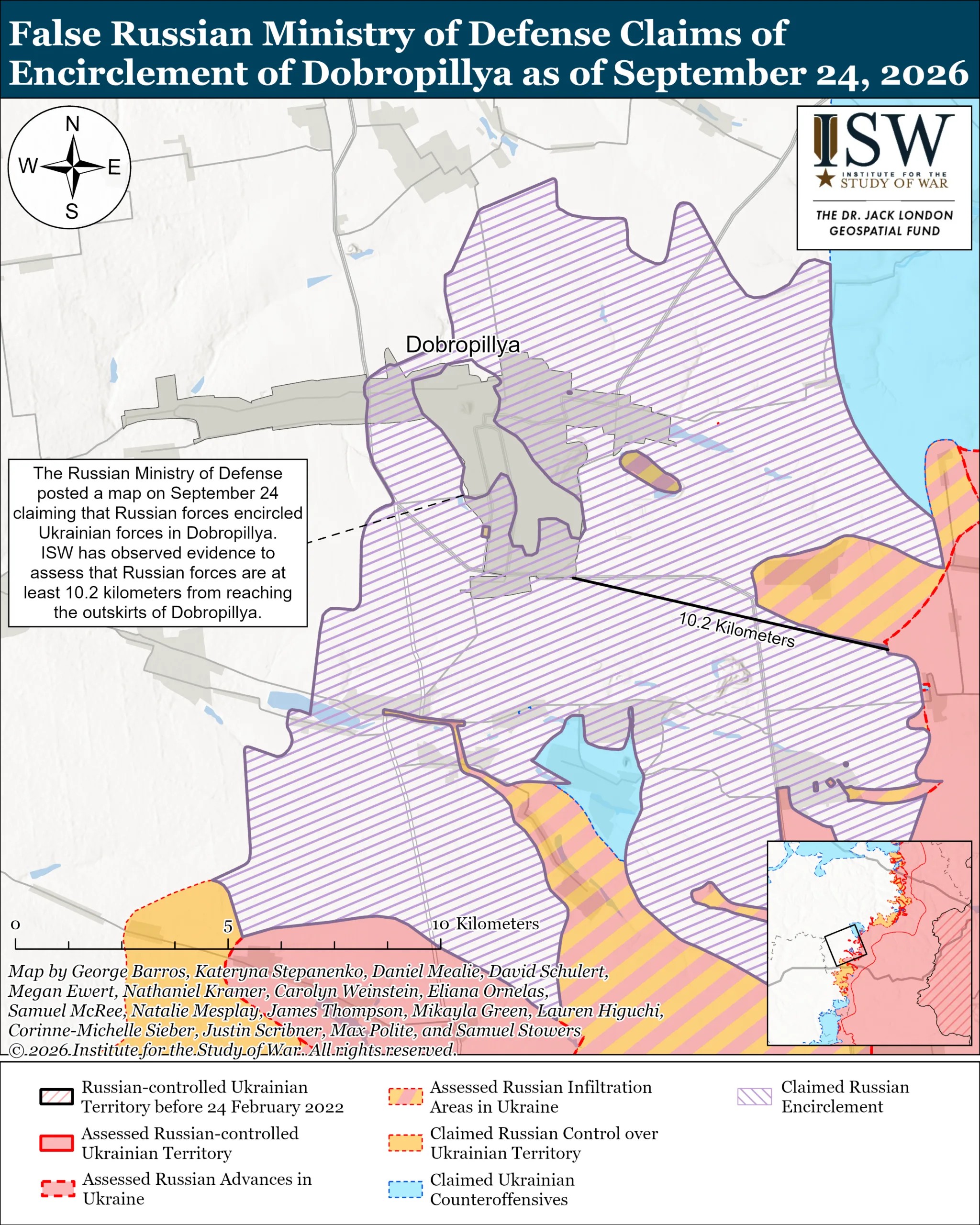
False Russian Ministry of Defense claims of encirclement of Dobropillia as of September 24, 2026. Source: Institute for the Study of War

Encircled on paper

Russia's Defence Ministry said on September 24 that units of its Centre Grouping were destroying encircled Ukrainian forces in the Dobropillia area while advancing towards Oleksandrivka, and published a map showing the city surrounded. The ISW's own map, in its assessment the same day, puts the nearest Russian forces 10.2 km from the city's southeastern outskirts, Euromaidan Press reported on September 25. The Ukrainian military says the city remains under its control.

The ISW said it had seen no evidence to support the encirclement claim, which it described as partly intended to divert attention from Ukraine's elimination of the Russian salient north of Lyman. It did observe small groups of Russian infiltrators operating east and northeast of Dobropillia on September 19 and 20, but did not assess that they had consolidated positions. One Russian milblogger suggested the "encirclement" might mean no more than fire control over Ukrainian supply roads west of the city.

The think tank blamed what Russian milbloggers themselves call "beautiful reports", a culture of inflated claims that it said has degraded the Defence Ministry's own picture of the battlefield. The ministry's statement described Dobropillia as a "strongly fortified settlement" whose capture would threaten Ukrainian supply lines running from Dnipropetrovsk region to the Fortress Belt. Biletskyi has said Russia's aim was to bypass the fortified cities through Dobropillia and link up with troops advancing from north of Lyman, rather than storm them head-on.

How close Russia came

Pokrovsk, the key logistics hub southwest of the belt, went first. Chief of the General Staff Valery Gerasimov told President Vladimir Putin on November 30 that it had been taken, and the city fell to Russia at the end of last year after months of street fighting.

By the summer Russian forces were advancing on Kostiantynivka, the southern anchor of the belt, with small groups infiltrating its outskirts and Putin saying the city was close to falling. "The city's fall seems to be more of a question of time," Emil Kastehelmi of Finland's Black Bird Group said in early July. Russian troops also took high ground between the Bakhmut-Siversk line and the belt that would bring Sloviansk and Kramatorsk into artillery range.

Kostiantynivka held. At the end of July, Ukrainian forces were still present across almost the whole city, according to open-source trackers, but the pincers were in place. A southern thrust through Dobropillia and a northern one from the Lyman salient would have closed a ring behind the four cities without Russia having to storm any of them.

Back to the river

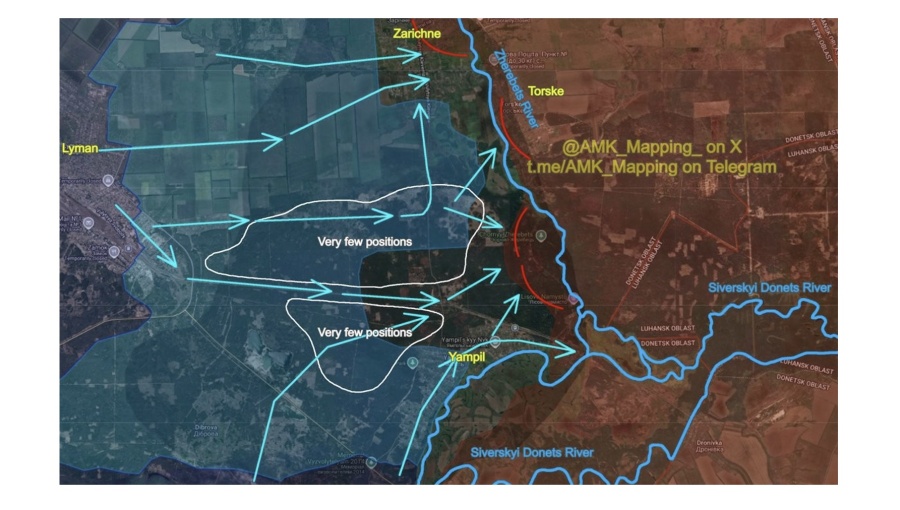
Vivaldi cut off the northern pincer. Ukrainian assault groups are now moving down several routes from Lyman towards the Zherebets River, trying to secure its western bank and finish clearing the village of Zarichne, according to open-source mapper AMK Mapping. Troops coming from Ozerne are clearing the remaining Russian positions in Yampil and attacking the last Russian bridgehead over the Zherebets from the south, while others advance east along the railway line from Lyman.
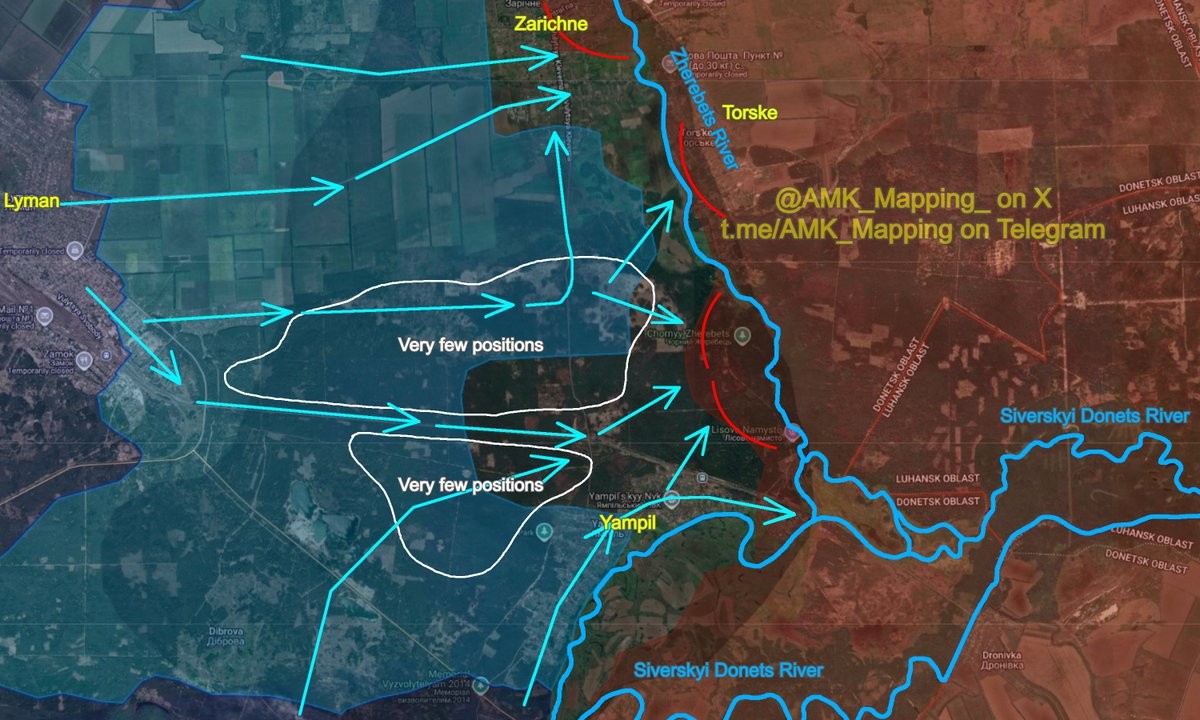
Ukrainian assault routes from Lyman towards the Zherebets River, Zarichne, Yampil and Torske. Source: AMK Mapping

The gains have reopened the route for Ukraine to send reinforcements south across the Siverskyi Donets into the area east of Mykolaivka and Sloviansk, flanking Russian positions from the north, the mapper said. Its caveat is two large stretches of forest where Ukraine has very few positions, which remain open to Russian infiltration that could disrupt the movement of assault groups and reinforcements, especially if the Russian bridgehead survives.

Russian forces are carrying out emergency counterattacks south of the Siverskyi Donets, east of Mykolaivka, and have likely re-entered Starodubivka, according to Hudson War Mapping, which called the situation "extremely confusing and complex".
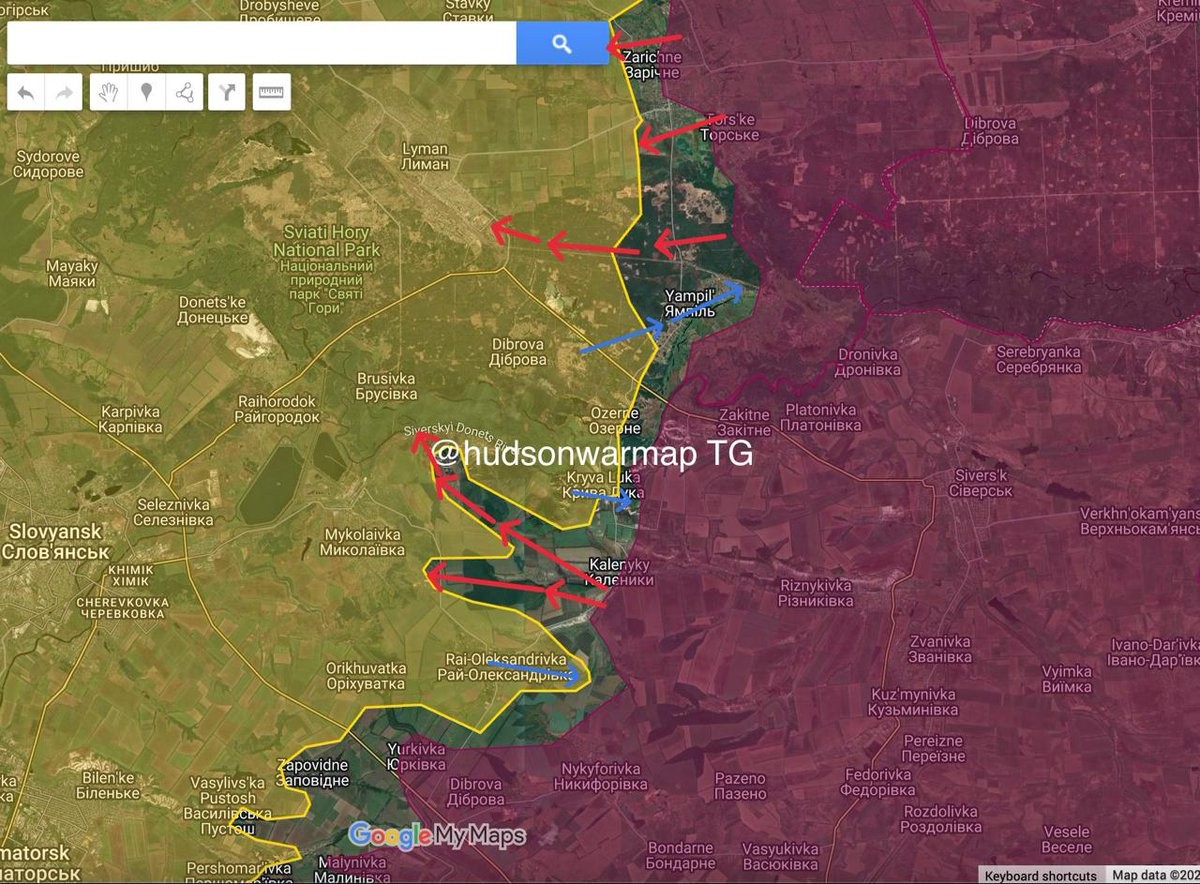
The Lyman-Sloviansk front around Yampil, Kryva Luka, Kalenyky and the Siverskyi Donets. Source: Hudson War Mapping

French open-source analyst Clement Molin puts the front of Ukrainian gains at nearly 90 km, from Borova to Sloviansk. "The Ukrainians are on the verge of securing Sloviansk - one of the two key cities in the Donbass - by pushing back the front line," he wrote on September 25, adding that Russia's Zapad grouping had suffered "a major defeat" and that much of the ground retaken has yet to be announced. Military analyst Delwin compared Vivaldi to Ukraine's Kursk incursion of 2024, launched at a similar point in the year, and said fierce infantry skirmishing continues across the Lyman-Sloviansk front, mostly in the grey zone.

None of the mappers' claims can be independently confirmed, and official figures are broader. Across the whole front, Russia has taken about 890 sq km this year and Ukraine has retaken about 800 sq km, President Volodymyr Zelenskiy told The Wall Street Journal in an interview published on September 22, against 3,000-4,000 sq km a year of Russian gains in earlier years.

In ones, twos and threes

Since December Russia has largely dropped the costly frontal assaults by massed infantry that drove up its casualty figures, and instead sends soldiers forward alone or in groups of two or three to slip through the Ukrainian line, take up positions between or behind the defenders and attack them from there. Small groups are also harder for Ukraine's drones to find and kill than a column of armour. In July Russian assault groups were already using summer vegetation to infiltrate Ukrainian positions before bringing up heavier weapons.

The tactic feeds on Ukraine's manpower crisis. With too few infantry to hold a continuous line, there are gaps of up to a kilometre between Ukrainian positions, covered by drones rather than soldiers. Infiltration has become a standard Russian tactic, a creeping "ink-blot" approach in which Ukrainian control is eroded by handfuls of Russians settling in behind the lines, researcher Chris Owen said on September 25. It can work because Ukrainian forces are thin on the ground, he said, but constant aerial surveillance and fast drone strikes have made it very costly.

Nikolai Gavrilov, a Russian military volunteer and milblogger, admitted that Lyman, which the Russian government had described as the scene of "house to house clearing" before Vivaldi, is firmly in Ukrainian hands and that infiltrators sent there are usually killed, captured or desert, in a post translated by Owen.

"The city was supposedly captured, but the reality is different. There is still an administration, police, and volunteer organisations of Ukraine present in the city," Gavrilov wrote. "Every day, units of the Ukrainian Armed Forces conduct patrols, using drones to monitor all the abandoned buildings, searching for our soldiers who may be trying to escape."

"Day after day, these soldiers, who have managed to establish contact, are killed. I know one fighter who managed to stay in contact for a week - the civilians betrayed them to the Ukrainian Armed Forces, and he was killed," he wrote. "Many fighters, after receiving orders to go to Lyman, simply turn off their radios and desert."

Desertion was already a growing problem for Moscow, with more than 28,000 Russian servicemen convicted of going absent without leave by May 2025, Meduza reported in July. Russian infiltrators are now also trying to get behind Ukrainian lines east of Lyman that they believe are poorly consolidated, Hudson War Mapping said.

A war Moscow needs to win soon

Losing the prospect of the belt this winter hurts a Kremlin running short of time and money. Russia's federal budget deficit reached RUB5.8 trillion ($68bn), or 2.5% of GDP, in the first eight months of the year, and Finance Minister Anton Siluanov has conceded that the full-year gap will overshoot the planned RUB3.786 trillion ($45bn) and could be at least double the original target. Industrial output grew just 0.1% in the first seven months, oil export revenues fell to $13.8bn in July from $15.8bn in June, and the Central Bank of Russia paused its rate cuts at 14% on September 11 with inflation still above 6%.

Zelenskiy estimated Russia's irrecoverable losses this year at about 270,000 troops, a figure that could not be independently verified. "He is neither winning nor losing, but his society is losing people and money for the sake of some 100 kilometers," he said.


Ukraine Hits Russian Fuel And Air Defenses As Kyiv Fields High-Speed Drones To Counter Jet Shaheds – Analysis


A Wild Hornets’ STING S drone (UAV) designed to destroy Russian kamikaze UAVs such as Shahed, Geran, Lancet, as well as reconnaissance drones. Photo Credit: wildhornets.com


September 26, 2026
Hudson Institute
By Can Kasapoğlu


Key Takeaways:

Ukraine’s General Staff said Sept. 19–20 strikes hit Moscow’s Kapotnya refinery (including an AVT-6 unit tied to military fuel) plus air-defense, radar, and drone-plant targets in occupied areas, while Russia kept attacking along Pokrovsk, Huliaipole, and the eastern fortress belt; post-Duma elections raise the chance of a Kremlin mobilization.

Zelenskyy and footage showed new high-speed interceptors—including Wild Hornets’ STING S and Vluchnyk’s ~$2,000 Zorelit v5 (~260 mph, SkyMap cueing)—downing jet-powered Geran/Shahed types that once often needed F-16s.

Watch Alabuga’s growing underground drone plants and whether August’s jump to ~57–62% jet-powered Shaheds holds in September.


1. Battlefield Assessment


Last week Ukraine continued to target the infrastructure that supports Russia’s military. According to the Ukrainian General Staff, on the night of September 19–20, Kyiv struck the Moscow Oil Refinery in Kapotnya, causing a major fire. The conflagration damaged several critical refinery components, including an AVT-6 crude-distillation unit, an integrated oil-processing unit, and an isomerization plant.

These facilities are key components of Russia’s war machine. The refinery’s AVT-6 distillation unit can process roughly 53 percent of its total crude throughput. The refinery can process as much as 12 million tons of oil annually and, according to the Ukrainian General Staff, supplies fuel to the Russian military.

Ukrainian forces also hit targets in occupied Ukraine. Kyiv reportedly struck a Buk-M3 air-defense system near Ukrainka in Zaporizhzhia Oblast, a Nebo-U radar near Balka in Donetsk Oblast, and a Russian drone-production facility near Siverskodonetsk in Luhansk Oblast. These attacks targeted Russia’s fuel infrastructure, air-defense assets, and drone-production capacity.

Meanwhile, legislative elections held in Russia from September 18–20 to elect all 450 seats of the State Duma marked an important political threshold. The electoral calendar no longer gives the Kremlin reason to delay potentially disruptive force-generation measures. It is possible, therefore, that Moscow may order a partial mobilization that could further shift the force-on-force balance against Ukraine.

Finally, Russia and Ukraine continued to contest the battlespace at a high operational tempo. Pokrovsk, Huliaipole, Kostiantynivka, Sloviansk, the Kramatorsk axis, and Ukraine’s eastern fortress belt defenses all saw heavy combat. Despite mounting casualties and limited territorial gains, Russian forces maintained an offensive posture on the ground.


2. Ukraine Introduces High-Speed Interceptors into the Counter-Shahed Battle


Static platforms once dominated drone warfare, but Russia and Ukraine now engage in a rapid cycle of offensive adaptation and defensive counteradaptation. Russia has expanded its use of faster, jet-powered Shahed derivatives. Ukraine is responding by accelerating the development of its own low-cost interceptor drones.

On September 19, Ukrainian President Volodymyr Zelenskyy announced that the Security Service of Ukraine had successfully employed a new interceptor against Russia’s jet-powered Shahed/Geran-type drones, releasing footage of the system in action. On the same day, additional footage emerged depicting Ukrainian forces using jet-powered unmanned aerial vehicles (UAVs) to intercept Russian jet-powered Geran-5 attack drones. Officials documented three separate Russian Geran-5 platform interceptions on September 19. They attributed two to unidentified jet-powered interceptors, and a third to Ukraine’s new STING S interceptor, a drone-hunting drone developed by the country’s Wild Hornets group.

These interceptions are notable. The Geran-5 is harder to target than earlier variants because of its higher speed and larger explosive payload. These features require faster interceptors that can close on the target before the attacking drone reaches its destination.

The Ukrainian Air Force has often dispatched manned combat aircraft, including the F-16, to intercept jet-powered Gerans. The appearance of the STING S interceptor alongside other unnamed jet-powered drone-hunting drones suggests that Ukraine is beginning to field multiple purpose-built high-speed counter-UAV systems. Kyiv is adapting in real time, as Russia’s expanded use of jet-powered one-way attack drones forces Ukrainian air defenses to respond with faster, cheaper, and more widely distributed interceptor platforms.

The Ukrainian manufacturer Vluchnyk is one company driving these innovations. The firm has completed internal testing of the Zorelit v5, or Starship, an interceptor designed specifically for high-speed reconnaissance and attack UAVs. The company says the system is ready for military use. Following codification, the Zorelit v5 is expected to become available through Ukraine’s ePoints procurement mechanism, which rewards military units for the confirmed destruction of Russian personnel and equipment.

The Zorelit v5 reportedly reaches 260 miles per hour and has a maximum range of approximately 29 miles. At a cruising speed of roughly 124 miles per hour, the system can carry a warhead and remain airborne for approximately 17 minutes. Its intended targets range from Russian reconnaissance UAVs and Gerbera decoys to Geran-2 attack drones and the faster, jet-powered Geran-3 and Geran-4 variants.

The interceptor can incorporate artificial intelligence–enabled target detection and tracking, including automated terminal guidance during the final phase of an engagement. The system can also integrate with SkyMap, which fuses air-target data from multiple detection layers, including radar and acoustic sensors, into a common picture that operators can access on a tablet.

Where less advanced systems would require individual interceptor teams to locate targets independently, SkyMap can provide operators with updated target tracks and cue them toward the relevant engagement area. This level of sensor fusion can help coordinate mobile fire groups, interceptor-drone crews, and other short-range air-defense elements against large, geographically dispersed UAV raids. In effect, Ukraine’s combination of inexpensive interceptors, distributed sensors, and digital command-and-control capabilities is turning the country’s counter-drone network into an increasingly integrated sensor-to-shooter architecture.

The Zorelit v5 builds on the already-produced Zorelit v4. Vluchnyk representatives say this earlier model has already entered combat service and has even received a North Atlantic Treaty Organization stock number, a unique numeric code used by NATO and allied countries to identify standardized supply items. The newer v5 incorporates combat-proven design features from the v4 system.

At a listed price of roughly $2,000 per interceptor, the v5 system illustrates a central feature of Ukraine’s emerging air-defense model. Against numerous and increasingly capable Russian one-way attack drones, Ukraine is attempting to match mass with a defensive architecture that is both scalable and economically sustainable. This exchange ratio matters as much as, if not more than, the v5 interceptor’s performance.


3. What to Monitor in the Coming Weeks

The Kremlin is reportedly expanding the underground production infrastructure at its drone-manufacturing facility at Alabuga in the Russian Republic of Tatarstan. Officials have built roughly 10 acres of underground space, providing Moscow with additional capacity for future production. Russia appears to have accelerated its construction effort following the first Ukrainian strikes against the facility and is increasingly dispersing its production of Geran drones and hardening supporting infrastructure. This suggests that Moscow is working to reduce the vulnerability of its manufacturing network to Ukrainian long-range strikes. This report will continue to track the open-source intelligence reporting on the Alabuga facility’s expanding subterranean footprint.

in August 2026 shifted toward sustained day-and-night attacks and greater use of jet-powered systems. An estimated 57–62 percent of the Shahed/Geran drones that Russia used during August were jet-powered, up from roughly 10 percent in June. Their higher speed compress Ukraine’s engagement windows and force Kyiv to rely more heavily on faster, more expensive air-defense assets. September’s data will show whether this shift in Russian drone operations is becoming a sustained pattern.


About the author: 

Can Kasapoğlu is a nonresident senior fellow at Hudson Institute. His work at Hudson focuses on political-military affairs in the Middle East, North Africa, and former Soviet regions. He specializes in open-source defense intelligence, geopolitical assessments, international weapons market trends, as well as emerging defense technologies and related concepts of operations.

Source: This article was published by the Hudson Institute

About Hudson Institute
Hudson Institute is a nonpartisan policy research organization dedicated to innovative research and analysis that promotes global security, prosperity, and freedom.
View all posts by Hudson Institute →



 

Coal India digs beyond coal into batteries, renewables and critical minerals

Coal India digs beyond coal into batteries, renewables and critical minerals
/ Albert Hyseni - UnsplashFacebook
By IntelliNews - Mumbai bureau September 25, 2026

State-owned coal mining giant Coal India (NSE: COALINDIA) has an ambitious plan to expand into new areas. According to a government of India note published on September 20, the company is planning to expand its footprint in coal gasification and coal-to-chemicals, thermal and renewable energy and battery storage, critical minerals and even advanced materials and diversified minerals.

At present, Coal India Ltd (CIL) is involved in four coal gasification and coal-to-chemicals projects spanning fertilisers, industrial chemicals and synthetic natural gas (SNG). The coal gasification process involves conversion of coal to synthesis gas, or syngas, which can then be utilised to produce SNG, ammonia, urea, ammonium nitrate, methanol and a number of other chemicals.

Coal India’s two coal gasification projects come in the form of Talcher Fertilizers with its annual urea production capacity of 1.27mn tonnes and Bharat Coal Gasification & Chemicals with capacity to produce 0.66mn tonnes of ammonium nitrate each year.

CIL is also participating in two SNG projects with Coal Gas India Ltd having the capacity to produce 633.6mn normal cubic metres (Nm³) of SNG annually, while the CIL-BPCL Chandrapur coal-to-SNG project is designed to produce an additional 633.6mn Nm³ per year.

On the coal gasification front, CIL is working on a pilot project at the Kasta West Block of Eastern Coalfields. The first phase came online in May last year, while the second phase started in June.

In the power sector meanwhile Coal India is working in-sync with Damodar Valley Corporation (DVC) to set up a 2×800 MW brownfield expansion at Chandrapura in the coal-rich eastern Indian state of Jharkhand, through an equal joint venture partnership.

The company is also eyeing a significant presence in the renewable energy space. It has already commissioned about 550 MW of solar capacity.  In addition to this, CIL is now looking at rooftop solar projects as well as ground-mounted and captive solar power projects. Reports suggest company plans to work via two separate models: solar power projects for captive use and commercial renewable-power projects.

Since battery storage is a vital chain in the renewable energy ecosystem, CIL is marking its presence there as well. An 187.5-MW/750 MWh battery energy storage system (BESS) project is currently under development for TGGENCO at Choutuppal in the state of Telangana, with a four-hour storage duration, the government said.

Added to this, CIL is developing an 80-MW/320 MWh BESS portfolio across four locations in Odisha with another four-hour duration period planned when finished.

With the rapid growth in industries such as battery storage, electric vehicles, renewable energy, electronics, advanced manufacturing, aerospace and defence, the requirement for critical minerals has also become very important. To capitalise on this opportunity, CIL intends to use its graphite assets in Madhya Pradesh and Chhattisgarh, as well as rare earth element and rare-metal assets in Andhra Pradesh and Maharashtra. As a result, the company is looking to set up an integrated graphite value chain.

R&D

Coal India is also boosting its research & development expertise. At present, the company funds the CIL Centre of Sustainable Energy at the Indian Institute of Technology (IIT) Madras with INR879mn ($9.16mn) dedicated to focusing on sustainable materials, mine repurposing and energy transition.

The company also supports CLEANZ at IIT Hyderabad, an INR980mn project with a focus on clean coal technology and low-grade Indian coal.

Furthermore, CIL is expanding its research and innovation programme, with a focus on digital mining, automation, advanced energy technologies and the development of indigenous solutions for the coal sector. Linked to this, the company has set up the CIL Centre for Innovation in Mining at IIT (ISM) Dhanbad with financial support of INR675mn - the centre is working on Mining 4.0 technologies, the Internet of Things (IoT), smart mining systems, immersive technologies and 5G applications.

A separate CII Centre at IIT (ISM) Dhanbad has received INR100mn and focuses on innovation and incubation, including prototyping, virtual reality, simulation and automation technologies.

Looking at the bigger picture, CIL’s wider R&D portfolio is made up of 20 projects with a total outlay of INR2.31bn. The projects cover technologies intended to improve mining efficiency and safety while supporting the company’s transition towards new energy and technology-driven operations. Key initiatives include an underground coal gasification project at Kasta West, the deployment of 5G captive networks across opencast and underground mines, development of bifacial perovskite solar cells and the application of artificial intelligence and geophysical exploration technologies for critical mineral exploration.

To this end, CIL has been consistently upping its R&D spending in recent years. Expenditure increased from INR613mn in FY2023-24 to INR2.46bn in FY2024-25 before declining to INR1.84bn in FY2025-26. It has provisioned an R&D budget of INR2.25bn for FY2026-27. The planned allocation rises to INR3.5bn in FY2027-28, INR4bn in FY2028-29 and INR5bn in FY2029-30.

The government of India has thus outlined a broader technology strategy for Coal India that includes strengthening the National Coal Conservation and Energy Efficiency Rating (NaCCER), expanding the hub-and-spoke model for research and accelerating the movement of technologies from research and development to commercial deployment.

It is a strategy that places greater emphasis on indigenous and future-ready technologies, with coal gasification, advanced materials, battery technologies and other emerging solutions identified as areas with potential to support the sector’s longer-term needs and reduce reliance on imported technologies.


Extreme El Niño could cost Latin America 2% of GDP, ECLAC warns

Extreme El Niño could cost Latin America 2% of GDP, ECLAC warns
/ unsplashFacebook
By bne IntelliNews September 23, 2026

An extreme El Niño event could wipe at least 2% off Latin America and the Caribbean's gross domestic product over three years and push as many as 4.8mn more people into poverty by the end of the decade, the United Nations Economic Commission for Latin America and the Caribbean (ECLAC) said in a new report.

The Santiago-based commission said half of the cumulative output loss would come in the first year after the event. It expects energy, fishing, agriculture and some infrastructure to suffer most. The warning came in a special report led by ECLAC Executive Secretary José Manuel Salazar-Xirinachs.

"Responses adopted once the emergency has been declared are considerably more expensive than preventive measures based on adequate anticipation. It is imperative that we shift from a response after losses to anticipatory management of climate risk," Salazar-Xirinachs said.

The report cited projections from the US National Oceanic and Atmospheric Administration (NOAA). NOAA puts the chance of El Niño reaching very high intensity during the northern hemisphere's autumn and winter of 2026-2027 at more than 90%. It gives a 69% probability of a historic "Super El Niño", with sea surface temperature anomalies of more than 2.5C or 3.0C in the Niño 3.4 region.

ECLAC said human-driven climate change was amplifying natural variability. It noted that global average temperatures were 1.55C above pre-industrial levels in 2024.

The commission said the economic effects would vary widely across countries and would last. It expects lower real output, inflationary pressure and higher poverty, as falling household income feeds through the region's economies.

Power grids exposed

The report said the region's power sector was especially vulnerable. Hydropower accounts for more than 70% of electricity generation in several countries, and more than half of installed capacity is over 30 years old.

ECLAC estimated a 60% chance of below-normal rainfall in the October-December quarter. It said 31.1% of the region's territory was on high alert. Hotter weather would drive up demand for air conditioning in cities such as Lima, São Paulo and Mexico City while water supplies were shrinking. According to the report, that raises the risk of blackouts and higher operating costs.

Fisheries and farms at risk

A weaker upwelling of cold Pacific waters would reduce phytoplankton and disrupt the marine food chain, ECLAC said. That could send stocks of anchovy, sardine and hake deeper or push them to migrate. During earlier Super El Niño episodes, the regional fish catch fell 52.7% in 1972-1973 and 26.9% in 1997-1998. Those episodes also brought harmful algal blooms and widespread coral bleaching.

ECLAC cited analysis by the Food and Agriculture Organization (FAO) showing a more than 70% probability of drought hitting agriculture in the coming months in several areas. These are Central America's Dry Corridor, Colombia, Venezuela, Cuba, the Dominican Republic and Haiti. The report said drought could threaten staple crops, animal feed supplies and rural incomes.

Call for anticipatory action

To stop climate shocks from turning into prolonged social and economic crises, ECLAC urged governments to adopt a 10-point policy package. It called for climate risk to become a permanent part of national policymaking and regulation. It also called for stronger protection of strategic infrastructure, wider early warning systems, and financial buffers such as reserve funds, catastrophe bonds and insurance.

The commission also recommended targeted cash transfers to vulnerable households and support for livelihoods in the Dry Corridor and fishing communities. It called for restoring reefs and mangroves and for flexible fishing quotas and closures. On energy and water, it urged countries to add more solar and wind power so grids depend less on rainfall, share energy reserves and manage cross-border river basins jointly. It also recommended curbing urban power demand during heatwaves.


LATAM BLOG: Trump keeps Machado's medal and Rodríguez's oil

LATAM BLOG: Trump keeps Machado's medal and Rodríguez's oil
María Corina Machado and Edmundo González, the opposition's 2024 candidate. Machado has been unable to return to Venezuela despite repeated attempts.

By Cynthia Michelle Aranguren Hernández September 24, 2026

María Corina Machado made three failed attempts to reach Venezuela from Panama by sea and air on September 21 and 22, her team said. On the second of those days Delcy Rodríguez, the country's acting president, held her first meeting with Donald Trump in New York.

The latest setbacks bring to seven the number of thwarted homecomings since the opposition leader and Nobel Peace Prize laureate left Venezuela clandestinely in December, according to Pedro Urruchurtu, her international relations adviser. "They are not allowing her to return to her own country," he wrote on X.

The overlap of dates captures how far Machado's fortunes have turned. On January 15, she presented Trump with her Nobel medal, framed and inscribed, calling it "recognition for his unique commitment with our freedom". The Norwegian Nobel Committee had already stated that the laureate's title can be neither shared nor transferred, and critics dismissed the gesture as a last-ditch bid for Trump's favour. The US leader nonetheless called the gift "a wonderful gesture of mutual respect". Shortly after US forces seized Nicolás Maduro on January 3 and whisked him to New York to face narcoterrorism charges, Trump said Machado lacked "the support or the respect within the country". It was a striking verdict. Barred from the July 2024 presidential election by the regime-controlled Supreme Court, the firebrand opposition leader had backed Edmundo González to stand in her place, and Washington itself later recognised him as the winner of a vote Maduro stole.

Yet Trump has since built his Venezuela policy around Rodríguez, Maduro's former vice-president, who took over after his capture and has proved receptive to US demands, opening the oil and mining sectors to foreign investors and releasing hundreds of political prisoners. On the day Machado lunched at the White House, Rodríguez was delivering the state of the nation address in Caracas, tiptoeing between keeping the Chavista base happy and starting to meet Washington's demands. Trump, who called her "a terrific person" who is “doing a great job,” has seemed content with the arrangement ever since.

Eight months on, Machado cannot get home. This week's first attempt was to be made by boat through the Panama Canal and across the Caribbean. Immigration formalities had been completed when the operator cancelled, citing mechanical problems, according to Idania Chirinos, an NTN24 journalist travelling with her. Plans to fly to Aruba and Curaçao and continue by sea also came to nothing. Machado holds a diplomatic passport that Panama issued on humanitarian grounds. Spanish daily ABC, whose correspondent accompanied her, said the document confers no citizenship.

Her team has not said who stopped her. A flight manifest listed her among the passengers of an aircraft that never took off, but it does not explain why. Asked about the matter, Trump denied telling her not to return.

The evening in New York gave Rodríguez rather more. The White House described the encounter as an informal pull-aside at a reception Trump hosted on the sidelines of the UN General Assembly, and published no readout. Marco Rubio, secretary of state, Scott Bessent, Treasury secretary, and senior aides Susie Wiles and Stephen Miller attended. Rodríguez called it "a historic meeting" that advanced co-operation on energy, mining and security.

Behind the handshake sits a major oil agreement Trump announced on August 28. Under it, a US-backed operator will develop 17 fields holding an estimated 65bn barrels, about a fifth of Venezuela's proven reserves. This month Washington also removed Venezuela from its list of countries that have "failed demonstrably" to combat drug trafficking, the first time it has escaped that designation since 2005.

Machado's exclusion owes as much to Washington as to Caracas. Twin devastating earthquakes struck northern Venezuela on June 24, eventually killing more than 6,500 people, and her most determined push to go home came in their aftermath. The Wall Street Journal reported that she boarded a private flight in Virginia bound for Curaçao, a trip cleared with US authorities. The aircraft was turned back over North Carolina after Washington signalled it did not support the journey. She flew commercially to Panama on June 28, where Copa Airlines then refused to let her board a flight home, citing fears of reprisals from Caracas.

Machado accused the Rodríguez government of shutting commercial airspace to keep her out, adding that it "had to reverse the decision". The authorities said the main airport at Maiquetía had closed because of severe earthquake damage, and US marines were later deployed to help rebuild it.

Washington's argument was that her return would distract from relief. US officials called it "counterproductive", and administration officials anonymously dismissed her persistence as "grotesque political opportunism". On July 15 Cartwright Weiland, a State Department official, told Congress: "She is a Venezuelan citizen and has the right to return." Rubio, long Machado's most prominent champion in Washington, was reported in January to have argued against backing her after Maduro's ouster, and in June urged her to be patient. This month he said she was entitled to return whenever she chose, and that Washington wanted her to have security guarantees.

Meanwhile her political space has narrowed. US-brokered talks between the Rodríguez government and parts of the opposition, under way since August, exclude Machado and Edmundo González. On September 2 Trump said Venezuela was not "ready yet" for a vote. Rodríguez said: "I don't set a date." The constitution's 180-day limit on an interim presidency has already expired.

That leaves Machado campaigning from abroad. On September 20 she endorsed a proposal by Bernie Moreno, a Republican senator, for a presidential election on July 24 2027, a date neither Caracas nor Washington has backed. Three days later Rodríguez used her debut address to the UN General Assembly to pledge that Venezuela would hold elections, but she declined to say when. "The Venezuelan people, with their ancestral wisdom, will decide the right moment," she said.

Machado's standing at home is an asset Washington has so far chosen not to use, preferring to strike lucrative deals with what is, in effect, a facelifted continuation of the very Chavista regime that wrecked the country's oil industry over the past two decades. An AtlasIntel poll for Bloomberg, taken in the days after the earthquakes, put Rodríguez's disapproval rating at 63.3% and found that Venezuelans trusted Machado more than state institutions. More than half of respondents rated the government's response to the disaster "very poor", and 45.7% said electing a new president mattered more than reconstruction.

Analysts see the imbalance in the relationship with Washington as the defining fact of Rodríguez's rule. "Delcy Rodríguez is a hostage of Trump as long as he is in the White House," María Isabel Puerta Riera, a political scientist, told Efecto Cocuyo. Machado's predicament mirrors it. Her fate also rests with a president who accepted her prize but not her claim to lead.

Croatian opposition seeks to oust PM over waste scandal

Croatian opposition seeks to oust PM over waste scandal
SDP leaders announce they are seeking a vote of confidence in PM Andrej Plenkovic. / SDPFacebook
By IntelliNews September 26, 2026

Croatia's main opposition Social Democratic Party (SDP) has submitted a no-confidence motion against Prime Minister Andrej Plenkovic over the illegal dumping of tens of thousands of tonnes of waste near the central town of Gospic, escalating political pressure on the government over the environmental scandal.

SDP lawmakers submitted the motion to parliament on September 25 with 54 signatures, seeking a debate on Plenkovic's political responsibility for the affair, a party statement said. The initiative has also won support from the green-left Mozemo! party and several smaller opposition groups, while the right-wing Most party and independent MPs Marija and Nino Raspudic have signed the motion.

"Today, we submitted a proposal to the Croatian parliament to initiate a vote of confidence in Prime Minister Andrej Plenkovic, along with 54 collected signatures from MPs," SDP political secretary Sasa Djujic told a news conference in parliament.

The motion focuses on the discovery of between 34,000 and 37,000 tonnes of waste at an industrial site near Gospic, much of it imported from Italy in 2023 and 2024. Investigators suspect illegal waste-management activities, while prosecutors are examining possible corruption and failures of state oversight.

Djujic said the scale and duration of the dumping meant political responsibility extended beyond those directly involved in handling the waste.

"Andreј Plenkovic has been leading the government for years, which passes regulations, regulates oversight and elects people to lead institutions," he said. "Citizens therefore have the right to demand an answer from him as to how the system he leads allowed such a case."

The opposition argues that around 37,000 tonnes of waste could not have been transported and stored over several years without failures in supervision. It also links the affair to changes in waste-management regulations and what it describes as a weakening of safeguards protecting the public interest.

The SDP also highlighted the State Inspectorate and its former head Andrija Mikulic, who was appointed by Plenkovic's government and was arrested in November 2025 in a corruption investigation related to illegal waste disposal. Mikulic denies the allegations.

"We are particularly raising the issue of the State Inspectorate and the corruption suspicions related to its former head, Andrija Mikulic, who was appointed by the Plenkovic government," Djujic said.

SDP deputy speaker Sabina Glasovac accused the government of systematically weakening environmental controls, saying waste imports had tripled since 2015 while supervision had declined.

"Waste imports have tripled since 2015, supervision has been decreasing for ten years and the control system has been weakening, you abolished shipment notifications in 2019 and the importer register in 2021, while fines have been reduced seven times," she said.

The controversy has intensified following public protests. Thousands gathered in central Zagreb on September 5 for a demonstration organised by the NGO Gospić je naš dom, demanding action over the waste stored near Gospic. The protest came after repeated government promises to accelerate the cleanup.

The government says the operation is unusually complex because much of the material is buried and there is no suitable facility in Croatia for its disposal. It has selected contractors to cover the site and remove waste stored in bags and is seeking a European company capable of handling the buried material.

Plenkovic said earlier this month that the cleanup was entering a new phase and that a procedure for removing the buried waste should be completed within 20 days. The government estimates that about 4,500 tonnes of waste is on the surface, with another 32,000 to 33,000 tonnes of ash buried at the site.

Environmental concerns were heightened this week by findings from experts working with Croatia's anti-corruption office USKOK, which detected hundreds of thousands of microplastic particles in groundwater monitoring wells near the site. The findings do not establish that public drinking water is unsafe, and the government has said testing has found no evidence requiring residents to stop using the public water supply.

The SDP argues, however, that the case exposes wider weaknesses in Croatia's waste-management system.

"Our position is clear - the prime minister must be held accountable for the way his government managed this problem and for the lack of timely protection of citizens," Djujic said.

The government has rejected opposition claims that it bears political responsibility for the illegal dumping, stressing that prosecutors and anti-corruption investigators are pursuing those responsible and that the priority is to remove the waste safely.

Turkey's electric car share leaps from 1% to 22% in three years

By Ben Aris in Berlin September 25, 2026

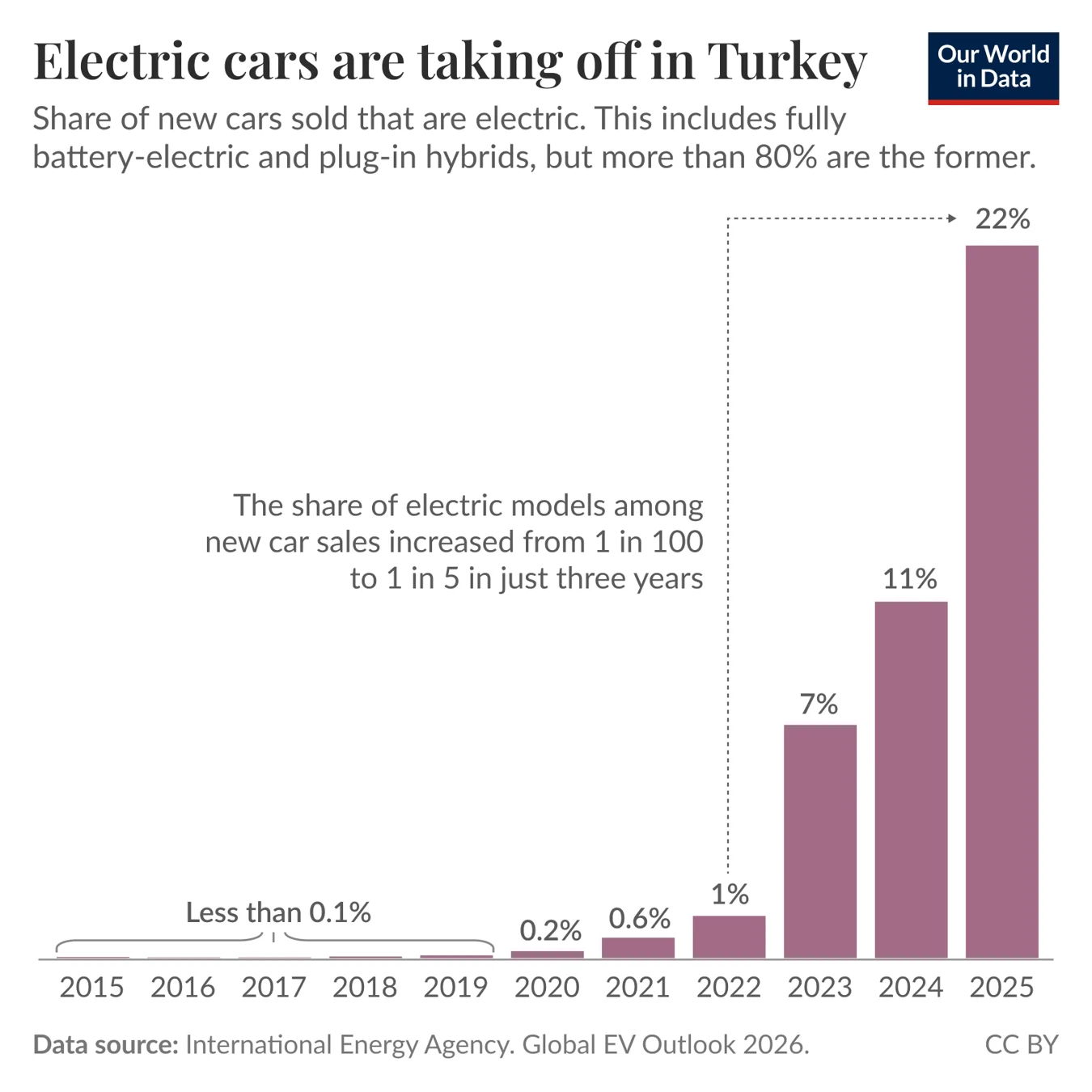
More than one in five new cars sold in Turkey in 2025 was electric, up from one in 100 in 2022, data compiled by Our World in Data show.

Share of new cars sold in Turkey that are electric, 2015-2025, including plug-in hybrids. Source: International Energy Agency, Global EV Outlook 2026, chart by Our World in Data (CC BY).

Electric models took 22% of new car sales last year, double the 11% of 2024 and up from 7% in 2023, according to figures from the International Energy Agency's Global EV Outlook 2026. As recently as 2020 the share was 0.2%. The numbers include plug-in hybrids, but more than 80% of the cars are fully battery-electric.

The data show a more than twentyfold rise in three years. The website credits a 2023 tax change that cut the registration tax on electric cars relative to petrol and diesel models, timed to coincide with the launch of Togg, the government-backed domestic EV maker that quickly became market leader, along with cheaper imports, many of them Chinese. By 2025 Turkey had matched the EU average for the electric share of new car sales.

The boom rode on a record year for the car market in 2025, when passenger car and light commercial vehicle sales rose 10.5% to 1.37mn units, according to the Automotive Distributors and Mobility Association (ODMD). Nearly 192,000 fully electric cars were sold, up 82% y/y, with Togg delivering 39,020 and Tesla 31,509.

Growth has slowed in 2026 as the overall market contracts. Electric car sales fell 12.3% y/y to 105,951 units in January-August, and dropped 32% in August alone, ODMD data show. Because passenger car sales fell faster, down 13.8% to 564,241, the fully electric share still edged up to 18.8% in the first eight months. Hybridstook a further 33.1%, meaning more than half of new cars sold had some form of electric drive.

The slowdown is concentrated at the top end. Sales of electric models rated above 160 kW fell 65.3% in January-August, while those below that threshold rose 7.3%. Togg has kept its lead, selling 30,734 cars in the period against 4,368 for Tesla.

Electric cars remain a small part of the fleet. There were 472,157 registered at the end of August, up 53% y/y but still only 2.6% of Turkey's 18mn passenger cars.

Schneider Electric to launch €1.2bn bid for Bulgaria's Shelly

Schneider Electric to launch €1.2bn bid for Bulgaria's Shelly
Bulgarian smart-home technology maker Shelly Group at IFA Berlin. / Shelly GroupFacebook
By bne IntelliNews September 24, 2026

France's Schneider Electric (SCHN.PA) plans to launch a voluntary public takeover offer for Bulgarian smart-home technology maker Shelly Group (SLYG.BB) at €70 per share, valuing the company at about €1.2bn, the companies said on September 24.

The acquisition would expand Schneider's presence in connected homes and residential energy management, combining Shelly's smart-device and software platform with Schneider's global reach and energy-management expertise.

Shelly shares rose 4.3% by 0859 GMT, while Schneider shares fell 0.5%.

The all-cash offer represents a 22% premium to Shelly's September 23 reference price and a 27% premium to its unaffected price on July 28, the companies said.

The offer is subject to regulatory approval and a minimum acceptance threshold of 95%. Schneider expects the deal to close in the first quarter of 2027 and said it intends to pursue full ownership and a possible delisting if successful.

Shelly's founders, Dimitar Dimitrov and Svetlin Todorov, who together hold about 57% of the company, support the deal and have agreed to sell their stakes under certain conditions.

Dimitrov, who owns about 29% and is co-CEO, plans to tender his shares and reinvest part of the proceeds alongside Schneider. He is expected to remain co-CEO after completion. Todorov, who owns about 28%, has agreed to sell his stake in two tranches, with the second subject to merger-control clearance.

RBC Capital Markets analyst Mark Fielding called the deal a "sensible bolt-on acquisition" that continues Schneider's smart-buildings strategy, noting that its value was less than 1% of Schneider's market capitalisation.

Jefferies said the deal had "strong rationale and high potential for synergies" with Schneider's residential business.

Shelly, which sells smart plugs, meters, locks and cameras as well as cloud services, has grown revenue by more than 40% annually since 2022 and sells products in more than 100 countries.

The Sofia-based company reported first-quarter 2026 revenue of €33.3mn, up 25.6% year-on-year.

Shelly said Schneider intends to maintain its headquarters, organisational structure and workforce in Bulgaria for at least three years after completion, including its research and development and engineering operations.

The offer has not yet been formally registered or published. Schneider's bid vehicle is expected to register it with Bulgaria's Financial Supervision Commission, with clearance expected by late November or early December.

Shelly announced in July that it was in preliminary talks with Schneider over a potential offer.