Croatia's main opposition Social Democratic Party (SDP) has submitted a no-confidence motion against Prime Minister Andrej Plenkovic over the illegal dumping of tens of thousands of tonnes of waste near the central town of Gospic, escalating political pressure on the government over the environmental scandal.
SDP lawmakers submitted the motion to parliament on September 25 with 54 signatures, seeking a debate on Plenkovic's political responsibility for the affair, a party statement said. The initiative has also won support from the green-left Mozemo! party and several smaller opposition groups, while the right-wing Most party and independent MPs Marija and Nino Raspudic have signed the motion.
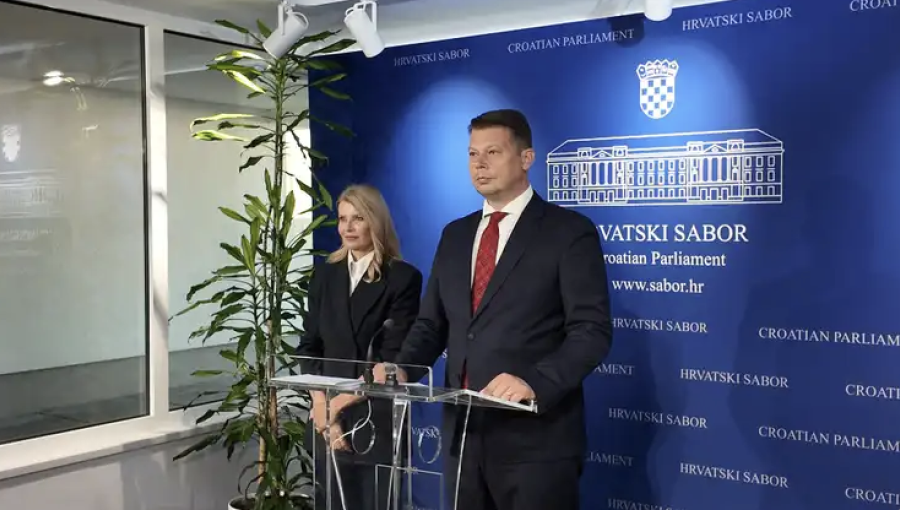
"Today, we submitted a proposal to the Croatian parliament to initiate a vote of confidence in Prime Minister Andrej Plenkovic, along with 54 collected signatures from MPs," SDP political secretary Sasa Djujic told a news conference in parliament.
The motion focuses on the discovery of between 34,000 and 37,000 tonnes of waste at an industrial site near Gospic, much of it imported from Italy in 2023 and 2024. Investigators suspect illegal waste-management activities, while prosecutors are examining possible corruption and failures of state oversight.
Djujic said the scale and duration of the dumping meant political responsibility extended beyond those directly involved in handling the waste.
"Andreј Plenkovic has been leading the government for years, which passes regulations, regulates oversight and elects people to lead institutions," he said. "Citizens therefore have the right to demand an answer from him as to how the system he leads allowed such a case."
The opposition argues that around 37,000 tonnes of waste could not have been transported and stored over several years without failures in supervision. It also links the affair to changes in waste-management regulations and what it describes as a weakening of safeguards protecting the public interest.
The SDP also highlighted the State Inspectorate and its former head Andrija Mikulic, who was appointed by Plenkovic's government and was arrested in November 2025 in a corruption investigation related to illegal waste disposal. Mikulic denies the allegations.
"We are particularly raising the issue of the State Inspectorate and the corruption suspicions related to its former head, Andrija Mikulic, who was appointed by the Plenkovic government," Djujic said.
SDP deputy speaker Sabina Glasovac accused the government of systematically weakening environmental controls, saying waste imports had tripled since 2015 while supervision had declined.
"Waste imports have tripled since 2015, supervision has been decreasing for ten years and the control system has been weakening, you abolished shipment notifications in 2019 and the importer register in 2021, while fines have been reduced seven times," she said.
The controversy has intensified following public protests. Thousands gathered in central Zagreb on September 5 for a demonstration organised by the NGO Gospić je naš dom, demanding action over the waste stored near Gospic. The protest came after repeated government promises to accelerate the cleanup.
The government says the operation is unusually complex because much of the material is buried and there is no suitable facility in Croatia for its disposal. It has selected contractors to cover the site and remove waste stored in bags and is seeking a European company capable of handling the buried material.
Plenkovic said earlier this month that the cleanup was entering a new phase and that a procedure for removing the buried waste should be completed within 20 days. The government estimates that about 4,500 tonnes of waste is on the surface, with another 32,000 to 33,000 tonnes of ash buried at the site.
Environmental concerns were heightened this week by findings from experts working with Croatia's anti-corruption office USKOK, which detected hundreds of thousands of microplastic particles in groundwater monitoring wells near the site. The findings do not establish that public drinking water is unsafe, and the government has said testing has found no evidence requiring residents to stop using the public water supply.
The SDP argues, however, that the case exposes wider weaknesses in Croatia's waste-management system.
"Our position is clear - the prime minister must be held accountable for the way his government managed this problem and for the lack of timely protection of citizens," Djujic said.
The government has rejected opposition claims that it bears political responsibility for the illegal dumping, stressing that prosecutors and anti-corruption investigators are pursuing those responsible and that the priority is to remove the waste safely.

No comments:
Post a Comment