OPG secures government equity financing for SMR project
Two government agencies are to invest a total of CAD3 billion (USD2.1 billion) and take "meaningful" minority stakes in Ontario Power Generation's Darlington New Nuclear Project, helping to de-risk the construction and operation of the small modular reactors.
_87584.jpg)
Canada Growth Fund Inc - a CAD15 billion arm's-length investment vehicle designed to attract private capital to build Canada's clean economy - has committed to invest up to CAD2 billion in the project, while Building Ontario Fund - a Crown agency with a mandate to catalyse investment in revenue-generating infrastructure projects across Ontario, backed by CAD8 billion in funding from the province - will invest CAD1 billion. Canada Growth Fund will acquire 15% ownership in the project, and Building Ontario Fund 7.5%. Ontario Power Generation (OPG) will continue to be the majority owner and operator.
The Province of Ontario on 8 May announced its final investment decision to give the green light to OPG for construction of what is expected to be the first operating commercial small modular reactor (SMR) in any G7 country. The plan is to eventually have four of GE Vernova Hitachi Nuclear Energy's BWRX-300 SMRs at the site, delivering up to 1,200 MW of reliable, affordable, and low-carbon electricity - enough to power 1.2 million homes, according to OPG - with a total projected cost of CAD20.9 billion.
Canada Growth Fund and Building Ontario Fund said they are leveraging their unique investment mandates and "bringing forward innovative financial arrangements to temporarily share certain risks that currently limit private sector interest today". This will pave the way to spur private sector and Indigenous investment in the project over time, they said.
Last month, the Darlington New Nuclear Project (DNNP) was named as one of the first projects to be reviewed by the Major Projects Office, set up by the federal government to help fast-track major projects.
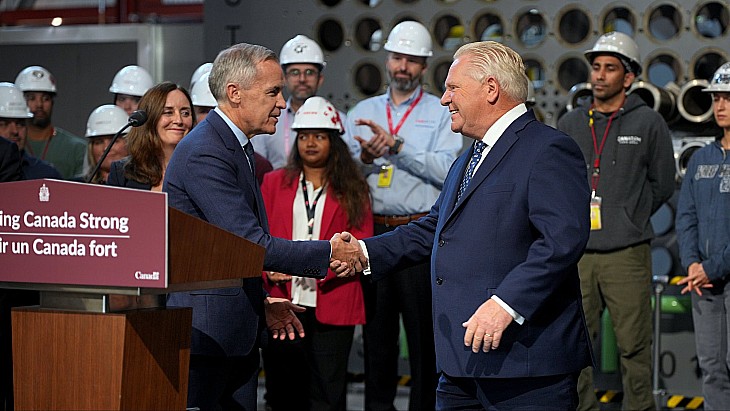
Mark Carney and Doug Ford announced the funding deals during a visit to the Darlington Nuclear Generating Station (Image: Doug Ford/X)
Announcing the investments alongside Ontario Premier Doug Ford, Canadian Prime Minister Mark Carney said the project would create thousands of high-paying careers and power hundreds of thousands of homes in Ontario with clean energy. "This is a generational investment that will build lasting security, prosperity, and opportunities," he said.
Ford described the investment as a down payment on Ontario's nuclear energy future. "We're protecting Ontario by supporting good-paying, long-term jobs for Ontario workers and building the energy infrastructure - including both SMRs and new, large-scale nuclear – needed to make Ontario an energy superpower," he said.
Provided conditions are satisfied, Canada Growth Fund (CGF) and Building Ontario Fund's capital will be made available to OPG in two tranches. The first tranche will comprise initial capital funding for the first unit, referred to as SMR 1; the second tranche of additional capital to fund the next three SMRs will be made available once certain project milestones have been met.
OPG has said it expects to complete construction of SMR 1 by the end of the decade and connect it to the grid by the end of 2030. Construction on SMRs 2-4 is expected to be completed in the mid-2030s.
"As a first-of-its-kind project, DNNP has a higher risk profile that limits access to traditional financing. In line with their mandates, CGF and BOF are investing at a stage where the Project is exposed to certain construction and technological risks," OPG, Canada Growth Fund and Building Ontario Fund (BOF) said. The funds' investments aim to de-risk the Darlington project "and advance it to a point where private sector participation can be efficiently catalysed in this essential energy infrastructure asset".
"DNNP represents a compelling opportunity for CGF and BOF to invest in a large-scale rate-regulated asset with rates subject to oversight and approval by the Ontario Energy Board," they said, adding that Canada Growth Fund and Building Ontario Fund will benefit from market-based investment governance, facilitating future participation from private investors.
Yannick Beaudoin, President and CEO of Canada Growth Fund Investment Management Inc, said there is "significant potential" for these first-of-a-kind SMRs to be replicated across Canada and globally. "We look forward to building upon this financing model to attract further interest from private investors committed to developing low-carbon energy infrastructure in Ontario and across Canada," he said.
Site progress
Since receiving the go-ahead from the provincial government in May, OPG has marked several milestones at the Darlington site where early preparation activities began in 2022.
The components of the project's tunnel boring machine, named Harriet Brooks after Canada's first female nuclear physicist, arrived on site in July, ready for assembly in early 2026. The 6.97-metre-width machine will be used to bore and line a 3.4-kilometre-long tunnel for the project's condenser cooling water system.
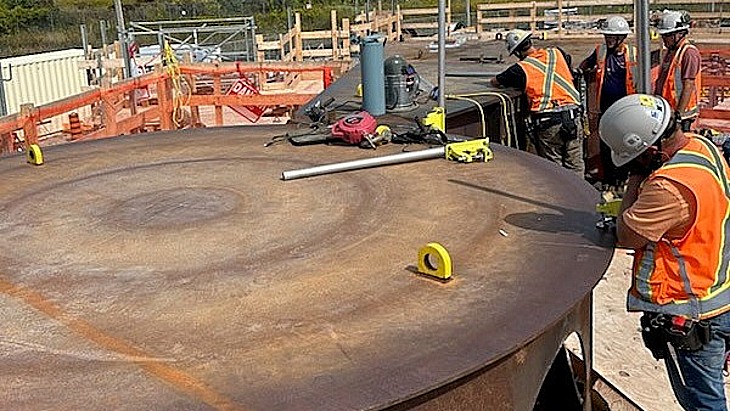
One of the components for the basemat module (Image: OPG)
The first assemblies that will make up the Basemat module - the foundation of the reactor building - are being delivered to site. The completed Basemat will eventually be craned into position at the bottom of the reactor building shaft, 35 metres deep.
The on-site pre-assembly building, which will support the final assembly of reactor building structural components for the first SMR unit, is complete, as is the fabrication building, where final assembly of modular building components will take place. Foundation work for the radiation waste building and control and service buildings has also been completed.
Excavation work is continuing on the reactor building shaft, forebay shaft, and the condenser cooling water launch shaft, while site grading for three additional SMR units has now been completed.
In pictures: Reactor vessel delivered for El Dabaa unit I
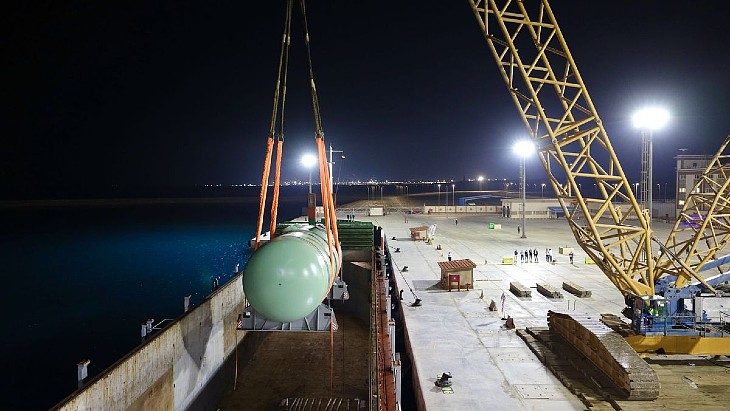
The 330-tonne reactor vessel was manufactured at Rosatom's Izhora plant, in a process which took 41 months. The reactor vessel is about 13 metres long and 4.5 metres in diameter. The service life is for an initial 60 years, with the possible extension to 80 years.
The cylindrical steel reactor vessel which houses the reactor core ensures a hermetic seal and withstands high pressures and temperatures, ensuring the safety and reliability of the power unit.
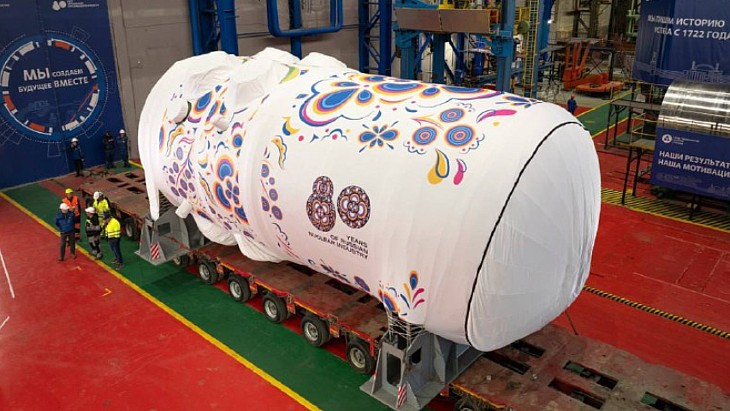
A ceremony held before the reactor pressure vessel was shipped (Image: Rosatom)
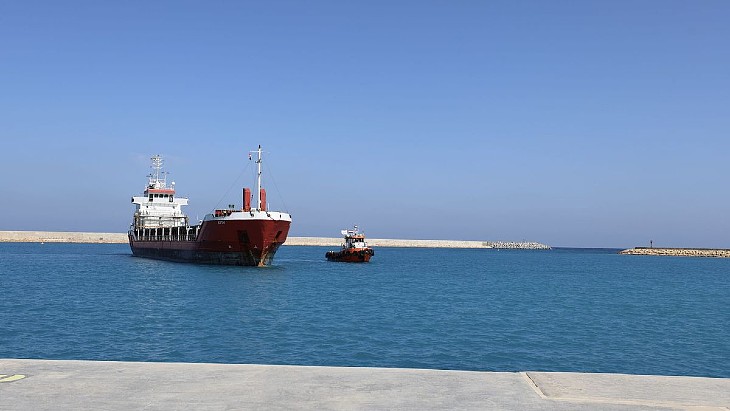
It was transported by a specially adapted cargo vessel (Image: Rosatom)
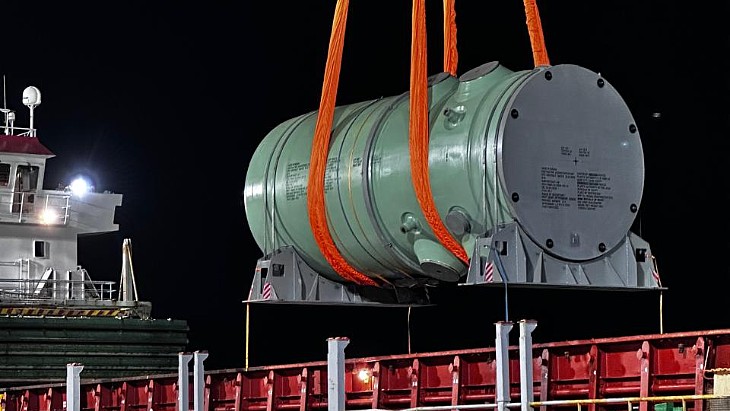
It was delivered by sea on 21 October after a 20-day journey from St Petersburg (Image: NPPA)
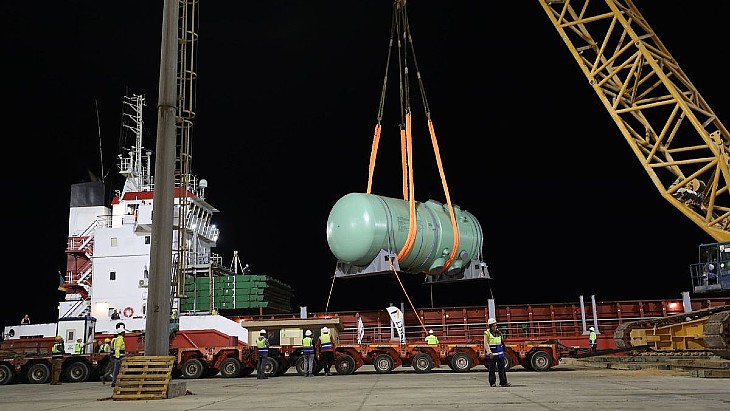
A giant crane was on hand to lift it off the ship (Image: Rosatom)
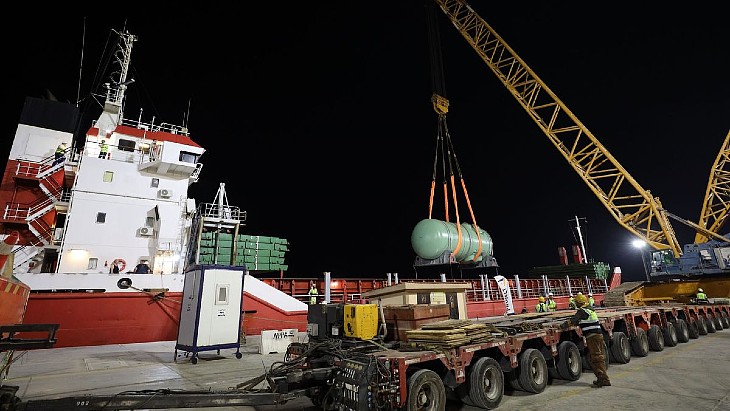
The port has been specially designed for large-scale deliveries (Image: Rosatom)
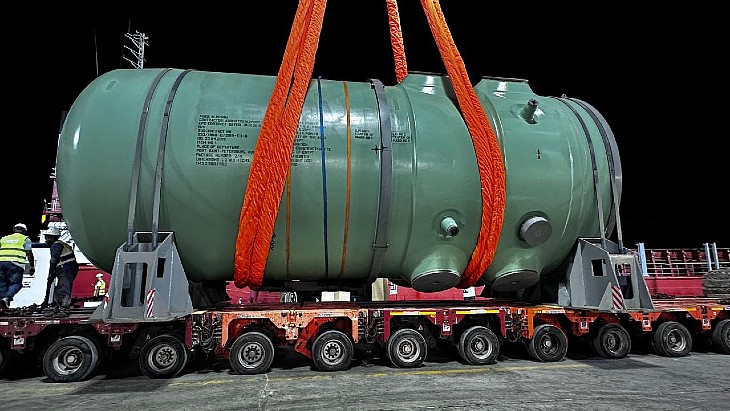
The last leg of the journey will be on land (Image: NPPA)
Sherif Helmy, Chairman of Egypt's Nuclear Power Plants Authority, said: "The reactor vessel for Unit 1 has been delivered to the specialised port at the El Dabaa NPP construction site, built by the Egyptian side for receiving large-scale equipment. Installation of the reactor vessel is scheduled for mid-November, and our teams are working tirelessly to achieve this key milestone."
Alexey Kononenko, Vice President of JSC Atomstroyexport and Director of the El Dabaa NPP Construction Project, said it was a "milestone" moment for the project and was "a reflection of the effective collaboration of our international team". He added: "We are now on the threshold of the year's most important production event - the installation of the reactor vessel for Unit 1 into its design position."
Background
El Dabaa will be Egypt's first nuclear power plant, and the first in Africa since South Africa's Koeberg was built nearly 40 years ago. The Rosatom-led project, about 320 kilometres north-west of Cairo, will comprise four VVER-1200 units, like those already in operation at the Leningrad and Novovoronezh nuclear power plants in Russia, and the Ostrovets plant in Belarus.
Under the 2017 contracts, Rosatom will not only build the plant, but will also supply Russian nuclear fuel for its entire life cycle, including building a storage facility and supplying containers for storing used nuclear fuel. It will also assist Egyptian partners in training personnel and plant maintenance for the first 10 years of its operation. Rosatom said last month that it is aiming for a future service life of 100 years for nuclear power plants.
The four units are being built almost concurrently, with first concrete at unit 1 in July 2022, followed in turn by the others, concluding with first concrete at unit 4 in January 2024. Egypt's aim is for 9% of electricity to be generated by nuclear by 2030, which would be achieved by the commercial operation of the first two units by that time, directly displacing oil and gas.
Outer dome installed at Lufeng unit 5
_25135.jpg)
On 18 October, the outer containment dome steel formwork module - measuring 51 metres in diameter, 13 metres in height, and weighing 261.8 tonnes - was raised using a 2,000-tonne crawler crane equipped with a laser target dynamic guidance system and placed on top of the walls of the double containment structure. The hoisting process took just 94 minutes to complete.
"This successful installation marked the first time that CGN completed the modular installation of the outer dome steel formwork for the Hualong One reactor, creating crucial conditions for subsequent containment pressure testing and nuclear island installation for unit 5," China General Nuclear (CGN) subsidiary CGN Lufeng Nuclear Power Company said.
In April 2022 the State Council approved construction of two Hualong One units at Lufeng as units 5 and 6. First concrete was poured for unit 5 on 8 September 2022 and that for unit 6 on 26 August 2023. Units 5 and 6 are expected to be connected to the grid in 2028 and 2029, respectively. The inner containment dome was installed at unit 5 in April 2024 and at unit 6 in July this year.
The dome is located on top of the nuclear island. Its main function is to ensure the integrity and leak tightness of the reactor building, and it plays a key role in the containment of radioactive substances.
The proposed construction of four 1250 MWe CAP1000 reactors (units 1-4) at the Lufeng site was approved by China's National Development and Reform Commission in September 2014. However, the construction of units 1 and 2 did not receive State Council approval until 19 August last year. The first safety-related concrete was poured for the nuclear island of unit 1 at the Lufeng plant on 24 February this year. Approval for units 3 and 4 is still pending.
Regulatory milestone for Wyoming advanced reactor
_88774.jpg)
TerraPower submitted an application to the US regulator for a permit that would allow the construction of Kemmerer Unit 1 in Lincoln County, Wyoming, in March 2024. The first-of-a-kind Natrium project is being developed through the US Department of Energy’s Advanced Reactor Demonstration Program (ARDP) public-private partnership.
According to the Environmental Impact Statement (EIS), Kemmerer Unit 1 would demonstrate an advanced sodium-cooled reactor, with one 840 MWt pool-type sodium fast reactor connected to a molten salt energy storage system that enables a variable energy supply of up to 500 MWe (net). The storage technology is designed to keep base output steady, ensuring constant reliability and can quickly ramp up when demand peaks: TerraPower says it is the only advanced reactor design with this unique feature.
The Environmental Impact Statement evaluates the environmental impacts of the proposed plant, which would demonstrate the Natrium advanced reactor while ultimately replacing electricity generation capacity following the planned retirement of existing coal-fired facilities. It says: "After weighing the environmental, economic, technical, and other benefits against environmental and other costs, and considering reasonable alternatives, the NRC staff recommends, unless safety issues mandate otherwise, that the NRC issue the requested Construction Permit to [TerraPower subsidiary] USO."
TerraPower President and CEO Chris Levesque said the announcement from the NRC was a "testament" to the team's dedication and rigour in meeting all federal licensing requirements. "The Natrium plant in Wyoming, Kemmerer Unit 1, is now the first advanced reactor technology to successfully complete an environmental impact statement for the NRC, bringing us another step closer to delivering America's next nuclear power plant," he said.
Earlier this year the NRC said it intended to accelerate its schedule to complete the review of TerraPower's construction permit application six months earlier than originally envisaged. The next step will be the completion of the final safety evaluation, which is anticipated by the end of December, the company said.
Construction of the non-nuclear portions of the site began in June 2024.


