Sunday, October 05, 2025

Jefferson’s War On The Barbary Pirates Is An Unjustified Password For Military Intervention – Analysis

LIBERTARIAN ANTI-IMPERIALISM
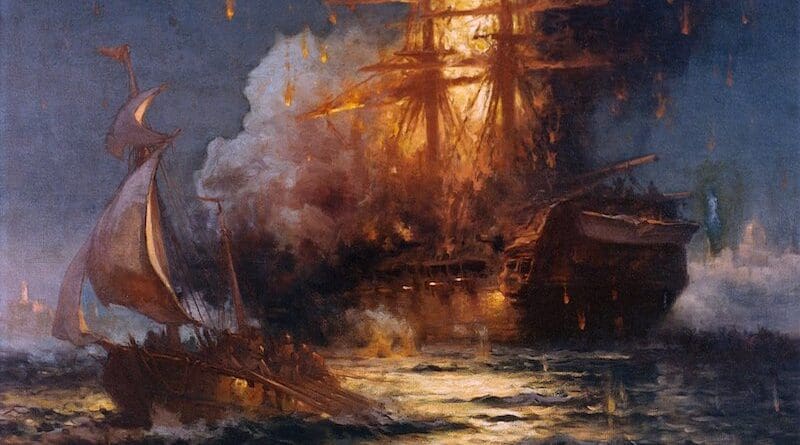

An 1897 painting of the burning of the USS Philadelphia. Credit: Wikipedia Commons

October 6, 2025
MISES
By Joshua Mawhorter


A few early episodes of US history are commonly employed as alleged historical precedents and justifications for modern US foreign interventionism in foreign policy. One such episode is Jefferson’s dealings with the Barbary pirates during his administration without a congressional declaration of war.

This is important because this episode, among others, is used as something of a historic “rhetorical password”—an attempt to superficially raise a point in one’s favor, masquerading as evidence—in order to avoid further argumentation. Readers are surely familiar with several rhetorical passwords and attempts to use them. For example, often when defending freedom of speech, one will often hear, “But you can’t yell ‘fire!’ in a crowded theater.” Such passwords often are disanalogous to the topic debated and usually ignorant of key historical context. Whether used consciously or not, rhetorical passwords act as counterpoints without true argumentation and are usually an attempt to move beyond a point made.

Historical examples can be and are used to draw lessons for the present, in fact, knowledge of history is crucial regarding domestic and foreign policy. However, superficial uses of historical events—often with little knowledge of the history—are used as rhetorical passwords and often obscure rather than clarify. In attempts to justify modern foreign policy interventions, it is common to hear, more or less elaborately, “Well, George Washington did it.” This is also the case with Jefferson and the brief war with the Barbary pirates. Arthur Schlesinger, Jr. wrote in the New York Times in 1951, “[American presidents] repeatedly committed American armed forces abroad without prior Congressional consultation or approval.”

We should note several things before proceeding to the history itself. For one, even if Jefferson did go to war with the Barbary pirates without congressional approval, and even if this situation is analogous to the current situation one wants to justify, it does not follow that just because Jefferson did something that it was justified. That would be like saying you know someone who played Russian roulette and lived, therefore, there’s no danger in playing Russian roulette now. Further, there are often significant overlooked disanologies—breaks in continuity—between a current situation and a historical event. For a historical event to be valid as a precedent, there has to be significant situational and contextual overlap. A single point of contact—that an American president deployed military action without a congressional declaration of war—is insufficient to demonstrate a valid analogy, especially when key differences are prevalent.

Using the Barbary Pirates

This episode of American history is often utilized to justify three, often-related, points in modern American foreign policy: 1) the legitimate ability of the president to take military action without a congressional declaration of war; 2) the need to violently confront radical Islam abroad to avoid being attacked at home; and, 3) the dangers of attempting peace through “appeasement.”

One article says, “While Muslim terrorists kidnapped and killed innocent people around the world as they do today, Thomas Jefferson knew exactly how to end radical Islam’s bloodshed – with a classic American take-no-prisoners smackdown.” The article is titled, “Tough guy Thomas Jefferson crushed Muslim terrorists.” Popular historian, David Barton (whose degree is actually in religious education, not history), said of this episode,

The willingness to use force and inflict casualties is the kind of attitude it will take to answer this challenge because historically, that’s the kind of attitude that will make the Muslims say, “The price for us is too high to pay. We’ll back off and leave you guys alone.” Unfortunately, even if we do that, Muslims may not necessarily leave the others [sic] guys alone.

Apparently, the lessons to be learned by implication from Jefferson’s brief war with the Barbary pirates are that it is often necessary for presidents to take unilateral military actions without the approval of Congress despite what the Constitution stipulates, that radical Islam must be combatted abroad to avoid fighting them here, and that military interventionism is always a superior alternative to “appeasement.” However, these lessons cannot be legitimately drawn from the war with the Barbary pirates. Instead, we see that the cost-benefit analysis does not make it obvious that war was the only obvious option, there are significant disanalogies between this event and modern War on Terror, and the fact that—while the war was limitedly successful—tribute was still paid to other states following this episode.

Cost-Benefit Analysis


Determined as we are to avoid, if possible, wasting the energies of our people in war and destruction, we shall avoid implicating ourselves with the powers of Europe, even in support of principles which we mean to pursue. They have so many other interests different from ours, that we must avoid being entangled in them. We believe we can enforce these principles as to ourselves by peaceable means, now that we are likely to have our public councils detached from foreign views. (Thomas Jefferson to Thomas Paine, as quoted in The Life and Writings of Thomas Jefferson, p. 215)

Unlike most modern wars, addressing the Barbary pirates in the Mediterranean involved discussions of cost-benefit analysis. In other words, officials actually attempted to weigh whether the costs of war would be greater or less than the cost of continuing to pay tribute and the costs of the capture and ransom of American soldiers. Prior to the Jefferson administration, previous administrations had dealt with similar problems from the pirates but elected to pay tribute rather than go to war, not because they wimped out, but because they recognized that the costs of war often outweigh the costs of tribute and the possible benefits from a war.

After 1787, though the Confederation Congress had concluded a favorable treaty with Morocco, the other Barbary States demanded higher tribute-taxes from American ships. Patrick Newman writes,


Minister to France Jefferson, usually cognizant of the cost of war, urged armed confrontation. Far more cogent was Minister to Great Britain John Adams, who wisely noted that tribute was less expensive than war. Secretary for Foreign Affairs John Jay, reactionary to the core, hoped to exploit the opportunity and develop a strong navy.


During the Jefferson presidential administration, after having decreased government spending by 27 percent from 1800 to 1802, Newman explains the following events and how even Jefferson rejected the cost-benefit analysis of Gallatin and Randolph that war would cost more than tribute,


When Tripoli of the Barbary States demanded more tribute, the new president refused and the US entered another naval war. Jefferson failed to secure a congressional declaration of war, setting an atrocious precedent for executive overreach. In vain, Gallatin and Randolph protested to Jefferson that Congress should pay Tripoli because the cost of war would be greater than tribute and interfere with their retrenchment goals. But the adamant Jefferson pushed military spending back up. After collapsing 73 percent from 1800 to 1802, naval expenditures had increased 75 percent by 1805. Gallatin believed part of the splurge was due to Secretary Smith’s shipping background and he later accused the Smiths of embezzling war appropriations to their mercantile firm Smith & Buchanan. In addition, the Tripoli War forced Gallatin to request a slight increase in tariffs. Proponents argued for the tariff increases on the grounds that they would only be temporary, but Congress ended up making them permanent. (emphasisadded)

This war did benefit pro-navy Federalists, especially northern merchants. In 1803, John Randolph opined that there were many “who pant for military command and the emoluments of office” which would be brought about by the war. While that may sound cynical, it would be naive to overlook, especially in discussing cost-benefit analysis, the many beneficiaries of a war. In wars, there are always people who benefit from the war spending—transferred from the taxpayer, directly or indirectly, to individuals who provide goods and services deemed necessary for the war. It is not uncommon that these beneficiaries have historically agitated for war. In fact, earlier in 1785, John Jay wrote upon hearing of Algiers declaring war against American shipping,

This war does not strike me as a great evil. The more we are ill-treated abroad, the more we shall unite and consolidate at home. Besides, as it may become a nursery for seamen, and lay the foundation for a respectable navy, it may eventually prove more beneficial than otherwise.


Disanalogy between the Barbary War and Present Circumstances

It ought to go without saying, but it is necessary to point out the fact that Jefferson’s limited military response against the aggressions of the Barbary pirates—while it may have some superficial similarities—is so significantly dissimilar to the modern War on Terror or post-WWII wars without congressional declaration that it becomes irrelevant as an example. The differences in scope, constitutional process, scale of forces, and geopolitical context are so great that the example becomes almost meaningless. To cite Jefferson’s brief naval actions as justification for contemporary wars is to ignore the massive disanalogies that make the comparison historically misleading.

Jefferson may arguably have set a bad precedent going forward, however, he did approach Congress and limited himself to congressional approval, even if there was no declaration of war. That Jefferson’s request for a declaration of war was rejected by Congress does not mean Jefferson simply ignored Congress. Political scientist and constitutional law expert, Louis Fisher, wrotein response to Arthur Schlesinger, Jr.’s attempt (above) to use Jefferson’s actions to justify Truman’s actions in the Korean War,

As valid precedent for Truman’s actions in the Korean War, Schlesinger pointed to Jefferson’s use of ships to repel the Barbary pirates. In fact, Jefferson took limited defensive actions in the Mediterranean and came to Congress to seek authority for anything that went “beyond the line of defense.” And Congress enacted ten statutes to authorize military action by Presidents Jefferson and Madison in the Barbary wars. There is no connection between the actions of Jefferson and Truman. Truman seized the full warmaking authority––defensive and offensive––and never came to Congress for authority. Jefferson respected congressional prerogatives and constitutional limits. Truman did neither. None of the examples cited by Schlesinger were of a magnitude to justify or legalize what Truman did in Korea.

In fact, Jefferson said in his First Annual Message (December 8, 1801),

I communicate all material information on this subject, that in the exercise of this important function confided by the Constitution to the Legislature exclusively their judgment may form itself on a knowledge and consideration of every circumstance of weight.

Congress soon after passed “An Act for the protection of the Commerce and Seamen of the United States, against the Tripolitan Cruisers” (February 6, 1802) that allowed Jefferson “to equip, officer, man, and employ such of the armed vessels of the United States as may be judged requisite by the President of the United States, for protecting effectually the commerce and seamen thereof on the Atlantic ocean, the Mediterranean and adjoining seas.” The president would also be able to “instruct the commanders of the respective public vessels aforesaid, to subdue, seize and make prize of all vessels, goods and effects, belonging to the Bey of Tripoli, or to his subjects,…” Section 3 further enabled “owners of private armed vessels…like authority for subduing, seizing, taking, and bringing into port, any Tripolitan vessel, goods or effects,…”

Jefferson’s brief naval response to the Barbary pirates bears only superficial resemblance to modern wars, especially the War on Terror, and the differences are decisive. His campaign was narrowly circumscribed, involving only a handful of frigates and marines operating in the Mediterranean, not multi-theater deployments with thousands of troops and permanent occupation through military bases for decades. Jefferson acknowledged constitutional limits, insisting that only Congress could authorize offensive action, and Congress, in fact, passed multiple statutes explicitly empowering limited naval hostilities—unlike post-WWII presidents who have waged prolonged wars without congressional declarations. The Barbary conflict lasted only a few years (1801-1805) and cost a few million dollars, whereas the War on Terror has extended for decades and cost trillions and thousands of lives. Its purpose was limited—to defend commerce and end tribute demands—not regime change, counterinsurgency, or global ideological struggle. Even its conclusion was modest: Tripoli agreed to peace in 1805, but the United States continued paying tribute to other Barbary states until 1816. To equate Jefferson’s constrained naval defense with modern open-ended wars is to erase the vast disanalogies in scope, cost, objectives, and constitutional process. In fact, if Jefferson’s war could be termed a success, it may be said that modern users of Jefferson’s actions attempt to borrow capital from Jefferson’s success to justify their failures.

If the US wants to effectively reduce radical Islamic terror, it ought to consider the foreign policy history of the last five decades, explore the significant connection between foreign occupation and suicide terrorism, and stop funding radical Islamic jihadists abroad when they are perceived to be fighting in US interests.


About the author: Joshua Mawhorter is assistant editor of Mises.org. He was a summer fellow at the Mises Institute (2023) and a government/economics and US history teacher since 2016. Josh has a bachelor’s degree in political science from California State University, Bakersfield, a master’s in political science from Southern New Hampshire University, and a master’s in Austrian economics from the Mises Graduate School (2023). He has self-published a few books, including The First Constitution: The Articles of Confederation, Tyrannosaurus Debt: The Student Loan Crisis and How to Survive, and “An Austrian Critique of Modern Monetary Theory”, his thesis. He also enjoys teaching in the areas of theology, the Old Testament, church history, apologetics, and philosophy.
Source: This article was published by the Mises Institute


MISES
The Mises Institute, founded in 1982, teaches the scholarship of Austrian economics, freedom, and peace. The liberal intellectual tradition of Ludwig von Mises (1881-1973) and Murray N. Rothbard (1926-1995) guides us. Accordingly, the Mises Institute seeks a profound and radical shift in the intellectual climate: away from statism and toward a private property order. The Mises Institute encourages critical historical research, and stands against political correctness.


California partnership aided COVID-19 response and health equity, report finds


STOP COVID-19 CA showed how researchers and communities can work together to tackle health disparities


University of California - Riverside


RIVERSIDE, Calif. -- The COVID-19 pandemic did not affect everyone equally. Communities of color, especially Latino (including undocumented persons), Black, and Native American groups, as well as people with low incomes, experienced much higher rates of infection, hospitalization, and death. 

Research has shown that several key factors worsened health inequalities during the COVID-19 pandemic. Crowded housing, dense neighborhoods, and location played a major role in how the virus spread. Systemic racism, discrimination, and unstable jobs made some communities even more at risk.

A new report, published in Health Expectations, highlights how the Share, Trust, Organize, Partner COVID-19 California Alliance, known as STOP COVID-19 CA, helped address these challenges. Formed in 2020 as part of the federal pandemic response, the network brought together 11 universities, including the University of California, Riverside, and more than 75 community organizations across 14 counties. Together, they focused on reaching communities most affected by COVID-19 and improving access to reliable information, testing, and vaccination, while laying the foundation for long-term health equity.

“Our evaluation looks at how a state-wide network helped strengthen partnerships between communities and researchers so they could work together to tackle health inequalities in underserved communities during the COVID-19 pandemic,” said Ann Cheney, senior author of the report and a professor of social medicine, population, and public health in the UC Riverside School of Medicine. “What made this network different was its community-first approach. Local organizations and grassroots leaders didn’t just participate; they led.” 

From shaping research questions to collecting data and writing reports, community partners contributed at every step, helping ensure that the work stayed grounded in real-life community needs and socio-cultural and economic contexts, rather than being driven by academic theory alone.

Between August 2020 and December 2021, STOP COVID-19 CA surveyed more than 11,000 Californians, conducted dozens of focus groups, participated in clinical trials, and organized hundreds of events — from town halls to vaccination clinics. Community health workers, known as promotoras, helped design and deliver health information in ways that resonated with local culture and language.

Cheney explained that in 2024 the network used a participatory and community-based evaluation method called Ripple Effects Mapping to better understand the network’s impact. The method showed that the network not only improved COVID-19 response efforts, but also strengthened relationships between community and academic partners, improved communication, and built lasting skills for future collaboration.

“Our report also points to bigger lessons,” Cheney said. “While the network made significant progress, participants noted the need for broader changes, especially in how universities work with community groups and how funding is shared. Ultimately, STOP COVID-19 CA showed that when communities are respected as leaders and equal partners, the results are more effective and more lasting.” 

The report found the network helped communities not only respond to an emergency but also begin to reshape public health responses to better serve those most impacted by inequality. According to the report, STOP COVID-19 CA remains a model for how researchers and communities can work together to advance health equity. 

“By combining academic expertise with local knowledge and leadership, the network showed what is possible when collaboration is rooted in trust, respect, and shared purpose,” Cheney said. “Beyond helping with urgent needs like COVID-19 testing and vaccines, the network also laid the groundwork for lasting changes to support ongoing community involvement in health equity research. It stands as a model for how diverse communities — across cultures, languages, and regions — can come together with researchers to tackle health disparities.”

Cheney’s coauthors on the report are academic partners at UCR and UC San Diego, as well as community partners at Conchita Servicios de la Comunidad in Mecca, California, and Global Action Research Center in San Diego. 

The research was supported by a grant from the National Heart, Lung, and Blood Institute of the National Institutes of Health.

The title of the paper, led by first author Evelyn Vázquez who was formerly at UCR, is “Ripple Effects Mapping: Evaluating Multilevel Perspectives and Impacts of a State-Wide Community Academic Partnership Network on COVID-19 Health Disparities.”

The University of California, Riverside is a doctoral research university, a living laboratory for groundbreaking exploration of issues critical to Inland Southern California, the state and communities around the world. Reflecting California's diverse culture, UCR's enrollment is more than 26,000 students. The campus opened a medical school in 2013 and has reached the heart of the Coachella Valley by way of the UCR Palm Desert Center. The campus has an annual impact of more than $2.7 billion on the U.S. economy. To learn more, visit www.ucr.edu.


Researchers deconstruct chikungunya outbreaks to improve prediction and vaccine development


University of Notre Dame
Researchers deconstruct chikungunya outbreaks to improve prediction and vaccine development 

image: 

An Aedes aegypti mosquito with red powder used to mark the animal in a behavior test.

view more 

Credit: (Photo by Matt Cashore/University of Notre Dame)


The symptoms come on quickly — acute fever, followed by debilitating joint pain that can last for months. Though rarely fatal, the chikungunya virus, a mosquito-borne illness, can be particularly severe for high-risk individuals, including newborns and older adults.

While the virus is common in tropical and subtropical regions, including Asia, Africa and South America, public health officials have been tracking reported infections in Europe and, in September, a confirmed case in Long Island, New York.

Outbreaks of chikungunya have prompted the Centers for Disease Control to issue health notices to travelers bound for Bangladesh; Cuba; Guangdong Province, China; Kenya; Madagascar; Somalia; and Sri Lanka.

In Guangdong Province, an “unprecedented” outbreak recently prompted government officials in China to mandate quarantines for anyone suspected of being infected by the virus, spraying individuals with mosquito repellent and spraying impacted buildings and other areas with insecticide.

In a new study, published in Science Advances, researchers at the University of Notre Dame analyzed more than 80 outbreaks of chikungunya virus to improve prediction of future outbreaks and inform vaccine trial development.

“Chikungunya outbreaks are unpredictable in both size and severity,” said Alex Perkins, the Ann and Daniel Monahan Collegiate Professor of infectious disease epidemiology in the Department of Biological Sciences, and co-author of the study. “You can have one outbreak that infects just a few people, and another in a similar setting that infects tens of thousands. That unpredictability is what makes public health planning — and vaccine development — so difficult.”

For the study, Alexander Meyer, a postdoctoral researcher in Perkins’ lab and lead author of the study, and a team of researchers reconstructed and analyzed 86 chikungunya outbreaks, creating the largest comparative dataset of its kind.

“Instead of looking at outbreaks in isolation, looking at many, all of which varied in size and severity, allowed us to search for patterns among them,” Meyer said.

Chikungunya was first identified in the 1950s. Outbreaks have become increasingly frequent and widespread, but they’re also sporadic and difficult to predict, posing a challenge to public health officials when it comes to planning for and preventing infections.

Changes in outbreaks of chikungunya, transmitted by bites from infected mosquitoes — Aedes aegypti or Aedes albopictus are the primary vectors — and other mosquito-borne illnesses are often considered in relation to climate change, as warmer, more humid conditions can promote mosquito activity.

But Perkins said this study showed that climate isn’t necessarily the most important factor when trying to predict the severity of an outbreak of disease caused by a virus like chikungunya.

“Climate factors like temperature and rainfall can tell us where outbreaks are possible, but this study shows that they don’t help very much in predicting how severe they will be,” he said. “Local conditions matter — things like housing quality, mosquito density and how communities respond. Some variation is simply due to chance. That randomness is part of the story, too.”

Currently, only two vaccines for chikungunya have received regulatory approval — but they are not widely available in regions where the virus is most common.

That is why having such a large, comprehensive dataset is so helpful when it comes to vaccine development, Perkins said.

To test for efficacy, vaccine makers need accurate predictions of where an outbreak might occur before it happens, to conduct trials and monitor whether candidate vaccines are effective.

The study demonstrates how a more comprehensive analysis of past outbreaks can help public health officials prepare for future outbreaks, thereby protecting vulnerable populations and aiding vaccine development.

Additional co-authors include Kathryn B. Anderson at the State University of New York, Natalie Dean at Emory University, and Sandra Mendoza Guerrero and Steven T. Stoddard at Bavarian Nordic Inc., which provided funding for the study. This work was additionally supported by the Office of the Assistant Secretary of Defense for Health Affairs.


Research unearths origins of Ancient Egypt’s Karnak Temple


Most complete study of the temple complex and its landscape establishes earliest occupation and hints at link to creation myth


University of Southampton

Karnak Temple 

image: 

Karnak Temple, Luxor, Egypt.

view more 

Credit: Dr Ben Pennington


Researchers have carried out the most comprehensive geoarchaeological survey of Egypt’s Karnak Temple near Luxor – one of the ancient world’s largest temple complexes and a UNESCO World Heritage site welcoming millions of tourists every year.

The study, published in Antiquity today [6 October] reveals new evidence on the age of the temple, tantalising links to ancient Egyptian mythology, and new insights about the interplay between the temple’s riverine landscape and the people who occupied and developed the site over its 3,000 years of use.

“This new research provides unprecedented detail on the evolution of Karnak Temple, from a small island to one of the defining institutions of Ancient Egypt,” says Dr Ben Pennington, lead author of the paper and a Visiting Fellow in Geoarchaeology at the University of Southampton.

Karnak temple is located 500 meters east of the present-day River Nile near Luxor, at the Ancient Egyptian religious capital of Thebes.

An international research team, led by Dr Angus Graham (Uppsala University) and involving several academics from the University of Southampton, analysed 61 sediment cores from within and around the temple site. The team also studied tens of thousands of ceramic fragments to help date their findings.

Using this evidence, researchers have been able to map out how the landscape around the site changed throughout its history.

They found that prior to about 2520 BCE, the site would have been unsuitable for permanent occupation due to being regularly flooded by fast-flowing water from the Nile. This means the earliest occupation at Karnak would have likely been during the Old Kingdom (c.2591–2152 BC). Ceramic fragments found at the site corroborate this finding, with the earliest dating from sometime between c.2305 to 1980 BC.

Dr Kristian Strutt, a co-author of the paper from the University of Southampton, said: “The age of Karnak Temple has been hotly contested in archaeological circles, but our new evidence places a temporal constraint on its earliest occupation and construction.”

The land on which Karnak was founded was formed when river channels cut into their beds to the west and east, creating an island of high ground in what is now the east/south-east of the temple precinct. This emerging island provided the foundation for occupation and early construction of Karnak temple.

Over subsequent centuries and millennia, the river channels either side of the site diverged further, creating more space for the temple complex to develop.

Researchers were surprised to find that the eastern channel – until this study not much more than a supposition – was more well-defined, and perhaps even larger than the channel to the west, which archaeologists had previously focussed on.

Dominic Barker, another co-author also from the University of Southampton added: “The river channels surrounding the site shaped how the temple could develop and where, with new construction taking place on top of old rivers as they silted up.”

 “We also see how Ancient Egyptians shaped the river itself, through the dumping of sands from the desert into channels, possibly to provide new land for building, for example.”

This new understanding of the temple’s landscape has striking similarities to an Ancient Egyptian creation myth, leading the team to believe that the decision to locate the temple here could have been linked to the religious views of its inhabitants.

Ancient Egyptian texts of the Old Kingdom say that the creator god manifested as high ground, emerging from ‘the lake’. The island upon which Karnak was found is the only known such area of high ground surrounded by water in the area.

“It’s tempting to suggest the Theban elites chose Karnak’s location for the dwelling place of a new form of the creator god, ‘Ra-Amun’, as it fitted the cosmogonical scene of high ground emerging from surrounding water,” says Dr Pennington.

“Later texts of the Middle Kingdom (c.1980–1760 BC) develop this idea, with the ‘primeval mound’ rising from the ‘Waters of Chaos’. During this period, the abating of the annual flood would have echoed this scene, with the mound on which Karnak was built appearing to ‘rise’ and grow from the receding floodwaters.”

With a concession to study the whole floodplain of the Luxor region, the team are now planning and carrying out work at other major sites in the area, to further understand the landscapes and waterscapes of the whole Ancient Egyptian religious capital zone.

The Conceptual origins and geomorphic evolution of the temple of Amun-Ra at Karnak (Luxor, Egypt) is published in Antiquity and is available online.

The work was supported by the Knut och Alice Wallenbergs Stiftelse (KAW 2013.0163) and Uppsala Universitet (HUMSAM 2014/17), together with a small grant from M och S WÃ¥ngstedts Stiftelse. The work was carried out under the auspices of the Egypt Exploration Society (London) with a permit from the Ministry of Tourism and Antiquities (Egypt).

Ends


Core samples being extracted at Karnak Temple

Core samples being extracted at Karnak Temple.


Core samples being extracted at Karnak Temple.

Credit

Dr Ben Pennington

Notes for editors

  1. The paper Conceptual origins and geomorphic evolution of the temple of Amun-Ra at Karnak (Luxor, Egypt) will be published in Antiquity. An advanced copy of the paper is available upon request.
  2. For Interviews with Dr Ben Pennington please contact Steve Williams, Media Manager, University of Southampton press@soton.ac.uk or 023 8059 3212.
  3. Images available here: https://safesend.soton.ac.uk/pickup?claimID=2gAWwbjQzvZYges4&claimPasscode=m8RPSX9eZSyosdCZ

Additional information

The University of Southampton drives original thinking, turns knowledge into action and impact, and creates solutions to the world’s challenges. We are among the top 100 institutions globally (QS World University Rankings 2025). Our academics are leaders in their fields, forging links with high-profile international businesses and organisations, and inspiring a 22,000-strong community of exceptional students, from over 135 countries worldwide. Through our high-quality education, the University helps students on a journey of discovery to realise their potential and join our global network of over 200,000 alumni. www.southampton.ac.uk

www.southampton.ac.uk/news/contact-press-team.page

Follow us on X: https://twitter.com/UoSMedia