Friday, June 20, 2025

Bill Gates in Brussels next week for fresh vaccine financing push with EU leaders

Copyright Evan Vucci/
Copyright 2022 The AP. All rights reserved

By Sandor Zsiros
Published on 19/06/2025 -

The head of the Gates Foundation hosts a pledging conference on Wednesday, together with EU leaders, in order to collect 9 billion dollars for vaccines. Gates will also participate in a debate at the European Parliament.

Bill Gates will visit Brussels next week to participate in a Gavi vaccine alliance summit together with EU leaders to pledge provision of vaccine purchases for developing countries in an event co-hosted by The Gates Foundation and the European Union.

The goal of the event is to collect €9 billion between 2026 and 2030. Commission President Ursula von der Leyen and the president of the European Parliament, Roberta Metsola, will likely represent the EU at the event.

Gavi is a global vaccine alliance bringing together public and private actors that help vaccinate more than half the world’s children against some of the deadliest diseases. The Gates Foundation, alongside the European Union, is its biggest sponsor. Gavi intends to immunise at least 500 million children in the next five years. This, according to their press release, would save 8-9 million lives. It is not immediately clear how much the EU will contribute to this plan financially.

The EU has provided €3.2 billion in financing to Gavi since 2003. There was enhanced cooperation between the two during the coronavirus pandemic in the COVAX programme. EU institutions together with individual member states have also contributed €2.55 billion to Gavi's programmes, amounting to one third of the budget of the campaign.

“When the Gates Foundation made its first investment in Gavi 25 years ago, I couldn’t have predicted the extraordinary impact it would have on combatting infectious diseases, lifting up economies and saving lives,” said Bill Gates in a press release announcing the summit in Brussels.

"Together with Gavi, we have the goal to vaccinate 500 million children by 2030. That is why the European Union is proud to co-host Gavi’s High-Level Pledging Summit in Brussels. Our support will remain steadfast,” von der Leyen is cited in the release as saying.

Besides the Gavi's pledging summit, Bill Gates will also have other agenda items in Brussels, participating on Tuesday in a debate with MEPs on the European Parliament's Development Committee.

The discussion will focus on assistance and innovation as drivers for improving health and living standards in the Global South.

The press release of the Parliament adds that several international donors, like the United States and several EU countries, are cutting their aid budgets.
EU review indicates Israel breached human rights in Gaza


Copyright AP Photo
By Jorge Liboreiro & Maïa de La Baume & Shona Murray, 
Video: Maria Psara
Published on 20/06/2025


A review of the EU-Israel Association Agreement has found "indications" that Israel breached its human rights obligations with actions in Gaza.

Israel's actions in the Gaza Strip indicate a breach of the human rights provisions contained in its Association Agreement with the European Union, a highly anticipated review from the bloc's diplomatic service has found, citing a collection of findings by independent international organisations.

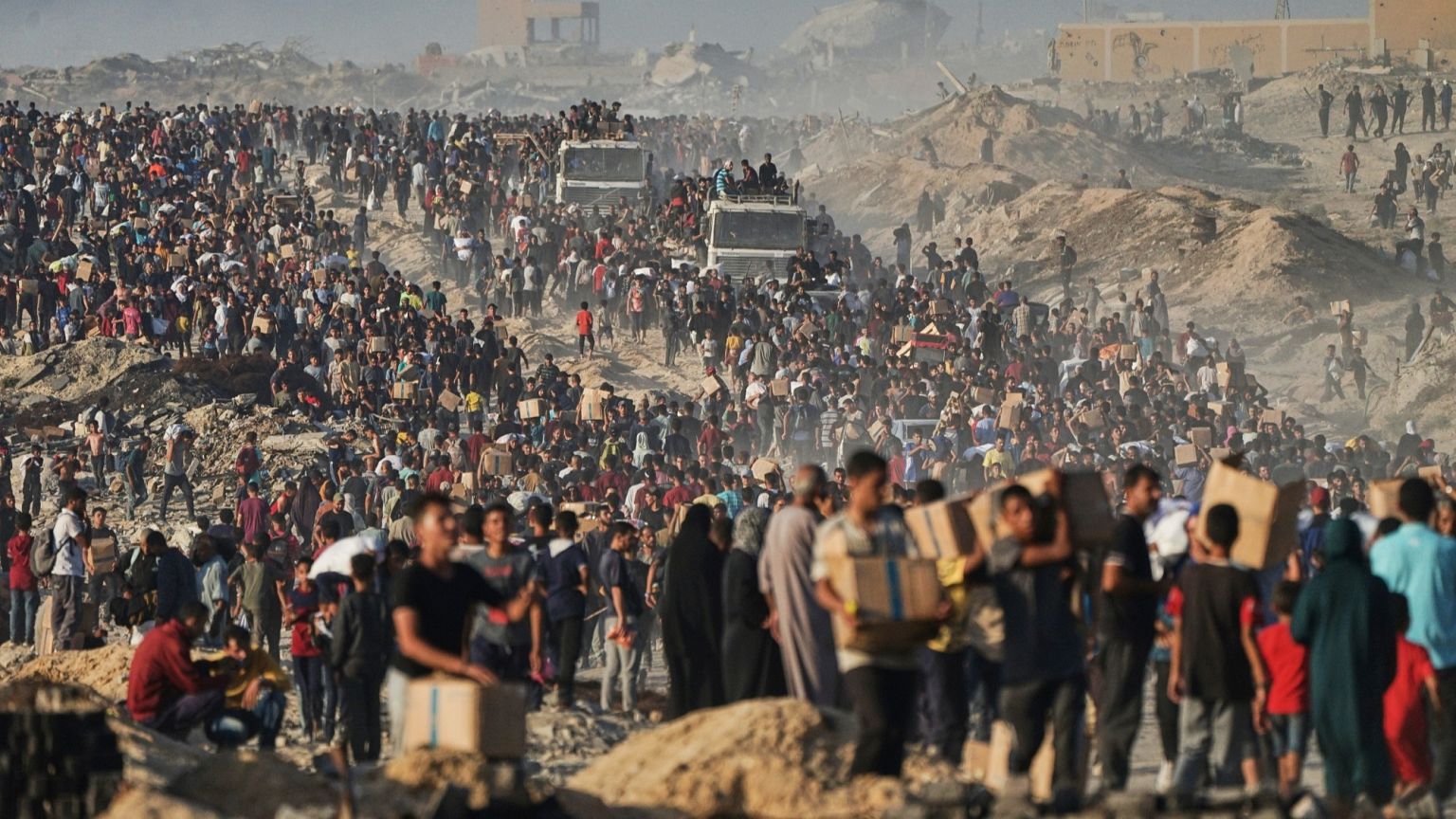
The breach stems from Israel's war on Gaza and the stringent conditions applied to the deliveries of humanitarian aid, which have stoked fears of widespread famine among Palestinians living in the densely populated enclave. It also covers Israel's decades-long occupation of the West Bank, where settlers have engaged in violent acts.

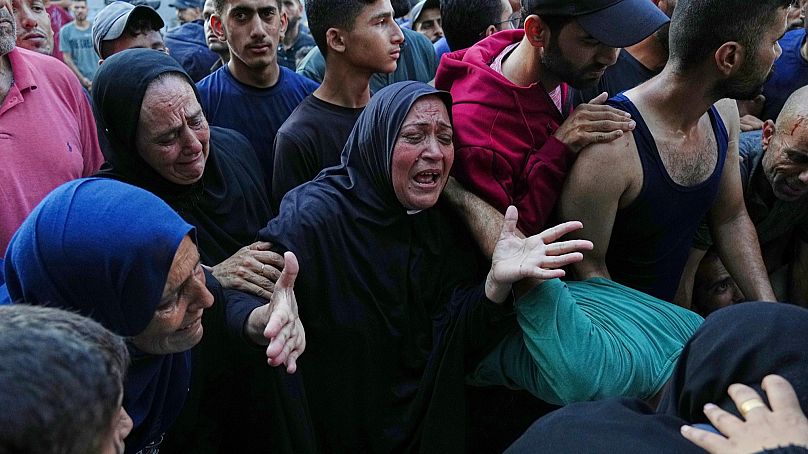
Europeans have reacted with shock and fury at reports of Palestinians being killed by the Israeli army while waiting for supplies at distribution sites.

The review was conducted by the European External Action Service (EEAS) and sent to member states on Friday under a restrictive format to avoid leaks.

"There are indications that Israel would be in breach of its human rights obligations under Article 2 of the EU-Israel Association Agreement," a senior diplomat told Euronews, quoting the conclusions contained in the document.

According to the diplomat, the review speaks about the blockade of humanitarian assistance, military strikes against hospitals, the forced displacement of the Palestinian population, mass arrests, arbitrary detentions, the expansion of settlements, which are illegal under international law, in the Occupied Territories, and the violence committed by settlers. The violations are described as numerous and serious.

The internal exercise was launched last month at the request of 17 countries, led by the Netherlands, to determine whether Israel was still complying with Article 2 of the Association Agreement, which states bilateral relations "shall be based on respect for human rights and democratic principles, which guides their internal and international policy and constitutes an essential element of this agreement".

Belgium, Denmark, Estonia, Finland, France, Ireland, Luxembourg, Malta, Poland, Portugal, Romania, Slovakia, Slovenia, Spain and Sweden backed the Dutch call.

Bulgaria, Croatia, Cyprus, the Czech Republic, Germany, Greece, Hungary, Italy and Lithuania were against, and Latvia adopted a "neutral" position, sources said then.

Israel decried the decision and called on Brussels to keep bilateral dialogue going.

"We completely reject the direction taken in the statement, which reflects a total misunderstanding of the complex reality Israel is facing," a spokesperson of Israel's foreign ministry said in May. "This war was forced upon Israel by Hamas, and Hamas is the one responsible for its continuation."

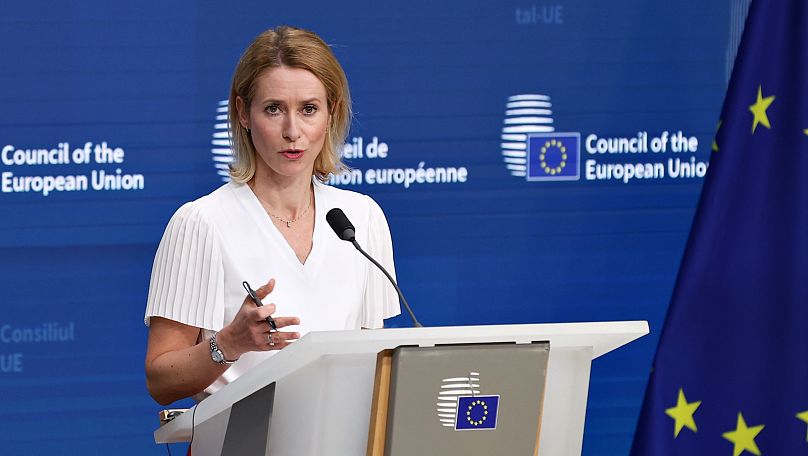
Kaja Kallas has recently hardened her tone towards Israel
.European Union, 2025.

The outcome of the review will be discussed by ambassadors on Friday and Sunday and later by foreign ministers on Monday. High Representative Kaja Kallas will personally brief EU leaders during a summit in Brussels on Thursday.

Kallas, who walks a fine line to keep all countries on the same page, has recently hardened her tone towards Israel and what she calls "weaponisation" of humanitarian aid.

"It is very painful for me to see the suffering," Kallas said earlier this week.

"When I'm hearing that 50 people have been killed in the line for getting flour, it is painful, of course, I ask myself, what more can we do?"

It will be up to member states to decide what course of action, if any, the EU should take in response to the critical findings. Possible options include the complete suspension of the agreement, which is highly unlikely, or the partial suspension of certain provisions related to free trade, research, technology, culture, and political dialogue.

Some options will require the unanimous support of all 27 member states, while others will require a qualified majority, meaning at least 55% of countries representing at least 65% of the bloc's population. Any decision to suspend the trade aspects of the agreement will be in the hands of the European Commission, and diplomats say that here too, an agreement will be difficult to reach.

No action until July

Given the short timing between the release of the review and Monday's meeting, concrete action is not expected to be taken until foreign ministers meet again in July.

A senior diplomat said it was "difficult" to predict whether the 17-strong group will remain united on the next steps, but hoped the findings would help "increase pressure" on Israel to alleviate the human suffering inside the war-torn strip.

"There are three important points that we want to see," the diplomat explained, speaking on condition of anonymity.

"First, a full and immediate end to the humanitarian blockade. Second, meaningful steps towards a ceasefire that enable the release of all hostages. And third, we would like to see that no more steps are taken to make the two-state solution more difficult."

The review coincides with the military escalation between Israel and Iran, which will also be high on the agenda when foreign ministers meet on Monday. It remains to be seen how the discussion on Iran will influence the deliberations on Gaza.

Israel's war on Gaza has caused a humanitarian catastrophe.
Associated Press.

A diplomat from another country said it was "critical" to keep the political attention on Gaza rather than "looking somewhere else", meaning Iran.

"If the report goes as far as we imagine, how many member states will still be willing not to do anything and keep on saying that it's business as usual?" the diplomat said. "Those member states will have to justify their inaction."

But the sense of urgency is not equally shared. Several capitals insist the EU should focus on keeping open lines with Tel Aviv instead of cutting them off.

"For us, what is important is to keep a decent level of communication with Israel. We want to keep the Association Agreement as it is," a third diplomat said. "For many of us, trade with Israel is important, and we don’t want to shut the doors."

A fourth diplomat noted: "We're away the humanitarian situation is very bad (but) it won't stop being dramatic even if we do suspend the agreement."

The review comes a day after Belgium, together with Finland, Ireland, Luxembourg, Poland, Portugal, Slovenia, Spain and Sweden, asked the European Commission to examine "how trade in goods and services linked to illegal settlements in the Occupied Palestinian Territory can be brought into line with international law".
Violence erupts in Kenya as 'goons' attack protesters over death in police custody

Hundreds of men armed with whips and clubs, known locally as 'goons', attacked groups of protesters in Kenya on Tuesday. The demonstrations were sparked by the recent death of a man while in police custody. According to reports, one person was killed during Tuesday’s unrest, and a Kenyan police officer has since been arrested in connection with the shooting.


Issued on: 17/06/2025 - RFI

Demonstrators near a burning motorbike during a protes in Nairobi, Kenya, on 17 June 2025. AFP - SIMON MAINA


By:Melissa Chemam with RFI

One person was killed in the Kenyan capital on Tuesday during protests, according to a witness,cited in Reuters news agency, who reported seeing the body of a man lying on the ground with a bleeding head wound. The cause of the fatal injury was not immediately clear.

Kenyan police were seen firing tear gas at protesters.

A police spokesperson later confirmed that a Kenyan police officer had been arrested in connection with the fatal shooting of an unarmed civilian during the unrest.

In central Nairobi — the epicentre of last year's demonstrations — small groups of protesters gathered peacefully, calling for an end to police brutality and demanding the resignation of a senior officer they hold responsible for the death of blogger and teacher Albert Ojwang earlier this month.

Shortly after, a group of men on motorbikes — known locally as "goons" — arrived at the scene, armed with whips and clubs, according to AFP journalists.

Tensions have been escalating across the country as the first anniversary of last year’s so-called ‘Gen Z’ protests approaches.

The government has been keen to prevent a repeat of last year’s unrest. However, Kenyans returned to the streets this week following the death of 31-year-old Ojwang, who died in police custody on 8 June 2025.

Last week, hundreds protested in Nairobi over the blogger’s death, setting vehicles ablaze as police responded with tear gas.

'Shocked'

"The goons attacked us. They overwhelmed us at first," Hanifa Adan, one of the leading voices from last year’s demonstrations, told the news agency AFP. "They cornered us and beat us with whips, and the police were just watching them do it."

Shop owners hastily shut their businesses as police officers fired tear gas into the crowds, and at least one motorbike was set alight.

"We are turning into a lawless country," said Ndungi Githuku of the civil rights group Kongamano La Mapinduzi. "We see hundreds of paid goons, with whips and crude weapons, coming to brutalise our people," he told the press.

"We are shocked to see the politicians in Kenya, led by the president, relying on goons to come with the whips," he added.

A helicopter was also seen hovering over the central business district.

"There are many people on boda bodas [motorbikes] who have infiltrated the peaceful demonstrations," said Rashid, a motorbike driver who asked not to give his full name, in comments to teh French news agency AFP.

One armed man told AFP he had been hired by the Nairobi governor's office, which did not immediately respond to a request for comment.

"They told us that we were coming to protect the shops. I didn’t know it would turn out like this," said the man, who was carrying a club. He added that he was paid 1,000 shillings (around $8) and "just wanted the money".

Kenyan broadcaster Citizen TV reported that demonstrations also broke out in Kenya’s second-largest city, Mombasa, on Tuesday, showing protesters chanting slogans and holding placards reading "Stop killing us" and "Ruto must stop killing us."
Acknowledged police violence

Last year's protests started mid-June and peaked when thousands stormed parliament on 25 June.

Rights groups say at least 60 people were killed during the protests in June and July 2024, and dozens more were illegally detained by security forces in the aftermath.

The death of Ojwang clearly added fuel to the fire. He died earlier this month after he was arrested over social media posts accusing Kenya's deputy inspector general Eliud Kipkoech Lagat of corruption.

While police initially said he died in his cell after hitting his own head against the wall, a government pathologist said the injuries were "unlikely to be self-inflicted". And the results of the autopsy, revealed on 10 June, confirmed the injuries observed on Ojwang were inflicted "by an external force".

As a consequence, Lagat announced in an official statement on Monday that he would "step aside" as investigations begin into a death in custody that has provoked protests and widespread outrage.

"I have today opted to step aside from the office of the Deputy Inspector General - Kenya Police Service pending completion of investigations," he wrote.

"I undertake to provide any support that may be required of me during the investigations of the unfortunate incident," he added. But he did not give any indication over how long the investigation, and his leave of absence, would be.

Rights groups told RFI's correspondent in Nairobi that the move is not enough and that Lagat should quit his position.

Two police officers and a civilian have been arrested in connection with Ojwang's death so far.

President William Ruto recognised on 11 June that Ojwang had died "at the hands of the police". He also urged investigators to act swiftly and pledged that the government would "protect citizens from rogue police officers".

And last Wednesday, Police Inspector General Douglas Kanja apologised for the police having previously implied that Ojwang died by suicide.

(with newswires)
French court backs government in controversial toxic waste case

A court in Strasbourg authorised the permanent containment of toxic waste from a former mine in eastern France, siding with the state against appeals lodged by local officials and residents concerned about the environmental impact


Issued on: 18/06/2025 - RFI

The Stocamine waste storage centre in Wittelsheim, eastern France. 
© AFP - Sébastien Bozon

The court ruled that the removal of the 42,000 tons of toxic waste (cyanide, arsenic, mercury among others.) stored at Stocamine, a former potash mine located in Wittelsheim, can no longer be carried out safely, mainly due to the deterioration of the site's infrastructure.

The court stated in its ruling that permanent containment "now represents, given the best available techniques, the measure most likely to preserve the water resource and, consequently, the right of future generations to meet their own needs."

This solution involves building concrete barriers around the waste-containing blocks and backfilling the shafts that provide access to them in order to ensure watertightness.

The ruling may be appealed within two months. It marks a new chapter in the long-standing standoff between environmental activists and the French government, which had extended indefinitely what was initially a temporary storage authorisation.

The Potash Mines of Alsace company (MDPA), which manages the site and is 100 percent state-owned, has since begun a large-scale project to pour concrete barriers in the underground tunnels.

Water table at risk

The government's decision and the ensuing work have sparked opposition in Alsace, a region in northeastern France.

Some officials, local residents, and organisations fear that keeping the waste buried underground, even under concrete, could eventually contaminate the Alsace groundwater table, which supplies drinking water to millions of people.

Their concern lies in the condition of the mine, which they argue is too degraded to prevent water infiltration – something that, upon contact with the toxic waste, could end up polluting the aquifer despite the presence of the concrete barriers.

(with AFP)
Israeli arms firm Rafael to sue France over sealed booth at Paris Air Show

Israeli defence company Rafael says it will sue the French government after its stand at the Paris Air Show was blocked off when the company refused to remove attack weapons. French authorities said the decision was taken in light of the war in Gaza.


Issued on: 18/06/2025 - RFI

French police secure the area in front of the closed IAI and Rafael stands at the Paris Airshow at Le Bourget Airport on 16 June 2025. REUTERS - Benoit Tessier

Since Monday morning, four Israeli booths – Rafael, Elbit Systems, Israel Aerospace Industries and UVision – have been hidden behind black wooden panels.

French authorities said the companies were displaying “offensive weapons”, which were not permitted under a pre-agreed framework with the Israeli government.

Faced with the companies’ refusal to remove the equipment, the booths were fenced off during the night from Sunday to Monday.

Legal threat over losses

“I assure you that we will sue the French government for what they have done to us,” Shlomo Toaff, executive vice president at Rafael, told Euronews.

“We are going to sue them for causing financial damage, for not giving us access to the property that we had rented. We think this is an unjust decision. We're not getting equal rights like the other exhibitors.”

Toaff also told Politico the firm expects losses “in the mid-double-digit million range”.

He said Rafael had rented the space a year earlier, submitted booth plans months ago, and cleared French customs about a month before the show. Despite that, the company was not given a way to appeal.

France blocks access to Israeli arms stands at Paris Air Show

Government defends decision

French Prime Minister François Bayrou said the ban was a response to the situation in Gaza.

“France considers that this is a terrible situation for the Gazans,” Bayrou told reporters on Monday. “France wanted to demonstrate that offensive weapons should not be present in this show.”

A French official told Politico that Israeli authorities had been informed weeks in advance and claimed the Israeli ambassador in Paris had agreed to the restrictions.

Toaff told the publication the rules were applied unfairly. “If a French company can display offensive weapons, there is no reason we cannot,” he said.

The Israeli Ministry of Defence called the move “scandalous and unprecedented” in a statement on Monday.

Israeli firms faced similar restrictions at France’s Eurosatory defence show in 2024, though later took part in a naval show following a court ruling.

The Paris Air Show runs until Sunday.
Citroën tells C3 and DS3 owners to stop driving after latest airbag death
Stellantis, is Citroën’s parent company

French carmaker Citroën has told drivers to immediately stop using C3 and DS3 cars across Europe after a second person in mainland France was killed by a faulty Takata airbag.


Issued on: 18/06/2025 - RFI

A mechanic removes an airbag module made by the Japanese airbag manufacturer Takata from a car, in a garage in Mulhouse, eastern France, on 19 February 2025. 
AFP - SEBASTIEN BOZON


On Tuesday, Transport Minister Philippe Tabarot called for the immediate immobilisation of all C3 and DS3 models with Takata airbags still in circulation. He said the company’s response had been “unacceptable and scandalous” and had “not matched the scale of the risk”.

Shortly after, Citroën announced it was placing all affected vehicles under a stop-drive order across Europe.

“We have decided to move to a ‘stop drive’ to speed up repairs,” Citroën’s new director Xavier Chardon told the French news agency AFP.

The company said 441,000 affected cars are still on the road in Europe, including 82,000 in France.

Defective Takata airbags prompt mass recall of popular car models in France

Fatal crash in Reims

The latest incident happened on 11 June in Reims. A 37-year-old woman died after the airbag in her 2014 Citroën C3 exploded when the car scraped a motorway barrier.

She had been trying to avoid a lorry. Metal fragments from the airbag struck her in the face. A teenage passenger was also injured.

Stellantis, Citroën’s parent company, said it sent the woman a registered letter on 20 May warning her about the airbag, but the address was incorrect and the letter was returned.

Some models had already been subject to earlier action.

In 2024, Citroën told owners in southern France with C3s built between 2008 and 2013 not to drive them until the airbags were replaced. That stop-drive order was extended to northern France in February 2025.

For later models, including those made from 2014, Stellantis launched a standard recall in May 2025, but without telling drivers to stop using their cars. The company said its analysis had not shown a risk of degradation beyond 2013.

In total, around 690,000 C3 and DS3 vehicles in France were fitted with the faulty airbags. Stellantis said 69.7 percent had been repaired by mid-June.

EU car industry must speed up electric sales or face billions in fines

Takata linked to global deaths

Takata airbags can explode when exposed to heat and humidity, sending metal fragments into the car. The defect has been linked to dozens of deaths around the world.

In France’s overseas territories, at least 17 people have been killed in incidents involving the airbags since 2016. One person also died in March in Guadeloupe. The Reims crash was the second fatal incident in mainland France.

Consumer group UFC-Que Choisir said the latest death “could have been avoided” if Stellantis had acted sooner.

The organisation has filed a legal complaint and called for a parliamentary inquiry. “Failures must be identified and those responsible held accountable,” it told French news agency AFP.

A criminal investigation for involuntary manslaughter has been opened. The case is now being handled by a specialised court in Paris.

Takata filed for bankruptcy in 2017. At the time, it had recalled or was expected to recall around 125 million vehicles worldwide by 2019.


EU countries back recycled plastic targets for new vehicles

EU countries Tuesday backed plans to set mandatory targets for recycled plastic content in new vehicles in a bid to reduce waste and promote the so-called "circular economy".


Issued on: 18/06/2025  RFI

Workers assemble vehicles on the assembly line of the SEAT car factory in Spain (illustration). Reuters/Albert Gea

Environmental ministers from the bloc's 27 nations approved a proposal by the European Commission to make sure at least 25 percent of the plastic in new cars has been recycled.

Gathered in Luxembourg, the ministers also extended the requirement to trucks, motorbikes and quadricycles - but delayed its envisaged entry into force.

"The end-of-life vehicle regulation is a game-changer for Europe," said Paulina Hennig-Kloska, the environment minister of Poland, which holds the EU's rotating presidency.

"It cuts waste, curbs our reliance on critical raw materials from abroad, and drives our car industry into the heart of the circular economy."

Vehicle manufacturing is among Europe's most resource-intensive industries.

It accounts for 10 percent of the bloc's overall consumption of plastics, and is responsible for 19 percent of demand for the EU's steel industry, according to Brussels.

Raw materials on the cards

Under a phased approach adopted by the European Council representing member states, within six years of the regulation entering force manufacturers will have to make sure 15 percent of plastic in new vehicles has been recycled.

The target will increase to 20 percent after eight years and finally reach 25 percent after a decade.

At least 25 percent of the recycled materials will have to be sourced from old, scrap vehicles.

EU car industry must speed up electric sales or face billions in fines

The text, which also sets requirements to ensure that new vehicles are designed to support reuse and recycling, needs to be negotiated with the European Parliament before it can be voted into law.

It empowers the commission to lay down temporary derogations if there is a shortage of recycled materials or prices are too high, the council said.

The regulation also opens the way to the setting of future targets for recycled steel, aluminium, and critical raw materials, it added.

(with AFP)


What impact could the Iran-Israel conflict have on the African continent?


The Middle East is bracing for another protracted conflict after Israel's surprise bombardment on Friday of Iranian nuclear and military sites killed several of the country's top generals and nuclear scientists. Iran has responded with strikes on Israel. As the situation escalates, there are concerns about the global impact. RFI asked a specialist on geopolitics at the French Institute for International Relations about the possible consequences for the African continent.


Issued on: 17/06/2025 -  RFI
The Israeli Iron Dome air defence system fires to intercept missiles during an Iranian attack over Tel Aviv on 15 June, 2025. AP - Leo Correa


With Israel and Iran exchanging fire for a fifth day, and planned talks on Iran's nuclear programme called off, there is growing concern about the potential impact beyond the Middle East.

Benjamin Augé, a researcher with the Africa and Climate programme at the French Institute for International Relations spoke to RFI about the practical and diplomatic consequences for Africa.

Benjamin Augé: I think it’s important to recall the historical context of Israel’s and Iran’s relationships with Africa. Israel had extremely strong ties with many African countries during the 1950s, 1960s and 1970s – until the Yom Kippur War, when most of them severed diplomatic relations with Israel.

Since [Prime Minister] Benjamin Netanyahu returned to power in 2009, his objective has been to rebuild those relationships. Currently, more than 40 African countries have diplomatic ties with Israel. But that doesn’t necessarily mean Israel wields significant influence in Africa.

Since the 7 October, 2023 attacks [by Hamas on Israel] and Israel’s subsequent war in Gaza, many of its normally pro-Israel partners – Togo, Cote d'Ivoire, Cameroon and Rwanda – have kept their distance. Rwanda even began delivering aid to Gaza as early as 20 October, 2023. So we’re already seeing Israel’s diplomatic position in Africa under significant strain.

The conflict in Gaza further weakens these already fragile ties – which are, in many cases, quite weak or practically non-existent in political and economic terms. So I think the conflict with Iran is not going to have a dramatic impact, given that Israel’s relationships with Africa are already weak and its exchanges with the continent are extremely limited.

Iran hails African countries' resistance to 'colonialism'

RFI: What about Iran?

BA: Iran’s relationships with Africa are also extremely weak. The most significant recent development was Niger opening an embassy in Tehran [in January 2024] after its coup against President Bazoum, and negotiations related to uranium – a move that raised alarm in the United States.

But aside from a few embassies with limited diplomatic staffing, mainly in predominantly Sunni areas in East Africa or the Sahel, Iran’s influence is very weak.

Tehran's main objective in these areas is often related to spreading Shiism, for instance in Nigeria with Imam Zakzaky – a politically controvesial Shiite cleric. Apart from that, Iran, much like Israel, is not putting many resources into its Africa policy or even developing a policy for the continent. So whatever happens in the Middle East, its effects on Africa will be limited due to this weak diplomatic presence.

Nigerian cleric held since 2015 regains freedom

RFI: Are we likely to see any African governments responding to the escalating conflict with policy statements?

BA: It’s not impossible that some governments may view Israel’s actions against Iran as aggression and may speak up – framing their criticism in terms of international law. Iran didn’t attack, Israel did, and that's a violation of international law. But I don't think they'll go much further than that, because there’s nothing for these countries to gain by strongly taking sides.

This is a peripheral conflict for them, and Israel’s image in Africa is already quite poor – not just in predominantly Sunni or Muslim countries, but more broadly. So if there’s a response, it’s likely to be a diplomatic note from the foreign ministry, emphasising international law, and that's it. Some may align with Iran, but it would be a small and marginal number.

RFI: What about oil and gas? Could the continent be impacted economically?

BA: Yes, there might be a ripple effect for the continent, just as there will be for the rest of the world. The price of oil might increase temporarily due to the conflict. But we shouldn’t forget that the price per barrel is currently quite low and the market is well-stocked. So I think the impact will be limited and short-lived. The main consequence for Africa might be a slight increase in petrol prices in the months ahead – but it would be a small variation, especially when we compare it to periods when tensions were much greater.

Oil prices drop, stocks climb as Iran-Israel war fears ease

Q: What happens if the conflict persists?

BA: If it continues, there might be some upward pressure on prices. But the reality is that the market is well-stocked and geopolitical tensions are not affecting production or delivery. Iran, in particular, is a small oil producer. Because of longstanding sanctions, it produces about 3 million barrels per day and exports roughly 2 million. The global market is currently at 100 million barrels per day. So the conflict’s long-term impact, both in price and in volume, is likely to be limited.

This interview, adapted from the original in French, has been lightly edited for clarity.
Georges Abdallah: The Lebanese activist France has held for over 40 years

A French court examined on Thursday whether to release Georges Ibrahim Abdallah, a Lebanese activist jailed in France since 1984 for his role in the assassinations of an American and an Israeli diplomat two years earlier. Now 74, he has been eligible for parole since 1999 – but despite more than a dozen requests and a conditional release order in 2023, Abdallah remains behind bars. Why?

Georges Abdallah (c) during his trial on 3 July 1986 in Paris. AFP - -

Issued on: 19/06/2025

The Paris Court of Appeal said Thursday it would issue its ruling on 17 July in what is Abdallah's umpteenth request for release.

Abdallah was arrested in 1984 in connection with the killings of US military attaché Charles Robert Ray and Israeli diplomat Yacov Barsimantov in Paris. While he was not the gunman, he was sentenced to life in prison in 1987 for complicity in their murders.

The assassinations were claimed by the Lebanese Armed Revolutionary Factions (LARF) – the Marxist-Communist pro-Palestinian militant group Abdallah founded in 1978 after he was wounded during Israel’s invasion of Lebanon.

LARF had ties to other leftist guerilla movements such as Italy’s Red Brigades and Germany’s Red Army Faction.

Abdallah, a former guerilla with the Popular Front for the Liberation of Palestine, has never denied his political motivations, calling himself a “fighter” rather than a “criminal".

Neither has he expressed remorse. "The path I followed was imposed on me by the human rights abuses perpetrated against the Palestinians," he said at his 1987 trial.
Conditional release denied

Most convicts serving life sentences in France are freed after less than 30 years. Abdallah has now been imprisoned for 41.

A 2021 ruling by the European Court of Human Rights stated that life sentences with eligibility for parole only after 40 years were incompatible with European law.

While Abdallah has been able to apply for parole since 1999, his 11 bids have been denied.

In November 2024, a French court ordered his release, providing he left France. But France’s anti-terror prosecutors, arguing he had not changed his political views, appealed the decision and it was suspended.

Ahead of another appeal court hearing in February this year, 11 Lebanese MPs called on France to immediately release him. But the trial was postponed until 19 June after the court said it needed more time.

A remote toy helicopter carrying the portrait of Georges Abdullah flies over the French embassy compound in Beirut, Lebanon, 28 January, 2013. AP - Hussein Malla

Abdullah’s lawyer, Jean-Louis Chalanset, argued his client was being singled out. “The stance of the court risks creating a de facto life imprisonment,” he said.

He accused the judiciary of “pettiness,” after it insisted Abdallah pay the victims' families around €16,000 in compensation.

Abdallah has refused to pay compensation directly to the United States. "I will never indemnify the country that drops bombs on Palestinian and Lebanese children," he reportedly told the court.

Chalanset also insisted on the fact that other extremist groups active in the 1970s and 1980s – including "politicial prisoners" with the French group Action Directe, or Corsican and Basque militants – have been released.

French court orders release of Lebanese militant held since 1984

US interference

Abdallah’s case has become a cause célèbre among some left-wing MPs, activists and human rights defenders. In October 2024, Nobel laureate Annie Ernaux said in a piece in communist daily L'Humanite that his detention "shamed France".

A number of his supporters claim the real reason for his continued detention lies not in the courts, but in Washington.

“The Americans have interferred in French sovereignty since the beginning,” said Lebanese journalist Pierre Abi Saab. “It’s an imperialist mindset, a kind of revenge. Georges Abdallah is paying for all peoples who have resisted US hegemony," he told RFI.

US interference is well-documented. In a 1986 declassified US memo, diplomats warned of potential attacks on American interests if Abdallah wasn’t prosecuted.

Former US diplomat Steve Kashkett, who handled anti-terrorism at the US embassy in Paris in the 1980s, confirms Washington’s deep involvement. “When I arrived at the embassy in 1986, Abdallah became my top priority,” he told RFI. "At that stage, it was clear to us that the French government, which was seeking to avoid Middle Eastern terrorism against French targets, had absolutely no intention of aggressively prosecuting Abdallah."

Washington therefore decided to intervene directly, with the US becoming a civil party in the case and hiring renowned French lawyer Georges Kiejman to represent its interests.

While the second diplomat assassinated by LARF was Israeli, Tel Aviv never formally joined the case as a civil party. “I remember Israel considering it,” Kashkett noted, “but it wasn’t necessary because we were doing it. Israel counted on the US to do the job.”
'Unique case'

From 1986, the American government took an active role in blocking Abdallah’s release. Another declassified document noted that attacks against US targets were "possible given America’s major role in securing Abdallah’s trial".

In 2013, WikiLeaks revealed that then-secretary of state Hillary Clinton sent a direct message to France’s foreign minister Laurent Fabius, urging him to find a way to prevent Abdallah’s release, even after a court had approved it. That same year, then-interior minister Manuel Valls refused to sign the expulsion order that would have allowed Abdallah to return to Lebanon.

Despite this, Kashkett insists that America’s actions should not be seen as interference given the US was a civil party during the trial. "Since the French invited the Americans to give our opinion, I don’t think we can speak of interference or pressure,” he said.

A protester holds a flag reading "Free Georges Abdallah" during a rally to demand the release of Lebanese pro-Palestinian activist Georges Ibrahim Abdallah on February 19, 2025, in Toulouse. AFP - MATTHIEU RONDEL

Others disagree. One of Abdallah’s early lawyers, Jean-Paul Mazurier, later revealed he was working for French intelligence at the time.

"We bowed down to the United States, which opposed his release," Mazurier told France Inter radio in 2024.

The late Jacques Vergès, another of Abdallah’s lawyers, referred in court to an “intolerable American diktat”, describing France as “America’s whore” in court documents.

Does Macron’s pledge on Palestine signal a return to France’s ‘Arab policy’?
Awaiting his release

After more than four decades, France may be growing tired of the case, says Abi Saab.

“France wants to get rid of this embarrassing case but it’s unclear whether they have the political will. There’s intimidation, interference. Since 1999, Georges Abdallah has been held hostage outside the rule of law. It’s a unique case.”

A small but vocal group continues to advocate for his release. There were demonstrations in Toulouse in February, near the prison where he is held. A protest planned in Paris was, however, banned due to concerns over “a tense social and international context", notably in Gaza.

While Abdallah refuses to compensate the US himself, he has agreed to Lebanon paying damages.

Chalanset, his lawyer, confirmed this week that the funds are now available should the court demand them. “The conditions of the court are met,” he said on 17 June. “We await his release.”

Champagne bosses on trial over abuse of African grape pickers


Three people and two companies went on trial in France on Thursday accused of forcing dozens of African migrants to live and work in squalid conditions during last year’s grape harvest in the Champagne region.


Issued on: 19/06/2025 - RFI

The Champagne harvest is at the centre of a human trafficking trial in France. AFP - FRANCOIS NASCIMBENI


The victims – mostly from Mali, Mauritania, Senegal and Cote d'Ivoire – were hired in Paris and transported to the Marne region by vineyard labour subcontractor Anavim.

In September 2023, police responding to a neighbour’s complaint found nearly 60 workers living in cramped, unsanitary housing in the village of Nesle-le-Repons.

The house had just two toilets, no hot water and exposed electrical wiring. Shared kitchen and living areas were outdoors and left open to the weather. Many workers slept on dirty mattresses or directly on the floor.

One of the workers, Kanouté Mody, told the Catholic daily La Croix that he had responded to a WhatsApp message offering well-paid work.

“We have paid to go work in hell,” he said, adding that each person gave 10 euros to board the bus to Champagne.

Another worker, Mamadou, told the news magazine Politis there was no drinking water on arrival.

“We had to wait 48 hours before they finally brought us a pack of water. For 56 people,” he said. “They took us to the vineyards crammed 10 in vans without windows, from 7am to 6pm. We worked like animals.”

Workers were promised 80 euros a day, but none received payment. Those who asked for a break were threatened with knives, according to the same report.

French champagne makers under pressure to protect pickers after harvest deaths


Human trafficking charges


The trial opened Thursday at the criminal court in Châlons-en-Champagne. The accused include Anavim’s director – a woman originally from Kyrgyzstan – along with two associates, one French and one Georgian. A vineyard cooperative is also being prosecuted as a legal entity.

They face charges of human trafficking, employing foreign nationals without permits, and housing workers in conditions that prosecutors say harmed their “security, health and dignity”.

At a press conference on Monday, public prosecutor Annick Browne said the building failed to meet even basic safety standards. Local officials shut the site down in 2023 after labour inspectors described it as “dilapidated” and “disgusting”.

Every year, around 120,000 seasonal workers are brought in to pick grapes across the Champagne region’s 34,000 hectares of vineyards. In 2023, the industry came under scrutiny after four harvesters died, reportedly from heatstroke during extreme temperatures.

For the first time, the Comité Champagne – representing 16,200 growers and 370 champagne houses – has joined proceedings as a civil party. In a statement released in March, its director, Charles Goemaere, said the organisation was “firmly opposed to these unacceptable practices”.

The victims' lawyer, Maxime Cessieux, told daily Le Parisien the accused had shown “total contempt” for human dignity.

David Desgranges, vice-president of the Committee Against Modern Slavery, said in comments reported by the French news agency AFP that “the public should be made aware of the extent of human trafficking in the agricultural sector” and that producers should understand “they may face legal procedures”.
France set to include consent in legal definition of rape

The French Senate has passed a bill that would define rape and sexual assault as any act without consent, bringing the country in line with several European neighbours.


Issued on: 19/06/2025 - RFI
France's current legal definition of rape defines it as "any act of sexual penetration... by violence, constraint, threat or surprise". A new bill would specify that there is "no consent" under these conditions. AP - Laurent Cipriani

The move follows the case of Dominique Pélicot, a man convicted by a court in Avignon of drugging his wife Gisèle so he and others could rape her.

The case drew national attention and renewed debate about how rape is prosecuted in France.

The bill passed this week redefines all sexual assaults – including rape – as “any non-consensual act”.

France’s National Assembly approved a slightly different version of the bill in April.

Wednesday's vote is not the final legislative hurdle. A joint committee of senators and lower-house MPs is expected to draft a joint text prior to the final adoption of the law in both houses.

“Consent is not saying no,” said Equality Minister Aurore Bergé. “It’s saying yes, an explicit yes, freely, without constraint or ambiguity.”

She described the vote as “a decisive step towards a genuine culture of consent”.

The pivotal 1970s trial that rewrote France's definition of rape


Concerns

The bill passed by both chambers defines consent as "free and informed, specific, prior and revocable", adding that it "cannot be inferred from the victim's silence or lack of reaction alone".

France's current legal definition of rape defines it as "any act of sexual penetration... by violence, constraint, threat or surprise" but this bill would specify that there is "no consent" under these conditions.

While Wednesday's vote shows an emerging consensus, some lawmakers and activists have expressed concerns about the change.

Advocates say this will enable the law to better hold perpetrators accountable.

But opponents say they fear the change will lead investigators to focus excessively on the victim's behaviour and place a burden on them to provide proof.

Consent-based rape laws already exist in several European countries including Germany, the Netherlands, Spain and Sweden.

(with AFP)
Thailand credits prey releases for 'extraordinary' tiger recovery

Kamphaeng Phet (Thailand) (AFP) – In the thick, steamy forests of western Thailand, 20 skittish sambar deer dart from an enclosure into the undergrowth -- unaware they may find themselves in the jaws of one of the habitat's 200 or so endangered tigers.


Issued on: 20/06/2025 

The Thai government and WWF have been breeding sambar deer and releasing them into the wild to provide tigers with prey © Lillian SUWANRUMPHA / AFP

The release is part of a project run by the government and conservation group WWF to provide tigers with prey to hunt and eat, which has helped the big cat make a remarkable recovery in Thailand.

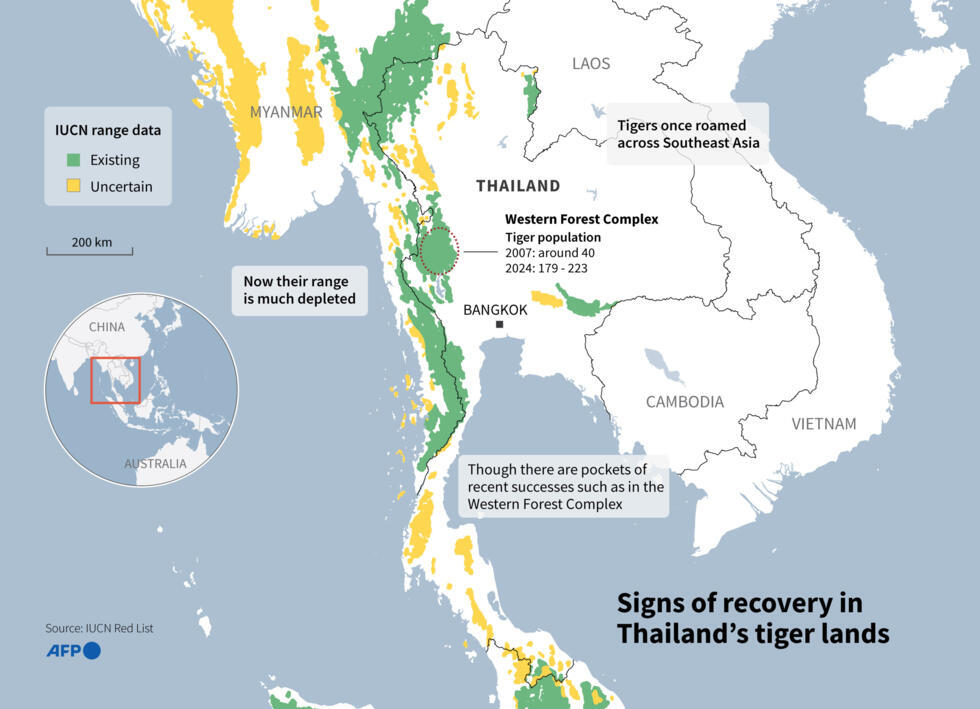
The wild tiger population in Thailand's Western Forest Complex, near the border with Myanmar, has increased almost fivefold in the last 15 years from about 40 in 2007 to between 179 and 223 last year, according to the kingdom's Department of National Parks (DNP).

It is an uptick that WWF's Tigers Alive initiative leader Stuart Chapman calls "extraordinary", especially as no other country in Southeast Asia has seen tiger numbers pick up at all.

Release of the deer is credited with helping the 'extraordinary' recovery in Thailand's tiger population, which has increased almost fivefold in the last 15 years 
© Handout / DNP/WWF-THAILAND/AFP

The DNP and the WWF have been breeding sambar, which are native to Thailand but classed as vulnerable, and releasing them as prey.

Now in its fifth year, the prey release is a "very good activity," says the DNP's Chaiya Danpho, as it addresses the ecosystem's lack of large ungulates for tigers to eat.

Worrapan Phumanee, a research manager for WWF Thailand, says that deer were previously scarce in the area, impacting the tiger population.

But "since starting the project, we've seen tigers become regular residents here and successfully breed," he says.

Thailand's tiger lands © John SAEKI / AFP

Cambodia, Laos and Vietnam have all lost their native populations of Indochinese tigers, while Myanmar is thought to have just 23 left in the wild, in large part due to poaching and wildlife trafficking.

Over the past century numbers worldwide have fallen from about 100,000 individuals to an estimated 5,500, according to the IUCN, which classifies tigers as endangered due to habitat loss and overhunting of the species and their natural prey.

But major tiger recoveries have been recorded in India and Nepal, where in recent years numbers of Bengal tigers have grown to 3,600 and 355 respectively thanks to conservation measures.

'Incredibly successful'


In a forest clearing in Khlong Lan National Park, DNP staff open the gate of the sambar deer enclosure where 10 males and 10 females have been grazing.

The deer watch cautiously as one brave individual darts out, before the rest follow at speed and disappear into the trees.

While some of the deer are killed and eaten by tigers, most of them go on to reproduce 
© Lillian SUWANRUMPHA / AFP

Worrapan says prey release programmes -- now also happening in Cambodia and Malaysia -- are part of wider restoration efforts to "rebuild ecosystems" in Southeast Asia, where they have been adapted for local purposes from similar initiatives that have existed for years in Africa.

The breeding and releases also aim to solve the problem of the sambar deer's own population decline due to hunting, says Worrapan.

"The purpose of releasing deer is not solely to serve as tiger prey but also to restore the deer population," he says, adding that GPS collar-monitoring has allowed researchers to track their lives after release.

The breeding and releases also aim to solve the problem of the sambar deer's own population decline due to hunting
 © Lillian SUWANRUMPHA / AFP

He says despite having only known captivity, the deer show a strong ability to adapt to outside threats.

"(They) don't simply wait passively. They try to evade predators and choose safe areas to thrive."

Chaiya says only a small number of the released deer end up as predator dinner, with most going on to reproduce.

The sambar deer and their offspring "play a role in the food chain within the ecosystem, serving as prey for predators," he says.

© 2025 AFP

New research says framing protests as fights for civil rights ‘backfires.’ So what might work?


Kim Voss, a UC Berkeley professor of sociology, says appeals rooted in American values may be more effective today than those evoking memories of the Civil Rights Movement.


University of California - Berkeley


Millions of people took to the streets last weekend in solidarity against President Donald Trump. Protest signs and public speeches decried his administration’s attacks on immigrants, LGBTQ people and other vulnerable groups. Many protesters deemed current policies an affront to civil rights. 

But framing modern social issues as attacks on civil rights may actually backfire, according to a new study published in the journal American Sociological Review. While most people hold positive views about civil rights in the abstract, framing contemporary problems like discrimination or poverty as civil rights violations actually decreases public support for government action. 

“Even more surprising to us was how widespread this negative effect was,” said Kim Voss, a UC Berkeley professor of sociology and co-author of the study. 

A scholar of labor and social movements, Voss said the findings might be partly explained by people’s “idealized,” if flawed, recollection of the Civil Rights Movement. She and her coauthors speculate that framing hardships today as civil rights violations evokes comparisons with the 1960s Civil Rights Movement, which makes contemporary problems appear less significant and therefore less worthy of government action. 

Voss and her co-authors, Fabiana Silva and Irene Bloemraad, surveyed approximately 7,500 California voters to gauge feelings about civil rights and how voters define the term. Surveys were conducted in 2016 and 2019 to reflect times before and after Trump’s first election.

Researchers also tested the effect of civil rights framing by having participants read three vignettes about people facing hardships. Some vignettes explicitly framed hardships as civil rights violations, while others were framed differently or had no frame at all. The team varied the types of hardships, including discrimination in the workplace and serious food insecurity, and also the demographic characteristics of the person facing the hardship. 

After reading each story, participants were asked if they support government intervention to remediate the hardship.

While the team expected civil rights framing would be more effective for increasing support for government action to address discrimination than for material hardships, they were surprised to learn it was counterproductive for both. It was also ineffective for hardships faced by Black people. 

UC Berkeley News spoke with Voss about this bipartisan “frame backfire,” the recent “No Kings” protests and what a more effective technique for framing movements might look like.

UC Berkeley News: You and your colleagues say that when social movements on the political left and right appeal to civil rights, those arguments backfire. Why? 

This was a surprising finding, one we did not expect. We term this effect “frame backfire” because civil rights framing was counterproductive across issues (material deprivation, unequal treatment), beneficiaries (African Americans, Mexican Americans, white Americans, undocumented Mexican immigrants) and audiences (liberals, conservatives, whites, African Americans, Latinos).

Importantly, we don’t think these negative effects can be explained by a simple story of racial backlash. If that were the case, we would expect some groups — particularly those more likely to have anti-Black attitudes — to react more negatively than others. 

But we found that liberals, conservatives, Democrats, Republicans, Black, Latino and white respondents all responded negatively to civil rights framing. In fact, we found that civil rights framing even reduced Black respondents’ support for government action to address hardships faced by Black people, which is not what we would have expected from a straightforward racial backlash story.

Social movements adopt the civil rights frame because they look at the Civil Rights Movement as an important and successful movement in American history. They think that by using the rhetoric of that movement and shaping their appeals similarly, they are going to be more successful. However, our research indicates that is no longer the case.

How does our collective memory of the Civil Rights Movement factor into our perception of modern movements that use civil rights frames?

The scholarship on collective memory highlights how the Civil Rights Movement of the 1950s and 1960s has become a positive collective memory. But it’s important to keep in mind that the collective memory of the Civil Rights Movement that is so often celebrated in contemporary textbooks and street names is highly idealized. It excludes the movement’s more controversial aspects, such as the push for economic justice, decent housing, health care and jobs. 

It also excludes just how controversial the Civil Rights Movement was in its heyday. In the 1960s, many Americans were disapproving of the movement, viewing its demands as too radical and its leaders as too disruptive. In 1966, for example, two-thirds of Americans had an unfavorable opinion of Martin Luther King Jr., a number that stands in stark contrast to the overwhelming percentage of Americans who hold a favorable view today.

We suspect that the idealized collective memory of the Civil Rights Movement may undermine the power of civil rights appeals today for two reasons. First, we believe that present-day appeals to civil rights evoke an implicit comparison to the historic Civil Rights Movement. Since contemporary hardships cannot match the flagrant state-sanctioned bigotry and violence of the civil rights era, the comparison makes today’s hardships look lesser and thus less worthy of ameliorative government action. Second, because the idealized collective memory excludes the more controversial aspects of the historic Civil Rights Movement, today’s movements seem less heroic and less worthy than the historic Civil Rights Movement.

So compared to hardships Black people faced decades ago, is it that today’s struggles just feel less significant? And that undercuts activist arguments? 

That’s a big part of it. But also important is how the idealized memory of the historic Civil Rights Movement has scrubbed out the more radical and contentious aspects of the movement.

Do your new findings apply to groups invoking civil rights claims across the political left and right? 

We know that contemporary groups make civil rights claims across the political spectrum — “immigrant rights are civil rights” or “trans rights are civil rights” or “gun rights are civil rights.” Also, our research shows that a majority of political conservatives, as well as political liberals, express positive feelings toward civil rights. 

Thus, it stands to reason that conservatives adopt the rhetoric and frame of the Civil Rights Movement because they, like progressives, assume that it helps to convince people to support their cause. Yet, if they do, our study indicates that such a strategy backfires, decreasing rather than increasing support for their movements.

At the same time, it’s useful to note that the vignettes we used to investigate the resonance of civil rights involved people facing hardships focused on unequal treatment, sexual harassment and material needs — issues that tend to be of greater concern to liberals and those on the progressive side of American politics. We did not test vignettes involving the protection of gun owners or against abortion, which are the kind of issues about which those on the right are more likely to mobilize.  

So if advocating on the basis of civil rights isn’t effective, what is?

In our larger body of research, we explore appeals based on human rights and American values, as well as civil rights. Perhaps surprisingly, especially for those with progressive politics, referencing American values was more resonant for our respondents, even respondents on the left, than civil rights. 

We don’t infer from this that an American values appeal is the only, nor the best, alternative to a civil rights frame. Instead, we suggest that activists need to construct what social movement scholars refer to as a new “master frame.” 

Master frames are those that are broad enough, and flexible and inclusive enough, that they can be used by lots of groups to make claims about many diverse issues. Our research implies that a new master frame will be necessary if activists are to build public support for the kind of inclusive, egalitarian and generous U.S. envisaged in the historical Civil Rights Movement.

This focus on the “American values” frame reminds me of the Harris-Walz campaign’s messaging around freedom in last year’s election. Is that the kind of appeal you mean?

What I have in mind is that those struggling for social justice, including for immigrants and labor, need to reclaim and reframe American values, the flag and the meaning of national identification.

In one of our earlier research articles, we examined how frames affected support for undocumented immigrants and U.S. citizens in need. For that article, we asked respondents what came to mind when they read the term “American values.” We found that the term evoked many different ideals, some in conflict with each other, but some that nudged people toward greater inclusion of undocumented residents. 

This suggests that those on the progressive left can’t leave the framing of American values to the current administration or to conservatives. Instead, they should elaborate the meaning of American values in such a way that it becomes a foundation for an inclusive master frame.  

Over the past week, thousands of people have protested the Trump administration. As a scholar of social movements, particularly around immigrants and labor, how are you thinking about the current moment? 

The current moment is a scary time when the United States seems to be marching toward authoritarianism. I also think about how, during the heyday of the Civil Rights Movement, it was the police who were violent, not the protestors, and how that violence was often used to try to discredit the movement. A version of this is what we saw in Los Angeles last week. 

The current moment is thus a time when it is crucially important to build a movement that can effectively challenge growing autocracy in the U.S., building instead a fairer, more inclusive U.S. 

We need to develop both the mobilization and coordination of protests that might come. It’s hopeful that we have this new frame emerging. I don’t know where that’s going, but articulating the opposition in terms of American values has real potential.
 

What will you be watching for as the current wave of protests continues to evolve?

At the “No Kings” protest last Saturday, I saw many American flags and banners that invoked American values in one way or another. For example, one sign at the Oakland protest proclaimed, “Kindness, Empathy, Compassion are American values.” Another asserted, “Without Immigrants and Democracy, there would be no America.” Yet a third declared, “We the people MUST protect the Constitution.” I think these flags and banners are a hopeful sign.  

But it’s early days in the fight against the cruelty of recent ICE raids and the growth of authoritarianism in the U.S. My knowledge of the history of social movements suggests that there is a long road ahead, one that will require coordination of protest, strategic thinking, greater mobilization, and articulation of the kinds of framings I saw beginning to emerge at the Oakland protests last Saturday.

At the same time, and turning again to the historic Civil Rights Movement, I keep in mind the lesson that what might seem radical or too demanding today can become normal, even heroic, decades later. Might the protests we’re seeing today be like that in the future?

This interview has been condensed and edited for clarity.