Friday, May 23, 2025

Israel’s Final Solution for Gaza


 May 23, 2025
Facebook

Photograph by Nathaniel St. Clair

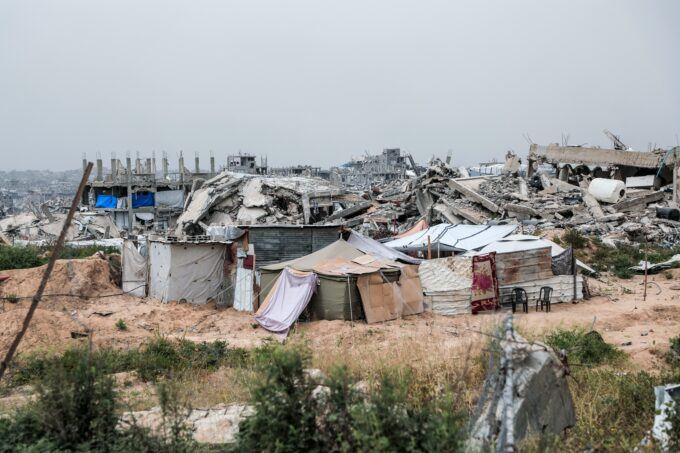
In early May, the security cabinet of Israel’s Prime Minister Benjamin Netanyahu met and agreed that Israel would ‘capture’ Gaza and remove its Palestinian population ‘to protect it’. To achieve this policy of annexation of Gaza, the Israelis tightened their siege by preventing the entry of food, water, electricity, and other humanitarian aid (they had already enforced a blockade of aid since 2 March 2025). Then, the Israelis began to bomb Gaza with increased ferocity, with Israeli ground forces gathering at the edge of Gaza and entering in short bursts. By 18 May, these Israeli ground forces began measured entries into Gaza. After intense pressure, the Netanyahu cabinet agreed to allow ‘basic amounts’ of food into Gaza. Meanwhile, the Israeli army released a ‘forced displacement’ order for the people in Khan Younis.

There is a tangle of war crimes in the paragraph above: 1. Population transfer in an occupied territory is illegal. 2. Deprival of food, water, and electricity for civilians is illegal. 3. Annexation of an occupied territory is illegal. 4. Deliberately killing civilians in a war zone is illegal.

It would be meaningless to recite chapter and verse to prove this, since it is by now well known that the Israelis have violated every single one of the laws of war and that their violations have been meticulously documented by the United Nations Special Rapporteur on the situation of human rights in the Palestinian territory occupied since 1967 Francesca Albanese in her annual report (and in recent statements, where she has spoken of a ‘[tragedy] foretold and [a] stain on our collective humanity’) and by Amnesty International in their report, ‘You Feel Like You Are Subhuman: Israel’s Genocide Against Palestinians in Gaza’. In Amnesty’s recent annual report, there is the chilling sentence: ‘the world has been made audience to a live-streamed genocide’.

Eradication

The bombardments to prepare the way for the annexation have been ferocious. The Israeli bombs have eradicated entire families of Palestinians. The word ‘eradicate’ is generally used in reference to pests or diseases. It is an ugly word. I am using it here deliberately. It comes from the Latin word eradicare, which means ‘to pull out from the roots’, a botanical meaning that now has far more sinister meanings when used in reference to humans. Eradicate sounds clinical when it refers to weeds, but horrendous when applied to humanity, just as clinical and bureaucratic as the term ‘The Final Solution’ (when used to refer to the horrendous genocide of the Jews in Europe). Hitler used the terms ‘annihilation’ (Vernichtung) and ‘eradicate’ or ‘exterminate’ (ausrotten) when he spoke of Jews in the 1930s, and then when he spoke of the Final Solution (Endlösung) in the 1940s. Language is cruel, already bearing the implications of the deed.

Consider the deed.

19 May 2025.

At 6 am, a group of Israeli special forces (mista’arvim) entered Khan Younis disguised as Palestinian women. They came under the cover of F-16 airstrikes and quadcopter drone strikes. The special forces soldiers executed Ahmad Kamel Sarhan in front of his family. Then they kidnapped his wife, his son Mohammed (age 12), and other, older children. No one knows where they have been taken. At least sixteen civilians died in the operation. Their names are:

Abeer Salah Khamis Ayyash

Ahmad Akram Mohammad al-Dali

Ahmad Kamel Hamdan Sarhan

Ahmad Mohammad Abu al-Rous

Ahmad Mohammad Kawarea

Elin Ashraf Hamdan Shalouf

Hasan Mahmoud al-Astal

Ibrahim Hamed Hussein al-Aqqad

Laila Fadi Naeem Ayyash

Malak Youssef Qeshta (Shalouf)

Mohammad Mahmoud Kawarea

Muhannad Mohammad Kawarea

Nabila Abd Wafi (Abu al-Rous)

Saja Salim Ibrahim Asleeh

Samira Abdel-Majid Ahmad al-Qarra

Tawfiq Ali Hamdan al-Qarra

An Israeli tank fired a shell at a home in the al-Amour neighbourhood in al-Fakhari, to the east of Khan Younis, and wiped out Safa Alyan Saleem al-Amour and her six daughters, Sama Rashad Omar al-Amour, Lama Rashad Omar al-Amour, Saja Rashad Omar al-Amour, Leen Rashad Omar al-Amour, Nada Rashad Omar al-Amour, and Layan Rashad Omar al-Amour.

Israeli artillery shellfire hit a house in al-Fakhari, killing five members of a family: Jumana Kamal Muhammad Abu Daqqa, Wassim Muhammad Ali Abu Daqqa, Siraj Muhammed Ali Abu Daqqa, Jolan Muhammad Ali Abu Daqqa, and Jilan Muhamed Ali Abu Daqqa.

These are a few of the attacks that took place on one day in one part of Gaza, from where I was merely able to get reports from people on the ground as well as press reports. The attacks took place as well in Gaza City, near the Indonesian Hospital, which had been targeted the day before. Other names could be filled in here for others killed by other deliberate acts of violence.

These attacks come at the same time as a severe crisis of hunger inflicts itself upon the people of Gaza, with children hardest hit. At least fifty-seven children have already died of malnutrition in Gaza, while 71,000 Palestinian children struggle to eat. The World Health Organisation warns of stunted growth, impaired cognitive development, and poor long-term health for the children who do not die. The Food and Agriculture Organisation warns of ‘famine looming’ in Gaza. Everyone warns about this or that. But these warnings amount to nothing. The UN Emergency Relief Coordinator Thomas Fletcher condemns Israel’s ‘cruel collective punishment’ of the Palestinians. He knows that ‘collective punishment’ is a war crime.

Consider the warnings. Consider the deed.

Consider the genocide.

 This article was produced by Globetrotter and No Cold War.

Vijay Prashad’s most recent book (with Noam Chomsky) is The Withdrawal: Iraq, Libya, Afghanistan and the Fragility of US Power (New Press, August 2022).

Systematic Starvation: Genocide and the Engineered Collapse of Gazan Society


 May 23, 2025
Facebook

Image by Mohammed Ibrahim.

Consequent to the escalated Zionist genocide of Indigenous Palestinian people, and after a blockade of all goods since the beginning of March 2025, Gaza is experiencing a severe humanitarian crisis, with widespread food scarcity and starvation among its population. Human rights organizations and international agencies report the Israeli blockade has led to catastrophic levels of hunger, particularly affecting children and vulnerable groups.

The Integrated Food Security Phase Classification (IPC) indicates approximately 244,000 people in Gaza face the most severe level of food insecurity, with nearly 71,000 children under five at risk of acute malnutrition. The World Food Program warns famine is imminent, affecting nearly the entire population of 2.3 million.

Human Rights Watch has accused Israel of using starvation as a weapon of war, a gross violation of international law, while noting children have died from starvation-related complications due to the blockade.

The United Nations and other organizations have called for immediate, unrestricted humanitarian access to prevent further deterioration. In addition, aid groups have criticized the proposed systems for potentially facilitating distribution of food and other essentials as being inadequate to meet the urgent needs.

Now, seemingly under pressure from the United States and conveniently using its mercenaries, Israel will allow “minimal” food and supplies into the besieged Palestinian enclave, while intensifying its devastating military assault.

In a recent press conference, Netanyahu ally and Israeli Finance Minister Bezalel Smotrich demonically said Israeli forces are engaged in a campaign to force Palestinians into the south of Gaza “and from there, God willing, to third countries, as part of President [Donald] Trump’s plan. This is a change of the course of history—nothing less.”

Other than a tool to move the population southward as part of a brazen criminal displacement campaign, which Smotrich openly admits, the starvation of Gaza has another insidious deliberate objective—methodical, socially engineered atomization of the people in Gaza, designed to create extreme deprivation, societal chaos, and internal strife, particularly through food scarcity and lack of control, and subsequently as a pretext for further genocide, expulsion, theft, and domination.

Research in Chimpanzees

Renowned Primatologist Jane Goodall documented a prolonged conflict (1974–1978) between two chimpanzee groups, the Kasakela and the Kahama, in Gombe Stream National Park, Tanzania. This “Gombe Chimpanzee War” saw the Kasakela community systematically attack and eliminate the Kahama group. Goodall’s findings were widely reported as support for the idea that warfare and territorial violence are natural elements of human behavior, inherited from our closest primate relatives.

Notably, reactionaries have co-opted these notions on so-called human nature to justify colonialism, falsely depicting Indigenous tribes as inherently violent “savages” to legitimize land theft and genocide.

AnthropologistBrian Ferguson has challenged Goodall’s interpretation. In a painstakingly thorough analysis of each case of documented aggression during the “Gombe Chimpanzee War,” he argues that the violence observed was not natural or inevitable. Rather, it was the result of external influences, primarily human interference by Goodall, her team, and others. Ferguson points to changes in provisioning (feeding) practices by these researchers, which disrupted social dynamics and led to unnatural group fragmentation. He also cites ecological pressures, such as resource scarcity due to nearby human activity, which may have exacerbated tensions.

Ferguson contends these factors, rather than innate aggression, better explain the conflict, emphasizing violence is context-dependent and can be negatively affected by human interference, and not a fixed part of primate and human nature. Drawing on primate studies, archaeology and anthropology, Ferguson argues war in human behavior is not innate—i.e.“human nature”—it emerged as a cultural construct when social inequalities were introduced with sedentary, agricultural life which enabled resource hoarding. Thus, he cautions against simplistic evolutionary (and reactionary) narratives which use such cases to justify human violence.

Where is the Palestinian Mandela?

The same dynamics are now unfolding in Gaza, where Israeli and American strategies of siege, blockade, and forced starvation create the very social fragmentation they later cite as proof of Palestinian dysfunction and innate barbarity.

The deliberate destruction of food systems, water infrastructure, medical systems, and communal cohesion is not incidental, it is an intentional form of warfare aimed at inducing despair, division, and eventual displacement.

Starvation is a tool of colonization, weaponized to weaken bodies, fracture bonds, undermine social cohesion, fuel internal aggression, weaken resistance, and turn survival into an isolating struggle. These conditions are neither natural nor inevitable; they are constructed and inflicted deliberately to serve a white supremacist goal—to manufacture potentially lethal chaos within Palestinian society and shift blame for genocide onto the victims themselves.

As internal conflict escalates, Zionist forces can portray Palestinians as irredeemably violent “savages,” justifying further domination under the guise of civilizing and evicting them “for their own good.” This was reflected by Trump in his immoral plan to turn Gaza into a resort.

This strategy mirrors decades of Zionist colonial tactics—assassination, imprisonment, torture, and psychological warfare—all deployed to reinforce the false narrative that Palestinian anti-colonial resistance is proof of inherent barbarism, rather than adefensive response to European invasion, oppression, and dispossession.

With classical colonial sleight of hand, liberal Zionists then ask, with feigned bewilderment: “Where is the Palestinian Mandela?” as if peace depends on the emergence of a more palatable victim. This notion ignores how many “Palestinian Mandelas” have emerged, only to be systematically assassinated and imprisoned by Zionist forces for embodying the possibility of peace and reconciliation through justice and decolonization. Likewise, the first Palestinian Intifada, a largely women-led uprising, and the “March of Return” were largely nonviolent—a strategy Zionists found more threatening than armed resistance and thus met with brutal, disproportionate force.

The deliberate starvation of Palestinian people in Gaza is an abominable nadir in an ongoing 77-year symphony of Israeli genocide and war crimes. However, it is possible to anticipate Zionist tactics and accompanying propaganda and to respond with foresight and strategy.

The cynical ploy by Israel and the United States to engineer conditions for forced displacement while blaming the Palestinian people they are starving should be rejected and serve as further impetus for boycott, divestment and sanctions (BDS) and other protests by all those opposing U.S.-led white supremacist colonialism, instead of allowing it to weaken, dishearten, and fracture resistance. This is the bare minimum for anyone who sees the predatory U.S.-led Zionist experiment in Palestine as a threat to the existence of the Palestinian people and to the rest of humanity.

Yoav Litvin is a Doctor of Psychology/ Behavioral Neuroscience. For more info, please visit yoavlitvin.com/about/