It’s possible that I shall make an ass of myself. But in that case one can always get out of it with a little dialectic. I have, of course, so worded my proposition as to be right either way (K.Marx, Letter to F.Engels on the Indian Mutiny)
Thursday, November 27, 2025
U.S. Coast Guard Wants "Maritime Domain Dominance"
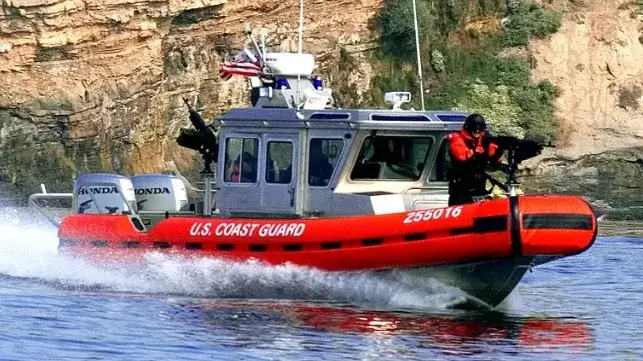
An MDD surveillance system would push MDA sensor information out to the "tactical edge," including small patrol craft (USCG file image)
The U.S. Coast Guard Futures Development and Integration (FD&I) Directorate has expanded upon the familiar concept of maritime domain awareness (MDA): its future objective is now maritime domain dominance (MDD), an operating concept that seeks to give every Coast Guard asset a unified MDA information picture and shorten the timeline from threat detection to action.
The FD&I Directorate has set up a Rapid Response Rapid Prototype (RAPTOR) team to support quick deployment of new tech solutions. Among other actions, RAPTOR has issued an RFI to industry seeking technologies that support the new MDD concept. In broad terms, RAPTOR is thinking about buying systems that connect every single air and surface asset with all air, space, shore and surface sensors in real-time, handing every Coast Guard unit a "single pane of glass" MDA intelligence picture. This universal MDA information network would "facilitate the decisions and actions to follow," and boost the speed and quality of threat identification in U.S. waters and maritime approaches, enabling dominance.
The first identified problem in the RFI is an MDA shortcoming. The service has to monitor 95,000 miles of coastline, plus maritime approaches. Sensor coverage for this mission set is currently insufficient, and the service believes it has to "rapidly field and deliver threshold capability to facilitate closing maritime surveillance gaps," thereby generating improved MDA.
Beyond sensing, the RAPTOR office also wants technology that supports "sense, decide, and act" operations. This requires more than just winning the threat detection battle of maritime domain awareness: it requires information sharing with frontline units so that they can do something useful. In short, the technology should support "transmission of targeting and actioning requests to the tactical edge."
"Maritime Domain Dominance ensures that awareness is converted into an operational advantage, enabling freedom of navigation, rapid response to emerging threats, and sustained control of our maritime domain," the office wrote.
Defense primes wishing to market fully integrated systems are discouraged. "The Coast Guard is not looking for a singular solution to provide the MDD capability, but rather a holistic and/or collection of capabilities to achieve this desired outcome," the service said.
Beyond programmatic goals, the office's new "dominance" terminology aligns with the assertive branding trends in the executive branch, as seen recently in the creation of the "National Energy Dominance Council." Realignment of branding is not new for the Coast Guard, as seen before with the strategic renaming of the long-deferred "heavy icebreaker" program as the "Polar Security Cutter" in 2018. The new name was a better fit with congressional funding priorities, and the underlying product remained the same - a lightly-armed, Antarctic-capable icebreaker.
"When we talk about icebreaking capability, that doesn’t sell very well to all audiences," then-chief of engineering Rear Adm. Melvin Bouboulis told USNI in 2018, speaking about the PSC program. "We understand that some folks think just it goes and breaks ice, but we’ve purposely changed the name of that program to Polar Security Cutter because it is really the U.S. presence in the Arctic regions and preserving our national interest and security in those areas."
Understanding Hazardous Area Classification on Ships and Offshore
Explosive gas atmospheres are a constant consideration in the design and operation of ships, FPSOs and offshore platforms. From cargo pump rooms to vent masts, every area where flammable vapor might occur must be identified and managed. This process, known as Hazardous Area Classification, forms the basis for safe design under IEC 60092-502, IEC 60079-10-1, and class rules such as those of ABS and Bureau Veritas.
Why Hazardous Area Classification Exists
When hydrocarbons are handled, vapors can mix with air to form explosive atmospheres. Even a small ignition source – a spark, a hot surface, or a malfunctioning mobile phone – can trigger a fire or explosion. The goal of hazardous area classification is to map where such mixtures can appear and to define what level of protection electrical and mechanical equipment must provide.
On ships and offshore installations, the classification does more than mark danger zones. It directly influences how cables are routed, where ventilation inlets are placed, and what type of equipment is installed. Correct classification prevents ignition and allows maintenance to take place safely without shutting down large parts of a plant.
Defining the Zones
The IEC zone system divides hazardous areas by the frequency and duration of an explosive atmosphere:
Zone 0: An explosive gas atmosphere is present continuously or for long periods. Typical examples are the interiors of cargo and slop tanks, pipelines containing flammable liquids, and pressure-relief vent lines. Equipment here must meet Equipment Protection Level (EPL) Ga – the highest protection standard – typically achieved through Ex ia intrinsically safe circuits or Ex ma encapsulation.
Zone 1: An explosive atmosphere is likely to occur in normal operation but not continuously. This includes pump rooms, manifolds, and cofferdams adjacent to cargo tanks that lack mechanical ventilation. IEC 60092-502 and the IMO IGC Code (2016 edition) specify boundaries extending typically 3 meters from vent outlets, loading manifolds, or pump-room openings, though exact distances vary based on ventilation rates and release characteristics. Equipment requires EPL Gb protection: Ex db flameproof, Ex eb increased safety, Ex ib intrinsic safety, Ex mb encapsulation, or pressurized Ex px enclosures.
Zone 2: An explosive atmosphere is not likely in normal operation and, if it occurs, will exist only briefly. Typical examples are areas extending several meters beyond Zone 1 boundaries, around vent masts, or deck areas above cargo tank tops. EPL Gc equipment is permitted: Ex ec, Ex ic, Ex mc, or Ex pzc types. This zone often extends 10 to 15 meters from Zone 1 sources depending on ventilation and layout.
Areas outside these limits are classified as non-hazardous, but adjacent spaces such as machinery rooms still require overpressure ventilation and gas detection systems to prevent vapor ingress.
How the Classification Shapes Ship and Rig Design
Hazardous area classification determines much of the physical layout of an offshore facility. Zone drawings produced during HAZID and HAZOP studies become the blueprint for every downstream decision.
Electrical systems must match zone requirements exactly. Cable entries between zones use certified barrier glands or sealing fittings to prevent gas migration through cable cores. Cable trays and metallic coverings are kept electrically conductive and bonded to the vessel structure to avoid static discharge, as specified in IEC 60092-502 and class society rules.
Ventilation plays a critical role. Machinery spaces, ballast-water-treatment rooms, or battery compartments located near Zone 1 areas must be maintained under positive pressure with continuous monitoring. Automatic alarms trigger if pressure drops below set point, and in critical cases, equipment shuts down to prevent vapor ingress. Air intakes are positioned outside hazardous limits – often 10 meters or more from vent outlets – while exhausts discharge clear of accommodation and control rooms.
Gas detection is mandatory at Zone 1 and 2 boundaries and within enclosed spaces that could accumulate vapor. Fixed hydrocarbon detectors, typically set to alarm at 20% LEL (Lower Explosive Limit), provide early warning. Portable detectors are required for entry into tanks, cofferdams, or any space that has been closed or poorly ventilated.
Common Ignition Sources Offshore
The main ignition hazards offshore include:
Hot surfaces: Exhaust manifolds, turbocharger casings, or overheated bearings
Electrical arcing: Switching contacts, motor brushes, or loose connections
Mechanical friction: Grinding, impact tools, or non-sparking bronze tools used incorrectly
Static electricity: Rapid fluid flow through pipelines, hoses, or tank cleaning equipment
Radio frequency emissions: Handheld radios, mobile phones, or improperly bonded antennas
Controlling these sources requires both design and procedure: grounding and bonding of all piping and equipment, temperature monitoring of machinery surfaces, certified explosion-protected apparatus, and strict hot work permit systems. Hot work requires strict permitting: spaces must be certified gas-free, continuously monitored, and attended by fire watch personnel. Work is not permitted in classified zones without prior gas-freeing and reclassification.
Maintenance and Verification
Class societies and flag states require ongoing inspection to confirm that installations continue to meet their original certification. Periodic tests include:
Insulation resistance of cables and terminations
Verification of seals on Ex d and Ex e enclosures
Surface temperature measurement of luminaires and motors
Ventilation flow rate and pressure differential checks
Gas detector calibration and functional testing
Records are maintained under the ship's Safety Management System (SMS) and reviewed during audits and port state inspections. Any modification to layout, equipment, or ventilation triggers a Management of Change (MOC) procedure, requiring re-assessment of zone boundaries and updates to hazardous area drawings. As-built documentation must reflect reality – discrepancies between design intent and installed condition are a common finding during audits.
Training ensures that crew and contractors understand where zones begin and end, which tools are permitted, and how to respond if gas is detected. Technicians working in Zone 2 areas often use an intrinsically safe camera and inspection tools to document equipment conditions without breaching safety boundaries. This enables verification of corrosion, cable terminations, and labeling during operation.
Temporary and Dynamic Hazards
Not all hazardous areas are permanent. Tank entry, cargo transfer upset conditions, or maintenance activities can create temporary Zone 0 conditions in normally safe spaces. Gas-freeing procedures, continuous monitoring, and controlled access prevent incidents during these operations. Understanding that zone boundaries can shift with operational state is as important as knowing the static classification.
Conclusion
Hazardous Area Classification is not a theoretical exercise. Rather, it is a detailed engineering map that supports safety across the entire lifecycle of an offshore structure. By applying standards such as IEC 60092-502 (2nd edition, 2024), IEC 60079-10-1, IMO SOLAS, and the IGC/IBC Codes, designers and operators control ignition risk even in the harshest marine environments.
From the welds around a cargo-tank bulkhead to the tools used during inspection, every decision supports one objective: maintaining safe operations in the presence of explosive atmospheres at sea.
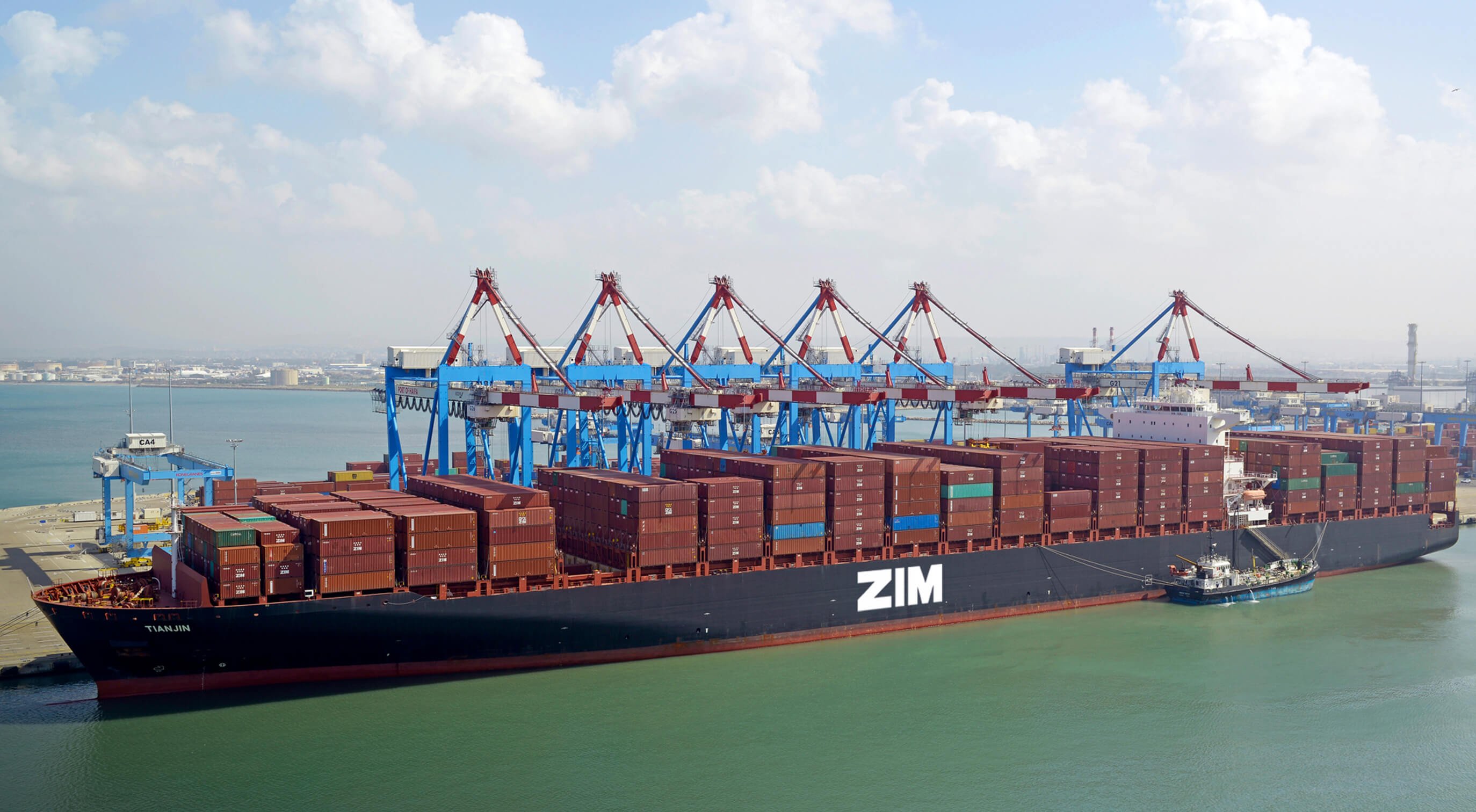
Container shipper Zim, which ranks at number 10 by global capacity, confirmed that its board is undertaking a “strategic review of alternatives.” It has been underway for the “past several months,” the company said in a statement confirming that it has multiple proposals in addition to a proposed management-led buyout.
The board said that it is considering potential value creation alternatives, including a sale of the company and capital allocation and return opportunities. Reports surfaced in August that long-time CEO and president Eli Glickman was leading a proposed management buyout offer that also includes Israeli businessman Rami Ungar, who controls Ray Shipping, an operator of RoRo car carriers and an importer of Kai Motors into Israel. Media reports suggest that four members of senior management are also participating in the buyout.
Zim termed the proposal it has received from Glickman and Ungar as “preliminary” and “non-binding.” Terms have not been announced, but the Israeli media reports the offer valued Zim at $2.3 to $2.4 billion while it was trading at around $1.9 billion. The stock price is up dramatically in the past month, with the market value now exceeding $2 billion.
The offer from the Glickman-Ungar group has been rejected, reports Calcalist, which was the first to also report the proposed acquisition. For its part, the board only said it had received the proposal and has also received “indications of interest from multiple parties, including strategic interest, which it is evaluating.”
The proposals to acquire the company come just five years after Zim went public on the New York Stock Exchange. Glickman has not spoken publicly about the motivation to take the company private, but the Zim share price has been very volatile.
Zim has been strongly impacted by not only market conditions but also the geopolitical situation. Last week, management reported third quarter results, and while the company is profitable, EBITDA was down 61 percent, and TEU volume carried decreased 5 percent. Revenues were off 36 percent, with management also citing changing tariff policies and the ongoing global trade war. It, however, increased the low end of the range for its full-year guidance, emphasizing the company’s resilience.
The company has a large debt, but also maintains a large cash position. Analysts note that it is also a high-cost operator, which could disadvantage Zim as the market continues to weaken for container shipping.
Eli Glickman has been CEO and president since 2017 and is credited with a turnaround for the company and saving it from insolvency. After reports that he was preparing the buyout offer, a group of shareholders pushed the board to add more independent directors. The board reported the recent addition of two directors, which the Israeli media outlet Globes reports are former supervisor of banks at the Bank of Israel Yair Avidan, and a former competition commissioner and head of the prime minister’s bureau Dr. Yoram Turbowicz.
Zim, which marked its 80th year in 2025, has emphasized its flexibility in the fleet and focus on midsized vessels and niche markets. It has been modernizing its fleet in partnership with owner/lessor Seaspan and was among the first to introduce LNG dual-fuel containerships. The company has a capacity of approximately 700,000 TEU, and a large order book with 163,000 TEU capacity according to Alphaliner.
An acquisition of Zim could be complicated by a Special State Share that was issued to the Israeli government in 2004 when the company was privatized. A potential buyer that would exceed 24 percent of the stock must first notify Israel, and a position over 35 percent requires Israeli approval. The share requires the company to remain incorporated in Israel, and at least a majority of the members of the Board of Directors, including the chairperson of the board and chief executive officer, must be Israeli citizens. The company must also maintain a fleet of at least 11 vessels, with at least three being cargo vessels, but it currently has a waiver permitting it to own fewer than the required number of ships. The State of Israel must also consent in writing to any winding-up, merger, or spin-off unless the Special State Share would remain effective.
Ukraine May Have Hit Another Russian Navy Ship in Novorossiysk
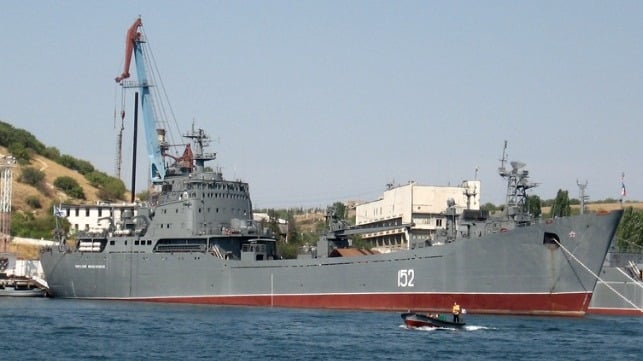
Tapir-class landing ship (Sergeant / CC BY SA 3.0)
Ukrainian forces hit the Russian port of Novorossiysk with another long-range drone and missile strike overnight Monday, prompting a massive air defense response.
The attack involved multiple divisions of the Ukrainian armed forces, including special operations forces, border guards, Ukrainian Navy coastal battery units, and intelligence agencies. Ukrainian sources told Kyiv Post that they managed to hit the port's economically-important oil terminal for the second time in two weeks, and caused additional damage to an S-300 or S-400 air defense missile complex.
Kyiv Post reports that the strike took aim at loading arms and pipe manifolds on the oil export pier of the terminal. It is possible that a Russian Navy landing ship - potentially a Project 1171 Tapir - was also hit and damaged during the attack. Ukrainian outlet Hromadske reported that a vessel was hit, and a pier-to-pier ship movement with two tugs assisting was spotted by satellite OSINT analyst Tom Bike after the strike, possibly signifying a newly-disabled vessel. However, Russian warships are frequently moved about the port, which is the main hub for the Black Sea Fleet; the former home port, Sevastopol, has been untenable for the past two years because of the threat of Ukrainian drone and missile attacks.
In addition, the Caspian Pipeline Consortium (CPC) - the Western joint venture that operates the export pipeline from Kazakhstan's abundant oilfields - reported Tuesday that the attack had damaged its administrative building for the CPC marine terminal. The strike prompted a temporary suspension of loadings at the offshore SPM buoy terminal, CPC said. Ukraine has previously attacked the pipeline: it hit a major pumping station in February, shutting it down until May.
Russian sources claimed that debris from Ukrainian drones hit two apartment buildings, damaging three apartments. However, Ukrainian sources claim that errant Russian air defense missiles caused the damage. Four people were reportedly hospitalized from the effects of the attack city-wide.
A related wave of strikes overnight Monday caused extensive damage to targets along Russia's Black Sea and Sea of Azov coastline, including an aircraft factory, a high-end surveillance plane and a drone factory in Taganrog and a refinery in Tuapse, Ukrainian media claimed.
[Breaking] Three seafarers have reportedly been injured in a fire aboard a boxship at the port of Wilmington, Delaware, according to local media.
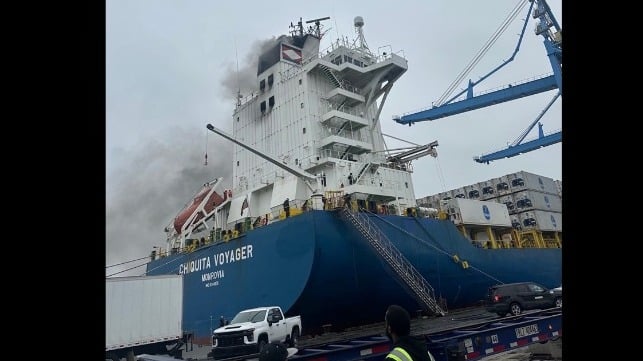
At about 0930, the crew of the container ship Chiquita Voyager reported a fire in the engine room. The blaze started with a generator and grew in size, according to local First State Update. Two crewmembers were initially reported missing.
The Wilmington Fire Department responded to the scene and deployed multiple units, including ladder trucks and a mobile EMS medical care unit. Multiple county and regional agencies responded as well. Suppression with onboard fire teams proceeded on multiple decks, aided with a water supply from the pier, and the Coast Guard responded to provide support from the water side.
At about 1000 hours, the master and the responders decided to evacuate the engine room and release CO2 flooding to extinguish the fire. With all crewmembers now accounted for, the fire team retreated from the compartment and CO2 was released.
Three crewmembers sustained minor burn injuries in the fire, the outlet reported, and they were transported to a nearby hospital for treatment. Efforts to combat the fire are ongoing.
Le Havre Floating LNG Terminal Demobilized as LNG Supply Crisis Subsides
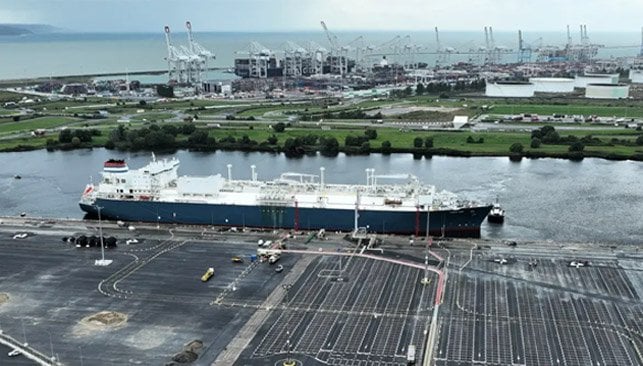
Cape Ann was commissioned in France just two years ago to add LNG import capacity (TotalEnergies)
Reporting that LNG supply conditions in France and Europe have stabilized, TotalEnergies announced that it is demobilizing the floating LNG storage and regasification unit (FSRU) it established at Le Havre. The vessel Cape Ann was pushed into the role as a quick solution in the fall of 2023 in response to a perceived gas crisis as Europe moved to replace supplies from Russia.
According to the company, the LNG terminal, which was the fifth established in France, is no longer necessary. They point to the lack of use of the terminal, which was viewed as a “safety net,” and especially for the winter months when peak demand was anticipated.
France’s Ministry of Energy Transition set the objectives for the terminal in March 2023, projecting five years of operation from commissioning. It was the follow-up to an August 2022 law for emergency measures, which sought to guarantee the security of gas supply to France. The goal was to handle 50 TWh per year, and when the Cape Annwent into service in October 2023, TotalEnergies reported it had a throughput capacity of up to 155 GWh per day, which represented up to 10 percent of France’s annual natural gas consumption.
TotalEnergies emphasizes that it undertook the project at the request of the authorities and implemented the project at its own expense without public subsidies. The company reserved 50 percent of the capacity of the terminal, and under French law, the remaining capacity was marketed to other market participants.
The terminal in Le Havre was in addition to Dunkirk, Montoir, Fos Cavaou, and Fos Tonkin. Under the contract, gas from Norway was being supplied via the Cape Ann.
The vessel, which is owned by Höegh LNG, was launched in 2010. It has a storage capacity of 142,500 cubic meters.
The Cape Ann had become France’s first floating terminal when it began operations in 2023. It was also continuing a long tradition of LNG operations at Le Havre. The first LNG terminal in continental Europe was built in Le Havre and operated from 1965 to 1989. TotalEnergies highlights that it is currently the world’s third-largest LNG player with a global portfolio of 40 Mt per year in 2024. It is committed to growing its LNG operations with a goal of reaching 50 percent of its sales from LNG by 2030.
BOO
Iranian Watchdog NGO UANI Adds 23 Tankers to “Ghost Armada”
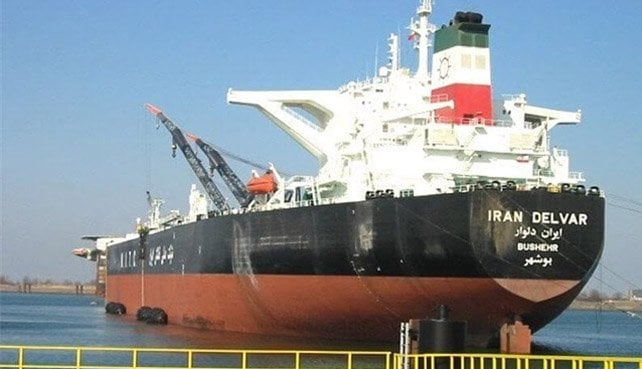
UANI has more than 560 tankers it reports as evading sanctions to support Iran's oil trade (Tasmin News Agency - CC-BY-4.0)
Marking the fifth anniversary of the publication of its listing of the “Ghost Armada,” the NGO United Against Nuclear Iran (UANI) is adding additional tankers to its listing of vessels supporting Iran’s oil exports. The NGO highlights that despite the sanction efforts, Iran continues to raise large sums from the sale of oil.
The group first released its listing in November 2020 and currently has a total of 560 vessels identified as supporting the Iranian oil trade. An additional 36 tankers that had previously participated in the trade are now listed as scrapped.
UANI is adding 23 additional sanction-evading vessels to its listing known as the “Ghost Armada,” a network of aging tankers that UANI reports are operating under opaque ownership structures, falsified documentation, and manipulated AIS signals to mask their cargo origin and destinations. It notes that 10 of the vessels are flagged in Panama, the largest vessel registry by the number of vessels, while others use different flags or false flags for their trade.
The group says the continued growth of the fleet “reinforces UANI’s commitment to spotlighting specific flag states, insurers, classification societies, and all maritime actors complicit in circumventing international law.”
Iran has continued to expand its oil and shipping networks and find new tactics to evade sanctions, with UANI asserting that the funds are being used to rebuild after the war with Israel and the American bombing earlier this year.
The group also recognized the ongoing efforts of the United States, including last week’s expansion of the sanctions against the networks supporting Iran’s oil trade. The U.S. also added additional tankers to its sanctions.
“UANI applauds President Trump and the U.S. Departments of State and Treasury for sanctioning this latest tranche of individuals, entities, and vessels which are funding the Iranian regime’s Armed Forces through the illicit sale of crude oil,” said UANI Chairman Governor Jeb Bush and CEO Ambassador Mark D. Wallace. “In last week’s designations, the U.S. government sanctioned seven vessels which first appeared on UANI’s Ghost Armada list and that UANI recommended for sanctions: Pioneer Sam, Tusitala, Nexo, Al Siddeq, Aquaris, Ava 10, and Bodhi.”
UANI reports it will continue to monitor and expose tankers complicit in sanctions evasion through advanced satellite imagery, maritime data analysis, and open-source intelligence. At the same time, the group is again calling on the international community to blacklist these ships, deny them access to insurance and port services, and ensure comprehensive sanctions compliance across all maritime sectors.
Ex-Ferry Set to Launch Day Cruise Concept Off Singapore and Malaysia
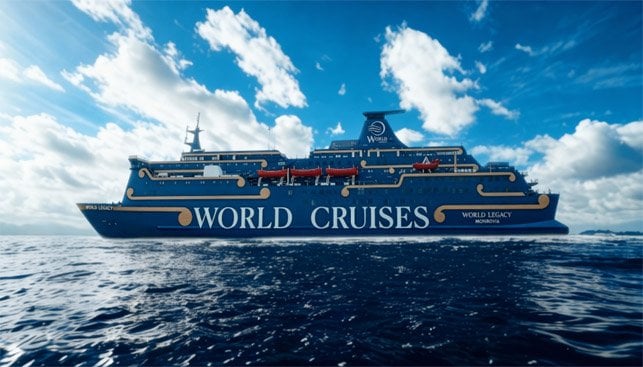
The 43-year-old ferry will become an entertainment destination anchored near Singapore (World Cruises)
A Singapore-based venture capital firm is launching a new day cruise operation, which it is billing as a retreat by day and a party celebration at night. The concept harkens back to the casino boats, which were old cruise ships anchored near Hong Kong and other Asian cities where gamblers and other travelers were moved by ferries out to the ships.
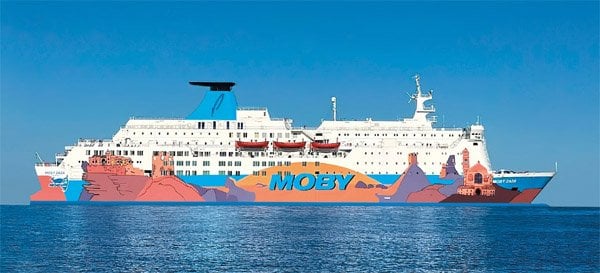
Calling itself World Cruises, the new company is launching in December in Singapore using an ex-ferry built in 1982 as the Olau Britannia. Over the years, the ship moved from Olau Line to other well-known ferry companies, including Fred. Olsen, Color, Stella, Fast Net, and after a stint as an accommodation ship to Moby in 2015, as the Moby Zaza. The ship, which measures 503 feet (153 meters), is approximately 22,000 gross tons and, as a ferry, had accommodations in berths for 938 passengers and space for 530 cars. For Moby, it ran mostly between France and Corsica or occasionally between Sardinia and Corsica.
The ferry was sold this year after Moby retired it, and it arrived in Asia in May. Joseph Phua, Managing Partner at Turn Capital in Singapore, says his team spent nearly a year bringing the concept to life, and they are scheduled to launch on December 18.
Italy's Moby Line ran the ship as a ferry in the Mediterranean (Moby)
The ship has been repainted and renamed World Legacy. It is now registered in Liberia and appears to be undergoing at least a refurbishment. Some amenities, such as a large outdoor sun deck, the company says, will not be available until 2026.
World Legacy will be anchored in a position approximately an hour’s ferry ride from Singapore and 30 to 40 minutes from Malaysia’s Johor port. Travelers buy a ticket, which gives them round-trip transportation to the ship on the shuttles, and once aboard, they can enjoy the amenities, and the fare includes a basic dim-sum style restaurant. Basic fares start at approximately US$45 for 24 hours aboard with an additional fee for cabins running between $39 to $139 per night, depending on size and whether it is a weekday or weekend. The initial plan calls for having 308 cabins available for sale.
Four berth cabin on the World Legacy
Once a week, on Friday, the ship is due to dock in Singapore. They are promoting a two-night/three-day mini cruise sailing from Singapore, and passengers return from the anchorage on the shuttles on Sunday.
“We wanted World Legacy to be more than a cruise,” says Martin Blanar, Vice President of Hotel Operations. “It’s a destination that transforms every hour. With activities that gradually evolve from having a peaceful morning to a thrilling night out, guests can curate their own rhythm at sea, making each time they visit our cruise uniquely theirs.”
The website bills the ship as a 24-hour adventure “at a floating lifestyle destination that never sleeps.” Providing a quick escape, they say the ship will offer wellness sessions in the morning and other relaxation activities, as well as activities for children. As the day evolves into night, the ship will provide nightlife, dining, and entertainment, shifting from a serene retreat into a lively social playground.
The ship will feature a sports bar, a theater for shows, including singers from Asia. There will also be a bar that they are calling a speakeasy. Another space, called a mandopop live lounge, will be offering Mandarin pop music performances.
Extra fee restaurant servicing traditional Chinese cuisine
Dining ranges from the 24-hour Asian-inspired eatery, Uncle Wu Café, to the Orchid Pavilion that serves traditional Chinese dishes or the buffet. They will also offer a kids’ arcade, private karaoke suites, and a spa.
Guests at the end of the 24 hours can choose their departure time from the multiple ferries or decide to extend their stay. The company calls the trips in December preview voyages, promising there is more to come in 2026.
The previous incarnation of casino boats using the same concepts ultimately died off as lavish resort casinos were built in Southeast Asia. The ships also proved costly to maintain, with most of them having been sold off for scrap. World Legacy looks to revive the approach with a strong entertainment focus.
Brazilian Prosecutors Sue Demanding Removal of Sunken Livestock Carrier
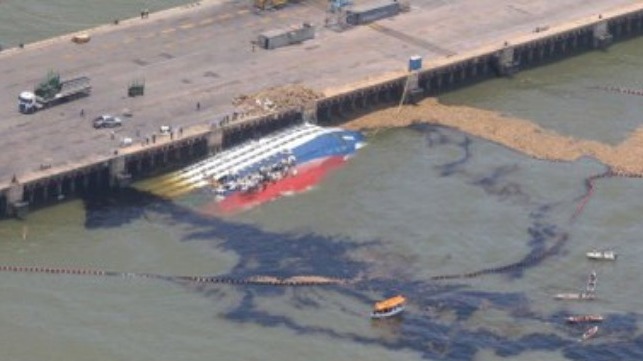
Livestock carrier Haidar capsized in 2015 and the hulk remains an environmental hazard a new suit contends (Para Prosecutor's Office)
A decade after a livestock carrier sank at the dock in the Brazilian Amazon region, public prosecutors are suing, demanding the immediate removal of the hulk, remediation efforts, and further compensation for the damages. The sinking of the vessel named Haidar in October 2015 is considered one of the worst environmental disasters in Brazil’s history, and prosecutors are contending that the remediation and recovery have been bungled.
The Federal Public Prosecutor’s Office in the Para region of Brazil filed the suit on November 25, requesting an urgent decision from the court. They are asking the court to order the defendants to present, within 30 days, a preventive plan for the removal of the oil still aboard the ship. They also want the court within 60 days to order the removal of the hulk, including the oily residue still aboard and the skeletal remains of as many as 5,000 cattle that were aboard the ship when it went down.
The case is also demanding an updated environmental assessment of the waters and sediment of the Para River near the Port of Villa do Conde, where the vessel sank. They also believe a new environmental remediation plan is required. The prosecutors are asking the court to award nearly $1 million due to the damage to the quality of life, tourism, and fishing. They are also calling for $17,000 award for a new fund for the region.
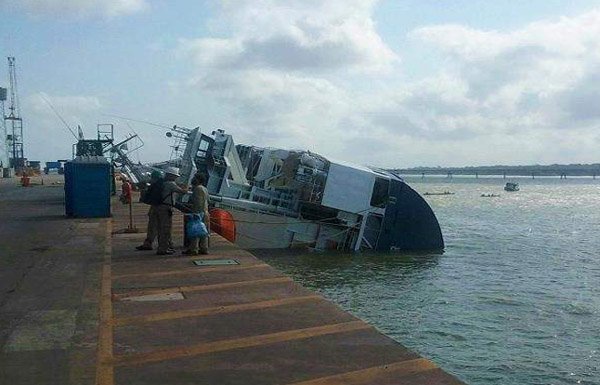
The Haidar was alongside loading cattle for export when the vessel began to list early on October 6, 2015. According to the reports, the captain suspended loading, but the animals became scared and moved to the side of the ship, increasing the list. Later reports blamed tidal conditions on the river and found that side ports had become stuck on two fenders on the dock. Stuck, the ship was not able to move with the tide and rolled onto its side.
Some of the cattle were able to escape the vessel, and a few were saved, but many drowned. The carcasses of as many as 1,000 cattle were retrieved from the river or washed ashore on beaches about 2.5 miles from the wreck. The remains of as many as 3,900 cattle are believed to be trapped in the ship.
The Haidar, which was built in 1994, was nearly 6,500 dwt and operated by a shipping company based in Lebanon. The company, along with the local agents, is named in the suit along with Brazil’s federal government and the state government.
The suit contends that there are approximately 700.000 liters of oil and residue trapped aboard the ship. A worst-case scenario in the environmental control plan estimates there are 215,000 liters of diesel, fuel, and lubricants aboard the ship. After the initial sinking, there was a new leak from the ship in 2018, and a further complaint in 2022.
The suit points to flaws in previous attempts at remediation. In 2019, a contract was awarded for the removal of the hulk, but it was later terminated without the work having been undertaken. The suit says the efforts resulted in “inadequate technical measures” that failed to completely remove the fuel from the hulk.
That was part of the outcome from a February 2018 agreement, which also provided $1.4 million to the families affected in the region and $560,000 for a community fund.
The suit reports that swimming remains prohibited in the area and that bars, restaurants, and guesthouses have all closed. It was once a popular tourist destination, and in addition, the residents are unable to fish the waters.
Earlier this year, BNAmericas reported that Norsk Hydro was also anxious to clear the dock to increase capacity for ore handling. The company was reportedly investigating the cost of removing the hulk, which remains submerged at the pier.
Op-Ed: Electric Containerships Won’t Work
But a fleet of auxiliary battery ships could clean up shipping
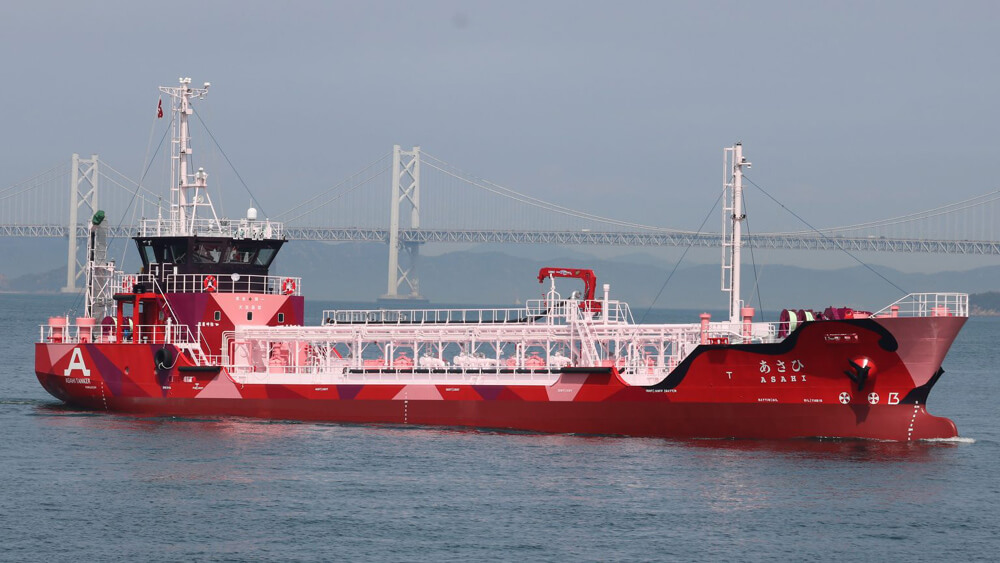
Japan in 2022 introduced an electric bunker vessel (Ashai Tankers)
Shipping moves 90% of global trade and produces nearly 3% of global emissions. The sector has proved challenging to clean up, as cargo ships can travel for weeks between ports and typically rely on cheap, energy-dense and extremely polluting heavy fuel oil.
Earlier this year, international efforts to move shipping towards net zero by using cleaner fuels fell apart under pressure from the United States. But as battery prices fall year on year, there might be another way forward.
Electric ferries already shuttle passengers and cars on short routes, while harbour tugs and inland cargo vessels are also going electric. At present, electrification works best over modest distances where charging can happen at the dock.
Could it ever work for container ships crisscrossing oceans? These giants can travel from China to Europe without refuelling due to the energy density of oil. The weight and expense of battery packs means it would be hard to swap oil for batteries.
But electrification isn’t all or nothing. Batteries would need to begin by operating alongside liquid fuels. In recent research, I lay out two potential ways to do this: using onboard battery packs and charging at ports, or connecting container ships to dedicated battery vessels.
How can batteries best help move cargo?
Electrification is worthwhile as a way to cut emissions and potentially save money. The question is how to do it – and whether it stacks up economically.
Placing batteries permanently on the ship is intuitive, matching the main way battery packs are used in electric cars, buses and trucks. In this scenario, ships would recharge in ports and also ideally at sea to make the most of the expensive batteries.
The second approach is different. Here, container ships able to propel themselves using fuel or electricity would tap into a global fleet of smaller battery vessels.
A container ship would link to a battery vessel and use its stored power as the vessel moves alongside it. The battery vessel would then peel off and return to port to charge up again. Battery vessels already exist, but at smaller scale. One option would be tightly integrating battery vessels, like the submarine swallowed by the ship in the Bond film The Spy Who Loved Me.
My modelling shows a container ship going from China to Europe could be powered by battery vessels between Chinese ports and Singapore. It would then use fuel to go from Singapore to Sri Lanka and then to the Horn of Africa. A lack of nearby land means battery vessels would have to power the ship for more than four days, which would be economical only if marine-rated battery prices fell extremely low (under A$100 per kilowatt-hour).
Once at the Horn of Africa, the ship could switch back to battery vessels that charge using the region’s booming solar capacity to go through the Red and Mediterranean Seas to Northern Europe. My modelling suggests it would take 33 battery vessels to go from China to Northern Europe.
Is it economically viable?
My modelling suggests it doesn’t make economic sense to install large battery packs on ships. For each giant New Panamax container ship, it would cost almost A$150 million to install 600 megawatt-hours of storage at $232,000 per MWh. Batteries rated for ocean conditions are more expensive. Fully charged, this giant battery pack would propel a container ship for 24 hours – about 700km.
The ship would have to be charged regularly to make the investment worthwhile. But long distances between some ports makes this difficult, and if the route had to change to go around Africa rather than through the Red Sea, the expensive battery would likely sit idle for weeks.
The off-ship battery vessel approach has more promise, as it offers a gradual approach and more flexibility.
Battery ships could be deployed first where renewable power is cheapest or where distances between stops are short. The benefits of partial electrification could potentially begin at today’s prices, assuming a carbon price was applied to shipping fuel.
While container ships are currently being built and retrofitted to allow electrical connectivity at port, this wouldn’t be enough. The giant engines of these ships would have to be modified to permit electric propulsion at the cost of 5–10% efficiency.
Fuel is a large cost for ship owners, as container ships burn more than 100 tonnes a day. A tonne of fuel costs about A$800 and provides the same useful power as about 6 megawatt-hours of electricity. When fuel is expensive, ships travel more slowly.
Even partial electrification would bring a speed boost. My research suggests running on electric propulsion could boost speeds by up to 50%.
If battery prices keep falling sharply, ship operators would gain a clear financial incentive to seek out electric options. Ships would travel slowly on fuel and faster on electricity.
Looking ahead
The shipping industry is looking to cut emissions and head towards net zero. This will require several technologies, ranging from clean fuels to more efficient engines and electrification where feasible.
To date, most research on shipping electrification has focused on short trips. But steep and ongoing price declines for batteries and renewables change this equation.
If carbon emissions are priced in more countries, the equation will change faster, as electricity would become far and away the cheaper option.
Giant battery packs on ocean-crossing container ships are unlikely ever to make financial sense. By contrast, the off-ship battery vessel is much more promising. Even if it ultimately proves infeasible, the idea deserves serious exploration.
About the author: Anthony Wiskich, Visiting Fellow in Economics, Australian National University; CSIRO
This article appears courtesy of The Conversation and may be found in its original form here.
Baleària Will Be First to Test Methanol-Powered Electricity Generation
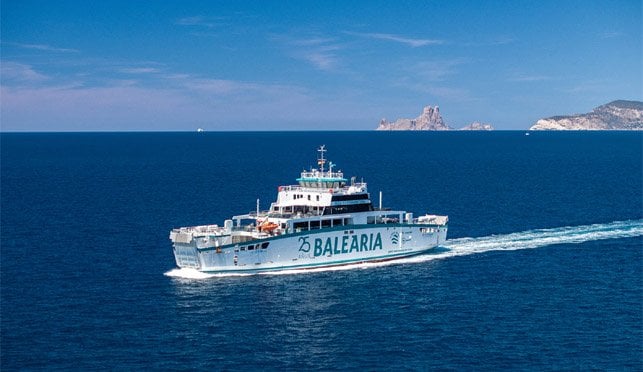
Electric ferry Cap de Barbaria will begin the demonstration of the system using methanol to create hydrogen to power a fuel cell (Baleria)
Spanish ferry operator Baleària announced it will begin operations on what is Europe's first autonomous e-methanol power generation system. The eNomad system, developed by Methanol Reformer, will enable renewable hydrogen to be produced from methanol to generate auxiliary electrical energy, and it will be incorporated into the operation of the company’s electric ferry Cap de Barbaria.
The Cap de Barbaria, which has been operating between Ibiza and Formentera since 2023, was designed to integrate a hydrogen system capable of supplying a portion of the energy required by the vessel. The ferry is 3,400 gross tons and sails between Ibiza and Formentera. It is 82 meters (269 feet) and carries up to 390 passengers and 50 vehicles. Known as the first electric ferry in Spain, it sails at speeds of 14 knots and is capable of zero-emission operations during port approaches and while docked.
“This compact equipment enables us to run a small-scale green hydrogen experimental laboratory in a real operating environment and on a route as sensitive and iconic as the one linking Ibiza and Formentera”, explains Javier Cervera, Corporate Director of Institutional Relations and the Energy Transition.
The eNomad system combines electricity generation from hydrogen, produced by reforming e-methanol, with a modular, compact, and autonomous design, capable of operating efficiently in port and maritime environments. Baleària says the pioneering European project will convert the ferry linking Ibiza and Formentera into a hydrogen research laboratory. They expect to validate the performance of the system in real-life operational conditions.
The hydrogen generated by this system will be used to power a fuel cell and produce auxiliary electricity. This electricity will support battery recharging and reduce the use of conventional generators, thereby lowering fuel consumption and emissions. In addition, Baleària will use this compact hydrogen production equipment to test different combinations of batteries and fuel cells in the ship's electric motor.
Through the pilot project, which is part of the BUCEMTO project financed by Net Generation Funds, Baleària reports it will be able to assess the potential of methanol as a flexible energy vector for maritime transport, combining the advantages of an easy-to-store liquid fuel with the possibility of generating hydrogen in situ, without the need for complex large-scale supply infrastructure. In addition, the shipping company will evaluate the hydrogen's contribution to overall consumption, reducing emissions, and the scalability of the solution to other ships and routes operated by the company.
Manufactured by a Catalan company specialising in sustainable energy solutions Methanol Reformer is expected to be available in the coming weeks for the start of the demonstration on the Cap de Barbaria.
The project is the next step in Baleària's efforts to reduce its carbon footprint. The company has 11 dual natural gas-powered vessels, three of which currently use bioLNG, and it is also making progress towards the total electrification of certain routes with 100% electric, zero-emissions fast ferry projects.