Thursday, October 16, 2025

A progressive vision is needed to stop the right


OCTOBER 11, 2025

Mike Phipps reviews How to Defeat the Far Right, by Nick Lowles, published by Harper North.

The far right is on the rise globally and Britain is no exception. It’s a fairly mixed bunch here but they share common ideas: chauvinistic nationalism – British exceptionalism – and a belief that the nation, either geographical or racial, is in decline or crisis and radical action is needed to halt it.

Journalist Nick Lowles, founder of HOPE not hate, has been fighting fascism for 35 years and has never known a time like this – particularly the events immediately following the Southport murders, when mosques under attack, police cars set on fire and outbreaks of violence occurred in over 25 cities and towns across the country.

The post-Southport riots tell us a lot about the interconnectivity of the far right, who are able to spread their messages, away from the eyes of respectable society, directly into people’s living rooms and bedrooms. They have built their mass media eco-system with the help of big money and powerful interests, the role of which is unfortunately not explored here.

So how best to fight this scourge? Nick Lowles, as others have done, draws on his long history of anti-fascist activity to argue that shouting “Nazi scum” at people is pretty useless. It’s certainly no substitute for long-term community engagement. Women especially are put off by the aggressive sloganeering of much of the anti-fascist movement and prefer positive messages.

The gender division on this issue needs more exploration. We know that women are less inclined to support far right ideas compared to men of the same age. Furthermore, figures who peddle misogyny as a gateway to other ideas associated with the radical right, such as Andrew Tate, have a huge social media reach among young men and boys. HOPE not hate is now the second largest provider of anti-prejudice training in schools and focuses on communities that are most susceptible to far right narratives.

Yet it is also noteworthy that the current wave of far right activity centred on hotels housing asylum seekers appears to involve more women and is being badged by organisers as being about women’s safety. This requires a more comprehensive and nuanced response by a much wider layer of the movement.

If abstract denunciations of the far right are ineffective, so too is hollow scaremongering. In 2006, the then Barking MP Margaret Hodge claimed that eight out of ten voters in her constituency were thinking of voting for the British National Party, because “they can’t get a home for their children, they see black and ethnic communities moving in and they are angry.”

This own goal gave the fascists a huge boost and considerable media attention. Ultimately, a huge campaign involving HOPE not hate in her constituency routed the BNP, but there are important lessons to learn from this. Keir Starmer should take note that talking up the danger of the far right while simultaneously making political concessions to their agenda, Hodge-style, is politically disastrous.

It’s also electorally damaging. Most people in Britain value its multicultural society and think the Government should do more to make it work. Almost three-quarters of people believe it’s the Government’s job to improve community cohesion.

But the road to cohesion and integration runs through other issues, about which diverse communities often feel equally strongly: jobs, housing , access to good education and open spaces. It’s a truism that the greatest antipathy to migrants is found in Britain’s most deprived areas. Government policy, for example accommodating asylum seekers in hotels disproportionately located in such areas, fuels tensions.

Lowles is keen to emphasise that to defuse these tensions there is no substitute for long-term work in the community. Yet it’s clear that some basic changes to Government policy could help enormously in the short term: “The best way to ‘smash the gangs’ is to remove their business model by creating safe asylum passages.”

If speaking English is seen as important to improving cohesion, the Government should restore the funding for this, which was slashed during the years of austerity. Above all the ghettoization of migrants in barracks and hotels needs to be replaced by speedier integration into the community, with the right to work and contribute.

The more this book explored the reasons for the rise of the far right, the distinct social layers they can mobilise and the political messages that attracts them – not just anti-migrant rhetoric – the more I felt the answer lay in a root and branch political renewal. Such a renewal goes far beyond the removal of impediments to voting discussed here.

HOPE not hate has done good work, documented in detail in this book, but it’s fighting a losing battle. Unless progressive political forces can set out an appealing and achievable vision of change – as they did in 2017 – we may well be facing an historic defeat in which liberal appeals for convivencia and toleration are tested to their limits.

Mike Phipps’ book Don’t Stop Thinking About Tomorrow: The Labour Party after Jeremy Corbyn (OR Books, 2022) can be ordered here.


The British Section of the League Against Imperialism and British interwar anticolonialism

 October 15, 2025

Ahead of a talk to the Socialist History Society on October 20thDilan Tulsiani outlines some of the themes in his paper Traditions of Dissent.

Traditions of Dissent provides a comprehensive analysis of the interwar British anticolonial organisation, the British Section of the League Against Imperialism.

In the aftermath of the First World War and the 1917 Russian Revolution, Britain had become a central hub for domestic and international anticolonial activists. Subsequently, the transnational anticolonial organisation, the League Against Imperialism, established a British Section which continued its operations throughout the interwar period. Traditions of Dissent explores the coalition of activists who participated in developing the British Section’s unique form of anticolonialism, which interconnected various British and transnational traditions in resisting British imperialism and supporting the rights of British and Colonial workers. This thesis resituates the importance of British anticolonialism in developing a substantial network of activists that openly protested against the British Empire’s policies from the British metropole. Crucially, the British Section’s activities in the interwar period display the tenacity of activists in Britain who campaigned against imperialism at the heart of the British Empire.

In recentring the importance of the British Section’s anticolonial actions in interwar Britain, the first half of this thesis provides an insight into the development and practice of the organisation’s philosophy and activities. The second half of the thesis highlights the overlooked contribution of women and people of colour in Britain who made up anticolonial activism in this period. Subsequently, the study examines the response by British policing agencies who had become increasingly concerned by the British Section’s activities and their popularity amongst workers from British colonies. This section of the thesis provides an insight into the justification of racialised policing techniques in the interwar period.

Successively, the penultimate chapter provides a reassessment of the events and factors that led to the dissolution of the British Section, emphasising the importance of British Section member and Communist Party MP, Shapurji Saklatvala. The final chapter of this thesis traces the lineage and legacy of the British Section’s evolution throughout various succeeding organisations in the twentieth century who carried the mantle of its unique form of anticolonialism which in turn influenced antiracist activism. The traditions of dissent that made up the British Section’s understanding of anticolonialism reverberated through its successors and have continued to inspire activists today.

This paper explores how political radicalism was understood in the interwar period amongst various internal divisions on the British left. Traditionally, the interwar period has been studied in relation to the rise of fascism. However, the interwar period also exhibits a period in history where a huge number of anticolonialists from European colonies developed a vast network with other activists and dissidents in Europe.

After the rise of Nazi regime, Britain became a safe hub for many of these anticolonial activists who sought to campaign against imperialism, and in doing so, began to examine widespread poverty and racism in British society that had not been addressed in relation to one another. This paper details the involvement of British Section members who strategically campaigned for the rights of British and colonial workers throughout Britain. In addition, some of these activists recognised the deep racial divisions that existed after the 1919 Race Riots, and made deliberate activities to form a solidarity between Black and Asian British families and anticolonialists.

Finally, much of the legacy of the League Against Imperialism has been linked to the 1955 Bandung Conference in which President Sukarno made reference to the League’s impressive establishment in 1927. Traditions of Dissent demonstrates a much larger legacy of the League, and more specifically, its British Section.The paper shows how the British Section’s anticolonialism transitioned throughout the twentieth century into antiracist ideology that was elemental to organisations such as the Movement for Colonial Freedom.

In spring 2025, many politicians and intellectuals, such as Jeremy Corbyn MP and Vijay Prashad, began a centennial campaign to mark 100 years since the League’s founding, which will organise various events until February 2027. This paper intends to re-emphasise the complexities of political radicalism and the importance of the British Section’s multi-racial cohort in campaigning against British imperialism during the interwar period. In doing so, it demonstrates the unique lineage of British anticolonialism that further developed anti-racist organisations due to its amalgamation of political traditions.

Dilan Tulsiani is a historian of transnational anticolonialism in the twentieth century. based at the School of History, Classics and Archaeology at the University of Edinburgh.Monday 20th October 5.30pm on Zoom Dilan Tulsiani ‘Traditions of Dissent: The British Section of the League Against Imperialism and British interwar anticolonialism’.Free on Zoom. Booking essential. To Book https://www.history.ac.uk/news-events/events/traditions-dissent-british-section-league-against-imperialism-british-interwar-anticolonialism

Image: https://wordcloud.app/books/burmese-days-by-george-orwell Licence: CC0 1.0 Public Domain Universal

UK

Overwhelming majority of Labour Party members would back breaking tax pledges to fund public services, poll finds

15 October, 2025 
Left Foot Forward


The Labour party had pledged during the election not to increase taxes on working people, and subsequently ruled out any rise in national insurance, VAT or income tax.


TweetShareWhatsAppMail


A clear majority of Labour Party members would support breaking the party’s manifesto pledges on tax, if it meant greater investment in public services, as pressure continues to grow on the chancellor to implement bolder measures to boost economic growth ahead of the budget next month.

A poll of party members carried out by Survation on behalf of LabourList found that 76% of those asked said that they would back a rise in national insurance, income tax or VAT in order to put more money into public services, with 20% opposed.

The Labour party had pledged during the election not to increase taxes on working people, and subsequently ruled out any rise in national insurance, VAT or income tax.

However, despite current forecasts predicting that the UK will be the second-fastest growing economy in the G7, some on the left have called on the government to go further and faster to improve public services which were decimated after 14 years of Tory austerity.

LabourList reports: “While 79% of those who backed Keir Starmer in the 2020 leadership contest would support the government breaking its promise not to raise those three taxes, support was weaker among those who backed Rebecca Long-Bailey at 69%.

“The poll also found that seven in ten of members (72%) believed that the government had upheld its manifesto commitment on tax, with 20% believing the government had broken its promise not to raise national insurance, income tax or VAT on working people.”

Basit Mahmood is editor of Left Foot Forward
UK

What is the future of our protest rights?

13 October, 2025 
Left Foot Forward


Why is a Labour government trying to resurrect Tory anti-protest powers that the courts found to be unlawful?


From the riots against the poll tax in both the 14th century and the 1980s, to the Suffragette and Chartist campaigns for voting rights, the fight against racism in the Bristol Bus Boycott and the mass demonstrations against the Iraq War, Britain’s past and present have been shaped by protest movements. But has change ever been achieved through a single day of marching with placards?

Even in those historic examples, governments haven’t always listened. In the recent case of the Gaza war protests, the government has continued to provide arms and diplomatic cover to Israel after two years of demonstrations. However, the reality is that without sustained protest and campaigning, change would never be achieved.

Now, with Home Secretary Shabana Mahmood announcing plans to grant police sweeping powers to restrict repeated protests, Left Foot Forward examines the future of protest rights in Britain.
The proscription of Palestine Action

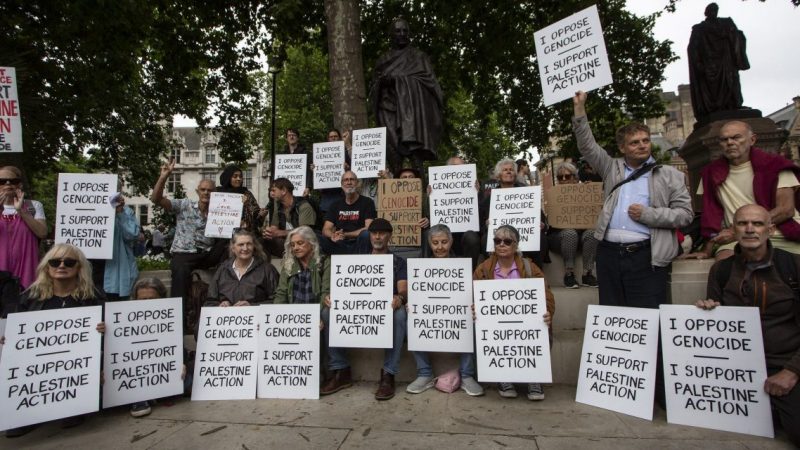
Restrictions on protests have intensified since the Labour government proscribed Palestine Action under the Terrorism Act 2000 in July. The move followed an incident in June, when some members of the group broke into RAF Brize Norton and reportedly spray-painted two military airplanes, among other acts of property damage.

In the parliamentary vote, the government bundled Palestine Action’s proscription with those of two far-right organisations — The Maniacs Murder Cult and The Russian Imperial Movement.

As well as RAF Brize Nortion, another key target of direct action by Palestine Action has been British factories producing weapons for Elbit Systems, Israel’s largest arms manufacturer. Two of their manufacturing sites in Bristol, one of which has since closed, have been the subject of dozens of Palestine Action protests.

A Declassified UK investigation in March revealed that the government had held a private meeting with Elbit Systems in December 2024. Although a recording of the meeting was made, both parties refused to release it.

Under the previous Conservative government, a Guardian and Palestine Action investigation uncovered internal Home Office documents showing Home Office ministers and staff had tried to influence police and prosecutors to crack down on activists targeting the UK factories of an Israeli arms manufacturer.

The documents showed that ministers and a director from the Attorney General’s Office representing the Crown Prosecution Service attended meetings with Elbit. They also revealed that Home Office officials contacted the police about Palestine Action.

The Synagogue attack and Defend Our Juries protest

Restrictions on protests are set to be tightened again. Following the antisemitic attack on Heaton Park Hebrew Synagogue on 2 October, the government said that pro-Palestine protestors should “recognise and respect the grief of British Jews” and not protest against Israel’s war in Gaza or their proscription of Palestine Action at the weekend.

Mahmood said protest is “a precious freedom in this country”, but called on protestors to “step back” and think about those who had lost a loved one in the terror attack.

“Just because you have a freedom, it doesn’t mean to say you have to use it all the time,” she said.

On 5 October, after Defend our Juries refused to cancel their weekly protest against the proscription of Palestine Action that weekend, the Home Office announced that police forces will be granted new powers to put stricter conditions on repeated protests.

In a statement, Mahmood wrote: “Large, repeated protests can leave sections of our country, particularly religious communities, feeling unsafe, intimidated and scared to leave their homes. 

“This has been particularly evident in relation to the considerable fear within the Jewish community, which has been expressed to me on many occasions in these recent difficult days.”

Under the proposed restrictions, police would have the power to change the time or location of protests, and organisers who defy their orders could face fines of up to £2,500 or even prison sentences.

However, Palestine Solidarity Campaign (PSC) has warned that there are already “unprecendented restrictions” on their protests.

“Already, the national marches for Palestine are subject to what even the police admit are unprecedented restrictions – curtailing the routes, times and duration of marches,” PSC said in a statement.

According to the group, police have only permitted their national marches to take place on two routes through central London over the past six months. More recently, police have also imposed conditions banning the banging of pots and pans, drums, and the use of megaphones during protests.
Tory attacks on protest rights

British people have been subjected to years of unprecedented attacks on their rights to protest by now. When the Tories passed the Police, Crime, Sentencing and Courts Act in 2022, followed by the Public Order Act in 2023, the landscape of protest rights in the UK shifted dramatically. The Public Order Act’s highly vague definition of protesting in ways that create ‘serious disruption’ could now get you arrested. At one point, this even extended to Braverman trying to criminalise homeless people deemed a nuisance or accused of having ‘an excessive smell’.

Braverman later introduced a statutory instrument to lower the threshold when police could intervene in protests from ‘serious disruption’ to ‘more than minor’. Statutory instruments can pass with minimal parliamentary scrutiny. Human rights group Liberty launched a legal challenge against the Tory government, and the Court of Appeal found that Braverman had made the change unlawfully. The Labour government initially appealed the decision but then dropped the case. But now, their plans to restrict repeated protests appear to be an attempt at restoring a Tory anti-protest power that had already been quashed.
New powers are ‘not new at all’

In response to the announcement, Amnesty International UK’s Law and Human Rights Director, Tom Southerden said: “The ‘new’ powers announced by the Home Secretary are not new at all – they are a reheat of powers that the last Government tried to push through under regulations that the courts found to be unlawful.

“Is the Government seriously suggesting that people protesting its decisions should only be able to do that a limited number of times? If it is, it is a ludicrous proposal, and if not, this is just a cynical attempt at looking tough.”

He added that Amnesty hopes “the Home Secretary’s threatened ‘review’ of the state of protest law in this country will take into account that there have been three anti-protest bills in as many years and that the Government is putting the fourth through Parliament as we speak”.

Labour backbenchers voice concerns

Labour MP Nadia Whittome expressed concern about the government’s announcement.

Whittome told Left Foot Forward: “Successive governments have severely eroded our right to protest, with the current Labour government sadly continuing this trend.

“It must be remembered that these restrictions are in response to protests against a genocide. If even demonstrations against one of the most grotesque crimes it is possible for human beings to commit face repression, where does this end?”.

She also warned that if Reform gains more power in the next election, Nigel Farage could use these powers to further curtail civil liberties: “It feels like we are going down a very dark path where the acceptability of protest is narrowly determined by the government and the police. This is especially irresponsible with the prospect of a far right government on the horizon, who could use and build on powers brought in by our government to further crush dissent.”

In a letter to Mahmood on 8 October, Andy McDonald, the Labour MP for Middlesbrough and Thornaby East, shared his “deep concern” about the government’s proposals to restrict protests on the basis of “cumulative impact”.

He noted that the powers “appear to resurrect Conservative proposals to restrict powers of protest, such as when they sought to amend the legal definition of ‘serious disruption’ following the passing of their Public Order Act 2023 and which was ruled unlawful by the courts.”

McDonald added that “a Labour Home Secretary should not be in the business of reviving failed attempts by a Tory government to restrict protest”.

“Legislating in haste further risks rationing freedom of expression, telling campaigners they have had their demonstration and must now be silent. That would be a profoundly dangerous precedent,” he pointed out.
‘Harder and harder to exercise our right to protest’

Liberty, which describes itself as having ‘a proud history of defending the right to protest’, said the move is likely to fuel more tensions by limiting the right to freedom of expression.

Akiko Hart, director at Liberty, said: “The police already have immense powers to restrict protests – handing them even more would undermine our rights further while failing to keep people safe from violence like the horrific and heartbreaking anti-Semitic attack in Manchester.

“During times of fear people understandably want to see action, but restricting protest further is likely to fuel tensions by taking away legal and safe ways for people to make their voices heard.”

Hart warned that the announcement comes “when it is already getting harder and harder to exercise our right to protest without falling foul of ever expanding anti-protest laws”.
From restricting protests to censoring speech

As part of the Home Secretary’s review of our protest rights, prime minister Keir Starmer has asked that Mahmood look into “some of the chants that are going on at some of these protests”.

This could mean that chants such as “From the river to the sea, Palestine will be free” could be covered in Labour’s changes to protest laws.

Pro-Palestine campaigners say they use the chant to call for the end of Israel’s occupation of Palestine, while critics view it as a call for the destruction of the state of Israel.

If the Labour government moves to legislate against protest chants or political slogans, the crackdown on protest rights would cross a new line — becoming a direct attack on free speech itself.

That’s not something any government should do, least of all one that says it stands for equality, justice and democracy.

Olivia Barber is a reporter at Left Foot Forward
Opinion

Trump, Farage and the right’s free speech hypocrisy


14 October, 2025
Left Foot Forward

What’s behind the Trump administration’s transatlantic provocations on UK free speech and who does the dark agenda really belong to?


The ‘free speech’ debate is wrapped in confusion. Political commentators agonise over questions such as ‘ Does the UK really have free speech? Are we too strict? Not strict enough? How can the US be so self-contradictory? And how do we negotiate with the US in this incredibly difficult and sensitive territory?

Donald Trump’s attitude to the free speech debate seems baffling. We witness the glaring contradiction of his administration relentlessly condemning European countries for restricting free speech, allegedly in a North Korean way, whilst simultaneously silencing dissenters, including their own news media and beloved comedians.

We can’t credit Trump with a logical brain, but the hypocrisy is barefaced. We feel equally bewildered on hearing Trumpworld expressing grief and rage at so-called ‘radical left attacks’ such as Charlie Kirk’s murder, whilst barely registering cases where the politics are reversed, like the far-right extremist Vance Boelter’s recent murder of a Democrat lawmaker. No flags were flown at half-mast. Trump could barely recall it.
What’s behind this preposterous hypocrisy?

The US first amendment on free speech is regulated in areas such as obscenity, child pornography, certain employment and other legal contexts. But the amendment fully protects hate speech. It’s a slightly grey area since speech that incites imminent lawless action or “potential violence” isn’t protected.

However, most of what would qualify as hate speech in other western countries is “legally protected” in the US. As regards the specific domain of hate speech, speakers have an absolute right to express any opinion about other people or institutions, however dangerous. In this domain, speech contains no red lines; anything goes.

This absolutist notion of hate speech binds it to other parts of the American psyche, including prevailing culture of r contempt for gun control. The freedom of citizens to speak and act as they please must be ring-fenced, whether or not it leads to harm, and should have the same unfettered, wild-west powers as the right to bear arms. To be truly American, words like guns, should remain unrestricted.

By contrast, in the UK and elsewhere, hate speech is regulated, a restraint which embeds two reasonable assumptions: Hate speech is a punishable offence because it is capable of causing psychological harm. Being told ‘you should be raped’ is a harmful speech act, whether rape happens or not.Even if we dispute the capacity of hate speech in itself to cause harm – the ‘it’s only words’ argument – it can trigger harmful physical actions. It’s why the court jailed Lucy Connolly for suggesting migrant hotels should be set alight, and why online attacks on MPs mean they need increased physical security. Jo Cox was murdered because ‘mere words’ led to a physical act.
Moral ladders and the free speech continuum

Regulated hate speech is vastly more complex and controversial than the absolute freedoms US haters enjoy because it is constrained by moral norms. What counts as morally acceptable occupies a response continuum and becomes relativised to who is speaking. At one end of the continuum is speech which is unacceptable to almost everyone (for example, endorsing paedophilia). One step further along we have e.g. rape threats, unacceptable to most (though secret chat happens about both activities).

Further along is, for example, racially abusive speech. At this point consensus starts to crumble on what constitutes hate speech and what should be penalised. Racists justify their verbal attacks using a muddled set of grounds: ‘it’s just words and so isn’t harmful’; ‘it’s just an emotional expression of legitimate frustration’; ‘it’s true (and therefore should be said)’; ‘regardless of whether or not it’s true or harmful, punishing me is a violation of my right to free speech’.

This messy grab-bag of excuses is often deployed, tacitly or explicitly, jointly or in part, to justify the use of hate speech.

When we move to the domain of, for example, anti-trans or misogynist hate speech the picture becomes even cloudier, with some believing its wrongness isn’t up for debate , and others claiming that it absolutely is.
Disparate starting points

Here, one person’s hate speech is another’s reasonable debate topic. Thus ‘trans person x isn’t a woman’ is, for some, a putative fact, for others, a discussion subject, and, for others, an instance of hate speech that undermines x’s core sense of identity and encourages dangerous anti-trans behaviour. Different groups are at different points on the moral ladder and hence occupy different positions on what counts as acceptable.

The domain of acceptability in hate speech constantly changes cultural shape but is expanding alarmingly with the rightward shift in attitudes. ‘Ethnic minorities should leave the country’ is racist hate speech for some but not for others. For advocates, such controversial statements can be further tamed with the handy new prefix ‘I’m not racist but …’

For all these reasons, democracies struggle with the cultural sensitivities around hate speech and with implementing workable, meaningful regulations. It’s precisely this complexity that makes the ‘free speech’ debate ripe for exploitation by the far-right.
Trump: ‘free speech’ king

It’s puzzling and alarming that, as Adam Bienkov notes, the repression of free speech is happening “in a country whose own constitution explicitly protects [it]”. But the truth is that Trump’s regime doesn’t want free speech as such. They want two other things instead.

They want to claim ‘free speech’ as part of their wholesale expropriation of the democratic narrative. Like ‘liberalism, sovereignty and justice’, genuine free speech, they argue, truly belongs to America but is absent from European ‘faux democracies’. It’s ‘us (not them) who truly value this fundamental freedom’.

But crucially, Trump’s regime also wants to restrict the use of free speech, including the absolute right to express hatred, to supporters of their own far-right ideology.

Challengers are not, it turns out, entitled to this freedom. With true irony, far-right ideologues fall back on the regulatory notions they despise to silence dissenters. “Attorney General Pam Bondi’s warning that the administration will “absolutely target anyone using hate speech” applies only to those, including Democrats, seeking to contest the administration’s own hate-driven racist, misogynist, anti-diversity, world view.
Making sense of the hypocrisy

Herein then lies some background for Trumpworld’s massively hypocritical use of ‘free speech’. They have weaponised their expropriated, idealised notion of absolute free speech as a mechanism for pumping out their own ideological far-right propaganda through the world’s communication arteries. This flow helps to undermine democracy and bolster the ‘superiority’ of Trumpworld.

At the same time, they borrow the notion of regulated free speech when challenged to suppress dissent. This restriction enables Trumpworld to distribute the wide-ranging contempt it harbours without obstacles, in particular those presented by democratic free speech regulation. It “secures the licence to speak with impunity, [free from] the consequences of that expression”, Nesrine Malik argues.

We see this multi-purpose weaponisation of free speech in the Trump administration’s response to Connolly’s jail sentence. Their complaint that it constitutes an “infringement of Lucy’s freedom of expression” leans on the absolutist notion that there should be no restraints on what people can say. It also portrays the UK as a repressive regime whose ‘faux free speech regulations’ result in the imprisonment of ‘innocent people’. All of this endorses and amplifies Connolly’s dangerous message.

Similarly, Trump’s assertion, during his UN speech, that Sadiq Khan ‘wants to implement Sharia law’, looks, particularly to the Muslim community, like hate speech, likely to accelerate dangerous anti-Muslim behaviour. But Trump was able to spread his anti-Muslim message by falling back on his presumed entitlement to peddle hate speech with absolute impunity.

Farage makes the one-way direction of this entitlement clear. He has a long history of arguably racist commentary in which he explicitly links immigrants with terrorism and expresses anti-Muslim views.

When Starmer recently called a Reform policy “racist”, Farage objected that it “will incite the radical left” and “directly threaten the safety of his campaigners”. Here Farage is effectively framing Starmer’s comment as hate speech. Like Bondi, he is appealing to our regulated notions of free speech to silence critics of his own presumed exclusive right to freely disseminate his poisonous rhetoric.
Chiming in

This rhetoric has leaked into our cultural bloodstream over time and now features on our moving ladder of moral norms.

When UK voices agree with Trump’s and Farage’s dog whistle attacks, they are availing themselves of the various mutually inconsistent excuses described earlier: saying ‘Kahn wants Sharia law for London’ is just ‘stating an innocent fact’. ‘Calling for migrant hotels to be set alight’ is just ‘words’ or ‘an expression of legitimate frustration’. ‘Punishing Connolly and those who defend her constitutes an attack on our civil liberties’.

Know your bully

Whilst regulated free speech seeks to protect citizens against harm, it is perceived by the far right as an obstacle to the regressive, authoritarian world order they are intent to roll out. Condemning Europe’s ‘free speech failures’ is like cargo hauliers complaining about blocked shipping lanes. The far right’s abusive double standards undermine constraints on the global free flow of their propaganda and on the temerity of anyone wanting to challenge them.

Our UK struggle with how to apply truly democratic, ethically regulated free speech is a good struggle – a necessary, negotiated part of the grown-up complexity and nuance of living with others in a genuine democracy. But we must keep clear sight of the precise ways in which authoritarian bullies are exploiting the principle of free speech for their own ends.

Claire Jones writes and edits for West England Bylines and is co-ordinator for the Oxfordshire branch of the progressive campaign group, Compass

Right-Wing Watch

Smear of the week – right-wing meltdown over Gary Neville’s flag comments, once again exposes right’s ‘free speech’ hypocrisy
12 October, 2025
Left Foot Forward


“Free speech, anyone?”


TweetShareWhatsAppMail


The usual suspects in the right-wing press flew into predictable hysteria this week, over Gary Neville’s comments on the Union Jack and St. George’s flags. Once again, the self-appointed champions of ‘free speech’ revealed how little they actually value it, especially when it comes from voices they dislike.

The former Manchester United and England footballer sparked a frenzy after posting a video in which he suggested that patriotic symbols like the Union Jack have become associated with division and hostility, particularly among what he described as “angry, middle-aged white men.”

Neville linked this surge in aggressive nationalism to Brexit, far-right protests outside asylum seeker hotels, and tensions after the terrorist attack on the Heaton Park Hebrew Congregation synagogue during Yom Kippur.

“It’s turning the country on itself,” Neville warned in the video, which quickly racked up over 1.2 million views.

The Daily Express gushingly reported that Neville was being ‘taunted’ after images emerged of Union Jacks and St. George’s crosses tied to lampposts outside his Hotel Football in Manchester. The story framed this petty prank as some kind of public rebuke, ignoring the fact that Neville had called for the removal of a flag from a construction site he is redeveloping, not a ban on flags altogether.

It seemed the Daily Mail had initiated the panic, with the Express noting how an anonymous worker had told the Mail that staff were required to attend mandatory “toolbox talks”- routine safety briefings – to enforce a ban on “political messaging”, with dismissal as a possible consequence.

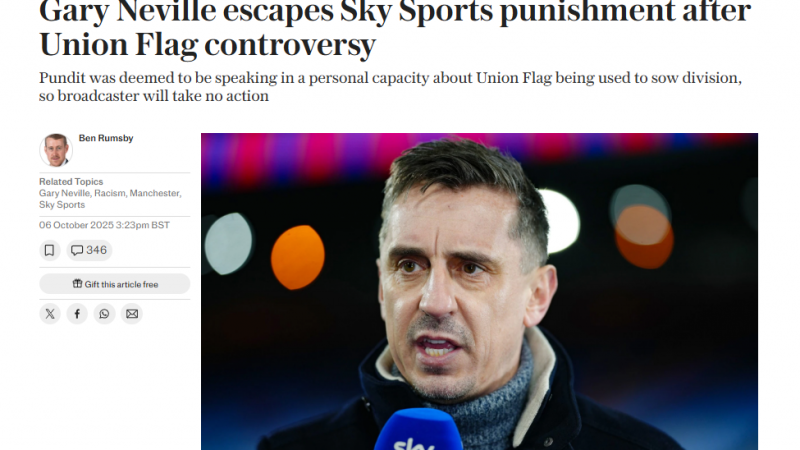
The Telegraph, meanwhile, went for a different angle, running with the headline: “Gary Neville escapes Sky Sports punishment after Union Flag controversy.”

The article made it clear that it had been deemed that Neville had spoken in a personal capacity, not as a Sky pundit, so therefore the broadcaster won’t take further action. But that didn’t stop the paper running with the implication that some sort of disciplinary action should have been considered.

But it was GB News’ presenter Carole Malone who went headfirst off the deep end.

“People like Gary Neville are part of the reason evil Islamists now live among us in Britain,” she said in an inflammatory rant.

She accused him of being an ‘idiot’ and sympathising with “Islamists who want us destroyed” over “patriotic Britons,” before descending into a tirade of personal insults:

“The poor sap is labouring under the illusion he has a brain – a political brain – when he’s embarrassingly devoid of any political nous.

“In fact, he’s a bit like his superhero, Keir Starmer, who has as much political aptitude as your average gnat. Both are so out of touch with the people of this country that they’re a joke.”

Her attack not only misrepresents Neville’s views but also dangerously conflates criticism of nationalism with sympathy for terrorism, a line of thinking that surely should have no place in responsible media.

What this latest media meltdown truly exposes is the hollow core of right-wing media’s free speech crusade. When Gary Neville expresses a personal, critical opinion, backed by real-world examples of how nationalism can fuel division, the same outlets that shout about “cancel culture” and “woke censorship” scramble to silence or mock him.

The irony wasn’t lost on observers, and reader wrote:

“Very well said Gary Neville. Although it does seem to have got a lot of “patriots” very upset. Mainly middle-aged white men.

“Free speech, anyone?”


Building a Party /w Sotiris and Gramsci

“One should stress the importance and significance which, in the modern world,
political parties have in the elaboration and diffusion of conceptions of the world…
because essentially what they do is to work out the ethics and the politics
corresponding to these conceptions and act as it were as their historical ‘laboratory’.
The parties recruit individuals out of the working mass, and the selection is made
on practical and theoretical criteria at the same time. The relation between
theory and practice becomes even closer the more the conception is vitally and
radically innovatory and opposed to old ways of thinking. For this reason one can
say that the parties are the elaborators of new integral and all encompassing
intellectuals and the crucibles where the unification of theory and practice, understood
as a real historical process takes place.”

Watch full video “The Possibilities of Left Government in Europe,” recorded 24 September 2025 in Toronto.

The Crisis at Canada Post

With its recent announcement to ‘modernize’ Canada Post, the Mark Carney government has, for all intents and purposes, dusted off the Harper-era “Five Point Action Plan” aimed at gutting the public postal service. In the midst of a bitter, two-year labour dispute with the Canadian Union of Postal Workers (CUPW), the government gave notice that it would accept and implement the recommendations put forward in labour arbitrator William Kaplan’s May 2025 Industrial Inquiry Commission report. Among others, these included the following:

  • Ending home mail delivery for all addresses that still receive it,
  • Lifting the 1994 moratorium on rural post office closures, and
  • Relaxing letter mail delivery standards to give Canada Post more transit time between sender and receiver.

Within hours of the announcement, CUPW responded by relaunching a nation-wide strike, reverting to the position it was in last December before the government ordered the union back to work under Section 107 of the Canada Labour Code.

With thousands of jobs on the line, sympathetic commenters felt the union had little choice but to resort to strike action.

Keeping the Lights On

Canada Post, according to the federal government, is “effectively insolvent.” After several years of staggering financial losses, Ottawa stepped in earlier this year to provide the Crown corporation $1-billion in “repayable funding.” This loan was needed, according to the Minister responsible for Canada Post, just “to keep the lights on.”

Officially, the modernization plan is about putting Canada Post back on a path to financial sustainability so that taxpayers won’t be left footing the bill for “repeated bailouts” of a service they use less and less.

But other observers suggest ulterior motives. With the Carney government’s first budget coming due in November and agencies ordered to find major cost reductions, the Canada Post announcement may be directed just as much at the wider federal public sector workforce as it is at the postal workforce.

The government’s choice to strip down the postal system left unaddressed a wide range of pressing social, economic, and industrial policy questions, prioritizing budgetary austerity and corporate profit over all else.

But there are alternatives. Adapting to 21st century realities need not mean paring down public postal services. As CUPW’s Delivering Community Power campaign makes clear, there are creative ways to redeploy a nationwide infrastructure with a physical presence in nearly every community:

  • Could Canada Post – like other post offices around the world – serve as an alternative to for-profit commercial banks, whose business models ignore the needs of people living on a low-income (not to mention the climate crisis)?
  • Could post offices – in many places the last-remaining physical presence of the federal government – be repurposed as “community hubs” where residents could access high-speed internet, government services, and meet-up spaces?
  • Could letter carriers help older Canadians “age in the right place,” by offering support services and at-home visits, as recommended by the National Institute on Ageing?

What’s more, the Carney government’s plan fails to consider the elephant in the room: Amazon and the growing ‘gigification’ of work in the delivery sector. Canada Post’s financial losses cannot be properly understood without accounting for the hyper-exploitative labour – and business – practices of this corporate behemoth that dominates the online consumer marketplace. •

BANNED IN AMERIKA, MADE IN CANADA

Antifa: A Graphic History of its Origins


 October 16, 2025

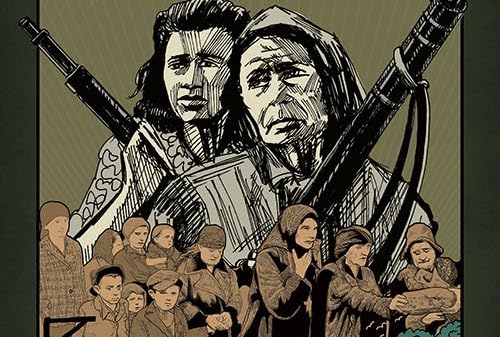
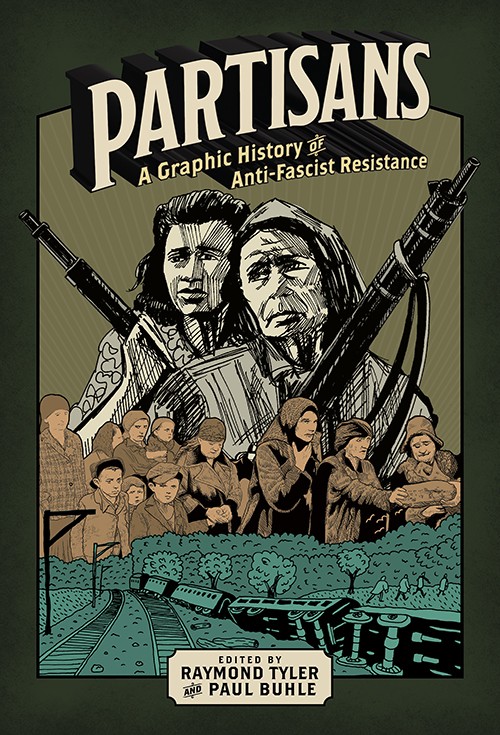
Cover art for the graphic novel Partisans: A Graphic History of Anti-fascist Resistance edited by Paul Buhle and Raymond Tyler

Leonard Cohen sings a song called “The Partisan”. It tells the story of an antifascist fighter in the heart of the war against Nazism. Beautifully rendered by Cohen on his 1969 album Songs From a Room, it tells the story of an antifascist fighter and his squad in what I assume to be the French countryside. By the time the tune is over, the teller of the tale is the only survivor. In the middle verses, the listener is introduced to a woman who gives the three fighters shelter and “Kept us hidden in the garret/Then the soldiers came/She died without a whisper.” The tragedy in this verse, so beautifully told, represents the facts of resisting fascists; fascists whose concern for the lives of those whose opinions they don’t share is virtually non-existent and is perhaps exceeded only by the anonymity of those who bomb and kill from the sky.

Recently, the Trump regime made the modern antifascist movement—known as antifa—a primary target in its establishment of a fascist USA. Although my immediate reaction to the announcement labeling antifa as a domestic terrorist organization involved at least a couple jokes regrading the essential ignorance of the White House declaration, it was underlined by the potentially greater danger that ignorance created for opponents of the trumpist movement. Because there is no actual entity that is antifa, the forces of law and order can label anyone opposed to Trump and his authoritarian program a domestic terrorist. Once an individual or organization is labeled in such a manner, even the pretense of civil rights and liberties pretty much disappears. Likewise, so do people.

Fighting fascism is a serious business. The recent case of writer and scholar Mark Bray is but one example of this. Bray’s primary work opposing fascism was to write a book titled Antifa: The Antifascist Handbook discussing fascism’s modern manifestations and the nature of the opposition to it. Right wing students at Rutgers University where he taught began a campaign of harassment in an ultimately successful campaign to force him out of his job. The harassment included threats to his family and himself; threats that convinced him they should leave the United States. For people who know the history of those opponents of Nazism who left Germany during the early years of the so-called Third Reich, Bray’s exile can’t help but make them wonder who will be next. Or how far will the installation of fascism progress around the world in the current period. When does the opposition to fascism require more than sarcasm, more than protest and how would that opposition look?

Of course, only time will give us the answers to those questions. In the meantime, it seems like a good practice would be to familiarize oneself with the history of resistance to fascism. There are dozens of texts, films and websites that are quite instructive for that pursuit. Some are fictive in nature and others are straight-up history and analysis. One recent addition to this collection of antifascist history is a supremely rendered graphic history titled Partisans: A Graphic History of Anti-Fascist Resistance. Edited by comics writer Raymond Tyler and longtime leftist historian Paul Buhle, this collection of handsomely depicted histories of various elements of the resistance to European fascism during World War Two is an inviting introduction to this under acknowledged aspect of the war against fascism in the twentieth century. The artwork, which ranges from the vivid colors of Seth Tobocman’s portrayal of the Yugoslav partisans under the leadership of Josip Broz Tito to the classical black and white cartoon panels of Daniel Selig’s entry on the French Partisans, invites readers young and old into a history that is simultaneously informative and inspirational. The narratives bend from the first person narrative of David Lasky’s water colored story of a Jewish uprising in eastern Europe to a story about the Soviet Partisans written and drawn by Raymond Tyler that reminded this reviewer of vintage Our Army at War comics from my 1960s childhood.

The different politics of various partisan groups is part of the conversation in several of the dozen stories in this collection. So are the differences based on ethnicity and religious beliefs. Women’s roles in the resistance are mentioned. Indeed, longtime comics writer Trina Robbins’ (the creator of Wimmen’s Comix) collaboration with artist Anne Timmons tells the story of three young Dutch women who served with the partisans in the Netherlands. Another story titled “Piccola Staffetta:My Small Contribution to the Resistance Against Mussolini” composed by Franca Bannerman, Isabella Bannerman, and Luisa Caetti is a tale about a girl who realizes she has been brainwashed by the fascists and joins the resistance performing small but important tasks. While reading this particular chapter, I was reminded of Hans Fallada’s novel about Nazi Germany and the small acts of resistance of a middle-aged couple, Every Man Dies Alone.

The moral of these stories and the watchword for any opposition to fascism is simple and evident throughout this graphic history. It’s not any kind of heroism that matters, but the resistance itself.

Ron Jacobs is the author of several books, including Daydream Sunset: Sixties Counterculture in the Seventies published by CounterPunch Books. His latest book, titled Nowhere Land: Journeys Through a Broken Nation, is now available. He lives in Vermont. He can be reached at: ronj1955@gmail.com


Partisans

A Graphic History of Anti-Fascist Resistance

Edited by Raymond Tyler and Paul Buhle


Add to Cart 
Paperback
Ebook
$34.95

148 pages
 ISBN 9781771136525
 Published August 2025

With eleven brand new comics created by legendary and upcoming writers and comics artists, Partisans flips a new page in the popular understanding of anti-Nazi and anti-fascist resistance. Through vivid illustrations and compelling narratives, Partisans brings to life the struggles and triumphs of those who resisted fascism. Within these pages, readers will encounter stories of resistance from the rugged mountains of the Balkans to the urban landscapes of occupied Europe. This comics collection reminds us that the fight against fascism is far from over and that the courage and sacrifices of those who came before us continue to light the way. Partisans is a must-read for anyone interested in history, social justice, and the transformative power of history and art.


Praise


“Vibrant, compelling stories of personal bravery and collective struggle—Partisans provides much-needed insights into the struggle for a better world.”
– Kate Evans, author of Red Rosa: A Graphic Biography of Rosa Luxemburg


“A stellar collection documenting the brief history of anti-fascists in Europe. By the end, you too will be excited to slap a fascist or two.”
– Yazan Al-Saadi, author of Lebanon is Burning and Other Dispatches


“Partisans, a graphic novel anthology of anti-fascist resistance, covers a wide scope of heroic activity by Russians, Ukrainians, Yugoslavians, Greeks, French, and others. It relies upon the latest research, which highlights the efforts of a variety of actors, including children, and illuminates the backdrop for armed struggle. Explaining this little-known though extremely compelling part of history to new readers will go far to puncture anti-Left myths and recover the real story, as lived first by the veterans of the Spanish Civil War and culminating with those who contributed to the final defeat of the Axis. The outstanding comic art both entertains and educates, political proof of an emerging and powerful form of storytelling.”
– Oliver Stone and Peter Kuznick, coauthors of The Untold History of the United States


“Partisans is masterful. Tyler and Buhle encapsulate complicated histories in compelling and easily understood narratives that burst to life through gorgeous illustrations. There is much to learn and enjoy in this book for young readers, newcomers to anti-fascist history, and even knowledgeable historians and activists.”
– Mark Bray, author of Antifa: The Anti-Fascist Handbook


“Vital history, the lessons of which should inform our thinking on what resistance can look like in the present.”
– Michael DeForge, author of Holy Lacrimony


“Partisans is a powerful, visually stunning tribute to the resisters who defied totalitarian regimes. Through evocative graphic novel chapters, each by a different artist, this book brings to life the stories of Partisans from all walks of life—young and old, women and men—from across the many lands darkened by fascism. You will learn their names. You will remember their courage. Historically rich and visually arresting, Partisans does more than explain the past; it will inspire readers to resist injustice now.”
– Diana Garvin, University of Oregon; author of Feeding Fascism: The Politics of Women's Food Work


“Partisans were a vital, but often overlooked, part of the defeat of Nazi Germany and its Axis allies during World War II. In every occupied country, Partisan groups waged anti-fascist guerrilla war against the Nazi invaders, carrying out raids, ambushes, and widespread sabotage. Partisans highlights different aspects of this struggle with a variety of art styles and stories ranging from personal accounts to historical overviews of Partisans in various countries, including Holland, Hungary, France, Yugoslavia, and the Soviet Union. A valuable contribution to the history of Partisan anti-fascist resistance.”
– Gord Hill, author of The Antifa Comic Book


“Don’t let the comic-book format fool you. This is a gut-wrenching story of people from all walks of life who made moral choices they never thought they would have to make. Especially notable is the emphasis on the role of women. From teenagers in Holland to an internationally known star such as Josephine Baker, these women, too, risked all. Most US leftists know about the Partisans of the Abraham Lincoln Brigade and the French Resistance. Now they’ll know about those in other places who are too often forgotten.”
– Maxine Phillips, coeditor of religioussocialism.org; former executive editor of Dissent Magazine


“Visually stunning and deeply informative, Partisans demonstrates why comics are such a powerful and potent art form. This book brilliantly delivers the histories that will give us the heart to fight current threats to democracy at home and abroad.”
– Peter Kuper, author of Insectopolis: A Natural History


Contents

Partisans: An Introduction
Raymond Tyler and Paul Buhle

World War II in Europe: A Timeline
Veterans of the Spanish Civil War
Sharon Rudahl

The Hungarian Resistance
story by Sander Feinberg, art by Summer McClinton

Freedom or Death: The French Partisans
story and art by Daniel Selig

Secret Agent
story and art by Sharon Rudahl

Tito’s Partisans
story and art by Seth Tobocman

Piccola Stafetta
story by Franca Bannerman and Luisa Cetti, art by Isabella Bannerman

Andartiko: Fighting Fascism in Greece
story and art by David Lester

Three Dutch Girls: Teenage Partisans in Holland
story by Trina Robbins, art by Anne Timmons

Uprising: A Jewish Partisan in Eastern Europe
story and art by David Lasky

Spomenik
story and art by Kevin Pyle

Soviet Partisans
story by Raymond Tyler, art by Gary and Laura Dumm

Afterword
Paul Buhle and Raymond Tyler
Acknowledgments
References
Contributors


The Antifa Comic Book: Revised and Expanded


Show Details

By Gord Hill
Foreword by Mark Bray
Paperback CAD $24.95

Read Excerpt (PDF)

Media   CBC comics list includes The Antifa Comic Book: Revised and Expanded


Description

With fascism in our midst, Indigenous artist Gord Hill revises and expands his brilliant graphic history of fascism and anti-fascist movements

When it was first published in 2018, Gord Hill's The Antifa Comic Book was heralded for its searing imagery documenting the history of fascism and anti-fascist movements over the last century. In the years since its publication, the term "antifa" has been co-opted by the right to falsely describe far-left political extremism and even terrorism. But the role played by antifa movements in fighting fascism and racism around the world remains as relevant and important as ever.

For this expanded edition, Gord Hill adds new material depicting more recent flashpoints of fascist activity, including the January 6, 2021, US Capitol attack, the murderous spree by Norwegian terrorist Anders Breivik, the infamous 2022 Canadian convoy protests, and Islamophobic and anti-migrant sentiment in a growing number of fascist governments in Europe. At the same time, Hill depicts the important work being done by anti-fascist individuals and organizations to combat this worrisome trend, made all the more crucial by Donald Trump's return to the White House.

Powerful and inspiring, The Antifa Comic Book is an important reminder of fascism in our midst and what can be done to stop it.

The book includes a new foreword by Mark Bray, historian and author of Antifa: The Anti-Fascist Handbook.

Reviews

Gord Hill's The Antifa Comic Book is so vitally important because it crafts a visual hymn to the everyday heroes, past and present, who put their bodies on the line to crush the ambitions of would-be fascist supermen. -Mark Bray, from the foreword