Wednesday, September 17, 2025

EU moves to sanction Israel over Gaza, West Bank humanitarian crisis
Copyright AP Photo/Virginia MayoBy  Shona MurrayPublished on 17/09/2025 - EURONEWS


Commission proposes package of sanctions that were trailed by Ursula von der Leyen in her State of the Union speech in Strasbourg last week.

The European Commission has issued a package of proposals aimed at sanctioning Israel for its ongoing military assault in Gaza, as well as deepening occupation of the West Bank, which Brussels says breach the EU-Israel Association Agreement.  

The measures also include sanctions on ten members of the Hamas terrorist organisation and two "extremist" ministers in the Israeli government, Security Minister, Itamar Ben Gvir and Finance Minister, Bezalel Smotrich for their role inciting violence in the West Bank.   

The decision to act against the Jewish state is based on "the rapidly deteriorating humanitarian situation in Gaza following the military intervention of Israel, the blockade of humanitarian aid, the intensifying of military operations", including the ongoing ground offensive, according to the European Commission.  

It also relates to the "decision of the Israeli authorities to advance the settlement plan", according to the executive arm of the EU.  

European Commission President Ursula von der Leyen already flagged the plan to use EU-wide measures to pressure Israel during her State of the Union address last week.  

"The horrific events taking place in Gaza on a daily basis must stop. There needs to be an immediate ceasefire, unrestrained access for all humanitarian aid, and the release of all hostages held by Hamas," she said.  

"We propose to suspend trade concessions with Israel, sanction extremist ministers and violent settlers, and put bilateral support to Israel on hold, without affecting our work with Israeli civil society or Yad Vashem Holocaust memorial," she then said.  

The EU will also suspend preferential trade in the Israel – EU Association Agreement, meaning, duties on certain goods exempted through the agreement will now apply.   

The EU is Israel's largest trading partner, accounting for 32% of Israel's total trade in goods with the world in 2024. Israel is the EU's 31st largest trading partner.   

Around 37% of goods traded between Israel and Europe are duty free as part of preferential trade agreement and it is this part which will be suspended if EU member states agree to support the proposal.   

It's estimated Israel will pay €227 million per year more in duties after the suspension of preferential trade agreement.  

Proposal is necessary and proportionate, says EU Trade Commissioner

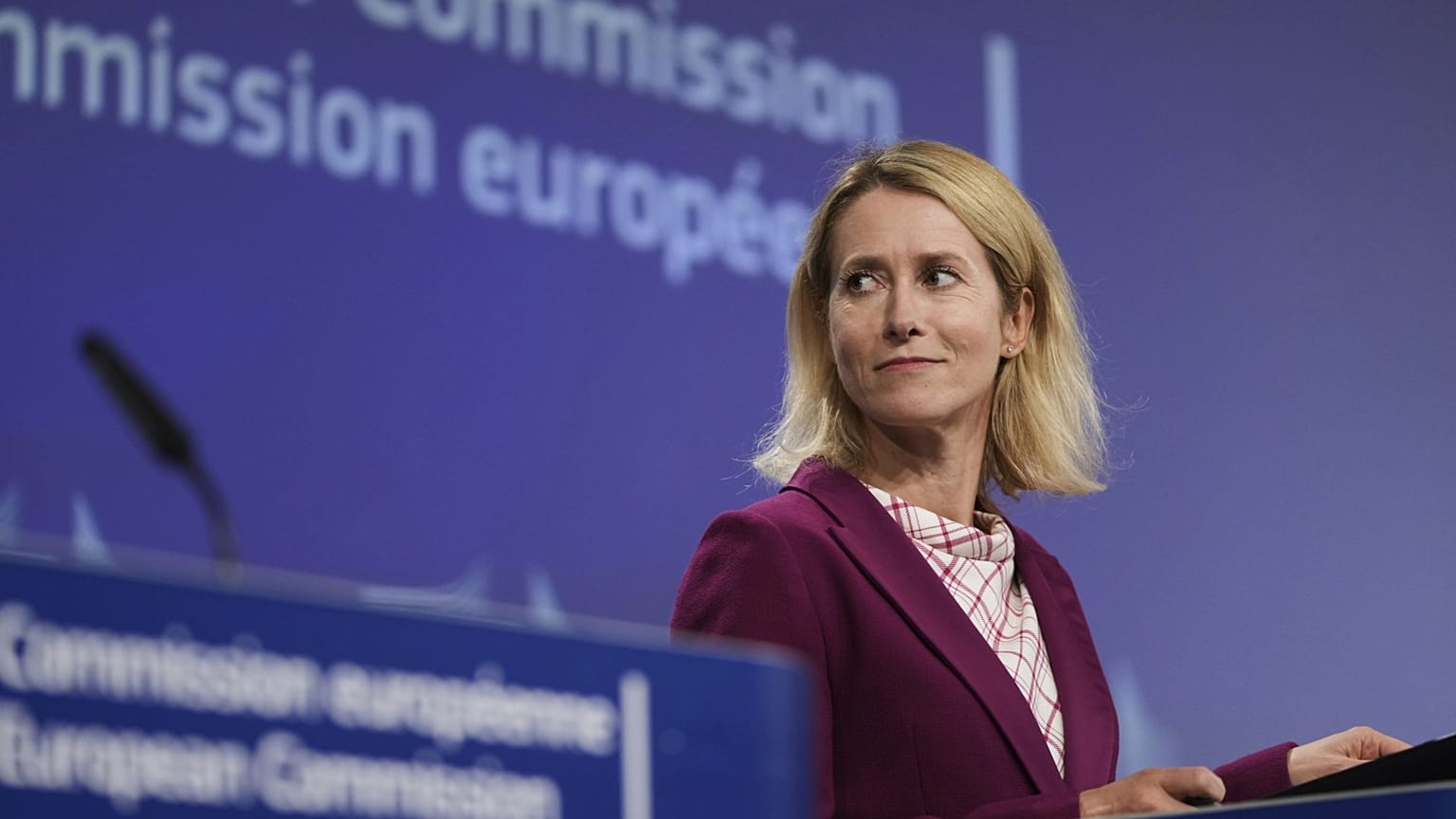
"The aim is not to punish Israel" but to alleviate the suffering in Gaza, said EU Foreign Policy chief, Kaja Kallas.    

"We are trying to pressure the Israeli government to change course," she said.  

Trade in goods between the EU and Israel in 2024 was worth €42.6 billion. EU imports from Israel were worth €15.9 billion.   

In addition, the EU will sanction violent settlers and several settler organisations in the West Bank.   

"We regret having to take this step", said EU Trade Commission Maros Sefcovic, but he said the EU saw "no alternative given the humanitarian situation in Gaza".   

It is "necessary" and "proportionate", he said.   

Commissioner Sefcovic said Commission president Ursula von der Leyen went to Israel after the 7 October 2023 terrorist attack where she shared the "shock and horror" of the Hamas terror attack in Kibbutz communities in Israel.  

 But he said: "Now is the time we must work together to end the humanitarian crisis in Gaza."   

He called for an "urgent ceasefire to stop the bloodshed".   

"Israelis need security", and "Palestinian people need real dignity", said Sefcovic.   

The Israel government has slammed the proposals and vowed not to change any policy related to Gaza or the West Bank.   

Israeli Foreign Minister Gideon Saar accused von der Leyen of "empowering" Hamas.   

Saar wrote to von der Leyen saying the action under the EU-Israel Association Agreement was "replete with false accusations and legal flaws".   

However, the EU has rejected this saying the process was within EU's legal rules and regulations.   

"This is about our own internal decision making. We are following the rules of trade, so it's not up for any country to comment our decision making – we are following our own rules," an EU official said.   

EU member states are now required to vote on the proposals requiring a qualified majority to pass.   

So far, all other prospective policies aimed at sanctioning Israel for its war in Gaza and further occupation of the West Bank have been routinely voted down by several member states including Italy, Germany, Austria, Czech Republic, Hungary and Bulgaria.   

If either of the two largest countries - Italy or Germany - support the plan, then it'll pass. However, both governments have been steadfast in their opposition to taking any action in response to Israel's actions in Gaza and the West Bank.   

There is no indication these positions have evolved.  

"The political lines are very much in the place where they have been so far," said EU Foreign policy chief Kaja Kallas.   

But she told reporters on Wednesday that "public opinion is shifting in member states and people want to see the suffering stop". 

Russian team comes dead last in Hungary’s annual grave digging contest

LACK OF PRACTICE; THEY LEAVE THEIR DEAD BEHIND IN UKRAINE

Russian team comes dead last in Hungary’s annual grave digging contest
A Russian team competed in Hungary's annual grave digging competition for the first time ever, but finished last from a field of 21 teams. / FIAT IFTA
By bne IntelliNews September 17, 2025

In a surprise move, Hungary invited a Russian team to its annual grave digging competition. In an even bigger surprise the team from Novosibirsk came dead last.

Events like this are popular in Europe, like Britain’s great downhill cheese-wheel-rolling event, Estonia’s annual wife-carrying race or Spain’s La Tomatina food fight in the village of Buñol, Hungary also has the somewhat more macabre competition to see which team can dig a grave the fastest.

With East-West tensions high, Hungary once again thumbed its nose at anti-Russian sentiments in the rest of Europe, and invited the Russian team from Siberia to compete. With more than an estimated million dead and wounded in the Ukraine conflict, Russia has plenty of experience in digging graves, but the team proved to be the slowest on the fields outside of Budapest, where the event was held.

Spade-wielding teams travelled to the small Hungarian village of Szekszárd from Serbia, Czechia and the locals to compete for gold, silver, and bronze medals cast in the shape of a spade.

The contest was held at Alsóvár cemetery on September 6 and organised by the Hungarian Cemetery Managers and Operators Association (Magyarországi Temetőfenntartók és Üzemeltetők Egyesülete) and both professional grave diggers and amateurs are allowed to compete.

Like any high-level athletic sport, the rules are strict. Competitors have to dig a hole that is exactly 1.6-metres deep, 80cm wide and 2-metres long, removing a total of 2.5 cubic metres of soil, in under two hours. The contestants then have to backfill the grave in just 15 minutes (without a coffin of course).

Keeping within the time limit is important but in addition a team of judges evaluated the accuracy of the grave’s dimensions, but there are no points for style or artistic interpretations. The walls of the grave must be perfectly vertical and the bottom perfectly flat. However, in previous years, there was an additional artistic category: teams were given 15 minutes to plant 24 pansies as tastefully as possible on the grave mound and water them before being judged on the arrangement.

In its eighth year, this year a local team of László Kiss and Róbert Nagy won for the third time in a row. The Hungarians from the town of Hajdúböszörmény finished their grave in a record 1:33 hours and 20 seconds to win yet another victory.

They credited their win to long practice as working grave diggers, but claim they did no special training for the event. Hungarian teams also took silver and bronze with times of 1:37 and 1:53.

However, the team from Siberia of Artyom Gorbikov and Sergey Yakushin, who work at the Novosibirsk crematorium, were the first Russian team to participate in the competition. They travelled thousands of miles especially to enter, but finished dead last from a total of 21 teams. Gorbikov and Yakushin put their poor performance down to having to struggle with “difficult ground and in scorching heat", The Insider reported.

Russian teams have been barred from competition in the Olympics and other major sporting events, but so far have not been barred from grave-digging. In 2021, the Russian Grave Company Championship was held in Novosibirsk. The team from Omsk won.


'Ukraine must win': Five members of Pussy Riot sentenced to jail in Russia

Pussy Riot's Diana Burkot, Anton Ponomarev, Masha Alyokhina and Olga Borisova perform at the Kaserne in Basel, Switzerland - June 2022
Copyright AP Photo

By David Mouriquand
Published on 

Five members of the feminist punk group Pussy Riot have been sentenced in absentia to prison in Russia. One member, Diana Burkot, said: “Ukraine must win, and Putin must face trial in The Hague.”

Five members of Pussy Riot have been sentenced in absentia to prison in Russia on charges relating to anti-war performances criticising the war in Ukraine.  

Reports from Mediazona – the independent Russian outlet co-founded by band members in the feminist punk collective – reveal the members sentenced included Maria Alyokhina, Taso Pletner, Olga Borisova, Alina Petrova and Diana Burkot.

The jail terms handed down by Moscow’s Basmanny District Court ranged from eight to 13 years, according to Rolling Stone and Mediazona. 

The members are accused of spreading “false information” about the Russian army in a music video released in December 2022 entitled 'Mama, Don’t Watch TV'. A separate charge relates to an incident in which a member of the group urinated on a portrait of Vladimir Putin in April 2024. 

All five members of Pussy Riot have rejected the charges, saying they were politically motivated.

Diana Burkot, from left, Anton Ponomarev, Maria Alyokhina and Olga Borisova perform at Funkhaus Berlin, in Berlin - May 2022 AP Photo

In a statement given to Rolling Stone, Diana Burkot said: “The full-scale war against Ukraine has been going on for more than three years. And I continue to believe: Ukraine must win, and Putin must face trial in The Hague.” 

Burkot added: “The Russian government is a textbook example of patriarchy – the worst kind of abuser: a tyrant, a narcissist, a gaslighter, a toxic manipulator who lives off the destruction of others’ will.” 

She urged “every person in this world to use their voice,” and went on to say that collective activism was the only way to “resist and overcome the crisis of democracy”. Burkot said that thankfully, the Russian government has “no access to my physical body,” but that “even if I were in Russia, I would say the same thing: go fuck yourself.” 

Nadezhda Tolokonnikova of Pussy Riot performs at the Sonic Temple Art and Music Festival at Mapfre Stadium - 2019 AP Photo

Pussy Riot rose to fame in 2012 with their protest piece ‘A Punk Prayer’, when three members of the group were imprisoned for a protest at a cathedral in Moscow.  

Since then, the group has consistently opposed Putin’s authoritarian regime and its clampdown on freedom of speech. 

In 2023, member Nadya Tolokonnikova was arrested in absentia and added to Russia’s International Wanted list. Last year, a court in Moscow sentenced Pyotr Verzilov - the unofficial spokesperson of Pussy Riot who left Russia in 2020 after authorities searched his home - to eight years and four months in absentia in prison for social media posts criticising the war in Ukraine.


Russian disinformation falsely claims


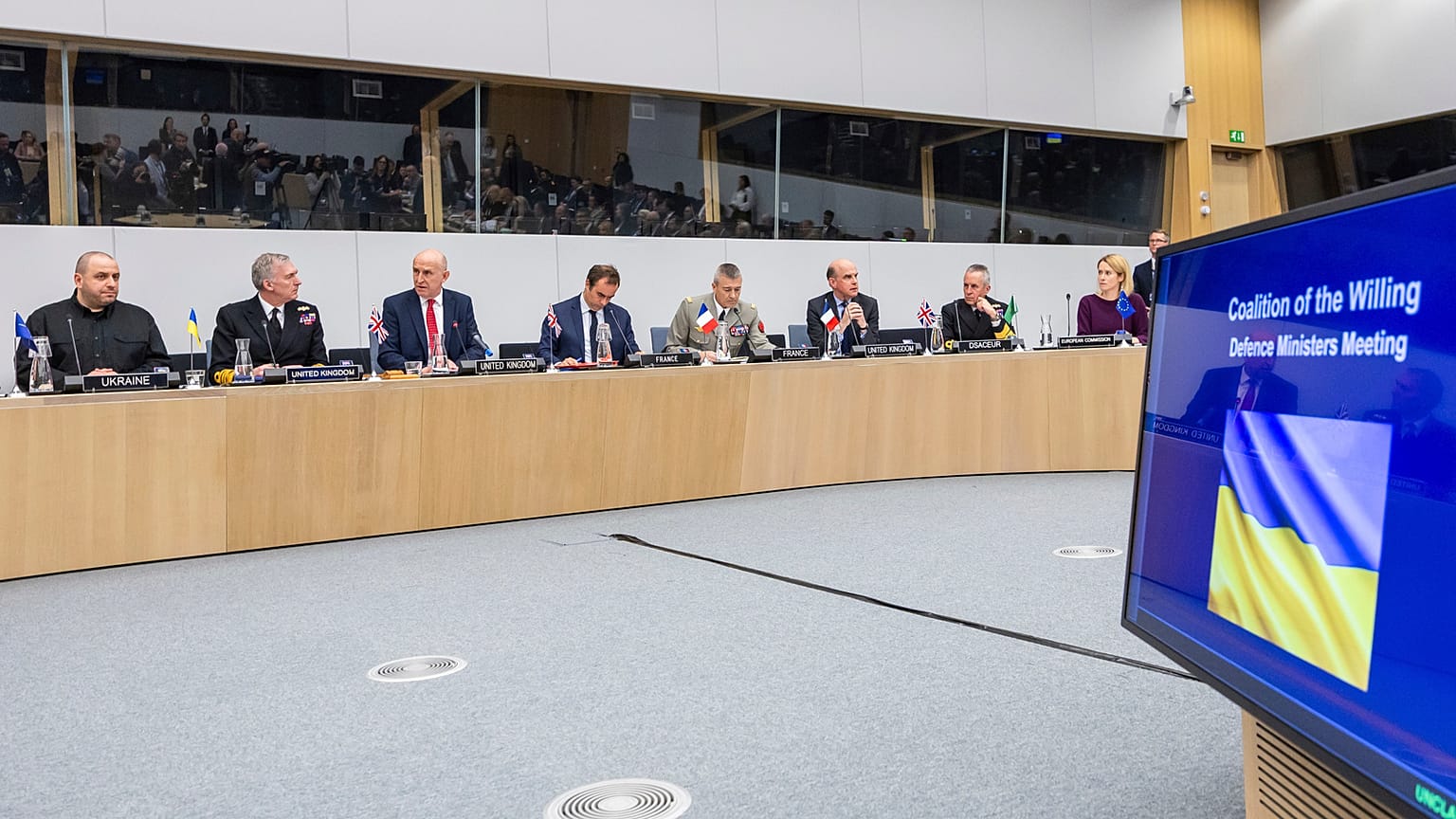
Coalition of the Willing plans to 'occupy'


Ukraine


Copyright Geert Vanden Wijngaert/Copyright 2025 The AP. All rights reserved.


By Mared Gwyn Jones
Published on 15/09/2025 - EURONEWS


Pro-Kremlin actors are using disinformation to take aim at Western efforts to facilitate a peace settlement for Ukraine.

A Kremlin-aligned disinformation operation is falsely accusing Ukraine's allies of plotting to divide the war-torn country's territory between them in the event of a peace deal with Russia.

The claims — which Euronews' verification and fact-checking team detected on Facebook, Instagram, Telegram, TikTok and X — are purportedly based on a disclosure of confidential French military documents by prominent Russian hacking group Killnet.

The disinformation claims that those leaked documents reveal a secret plan to divide the territory and natural resources of Ukraine between four allies — France, the UK, Poland and Romania — and to deploy as many as 50,000 peacekeeping troops.

A map allegedly detailing the plan to "divide Ukraine into zones of influence" is also circulating.

But a closer look at the map shows several grammatical and spelling errors which, according to a new French government X account which debunks false claims, demonstrate that the map is not the work of the French military.

For example, Belarus is incorrectly translated into French as "Biélarus" rather than "Biélorussie".

The name of former French General Thierry Burkhard is also misspelt.

French debunkers have also pointed out that the title of the map omits the French article 'la', which they say is a mistake typically made by Russian native speakers.

The map also shows Crimea, annexed by Russia in 2014, as an integral part of Russia's territory, while France and Western allies consider the territory to be a Ukrainian territory under Russia control.

Despite these errors exposing the map as disinformation, EuroVerify detected the map and accompanying false claims on several Kremlin-aligned media outlets.

The same claims have also been re-hashed into an AI-generated video resembling a news report.

According to open source intelligence experts, the map was first shared on Telegram account Mash on 9 September.

Mash is a Russian media known for being close to the Kremlin and one of the most popular Russian-language channels on the platform.

It's known for spreading false information aimed at undermining Ukraine and its allies. It's believed to be behind previous false allegations that Kyiv was selling the organs of deceased soldiers on the black market, as well as unfounded claims Ukraine had lost as many as 1.7 million armed forces, previously debunked by Euroverify.

While so-called community notes contradicting the false claims have now been added to certain posts on X, the claims are still circulating without corrections on other platforms, including Facebook and Instagram.


https://theanarchistlibrary.org/library/peter-arshinov-history-of-the-makhnovist-movement-1918-1921


UK judge blocks plan to send migrant back to France under new 'one in one out' deal

A boat thought to carry migrants is escorted by a vessel from the French Gendarmerie Nationale in the English Channel, 4 September, 2024
Copyright AP Photo

By Gavin Blackburn
Published on 


The ruling is a setback for Prime Minister Keir Starmer's efforts to stop people crossing the channel from France in small boats.

A British judge temporarily blocked the government from sending an asylum-seeker who crossed the English Channel back to France, delaying the first deportation under an agreement between London and Paris.

The 25-year-old Eritrean man was due to leave Britain on Wednesday on a commercial flight.

But after his lawyers appealed, High Court judge Clive Sheldon granted "a short period of interim relief" so the man can present evidence to support his claim that he is a victim of human trafficking.

Lawyers for Home Secretary Shabana Mahmood argued that the man, who can't be identified for legal reasons, could and should have sought asylum in France.

"It seems to me there is a serious issue to be tried with respect to the trafficking claim and whether or not the secretary of state has carried out her investigatory duties in a lawful manner," the judge said.

British Prime Minister Keir Starmer and his wife Victoria arrive at Windsor Castle, 17 September, 2025 AP Photo


The ruling is a setback for Prime Minister Keir Starmer's efforts to stop people crossing the channel from France in small boats.

Mahmood said the government would appeal the decision. Despite the court ruling, the first removals to France are expected to take place this week.

"Last-minute attempts to frustrate a removal are intolerable and I will fight them at every step," Mahmood said.

"Migrants suddenly deciding that they are a modern slave on the eve of their removal, having never made such a claim before, make a mockery of our laws and this country’s generosity."

More than 30,000 people have made the crossing so far this year, a decrease on the 37,000 who arrived last year.

Dozens have died in recent years trying to cross one of the world’s busiest shipping lanes in overcrowded dinghies.

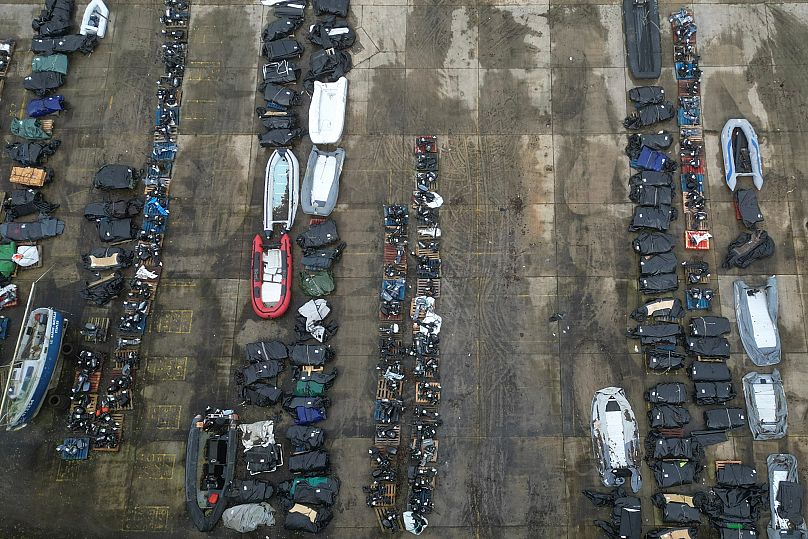
A general view of small boats and inflatable dinghies in a Border Force compound after being confiscated from migrants attempting to cross to the UK, 26 February, 2025 AP Photo

Starmer scrapped the previous Conservative administration's contentious plan to send migrants who crossed the channel on a one-way trip to Rwanda.

Instead, he has pinned hopes on a deal with Paris to send some people who cross back to France, in return for accepting some asylum-seekers currently in France who have family ties to Britain.

UK officials have suggested the "one in, one out" plan is a major breakthrough, despite the initial program involving a limited number of people.

The government is also looking to speed up the processing of asylum claims. Officials have housed tens of thousands of migrants awaiting decisions in hotels at public expense and the hotels have become flashpoints for protests.


Eritrean man halts deportation in first test

of UK-France asylum pact


A British court has blocked the planned removal of an Eritrean asylum seeker to France, handing Prime Minister Keir Starmer an early setback in his plan to stop small-boat crossings of the English Channel.


Issued on: 17/09/2025 - RFI


Migrants try to board a smuggler's boat in an attempt to cross the English Channel off the beach of Gravelines, northern France on 12 August 2025. AFP - SAMEER AL-DOUMY

The 25-year-old man, who cannot be named for legal reasons, arrived in Britain on 12 August. He was due to be put on a flight to Paris on Wednesday under the “one in, one out” scheme agreed in July by Britain and France.

But on Tuesday, London’s High Court granted him an interim injunction after his lawyers argued he may be a victim of trafficking.

“There is a serious issue to be tried in relation to the trafficking claim and whether or not the Secretary of State has carried out her investigatory duties in a lawful manner,” said Judge Clive Sheldon.

The ruling delays what would have been the first return flight under the scheme, which aims to reduce irregular migration. More than 30,000 people have crossed the Channel in small-boat journeys so far this year – the fastest pace since records began in 2018.

UK and France start migrant return scheme to curb illegal Channel crossings


Legal challenge


The man’s lawyers told the court he needed more time to provide evidence of his claim. Court papers show he travelled through Ethiopia and Italy before reaching France, where his mother paid smugglers $1,400 to arrange his Channel crossing.

Home Office lawyers argued he could have claimed asylum in France. They warned that delaying his removal could encourage others to make similar challenges.

Court documents show the Home Office had already rejected his trafficking claim but confirmed in a letter on Tuesday that he has the right to make further representations. The judge ruled he should have 14 days to do so.

“I am going to grant a short period of interim relief,” Sheldon said. “The status quo is that the claimant is currently in this country and has not been removed”.

Anti-migrant unrest erupts despite UK's tightening of migration policy


Political pressure


The UK-France agreement was announced by Starmer and President Emmanuel Macron in July. Under the deal, France agreed to take back people who arrived illegally in Britain, while the UK would accept the same number of recognised asylum seekers with family ties in the country.

Starmer has made tackling small-boat arrivals a central pledge of his government. But the policy has already come under fire – rights groups say it risks breaching international law, while the opposition says it is too weak.

Conservative leader Kemi Badenoch told LBC radio the injunction proved her party’s concerns.

“We told you so,” she said. “We are basically turning our country into a refuge for anyone who may have even the slightest bit of unhappiness in any other country”.

Nigel Farage, head of Reform UK, also attacked the plan, saying “one in, one out, and with another one in, still means plus one for everyone that crosses the Channel”.

A Home Office spokesperson told the BBC the government still expected flights to go ahead soon. “The interim ruling will not prevent delivery of the wider policy,” the spokesperson said.

No migrant has yet been removed under the scheme, which is likely to face more legal tests in the coming weeks.

(with newswires)


Flood corruption scandal shakes the Philippines

Flood corruption scandal shakes the Philippines
Flooded streets in the Philippines / Tear Cordez - Pexels
By bno - Jakarta Office September 18, 2025

The Philippines is grappling with a widespread controversy surrounding its flood control programme, with allegations of billions of pesos being siphoned off from projects meant to protect vulnerable communities from worsening floods. The issue came to prominence after President Ferdinand Marcos Jr highlighted irregularities in his State of the Nation Address on July 28, prompting an avalanche of revelations, resignations and calls for accountability.

According to ABS-CBN News, the scandal centres on the suspected misuse of around PHP118bn from the Department of Public Works and Highways (DPWH) over the past three years. Funds allocated for flood mitigation are alleged to have been channelled into a network of favoured contractors, lawmakers and civil servants. Although some 5,500 projects have been reported as completed since 2022, extensive media inquiries have found evidence of poorly built or non-existent works — dubbed “ghost projects” — which failed to protect communities during this year’s heavy monsoon rains and typhoons.

A trail of alarming discoveries

A timeline published by ABS-CBN outlines how the controversy unfolded. Immediately after his July address, President Marcos ordered an inquiry into possible fraud. On August 4, Senator Panfilo Lacson disclosed that 67 legislators in 2022 acted as contractors for their own schemes. A week later, the president identified 15 companies that collectively obtained PHP100bn in contracts, many located in areas not especially prone to flooding.

Further probes exposed glaring deficiencies. On August 15, the president inspected structures in Bulacan province that had been signed off as complete despite missing vital elements. Days later, a dike in Oriental Mindoro collapsed, its interior reportedly filled with sand and thin concrete. ABS-CBN also obtained records revealing that one leading contractor, awarded substantial flood works, had a paid-up capital of only PHP250,000 in 2019.

By late August, the Senate’s Blue Ribbon Committee had begun hearings. Several major contractors refused to attend, while Public Works Secretary Manny Bonoan admitted learning only recently of “ghost” projects, including a PHP77mn scheme in Hagonoy that existed only on paper. Growing pressure culminated in Bonoan’s resignation on August 31, with Vince Dizon assuming leadership of the DPWH and demanding courtesy resignations from senior staff.

Expanding probes - political fallout

Investigations widened in early September. The House of Representatives launched its own inquiry after Finance Secretary Ralph Recto estimated losses from fraudulent flood control works at more than PHP100bn between 2023 and 2025. Authorities raided the compound of high-profile contractors Pacifico and Sarah Discaya, seizing luxury vehicles. The Philippine Contractors Accreditation Board subsequently revoked licences of nine companies linked to the pair, while the Justice Department issued lookout bulletins for officials and builders implicated in the affair.

Names of prominent politicians have surfaced. Former DPWH engineer Brice Hernandez accused Senators Jinggoy Estrada and Joel Villanueva of receiving kickbacks, claims both deny. Other allegations touched on senior figures in Congress, prompting Senate President Chiz Escudero to step down, replaced by Tito Sotto. President Marcos later formed the Independent Commission on Infrastructure, led by former Supreme Court Justice Andres Reyes Jr, to steer the investigation.

The Associated Press reports that Marcos has urged Filipinos to express their indignation but appealed for calm. “Of course they are angry; I am angry,” he said, while warning against unrest. Security chiefs stressed the armed forces would remain neutral amid appeals from some protest leaders for a “people power” revolt akin to uprisings that unseated past presidents.

Public anger has been most visible online, though rallies have taken place in Manila and other cities. A larger demonstration is expected at the capital’s pro-democracy shrine on September 21. Police and troops have been placed on alert, but gatherings so far have been peaceful, in contrast to violent protests recently seen elsewhere in Asia.

Climate adaptation tragedy

Beyond corruption, environmental advocates argue that the scandal undermines the country’s ability to face intensifying climate risks. Greenpeace Philippines warned that as much as PHP1.029 trillion of climate-linked public spending may have been lost to graft since 2023, including PHP560bn this year alone. Of the DPWH’s PHP800bn climate-tagged budget for 2025, an estimated PHP173bn allocated to flood protection may be vulnerable.

Jefferson Chua of Greenpeace described the diversion of climate funds as “atrocious,” equating the culprits to “climate criminals.” He said the plunder leaves Filipinos exposed to increasingly destructive floods while pushing the country deeper into debt through loans for disaster recovery. The group also criticised the government’s reliance on grey infrastructure, urging investment in watershed restoration, community-led measures and bans on plastic waste to complement engineering solutions.

Next steps, accountability

President Marcos has pledged that the independent commission’s probe will spare no one, including allies. Meanwhile, thousands of citizens have lodged complaints via a government portal, demanding transparency and restitution. The administration has reportedly suspended 2026 funding for flood mitigation pending a thorough review, redirecting some resources towards health, education and agriculture.

For millions living in flood-prone districts, the outcome of these inquiries carries urgent significance. Failed or substandard defences translate directly into lost homes, livelihoods and lives during seasonal storms. Civil society groups, Catholic leaders and business organisations have joined calls for stringent prosecutions, reforms to procurement systems, and safeguards to protect climate finance from corruption.

The scandal has exposed systemic weaknesses in oversight and a culture of impunity in public works. A key question now is whether the Marcos administration can rebuild public confidence and ensure that infrastructure spending fulfils its intended role in protecting communities from worsening floods and other climate-related risks. Effective accountability will need to cover both those involved in misusing funds and broader systemic issues that leave disaster-prone areas vulnerable.


Reprogramming obesity: New drug from Italian biotech aims to treat the underlying causes of obesity


RNA-based drug is designed to rewire the metabolism to provide lasting weight loss, while preserving muscle mass; weekly jab is in clinical trials, following promising results in preclinical studies


European Association for the Study of Diabetes


Details of a new drug that aims to treat the underlying causes of obesity are being presented at the annual meeting of the European Association for the Study of Diabetes (EASD) in Vienna, Austria (15-19 September).

The treatment of obesity has been transformed in recent years by glucagon-like peptide-1 (GLP-1) receptor agonists such as semaglutide, which reduce appetite, slow the release of food from the stomach and increase feelings of fullness.

These drugs are highly effective for weight loss but many people regain weight after stopping treatment. That’s because obesity is driven by more than appetite alone – it also involves disrupted lipid and glucose metabolism, changes in adipose tissue and mitochondrial dysfunction, leaving plenty of room for new approaches, explains Riccardo Panella, co-founder and CEO of Turin-based biotech Resalis Therapeutics.  

The company’s approach involves an antisense oligonucleotide – a small, lab-made fragment of genetic material designed to block a specific RNA in the body.  The new drug, which is called RES-010, is designed to block an RNA molecule called miR-22.

miR22 is a “master controller” of many processes involved in obesity, including lipid metabolism (how the body breaks down and uses fats), the production and activity of mitochondria (the tiny structures that provide cells with energy) and adipose tissue remodelling (changes in how body fat is organised and how it functions), says Dr Panella, who is one of the authors of the new research.

The hope is that by tackling all these factors simultaneously, RES-010, which is administered once a week as a subcutaneous injection, will reprogramme the metabolism, producing long-lasting weight loss.

Pre-clinical studies show that the compound can induce significant weight loss – and that the lost weight isn’t regained when treatment stops.  A phase 1 trial is now under way.1

In tests on obese mice, mice given weekly injections of the drug lost about 12% more weight than untreated mice. The weight loss occurred gradually over the five months of treatment, leading to the animals returning to healthy weight.

“Importantly, the treated mice lost weight despite eating the same amount as the untreated mice, which suggests RES-010 isn’t suppressing appetite but reprogramming the metabolism,” says Dr Panella.

Experiments also showed that mice that had been treated with RES-010 did not regain weight after the drug was stopped.

The team also explored giving RES-010 and semaglutide alone and together to mice and non-human primates (NHPs).

They found that RES-010 selectively targeted fat mass.  This is important because rapid weight loss when on a diet or taking GLP-1 drugs2 can lead to lean mass, which includes muscle and bone, being lost too.

“Lean mass, especially skeletal muscle, is central to strength, stamina and blood sugar regulation, and so its loss is potentially harmful,” says Dr Panella.

NHPs given RES-010 lost 15% fat mass and 1% lean mass over ten weeks.  This compares with 16% fat mass and 8% lean mass for semaglutide alone.

The team also looked at whether the animals regained weight after treatment was stopped.

They observed that while the NHPs given semaglutide alone regained weight after semaglutide was discontinued, the animals receiving the combination treatment did not regain weight after semaglutide was stopped and they remained on RES-010 alone. Moreover, no rebound occurred when RES-010 was also stopped a few weeks later.

No significant side-effects were seen in the mice or the NHPs at therapeutic doses, says Dr Panella.

Tests on animals and non-human organoids have shown how the drug works.

Dr Panella says: “RES-010 works by reprogramming how cells handle fat and energy

“Rather than reducing appetite, it changes the way in which the body uses fats, boosts the production and activity of mitochondria, the ‘batteries’ that power cells, and helps convert white fat, which stores energy, into brown fat, which burns it.

“Because it acts on these fundamental pathways, weight regain is less likely.

“RES-010 is pioneering a new class of RNA medicines that reprogramme the body’s metabolism, with the aim of producing long-lasting weight loss and improved metabolic health by, for example, improving liver health.”

The drug is now being given to humans for the first time, in a phase 1 clinical trial in the Netherlands.

The randomised double-blind, placebo-controlled study, will involve up to 80 participants (including some with overweight or obesity) and assess the safety and side-effects of various doses.  The first participants were treated in November 2024 and the initial results are expected at the beginning of 2026. .