Sunday, August 31, 2025

YOUR DATA IS IN MUSK'S HANDS

U$ Social Security Data Chief Who Blew Whistle on DOGE Resigns, Citing 'Culture of Fear'

Social Security Administration chief data officer Charles Borges described "fear and anxiety over potential illegal actions resulting in the loss of citizen data" in his resignation letter.
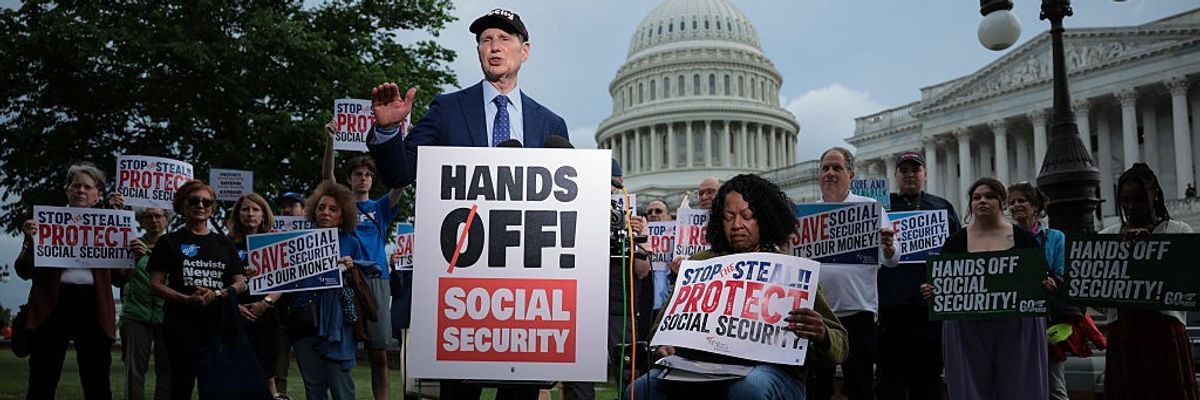

US Sen. Ron Wyden (D-Ore.) speaks during a press conference on Social Security in front of the US Capitol on May 5, 2025 in Washington, DC.
(Photo by Kayla Bartkowski/Getty Images)


Brad Reed
Aug 29, 2025
COMMON DREAMS

A federal worker who filed a shock whistleblower report alleging that employees of the Department of Government Efficiency had potentially compromised Americans' Social Security data abruptly resigned on Friday.

In a letter obtained by independent journalist Melissa Kabas, Social Security Administration (SSA) chief data officer Charles Borges said that he was "involuntarily" stepping down from his position at the agency due to "serious... mental, physical, and emotional distress" caused in the wake of his whistleblower report.

RECOMMENDED...



'Nightmare Scenario': Watchdog Says AI Cybercrime Shows Vital Need for Regulation


'This is Criminal': Shock Whistleblower Report Claims DOGE Put Americans' Social Security Data at Risk

Borges said that after filing his report with the help of the Government Accountability Project, he was subjected to "exclusion, isolation, internal strife, and a culture of fear" that created a hostile work environment and made "work conditions intolerable."


Borges then recounted that he filed the whistleblower report because he was concerned that Department of Government Efficiency (DOGE) employees had uploaded Americans' Social Security information onto a cloud server that he believed was vulnerable to external hackers.

"As these events unfolded, newly installed leadership in IT and executive offices created a culture of panic and dread, with minimal information sharing, frequent discussions on employee termination, and general organizational dysfunction," Borges claimed. "Executives and employees were afraid to share information or concerns on questionable activities for fear of retribution and termination."

Borges concluded by saying that the total lack of visibility into the actions of DOGE employees who were handling Americans' most sensitive data created a sense of "fear and anxiety over potential illegal actions resulting in the loss of citizen data."

The report, whose existence was made public earlier this week, contends that Borges has evidence of a wide array of wrongdoing by DOGE employees, including "apparent systemic data security violations, uninhibited administrative access to highly sensitive production environments, and potential violations of internal SSA security protocols and federal privacy laws by DOGE personnel."

At the heart of Borges' complaint is an effort by DOGE employees to make "a live copy of the country's Social Security information in a cloud environment" that "apparently lacks any security oversight from SSA or tracking to determine who is accessing or has accessed the copy of this data."

Should hackers gain access to this copy of Social Security data, the report warns, it could result in identity theft on an unprecedented scale and lead to the loss of crucial food and healthcare benefits for millions of Americans. The report states that the government may also have to give every American a new Social Security number "at great cost."


Social Security whistleblower forced out after exposing massive data risk

Sarah K. Burris
August 29, 2025 
RAW STORY


FILE PHOTO: United States Social Security Administration logo and U.S. flag are seen in this illustration taken April 23, 2025. REUTERS/Dado Ruvic/Illustration/File Photo

The chief data officer at the Social Security Administration, who sounded the alarm that the Department of Government Efficiency uploaded the unsecured personal information of hundreds of millions of Americans onto a vulnerable cloud server, is out after filing his whistleblower complaint.

Charles Borges filed the complaint on Wednesday, which revealed that members of DOGE, tasked with eliminating parts of the federal government, had accessed personal data uploaded to a cloud server.

New York Times political correspondent Nicholas Nehamas posted the resignation letter on X, saying that while he resigned, he was ultimately shoved out of a hostile work environment.

In the letter of resignation dated Friday, Borges said he was "involuntarily leaving my position at the Social Security Administration (SSA)."

"This involuntary resignation is the result of SSA's actions against me, which make my duties impossible to perform legally and ethically, have caused me serious attendant mental, physical, and emotional distress, and constitute a constructive discharge. After reporting internally to management and externally to regulators, serious data and security and integrity concerns impacting our citizens' most sensitive personal data, I have suffered exclusion, isolation, internal strife, and a culture of fear, creating a hostile work environment and making work conditions intolerable."

Borges noted that he's been in public service for decades, serving first as an active-duty Naval Officer and is a decorated combat veteran. He explained that in his capacity at SSA, he has been "responsible for providing oversight and Governance to ensure the safety, integrity, and security of the public's data." That requires "full visibility into data access and exchange across all SSA systems and environments."

He was responsible for "ensuring compliance with federal data privacy, security, and regulatory requirements, as well as ensuring data is handled in accordance with internal and external policies, standards and industry best practices." However, Borges said, that he recently was made aware of "several projects and incidents" in which laws or regulations were violated.

Borges warned that it involves the "potential safety and security of high-value data assets in the cloud, possibly providing unauthorized or inappropriate access to agency enterprise data storage solutions and may involve unauthorized data exchange with other agencies." He explained that it came as a result of 'newly installed leadership in IT and executive offices." Those new staff created a culture of fear that made employees scared to share information or even discuss "questionable activities" out of "retribution or termination."

Read the full letter from Borges here.
DISNEY 'EVIL MOUSE' INC.

'Failing the American people': Ousted ABC reporter rips old network for caving to Trump

Daniel Hampton
August 29, 2025 
RAW STORY


KONSKIE, POLAND - November 12, 2018: ABC News logo displayed on smartphone. (Piotr Swat / Shutterstock)

Terry Moran, a broadcast journalist who was fired from ABC News in June after posting a message on X referring to top White House adviser Stephen Miller as a "world-class hater," blasted his old employer this week for "failing the American people."

Moran posted to social media, "The thing about Stephen Miller is not that he is the brains behind Trumpism. Yes, he is one of the people who conceptualizes the impulses of the Trumpist movement and translates them into policy. But that's not what's interesting about Miller. It's not the brains. It's the bile. Miller is a man who is richly endowed with the capacity for hatred. He's a world-class hater."

Moran joined "In Good Faith with Philip DeFranco" on Thursday to talk about Trump 2.0.

When asked if he knew the post would put his job at risk, Moran said he wouldn't have made the post if he knew he'd get fired.

"But I did think I'd get in trouble and good trouble," he said, noting he had earned a reputation of challenging the network's coverage — including advocating for more coverage of President Joe Biden's age and fairer coverage of President Donald Trump.

"It wasn't, 'Oh, the hell with it,'" he said, referring to flippantly posting on X.

ABC, he said, was under intense pressure from the White House to fire Moran. Disney executives in California made the call, he added.

“Look, Disney is a multi-kabillion dollar business, right? ABC News is a little tiny speck in that giant empire. The last thing that the head of Disney or anybody in these corporate offices wants is a problem with the president of the United States because somebody in the news division tweeted something,” he said.

Moran said network TV is "failing the American people."

They have corporate pressure on them and they have kind of rules — what they can say and what they can’t say, what they can describe and what they can't describe,” Moran said of his fellow journalists. “The facts in front of them are eluding their coverage. And I think they are disserving the American people.”

His remarks come after ABC settled a lawsuit with Trump by agreeing to pay $15 million to Trump's presidential library and $1 million to his legal team to resolve a defamation lawsuit stemming from on-air statements by anchor George Stephanopoulos.

Watch the clip below or at this link.


DESANTISLAND
Here's the sinister truth behind Florida's flourishing book bans


Diane Roberts,
 Florida Phoenix
August 28, 2025 


School libraries are under assault in Florida. Picture: Shutterstock.com

It’s Banned Books Week in Florida!


OK, the observance is in October, but it’s always Banned Books Week in Florida. Every day seems to bring another hissy fit from a state goon or “concerned” parent hell-bent on returning us to the glory days of censorship.

Hillsborough County School Superintendent Van Ayres has been attacked by parents and shouted at by state government for failing to remove materials chest-thumping Attorney General James Uthmeier claims are “pornographic“ from school libraries.

Ayres already had two books — Call Me By Your Name, a gay romance with some sex scenes, and Jack of Hearts (and Other Parts), which has no sex scenes — taken off the shelves.

That was not enough for Uthmeier and some of the school board’s more hysterical members. So, in an abundance of caution, Ayres had 600 more removed from schools for a “review,” estimated to cost $350,000.


It was not enough: During a June school board meeting, one member called many surviving books “nasty and disgusting,” and another, obviously in need of smelling salts, said, “I, as a 56-year-old woman, mother of five and a physician, can’t look at these pages.”

She wants heads to roll:

“Have you considered firing all your media specialists and starting from scratch with women and men who can read, or have a single shred of decency? These people that you trust to review these materials are abusing the children of your county. They’re child abusers.”

Here are some of those child-abusing materials: The Diary of Anne Frank, What Girls Are Made Of, The Bluest Eye, I Know Why the Caged Bird Sings, Slaughterhouse Five, and The Handmaid’s Tale.


Women and men who can — and do — read will know the authors of those books include a Booker Prize winner, a National Book Award winner, winner of a Presidential Medal of Freedom, and a Nobel Prize laureate.

Obviously, a bunch of perverts and losers.

‘Overbroad and unconstitutional’

The good news is that some at that ambush of a meeting objected to the objections.

One parent said it was not the state’s responsibility to decide what books her kid should have access to, it was hers: “Don’t tell me that it’s inappropriate if I think it’s appropriate for my child to read.”

The chair of the school board also took exception to the abuse heaped on school librarians (annoyingly now called “media specialists”) who are, in fact, experts in “age-appropriate” materials.

The even better news is that a federal judge has struck down the worst parts of Gov. Ron DeSantis’ pet book-banning law as “overbroad and unconstitutional.”

A gaggle of big publishers including Simon and Schuster, Hachette, HarperCollins, Penguin Random House, plus a bunch of well-known authors and hacked-off parents, sued over the state’s vague decree that if a text “describes sexual conduct” it’s “pornographic.”

U.S. District Judge Carlos Mendoza, probably trying hard not to roll his eyes, pointed out the state can’t seem to define what they mean by “sexual conduct”: Consensual intercourse? A kiss? A rape? A seductive conversation? A hand sliding down (or up) to touch certain body parts which may or may not be named? Joyous marital congress?

The state’s arguments boiled down to:If a parent or random Moms for Liberty busybody think something is obscene and therefore an assault on the Moral Fiber of Our Youth, it is, even if they can’t quite get specific about what that means. They know obscenity when they see it, by golly.
Books in public school libraries should promote “government speech,” i.e., the views espoused by the DeSantis regime.

Views such as, say, gays are not good; trans people are worse; sex outside of marriage is terrible; authority should not be questioned; climate change should not be studied.

Legal fees

According the state, “When the government speaks, it ‘can freely select the views that it wants to express, including choosing not to speak and speaking through the removal of speech that the government disapproves.”

According to DeSantis’ lawyers, school books are “not subject to the First Amendment.”

You thought free speech was protected in the Free State of Florida?

In 2023, PEN America file a lawsuit against the Escambia County School District for removing or restricting access to books some people found objectionable. Escambia keeps losing in court, but that hasn’t stopped them from continuing to spend taxpayer money: at least $440,000. So far. To make an obvious point, think about the field trips and school supplies that cash could have funded.

What’s all this book banning really about, anyway?

Authoritarianism for authoritarianism’s sake? That’s probably part of it. Bullies love to bully.

Does it spring from deeply held religious notions of “purity” which hold that any exposure to what some people see as “immoral” words or images will pollute the minds of innocent children?

Y’all might remember the embarrassing kerfluffle at a Tallahassee charter school over showing students one of the great achievements of Western art.

The teacher leading a unit on the Renaissance had the temerity to display a picture of Michelangelo’s statue of David. Some parents freaked out: You could see David’s junk!

As if half the planet does not sport similar junk.

Consider And Tango Makes Three, the famous true story of two male penguins raising a chick at New York’s Central Park Zoo. That book has been snatched off library shelves all over Florida because, well, maybe because it could encourage tolerance toward flightless birds?

Fear factor


The banners seem to think stories with a gay hero or a trans character will turn kids gay or trans.

These people do not assume stories with gun violence will turn kids into mass shooters. But books telling the truth about Native American genocide and slavery will make kids question the essential virtue of America. Biographies of Malcolm X or Martin Luther King or novels by Ralph Ellison or Alice Walker will make white kids feel guilty.

It’s true the Left has been known to criticize certain books — The Adventures of Huckleberry Finn and To Kill a Mockingbird, for racist language, or Lolita for its depiction of pedophilia — but rarely demand they be deep-sixed altogether.

Still, nobody can take away the Right’s title as the undisputed heavyweight champs of the book banning world.

Here’s the real reason for MAGA animosity to books: Fear.

They are scared of an America where white is not the default ethnicity, Christianity is not the dominant religion, heterosexuality is only one kind of “normal,” and history is a complicated tangle of high ideals and low crimes. They cannot bear the thought their children will grow up in the 21st century when all they cherished as solid and eternal can be questioned, even discarded.

So, they fight for control.

Until March of this year, a website called BookLooks, founded by a member of Moms for Liberty, touted a ratings system for books it deemed unsuitable for decent eyeballs.

BookLooks has shut down, saying that “after much prayer and reflection it has become apparent that His work for us here is complete and that He has other callings for us.” However, the ratings system is still all over the Web, with “0″ (no sex, no swearing, no nudity, no booze or drugs), to “4″ denoting a text with “depictions of sexual organs in a state of arousal” plus oral sex of every kind.

Level 5, “Aberrant Content,” means stuff so filthy (“sadomasochistic abuse, assault, and ‘beastiality’” (sic) it’d burn the retinas of a saint.
‘Book of Books’

Take a look at the Moms’ Book of Books, a document that is at once alarming, absurd, and not a little prurient.

It quotes carefully curated and utterly out of context scenes of sex and sexual assault from Toni Morrison’s The Bluest Eye or Yaa Gyaasi’s Homegoing. (Newsflash: in a novel about slavery, you’re pretty much going to encounter sexual assault.)

They react with horror at novels about kids coming to terms with being gay, such as The Perks of Being a Wallflower. They declare books dangerous for supposedly promoting “alternative gender ideologies.”

The Book of Books also lavishly shares sex act image after sex act image from graphic novels including The Handmaid’s Tale and Maia Kobabe’s Gender Queer. That stuff is, admittedly, pretty raw, even hard to look at. However, you can’t help wondering why they couldn’t have done with just two or three explicit pictures — and whether the compilers were getting a naughty thrill out of the whole thing.

We expect the Moms and their ilk to freak out over sex of any flavor, but even more of their ire has been directed at references to race, which they label “controversial social commentary” or just “hate.” They don’t mean “hate” as in scenes of racist violence or oppression of people of color. They mean people of color daring to expose or criticize or otherwise express strong disapproval of racism.
‘Nasty white folks’

Adding to the many transgressions of The Bluest Eye, they point to this sentence: “Nasty white folks is about the nastiest things they is.”

In Angie Thomas’ The Hate U Give, the Moms clutch their pearls at: “A sixteen-year-old black boy is dead because a white cop killed him. What else could it be?”

Sherman Alexie’s The Absolutely True Diary of a Part-Time Indian raises alarm for this: “Our white dentist believed that Indians only felt half as much pain as white people did, so he only gave us half the Novocain.”

This nonsense would be hilarious if it weren’t driving public education policy in Florida. Those who want to ban or suppress books are closing the barn door after the horse has bolted and is now in the next town, sitting in a bar drinking a Mai Tai. They’re also exposing themselves as the frightened creatures they are.

The bans will continue: Escambia County has removed another 400-plus books from its libraries without reviewing a single one. The lawsuits will continue. And the 21st century will continue, despite the state of Florida trying its best to drag us back to the 19th.
CURSED

'He's cooked': Pentagon official appears to be suing astrologist mistress in messy case

Travis Gettys
August 29, 2025 
RAW STORY


Anthony Tata/Department of Defense

A high-ranking Pentagon official is locked in a legal battle with an online celebrity following the end of his alleged extramarital affair with the Florida woman who calls herself “the internet’s most notorious astrologer."

A John Doe lawsuit was filed Aug. 22 against Amy Tripp in Palm Beach County, Florida, accusing the online astrologist who calls herself "Starheal" of harassment, bullying and defamation following the end of their 15-month affair, and the plaintiff is described as a Department of Defense official who New York Magazine's The Cut determined was Anthony Tata.

"The lawsuit frames the relationship between Doe and Tripp as 'a casual sexual relationship as well as a professional relationship regarding the astrology business,'" the website reported. "Doe, who’s described as a recently confirmed Defense Department official and retired from the military, says that he developed 'an interest in astrology' and invested in Tripp’s company, Starheal LLC, in exchange for 5 percent equity."

Tripp, who's probably best known for correctly predicting the exact date when Joe Biden would end his re-election campaign, told Doe in June that astrological signs told her that his confirmation was imminent, and the suit claims that impending development led him to break up with her by text, saying he hoped to reconcile with his wife.

The suit alleges that Tripp started "lashing out" and publicly posting false claims about Doe and his wife, as well as repeatedly calling them and threatening violence, and The Cut found Palm Beach County court records showing Tata was granted a temporary restraining order against her.

Other data points match up with Tata, including the July 15 confirmation vote mentioned in the suit, which also specifies that Doe is a resident of Palm Beach County, and a reference to the plaintiff as a novelist, and Tata has published several action thrillers.

"The lawyers listed on John Doe’s lawsuit, one of whom represents Tata in the matter of the restraining order against Tripp, said they would neither confirm nor deny that Doe is Tata," The Cut reported. "A representative for Tripp said that, 'Ms. Tripp strenuously denies the allegations in the complaint and trusts that the process will fully vindicate her.'"

The suit alleges that Tripp appeared to be trying to extort $25,000 from Doe in exchange for her silence, and one text message purportedly from her to Doe's wife allegedly threatens to file a police report falsely accusing him of an unspecified crime.

Tripp herself appeared to vaguely reference the suit in a since-deleted tweet. “Coercive controllers love to humiliate their victims and put them in double binds (orchestrated situations that no matter what they do it’s bad for them),” she wrote on Thursday. “They also make false allegations and always want to control the narrative to silence and discredit their victim."

"He won’t get confirmed," the message reads. "He’s cooked.”

“I just told the White House. You want to be next?” reads another message to Doe's wife. “You have skeletons in your closet.”

Tata, who was confirmed last month as under secretary of defense for personnel and readiness, is a retired U.S. Army brigadier general who served in Afghanistan and later served as a school superintendent and secretary of transportation in North Carolina, and President Donald Trump nominated him after the 2020 election to serve in a top Pentagon position.

However, the White House was later forced to withdraw that nomination over reports about his past Islamophobic tweets about Barack Obama.
U$A

New attack on abortion 'will fuel fear' nationwide: expert

Jessica Corbett,
 Common Dreams
August 29, 2025 


FILE PHOTO: A patient prepares to take Mifepristone, the first pill in a medical abortion, at Alamo Women's Clinic in Carbondale, Illinois, U.S., April 9, 2024. REUTERS/Evelyn Hockstein/File Photo

Republicans in the Texas House of Representatives on Thursday night advanced another anti-abortion bounty hunter bill, this one taking aim at medications mailed from states that support reproductive freedom so Texans can choose to end pregnancies.

House Bill 7 passed 82-48 along party lines during Texas' second special legislative session of the year. The proposal from state Rep. Jeff Leach (R-67) still needs approval from the Senate—which previously passed similar legislation—before it heads to the desk of Republican Gov. Greg Abbott. He has signed various attacks on reproductive rights, including Senate Bill 8, a 2021 state law that entices vigilantes with $10,000 bounties to enforce a six-week abortion ban.

Like S.B. 8, the new bill relies on lawsuits filed by private citizens. H.B. 7 would empower them to sue out-of-state healthcare providers, medication manufacturers, and anyone who mails or otherwise provides abortion pills to someone in the state for up to $100,000 in damages per violation—even if no abortion occurs. Under pressure from some anti-choice groups, Republicans added language allowing vigilantes to keep only $10,000; the rest would go to a charity they choose.

"It's designed to trap Texans into forced pregnancy," Shellie Hayes-McMahon, executive director of Planned Parenthood Texas Votes, told the Houston Chronicle. "Instead of fixing the crisis they (Texas lawmakers) manufactured, they're doubling down to punish anyone who dares to help a Texan. This bill is not about safety, it's about control."


The bill is part of a broader effort to stop the flow of abortion medications—mifepristone and misoprostol—into states that have ramped up restrictions in the wake of the U.S. Supreme Court's right-wing supermajority reversing Roe v. Wade in 2022.

As GOP lawmakers have worked to further restrict reproductive freedom, Democrat-controlled states have enacted "shield laws" to protect doctors and patients. Laws enabling telehealth abortions are key targets for Republican officials and far-right activists—including "anti-abortion legal terrorist" Jonathan Mitchell, the chief architect of S.B. 8 who's now representing a Texas man in a wrongful death case against a California doctor accused of providing pills that his girlfriend used to end her pregnancy.

The New York Times reported that "supporters hope and opponents fear" H.B. 7 "will serve as a model for other states to limit medication abortion by promoting a rash of lawsuits against medical providers, pharmaceutical companies, and companies such as FedEx or UPS that may ship the drugs."


Supporters and opponents also anticipate court battles over the bill itself. "Texas is sort of the tip of the spear," Marc Hearron, the associate director of litigation at the Center for Reproductive Rights, told the Times. "It's setting up a clash."

H.B. 7 is "pushing up against the limits of how much a state can control," Hearron added. "Each state can have its own laws, but throughout our history, we have been able to travel across the country, send things across the country."


After Thursday's vote, Blair Wallace, policy and advocacy strategist on reproductive freedom at the ACLU of Texas, warned in a statement that "H.B. 7 exports Texas' extreme abortion ban far beyond state borders."

"It will fuel fear among manufacturers and providers nationwide, while encouraging neighbors to police one another's reproductive lives, further isolating pregnant Texans, and punishing the people who care for them," she said. "We believe in a Texas where people have the freedom to make decisions about our own bodies and futures."


Circle versus rectangle: Finding ‘Earth 2.0’ may be easier using a new telescope shape


Guest editorial by Prof Heidi Newberg, an astrophysicist at Rensselaer Polytechnic Institute and author of a new Frontiers in Astronomy and Space Sciences article


Frontiers

Concept design for a rectangular space telescope 

image: 

Concept design for a rectangular space telescope, modeled after the Diffractive Interfero Coronagraph Exoplanet Resolver (DICER), a notional infrared space observatory, and the James Webb Space Telescope. Credit: Leaf Swordy/Rensselaer Polytechnic Institute.

view more 

Credit: Leaf Swordy/Rensselaer Polytechnic Institute


by Prof Heidi Newberg

The Earth supports the only known life in the universe, all of it depending heavily on the presence of liquid water to facilitate chemical reactions. While single-celled life has existed almost as long as the Earth itself, it took roughly three billion years for multicellular life to form. Human life has existed for less than one 10 thousandth of the age of the Earth.

All of this suggests that life might be common on planets that support liquid water, but it might be uncommon to find life that studies the universe and seeks to travel through space, like we do. To find extraterrestrial life, it might be necessary for us to travel to it.

However, the vastness of space, coupled with the impossibility of traveling or communicating faster than the speed of light, places practical limits on how far we can roam. Only the closest stars to the sun could possibly be visited in a human lifetime, even by a space probe. In addition, only stars similar in size and temperature to the sun are long-lived enough, and have stable enough atmospheres, for multicellular life to have time to form. For this reason, the most valuable stars to study are the 60 or so sun-like stars that are closer to us than approximately 30 light-years. The most promising planets orbiting these stars would have sizes and temperatures similar to the Earth, so solid ground and liquid water can exist.

A needle in the haystack

Observing an Earth-like exoplanet separately from the star it is orbiting around is a major challenge. Even in the best possible scenario, the star is a million times brighter than the planet; if the two objects are blurred together, there is no hope of detecting the planet. Optics theory says that the best resolution one can get in telescope images depends on the size of the telescope and the wavelength of the observed light. Planets with liquid water give off the most light at wavelengths around 10 microns (the width of a thin human hair and 20 times the typical wavelength of visible light). At this wavelength, a telescope needs to collect light over a distance of at least 20 meters to have enough resolution to separate the Earth from the sun at a distance of 30 light-years. Additionally, the telescope must be in space, because looking through the Earth’s atmosphere would blur the image too much. However, our largest space telescope – the James Webb Space Telescope (JWST) – is only 6.5 meters in diameter, and that telescope was extremely difficult to launch.

Because deploying a 20-meter space telescope seems out-of-reach with current technology, scientists have explored several alternative approaches. One involves launching multiple, smaller telescopes that maintain extremely accurate distances between them, so that the whole set acts as one telescope with a large diameter. But, maintaining the required spacecraft position accuracy (which must be precisely calibrated to the size of a typical molecule) is also currently infeasible.

Other proposals use shorter wavelength light, so that a smaller telescope can be used. However, in visible light a sun-like star is more than 10 billion times brighter than the Earth. It is beyond our current capability to block out enough starlight to be able to see the planet in this case, even if in principle the image has high enough resolution.

One idea for blocking the starlight involves flying a spacecraft called a ‘starshade’ that is tens of meters across, at a distance of tens of thousands of miles in front of the space telescope, so that it exactly blocks the light from the star while the light from a companion planet is not blocked. However, this plan requires that two spacecraft be launched (a telescope and a starshade). Furthermore, pointing the telescope at different stars would entail moving the starshade thousands of miles, using up prohibitively large quantities of fuel.

A rectangular perspective

In our paper, we propose a more feasible alternative. We show that it is possible to find nearby, Earth-like planets orbiting sun-like stars with a telescope that is about the same size as JWST, operating at roughly the same infrared (10 micron) wavelength as JWST, with a mirror that is a one by 20 meter rectangle instead of a circle 6.5 meters in diameter.

With a mirror of this shape and size, we can separate a star from an exoplanet in the direction that the telescope mirror is 20 meters long. To find exoplanets at any position around a star, the mirror can be rotated so its long axis will sometimes align with the star and planet. We show that this design can in principle find half of all existing Earth-like planets orbiting sun-like stars within 30 light-years in less than three years. While our design will need further engineering and optimization before its capabilities are assured, there are no obvious requirements that need intense technological development, as is the case for other leading ideas.

If there is about one Earth-like planet orbiting the average sun-like star, then we would find around 30 promising planets. Follow-up study of these planets could identify those with atmospheres that suggest the presence of life, for example oxygen that was formed through photosynthesis. For the most promising candidate, we could dispatch a probe that would eventually beam back images of the planet’s surface. The rectangular telescope could provide a straightforward path towards identifying our sister planet: Earth 2.0.

New documentary casts Marianne Faithfull in new light

Venice (AFP) – A new documentary about British singer-songwriter Marianne Faithfull urges viewers to take a fresh look at the extraordinary life of the "Swinging 60s" icon who died in January this year.


Issued on: 31/08/2025 - RFI
In the 1960s Marianne Faithfull was best known as the girlfriend of Rolling Stones singer Mick Jagger, overshadowing the launch of her own singing career

In the 1960s Marianne Faithfull was best known as the girlfriend of Rolling Stones singer Mick Jagger, overshadowing the launch of her own singing career – Copyright

"Broken English" is an out-of-competition entry in the prestigious festival from British directing duo Jane Pollard and Iain Forsyth, which casts the singer-songwriter's legacy and reputation in a new light.

After being discovered in 1964, Faithfull shot to fame with the hit "As Tears Go By", written by her former boyfriend, Mick Jagger, and Rolling Stones guitarist Keith Richards.

"Broken English" includes archival footage and conversations with Faithfull -- who died at age 78 during production -- but the film's unique format means it mixes fiction and multiple genres.

It features a fictional Ministry of Not Forgetting -- whose director is played by Tilda Swinton -- charged with rectifying the historical memory of Faithfull, whose outspokenness and no-holds-barred lifestyle fuelled a backlash from the British press.

Her relationship with Jagger ended up overshadowing her own career, while sudden fame and fortune brought on drug addiction and eventually homelessness.

Her 1979 album "Broken English" breathed new life into her career, and she worked relentlessly, collaborating with a stream of younger artists keen to work with her.
'Rightfully wary'

In seeking to set the story straight on her life, the real-life Faithfull is presented with photographs or other materials by a fictional archivist (George MacKay), even as contemporary musicians interpret Faithfull's work or reflect on her influence.

Filmmaker Forsyth said he saw the film as a portrait of the artist, rather than a documentary.

"If you think of all of the great portraits throughout history, the paintings, the photography, that has captured the essence of someone, they all do it in some sort of way collaborating with their subject," Forsyth told a press conference Saturday.

As a format, documentary "carries with it a journalistic kind of baggage" that did not fit the filmmakers' purposes, Pollard said.

She conceded that Faithfull was initially "rightfully wary" of the idea of the fictional institution scouring her past.

"But I think she could recognise very quickly in the days that we were filming with her how it allowed a freedom to be able to open up and explore to look back and reconsider," Pollard said.

She called for "urgent recalibration of some brilliant artists' legacies that are just simply going to be forgotten or misrepresented."

In recent years, the British pop-rock balladeer, who released more than 20 albums during her career, battled illness, including breast cancer and a severe bout of Covid.

In the film, Faithfull is in a wheelchair and wearing a nasal cannula for oxygen.

The film on her is one of several documentaries by international directors in the Venice festival running through September 6 on the Lido, including Gianfranco Rosi's ode to Naples, "Sotto le Nuvole" (Under the Clouds) and "Ghost Elephants" from Werner Herzog.


- Hidden worlds -

"Sotto le Nuvole" is a black-and-white look at Naples and the volcanoes hovering around it, Mount Vesuvius and the Phlegraean Fields, where near-daily earthquakes "are a source of destabilisation, fear and a sense of precariousness," Rosi told journalists.

Cutting back and forth with images of steam rising from the volcanoes, the film goes underground, under the yet-unexcavated depths of Herculaneum or the bowels of Naples' archaeology museum, where dusty statues and busts are silent witness to past eras.

A sense of unease hovers throughout the film, which follows tomb raiders' tunnels and includes calls from anxious citizens to the fire department after earthquakes.

The film, which took three years to edit, is the only documentary in the main competition, where 21 works are vying for the top Golden Lion prize.

"Ghost Elephants" by Herzog, who received a lifetime achievement award during the festival's opening ceremony, follows the search for an elusive -- and possibly nonexistant -- new species of elephant in the high-altitude forests of Angola.

Another documentary taking the viewer to hidden worlds is Massimiliano Camaiti's "Agnus Dei", shot inside a Rome cloister where each spring the nuns raise a pair of lambs for their wool, which they weave into a vestment for the pope.

The documentary was filmed during the hospitalisation and death of Pope Francis, and the election of new Pope Leo.

© 2025 AFP

Kyivstar rings Nasdaq bell in landmark listing for Ukraine amid reconstruction push

Kyivstar rings Nasdaq bell in landmark listing for Ukraine amid reconstruction push
Ukrainian officials described the Kyivstar listing as an important signal that the country’s businesses continue to thrive and attract foreign investment despite the strains of war. / Nasdaq
By bne IntelliNews August 31, 2025

Ukraine’s largest digital operator Kyivstar marked its historic debut on the Nasdaq Stock Market on August 29, becoming the first Ukrainian company to trade on a US exchange, in a move its executives and government officials said underlined the country’s resilience and reconstruction ambitions, Nasdaq said in a press release.

The opening bell ceremony featured Kyivstar president Oleksandr Komarov, members of its board, Ukrainian Prime Minister Yuliia Svyrydenko, the head of the president’s office Andriy Yermak and Economy Minister Oleksii Sobolev, alongside parent company VEON Ltd. and invited investors.

“Kyivstar is privileged to serve as an example of how Ukrainian businesses combine resilience with development and growth,” Komarov said. “This week, as the flagbearer of Ukraine in US stock markets, we set an example for our peers in Ukraine and accelerate the conversation with US and global investors for opportunities that Kyivstar and Ukraine present. We look forward to carrying this conversation further and into action.”

The bell-ringing capped a week of activities in New York that spotlighted Kyivstar’s listing and wider opportunities for investors in Ukraine’s war-hit but determined economy.

“For me, there's nothing more special than what we're doing right here in New York with Kyivstar and for Ukraine,” said Augie K Fabela II, chairman and founder of VEON. “This week’s engagements demonstrated once again the strong interest not only in Kyivstar’s successful business, but in the opportunity to invest in Ukraine and participate in the country’s rebuilding and recovery.”

VEON, which is listed on Nasdaq, is the parent company of Kyivstar and operates digital and telecom services across five countries, serving about 160mn customers.

“Kyivstar’s listing on Nasdaq is a major milestone for VEON, but this week’s engagements have been so much more than that,” added VEON Group CEO and Kyivstar board chairman Kaan Terzioglu. “This is also about Ukraine putting its flag up here in New York, at the heart of global business and finance, and saying ‘we are here to grow’. We look forward to creating more value for all our stakeholders – our company, investors and Ukraine itself.”

The ceremony followed a series of investor-focused events during the week. VEON and Kyivstar convened a meeting with more than 160 participants both in person and online, followed by the first “Invest in Ukraine, NOW!” US-Ukraine Business Symposium.

The symposium gathered senior American and Ukrainian business leaders, investors and officials to discuss Ukraine’s innovation ecosystem, the resilience of its economy during the war and the potential of its reconstruction. At all events, including the Nasdaq bell-ringing, participants observed a moment of silence for victims of recent attacks on Ukraine.

A symbol of resilience

The Odesa-headquartered company, which has operated in Ukraine for more than 27 years, serves 22.4mn mobile customers and 1.1mn home internet subscribers. Its services span 4G, digital TV, cloud computing, cybersecurity and big data. Together with VEON, Kyivstar plans to invest $1bn in Ukraine between 2023 and 2027 in infrastructure, social projects, technological upgrades, charitable initiatives and acquisitions.

For Ukraine’s government, the listing is being framed as a powerful symbol. Officials accompanying Kyivstar executives in New York described the step as an important signal that the country’s businesses can continue to thrive and attract foreign investment despite the strains of war.

“Selling the story of Ukraine as an investable country is as critical as securing support from partners,” Svyrydenko said.

Analysts welcomed the listing as an unprecedented step for a Ukrainian company, but noted the risks. A financial analyst quoted by GuruFocus said the move could “enhance visibility and attract investors”, while cautioning that “investors should be mindful of the geopolitical risks and market volatility that could impact the company’s performance”. 

For VEON and Kyivstar, the listing is intended not only as a capital markets event but also as a diplomatic and economic milestone. By securing a place on the Nasdaq, Kyivstar becomes the first Ukrainian investment opportunity available to American equity investors.

Executives emphasised the dual role of the listing – to raise capital and to anchor Ukraine more firmly within global markets. “This is about confidence, both in Kyivstar as a business and in Ukraine’s future,” Terzioglu said.

Kyivstar’s management also pointed to its role in maintaining critical connectivity during the war, helping Ukraine’s businesses and citizens remain linked through mobile and fixed networks despite heavy damage to infrastructure. The company has invested in backup energy, satellite redundancy and cybersecurity since 2022.

With its US market debut, Kyivstar hopes to leverage international capital for expansion while reinforcing its position as a pillar of Ukraine’s digital economy. Investors, meanwhile, face a choice between betting on Ukraine’s eventual recovery or holding back amid the uncertainties of a protracted war.

As VEON chairman Fabela put it: “This week has been about showing that even in the toughest circumstances, Ukraine is open for business and growth. That is the message we brought to Wall Street.”


Court rejects release of Moroccan woman on trial in blasphemy case, lawyers say

RABAT, Morocco (AP) — Her arrest has polarized public opinion across Morocco. Some see it as a valid response to provocation and others view it as a violation of democracy and freedom of speech.


Akram Oubachir
August 28, 2025

RABAT, Morocco (AP) — Attorneys for a Moroccan feminist on trial for blasphemy said their request for her to be released due to health concerns was rejected Wednesday.

Attorneys for Ibtissam Lachgar asked the presiding judge to grant her provisional freedom while the court in Rabat considers whether messages on a T-shirt she was wearing in a selfie she posted online violated part of Morocco’s criminal code outlawing offending the monarchy or Islam.

Naima Elguellaf, her attorney, said Lachgar was battling cancer and struggling while cut off from needed care.

“She has a surgery planned in September, where doctors will decide whether she will still live with a prosthetic arm or have her arm amputated,” Elguellaf told reporters after court adjourned.

One of Lachgar’s attorneys said in the evening that the court had rejected the request.

Lachgar’s health concerns are the latest chapter in a case that has captured global attention and fragmented public opinion at home in Morocco.

Long known for provocative activism, Lachgar was arrested last month after posting the photo of herself in the shirt with writing referring to the sexual identity of a deity and calling Islam fascist and misogynistic. She was charged with blasphemy and with disseminating the image online.

She faces up to five years in prison and up to $20,000 in fines if convicted.

Blasphemy has long been illegal in Morocco and cases like Lachgar’s occasionally make headlines, including in 2022, when a 32-year-old blogger was sentenced to five years after sharing satirical posts in which she mocked the Quran.

Lachgar, 50, is a psychologist and co-founder of the Alternative Movement for Individual Freedoms, known by its French acronym MALI. She is a vocal defender of women’s and LGBTQ rights in Morocco.

Though the country is politically moderate compared to others in the Middle East and North Africa, same-sex relations are illegal, certain kinds of speech can bring criminal charges, and feminists say gender inequality persists.

Lachgar has called for decriminalizing sex outside of marriage, which remains illegal. In 2009, she staged a midday picnic during Ramadan to protest the ban on eating and drinking in public during the holy month when a majority of the country fasts.

She also made headlines more than a decade ago when she organized a demonstration outside Morocco’s parliament, where couples kissed to support two teenagers facing indecency charges after posting a photo of themselves kissing on Facebook.

In court on Wednesday, Lachgar wore an arm sling and a headscarf as her attorneys protested how she was kept in isolation while behind bars.

Her arrest has polarized public opinion across Morocco. Some see it as a valid response to provocation and others view it as a violation of democracy and freedom of speech.

“The scope of the right to freedom of expression is broad and broad, but it does not extend to mocking people’s beliefs, nor does it tolerate grave insults to their religion,” said Mustapha Ramid, a former government minister and member Morocco’s largest Islamist party.

Morocco’s Federation of Women’s Rights Associations has said the case is deeply concerning, merits “strong condemnation,” and violates laws protecting freedom of expression.


LGBTQ RIGHTS ARE HUMAN RIGHTS


Men charged with hugging and kissing are among group publicly caned by Indonesian Islamic court

BANDA ACEH, Indonesia (AP) — The court in Aceh sentenced the men to 80 strikes each after Islamic religious police said they caught them engaged in what the court deemed were the sexual acts of hugging and kissing in a bathroom of a public park, court records said.


Edna Tarigan and Yayan Zamzami
August 27, 2025


BANDA ACEH, Indonesia (AP) — Two men in Indonesia’s conservative Aceh province were among a group of people publicly caned on Tuesday after an Islamic Shariah court convicted them of violating Islamic law by hugging and kissing, which the court ruled can lead to banned sexual relations.

An audience of about 100 people witnessed the caning on a stage in Bustanussalatin city park in Banda Aceh on Tuesday. The men, aged 20 and 21, were whipped across their backs with a rattan cane dozens of times by a group of people wearing robes and hoods.

Aceh allows up to 100 lashes for morality offenses including gay sex and sex between unmarried people. Caning is also a punishment in Aceh for gambling, drinking alcohol, women who wear tight clothes and men who do not attend Friday prayers.


The court in Aceh sentenced the men to 80 strikes each after Islamic religious police said they caught them engaged in what the court deemed were the sexual acts of hugging and kissing in a bathroom of a public park, court records said.

Eight other people were publicly caned Tuesday for adultery and gambling.

The men were arrested in April at Taman Sari city park in Banda Aceh after residents told a police patrol they saw the men enter the same park bathroom. The police found the men inside kissing and hugging. Prior to meeting in the park, the pair made contact through an online dating app, court records said.

Aceh is the only province in Indonesia to practice Shariah law. There have been four previous canings for cases related to homosexuality since the province implemented Islamic law and established a religious police and court system in 2006. The change was a concession by the national government to end a long-running separatist uprising.

Indonesia’s national criminal code does not regulate homosexuality but the central government cannot strike down Shariah law in Aceh. However, the central government previously pressured Aceh officials to drop an earlier version of a law calling for people to be stoned to death for adultery.

Aceh expanded its Islamic bylaws and criminal code in 2015, extending Shariah law to non-Muslims, who account for about 1% of the province’s population.

Two other men were publicly caned in February at the same Aceh park after a Shariah court convicted them of having sex.


A coalition of human rights groups filed a petition to Indonesia’s Supreme Court in 2016 seeking a review of Aceh’s regional regulations allowing caning, but the request was rejected. Indonesia’s Ministry of Home Affairs issued a letter in 2016 to Aceh’s governor about caning, noting regional laws in Indonesia should be enforced for minor crimes.

Canning is a corporal punishment and Indonesia has ratified a convention mandating the abolition of inhumane punishments, said Maidina Rahmawati, acting executive director of the Institute for Criminal Justice Reform in Indonesia.

“That public caning, even the act of caning itself, is contrary to various laws and regulations and also contrary to human rights interests in Indonesia because its exposure is not good for Indonesia,” Rahmawati said.

Shifting political dynamics played a role in the implementation of the policy, Rahmawati said.

“Because it seemed like this was the right thing to do, it had to be done, it had to be narrated to support the Sharia-based government in Aceh,” Rahmawati said.

Amnesty International issued a statement Tuesday calling the caning of the two men “a disturbing act of state-sanctioned discrimination and cruelty.”

“This punishment is a horrifying reminder of the institutionalized stigma and abuse faced by LGBTQ+ individuals in Aceh. Intimate relationships between consenting adults should never be criminalized,” Amnesty’s Regional Research Director Montse Ferrer said in the statement.

Aulia Saputra, a Banda Aceh resident who attended the caning, said the punishment may prevent other violations of Shariah law.

“I hope that with the implementation of this caning punishment, it can serve as a lesson for the offender and also create a deterrent effect, so that such incidents do not happen again in the future,” Saputra said.

___

Tarigan reported from Jakarta, Indonesia.


Opinion

Labor Day and Catholic teaching esteem a better kind of politics. Militarizing our cities isn't it.

(RNS) — Believers know that this is not how we are meant to live with one another.


Soldiers from the District of Columbia National Guard patrol along the National Mall near the U.S. Capitol, Aug. 14, 2025, in Washington. (AP Photo/Jacquelyn Martin)

Steven P. Millies
August 28, 2025

(RNS) — Labor Day is approaching, and just a few days later I will begin teaching my fall classes. Like every fall semester, the largest class I’ll teach will be on Catholic social teaching. This coincidence — thinking about Catholic social teaching just after celebrating the American worker — always puts in concrete terms what Catholic social teaching means.

A deeply Catholic city, Chicago always has been a city of workers. The 1886 bombing of Haymarket Square in Chicago played a significant role in why we have a Labor Day, and the labor movement still is important here.

Modern Catholic social teaching began in 1891 with Pope Leo XIII’s teaching on labor in an encyclical letter where Leo linked human labor to human dignity. A century and more later, Pope Leo XIV has pointed to Catholic social teaching as an inspiration behind his choice of papal name.


Today, Catholic social teaching is sometimes organized into seven principles, or nine principles, or 10 principles, or 12 principles — all of them tools to help us understand what the Catholic Church says about the life of and life in society. But the heart of Catholic social teaching can be found in the Greatest Commandment — “You shall love the Lord, your God, with all your heart, with all your soul, and with all your mind. This is the greatest and the first commandment. The second is like it: You shall love your neighbor as yourself.”

This restatement of the Jewish Shema’s call to faithfulness commits us to keep faith with the God who created everything and everyone by loving all that God has created and all whom God loves.

Naturally, because Scripture is so frequently insistent about it, we always show our faithfulness with a preference for anyone who is vulnerable, because, as Jesus showed us, God loves the poor. Just as naturally, Catholic social teaching gets much more specific about labor and economic life, our care for the Earth, the dignity of the human person and all sorts of other cases. 

Cardinal Joseph Bernardin, Chicago’s archbishop from 1982 to his death in 1996, suggested a different way to approach Catholic social teaching. He gathered all of its strands together in what he called a consistent ethic of life, a perspective later embraced by Pope John Paul II. The consistent ethic simply asks us to put this perspective of Catholic social teaching above our partisan preferences, and always to approach social questions as moral questions that invite us into closer relationship with God.

Pope Francis breathed new life into the ethic with his 2020 encyclical letter, “Fratelli Tutti,” and not long before his election, Francis’ successor, Leo, praised the consistent ethic of life. 

As I’ve written before, though, something else must come first before we can live our faith in this way. Before we can be of use to the poor and the vulnerable, we need to have institutions to act through. Catholic social teaching reminds us that we need each other and our created nature calls us always to act as a community; individual acts are not enough. Our faith calls on us to support a healthy politics.


There’s another reason Catholic social teaching and healthy politics are top of mind as I prepare to start classes. Right now, President Donald Trump is in the public warm-up phase of his promised deployment of the National Guard here in Chicago. There is no fact-based rationale for a Guard deployment to address crime in my city: Trump’s motivations are nakedly partisan, and his method is sickeningly despotic, something our nation’s founders would recognize for what it is.

As Joseph Nunn of the Brennan Center for Justice has said, “The last person who asserted the authority to use military personnel for routine law enforcement anywhere in the country for any reason was King George.”

Illinois Gov. JB Pritzker has made a compelling and scathing case against Trump on the facts and the politics. But Pritzker wisely also urged Chicagoans to “look to the members of the faith community … for guidance on how to mobilize.” That is where Catholic social teaching can help us. It reminds us why it is important to mobilize against this militarization of domestic spaces.

There are far better ways to address violent crime that are supported by research and use public policy to address people’s needs. Moreover, people who live in the often poorer neighborhoods that will be garrisoned and the people who may be brutalized and arrested by the Guard will suffer from all this. So will members of the National Guard themselves whose lives are disrupted and who are put in terrible situations.

But there is a more fundamental problem. The militarization of our cities is an expression of a sort of politics that is contrary to Catholic faith and Catholic social teaching. It is a politics based on force rather than persuasion, one which says we must be pitted against each other rather than always for each other.

This is a constant understanding of the Catholic Church. It is not only Francis who urged us to adopt “A Better Kind of Politics” that is based on how much we all need each other. John Paul condemned exactly the sorts of things Trump is contemplating when the Philippine and Polish governments did them. The use of military forces against civilians is as wrong at home in our streets as it is in some other place during war. 


The Catholic tradition — really, Christianity and every faith tradition — can speak forcefully to why a deployment in cities like Chicago and others are morally repugnant. Believers know that this is not how we are meant to live with one another. 

Labor Day always is an opportunity to reflect on what Catholic social teaching calls “solidarity,” that way we all depend on one another because none of us can survive without the labor of others. As this Labor Day approaches, that reflection is even more timely for Catholics and all Americans.

Pritzker was right. This is not an issue with two sides, and Catholic social teaching agrees. We all simply must cooperate together to live justly in peace. We all owe to each other our commitment to live in cooperation that way. And there is no way that a military deployment can ever take the place of that better kind of politics.

(Steven P. Millies is professor of public theology and director of the Bernardin Center at Catholic Theological Union. The views expressed in this commentary do not necessarily reflect those of Religion News Service.)